Facilitating Strategic Linkages of DRR and CCA: ESCAP Initiatives on Regional  Solutions to Local Issues  Sanjay K Srivastava, Ph D Regional Adviser – Disaster Risk Reduction  Information Communication Technology  and Disaster Risk Reduction Division (IDD) SCR Regional Workshop, Bangkok, 22-23 July, 2010
Alarming Adaptation Deficits - Agriculture Sector
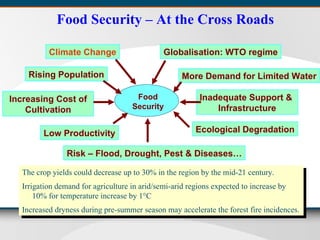
Food Security – At the Cross Roads The crop yields could decrease up to 30% in the region by the mid-21 century. Irrigation demand for agriculture in arid/semi-arid regions expected to increase by 10% for temperature increase by 1°C Increased dryness during pre-summer season may accelerate the forest fire incidences. Food Security Globalisation: WTO regime Rising Population Increasing Cost of Cultivation Low Productivity More Demand for Limited Water Ecological Degradation Inadequate Support &  Infrastructure Climate Change Risk – Flood, Drought, Pest & Diseases…
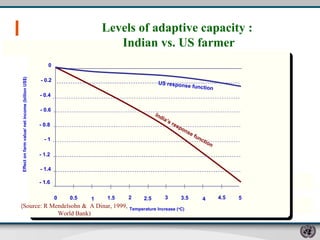
“ ( Source: R Mendelsohn &  A Dinar, 1999, World Bank) Levels of adaptive capacity :  Indian vs. US farmer 0 - 0.2 0.5 - 0.4 - 0.6 - 0.8 - 1 - 1.2 - 1.4 - 1.6 1 1.5 2 2.5 3 3.5 4 4.5 5 India’s response function US response function 0 Temperature Increase ( o C) Effect on farm value/ net income (billion US$)
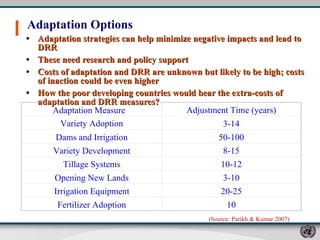
Adaptation Options   Adaptation strategies can help minimize negative impacts and lead to DRR These need research and policy support Costs of adaptation and DRR are unknown but likely to be high; costs of inaction could be even higher How the poor developing countries would bear the extra-costs of adaptation and DRR measures?  (Source: Parikh & Kumar 2007) Adaptation Measure Adjustment Time (years) Variety Adoption 3-14 Dams and Irrigation 50-100 Variety Development 8-15 Tillage Systems 10-12 Opening New Lands 3-10 Irrigation Equipment 20-25 Fertilizer Adoption 10
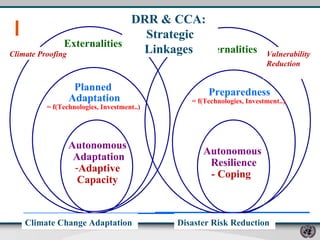
Autonomous  Adaptation Adaptive  Capacity  Planned  Adaptation = f(Technologies, Investment..)  Externalities   Autonomous  Resilience - Coping  Preparedness = f(Technologies, Investment..)  Externalities   Climate Change Adaptation   Disaster Risk Reduction   Climate Proofing Vulnerability Reduction DRR & CCA:  Strategic Linkages
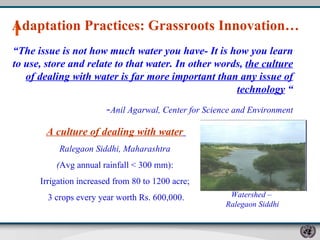
“ The issue is not how much water you have- It is how you learn to use, store and relate to that water. In other words,  the culture of dealing with water is far more important than any issue of technology  “ - Anil Agarwal, Center for Science and Environment Adaptation Practices: Grassroots Innovation…  A culture of dealing with water   Ralegaon Siddhi, Maharashtra  ( Avg annual rainfall < 300 mm):  Irrigation increased from 80 to 1200 acre;  3 crops every year worth Rs. 600,000. Watershed –  Ralegaon Siddhi
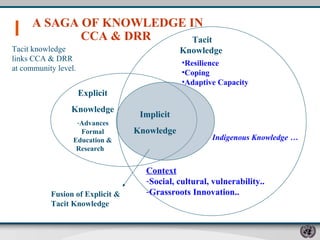
Explicit Knowledge Advances Formal Education & Research  Implicit  Knowledge  Tacit Knowledge  A SAGA OF KNOWLEDGE IN CCA & DRR   Resilience Coping  Adaptive Capacity  Fusion of Explicit & Tacit Knowledge  Context   Social, cultural, vulnerability.. Grassroots Innovation..  Indigenous Knowledge  … Tacit knowledge  links CCA & DRR at community level.
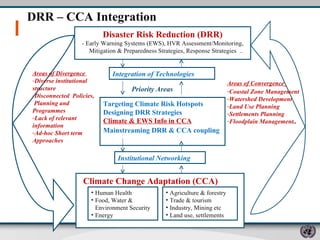
DRR – CCA Integration  Priority Areas Disaster Risk Reduction (DRR) - Early Warning Systems (EWS), HVR Assessment/Monitoring, Mitigation & Preparedness Strategies, Response Strategies  ..  Human Health Food, Water & Environment Security Energy  Agriculture & forestry  Trade & tourism  Industry, Mining etc Land use, settlements Institutional Networking Integration of Technologies Targeting Climate Risk Hotspots Designing DRR Strategies Climate & EWS Info in CCA Mainstreaming DRR & CCA coupling   Areas of Convergence   Coastal Zone Management Watershed Development  Land Use Planning  Settlements Planning Floodplain Management ..  Areas of Divergence  Diverse institutional structure Disconnected  Policies,  Planning and Programmes Lack of relevant information Ad-hoc Short term Approaches  Climate Change Adaptation (CCA)
Regional Solutions – Local Issues Early Warning for Integration of CCA and DRR
ESCAP is the regional development arm of the United Nations for the Asia-Pacific region 62 Governments - from Turkey in the west to Kiribati in the east, and from the Russian Federation in the north to New Zealand in the south The largest United Nations body serving the Asia-Pacific region with over 600 staff ESCAP has more than  five decades of experience integrating disaster risk management with economic and social development  at the regional level. ..Regional approach for cooperation specific focus on Asia Pacific  Least Developed Countries (LDCs), SID, Landlocked Countries..
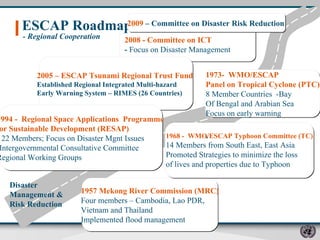
1957 Mekong River Commission (MRC) Four members – Cambodia, Lao PDR,  Vietnam and Thailand  Implemented flood management 1968 -  WMO/ESCAP Typhoon Committee (TC) 14 Members from South East, East Asia Promoted Strategies to minimize the loss of lives and properties due to Typhoon   2008 - Committee on ICT  -  Focus on Disaster Management   ESCAP Roadmap  2005 – ESCAP Tsunami Regional Trust Fund   Established Regional Integrated Multi-hazard  Early Warning System – RIMES (26 Countries) 2009  – Committee on Disaster Risk Reduction   1973-  WMO/ESCAP Panel on Tropical Cyclone (PTC) 8 Member Countries  -Bay  Of Bengal and Arabian Sea Focus on early warning ’  1994   -  Regional Space Applications  Programme  for Sustainable Development   (RESAP)  -  22 Members; Focus on Disaster Mgnt Issues  Intergovernmental Consultative Committee  Regional Working Groups  Disaster  Management & Risk Reduction - Regional Cooperation
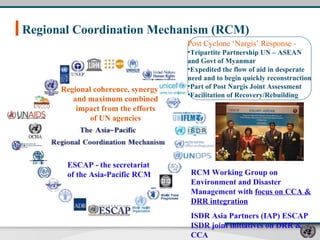
Regional Coordination Mechanism (RCM)   Regional coherence, synergy and maximum combined impact from the efforts of UN agencies ESCAP - the secretariat  of the Asia-Pacific RCM   Post Cyclone ‘Nargis’ Response -  Tripartite Partnership UN – ASEAN  and Govt of Myanmar   Expedited the flow of aid in desperate  need and to begin quickly reconstruction Part of Post Nargis Joint Assessment  Facilitation of Recovery/Rebuilding   RCM Working Group on Environment and Disaster Management with  focus on CCA & DRR integration   ISDR Asia Partners (IAP) ESCAP ISDR joint initiatives on DRR & CCA
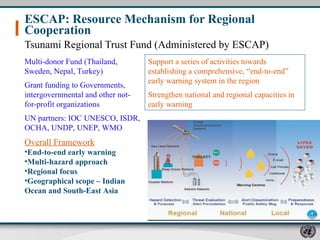
ESCAP: Resource Mechanism for Regional Cooperation  Tsunami Regional Trust Fund ( Administered by ESCAP) Support a series of activities towards establishing a comprehensive, “end-to-end” early warning system in the region Strengthen national and regional capacities in early warning Multi-donor Fund (Thailand, Sweden, Nepal, Turkey) Grant funding to Governments, intergovernmental and other not-for-profit organizations UN partners: IOC UNESCO, ISDR, OCHA, UNDP, UNEP, WMO Overall Framework   End-to-end early warning  Multi-hazard approach Regional focus Geographical scope – Indian Ocean and South-East Asia
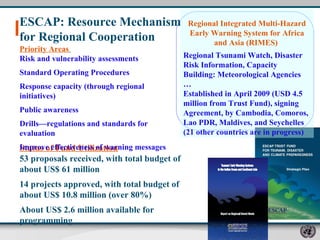
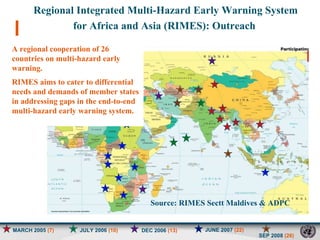
Status of Fund Utilization   53 proposals received, with total budget of about US$ 61 million 14 projects approved, with total budget of about US$ 10.8 million (over 80%) About US$ 2.6 million available for programming ESCAP: Resource Mechanism  for Regional Cooperation Priority Areas   Risk and vulnerability assessments Standard Operating Procedures Response capacity (through regional initiatives) Public awareness Drills—regulations and standards for evaluation Improve effectiveness of warning messages Regional Integrated Multi-Hazard Early Warning System for Africa and Asia (RIMES)   Regional Tsunami Watch, Disaster Risk Information, Capacity Building: Meteorological Agencies … Established in April 2009 (USD 4.5 million from Trust Fund), signing Agreement, by Cambodia, Comoros, Lao PDR, Maldives, and Seychelles (21 other countries are in progress)
MARCH 2005  (7) JULY 2006  (10) JUNE 2007  (22) SEP 2008  (26) DEC 2006  (13) Regional Integrated Multi-Hazard Early Warning System  for Africa and Asia (RIMES): Outreach  A regional cooperation of 26 countries on multi-hazard early warning.  RIMES aims to cater to differential needs and demands of member states in addressing gaps in the end-to-end multi-hazard early warning system. Source: RIMES Sectt Maldives & ADPC
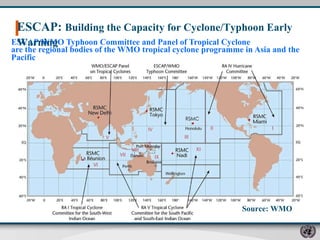
ESCAP/WMO Typhoon Committee and Panel of Tropical Cyclone are the regional bodies of the WMO tropical cyclone programme in Asia and the Pacific   ESCAP:  Building the Capacity for Cyclone/Typhoon Early Warning   Source: WMO
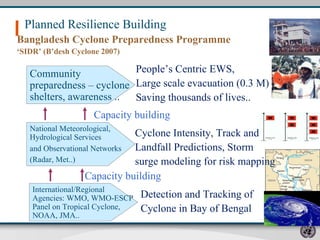
Bangladesh Cyclone Preparedness Programme ‘ SIDR’ (B’desh Cyclone 2007) Cyclone Intensity, Track and  Landfall Predictions, Storm  surge modeling for risk mapping ..   Planned Resilience Building   International/Regional Agencies: WMO, WMO-ESCP Panel on Tropical Cyclone, NOAA, JMA.. National Meteorological, Hydrological Services and Observational Networks (Radar, Met..)   Community preparedness – cyclone shelters, awareness ..  Detection and Tracking of  Cyclone in Bay of Bengal Capacity building Capacity building People’s Centric EWS,  Large scale evacuation (0.3 M) Saving thousands of lives..
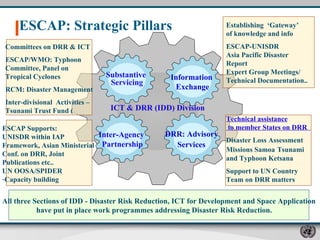
ESCAP: Strategic Pillars   Establishing  ‘Gateway’ of knowledge and info ESCAP-UNISDR  Asia Pacific Disaster  Report Expert Group Meetings/ Technical Documentation.. All three Sections of IDD - Disaster Risk Reduction, ICT for Development and Space Application have put in place work programmes addressing Disaster Risk Reduction.  Committees on DRR & ICT ESCAP/WMO: Typhoon  Committee, Panel on  Tropical Cyclones RCM: Disaster Management Inter-divisional  Activities – Tsunami Trust Fund ( ESCAP Supports: UNISDR within IAP  Framework, Asian Ministerial  Conf. on DRR, Joint  Publications etc..  UN OOSA/SPIDER Capacity building Technical assistance to member States on DRR  Disaster Loss Assessment  Missions Samoa   Tsunami  and Typhoon Ketsana Support to UN Country  Team on DRR matters Substantive  Servicing Information  Exchange Inter-Agency  Partnership DRR: Advisory  Services   ICT & DRR (IDD) Division
Technical Assistance  Mainstreaming DRR/CAA
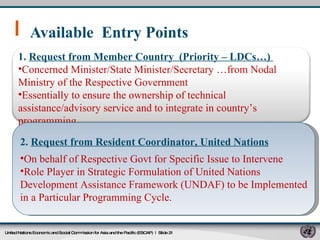
Available  Entry Points  United Nations Economic and Social Commission for Asia and the Pacific (ESCAP)   |  Slide  1.  Request from Member Country  (Priority – LDCs…)  Concerned Minister/State Minister/Secretary …from Nodal Ministry of the Respective Government  Essentially to ensure the ownership of technical assistance/advisory service and to integrate in country’s programming 2.  Request from Resident Coordinator, United Nations On behalf of Respective Govt for Specific Issue to Intervene  Role Player in Strategic Formulation of United Nations Development Assistance Framework (UNDAF) to be Implemented in a Particular Programming Cycle.
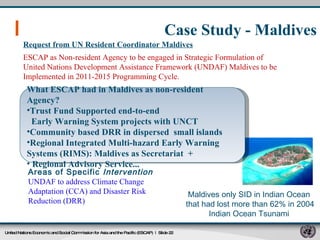
Case Study - Maldives United Nations Economic and Social Commission for Asia and the Pacific (ESCAP)   |  Slide  Request from UN Resident Coordinator Maldives ESCAP as Non-resident Agency to be engaged in Strategic Formulation of United Nations Development Assistance Framework (UNDAF) Maldives to be Implemented in 2011-2015 Programming Cycle. UNDAF to address Climate Change Adaptation (CCA) and Disaster Risk Reduction (DRR) Areas of Specific  Intervention   Maldives only SID in Indian Ocean  that had lost more than 62% in 2004 Indian Ocean Tsunami  What ESCAP had in Maldives as non-resident Agency? Trust Fund Supported end-to-end Early Warning System projects with UNCT Community based DRR in dispersed  small islands Regional Integrated Multi-hazard Early Warning Systems (RIMS): Maldives as Secretariat  + Regional Advisory Service...
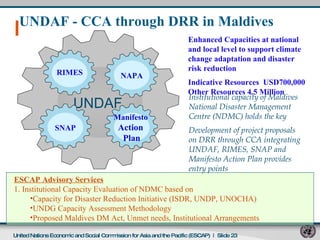
UNDAF - CCA through DRR in Maldives  Enhanced Capacities at national and local level to support climate change adaptation and disaster risk reduction Indicative Resources  USD700,000 Other Resources 4.5 Million   ESCAP Advisory Services 1. Institutional Capacity Evaluation of NDMC based on  Capacity for Disaster Reduction Initiative (ISDR, UNDP, UNOCHA) UNDG Capacity Assessment Methodology Proposed Maldives DM Act, Unmet needs, Institutional Arrangements  Institutional capacity of Maldives  National Disaster Management  Centre (NDMC) holds the key Development of project proposals on DRR through CCA integrating  UNDAF, RIMES, SNAP and  Manifesto Action Plan provides  entry points  United Nations Economic and Social Commission for Asia and the Pacific (ESCAP)   |  Slide  UNDAF RIMES NAPA SNAP Manifesto  Action  Plan
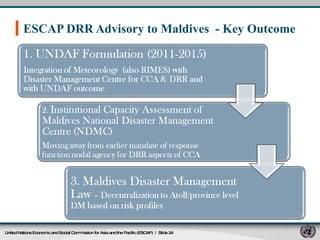
ESCAP DRR Advisory to Maldives  - Key Outcome  United Nations Economic and Social Commission for Asia and the Pacific (ESCAP)   |  Slide
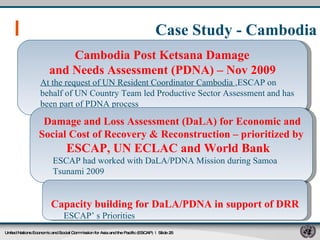
Case Study - Cambodia United Nations Economic and Social Commission for Asia and the Pacific (ESCAP)   |  Slide  Cambodia Post Ketsana Damage  and Needs Assessment (PDNA) – Nov 2009 At the request of UN Resident Coordinator Cambodia  ,ESCAP on behalf of UN Country Team led Productive Sector Assessment and has been part of PDNA process Damage and Loss Assessment (DaLA) for Economic and Social Cost of Recovery & Reconstruction – prioritized by ESCAP, UN ECLAC and World Bank  ESCAP had worked with DaLA/PDNA Mission during Samoa Tsunami 2009 Capacity building for DaLA/PDNA in support of DRR ESCAP’ s Priorities
Ketsana Post Disaster Needs  Assessment [PDNA]Cambodia United Nations Economic and Social Commission for Asia and the Pacific (ESCAP)   |  Slide  An End-to-End Approach  DaLA PDNA Advocacy Donor’s Roundtable Projectization for aid, loan &  Budegetry support  Support from DPs/INGOs
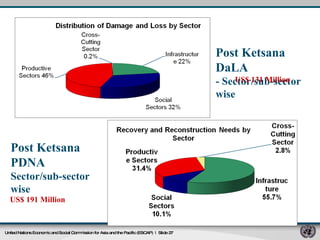
United Nations Economic and Social Commission for Asia and the Pacific (ESCAP)   |  Slide  Post Ketsana DaLA - Sector/sub-sector wise Post Ketsana PDNA Sector/sub-sector wise US$ 191 Million US$ 131 Million
Recovery and Reconstruction Needs
Donor Commitment
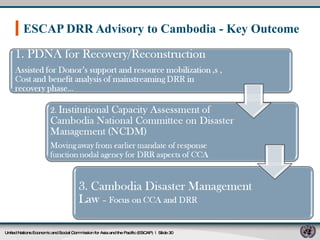
ESCAP DRR Advisory to Cambodia - Key Outcome  United Nations Economic and Social Commission for Asia and the Pacific (ESCAP)   |  Slide
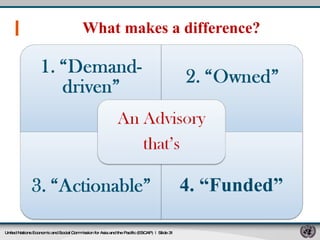
What makes a difference?  United Nations Economic and Social Commission for Asia and the Pacific (ESCAP)   |  Slide  4. “Funded”
Most Critical Gap PDNA does take into account mainstreaming DRR in post disaster recovery and reconstruction but what was missing critically – the know how to integrate CCA along with DRR?  PDNA worth US$ 191 million investment during post-Ketsana Recovery and Reconstruction had the opportunity to put in place the elements of Smart DRR but we lacked know how…  It’s important that SCR Regional Workshop  should bring out ..Regional Solution to Local Issues

Fascilitating strategic linkages of DRR and CCA - unescap

  • 1.
    Facilitating Strategic Linkagesof DRR and CCA: ESCAP Initiatives on Regional Solutions to Local Issues Sanjay K Srivastava, Ph D Regional Adviser – Disaster Risk Reduction Information Communication Technology and Disaster Risk Reduction Division (IDD) SCR Regional Workshop, Bangkok, 22-23 July, 2010
  • 2.
    Alarming Adaptation Deficits- Agriculture Sector
  • 3.
    Food Security –At the Cross Roads The crop yields could decrease up to 30% in the region by the mid-21 century. Irrigation demand for agriculture in arid/semi-arid regions expected to increase by 10% for temperature increase by 1°C Increased dryness during pre-summer season may accelerate the forest fire incidences. Food Security Globalisation: WTO regime Rising Population Increasing Cost of Cultivation Low Productivity More Demand for Limited Water Ecological Degradation Inadequate Support & Infrastructure Climate Change Risk – Flood, Drought, Pest & Diseases…
  • 4.
    “ ( Source:R Mendelsohn & A Dinar, 1999, World Bank) Levels of adaptive capacity : Indian vs. US farmer 0 - 0.2 0.5 - 0.4 - 0.6 - 0.8 - 1 - 1.2 - 1.4 - 1.6 1 1.5 2 2.5 3 3.5 4 4.5 5 India’s response function US response function 0 Temperature Increase ( o C) Effect on farm value/ net income (billion US$)
  • 5.
    Adaptation Options Adaptation strategies can help minimize negative impacts and lead to DRR These need research and policy support Costs of adaptation and DRR are unknown but likely to be high; costs of inaction could be even higher How the poor developing countries would bear the extra-costs of adaptation and DRR measures? (Source: Parikh & Kumar 2007) Adaptation Measure Adjustment Time (years) Variety Adoption 3-14 Dams and Irrigation 50-100 Variety Development 8-15 Tillage Systems 10-12 Opening New Lands 3-10 Irrigation Equipment 20-25 Fertilizer Adoption 10
  • 6.
    Autonomous AdaptationAdaptive Capacity Planned Adaptation = f(Technologies, Investment..) Externalities Autonomous Resilience - Coping Preparedness = f(Technologies, Investment..) Externalities Climate Change Adaptation Disaster Risk Reduction Climate Proofing Vulnerability Reduction DRR & CCA: Strategic Linkages
  • 7.
    “ The issueis not how much water you have- It is how you learn to use, store and relate to that water. In other words, the culture of dealing with water is far more important than any issue of technology “ - Anil Agarwal, Center for Science and Environment Adaptation Practices: Grassroots Innovation… A culture of dealing with water Ralegaon Siddhi, Maharashtra ( Avg annual rainfall < 300 mm): Irrigation increased from 80 to 1200 acre; 3 crops every year worth Rs. 600,000. Watershed – Ralegaon Siddhi
  • 8.
    Explicit Knowledge AdvancesFormal Education & Research Implicit Knowledge Tacit Knowledge A SAGA OF KNOWLEDGE IN CCA & DRR Resilience Coping Adaptive Capacity Fusion of Explicit & Tacit Knowledge Context Social, cultural, vulnerability.. Grassroots Innovation.. Indigenous Knowledge … Tacit knowledge links CCA & DRR at community level.
  • 9.
    DRR – CCAIntegration Priority Areas Disaster Risk Reduction (DRR) - Early Warning Systems (EWS), HVR Assessment/Monitoring, Mitigation & Preparedness Strategies, Response Strategies .. Human Health Food, Water & Environment Security Energy Agriculture & forestry Trade & tourism Industry, Mining etc Land use, settlements Institutional Networking Integration of Technologies Targeting Climate Risk Hotspots Designing DRR Strategies Climate & EWS Info in CCA Mainstreaming DRR & CCA coupling Areas of Convergence Coastal Zone Management Watershed Development Land Use Planning Settlements Planning Floodplain Management .. Areas of Divergence Diverse institutional structure Disconnected Policies, Planning and Programmes Lack of relevant information Ad-hoc Short term Approaches Climate Change Adaptation (CCA)
  • 10.
    Regional Solutions –Local Issues Early Warning for Integration of CCA and DRR
  • 11.
    ESCAP is theregional development arm of the United Nations for the Asia-Pacific region 62 Governments - from Turkey in the west to Kiribati in the east, and from the Russian Federation in the north to New Zealand in the south The largest United Nations body serving the Asia-Pacific region with over 600 staff ESCAP has more than five decades of experience integrating disaster risk management with economic and social development at the regional level. ..Regional approach for cooperation specific focus on Asia Pacific Least Developed Countries (LDCs), SID, Landlocked Countries..
  • 12.
    1957 Mekong RiverCommission (MRC) Four members – Cambodia, Lao PDR, Vietnam and Thailand Implemented flood management 1968 - WMO/ESCAP Typhoon Committee (TC) 14 Members from South East, East Asia Promoted Strategies to minimize the loss of lives and properties due to Typhoon 2008 - Committee on ICT - Focus on Disaster Management ESCAP Roadmap 2005 – ESCAP Tsunami Regional Trust Fund Established Regional Integrated Multi-hazard Early Warning System – RIMES (26 Countries) 2009 – Committee on Disaster Risk Reduction 1973- WMO/ESCAP Panel on Tropical Cyclone (PTC) 8 Member Countries -Bay Of Bengal and Arabian Sea Focus on early warning ’ 1994 - Regional Space Applications Programme for Sustainable Development (RESAP) - 22 Members; Focus on Disaster Mgnt Issues Intergovernmental Consultative Committee Regional Working Groups Disaster Management & Risk Reduction - Regional Cooperation
  • 13.
    Regional Coordination Mechanism(RCM) Regional coherence, synergy and maximum combined impact from the efforts of UN agencies ESCAP - the secretariat of the Asia-Pacific RCM Post Cyclone ‘Nargis’ Response - Tripartite Partnership UN – ASEAN and Govt of Myanmar Expedited the flow of aid in desperate need and to begin quickly reconstruction Part of Post Nargis Joint Assessment Facilitation of Recovery/Rebuilding RCM Working Group on Environment and Disaster Management with focus on CCA & DRR integration ISDR Asia Partners (IAP) ESCAP ISDR joint initiatives on DRR & CCA
  • 14.
    ESCAP: Resource Mechanismfor Regional Cooperation Tsunami Regional Trust Fund ( Administered by ESCAP) Support a series of activities towards establishing a comprehensive, “end-to-end” early warning system in the region Strengthen national and regional capacities in early warning Multi-donor Fund (Thailand, Sweden, Nepal, Turkey) Grant funding to Governments, intergovernmental and other not-for-profit organizations UN partners: IOC UNESCO, ISDR, OCHA, UNDP, UNEP, WMO Overall Framework End-to-end early warning Multi-hazard approach Regional focus Geographical scope – Indian Ocean and South-East Asia
  • 15.
    Status of FundUtilization 53 proposals received, with total budget of about US$ 61 million 14 projects approved, with total budget of about US$ 10.8 million (over 80%) About US$ 2.6 million available for programming ESCAP: Resource Mechanism for Regional Cooperation Priority Areas Risk and vulnerability assessments Standard Operating Procedures Response capacity (through regional initiatives) Public awareness Drills—regulations and standards for evaluation Improve effectiveness of warning messages Regional Integrated Multi-Hazard Early Warning System for Africa and Asia (RIMES) Regional Tsunami Watch, Disaster Risk Information, Capacity Building: Meteorological Agencies … Established in April 2009 (USD 4.5 million from Trust Fund), signing Agreement, by Cambodia, Comoros, Lao PDR, Maldives, and Seychelles (21 other countries are in progress)
  • 16.
    MARCH 2005 (7) JULY 2006 (10) JUNE 2007 (22) SEP 2008 (26) DEC 2006 (13) Regional Integrated Multi-Hazard Early Warning System for Africa and Asia (RIMES): Outreach A regional cooperation of 26 countries on multi-hazard early warning. RIMES aims to cater to differential needs and demands of member states in addressing gaps in the end-to-end multi-hazard early warning system. Source: RIMES Sectt Maldives & ADPC
  • 17.
    ESCAP/WMO Typhoon Committeeand Panel of Tropical Cyclone are the regional bodies of the WMO tropical cyclone programme in Asia and the Pacific ESCAP: Building the Capacity for Cyclone/Typhoon Early Warning Source: WMO
  • 18.
    Bangladesh Cyclone PreparednessProgramme ‘ SIDR’ (B’desh Cyclone 2007) Cyclone Intensity, Track and Landfall Predictions, Storm surge modeling for risk mapping .. Planned Resilience Building International/Regional Agencies: WMO, WMO-ESCP Panel on Tropical Cyclone, NOAA, JMA.. National Meteorological, Hydrological Services and Observational Networks (Radar, Met..) Community preparedness – cyclone shelters, awareness .. Detection and Tracking of Cyclone in Bay of Bengal Capacity building Capacity building People’s Centric EWS, Large scale evacuation (0.3 M) Saving thousands of lives..
  • 19.
    ESCAP: Strategic Pillars Establishing ‘Gateway’ of knowledge and info ESCAP-UNISDR Asia Pacific Disaster Report Expert Group Meetings/ Technical Documentation.. All three Sections of IDD - Disaster Risk Reduction, ICT for Development and Space Application have put in place work programmes addressing Disaster Risk Reduction. Committees on DRR & ICT ESCAP/WMO: Typhoon Committee, Panel on Tropical Cyclones RCM: Disaster Management Inter-divisional Activities – Tsunami Trust Fund ( ESCAP Supports: UNISDR within IAP Framework, Asian Ministerial Conf. on DRR, Joint Publications etc.. UN OOSA/SPIDER Capacity building Technical assistance to member States on DRR Disaster Loss Assessment Missions Samoa Tsunami and Typhoon Ketsana Support to UN Country Team on DRR matters Substantive Servicing Information Exchange Inter-Agency Partnership DRR: Advisory Services ICT & DRR (IDD) Division
  • 20.
    Technical Assistance Mainstreaming DRR/CAA
  • 21.
    Available EntryPoints United Nations Economic and Social Commission for Asia and the Pacific (ESCAP) | Slide 1. Request from Member Country (Priority – LDCs…) Concerned Minister/State Minister/Secretary …from Nodal Ministry of the Respective Government Essentially to ensure the ownership of technical assistance/advisory service and to integrate in country’s programming 2. Request from Resident Coordinator, United Nations On behalf of Respective Govt for Specific Issue to Intervene Role Player in Strategic Formulation of United Nations Development Assistance Framework (UNDAF) to be Implemented in a Particular Programming Cycle.
  • 22.
    Case Study -Maldives United Nations Economic and Social Commission for Asia and the Pacific (ESCAP) | Slide Request from UN Resident Coordinator Maldives ESCAP as Non-resident Agency to be engaged in Strategic Formulation of United Nations Development Assistance Framework (UNDAF) Maldives to be Implemented in 2011-2015 Programming Cycle. UNDAF to address Climate Change Adaptation (CCA) and Disaster Risk Reduction (DRR) Areas of Specific Intervention Maldives only SID in Indian Ocean that had lost more than 62% in 2004 Indian Ocean Tsunami What ESCAP had in Maldives as non-resident Agency? Trust Fund Supported end-to-end Early Warning System projects with UNCT Community based DRR in dispersed small islands Regional Integrated Multi-hazard Early Warning Systems (RIMS): Maldives as Secretariat + Regional Advisory Service...
  • 23.
    UNDAF - CCAthrough DRR in Maldives Enhanced Capacities at national and local level to support climate change adaptation and disaster risk reduction Indicative Resources USD700,000 Other Resources 4.5 Million ESCAP Advisory Services 1. Institutional Capacity Evaluation of NDMC based on Capacity for Disaster Reduction Initiative (ISDR, UNDP, UNOCHA) UNDG Capacity Assessment Methodology Proposed Maldives DM Act, Unmet needs, Institutional Arrangements Institutional capacity of Maldives National Disaster Management Centre (NDMC) holds the key Development of project proposals on DRR through CCA integrating UNDAF, RIMES, SNAP and Manifesto Action Plan provides entry points United Nations Economic and Social Commission for Asia and the Pacific (ESCAP) | Slide UNDAF RIMES NAPA SNAP Manifesto Action Plan
  • 24.
    ESCAP DRR Advisoryto Maldives - Key Outcome United Nations Economic and Social Commission for Asia and the Pacific (ESCAP) | Slide
  • 25.
    Case Study -Cambodia United Nations Economic and Social Commission for Asia and the Pacific (ESCAP) | Slide Cambodia Post Ketsana Damage and Needs Assessment (PDNA) – Nov 2009 At the request of UN Resident Coordinator Cambodia ,ESCAP on behalf of UN Country Team led Productive Sector Assessment and has been part of PDNA process Damage and Loss Assessment (DaLA) for Economic and Social Cost of Recovery & Reconstruction – prioritized by ESCAP, UN ECLAC and World Bank ESCAP had worked with DaLA/PDNA Mission during Samoa Tsunami 2009 Capacity building for DaLA/PDNA in support of DRR ESCAP’ s Priorities
  • 26.
    Ketsana Post DisasterNeeds Assessment [PDNA]Cambodia United Nations Economic and Social Commission for Asia and the Pacific (ESCAP) | Slide An End-to-End Approach DaLA PDNA Advocacy Donor’s Roundtable Projectization for aid, loan & Budegetry support Support from DPs/INGOs
  • 27.
    United Nations Economicand Social Commission for Asia and the Pacific (ESCAP) | Slide Post Ketsana DaLA - Sector/sub-sector wise Post Ketsana PDNA Sector/sub-sector wise US$ 191 Million US$ 131 Million
  • 28.
  • 29.
  • 30.
    ESCAP DRR Advisoryto Cambodia - Key Outcome United Nations Economic and Social Commission for Asia and the Pacific (ESCAP) | Slide
  • 31.
    What makes adifference? United Nations Economic and Social Commission for Asia and the Pacific (ESCAP) | Slide 4. “Funded”
  • 32.
    Most Critical GapPDNA does take into account mainstreaming DRR in post disaster recovery and reconstruction but what was missing critically – the know how to integrate CCA along with DRR? PDNA worth US$ 191 million investment during post-Ketsana Recovery and Reconstruction had the opportunity to put in place the elements of Smart DRR but we lacked know how… It’s important that SCR Regional Workshop should bring out ..Regional Solution to Local Issues