Roadmap


  Oxfam India & GDS
DRR and Climate Change
 An Oxfam Perspective
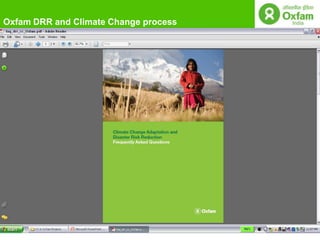
Oxfam DRR and Climate Change process


2
Relationship between climate change adaptation and
DRR –
    • Oxfam is increasingly seeing the effects of climate change on the
      communities with which we work. We are beginning to respond
      to this in our work with communities and in our campaigns and
      advocacy. At the same time, we are building rapidly on our
      disaster risk reduction (DRR) programming as a key way of
      reducing the loss of lives and livelihoods in disaster-prone areas.

    • However, DRR programmes may have nothing to do with climate
      change (if the disasters in question are earthquakes and
      tsunamis), or the disasters may be recurring even in the absence
      of climate change, and so DRR is an appropriate response for
      Oxfam whether or not climate change is exacerbating these.

    • We simply do not know enough about all the atmospheric and oceanic
      processes to get a truly accurate scenario of how climate will react on
      a local and regional scale. However in recent years we have
      considerable evidence that the earth has begun to warm more quickly
3     than ever before
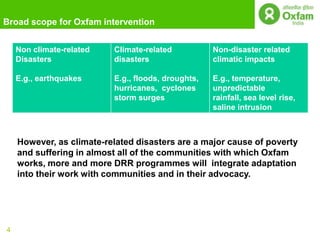
Broad scope for Oxfam intervention


    Non climate-related   Climate-related           Non-disaster related
    Disasters             disasters                 climatic impacts

    E.g., earthquakes     E.g., floods, droughts,   E.g., temperature,
                          hurricanes, cyclones      unpredictable
                          storm surges              rainfall, sea level rise,
                                                    saline intrusion


    However, as climate-related disasters are a major cause of poverty
    and suffering in almost all of the communities with which Oxfam
    works, more and more DRR programmes will integrate adaptation
    into their work with communities and in their advocacy.


4
• Oxfam is still in the process of analyzing how Climate Change is
      affecting the implementation of Oxfam-supported projects in the
      India (coastal, flood plain)).

    • If so, to reduce the impacts of climate change, Oxfam needs to
      incorporate adequate measures into its project design. Design
      adaptability, engagement on coping issues in 20 years

    Climate date that will affect our programmes
    • Temperature increase 0.5 - 2 °C by 2030 and 1 - 7 °C by 2070
    • Increase in the frequency and intensity in rainfall (South Asia,
       South East Asia)
    • Increase in global sea-level rise 3 -16 cm by 2030 and 7-50 cm by
       2070
    • Increasing reduction in snow and ice in Himalayan and Tibetan
       glaciers
5
Impact on programmes


    • Impact on agriculture – shift in seasons and agro-ecological
      zones, water stress (drought and floods) and decline in water-
      table, reduced soil fertility and increasing salinity, loss of
      agricultural land due to sea water inundation, reduced crop and
      grass yields, and loss of livestock (food insecurity)

    • Contamination of ground Water;

    • Impact on coastal zones - sea water inundation and loss of land
      area, storm surge and coastal erosion, impact on aquaculture,
      coastal agriculture and reduction in fresh water availability

    • Increase conflict due to land use pressure, and resource use and
      migration (in direct affect)


6
The Project intervention (Design of DRR):

    • Project was not pre-designed, it has evolved with
      finding solutions and trials with community.
    • The project approach has been „community based
      disaster risk management‟.
    • The focus has been on-
     • To enable & capacitate the community;
     • To evolve community based coping mechanism;
     GDS believes in the principle that “sufferer is the first
                           responder”


                                                     7
7
Situation/Problem Analysis:

        The poor and the women are the most
     vulnerable- the extent of vulnerability as well
    as coping capacity directly proportional to the
       socio-economic and gender status of the
                        people.

       Agriculture is the main source of livelihood;
       Majority of farmers are small and marginal.
       Flood destroys not only the Kharif (monsoon season) crop but also delays the next Rabi
        (winter season) crop due to water locking and water logging.
       People‟s interest and investment in agriculture declining.
       Seasonal male migration is rampant


                                                                        8
8
Situation/Problem Analysis:


     During floods gender discrimination is clearly visible
     Women particularly the elderly eat and drink less to avoid
      going to toilet
     Drinking water sources get submerged;
     Conditions highly favourable for outbreak of epidemics;
     People have accepted floods as destiny and resigned to their
      fate;
     Dependency on relief assistance


                                                   9
9
The Model Finalization process:

     • Initiated with problem identification, analysis and prioritization.
     • Micro planning process initiated in villages with community
       participation.
     • Interventions designed for flood mitigation were based on
       specific problems identified during micro planning process.
     • Continuous process of participatory reviewing and deriving
       learning carried out- leading to timely refinement/fine-tuning in
       the implementation design


                                                              10
10
Integration of Climate Change with D ExperienceRM – GDS


     • Monsoons in the year 2007 broke all norms and trends- heavy
       rains in early July caused massive floods almost six weeks
       before the „normal‟ time for floods

     • While most components of the DRM model stood to the test, the
       agriculture safeguarding component (pre-flood paddy) was
       knocked completely off the course!

     • It forced us to give serious consideration to the phenomenon of
       „Climate Change‟ and to look out for ways to make our DRM and
       livelihoods interventions effective.


11
DRR & CC in Grameen Development Services


     Integration of Climate Change with DRM
     • Towards integrating the „climate change‟ dimension, we have
       undertaken a study to comprehend the issues and nuances
       related to climate change

     • The focus has been on the effects of climate change on
       livelihoods (especially, agriculture)


12
Study on Climate Change Phenomenon


     • The study has looked into the following aspects
       • Changes in climatic pattern
       • Impact on life and livelihoods
       • Coping Strategies
       • Demands

     • The method comprises of
       • FGDs and key informant interviews with community to
         understand their perspective on the issue
       • Taking inputs from scientists and subject matter experts


13
Changes in climate trends


     1.   Rainfall:

             Late arrival and early end

             Change in intensity and timing- becoming increasingly
              erratic

             Decline in winter rains


14
Changes in climate trends


     2. Seasons

     •   Change in duration of the seasons

     •   Summer are very hot and dry

     •   Winter are concentrated and short

     •   Fogs lasts throughout the day

     •   Weak Pachuva and strong Purva

     •   Absence of “loo”

15
Changes in climate trends

     4. Floods

     •   Change in the period of arrival

     •   Persistent water-logging

     •   Increase in intensity

     •   Irregular pattern


16
Impact


     1.     Agriculture:
          •    Damage to crops
          •    Disturbance in crop-cycle
          •    Need for multiple-irrigation, even during kharif
          •    Rise in insect/pest infestation
          •    Rise in weeds like khod jawaya, gilli danda and ban mutter
          •    Fall in size of grains


17
Impact on Economy


     • Increase in cost of agriculture inputs; decline in production and
       productivity

     •   Decline in livestock based livelihoods

     •   Large scale migration


18
Emerging coping strategies


     • Use of high yielding varieties
     • Balanced use of fertilizers and pesticides
     • Creation co-operatives with the help of NGOs
     • Nursery cropping
     • Change in cropping pattern and sowing time
     • Growing bamboo terraces
     • Emphasis on jayad cropping
     • Preference to mixed cropping


19
Emerging demands


     •    Better varieties
         • short-duration
         • heat and water tolerant
         • high yielding
     •    More facilities to undertake jayad cropping
     •    Knowledge of better practices in cropping
     •    Micro-insurance for crop damage
     •    Improved flood control programmes
     •    Education on climate-change


20
Thank you


21

India - Climate change and disaster management - Oxfam

  • 1.
    Roadmap OxfamIndia & GDS DRR and Climate Change An Oxfam Perspective
  • 2.
    Oxfam DRR andClimate Change process 2
  • 3.
    Relationship between climatechange adaptation and DRR – • Oxfam is increasingly seeing the effects of climate change on the communities with which we work. We are beginning to respond to this in our work with communities and in our campaigns and advocacy. At the same time, we are building rapidly on our disaster risk reduction (DRR) programming as a key way of reducing the loss of lives and livelihoods in disaster-prone areas. • However, DRR programmes may have nothing to do with climate change (if the disasters in question are earthquakes and tsunamis), or the disasters may be recurring even in the absence of climate change, and so DRR is an appropriate response for Oxfam whether or not climate change is exacerbating these. • We simply do not know enough about all the atmospheric and oceanic processes to get a truly accurate scenario of how climate will react on a local and regional scale. However in recent years we have considerable evidence that the earth has begun to warm more quickly 3 than ever before
  • 4.
    Broad scope forOxfam intervention Non climate-related Climate-related Non-disaster related Disasters disasters climatic impacts E.g., earthquakes E.g., floods, droughts, E.g., temperature, hurricanes, cyclones unpredictable storm surges rainfall, sea level rise, saline intrusion However, as climate-related disasters are a major cause of poverty and suffering in almost all of the communities with which Oxfam works, more and more DRR programmes will integrate adaptation into their work with communities and in their advocacy. 4
  • 5.
    • Oxfam isstill in the process of analyzing how Climate Change is affecting the implementation of Oxfam-supported projects in the India (coastal, flood plain)). • If so, to reduce the impacts of climate change, Oxfam needs to incorporate adequate measures into its project design. Design adaptability, engagement on coping issues in 20 years Climate date that will affect our programmes • Temperature increase 0.5 - 2 °C by 2030 and 1 - 7 °C by 2070 • Increase in the frequency and intensity in rainfall (South Asia, South East Asia) • Increase in global sea-level rise 3 -16 cm by 2030 and 7-50 cm by 2070 • Increasing reduction in snow and ice in Himalayan and Tibetan glaciers 5
  • 6.
    Impact on programmes • Impact on agriculture – shift in seasons and agro-ecological zones, water stress (drought and floods) and decline in water- table, reduced soil fertility and increasing salinity, loss of agricultural land due to sea water inundation, reduced crop and grass yields, and loss of livestock (food insecurity) • Contamination of ground Water; • Impact on coastal zones - sea water inundation and loss of land area, storm surge and coastal erosion, impact on aquaculture, coastal agriculture and reduction in fresh water availability • Increase conflict due to land use pressure, and resource use and migration (in direct affect) 6
  • 7.
    The Project intervention(Design of DRR): • Project was not pre-designed, it has evolved with finding solutions and trials with community. • The project approach has been „community based disaster risk management‟. • The focus has been on- • To enable & capacitate the community; • To evolve community based coping mechanism; GDS believes in the principle that “sufferer is the first responder” 7 7
  • 8.
    Situation/Problem Analysis: The poor and the women are the most vulnerable- the extent of vulnerability as well as coping capacity directly proportional to the socio-economic and gender status of the people.  Agriculture is the main source of livelihood;  Majority of farmers are small and marginal.  Flood destroys not only the Kharif (monsoon season) crop but also delays the next Rabi (winter season) crop due to water locking and water logging.  People‟s interest and investment in agriculture declining.  Seasonal male migration is rampant 8 8
  • 9.
    Situation/Problem Analysis:  During floods gender discrimination is clearly visible  Women particularly the elderly eat and drink less to avoid going to toilet  Drinking water sources get submerged;  Conditions highly favourable for outbreak of epidemics;  People have accepted floods as destiny and resigned to their fate;  Dependency on relief assistance 9 9
  • 10.
    The Model Finalizationprocess: • Initiated with problem identification, analysis and prioritization. • Micro planning process initiated in villages with community participation. • Interventions designed for flood mitigation were based on specific problems identified during micro planning process. • Continuous process of participatory reviewing and deriving learning carried out- leading to timely refinement/fine-tuning in the implementation design 10 10
  • 11.
    Integration of ClimateChange with D ExperienceRM – GDS • Monsoons in the year 2007 broke all norms and trends- heavy rains in early July caused massive floods almost six weeks before the „normal‟ time for floods • While most components of the DRM model stood to the test, the agriculture safeguarding component (pre-flood paddy) was knocked completely off the course! • It forced us to give serious consideration to the phenomenon of „Climate Change‟ and to look out for ways to make our DRM and livelihoods interventions effective. 11
  • 12.
    DRR & CCin Grameen Development Services Integration of Climate Change with DRM • Towards integrating the „climate change‟ dimension, we have undertaken a study to comprehend the issues and nuances related to climate change • The focus has been on the effects of climate change on livelihoods (especially, agriculture) 12
  • 13.
    Study on ClimateChange Phenomenon • The study has looked into the following aspects • Changes in climatic pattern • Impact on life and livelihoods • Coping Strategies • Demands • The method comprises of • FGDs and key informant interviews with community to understand their perspective on the issue • Taking inputs from scientists and subject matter experts 13
  • 14.
    Changes in climatetrends 1. Rainfall:  Late arrival and early end  Change in intensity and timing- becoming increasingly erratic  Decline in winter rains 14
  • 15.
    Changes in climatetrends 2. Seasons • Change in duration of the seasons • Summer are very hot and dry • Winter are concentrated and short • Fogs lasts throughout the day • Weak Pachuva and strong Purva • Absence of “loo” 15
  • 16.
    Changes in climatetrends 4. Floods • Change in the period of arrival • Persistent water-logging • Increase in intensity • Irregular pattern 16
  • 17.
    Impact 1. Agriculture: • Damage to crops • Disturbance in crop-cycle • Need for multiple-irrigation, even during kharif • Rise in insect/pest infestation • Rise in weeds like khod jawaya, gilli danda and ban mutter • Fall in size of grains 17
  • 18.
    Impact on Economy • Increase in cost of agriculture inputs; decline in production and productivity • Decline in livestock based livelihoods • Large scale migration 18
  • 19.
    Emerging coping strategies • Use of high yielding varieties • Balanced use of fertilizers and pesticides • Creation co-operatives with the help of NGOs • Nursery cropping • Change in cropping pattern and sowing time • Growing bamboo terraces • Emphasis on jayad cropping • Preference to mixed cropping 19
  • 20.
    Emerging demands • Better varieties • short-duration • heat and water tolerant • high yielding • More facilities to undertake jayad cropping • Knowledge of better practices in cropping • Micro-insurance for crop damage • Improved flood control programmes • Education on climate-change 20
  • 21.