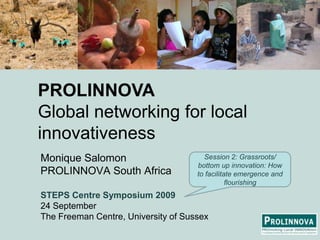
PROLINNOVAGlobal networking for local innovativenessMonique SalomonPROLINNOVA South AfricaSTEPS Centre Symposium 200924 SeptemberTheFreeman Centre, University of SussexSession 2: Grassroots/ bottom up innovation: How to facilitate emergence and flourishing
Key concerns in this sessionIf and how can we:Link grassroots to formal R&D?Promote bottom-up initiatives without stifling innovativeness and creativity?Steer bottom-up innovations in environmentally sustainable directions?“Yes we can…. or at least we are working on it”
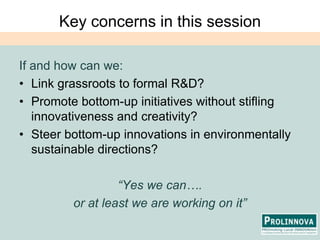
Who is “we”PROmoting Local INNOVAtionin ecologically-oriented agriculture and natural resource management, in short PROLINNOVAEst. 1999: as international multi-stakeholder network; connecting “islands of success” (e.g. LEISA, Promoting Farmer Innovation, Indigenous Soil and Water Innovations, Farmer Field Schools)Focus: Farmers/resource users as innovators, stimulating their innovative capacity, and promote partnerships and methodologies that support local innovation processesOver 100 organisations(Nov 2006)
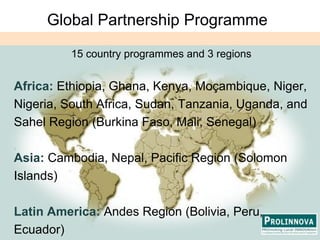
Global Partnership Programme15 country programmes and 3 regionsAfrica: Ethiopia, Ghana, Kenya, Moçambique, Niger, Nigeria, South Africa, Sudan, Tanzania, Uganda, and Sahel Region (Burkina Faso, Mali, Senegal)Asia: Cambodia, Nepal, Pacific Region (Solomon Islands)Latin America: Andes Region (Bolivia, Peru, Ecuador)
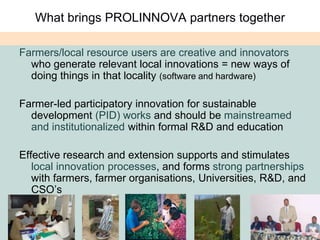
What brings PROLINNOVA partners togetherFarmers/local resource users are creative and innovators who generate relevant local innovations = new ways of doing things in that locality (software and hardware)Farmer-led participatory innovation for sustainable development (PID) works and should be mainstreamed and institutionalized within formal R&D and educationEffective research and extension supports and stimulates local innovation processes, and forms strong partnerships with farmers, farmer organisations, Universities, R&D, and CSO’s
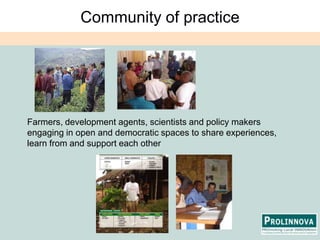
Community of practiceFarmers, development agents, scientists and policy makers engaging in open and democratic spaces to share experiences, learn from and support each other
Country-driven activitiesCommon elements:Creating the evidence: Studies of local innovation, farmer-led participatory innovation development (PID) on the ground, and Documenting thisEstablishing national and sub-national multi-stakeholder platforms for information sharing, joint learning and institutionalizing PIDCapacity building and curriculum development in PIDPolicy dialogue and mainstreaming PID at local, 	district and national level
How the Programme “hangs together”Governance	Country/regional programmes are hosted by local, experienced civil society organizations (CSO’s); Coordinated by multi-stakeholder steering committees, also at international levelFacilitation supportETC EcoCulture (Secretariat), IIRR Philippines,  Centre for International Cooperation/Free University of Amsterdam, and IED AfriqueFundingDGIS (NL),and CTA, DURAS, EED, IFAD, Misereor, Oxfam-Novib, Research-into-Use, Rockefeller Foundation, Worldbank; Country Programmes are run with own contribution (cash and kind).
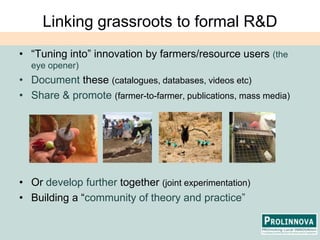
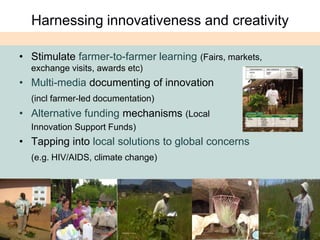
Linking grassroots to formal R&D“Tuning into” innovation by farmers/resource users (the eye opener)Document these (catalogues, databases, videos etc)Share & promote (farmer-to-farmer, publications, mass media)Or develop further together (joint experimentation)Building a “community of theory and practice”
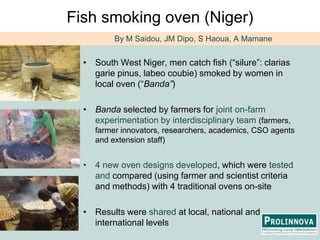
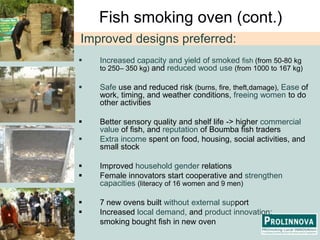
Fish smoking oven (Niger)By M Saidou, JM Dipo, S Haoua, A MamaneSouth West Niger, men catch fish (“silure”: clariasgariepinus, labeocoubie) smoked by women in local oven (“Banda”) Banda selected by farmers for joint on-farm experimentation by interdisciplinary team (farmers, farmer innovators, researchers, academics, CSO agents and extension staff)4 new oven designs developed, which were tested and compared (using farmer and scientist criteria and methods) with 4 traditional ovens on-siteResults were shared at local, national and international levels
Fish smoking oven (cont.)Improved designs preferred:Increased capacity and yield of smoked fish (from 50-80 kg to 250– 350 kg) and reduced wooduse(from 1000 to 167 kg)
Safe use and reduced risk (burns, fire, theft,damage), Ease of work, timing, and weather conditions, freeing women to do other activities
Better sensory quality and shelf life -> higher commercial value of fish, and reputation of Boumba fish traders
Extra income spent on food, housing, social activities, and small stock

Manifesto: Monique Salomon - Prolinnova: global networking

  • 1.
    PROLINNOVAGlobal networking forlocal innovativenessMonique SalomonPROLINNOVA South AfricaSTEPS Centre Symposium 200924 SeptemberTheFreeman Centre, University of SussexSession 2: Grassroots/ bottom up innovation: How to facilitate emergence and flourishing
  • 2.
    Key concerns inthis sessionIf and how can we:Link grassroots to formal R&D?Promote bottom-up initiatives without stifling innovativeness and creativity?Steer bottom-up innovations in environmentally sustainable directions?“Yes we can…. or at least we are working on it”
  • 3.
    Who is “we”PROmotingLocal INNOVAtionin ecologically-oriented agriculture and natural resource management, in short PROLINNOVAEst. 1999: as international multi-stakeholder network; connecting “islands of success” (e.g. LEISA, Promoting Farmer Innovation, Indigenous Soil and Water Innovations, Farmer Field Schools)Focus: Farmers/resource users as innovators, stimulating their innovative capacity, and promote partnerships and methodologies that support local innovation processesOver 100 organisations(Nov 2006)
  • 4.
    Global Partnership Programme15country programmes and 3 regionsAfrica: Ethiopia, Ghana, Kenya, Moçambique, Niger, Nigeria, South Africa, Sudan, Tanzania, Uganda, and Sahel Region (Burkina Faso, Mali, Senegal)Asia: Cambodia, Nepal, Pacific Region (Solomon Islands)Latin America: Andes Region (Bolivia, Peru, Ecuador)
  • 5.
    What brings PROLINNOVApartners togetherFarmers/local resource users are creative and innovators who generate relevant local innovations = new ways of doing things in that locality (software and hardware)Farmer-led participatory innovation for sustainable development (PID) works and should be mainstreamed and institutionalized within formal R&D and educationEffective research and extension supports and stimulates local innovation processes, and forms strong partnerships with farmers, farmer organisations, Universities, R&D, and CSO’s
  • 7.
    Community of practiceFarmers,development agents, scientists and policy makers engaging in open and democratic spaces to share experiences, learn from and support each other
  • 8.
    Country-driven activitiesCommon elements:Creatingthe evidence: Studies of local innovation, farmer-led participatory innovation development (PID) on the ground, and Documenting thisEstablishing national and sub-national multi-stakeholder platforms for information sharing, joint learning and institutionalizing PIDCapacity building and curriculum development in PIDPolicy dialogue and mainstreaming PID at local, district and national level
  • 9.
    How the Programme“hangs together”Governance Country/regional programmes are hosted by local, experienced civil society organizations (CSO’s); Coordinated by multi-stakeholder steering committees, also at international levelFacilitation supportETC EcoCulture (Secretariat), IIRR Philippines, Centre for International Cooperation/Free University of Amsterdam, and IED AfriqueFundingDGIS (NL),and CTA, DURAS, EED, IFAD, Misereor, Oxfam-Novib, Research-into-Use, Rockefeller Foundation, Worldbank; Country Programmes are run with own contribution (cash and kind).
  • 10.
    Linking grassroots toformal R&D“Tuning into” innovation by farmers/resource users (the eye opener)Document these (catalogues, databases, videos etc)Share & promote (farmer-to-farmer, publications, mass media)Or develop further together (joint experimentation)Building a “community of theory and practice”
  • 11.
    Fish smoking oven(Niger)By M Saidou, JM Dipo, S Haoua, A MamaneSouth West Niger, men catch fish (“silure”: clariasgariepinus, labeocoubie) smoked by women in local oven (“Banda”) Banda selected by farmers for joint on-farm experimentation by interdisciplinary team (farmers, farmer innovators, researchers, academics, CSO agents and extension staff)4 new oven designs developed, which were tested and compared (using farmer and scientist criteria and methods) with 4 traditional ovens on-siteResults were shared at local, national and international levels
  • 12.
    Fish smoking oven(cont.)Improved designs preferred:Increased capacity and yield of smoked fish (from 50-80 kg to 250– 350 kg) and reduced wooduse(from 1000 to 167 kg)
  • 13.
    Safe use andreduced risk (burns, fire, theft,damage), Ease of work, timing, and weather conditions, freeing women to do other activities
  • 14.
    Better sensory qualityand shelf life -> higher commercial value of fish, and reputation of Boumba fish traders
  • 15.
    Extra income spenton food, housing, social activities, and small stock