Quick Water: Update on the water related indicators
for sustainable crop-livestock intensification planning
            in Ethiopia ‘early win’ project

             Charlotte MacAlister (IWMI)
            Africa Rising Quick Water Early Win Project
         Final Workshop, Addis Ababa, 14 September 2012
•   Introduction to Africa Rising
•   Introduction to Quick Water approach: scope and objectives
•   Methodology for development of intensification trajectories in Ethiopia
•   Ethiopian context: development and intensification planning and policy
    background from food for work/MERIT to FEWsnet
•   Selection of trajectories and indicators for Ethiopia
•   Roundtable discussion and feedback
•   Mapping trajectories-indicators and development of toolbox
•   Demonstration of tool
•   Roundtable testing of toolbox
•   Feedback and future development
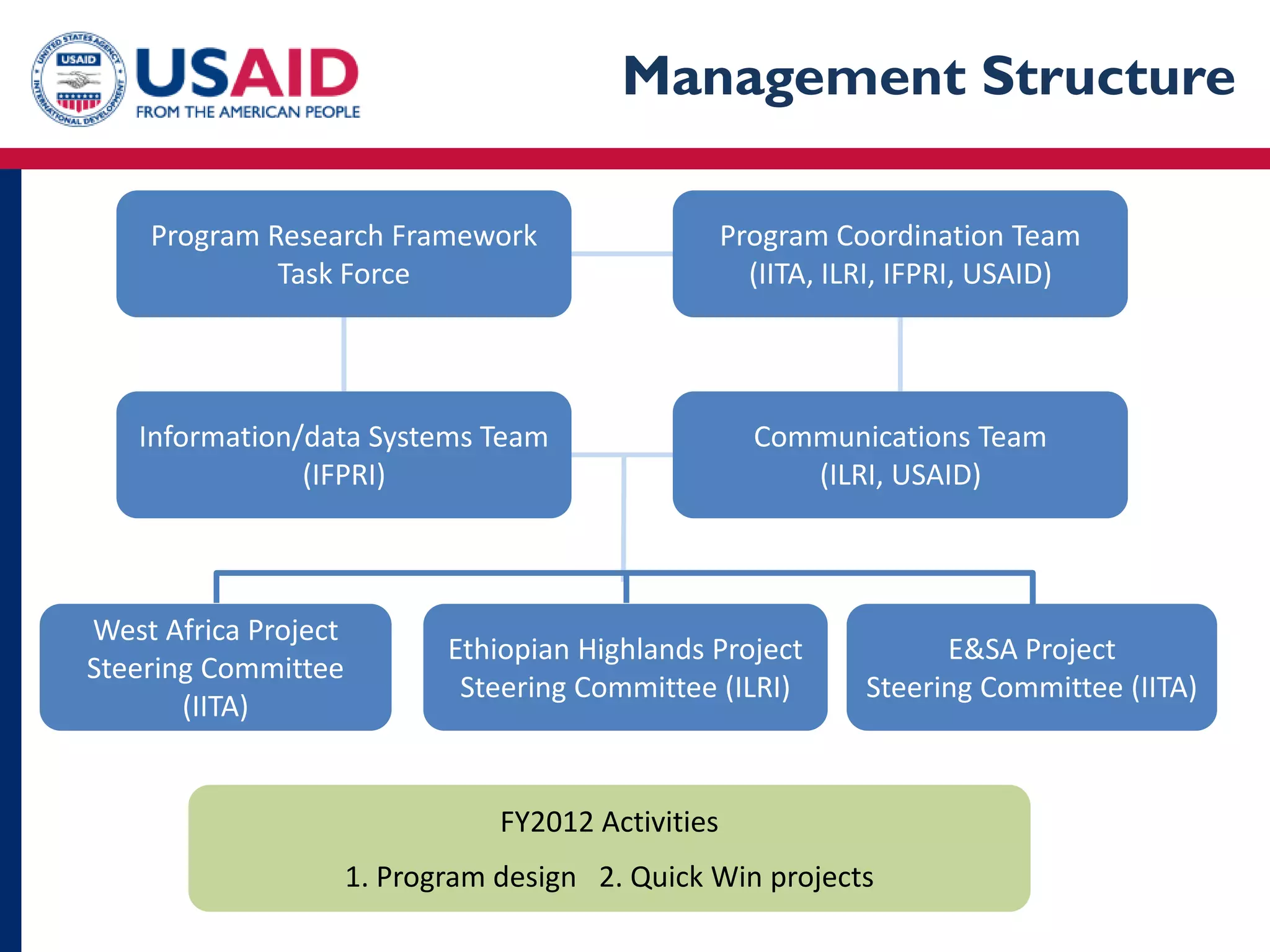
Management Structure

    Program Research Framework                       Program Coordination Team
             Task Force                                (IITA, ILRI, IFPRI, USAID)


   Information/data Systems Team                       Communications Team
               (IFPRI)                                    (ILRI, USAID)


West Africa Project
                             Ethiopian Highlands Project              E&SA Project
Steering Committee
                              Steering Committee (ILRI)         Steering Committee (IITA)
       (IITA)


                                 FY2012 Activities
                      1. Program design 2. Quick Win projects
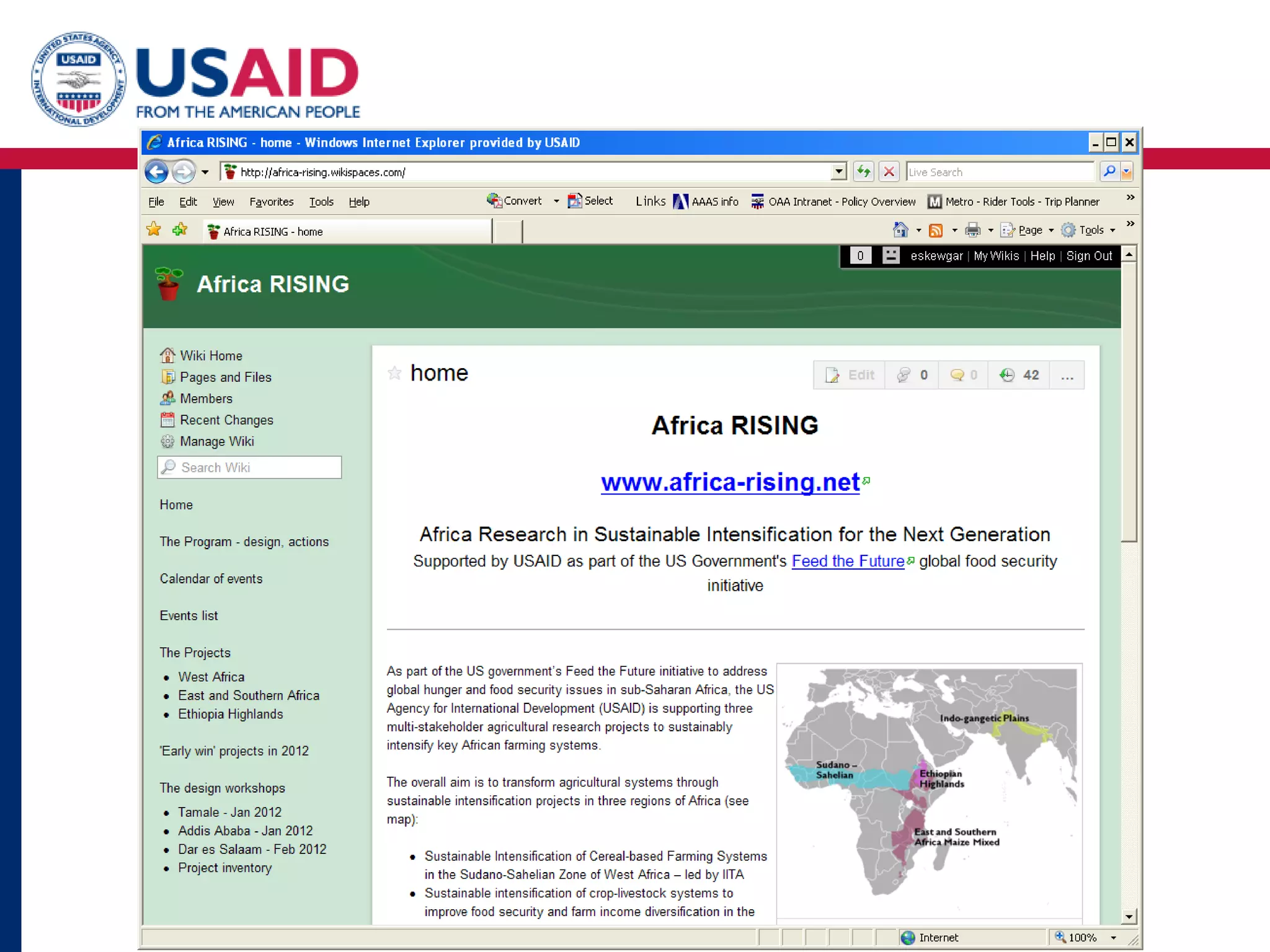
Africa RISING

Program Purpose and Objectives

Provide pathways out of hunger and poverty for small holder families,
particularly for women and children, through sustainably intensified farming
systems that sufficiently improve food, nutrition, and income security and
conserve or enhance the natural resource base.

• Identify demand-driven sustainable intensification options that are socially
  acceptable, economically feasible, and environmentally sound
• Combine and adapt these options to address constraints and exploit
  opportunities.
• Evaluate their effectiveness at multiple scales.
• Catalyze ongoing sustainable farm intensification.
Africa RISING


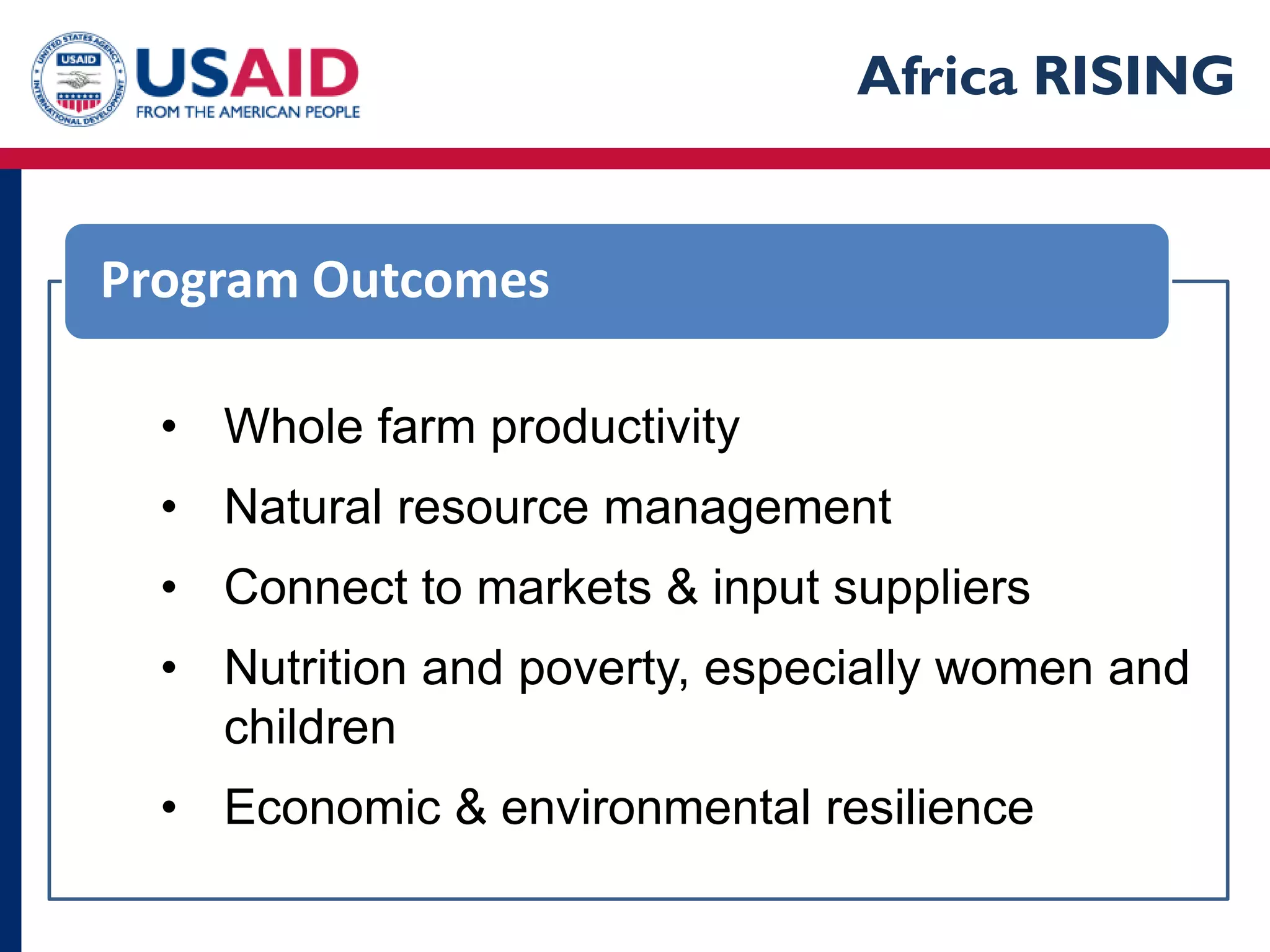
Program Outcomes

  • Whole farm productivity
  • Natural resource management
  • Connect to markets & input suppliers
  • Nutrition and poverty, especially women and
    children
  • Economic & environmental resilience
Africa RISING


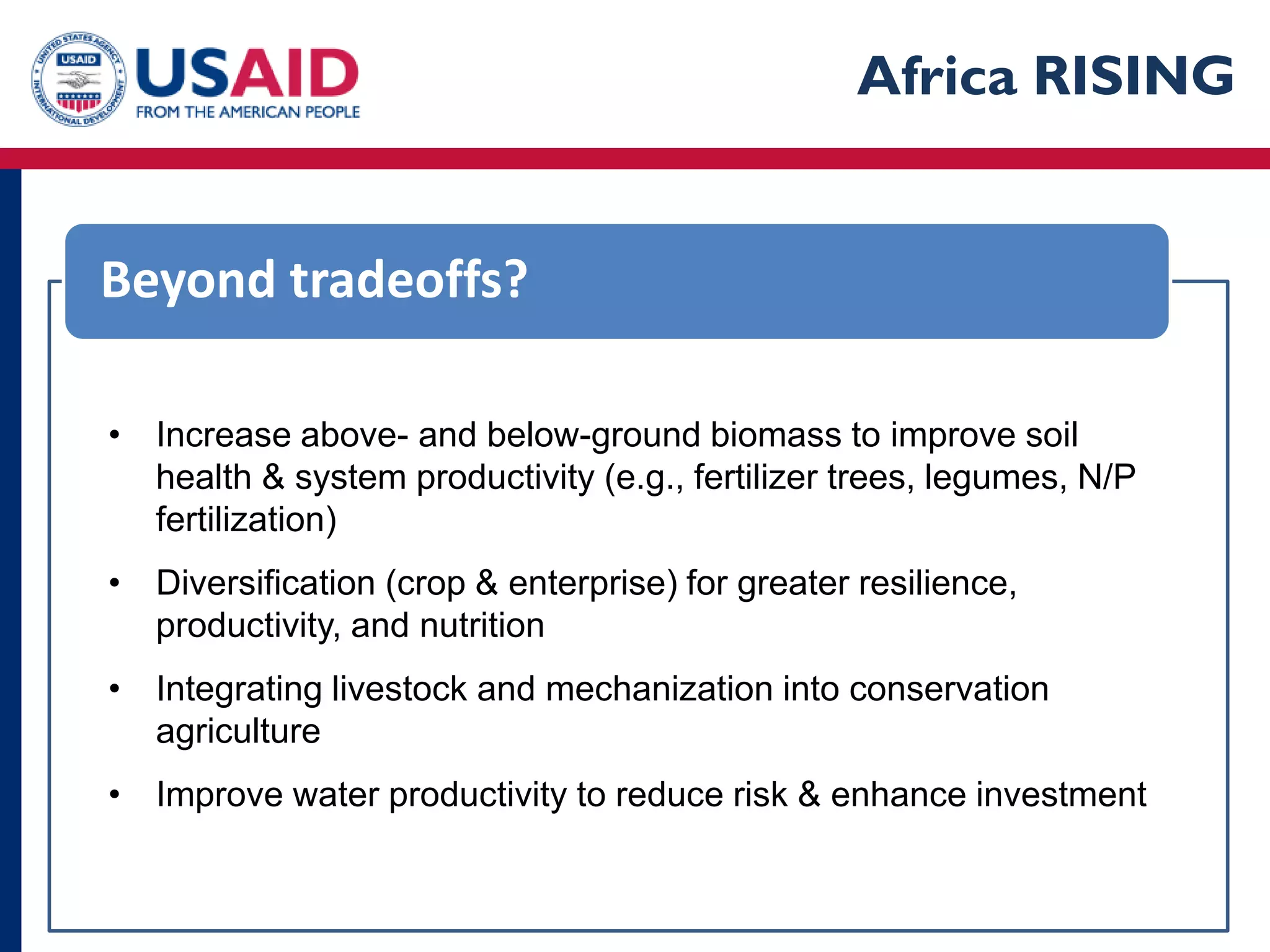
Beyond tradeoffs?

• Increase above- and below-ground biomass to improve soil
  health & system productivity (e.g., fertilizer trees, legumes, N/P
  fertilization)
• Diversification (crop & enterprise) for greater resilience,
  productivity, and nutrition
• Integrating livestock and mechanization into conservation
  agriculture
• Improve water productivity to reduce risk & enhance investment
Africa RISING

    Quick Wins in the Ethiopian Highlands:

•   Improving the evidence for targeting agricultural management interventions
    in Ethiopia
•   Targeting research design for technology integration at farm scale
•   Sustainable tree-crop-livestock intensification as a pillar for the Ethiopian
    climate resilient green economy
•   Regionalizing fertilizer rate recommendation for wheat-teff production
    systems
•   Fodder and feed as a key opportunity for driving sustainable intensification of
    crop-livestock systems
•   Improving productivity and rural livelihoods of smallholder farmers in the
    Bale highlands by integrating pulses in crop-livestock production systems
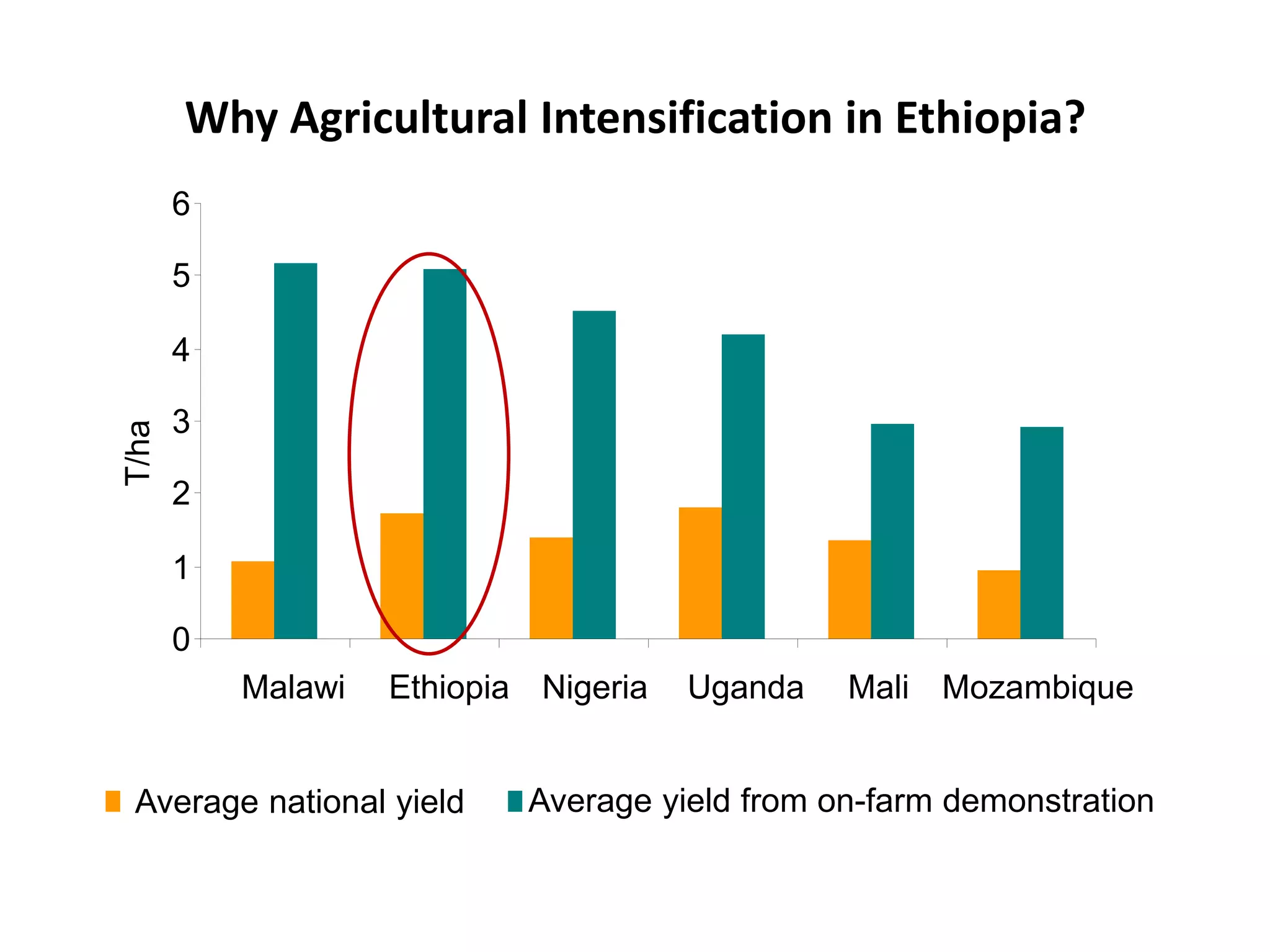
Why Agricultural Intensification in Ethiopia?
       6

       5

       4

       3
T/ha


       2

       1

       0
           Malawi   Ethiopia Nigeria   Uganda   Mali Mozambique


 Average national yield     Average yield from on-farm demonstration
Objective: to provide a tool which can be used to support the spatial
targeting of agricultural intensification practices to areas where the
biophysical and livelihood conditions are likely to sustain long term
development. Water is the entry point.

Project scope and limitations: proof of concept/demonstration of what is
possible; short term project with limited time/resources

Team: Economist/policy – Gebre; Crop specialist – Teklu; Livestock – Amare;
Water – Charlotte; Spatial – Catherine/Yenenesh/An/Abisalom

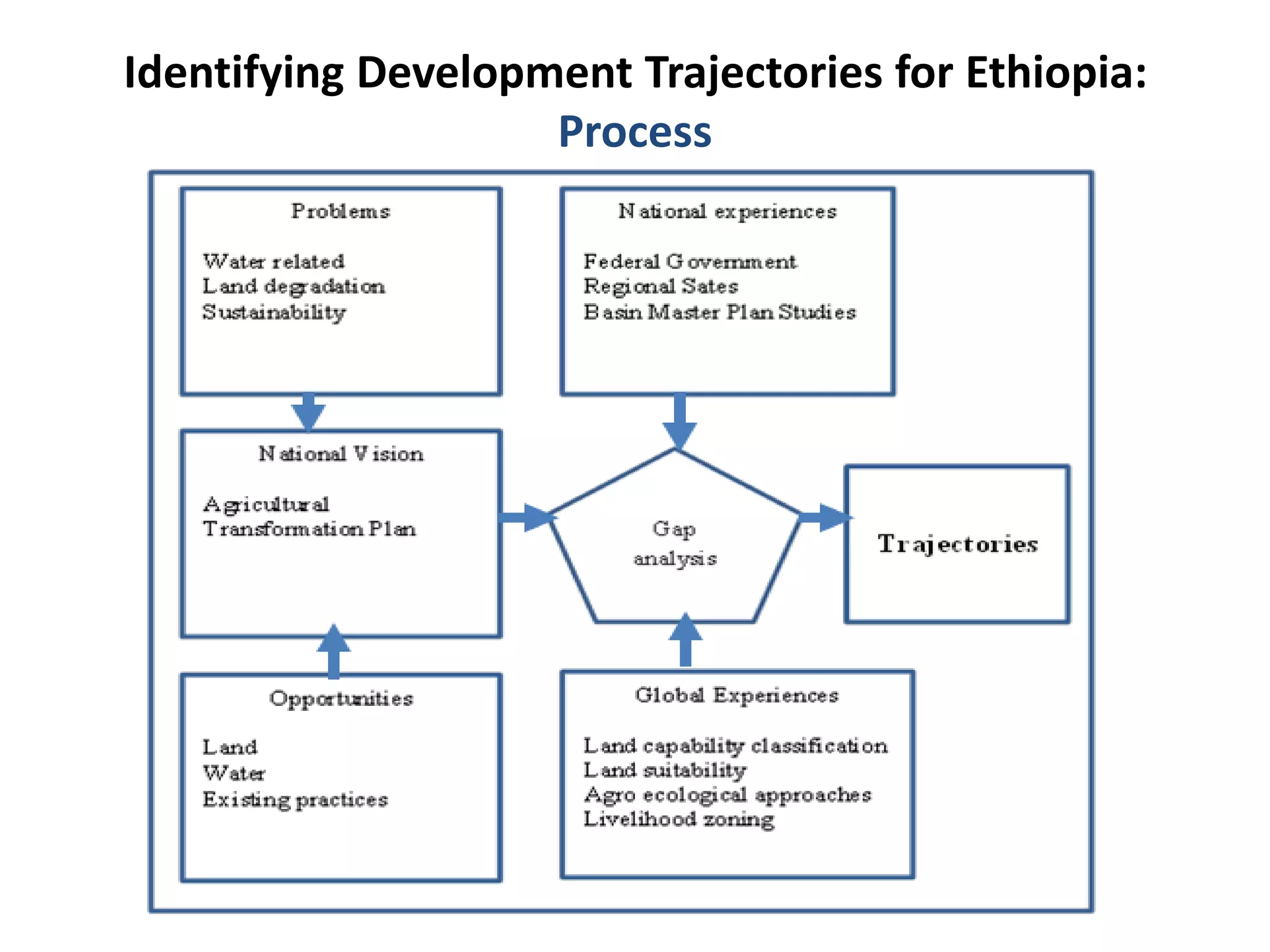
Process: identification of trajectories and indicators; consultation with line
agencies at regional level– feedback on both

Development of simple tool which produces national maps of selected
trajectories and targets
Some key challenges to making intensification sustainable:

• Do agricultural intensification initiatives account for water
  centered issues?

• Is there consistency across different initiatives / policies
  locally and nationally?

• Are the indicators for agricultural intensification planning
  strategies based on local and global experience?

• Are ongoing intensification efforts embedded in the
  livelihood of local communities?
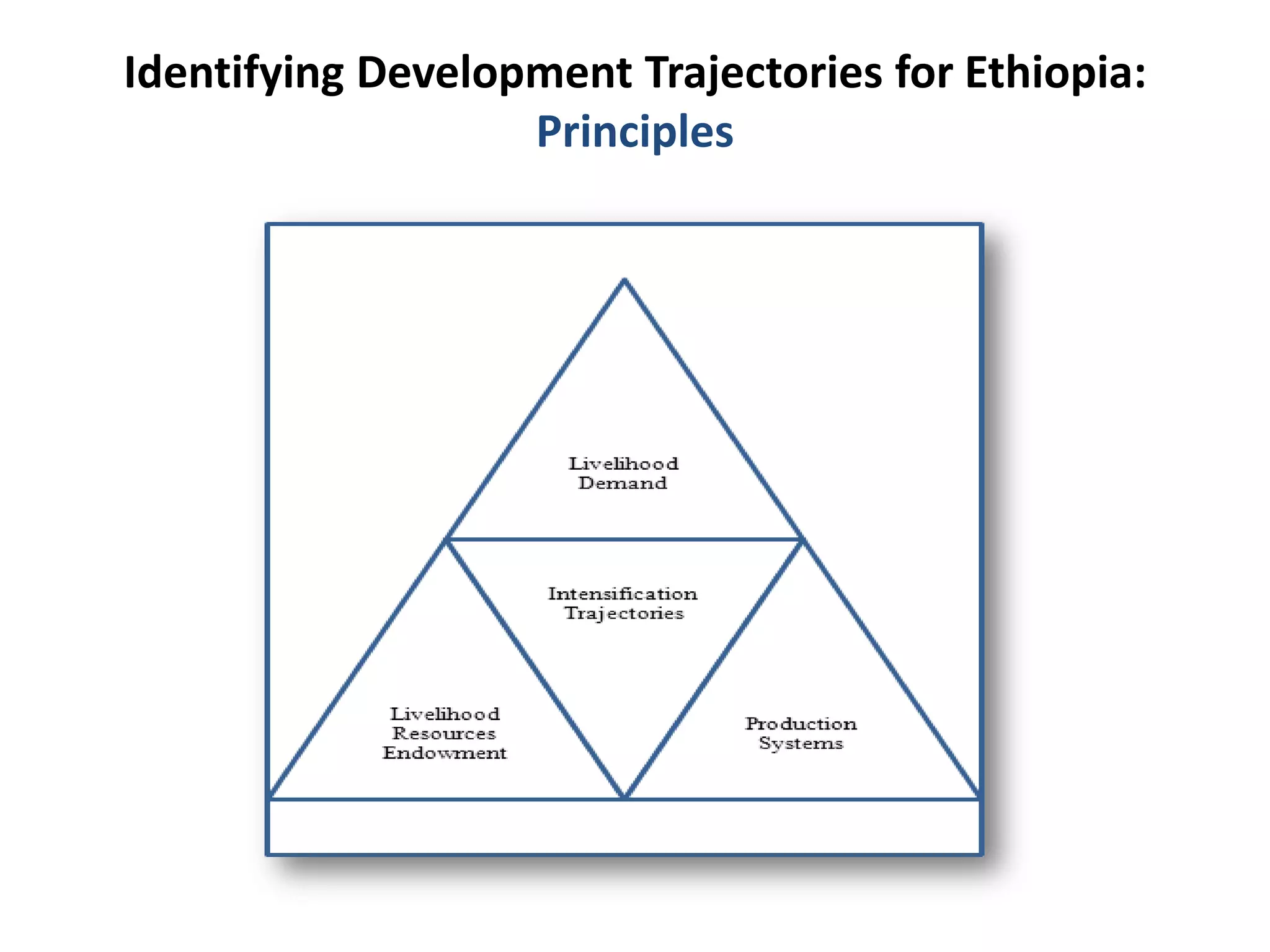
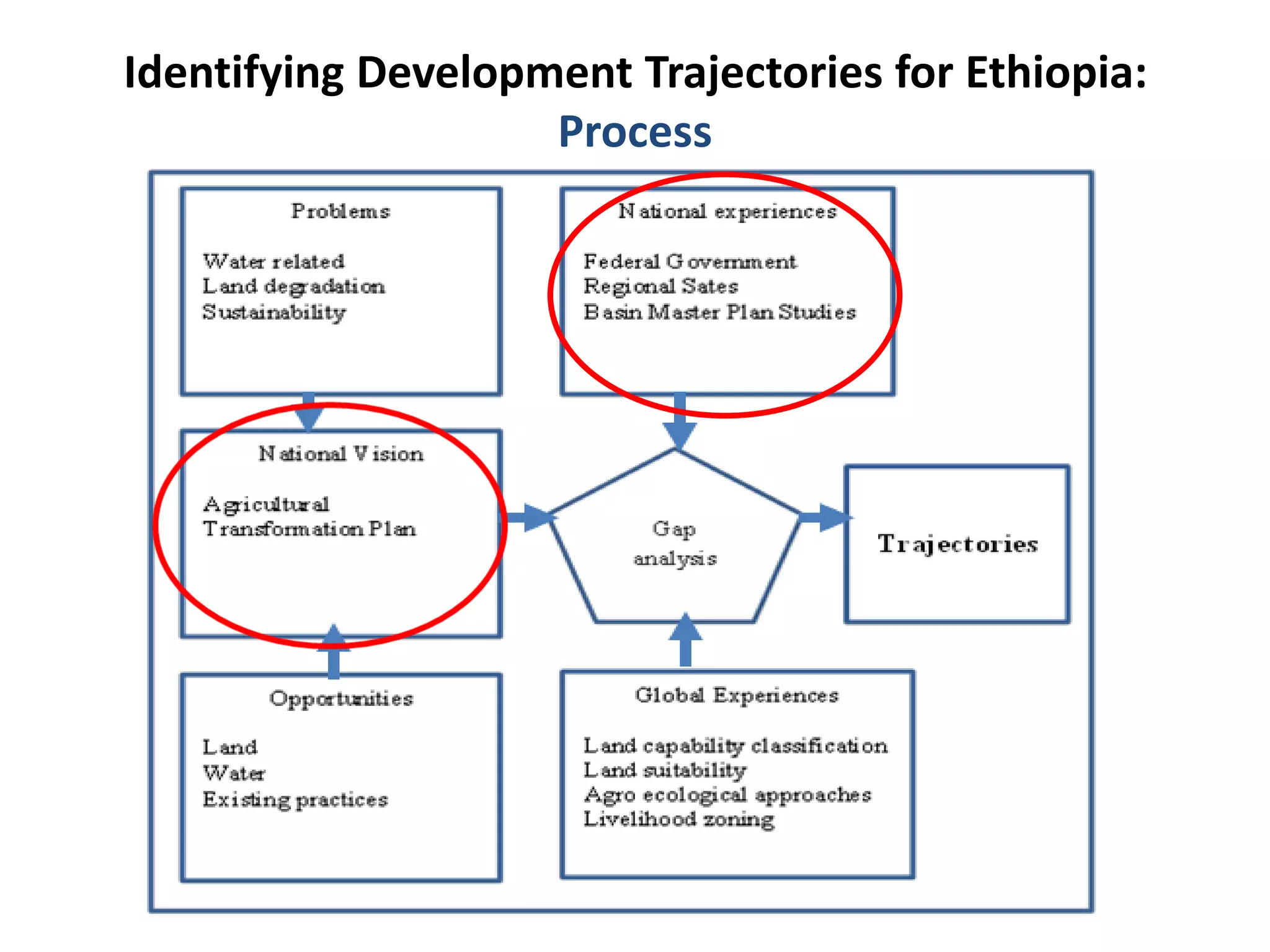
Identifying Development Trajectories for Ethiopia:
                   Principles
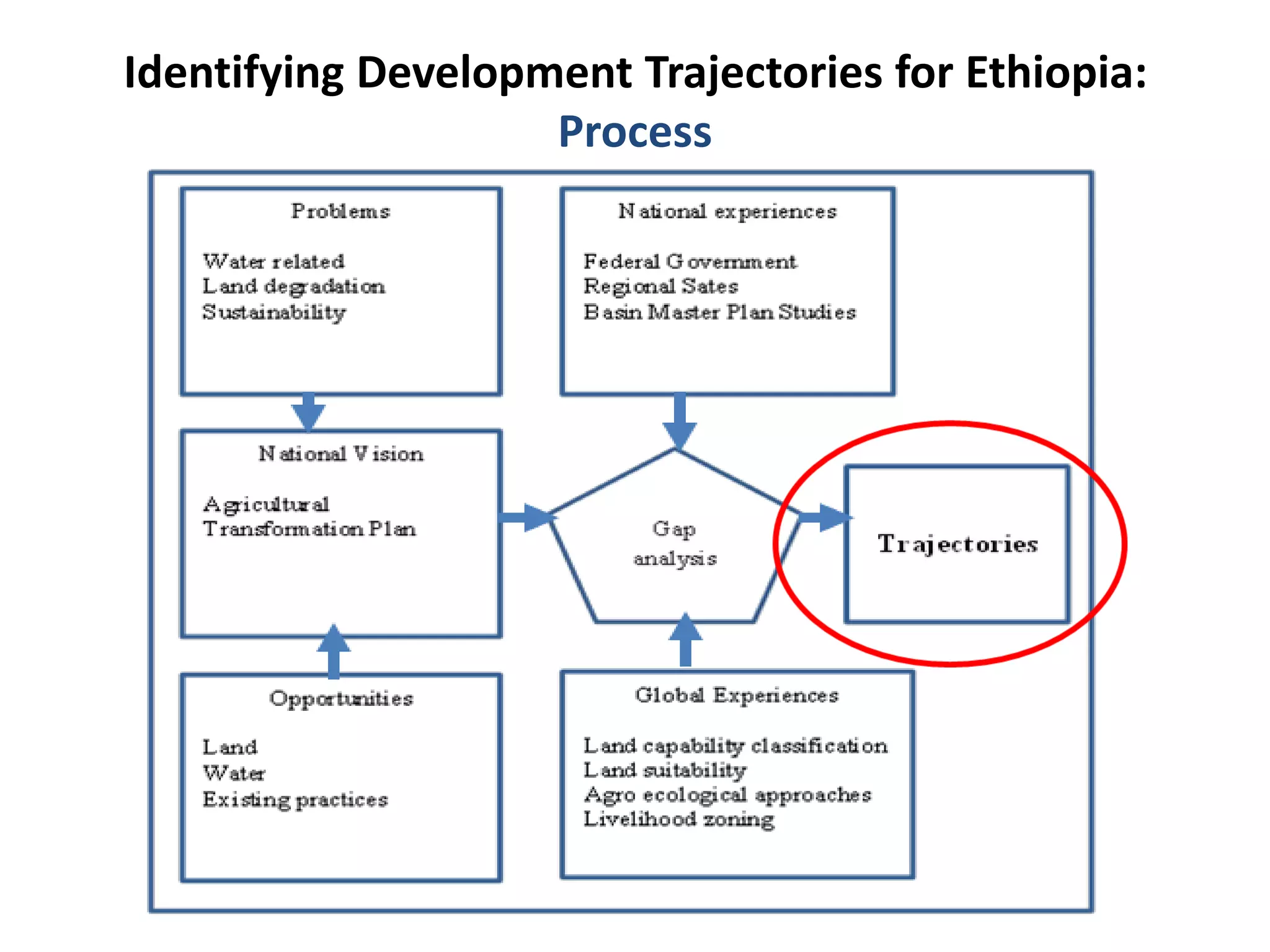
Identifying Development Trajectories for Ethiopia:
                    Process
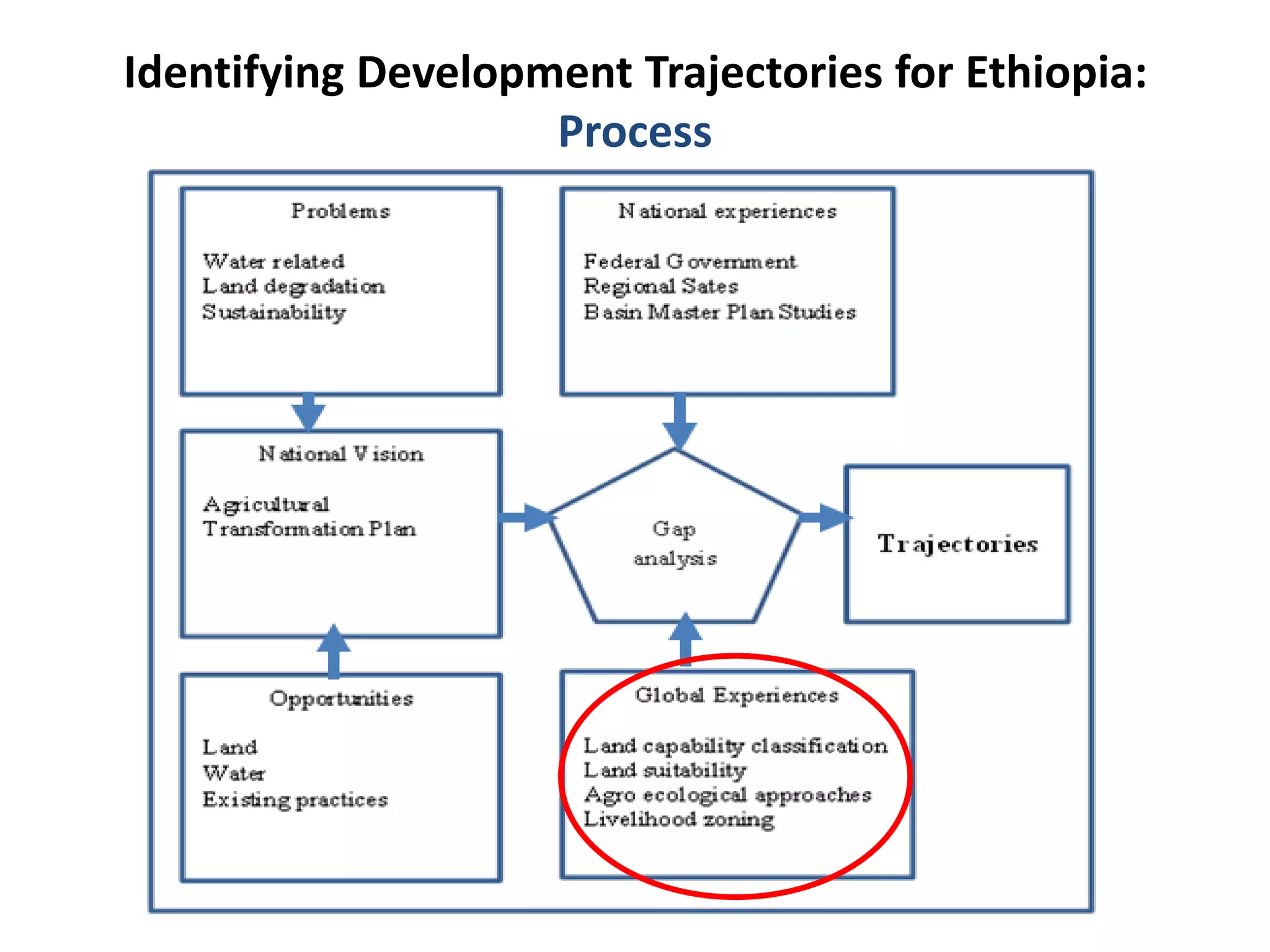
Identifying Development Trajectories for Ethiopia:
                    Process
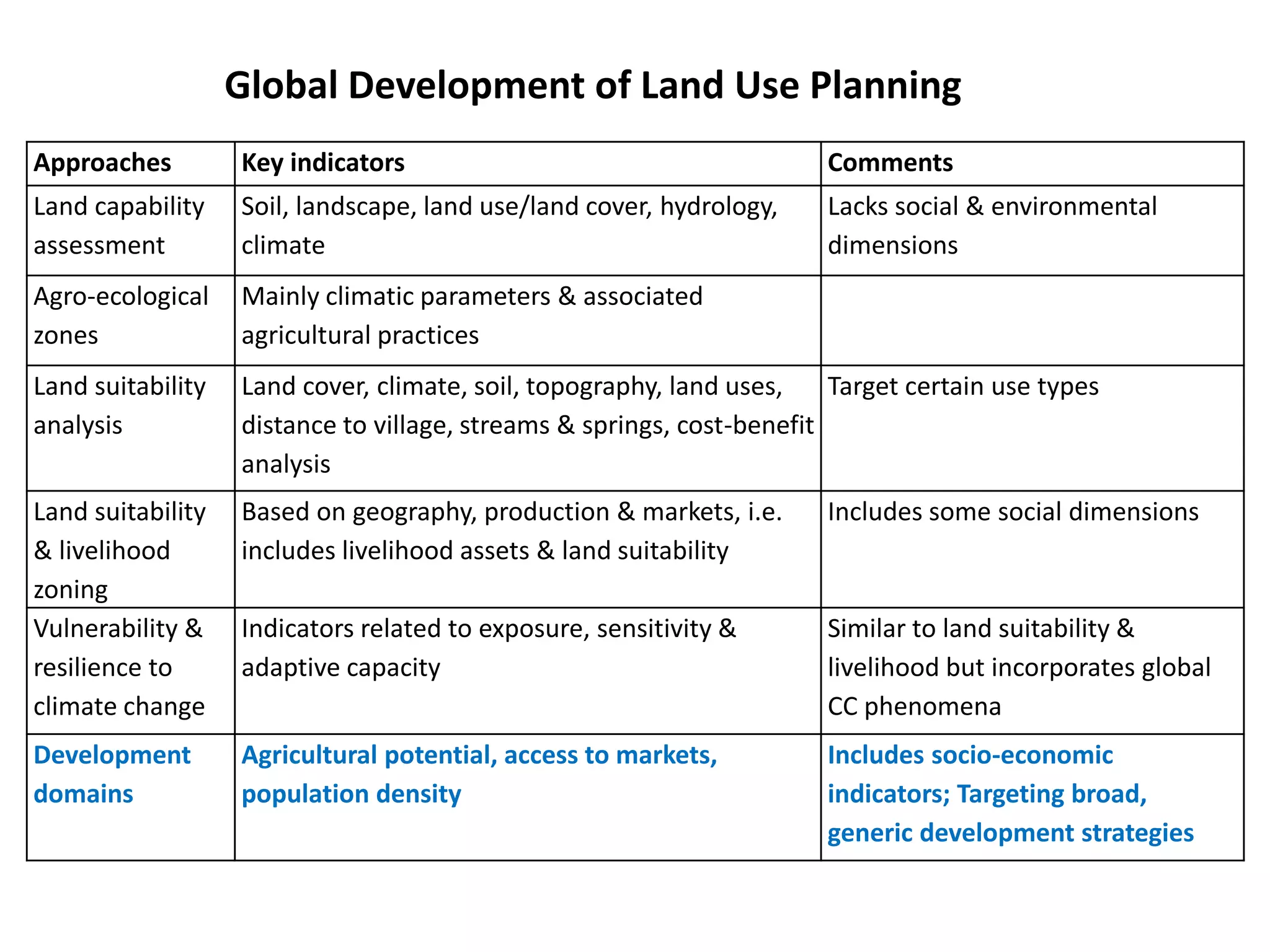
Global Development of Land Use Planning
Approaches         Key indicators                                      Comments
Land capability    Soil, landscape, land use/land cover, hydrology,    Lacks social & environmental
assessment         climate                                             dimensions
Agro-ecological    Mainly climatic parameters & associated
zones              agricultural practices
Land suitability   Land cover, climate, soil, topography, land uses,    Target certain use types
analysis           distance to village, streams & springs, cost-benefit
                   analysis
Land suitability   Based on geography, production & markets, i.e.      Includes some social dimensions
& livelihood       includes livelihood assets & land suitability
zoning
Vulnerability &    Indicators related to exposure, sensitivity &       Similar to land suitability &
resilience to      adaptive capacity                                   livelihood but incorporates global
climate change                                                         CC phenomena
Development        Agricultural potential, access to markets,          Includes socio-economic
domains            population density                                  indicators; Targeting broad,
                                                                       generic development strategies
Identifying Development Trajectories for Ethiopia:
                    Process
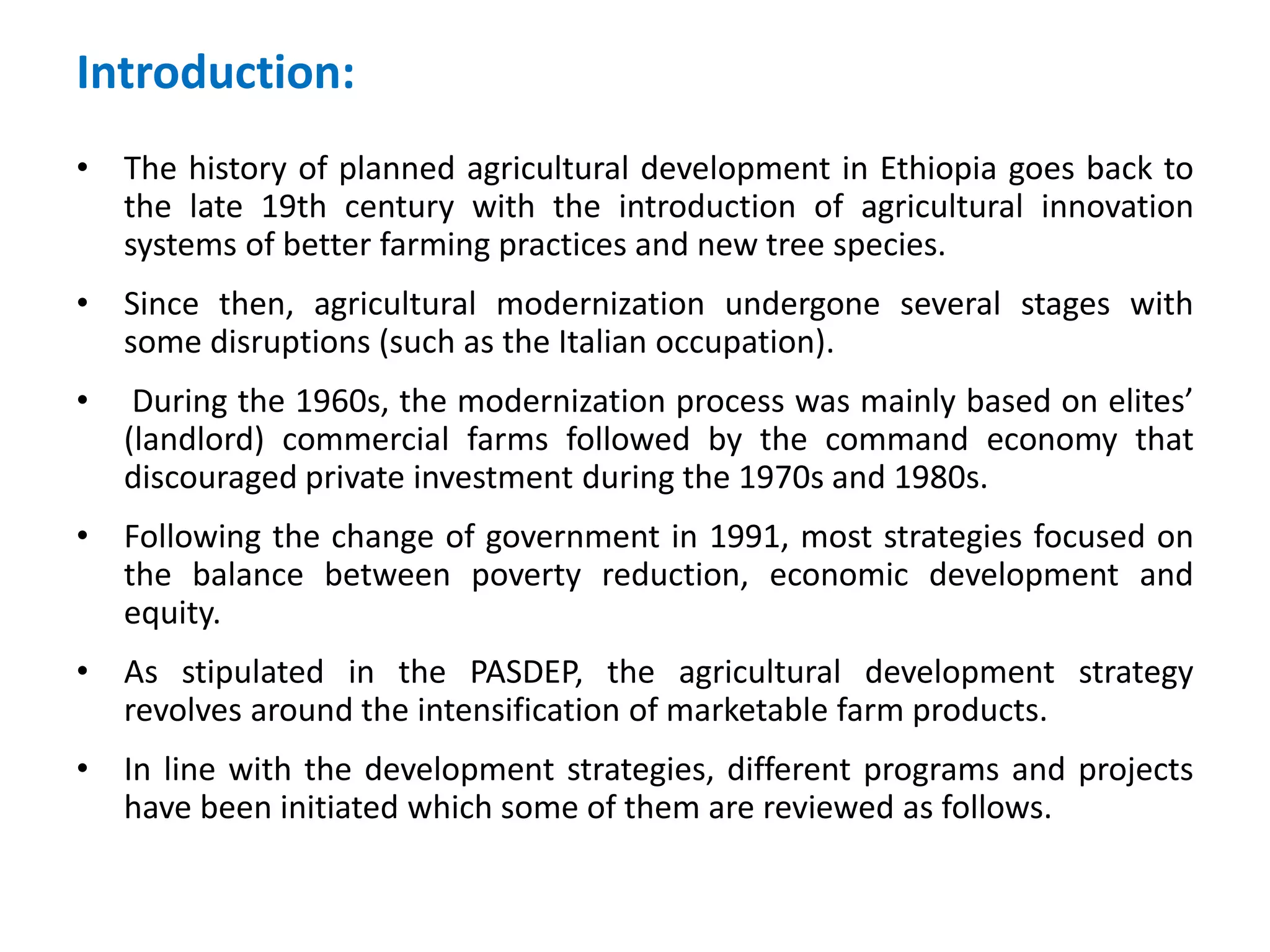
Introduction:
• The history of planned agricultural development in Ethiopia goes back to
  the late 19th century with the introduction of agricultural innovation
  systems of better farming practices and new tree species.
• Since then, agricultural modernization undergone several stages with
  some disruptions (such as the Italian occupation).
•    During the 1960s, the modernization process was mainly based on elites’
    (landlord) commercial farms followed by the command economy that
    discouraged private investment during the 1970s and 1980s.
• Following the change of government in 1991, most strategies focused on
  the balance between poverty reduction, economic development and
  equity.
• As stipulated in the PASDEP, the agricultural development strategy
  revolves around the intensification of marketable farm products.
• In line with the development strategies, different programs and projects
  have been initiated which some of them are reviewed as follows.
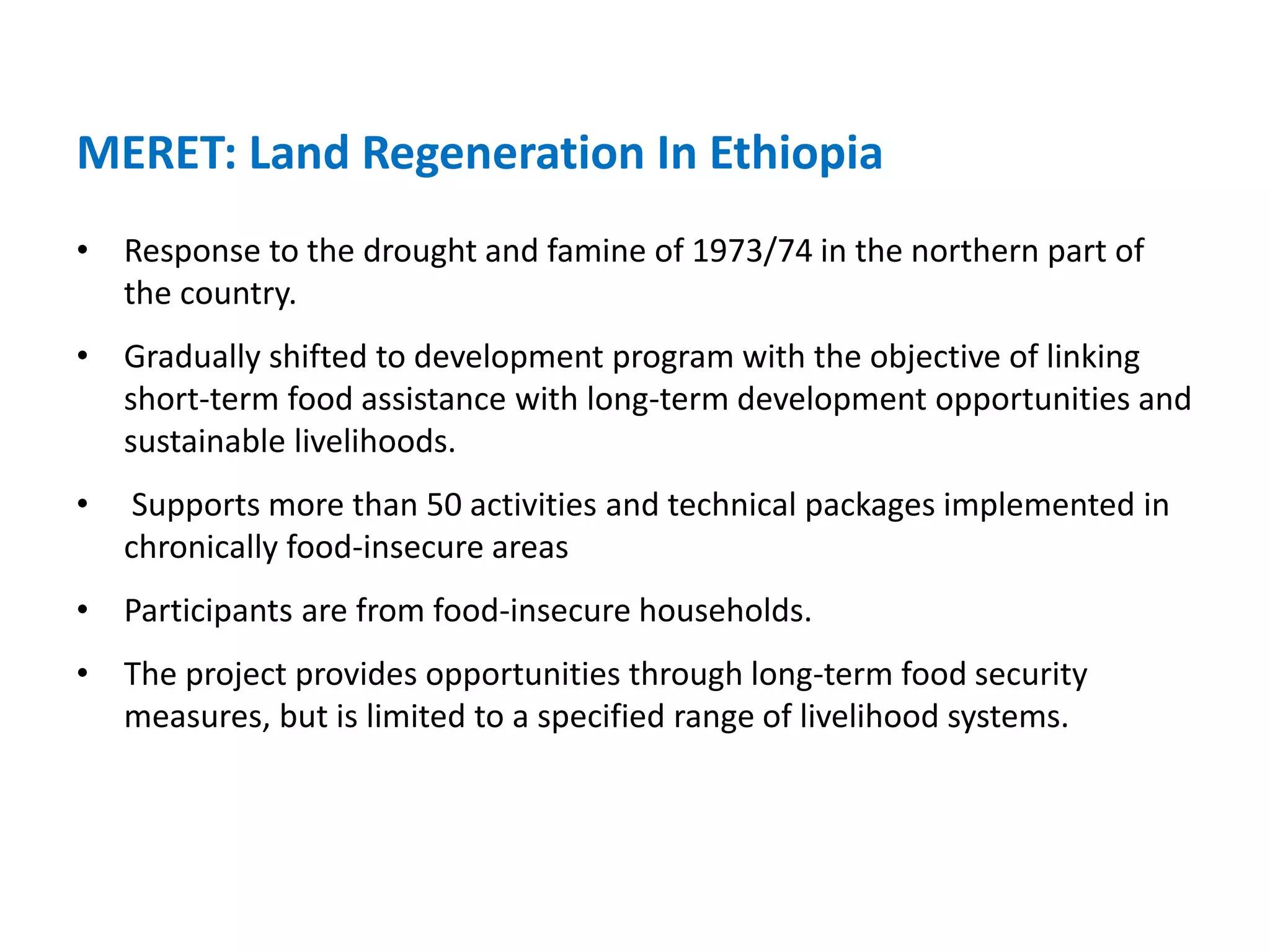
MERET: Land Regeneration In Ethiopia
• Response to the drought and famine of 1973/74 in the northern part of
  the country.
• Gradually shifted to development program with the objective of linking
  short-term food assistance with long-term development opportunities and
  sustainable livelihoods.
•    Supports more than 50 activities and technical packages implemented in
    chronically food-insecure areas
• Participants are from food-insecure households.
• The project provides opportunities through long-term food security
  measures, but is limited to a specified range of livelihood systems.
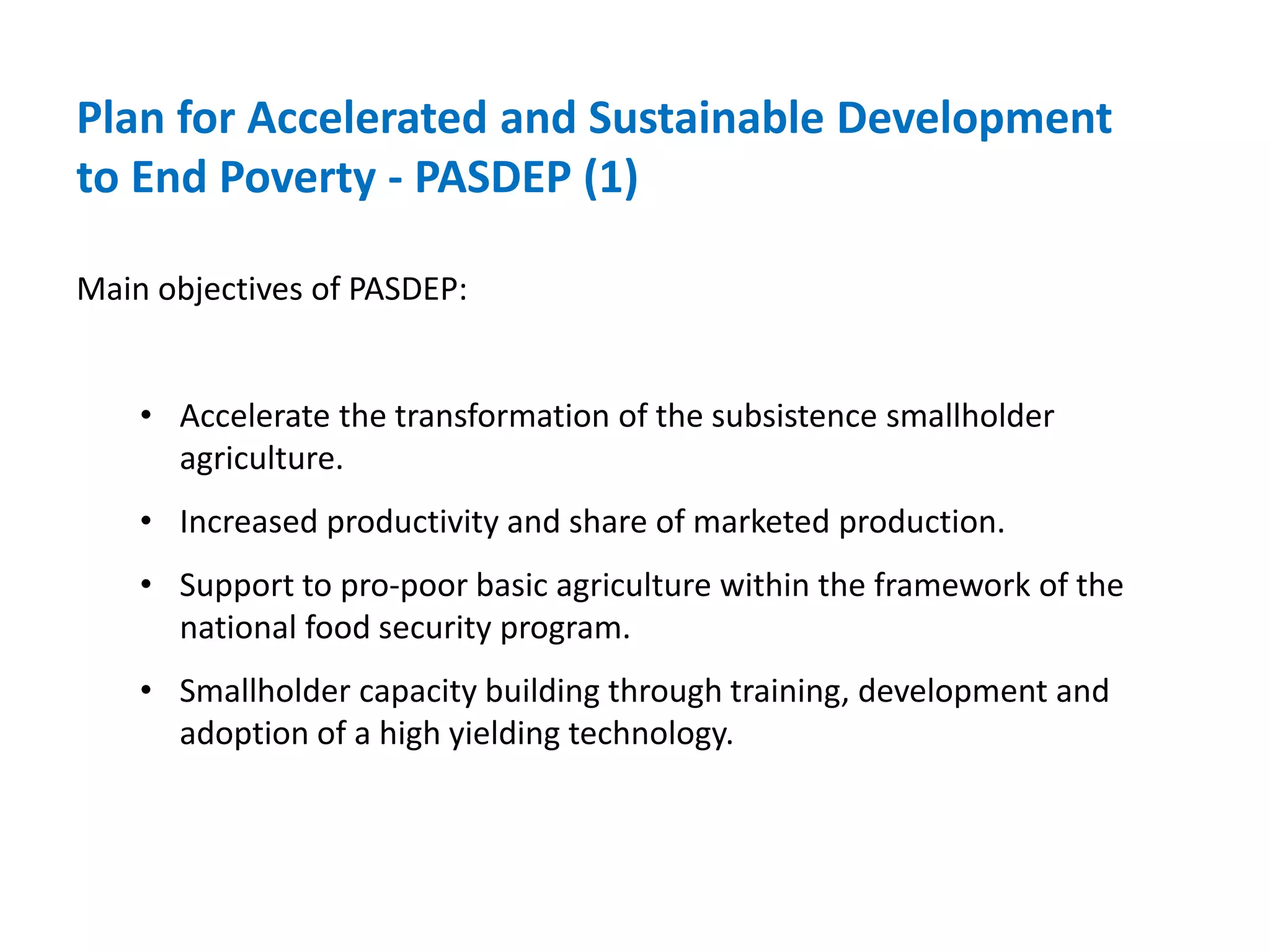
Plan for Accelerated and Sustainable Development
to End Poverty - PASDEP (1)

Main objectives of PASDEP:


    • Accelerate the transformation of the subsistence smallholder
      agriculture.
    • Increased productivity and share of marketed production.
    • Support to pro-poor basic agriculture within the framework of the
      national food security program.
    • Smallholder capacity building through training, development and
      adoption of a high yielding technology.
PASDEP (2)

• Strengthened agricultural research and extension service delivery
  mechanisms
• Promotion of increased diversification of agriculture through high value
  added commodities
• Promotion of commercialization of agriculture and establishment of a
  marketing system
• Development of small-scale irrigation and water harvesting technologies
  and sustainable use/management of natural resources.
PASDEP (3)
Recognized three main agro-ecological zones based on rainfall, land type and
altitude to respond to the particular conditions:
Zone 1: High rainfall areas
    • Efficient utilization of available rainwater for improved agricultural
      production with a special emphasis on high value crops for export.
    • Natural resources conservation, agro-forestry and livestock
      development.
Zone 2: Moisture stress areas
    • Food security measures and increased off-farm income opportunities.
    • Soil and water conservation livestock resources development (small
      ruminants) and small-scale irrigation.
Zone 3: Pastoral areas
    • Livestock production and marketing was given importance.
Agricultural Growth Program (AGP)

• Food security and poverty reduction remains at the heart of agriculture
  and water resources development.
• Gradual shift to high-value crops, promoting niche high-value export
  crops.
• Facilitates the commercialization of agriculture where it is feasible .
• Integrates farmers with both local and global markets.
• Although AGP uses relatively comprehensive indicators (both bio-physical
  and socio-economic), focus is given to selected high-potential areas.
Sustainable Land Management (SLM)


• Parallel to the AGP, the Sustainable Land Management (SLM) program was
  crafted to ensure sustainability of the natural resource base focusing on
  the high potential less degraded areas.

• Unlike the MERET project that operates in degraded and food insecure
  areas, SLM targets the food secured and less degraded areas, but food
  security is still the major objective
Growth Corridors

Regional focus, based largely on resource endowment.

For example:
     • Tigray Region has delineated the Raya Valley-Humera lowland growth
       corridors based on their ground and surface water potentials.
     • Oromia regional state acknowledge that the lowland parts of the region
       are vulnerable to recurrent droughts but supposed to have sufficient
       surface/ground water and good development potential .
     • Amhara followed different approach to classify the region into six growth
       corridors/poles (namely Central, Eastern, North-West, South-West, Tana-
       Beles and Tekeze catchments) .
     • In general the growth corridor approach was based on water and water
       based investment potentials.
AgWater Solutions Project

• Water as the entry point.
• Addresses pro-poor needs rather than on the development of
  potentially suitable areas/resources.
• Different people in different places have different needs.
• Demand for investment in water likened to availability of water
  and needs.
• Livelihood mapping was essentially based on three criteria, hence
  it is likely to reach at different livelihood settings if other criteria
  are considered.
Gap Analysis (1)

The gap analysis is based on the following principles:

• Whether agricultural intensification initiatives in Ethiopia are planned with
  the perception of water centered problems and sustainable intensification
  trajectories
• Whether there is consistencies across different initiatives in terms of
  indicators used to plan and monitor the intensification process and paths
  to make the exchange of information between projects simpler
• Whether these indicators for agricultural intensification planning and post
  implementation monitoring are drawn based on global experiences
• Whether the ongoing efforts of intensification embedded the livelihood
  of local community into agricultural intensification process.
Gap Analysis (2)

• Almost all programs and projects have targeted agricultural production
  and poverty reduction.
• Water as entry point has been given due emphasis in all
  projects/programs
• They lack consistency in terms of livelihood systems.
• PASDEP: indicators used to characterize livelihood zones were mainly bio-
  physical characteristics with little consideration to socio-economic
  characteristics.
• PASDEP and Agwater solution project were more comprehensive to
  address all production/livelihood systems
• Livestock as livelihood system did not come bold except in PASDEP
Gap Analysis (3)

In terms of trajectories:

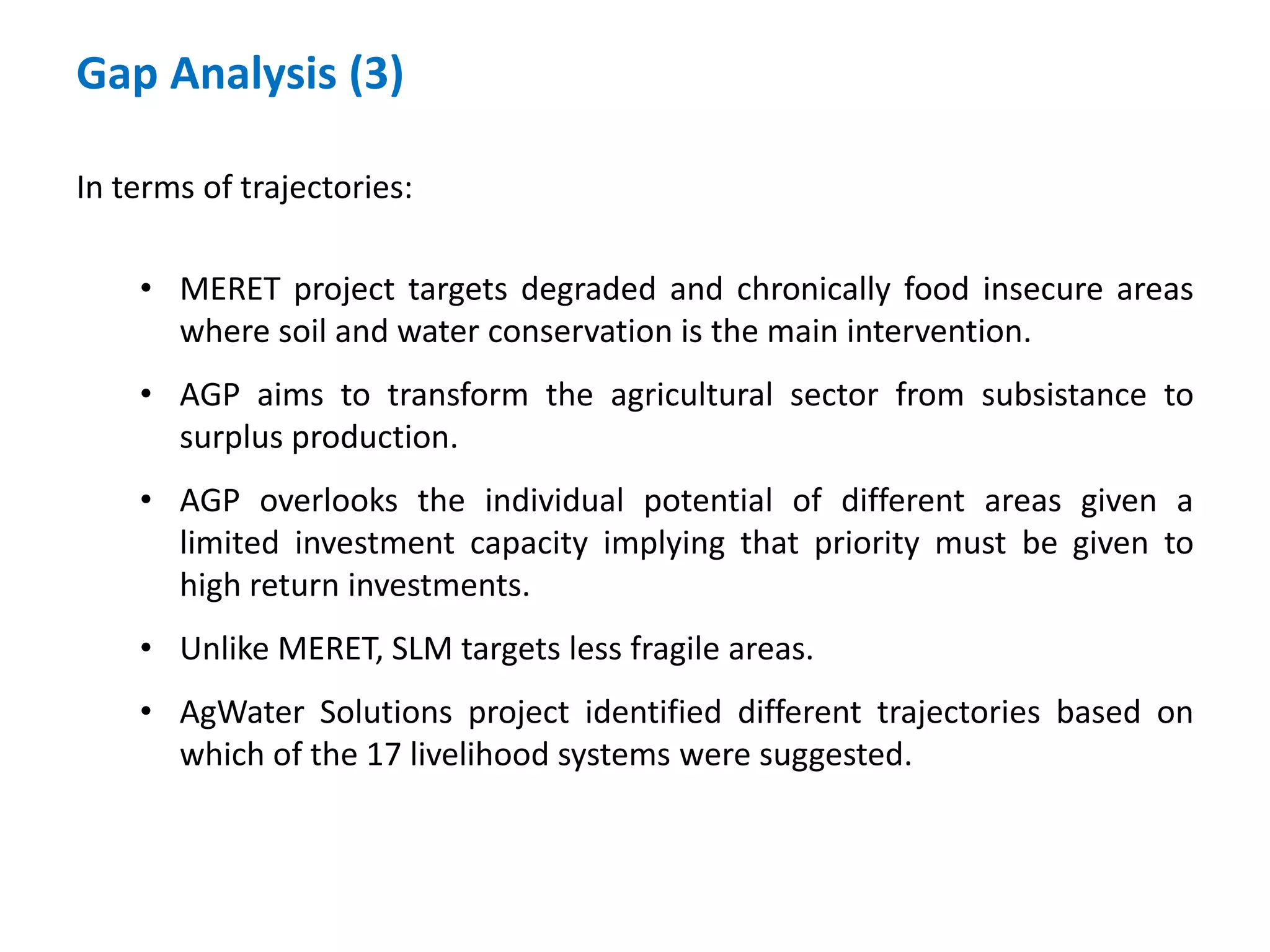
    • MERET project targets degraded and chronically food insecure areas
      where soil and water conservation is the main intervention.
    • AGP aims to transform the agricultural sector from subsistance to
      surplus production.
    • AGP overlooks the individual potential of different areas given a
      limited investment capacity implying that priority must be given to
      high return investments.
    • Unlike MERET, SLM targets less fragile areas.
    • AgWater Solutions project identified different trajectories based on
      which of the 17 livelihood systems were suggested.
Identifying Development Trajectories for Ethiopia:
                    Process
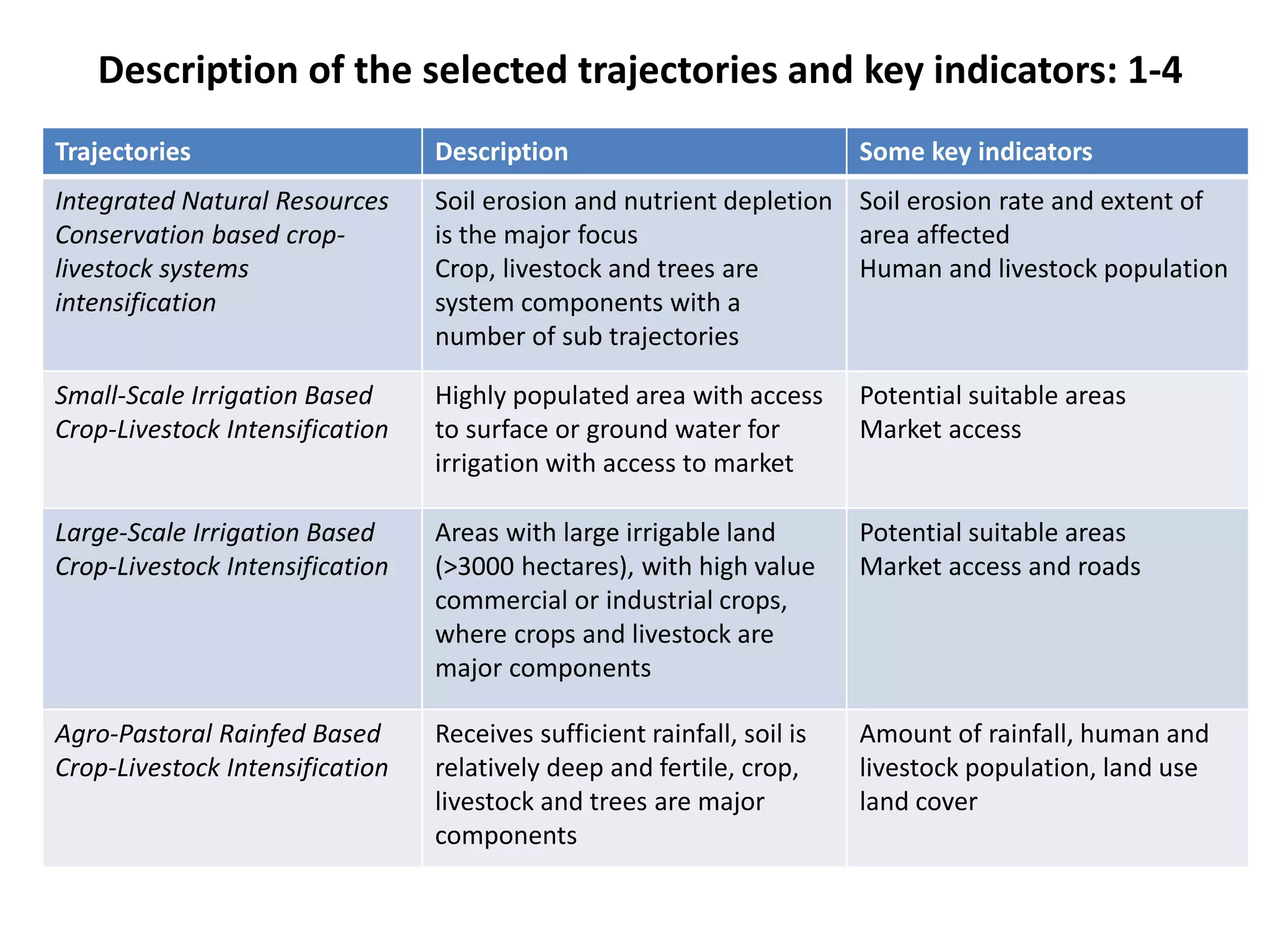
Description of the selected trajectories and key indicators: 1-4
Trajectories                     Description                             Some key indicators
Integrated Natural Resources     Soil erosion and nutrient depletion Soil erosion rate and extent of
Conservation based crop-         is the major focus                  area affected
livestock systems                Crop, livestock and trees are       Human and livestock population
intensification                  system components with a
                                 number of sub trajectories

Small-Scale Irrigation Based     Highly populated area with access       Potential suitable areas
Crop-Livestock Intensification   to surface or ground water for          Market access
                                 irrigation with access to market

Large-Scale Irrigation Based     Areas with large irrigable land         Potential suitable areas
Crop-Livestock Intensification   (>3000 hectares), with high value       Market access and roads
                                 commercial or industrial crops,
                                 where crops and livestock are
                                 major components

Agro-Pastoral Rainfed Based      Receives sufficient rainfall, soil is   Amount of rainfall, human and
Crop-Livestock Intensification   relatively deep and fertile, crop,      livestock population, land use
                                 livestock and trees are major           land cover
                                 components
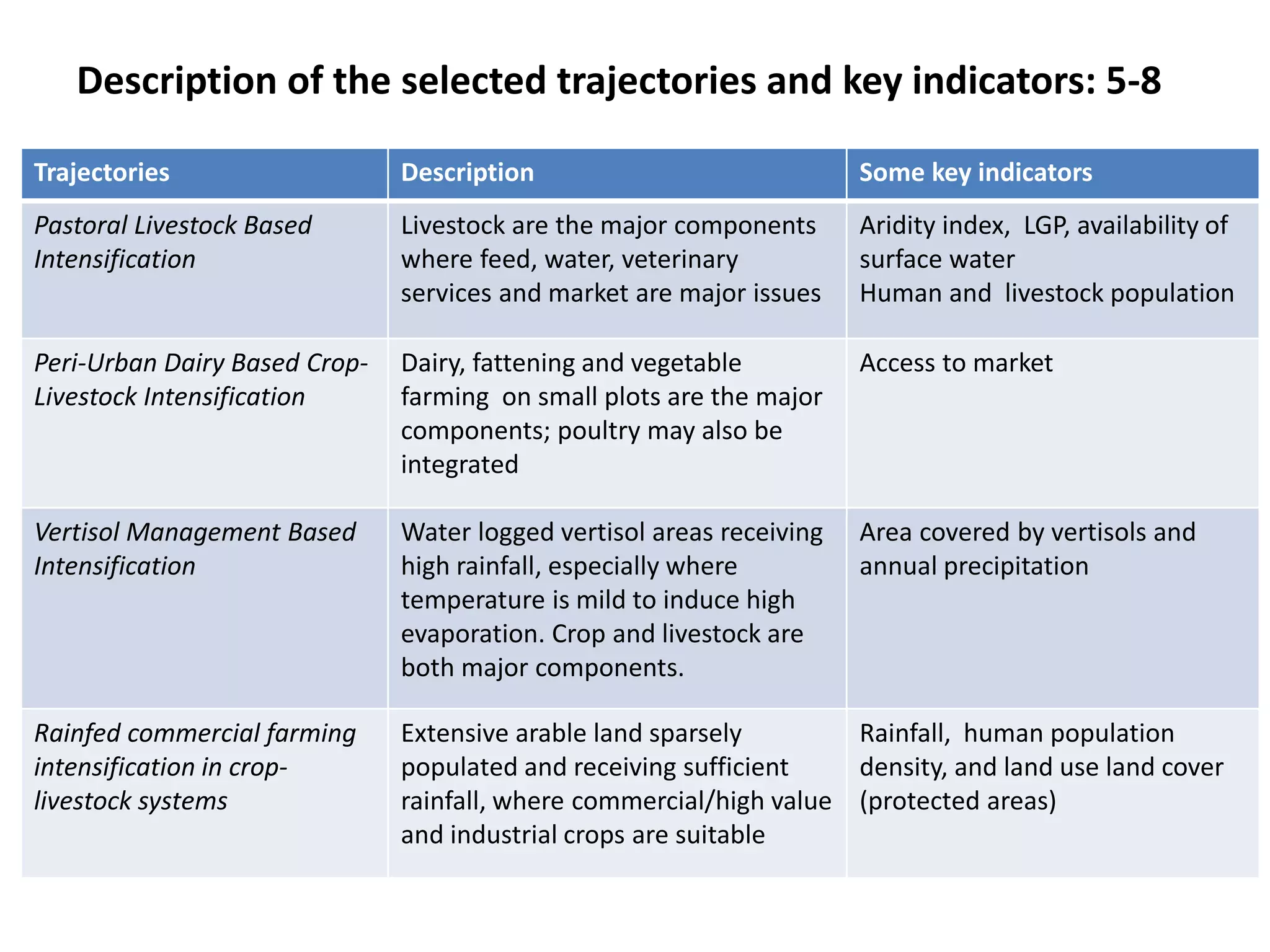
Description of the selected trajectories and key indicators: 5-8

Trajectories                   Description                             Some key indicators
Pastoral Livestock Based       Livestock are the major components      Aridity index, LGP, availability of
Intensification                where feed, water, veterinary           surface water
                               services and market are major issues    Human and livestock population

Peri-Urban Dairy Based Crop-   Dairy, fattening and vegetable          Access to market
Livestock Intensification      farming on small plots are the major
                               components; poultry may also be
                               integrated

Vertisol Management Based      Water logged vertisol areas receiving   Area covered by vertisols and
Intensification                high rainfall, especially where         annual precipitation
                               temperature is mild to induce high
                               evaporation. Crop and livestock are
                               both major components.

Rainfed commercial farming     Extensive arable land sparsely        Rainfall, human population
intensification in crop-       populated and receiving sufficient    density, and land use land cover
livestock systems              rainfall, where commercial/high value (protected areas)
                               and industrial crops are suitable
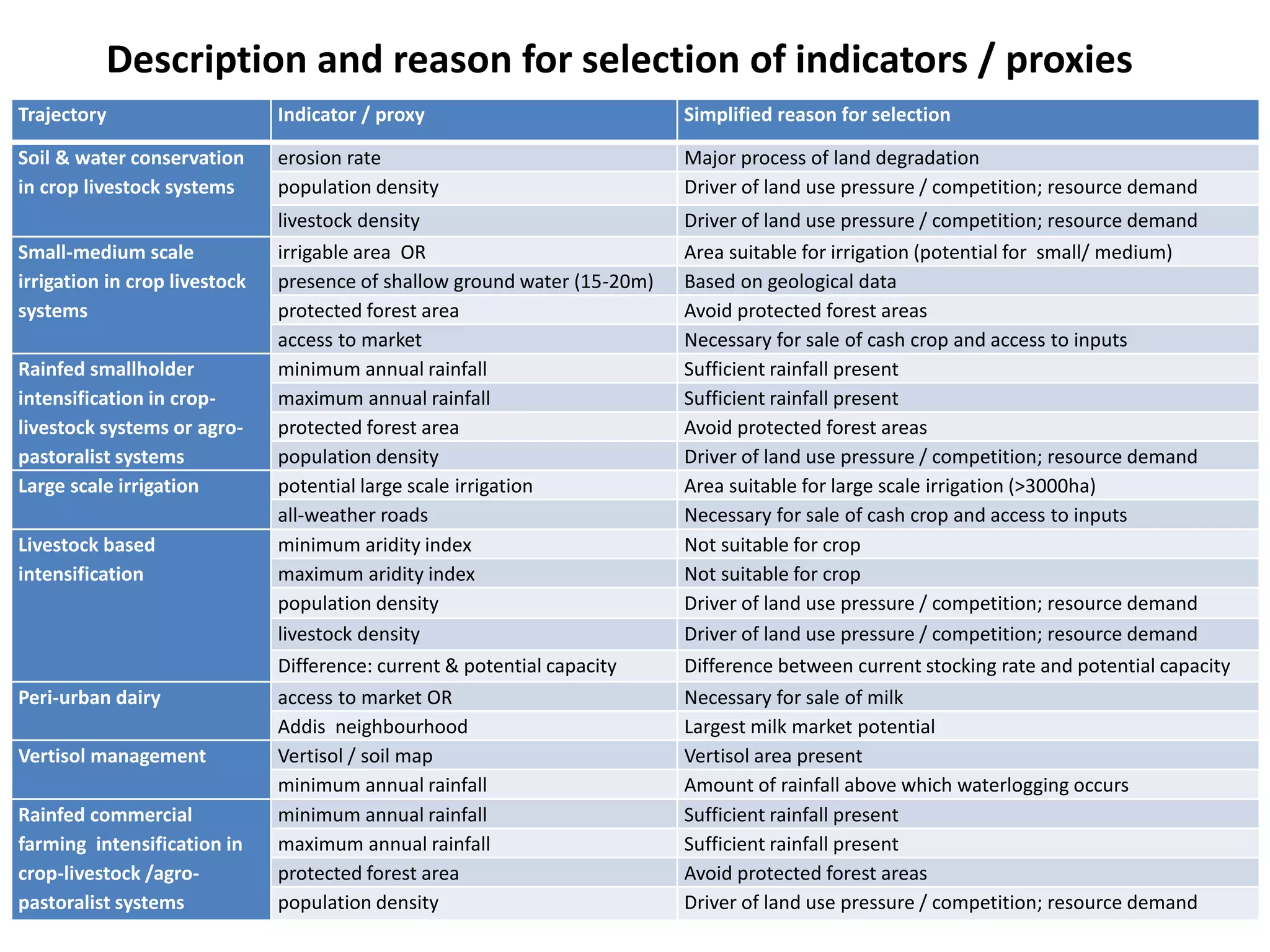
Description and reason for selection of indicators / proxies
Trajectory                     Indicator / proxy                           Simplified reason for selection

Soil & water conservation      erosion rate                                Major process of land degradation
in crop livestock systems      population density                          Driver of land use pressure / competition; resource demand
                               livestock density                           Driver of land use pressure / competition; resource demand
Small-medium scale             irrigable area OR                           Area suitable for irrigation (potential for small/ medium)
irrigation in crop livestock   presence of shallow ground water (15-20m)   Based on geological data
systems                        protected forest area                       Avoid protected forest areas
                               access to market                            Necessary for sale of cash crop and access to inputs
Rainfed smallholder            minimum annual rainfall                     Sufficient rainfall present
intensification in crop-       maximum annual rainfall                     Sufficient rainfall present
livestock systems or agro-     protected forest area                       Avoid protected forest areas
pastoralist systems            population density                          Driver of land use pressure / competition; resource demand
Large scale irrigation         potential large scale irrigation            Area suitable for large scale irrigation (>3000ha)
                               all-weather roads                           Necessary for sale of cash crop and access to inputs
Livestock based                minimum aridity index                       Not suitable for crop
intensification                maximum aridity index                       Not suitable for crop
                               population density                          Driver of land use pressure / competition; resource demand
                               livestock density                           Driver of land use pressure / competition; resource demand
                               Difference: current & potential capacity    Difference between current stocking rate and potential capacity
Peri-urban dairy               access to market OR                         Necessary for sale of milk
                               Addis neighbourhood                         Largest milk market potential
Vertisol management            Vertisol / soil map                         Vertisol area present
                               minimum annual rainfall                     Amount of rainfall above which waterlogging occurs
Rainfed commercial             minimum annual rainfall                     Sufficient rainfall present
farming intensification in     maximum annual rainfall                     Sufficient rainfall present
crop-livestock /agro-          protected forest area                       Avoid protected forest areas
pastoralist systems            population density                          Driver of land use pressure / competition; resource demand
Background to the tool – how
trajectories and indicators can be
        turned into maps
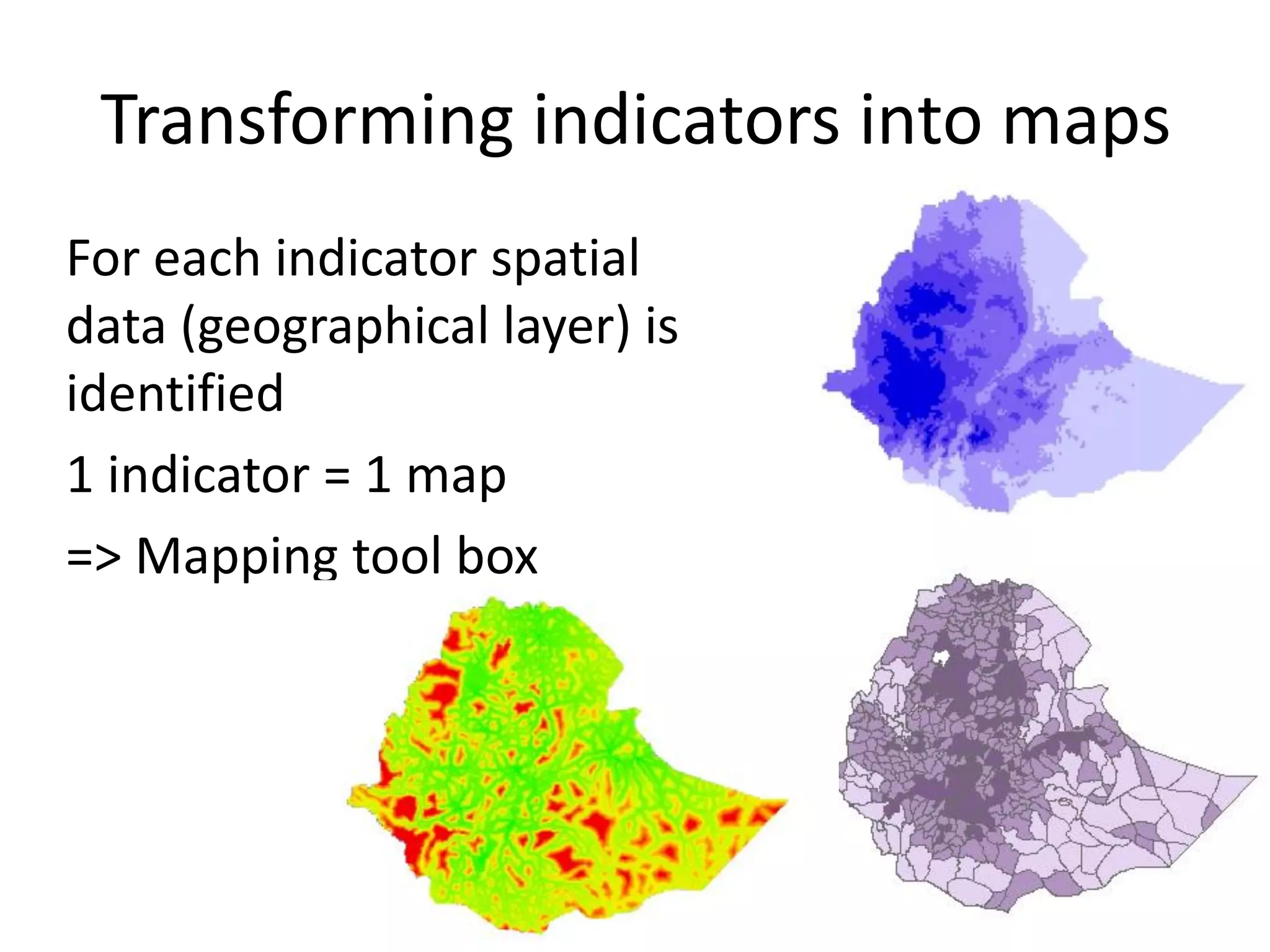
Transforming indicators into maps
For each indicator spatial
data (geographical layer) is
identified
1 indicator = 1 map
=> Mapping tool box
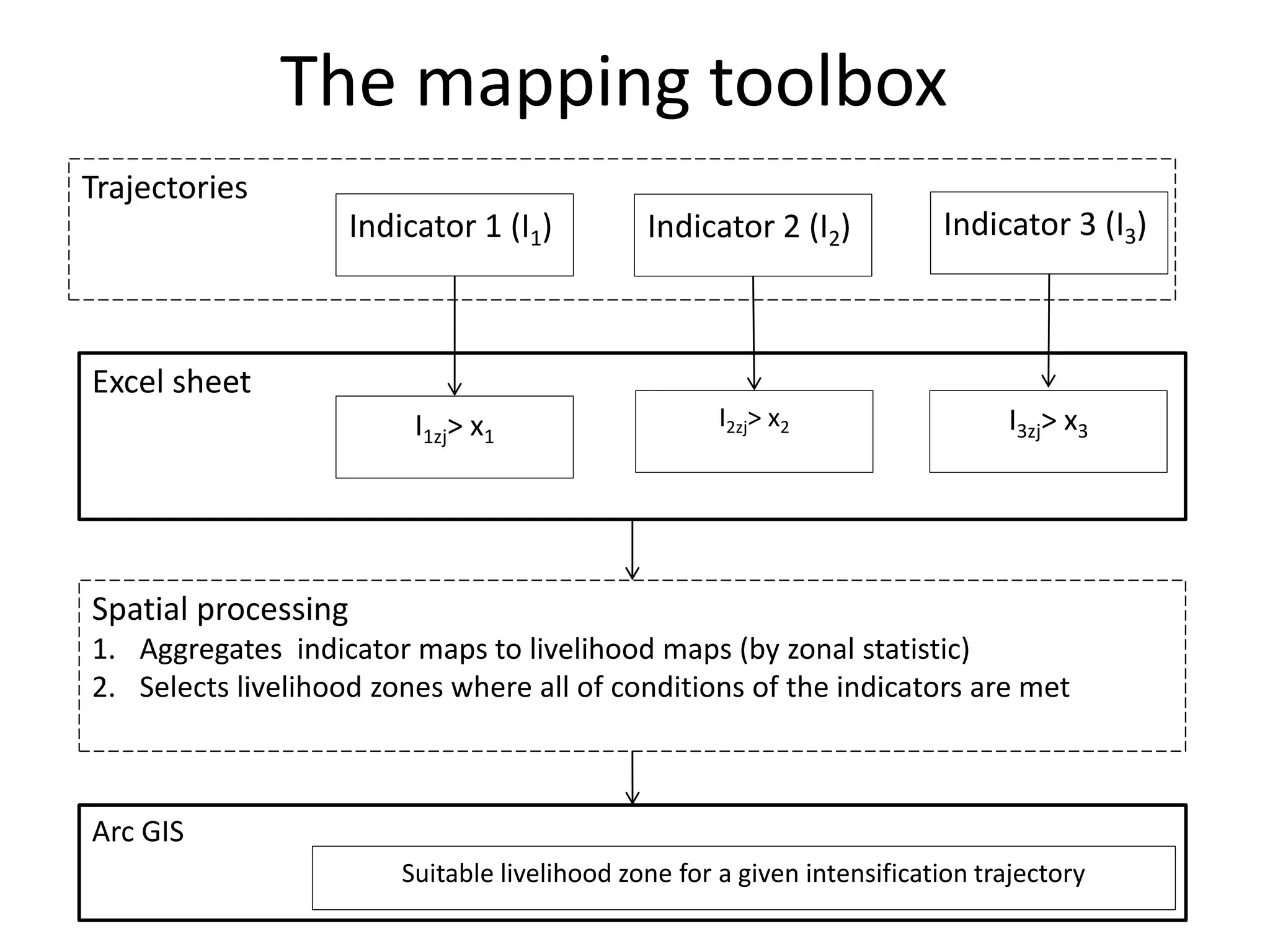
Mapping toolbox
Combines indicator maps into trajectories
Livelihood scale
  – Units of observation are livelihood zones
  – Links trajectories to livelihoods
  – FEWSNET livelihood zone map (180 zones):
  Areas within which households (on average) share
  similar livelihood patterns
  i.e. they have access to the same set of food and
  cash income sources and to the same markets
The mapping toolbox
Trajectories
                     Indicator 1 (I1)          Indicator 2 (I2)           Indicator 3 (I3)


Excel sheet
                          I1zj> x1                    I2zj> x2                  I3zj> x3


Spatial processing
1. Aggregates indicator maps to livelihood maps (by zonal statistic)
2. Selects livelihood zones where all of conditions of the indicators are met


Arc GIS
                         Suitable livelihood zone for a given intensification trajectory
Live demonstration of tool
Thank-you very much for
         your attention!

 Let’s work together to make this a
useful product with a whole range of
        potential applications
http://africa-rising.wikispaces.com/

Quick Water: Update on the water related indicators for sustainable crop-livestock intensification planning in Ethiopia ‘early win’ project

  • 1.
    Quick Water: Updateon the water related indicators for sustainable crop-livestock intensification planning in Ethiopia ‘early win’ project Charlotte MacAlister (IWMI) Africa Rising Quick Water Early Win Project Final Workshop, Addis Ababa, 14 September 2012
  • 2.
    Introduction to Africa Rising • Introduction to Quick Water approach: scope and objectives • Methodology for development of intensification trajectories in Ethiopia • Ethiopian context: development and intensification planning and policy background from food for work/MERIT to FEWsnet • Selection of trajectories and indicators for Ethiopia • Roundtable discussion and feedback • Mapping trajectories-indicators and development of toolbox • Demonstration of tool • Roundtable testing of toolbox • Feedback and future development
  • 4.
    Management Structure Program Research Framework Program Coordination Team Task Force (IITA, ILRI, IFPRI, USAID) Information/data Systems Team Communications Team (IFPRI) (ILRI, USAID) West Africa Project Ethiopian Highlands Project E&SA Project Steering Committee Steering Committee (ILRI) Steering Committee (IITA) (IITA) FY2012 Activities 1. Program design 2. Quick Win projects
  • 5.
    Africa RISING Program Purposeand Objectives Provide pathways out of hunger and poverty for small holder families, particularly for women and children, through sustainably intensified farming systems that sufficiently improve food, nutrition, and income security and conserve or enhance the natural resource base. • Identify demand-driven sustainable intensification options that are socially acceptable, economically feasible, and environmentally sound • Combine and adapt these options to address constraints and exploit opportunities. • Evaluate their effectiveness at multiple scales. • Catalyze ongoing sustainable farm intensification.
  • 6.
    Africa RISING Program Outcomes • Whole farm productivity • Natural resource management • Connect to markets & input suppliers • Nutrition and poverty, especially women and children • Economic & environmental resilience
  • 8.
    Africa RISING Beyond tradeoffs? •Increase above- and below-ground biomass to improve soil health & system productivity (e.g., fertilizer trees, legumes, N/P fertilization) • Diversification (crop & enterprise) for greater resilience, productivity, and nutrition • Integrating livestock and mechanization into conservation agriculture • Improve water productivity to reduce risk & enhance investment
  • 9.
    Africa RISING Quick Wins in the Ethiopian Highlands: • Improving the evidence for targeting agricultural management interventions in Ethiopia • Targeting research design for technology integration at farm scale • Sustainable tree-crop-livestock intensification as a pillar for the Ethiopian climate resilient green economy • Regionalizing fertilizer rate recommendation for wheat-teff production systems • Fodder and feed as a key opportunity for driving sustainable intensification of crop-livestock systems • Improving productivity and rural livelihoods of smallholder farmers in the Bale highlands by integrating pulses in crop-livestock production systems
  • 10.
    Why Agricultural Intensificationin Ethiopia? 6 5 4 3 T/ha 2 1 0 Malawi Ethiopia Nigeria Uganda Mali Mozambique Average national yield Average yield from on-farm demonstration
  • 11.
    Objective: to providea tool which can be used to support the spatial targeting of agricultural intensification practices to areas where the biophysical and livelihood conditions are likely to sustain long term development. Water is the entry point. Project scope and limitations: proof of concept/demonstration of what is possible; short term project with limited time/resources Team: Economist/policy – Gebre; Crop specialist – Teklu; Livestock – Amare; Water – Charlotte; Spatial – Catherine/Yenenesh/An/Abisalom Process: identification of trajectories and indicators; consultation with line agencies at regional level– feedback on both Development of simple tool which produces national maps of selected trajectories and targets
  • 12.
    Some key challengesto making intensification sustainable: • Do agricultural intensification initiatives account for water centered issues? • Is there consistency across different initiatives / policies locally and nationally? • Are the indicators for agricultural intensification planning strategies based on local and global experience? • Are ongoing intensification efforts embedded in the livelihood of local communities?
  • 13.
    Identifying Development Trajectoriesfor Ethiopia: Principles
  • 14.
  • 15.
  • 16.
    Global Development ofLand Use Planning Approaches Key indicators Comments Land capability Soil, landscape, land use/land cover, hydrology, Lacks social & environmental assessment climate dimensions Agro-ecological Mainly climatic parameters & associated zones agricultural practices Land suitability Land cover, climate, soil, topography, land uses, Target certain use types analysis distance to village, streams & springs, cost-benefit analysis Land suitability Based on geography, production & markets, i.e. Includes some social dimensions & livelihood includes livelihood assets & land suitability zoning Vulnerability & Indicators related to exposure, sensitivity & Similar to land suitability & resilience to adaptive capacity livelihood but incorporates global climate change CC phenomena Development Agricultural potential, access to markets, Includes socio-economic domains population density indicators; Targeting broad, generic development strategies
  • 17.
  • 18.
    Introduction: • The historyof planned agricultural development in Ethiopia goes back to the late 19th century with the introduction of agricultural innovation systems of better farming practices and new tree species. • Since then, agricultural modernization undergone several stages with some disruptions (such as the Italian occupation). • During the 1960s, the modernization process was mainly based on elites’ (landlord) commercial farms followed by the command economy that discouraged private investment during the 1970s and 1980s. • Following the change of government in 1991, most strategies focused on the balance between poverty reduction, economic development and equity. • As stipulated in the PASDEP, the agricultural development strategy revolves around the intensification of marketable farm products. • In line with the development strategies, different programs and projects have been initiated which some of them are reviewed as follows.
  • 19.
    MERET: Land RegenerationIn Ethiopia • Response to the drought and famine of 1973/74 in the northern part of the country. • Gradually shifted to development program with the objective of linking short-term food assistance with long-term development opportunities and sustainable livelihoods. • Supports more than 50 activities and technical packages implemented in chronically food-insecure areas • Participants are from food-insecure households. • The project provides opportunities through long-term food security measures, but is limited to a specified range of livelihood systems.
  • 20.
    Plan for Acceleratedand Sustainable Development to End Poverty - PASDEP (1) Main objectives of PASDEP: • Accelerate the transformation of the subsistence smallholder agriculture. • Increased productivity and share of marketed production. • Support to pro-poor basic agriculture within the framework of the national food security program. • Smallholder capacity building through training, development and adoption of a high yielding technology.
  • 21.
    PASDEP (2) • Strengthenedagricultural research and extension service delivery mechanisms • Promotion of increased diversification of agriculture through high value added commodities • Promotion of commercialization of agriculture and establishment of a marketing system • Development of small-scale irrigation and water harvesting technologies and sustainable use/management of natural resources.
  • 22.
    PASDEP (3) Recognized threemain agro-ecological zones based on rainfall, land type and altitude to respond to the particular conditions: Zone 1: High rainfall areas • Efficient utilization of available rainwater for improved agricultural production with a special emphasis on high value crops for export. • Natural resources conservation, agro-forestry and livestock development. Zone 2: Moisture stress areas • Food security measures and increased off-farm income opportunities. • Soil and water conservation livestock resources development (small ruminants) and small-scale irrigation. Zone 3: Pastoral areas • Livestock production and marketing was given importance.
  • 23.
    Agricultural Growth Program(AGP) • Food security and poverty reduction remains at the heart of agriculture and water resources development. • Gradual shift to high-value crops, promoting niche high-value export crops. • Facilitates the commercialization of agriculture where it is feasible . • Integrates farmers with both local and global markets. • Although AGP uses relatively comprehensive indicators (both bio-physical and socio-economic), focus is given to selected high-potential areas.
  • 24.
    Sustainable Land Management(SLM) • Parallel to the AGP, the Sustainable Land Management (SLM) program was crafted to ensure sustainability of the natural resource base focusing on the high potential less degraded areas. • Unlike the MERET project that operates in degraded and food insecure areas, SLM targets the food secured and less degraded areas, but food security is still the major objective
  • 25.
    Growth Corridors Regional focus,based largely on resource endowment. For example: • Tigray Region has delineated the Raya Valley-Humera lowland growth corridors based on their ground and surface water potentials. • Oromia regional state acknowledge that the lowland parts of the region are vulnerable to recurrent droughts but supposed to have sufficient surface/ground water and good development potential . • Amhara followed different approach to classify the region into six growth corridors/poles (namely Central, Eastern, North-West, South-West, Tana- Beles and Tekeze catchments) . • In general the growth corridor approach was based on water and water based investment potentials.
  • 26.
    AgWater Solutions Project •Water as the entry point. • Addresses pro-poor needs rather than on the development of potentially suitable areas/resources. • Different people in different places have different needs. • Demand for investment in water likened to availability of water and needs. • Livelihood mapping was essentially based on three criteria, hence it is likely to reach at different livelihood settings if other criteria are considered.
  • 27.
    Gap Analysis (1) Thegap analysis is based on the following principles: • Whether agricultural intensification initiatives in Ethiopia are planned with the perception of water centered problems and sustainable intensification trajectories • Whether there is consistencies across different initiatives in terms of indicators used to plan and monitor the intensification process and paths to make the exchange of information between projects simpler • Whether these indicators for agricultural intensification planning and post implementation monitoring are drawn based on global experiences • Whether the ongoing efforts of intensification embedded the livelihood of local community into agricultural intensification process.
  • 28.
    Gap Analysis (2) •Almost all programs and projects have targeted agricultural production and poverty reduction. • Water as entry point has been given due emphasis in all projects/programs • They lack consistency in terms of livelihood systems. • PASDEP: indicators used to characterize livelihood zones were mainly bio- physical characteristics with little consideration to socio-economic characteristics. • PASDEP and Agwater solution project were more comprehensive to address all production/livelihood systems • Livestock as livelihood system did not come bold except in PASDEP
  • 29.
    Gap Analysis (3) Interms of trajectories: • MERET project targets degraded and chronically food insecure areas where soil and water conservation is the main intervention. • AGP aims to transform the agricultural sector from subsistance to surplus production. • AGP overlooks the individual potential of different areas given a limited investment capacity implying that priority must be given to high return investments. • Unlike MERET, SLM targets less fragile areas. • AgWater Solutions project identified different trajectories based on which of the 17 livelihood systems were suggested.
  • 30.
  • 31.
    Description of theselected trajectories and key indicators: 1-4 Trajectories Description Some key indicators Integrated Natural Resources Soil erosion and nutrient depletion Soil erosion rate and extent of Conservation based crop- is the major focus area affected livestock systems Crop, livestock and trees are Human and livestock population intensification system components with a number of sub trajectories Small-Scale Irrigation Based Highly populated area with access Potential suitable areas Crop-Livestock Intensification to surface or ground water for Market access irrigation with access to market Large-Scale Irrigation Based Areas with large irrigable land Potential suitable areas Crop-Livestock Intensification (>3000 hectares), with high value Market access and roads commercial or industrial crops, where crops and livestock are major components Agro-Pastoral Rainfed Based Receives sufficient rainfall, soil is Amount of rainfall, human and Crop-Livestock Intensification relatively deep and fertile, crop, livestock population, land use livestock and trees are major land cover components
  • 32.
    Description of theselected trajectories and key indicators: 5-8 Trajectories Description Some key indicators Pastoral Livestock Based Livestock are the major components Aridity index, LGP, availability of Intensification where feed, water, veterinary surface water services and market are major issues Human and livestock population Peri-Urban Dairy Based Crop- Dairy, fattening and vegetable Access to market Livestock Intensification farming on small plots are the major components; poultry may also be integrated Vertisol Management Based Water logged vertisol areas receiving Area covered by vertisols and Intensification high rainfall, especially where annual precipitation temperature is mild to induce high evaporation. Crop and livestock are both major components. Rainfed commercial farming Extensive arable land sparsely Rainfall, human population intensification in crop- populated and receiving sufficient density, and land use land cover livestock systems rainfall, where commercial/high value (protected areas) and industrial crops are suitable
  • 33.
    Description and reasonfor selection of indicators / proxies Trajectory Indicator / proxy Simplified reason for selection Soil & water conservation erosion rate Major process of land degradation in crop livestock systems population density Driver of land use pressure / competition; resource demand livestock density Driver of land use pressure / competition; resource demand Small-medium scale irrigable area OR Area suitable for irrigation (potential for small/ medium) irrigation in crop livestock presence of shallow ground water (15-20m) Based on geological data systems protected forest area Avoid protected forest areas access to market Necessary for sale of cash crop and access to inputs Rainfed smallholder minimum annual rainfall Sufficient rainfall present intensification in crop- maximum annual rainfall Sufficient rainfall present livestock systems or agro- protected forest area Avoid protected forest areas pastoralist systems population density Driver of land use pressure / competition; resource demand Large scale irrigation potential large scale irrigation Area suitable for large scale irrigation (>3000ha) all-weather roads Necessary for sale of cash crop and access to inputs Livestock based minimum aridity index Not suitable for crop intensification maximum aridity index Not suitable for crop population density Driver of land use pressure / competition; resource demand livestock density Driver of land use pressure / competition; resource demand Difference: current & potential capacity Difference between current stocking rate and potential capacity Peri-urban dairy access to market OR Necessary for sale of milk Addis neighbourhood Largest milk market potential Vertisol management Vertisol / soil map Vertisol area present minimum annual rainfall Amount of rainfall above which waterlogging occurs Rainfed commercial minimum annual rainfall Sufficient rainfall present farming intensification in maximum annual rainfall Sufficient rainfall present crop-livestock /agro- protected forest area Avoid protected forest areas pastoralist systems population density Driver of land use pressure / competition; resource demand
  • 34.
    Background to thetool – how trajectories and indicators can be turned into maps
  • 35.
    Transforming indicators intomaps For each indicator spatial data (geographical layer) is identified 1 indicator = 1 map => Mapping tool box
  • 36.
    Mapping toolbox Combines indicatormaps into trajectories Livelihood scale – Units of observation are livelihood zones – Links trajectories to livelihoods – FEWSNET livelihood zone map (180 zones): Areas within which households (on average) share similar livelihood patterns i.e. they have access to the same set of food and cash income sources and to the same markets
  • 37.
    The mapping toolbox Trajectories Indicator 1 (I1) Indicator 2 (I2) Indicator 3 (I3) Excel sheet I1zj> x1 I2zj> x2 I3zj> x3 Spatial processing 1. Aggregates indicator maps to livelihood maps (by zonal statistic) 2. Selects livelihood zones where all of conditions of the indicators are met Arc GIS Suitable livelihood zone for a given intensification trajectory
  • 38.
  • 39.
    Thank-you very muchfor your attention! Let’s work together to make this a useful product with a whole range of potential applications
  • 40.