ACUTE RHEUMATIC 
FEVER
INTRODUCTION 
 Acute rheumatic fever is an immunological disorder 
initiated by group A beta hemolytic streptococcus 
 Antibodies produced against some streptococcus cell 
wall proteins and sugars react with the connective 
tissue and heart and result in rheumatic fever
EPIDEMIOLOGY 
 It constitutes 17 – 50 % of all cardiac patients in 
hospital 
 Prevalence rate : 0.55 – 0.67 /1000 
 Incidence rate : 5.3 / 1000 ( ICMR survey 2010) 
 Age : 5 to 15 years 
 Both sex are equally affected but mitral valve disease 
and chorea are common in female , and aortic valve 
involvement is more in male
PREDISPOSING FACTORS 
 Poor socioeconomic status 
 Overcrowding 
 Under and poor nutrition 
 Family history of rheumatic disease 
 Age group 5 – 15 yrs ( peak incidence at 8 yrs)
ETIOPATHOGENESIS 
 Etiology is unknown 
 Strong association with beta hemolytic streptococcus 
is indicated by : 
 History of preceding sore throat in 50% of cases 
 Epidemics of streptococcus infection are followed 
by higher incedence 
 Seasonal variation of both are identical 
 Penicillin prophylaxis prevents recurrence 
 > 85% patients show eleveted anti streptococcal 
antibody titer
 Following streptococcal sore throat there is latent 
period of 10 days to several weeks 
 Streptococci have never isolated from rheumatic 
lesions in joints, heart or blood stream 
 Streptococcal products against which antibodies 
produced are streptolysin , hyluronidase , erythrogenic 
toxins , deoxyribonuclease 
 Association with HLA – DR3 and B cell antigen serum 
883
 Patient of rheumatic fever produce antibody against 
streptococcal cell wall and membrane protiens 
 Streptococcal antigen and human myocarium 
appears to be identical antigenically 
 These antibodies react with human connective tissue 
mainly cardiac , striated and vascular smooth muscle 
 Immunoflurescent techniques – antibodies atteched 
to sarcolemma of cardiac muscle
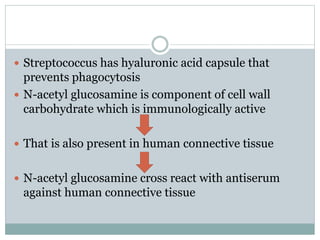
 Streptococcus has hyaluronic acid capsule that 
prevents phagocytosis 
 N-acetyl glucosamine is component of cell wall 
carbohydrate which is immunologically active 
 That is also present in human connective tissue 
 N-acetyl glucosamine cross react with antiserum 
against human connective tissue
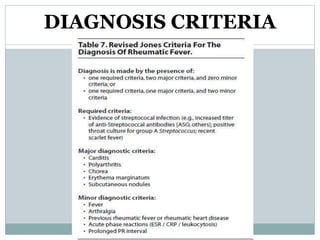
DIAGNOSIS CRITERIA
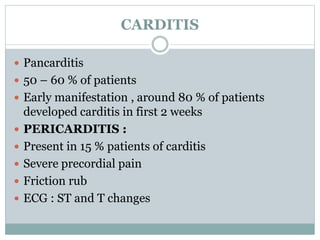
CARDITIS 
 Pancarditis 
 50 – 60 % of patients 
 Early manifestation , around 80 % of patients 
developed carditis in first 2 weeks 
 PERICARDITIS : 
 Present in 15 % patients of carditis 
 Severe precordial pain 
 Friction rub 
 ECG : ST and T changes
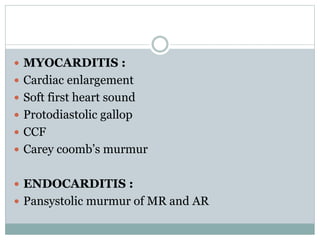
 MYOCARDITIS : 
 Cardiac enlargement 
 Soft first heart sound 
 Protodiastolic gallop 
 CCF 
 Carey coomb’s murmur 
 ENDOCARDITIS : 
 Pansystolic murmur of MR and AR
POLYARTHRITIS 
 Flitting & fleeting migratory polyarthritis, involving 
major joints 
 Commonly involved large joints-knee, ankle, elbow & 
wrist 
 Occur in 80% 
 In children below 5 yrs arthritis usually mild 
 Arthritis do not progress to chronic disease 
 Rheumatic joints are generally hot, red, swollen, 
and exquisitely tender.
 A dramatic response to even small doses of 
salicylates . 
 The absence of such a response should 
suggest an alternative diagnosis. 
 Rheumatic arthritis is typically not deforming. 
 Arthritis is the earliest manifestation of acute 
rheumatic fever.
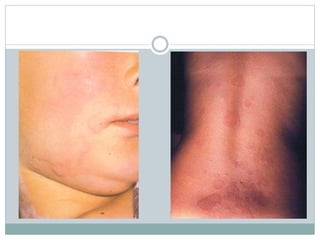
ERYTHEMA MARGINATUM 
 Nonpruritic serpiginous or annular erythematous 
rash more prominent on the trunk & inner 
proximal portions of the extremities. 
 Rash is faintly reddish, not raised above the skin 
and non itching 
 Rash disappears on exposure to cold & reappears 
after hot shower.
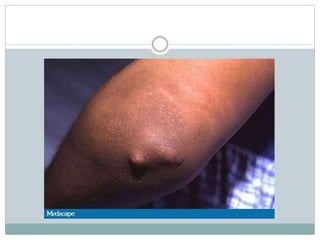
SUBCUTANEOUS NODULES 
 Hard, painless, nonpruritic, freely mobile, 0.2 to 2cm 
in diameter. 
 Found symmetrically, single or in clusters, on 
extensor surfaces of both large & small joints, over 
the scalp or along the spine. 
 Lasts for weeks. 
 Always associated with severe carditis
SYDENHAM’S CHOREA 
 Neuropsychiatric disorder 
 10 – 15 % of patients 
 More often in pre-pubertal girls than in boys. 
 Characterized by involuntary movements specially of 
the face and limbs, muscle weakness, disturbances of 
speech and gait, poor scholastic performance 
 Neurologic Signs : Choric Movement & Hypotonia 
 Psychiatric Signs : Emotional Liability, 
Hyperactivity, Separation Anxiety, Obsessions & 
Compulsions
 Exceptions to the Jone’s criteria : 
 Chorea may occur as the only manifestation 
 Indolent carditis may be the only manifestation if 
patient come to medical attentio after months of 
onset 
 Patients with rheumatic fever recurrence may not 
fulfill the jone’s criteria
OTHER CLINICAL FEATURES 
 Abdominal pain 
 Rapid sleeping HR 
 Tachycardia out of proportion of fever 
 Malaise 
 Anemia 
 Epistaxis 
 Precordial pain
DIFFERENTIAL DIAGNOSIS 
 Juvenile rheumatoid arthritis 
 Collagen vascular diseases 
 Virus associated acute arthritis 
 Hematologic disorder
CLINICAL COURSE 
 Carditis can cause permanent cardiac damage, signs 
of mild carditis disappear in weeks but in severe 
carditis it may last for 6 months 
 Arthritis subsides within a few days to weeks without 
treatment 
 Chorea gradually subsides in 6 to 7 months and 
usually does not cause permanent neurologic 
sequelae
MANAGEMENT 
 Investigation : 
 CBC 
 Acute phase reactant 
 Throat culture 
 ASO titer 
 Chest x ray 
 ECG 
 2D echo
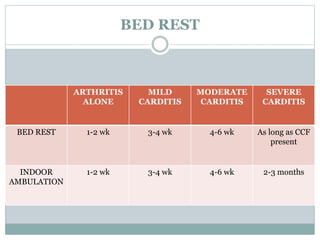
BED REST 
ARTHRITIS 
ALONE 
MILD 
CARDITIS 
MODERATE 
CARDITIS 
SEVERE 
CARDITIS 
BED REST 1-2 wk 3-4 wk 4-6 wk As long as CCF 
present 
INDOOR 
AMBULATION 
1-2 wk 3-4 wk 4-6 wk 2-3 months
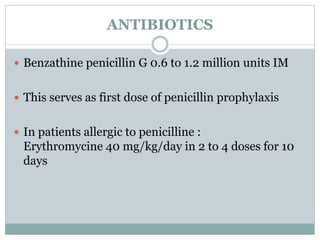
ANTIBIOTICS 
 Benzathine penicillin G 0.6 to 1.2 million units IM 
 This serves as first dose of penicillin prophylaxis 
 In patients allergic to penicilline : 
Erythromycine 40 mg/kg/day in 2 to 4 doses for 10 
days
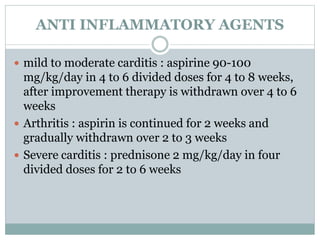
ANTI INFLAMMATORY AGENTS 
 mild to moderate carditis : aspirine 90-100 
mg/kg/day in 4 to 6 divided doses for 4 to 8 weeks, 
after improvement therapy is withdrawn over 4 to 6 
weeks 
 Arthritis : aspirin is continued for 2 weeks and 
gradually withdrawn over 2 to 3 weeks 
 Severe carditis : prednisone 2 mg/kg/day in four 
divided doses for 2 to 6 weeks
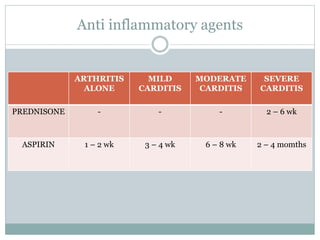
Anti inflammatory agents 
ARTHRITIS 
ALONE 
MILD 
CARDITIS 
MODERATE 
CARDITIS 
SEVERE 
CARDITIS 
PREDNISONE - - - 2 – 6 wk 
ASPIRIN 1 – 2 wk 3 – 4 wk 6 – 8 wk 2 – 4 momths
TREATMENT OF CHF 
 Complete bed rest with orthopneic position 
 Moist and cool oxygen 
 Prednisone 
 Digoxine 
 Furosemide if indicated
MANAGEMENT OF SYDENHM’S CHOREA 
 Reduce physical and emotional stress 
 Phenobarbital ( 15 – 30 mg every 6 to 8 hrs) 
 Haloperidol ( 2 mg every 8 hrs ) 
 Valproic acid 
 Chlorpromazine 
 Diazepam 
 Steroids 
 Plasma exchange and IVIG
PROGNOSIS 
 The more sever the cardiac involvement at the time 
the patient first seen, greater the incidence of 
residual heart disease. 
 The severity of valvular involvement increases with 
each recurrence. 
 Valvular disease resolve more frequently when 
prophylaxis is followed.
PREVENTION 
 PRIMARY PREVENTION : 
 10 days course of penicillin therapy for streptococcus 
pharyngitis 
 Not possible in all patients : 
 30% patients have subclinical phryngitis 
 30% patients developed rheumatic fever without 
symptoms of streptococcal pharyngitis
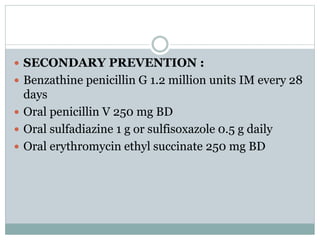
 SECONDARY PREVENTION : 
 Benzathine penicillin G 1.2 million units IM every 28 
days 
 Oral penicillin V 250 mg BD 
 Oral sulfadiazine 1 g or sulfisoxazole 0.5 g daily 
 Oral erythromycin ethyl succinate 250 mg BD
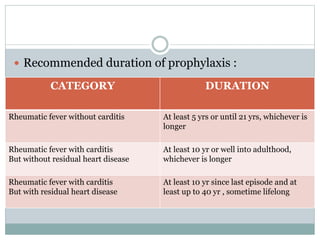
 Recommended duration of prophylaxis : 
CATEGORY DURATION 
Rheumatic fever without carditis At least 5 yrs or until 21 yrs, whichever is 
longer 
Rheumatic fever with carditis 
But without residual heart disease 
At least 10 yr or well into adulthood, 
whichever is longer 
Rheumatic fever with carditis 
But with residual heart disease 
At least 10 yr since last episode and at 
least up to 40 yr , sometime lifelong
THANK YOU

Acute rheumatic fever

  • 1.
  • 2.
    INTRODUCTION  Acuterheumatic fever is an immunological disorder initiated by group A beta hemolytic streptococcus  Antibodies produced against some streptococcus cell wall proteins and sugars react with the connective tissue and heart and result in rheumatic fever
  • 3.
    EPIDEMIOLOGY  Itconstitutes 17 – 50 % of all cardiac patients in hospital  Prevalence rate : 0.55 – 0.67 /1000  Incidence rate : 5.3 / 1000 ( ICMR survey 2010)  Age : 5 to 15 years  Both sex are equally affected but mitral valve disease and chorea are common in female , and aortic valve involvement is more in male
  • 4.
    PREDISPOSING FACTORS Poor socioeconomic status  Overcrowding  Under and poor nutrition  Family history of rheumatic disease  Age group 5 – 15 yrs ( peak incidence at 8 yrs)
  • 5.
    ETIOPATHOGENESIS  Etiologyis unknown  Strong association with beta hemolytic streptococcus is indicated by :  History of preceding sore throat in 50% of cases  Epidemics of streptococcus infection are followed by higher incedence  Seasonal variation of both are identical  Penicillin prophylaxis prevents recurrence  > 85% patients show eleveted anti streptococcal antibody titer
  • 6.
     Following streptococcalsore throat there is latent period of 10 days to several weeks  Streptococci have never isolated from rheumatic lesions in joints, heart or blood stream  Streptococcal products against which antibodies produced are streptolysin , hyluronidase , erythrogenic toxins , deoxyribonuclease  Association with HLA – DR3 and B cell antigen serum 883
  • 7.
     Patient ofrheumatic fever produce antibody against streptococcal cell wall and membrane protiens  Streptococcal antigen and human myocarium appears to be identical antigenically  These antibodies react with human connective tissue mainly cardiac , striated and vascular smooth muscle  Immunoflurescent techniques – antibodies atteched to sarcolemma of cardiac muscle
  • 8.
     Streptococcus hashyaluronic acid capsule that prevents phagocytosis  N-acetyl glucosamine is component of cell wall carbohydrate which is immunologically active  That is also present in human connective tissue  N-acetyl glucosamine cross react with antiserum against human connective tissue
  • 9.
  • 10.
    CARDITIS  Pancarditis  50 – 60 % of patients  Early manifestation , around 80 % of patients developed carditis in first 2 weeks  PERICARDITIS :  Present in 15 % patients of carditis  Severe precordial pain  Friction rub  ECG : ST and T changes
  • 11.
     MYOCARDITIS :  Cardiac enlargement  Soft first heart sound  Protodiastolic gallop  CCF  Carey coomb’s murmur  ENDOCARDITIS :  Pansystolic murmur of MR and AR
  • 12.
    POLYARTHRITIS  Flitting& fleeting migratory polyarthritis, involving major joints  Commonly involved large joints-knee, ankle, elbow & wrist  Occur in 80%  In children below 5 yrs arthritis usually mild  Arthritis do not progress to chronic disease  Rheumatic joints are generally hot, red, swollen, and exquisitely tender.
  • 13.
     A dramaticresponse to even small doses of salicylates .  The absence of such a response should suggest an alternative diagnosis.  Rheumatic arthritis is typically not deforming.  Arthritis is the earliest manifestation of acute rheumatic fever.
  • 14.
    ERYTHEMA MARGINATUM Nonpruritic serpiginous or annular erythematous rash more prominent on the trunk & inner proximal portions of the extremities.  Rash is faintly reddish, not raised above the skin and non itching  Rash disappears on exposure to cold & reappears after hot shower.
  • 16.
    SUBCUTANEOUS NODULES Hard, painless, nonpruritic, freely mobile, 0.2 to 2cm in diameter.  Found symmetrically, single or in clusters, on extensor surfaces of both large & small joints, over the scalp or along the spine.  Lasts for weeks.  Always associated with severe carditis
  • 18.
    SYDENHAM’S CHOREA Neuropsychiatric disorder  10 – 15 % of patients  More often in pre-pubertal girls than in boys.  Characterized by involuntary movements specially of the face and limbs, muscle weakness, disturbances of speech and gait, poor scholastic performance  Neurologic Signs : Choric Movement & Hypotonia  Psychiatric Signs : Emotional Liability, Hyperactivity, Separation Anxiety, Obsessions & Compulsions
  • 19.
     Exceptions tothe Jone’s criteria :  Chorea may occur as the only manifestation  Indolent carditis may be the only manifestation if patient come to medical attentio after months of onset  Patients with rheumatic fever recurrence may not fulfill the jone’s criteria
  • 20.
    OTHER CLINICAL FEATURES  Abdominal pain  Rapid sleeping HR  Tachycardia out of proportion of fever  Malaise  Anemia  Epistaxis  Precordial pain
  • 21.
    DIFFERENTIAL DIAGNOSIS Juvenile rheumatoid arthritis  Collagen vascular diseases  Virus associated acute arthritis  Hematologic disorder
  • 22.
    CLINICAL COURSE Carditis can cause permanent cardiac damage, signs of mild carditis disappear in weeks but in severe carditis it may last for 6 months  Arthritis subsides within a few days to weeks without treatment  Chorea gradually subsides in 6 to 7 months and usually does not cause permanent neurologic sequelae
  • 23.
    MANAGEMENT  Investigation:  CBC  Acute phase reactant  Throat culture  ASO titer  Chest x ray  ECG  2D echo
  • 24.
    BED REST ARTHRITIS ALONE MILD CARDITIS MODERATE CARDITIS SEVERE CARDITIS BED REST 1-2 wk 3-4 wk 4-6 wk As long as CCF present INDOOR AMBULATION 1-2 wk 3-4 wk 4-6 wk 2-3 months
  • 25.
    ANTIBIOTICS  Benzathinepenicillin G 0.6 to 1.2 million units IM  This serves as first dose of penicillin prophylaxis  In patients allergic to penicilline : Erythromycine 40 mg/kg/day in 2 to 4 doses for 10 days
  • 26.
    ANTI INFLAMMATORY AGENTS  mild to moderate carditis : aspirine 90-100 mg/kg/day in 4 to 6 divided doses for 4 to 8 weeks, after improvement therapy is withdrawn over 4 to 6 weeks  Arthritis : aspirin is continued for 2 weeks and gradually withdrawn over 2 to 3 weeks  Severe carditis : prednisone 2 mg/kg/day in four divided doses for 2 to 6 weeks
  • 27.
    Anti inflammatory agents ARTHRITIS ALONE MILD CARDITIS MODERATE CARDITIS SEVERE CARDITIS PREDNISONE - - - 2 – 6 wk ASPIRIN 1 – 2 wk 3 – 4 wk 6 – 8 wk 2 – 4 momths
  • 28.
    TREATMENT OF CHF  Complete bed rest with orthopneic position  Moist and cool oxygen  Prednisone  Digoxine  Furosemide if indicated
  • 29.
    MANAGEMENT OF SYDENHM’SCHOREA  Reduce physical and emotional stress  Phenobarbital ( 15 – 30 mg every 6 to 8 hrs)  Haloperidol ( 2 mg every 8 hrs )  Valproic acid  Chlorpromazine  Diazepam  Steroids  Plasma exchange and IVIG
  • 30.
    PROGNOSIS  Themore sever the cardiac involvement at the time the patient first seen, greater the incidence of residual heart disease.  The severity of valvular involvement increases with each recurrence.  Valvular disease resolve more frequently when prophylaxis is followed.
  • 31.
    PREVENTION  PRIMARYPREVENTION :  10 days course of penicillin therapy for streptococcus pharyngitis  Not possible in all patients :  30% patients have subclinical phryngitis  30% patients developed rheumatic fever without symptoms of streptococcal pharyngitis
  • 32.
     SECONDARY PREVENTION:  Benzathine penicillin G 1.2 million units IM every 28 days  Oral penicillin V 250 mg BD  Oral sulfadiazine 1 g or sulfisoxazole 0.5 g daily  Oral erythromycin ethyl succinate 250 mg BD
  • 33.
     Recommended durationof prophylaxis : CATEGORY DURATION Rheumatic fever without carditis At least 5 yrs or until 21 yrs, whichever is longer Rheumatic fever with carditis But without residual heart disease At least 10 yr or well into adulthood, whichever is longer Rheumatic fever with carditis But with residual heart disease At least 10 yr since last episode and at least up to 40 yr , sometime lifelong
  • 34.