RT 7
M. Welch, RRT, RCP
Professor
ELAC / SMC RT Program
Spring 2022
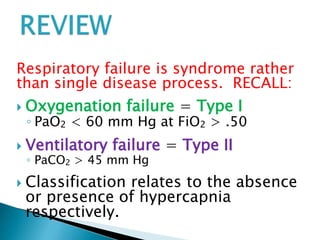
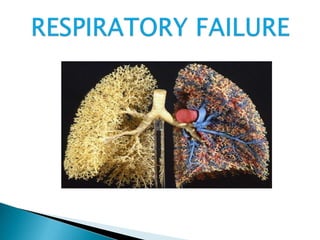
Respiratory failure is syndrome rather
than single disease process. RECALL:
 Oxygenation failure = Type I
◦ PaO2 < 60 mm Hg at FiO2 > .50
 Ventilatory failure = Type II
◦ PaCO2 > 45 mm Hg
 Classification relates to the absence
or presence of hypercapnia
respectively.
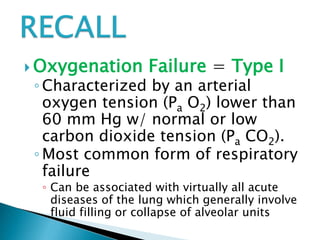
 Oxygenation Failure = Type I
◦ Characterized by an arterial
oxygen tension (Pa O2) lower than
60 mm Hg w/ normal or low
carbon dioxide tension (Pa CO2).
◦ Most common form of respiratory
failure
◦ Can be associated with virtually all acute
diseases of the lung which generally involve
fluid filling or collapse of alveolar units
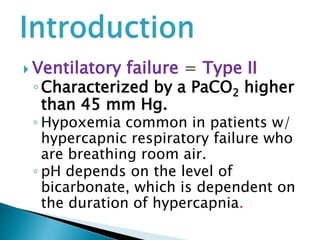
 Ventilatory failure = Type II
◦Characterized by a PaCO2 higher
than 45 mm Hg.
◦ Hypoxemia common in patients w/
hypercapnic respiratory failure who
are breathing room air.
◦ pH depends on the level of
bicarbonate, which is dependent on
the duration of hypercapnia.
 Acute: abnormal elevation of the
PaCO2 without renal compensation
 Chronic: abnormal elevation of the
PaCO2 with renal compensation
(abnormal Base Excess [BE] with the
pH in normal range)
 Mixed: a combination of acute and
chronic (abnormal BE but the pH is not
in the normal range)
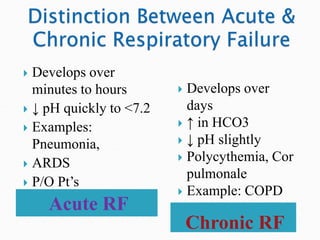
Acute RF
Chronic RF
 Develops over
minutes to hours
 ↓ pH quickly to <7.2
 Examples:
Pneumonia,
 ARDS
 P/O Pt’s
 Develops over
days
 ↑ in HCO3
 ↓ pH slightly
 Polycythemia, Cor
pulmonale
 Example: COPD
 Dysfunction of Central Nervous
System (CNS)
◦(Depression of respiratory centers)
Drug Overdose
Head Trauma
Infection
Hemorrhage
Sleep Apnea
◦Neuromuscular disease
Cerebral disease
Spinal cord trauma / injury
abnormalities
Muscular diseases
 Myasthenia Gravis
 Guillian-Barre syndrome
 Poliomyelitis
 Amyotropic Lateral Sclerosis / ALS
 AKA?

Musculoskeletal Dysfunction
◦Chest Trauma
◦Thoracic cage abnormalities
 Kyphoscoliosis
◦Upper and lower airway
obstruction
◦Malnutrition & electrolyte
disturbances
Pulmonary Dysfunction
◦Emphysema
◦Chronic Bronchitis
◦Asthma
◦Cystic Fibrosis
◦Restrictive lung diseases
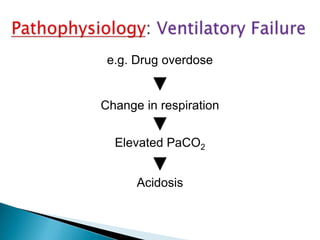
e.g. Drug overdose
Change in respiration
Acidosis
Elevated PaCO2
Pathophysiology:
◦Increased PaCO2
◦decreased pH
◦Acidosis
◦Somnolence
◦Coma
 Respiratory failure may be associated
with a variety of clinical
manifestations.
◦ However, most are nonspecific, & very significant
respiratory failure may be present without
dramatic signs or symptoms.
 This emphasizes the importance of
measuring arterial blood gases in all
patients who are seriously ill or in whom
respiratory failure is suspected.
 Complete blood count (CBC) may
indicate anemia
◦ can also contribute to tissue hypoxia
◦ polycythemia may indicate chronic hypoxemic
respiratory failure.
 A chemistry panel may be helpful in the
evaluation and management of a patient in
respiratory failure.
◦ Abnormalities in electrolytes such as potassium,
magnesium, and phosphate may aggravate
respiratory failure and other organ function.
 Chest radiography is essential in
evaluation of respiratory failure because
it frequently reveals cause.
◦ Distinguishing between cardiogenic & noncardiogenic
pulmonary edema often difficult.
 Increased heart size / vascular redistribution /
peribronchial cuffing
 pleural effusions / septal lines / perihilar bat-wing
distribution of infiltrates suggest hydrostatic edema
◦ the lack of these findings suggests acute respiratory
distress syndrome (ARDS).
 Patients with acute respiratory
failure generally are unable to
perform PFTs;
◦These tests most useful in the
evaluation of chronic respiratory
failure.
Nonspecific:
◦Headache
◦Diminished alertness
◦Warm & flushed skin
◦Bounding peripheral pulses
◦Hypothermia and altered mental
status = drug OD
Nonspecific:
◦Tachycardia & hypertension
◦Respiratory alternans or
abdominal paradox
 = diaphragmatic fatigue
◦Hypoxemia is often seen in
conjunction with ventilatory
failure
Laboratory abnormalities
(ABG)
◦High PaCO2
◦Acidemia if Acute
◦Elevated total CO2 on
electrolyte panel
•Specific treatment of oxygenation &
/or ventilatory failure C/B Drug
Overdose (Narcotic / Barbiturate / alcohol )
 Identify type of drug, amount ingested and time
since ingestion.
 Diagnose and treat trauma.
 Prevent and/or treat aspiration; look for right lower
lobe crackles
 intubate if suspected or confirmed
 CMV to reestablish and maintain normal PaCO2
 100% oxygen initially then reduce FIO2 to maintain
clinical oxygenation
•Specific Treatment of oxygenation
& /or ventilatory failure C/B Drug
Overdose (Narcotic / Barbiturate / alcohol)
 Prevent drug absorption:
 Stomach lavage
◦ watch for aspiration
 Induce vomiting
 Charcoal
 Dialysis
 Administer antidote, i.e.: Narcan, etc.
 Psychiatric consult
◦IF severe/acute most likely
invasive MV
◦HOWEVER:
◦IF patient awake and able to
cooperate with care and is
suspected COPD or CHF
Exacerbation: NIV is now the
preferred approach
◦IF NIV fails, then MV is instituted
 PRIOR to NIV, often the following are considered:
◦ HFNC What are the possible beneficial effects?
 High-flow system to deliver known FIO2
 Provide small amount of “CPAP” 2-5 or 6 cmH2O ?
1 cmH2O per every 10 Lpm?
 “wash out” anatomical deadspace of oralpharynx
 Reduce Insp. WOB by small, but statistically significant
amount
 Potential benefits of heated humidification on mucus? Not
well studied, but appears to have some “clinical effect”?
◦ Very frequent/intensive bronchodilators? (COPD Pt)
◦ MediNeb therapy? (COPD Pt)
◦ CPAP? (Defined as NIV by many)
 What is the PRIMARY difference between CPAP and BiPaP?
Mechanical ventilation
 First: Rapid Sequence Intubation f/b
◦ VT 5–8 ml/kg IBW
◦ Keep Pplateau < 35 cm H2O
◦ Respiratory rate according to age and
metabolic rate
◦ FiO2 adjusted with pulse oximetry
◦ Treat cause of ventilatory failure
◦ Wean from CMV as soon as possible
(ASAP)
Weaning criteria
◦ Etiology of ventilatory failure resolved
◦ Patient’s condition stable and improving
◦ Vital capacity (VC) > 10–15 mL/kg
◦ Resting minute volume < 10 L/min
◦ MIP > -20 cm H2O
◦ Adequate oxygenation on FiO2 < .50
◦ Spontaneous respiratory rate < 35
breaths/min
◦ Spontaneous tidal volume > 325 mL
 Weaning Methods:
◦SIMV
 Decrease number of mechanical breaths until
support is no longer necessary
◦Pressure Support
 Set to acceptable tidal volume and rate without use
of accessory muscles and wean thereafter
◦ T-Piece
 AKA: SBT (Spontaneous Breathing Trial)
 Temporary discontinuation of mechanical ventilation
 “Blow-by” of appropriate FiO2
 Complications of acute respiratory
failure may be:
◦ Pulmonary
◦ Cardiovascular
◦ Gastrointestinal (GI)
 Stress ulceration common
◦ Infectious
◦ Renal
 Acute renal failure & electrolyte abnormalities
◦ Nutritional
 Malnutrition & effect on respiratory performance
 Common pulmonary complications include:
◦ Pulmonary embolism
◦ Oxygen toxicity
◦ CO2 narcosis
◦ Barotrauma
◦ Pulmonary fibrosis
◦ Complications secondary to the use of CMV devices
 Patients also prone to develop nosocomial
pneumonia (VAP)
 Pulmonary fibrosis may follow acute lung
injury associated with ARDS.
 Common cardiovascular complications
include:
◦ Hypotension
◦ Reduced cardiac output
◦ Arrhythmia
◦ Pericarditis
◦ Acute myocardial infarction (AMI)
 These may be related to the underlying
disease process, mechanical ventilation, or
the use of pulmonary artery catheters
 Frequent infectious complications
or nosocomial infections such as:
◦ Pneumonia
◦ Urinary tract infections (UTI’s)
◦ Catheter-related sepsis
 These usually occur with the use of
mechanical devices.
 Incidence of nosocomial pneumonia is
high & associated with significant
mortality.
 Mortality associated with respiratory
failure varies according to the etiology.
◦ For ARDS, mortality is approximately 40-45%;
 This figure has not changed significantly over the
years.
◦ Younger patients (< 60 y) have better survival
rates than older patients.
◦ Approximately two thirds of patients who
survive an episode of ARDS manifest some
impairment of pulmonary function 1 or more
years after recovery.
◦ Significant mortality also occurs in patients
admitted with hypercapnic respiratory failure.
 Often because these patients have a chronic
respiratory disorder & other comorbidities such as
cardiopulmonary, renal, hepatic, or neurologic
disease.
 These patients also may have poor nutritional status.
◦ For patients with COPD and acute respiratory
failure, the overall mortality has declined from
approximately 26% to 10%.
◦ Acute exacerbation of COPD carries a mortality
of approximately 30%.
“A surplus of effort
can overcome a
deficit of
confidence."
Sonia Sotomayor, 2013

Resp. failure type 2 ventilatory failure

  • 1.
    RT 7 M. Welch,RRT, RCP Professor ELAC / SMC RT Program Spring 2022
  • 2.
    Respiratory failure issyndrome rather than single disease process. RECALL:  Oxygenation failure = Type I ◦ PaO2 < 60 mm Hg at FiO2 > .50  Ventilatory failure = Type II ◦ PaCO2 > 45 mm Hg  Classification relates to the absence or presence of hypercapnia respectively.
  • 3.
     Oxygenation Failure= Type I ◦ Characterized by an arterial oxygen tension (Pa O2) lower than 60 mm Hg w/ normal or low carbon dioxide tension (Pa CO2). ◦ Most common form of respiratory failure ◦ Can be associated with virtually all acute diseases of the lung which generally involve fluid filling or collapse of alveolar units
  • 4.
     Ventilatory failure= Type II ◦Characterized by a PaCO2 higher than 45 mm Hg. ◦ Hypoxemia common in patients w/ hypercapnic respiratory failure who are breathing room air. ◦ pH depends on the level of bicarbonate, which is dependent on the duration of hypercapnia.
  • 6.
     Acute: abnormalelevation of the PaCO2 without renal compensation  Chronic: abnormal elevation of the PaCO2 with renal compensation (abnormal Base Excess [BE] with the pH in normal range)  Mixed: a combination of acute and chronic (abnormal BE but the pH is not in the normal range)
  • 7.
    Acute RF Chronic RF Develops over minutes to hours  ↓ pH quickly to <7.2  Examples: Pneumonia,  ARDS  P/O Pt’s  Develops over days  ↑ in HCO3  ↓ pH slightly  Polycythemia, Cor pulmonale  Example: COPD
  • 8.
     Dysfunction ofCentral Nervous System (CNS) ◦(Depression of respiratory centers) Drug Overdose Head Trauma Infection Hemorrhage Sleep Apnea
  • 9.
    ◦Neuromuscular disease Cerebral disease Spinalcord trauma / injury abnormalities Muscular diseases  Myasthenia Gravis  Guillian-Barre syndrome  Poliomyelitis  Amyotropic Lateral Sclerosis / ALS  AKA? 
  • 10.
    Musculoskeletal Dysfunction ◦Chest Trauma ◦Thoraciccage abnormalities  Kyphoscoliosis ◦Upper and lower airway obstruction ◦Malnutrition & electrolyte disturbances
  • 11.
  • 12.
    e.g. Drug overdose Changein respiration Acidosis Elevated PaCO2
  • 13.
  • 15.
     Respiratory failuremay be associated with a variety of clinical manifestations. ◦ However, most are nonspecific, & very significant respiratory failure may be present without dramatic signs or symptoms.  This emphasizes the importance of measuring arterial blood gases in all patients who are seriously ill or in whom respiratory failure is suspected.
  • 16.
     Complete bloodcount (CBC) may indicate anemia ◦ can also contribute to tissue hypoxia ◦ polycythemia may indicate chronic hypoxemic respiratory failure.  A chemistry panel may be helpful in the evaluation and management of a patient in respiratory failure. ◦ Abnormalities in electrolytes such as potassium, magnesium, and phosphate may aggravate respiratory failure and other organ function.
  • 17.
     Chest radiographyis essential in evaluation of respiratory failure because it frequently reveals cause. ◦ Distinguishing between cardiogenic & noncardiogenic pulmonary edema often difficult.  Increased heart size / vascular redistribution / peribronchial cuffing  pleural effusions / septal lines / perihilar bat-wing distribution of infiltrates suggest hydrostatic edema ◦ the lack of these findings suggests acute respiratory distress syndrome (ARDS).
  • 18.
     Patients withacute respiratory failure generally are unable to perform PFTs; ◦These tests most useful in the evaluation of chronic respiratory failure.
  • 19.
    Nonspecific: ◦Headache ◦Diminished alertness ◦Warm &flushed skin ◦Bounding peripheral pulses ◦Hypothermia and altered mental status = drug OD
  • 20.
    Nonspecific: ◦Tachycardia & hypertension ◦Respiratoryalternans or abdominal paradox  = diaphragmatic fatigue ◦Hypoxemia is often seen in conjunction with ventilatory failure
  • 21.
    Laboratory abnormalities (ABG) ◦High PaCO2 ◦Acidemiaif Acute ◦Elevated total CO2 on electrolyte panel
  • 22.
    •Specific treatment ofoxygenation & /or ventilatory failure C/B Drug Overdose (Narcotic / Barbiturate / alcohol )  Identify type of drug, amount ingested and time since ingestion.  Diagnose and treat trauma.  Prevent and/or treat aspiration; look for right lower lobe crackles  intubate if suspected or confirmed  CMV to reestablish and maintain normal PaCO2  100% oxygen initially then reduce FIO2 to maintain clinical oxygenation
  • 23.
    •Specific Treatment ofoxygenation & /or ventilatory failure C/B Drug Overdose (Narcotic / Barbiturate / alcohol)  Prevent drug absorption:  Stomach lavage ◦ watch for aspiration  Induce vomiting  Charcoal  Dialysis  Administer antidote, i.e.: Narcan, etc.  Psychiatric consult
  • 24.
    ◦IF severe/acute mostlikely invasive MV ◦HOWEVER: ◦IF patient awake and able to cooperate with care and is suspected COPD or CHF Exacerbation: NIV is now the preferred approach ◦IF NIV fails, then MV is instituted
  • 25.
     PRIOR toNIV, often the following are considered: ◦ HFNC What are the possible beneficial effects?  High-flow system to deliver known FIO2  Provide small amount of “CPAP” 2-5 or 6 cmH2O ? 1 cmH2O per every 10 Lpm?  “wash out” anatomical deadspace of oralpharynx  Reduce Insp. WOB by small, but statistically significant amount  Potential benefits of heated humidification on mucus? Not well studied, but appears to have some “clinical effect”? ◦ Very frequent/intensive bronchodilators? (COPD Pt) ◦ MediNeb therapy? (COPD Pt) ◦ CPAP? (Defined as NIV by many)  What is the PRIMARY difference between CPAP and BiPaP?
  • 26.
    Mechanical ventilation  First:Rapid Sequence Intubation f/b ◦ VT 5–8 ml/kg IBW ◦ Keep Pplateau < 35 cm H2O ◦ Respiratory rate according to age and metabolic rate ◦ FiO2 adjusted with pulse oximetry ◦ Treat cause of ventilatory failure ◦ Wean from CMV as soon as possible (ASAP)
  • 27.
    Weaning criteria ◦ Etiologyof ventilatory failure resolved ◦ Patient’s condition stable and improving ◦ Vital capacity (VC) > 10–15 mL/kg ◦ Resting minute volume < 10 L/min ◦ MIP > -20 cm H2O ◦ Adequate oxygenation on FiO2 < .50 ◦ Spontaneous respiratory rate < 35 breaths/min ◦ Spontaneous tidal volume > 325 mL
  • 28.
     Weaning Methods: ◦SIMV Decrease number of mechanical breaths until support is no longer necessary ◦Pressure Support  Set to acceptable tidal volume and rate without use of accessory muscles and wean thereafter ◦ T-Piece  AKA: SBT (Spontaneous Breathing Trial)  Temporary discontinuation of mechanical ventilation  “Blow-by” of appropriate FiO2
  • 29.
     Complications ofacute respiratory failure may be: ◦ Pulmonary ◦ Cardiovascular ◦ Gastrointestinal (GI)  Stress ulceration common ◦ Infectious ◦ Renal  Acute renal failure & electrolyte abnormalities ◦ Nutritional  Malnutrition & effect on respiratory performance
  • 30.
     Common pulmonarycomplications include: ◦ Pulmonary embolism ◦ Oxygen toxicity ◦ CO2 narcosis ◦ Barotrauma ◦ Pulmonary fibrosis ◦ Complications secondary to the use of CMV devices  Patients also prone to develop nosocomial pneumonia (VAP)  Pulmonary fibrosis may follow acute lung injury associated with ARDS.
  • 31.
     Common cardiovascularcomplications include: ◦ Hypotension ◦ Reduced cardiac output ◦ Arrhythmia ◦ Pericarditis ◦ Acute myocardial infarction (AMI)  These may be related to the underlying disease process, mechanical ventilation, or the use of pulmonary artery catheters
  • 32.
     Frequent infectiouscomplications or nosocomial infections such as: ◦ Pneumonia ◦ Urinary tract infections (UTI’s) ◦ Catheter-related sepsis  These usually occur with the use of mechanical devices.  Incidence of nosocomial pneumonia is high & associated with significant mortality.
  • 33.
     Mortality associatedwith respiratory failure varies according to the etiology. ◦ For ARDS, mortality is approximately 40-45%;  This figure has not changed significantly over the years. ◦ Younger patients (< 60 y) have better survival rates than older patients. ◦ Approximately two thirds of patients who survive an episode of ARDS manifest some impairment of pulmonary function 1 or more years after recovery.
  • 34.
    ◦ Significant mortalityalso occurs in patients admitted with hypercapnic respiratory failure.  Often because these patients have a chronic respiratory disorder & other comorbidities such as cardiopulmonary, renal, hepatic, or neurologic disease.  These patients also may have poor nutritional status. ◦ For patients with COPD and acute respiratory failure, the overall mortality has declined from approximately 26% to 10%. ◦ Acute exacerbation of COPD carries a mortality of approximately 30%.
  • 35.
    “A surplus ofeffort can overcome a deficit of confidence." Sonia Sotomayor, 2013