ACUTE MYELOGENOUS LEUKEMIA
(AML)
                   Tesoro, Willianne C.
                              DMD-2D
ACUTE MYELOGENOUS LEUKEMIA
 (AML) is a clonal hematopoietic disorder resulting
  from genetic alterations in normal hematopoietic
  stem cells.
 These changes alter normal hematopoietic growth
  and differentiation, resulting in an accumulation of
  large numbers of abnormal, immature myeloid cells
  in the bone marrow and peripheral blood.
 These cells are capable of dividing and
  proliferating, but cannot differentiate into mature
  hematopoietic cells.
 AML is more common in men than women.
 AML is the most common acute leukemia affecting
  adults, and its incidence increases with age.
PATHOGENESIS

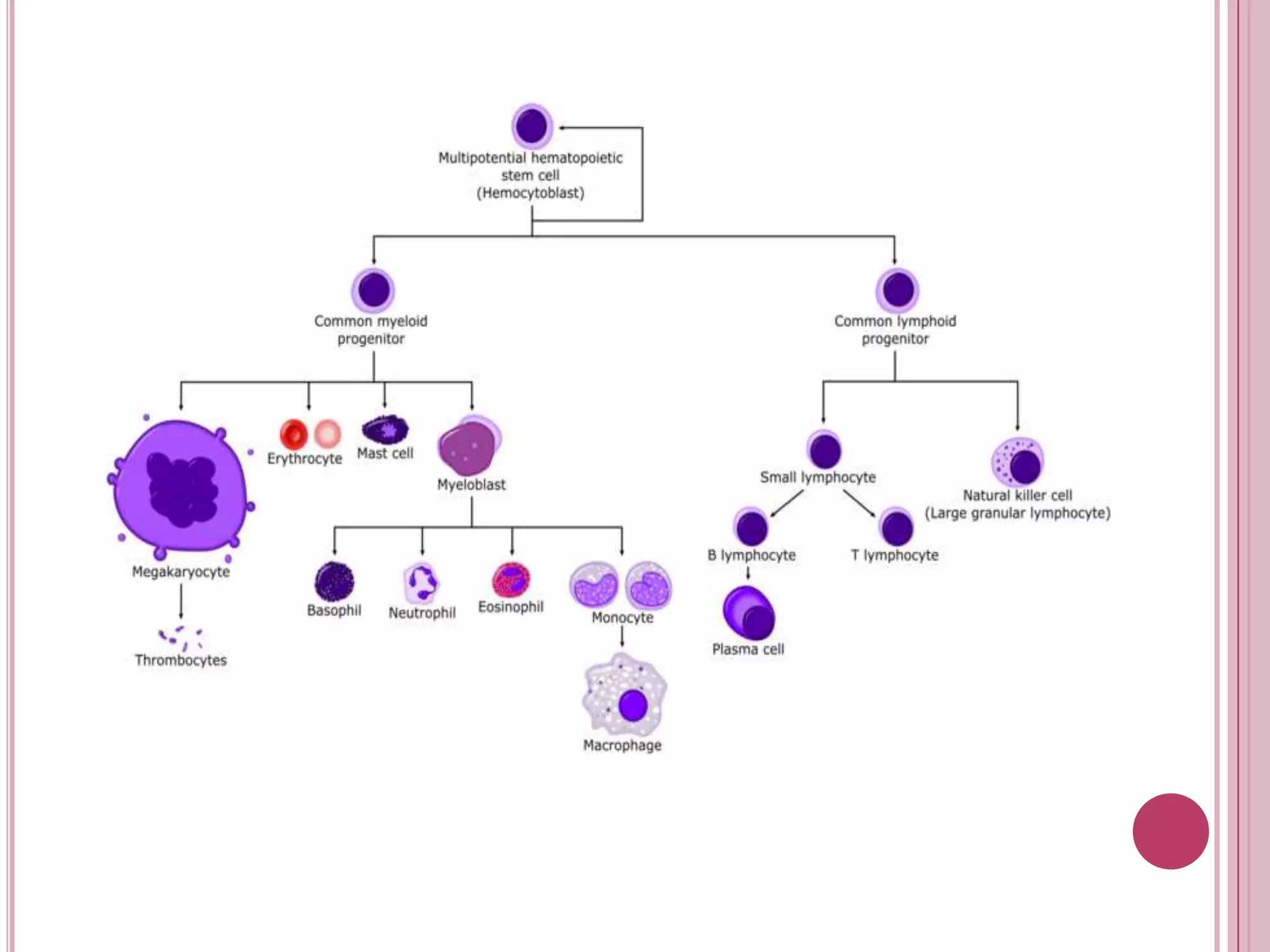
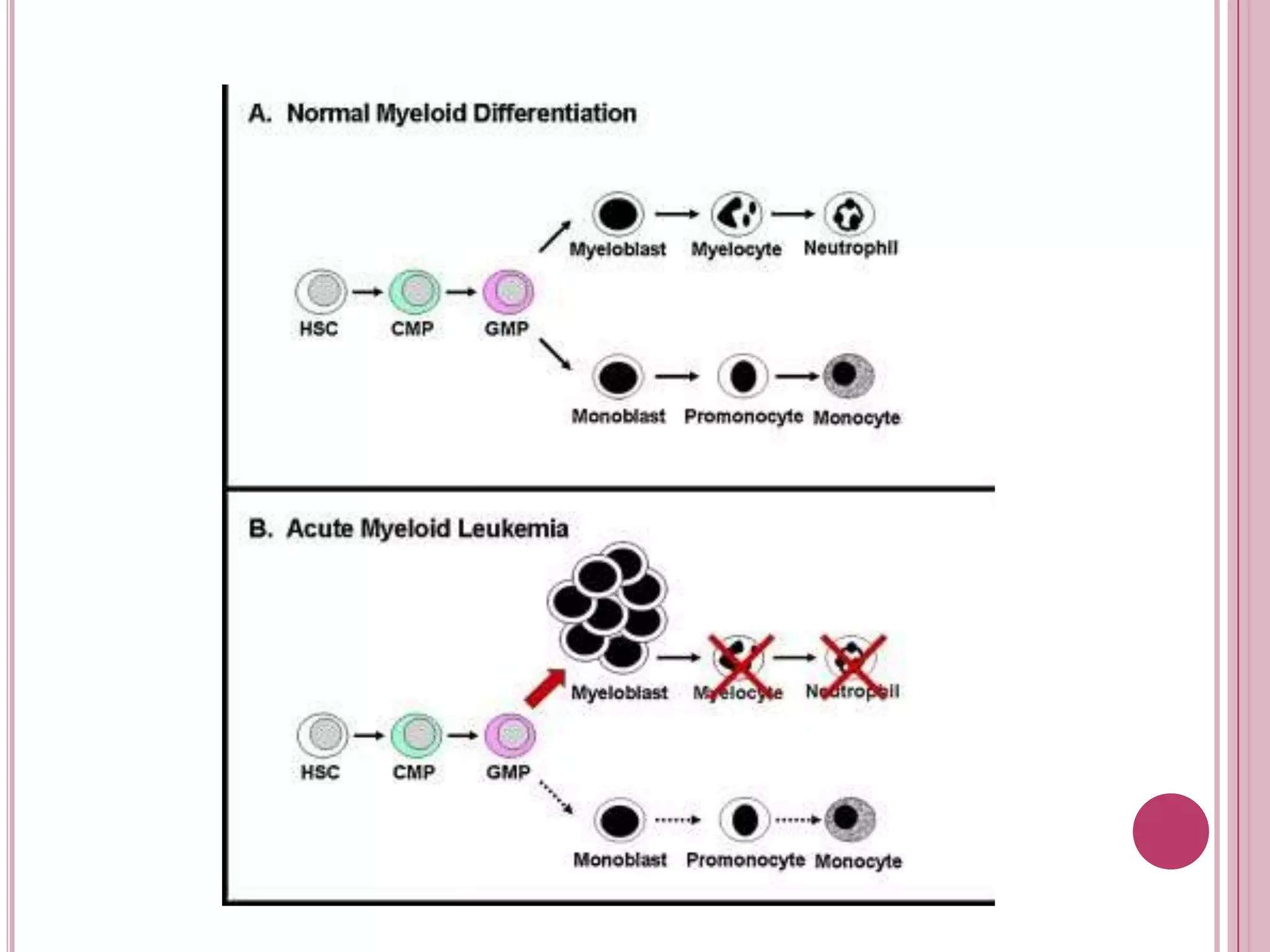
 The malignant cell in AML is the myeloblast.
 In normal hematopoiesis, the myeloblast is an
  immature precursor of myeloid white blood cells; a
  normal myeloblast will gradually mature into a
  mature white blood cell.
 In AML, though, a single myeloblast accumulates
  genetic changes which "freeze" the cell in its
  immature state and prevent differentiation.
CHROMOSOMAL TRANSLOCATION
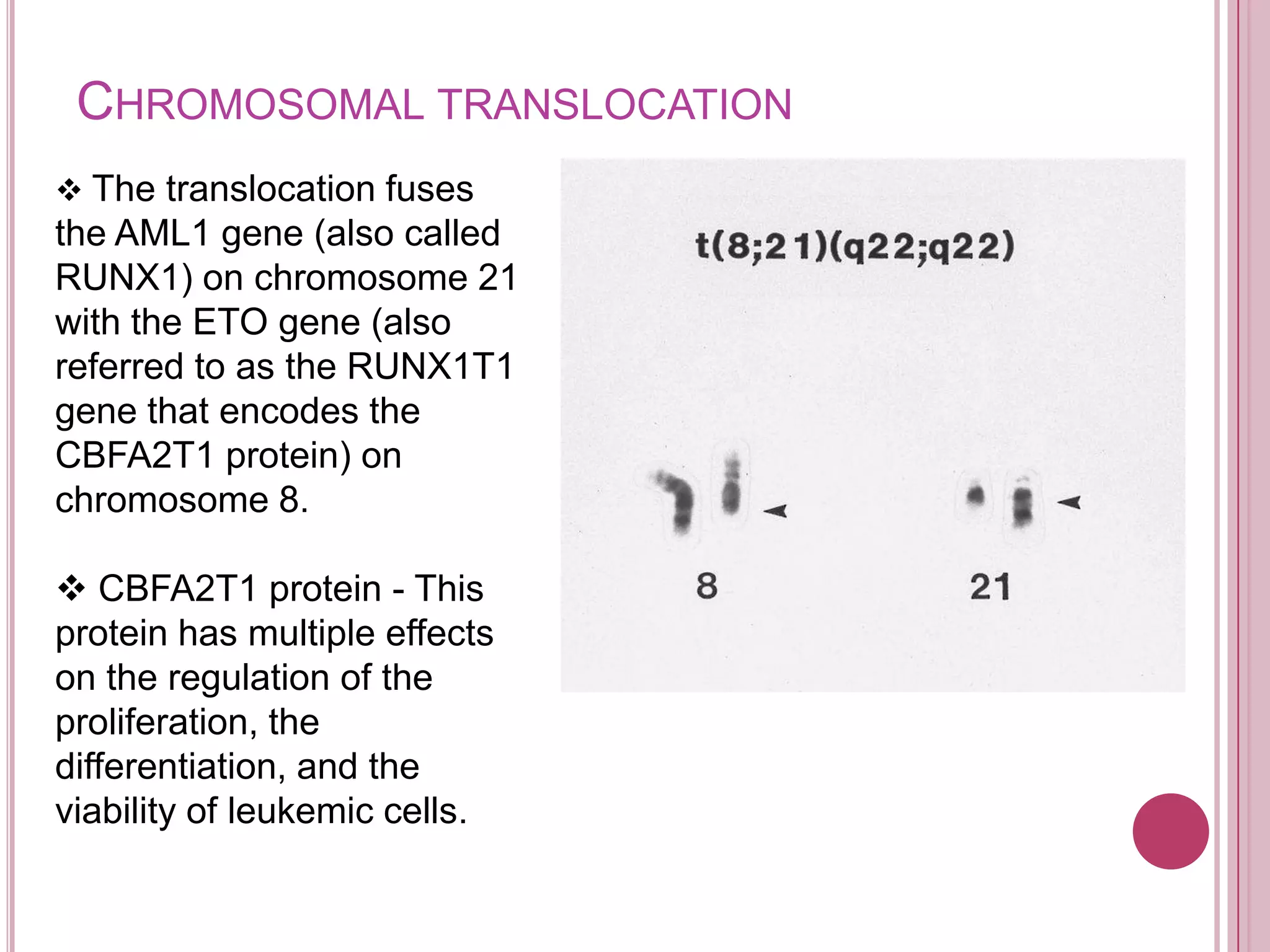
 The translocation fuses
the AML1 gene (also called
RUNX1) on chromosome 21
with the ETO gene (also
referred to as the RUNX1T1
gene that encodes the
CBFA2T1 protein) on
chromosome 8.

 CBFA2T1 protein - This
protein has multiple effects
on the regulation of the
proliferation, the
differentiation, and the
viability of leukemic cells.
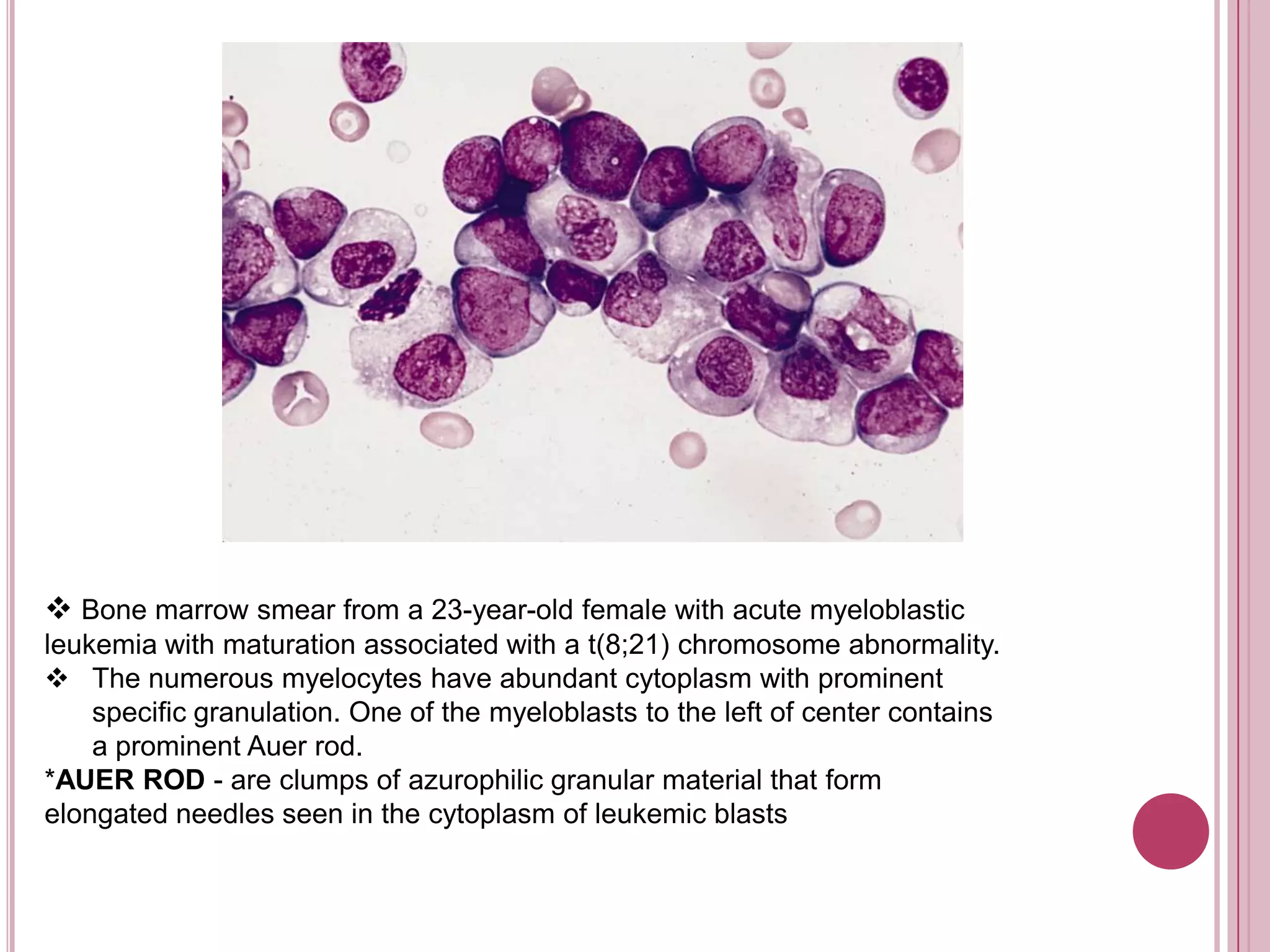
 Bone marrow smear from a 23-year-old female with acute myeloblastic
leukemia with maturation associated with a t(8;21) chromosome abnormality.
 The numerous myelocytes have abundant cytoplasm with prominent
    specific granulation. One of the myeloblasts to the left of center contains
    a prominent Auer rod.
*AUER ROD - are clumps of azurophilic granular material that form
elongated needles seen in the cytoplasm of leukemic blasts
SIGNS AND SYMPTOMS

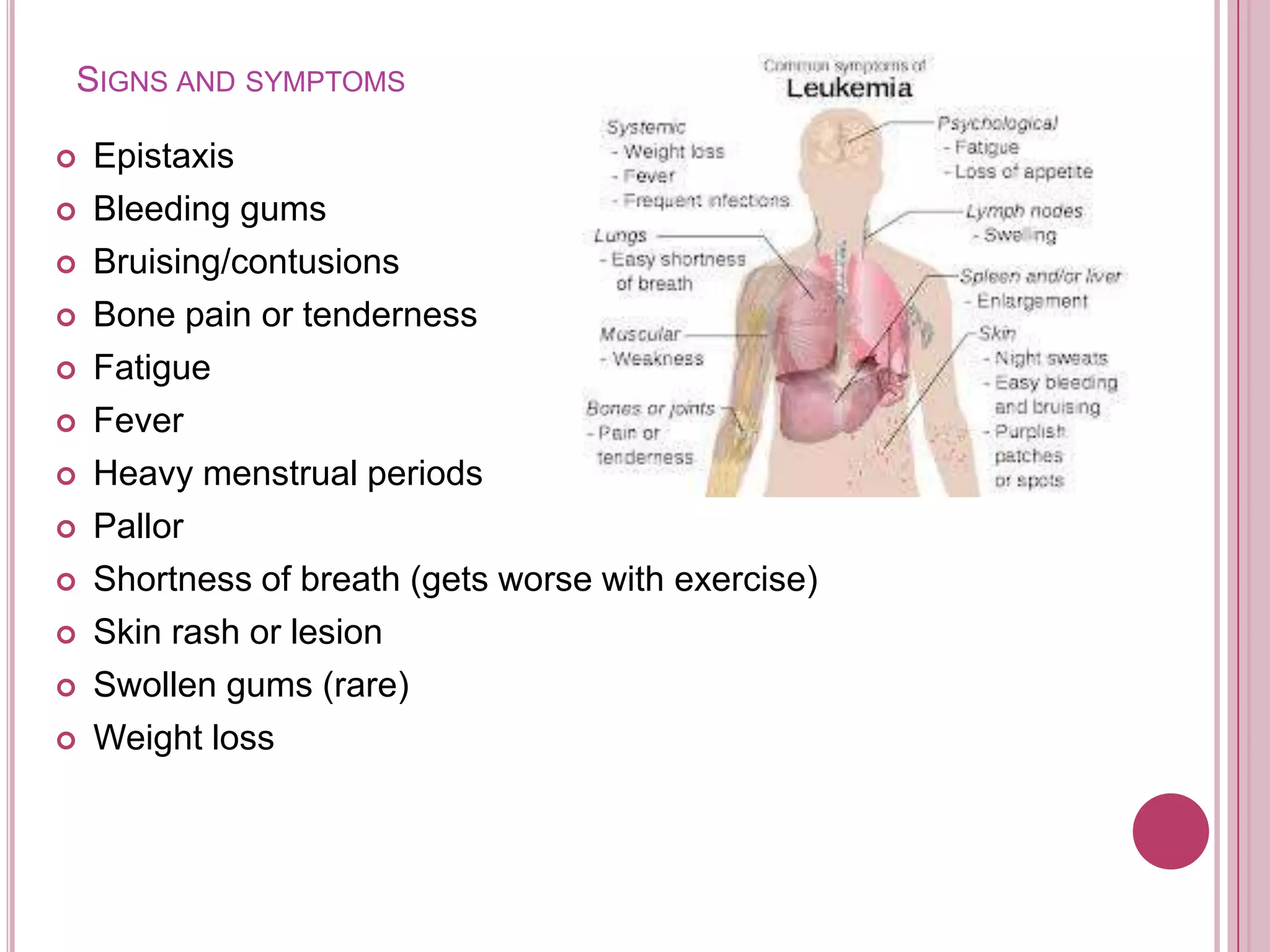
   Epistaxis
   Bleeding gums
   Bruising/contusions
   Bone pain or tenderness
   Fatigue
   Fever
   Heavy menstrual periods
   Pallor
   Shortness of breath (gets worse with exercise)
   Skin rash or lesion
   Swollen gums (rare)
   Weight loss
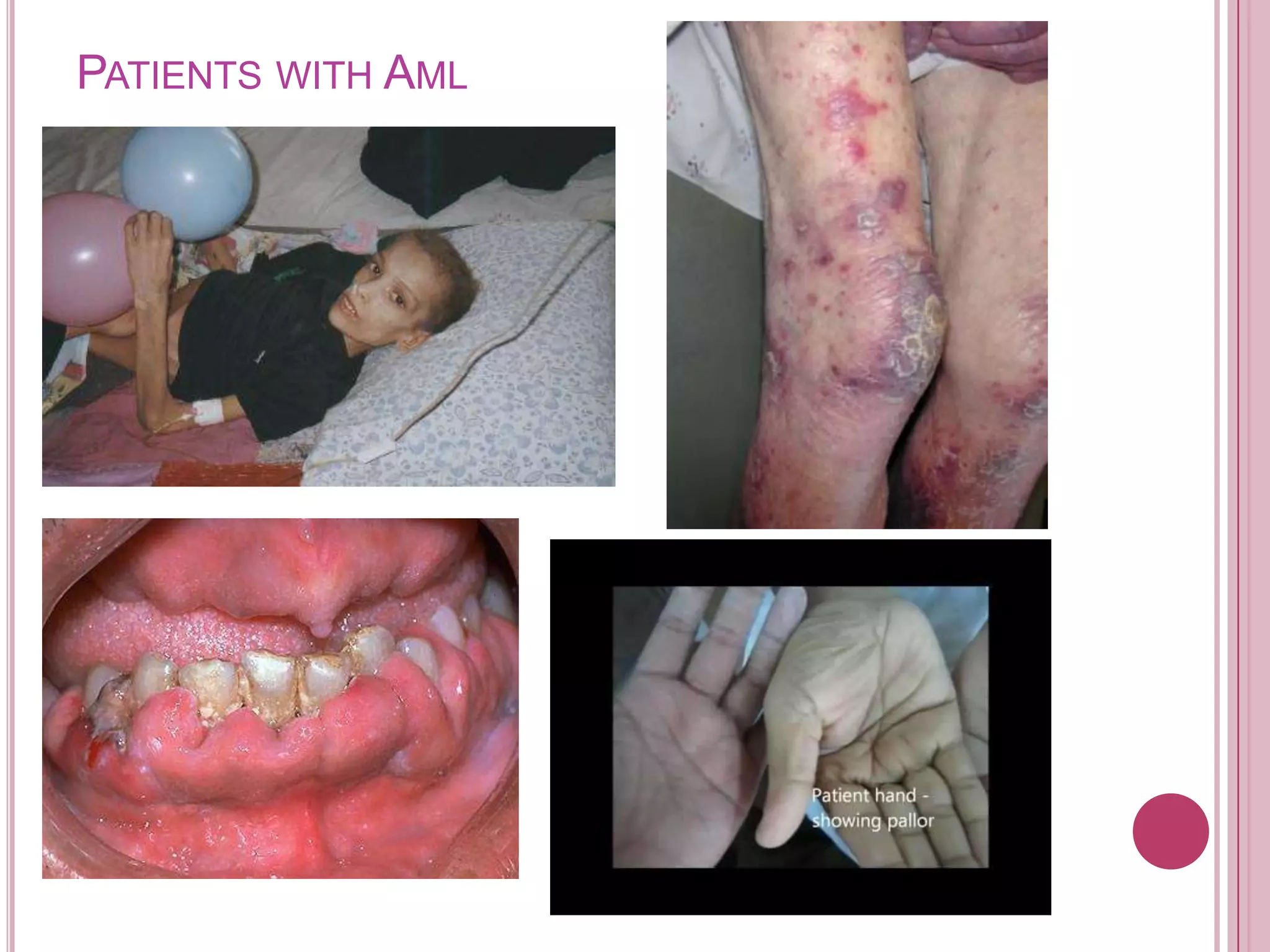
PATIENTS WITH AML
DIAGNOSIS

   Physical exam
   CBC(Complete Blood Count) -
   Peripheral blood smear- A procedure in which a sample of blood is checked for blast
    cells, the number and kinds of white blood cells, the number of platelets, and changes in
    the shape of blood cells.
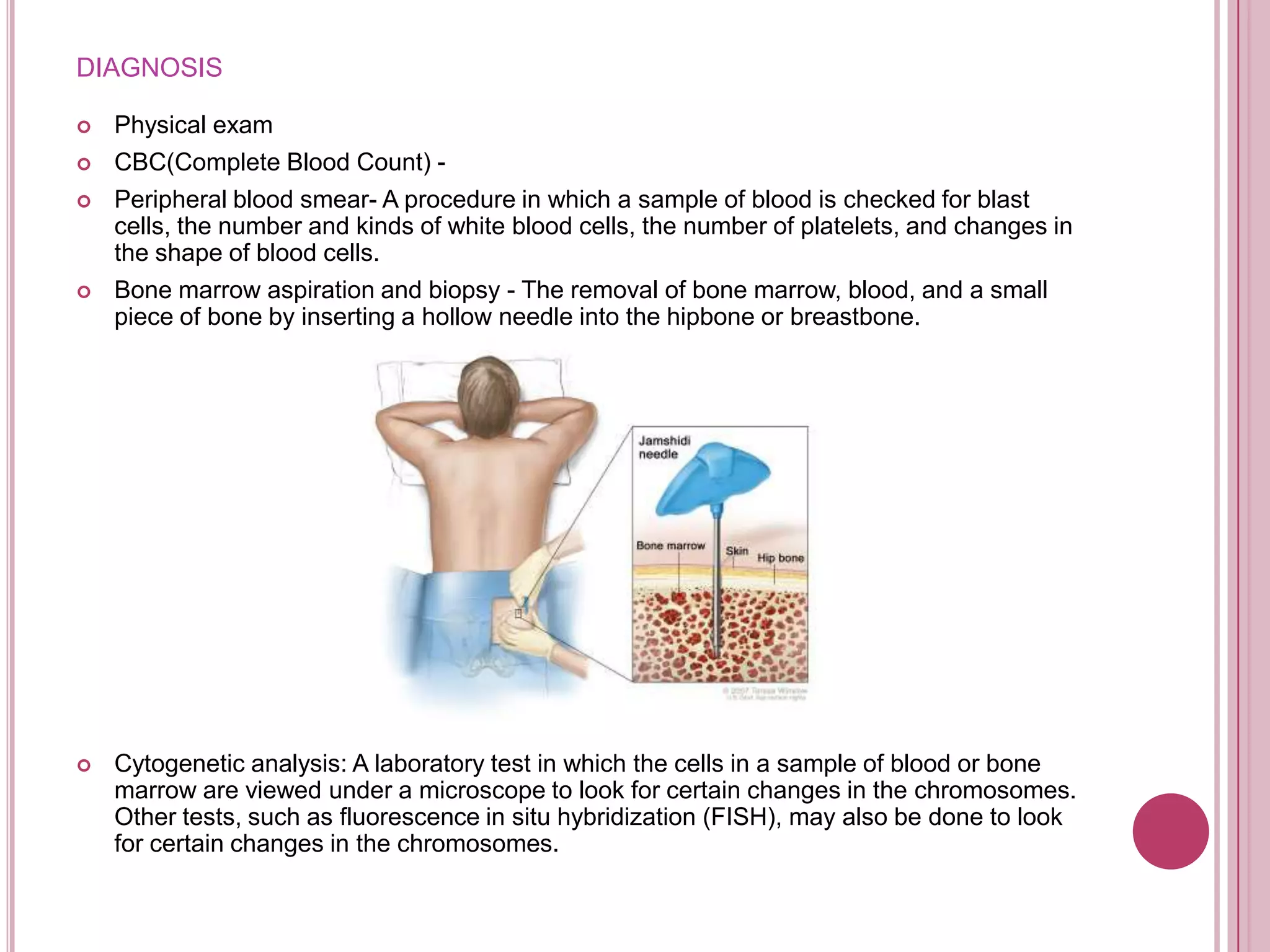
   Bone marrow aspiration and biopsy - The removal of bone marrow, blood, and a small
    piece of bone by inserting a hollow needle into the hipbone or breastbone.


   Cytogenetic analysis: A laboratory test in which the cells in a sample of blood or bone
    marrow are viewed under a microscope to look for certain changes in the chromosomes.
    Other tests, such as fluorescence in situ hybridization (FISH), may also be done to look
    for certain changes in the chromosomes.
TREATMENT
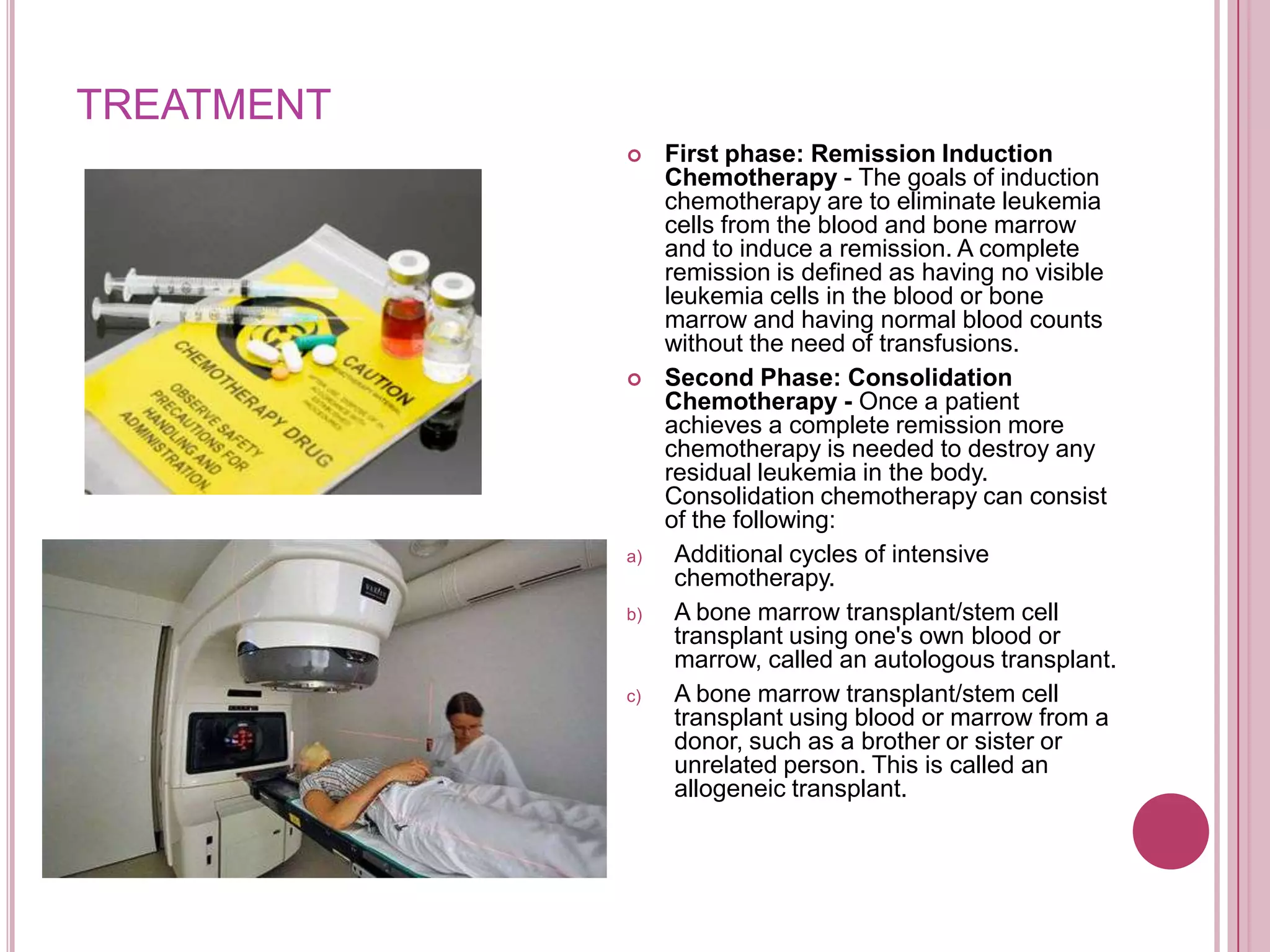
                First phase: Remission Induction
                 Chemotherapy - The goals of induction
                 chemotherapy are to eliminate leukemia
                 cells from the blood and bone marrow
                 and to induce a remission. A complete
                 remission is defined as having no visible
                 leukemia cells in the blood or bone
                 marrow and having normal blood counts
                 without the need of transfusions.
                Second Phase: Consolidation
                 Chemotherapy - Once a patient
                 achieves a complete remission more
                 chemotherapy is needed to destroy any
                 residual leukemia in the body.
                 Consolidation chemotherapy can consist
                 of the following:
            a)    Additional cycles of intensive
                  chemotherapy.
            b)    A bone marrow transplant/stem cell
                  transplant using one's own blood or
                  marrow, called an autologous transplant.
            c)    A bone marrow transplant/stem cell
                  transplant using blood or marrow from a
                  donor, such as a brother or sister or
                  unrelated person. This is called an
                  allogeneic transplant.

Acute myelogenous leukemia (aml)

  • 1.
    ACUTE MYELOGENOUS LEUKEMIA (AML) Tesoro, Willianne C. DMD-2D
  • 2.
    ACUTE MYELOGENOUS LEUKEMIA (AML) is a clonal hematopoietic disorder resulting from genetic alterations in normal hematopoietic stem cells.  These changes alter normal hematopoietic growth and differentiation, resulting in an accumulation of large numbers of abnormal, immature myeloid cells in the bone marrow and peripheral blood.  These cells are capable of dividing and proliferating, but cannot differentiate into mature hematopoietic cells.  AML is more common in men than women.  AML is the most common acute leukemia affecting adults, and its incidence increases with age.
  • 3.
    PATHOGENESIS  The malignantcell in AML is the myeloblast.  In normal hematopoiesis, the myeloblast is an immature precursor of myeloid white blood cells; a normal myeloblast will gradually mature into a mature white blood cell.  In AML, though, a single myeloblast accumulates genetic changes which "freeze" the cell in its immature state and prevent differentiation.
  • 6.
    CHROMOSOMAL TRANSLOCATION  Thetranslocation fuses the AML1 gene (also called RUNX1) on chromosome 21 with the ETO gene (also referred to as the RUNX1T1 gene that encodes the CBFA2T1 protein) on chromosome 8.  CBFA2T1 protein - This protein has multiple effects on the regulation of the proliferation, the differentiation, and the viability of leukemic cells.
  • 7.
     Bone marrowsmear from a 23-year-old female with acute myeloblastic leukemia with maturation associated with a t(8;21) chromosome abnormality.  The numerous myelocytes have abundant cytoplasm with prominent specific granulation. One of the myeloblasts to the left of center contains a prominent Auer rod. *AUER ROD - are clumps of azurophilic granular material that form elongated needles seen in the cytoplasm of leukemic blasts
  • 8.
    SIGNS AND SYMPTOMS  Epistaxis  Bleeding gums  Bruising/contusions  Bone pain or tenderness  Fatigue  Fever  Heavy menstrual periods  Pallor  Shortness of breath (gets worse with exercise)  Skin rash or lesion  Swollen gums (rare)  Weight loss
  • 9.
  • 10.
    DIAGNOSIS  Physical exam  CBC(Complete Blood Count) -  Peripheral blood smear- A procedure in which a sample of blood is checked for blast cells, the number and kinds of white blood cells, the number of platelets, and changes in the shape of blood cells.  Bone marrow aspiration and biopsy - The removal of bone marrow, blood, and a small piece of bone by inserting a hollow needle into the hipbone or breastbone.  Cytogenetic analysis: A laboratory test in which the cells in a sample of blood or bone marrow are viewed under a microscope to look for certain changes in the chromosomes. Other tests, such as fluorescence in situ hybridization (FISH), may also be done to look for certain changes in the chromosomes.
  • 11.
    TREATMENT  First phase: Remission Induction Chemotherapy - The goals of induction chemotherapy are to eliminate leukemia cells from the blood and bone marrow and to induce a remission. A complete remission is defined as having no visible leukemia cells in the blood or bone marrow and having normal blood counts without the need of transfusions.  Second Phase: Consolidation Chemotherapy - Once a patient achieves a complete remission more chemotherapy is needed to destroy any residual leukemia in the body. Consolidation chemotherapy can consist of the following: a) Additional cycles of intensive chemotherapy. b) A bone marrow transplant/stem cell transplant using one's own blood or marrow, called an autologous transplant. c) A bone marrow transplant/stem cell transplant using blood or marrow from a donor, such as a brother or sister or unrelated person. This is called an allogeneic transplant.