

MAPLE SYRUP
  DISEASE
”Branched-chain
 ketoaciduria”

By: PANGAN, DMD2D
What is MSUD?
 is an autosomal recessive, metabolic
 disorder affecting branched-chain amino
 acids.
 It is one type of ”organic acidemia” the
 disease is named for the presence of
 sweet-smelling urine, with an odor similar to
 that of maple syrup.
 is a potentially deadly disorder that
 affects the way the body breaks down
 three amino acids, leucine, isoleucine, and
 valine. (used as supplements for body
 (muscle) building.)
What is MSUD?
 People with MSUD have a mutation that
  results in a deficiency for one of the 6
  proteins that make up this complex.
  Therefore, they can't break down
  leucine, isoleucine, and valine.
 They end up with dangerously high levels of
  these amino acids in their blood, causing
  the rapid degeneration of brain cells and
  death if left untreated.
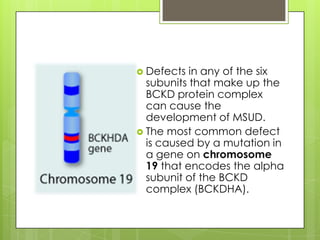
 Defects  in any of the six
  subunits that make up the
  BCKD protein complex
  can cause the
  development of MSUD.
 The most common defect
  is caused by a mutation in
  a gene on chromosome
  19 that encodes the alpha
  subunit of the BCKD
  complex (BCKDHA).
How do people get MSUD?
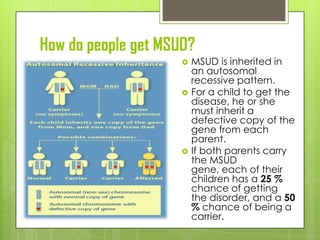
                        MSUD is inherited in
                         an autosomal
                         recessive pattern.
                        For a child to get the
                         disease, he or she
                         must inherit a
                         defective copy of the
                         gene from each
                         parent.
                        If both parents carry
                         the MSUD
                         gene, each of their
                         children has a 25 %
                         chance of getting
                         the disorder, and a 50
                         % chance of being a
                         carrier.
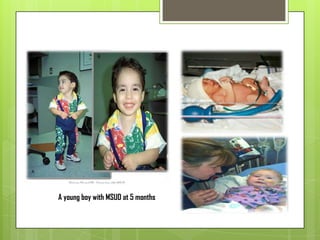
A young boy with MSUD at 5 months
What are the symptoms of MSUD?
 A baby who has the disorder may appear
  normal at birth. But within three to four
  days, the symptoms appear. These may
  include:
• loss of appetite
• fussiness
• sweet-smelling urine
 The elevated levels of amino acids in the
urine generate the smell, which is
reminiscent of maple syrup.
How do doctors diagnose MSUD?
 In some states, all babies are screened for
  MSUD within 24 hours after birth.
 A blood sample taken from the baby's
  heel is analyzed for high leucine levels.
How is MSUD treated?
 Treatment involved dietary restriction of the
  amino acids leucine, isoleucine, and valine.
 This treatment must begin very early to
  prevent brain damage.
 Babies with the disease must eat a special
  formula that does not contain the amino
  acids leucine, isoleucine, and valine.
 As the person grows to adulthood, he or she
  must always watch their diet, avoiding high
  protein foods such as meat, eggs, and nuts.
How is MSUD treated?
 Iflevels of the three amino acids still get too
  high, patients can be treated with an
  intravenous (given through a vein) solution
  that helps the body use up excess
  leucine, isoleucine, and valine for protein
  synthesis.
 Gene therapy is also a potential future
  treatment for patients with MSUD.
 This would involve replacing the mutated
  gene with a good copy, allowing the
  patient's cells to generate a functional BCKD
  protein complex and break down the excess
  amino acids

10. pangan maple syrup disease

  • 1.
    MAPLE SYRUP DISEASE ”Branched-chain ketoaciduria” By: PANGAN, DMD2D
  • 2.
    What is MSUD? is an autosomal recessive, metabolic disorder affecting branched-chain amino acids.  It is one type of ”organic acidemia” the disease is named for the presence of sweet-smelling urine, with an odor similar to that of maple syrup.  is a potentially deadly disorder that affects the way the body breaks down three amino acids, leucine, isoleucine, and valine. (used as supplements for body (muscle) building.)
  • 3.
    What is MSUD? People with MSUD have a mutation that results in a deficiency for one of the 6 proteins that make up this complex. Therefore, they can't break down leucine, isoleucine, and valine.  They end up with dangerously high levels of these amino acids in their blood, causing the rapid degeneration of brain cells and death if left untreated.
  • 4.
     Defects in any of the six subunits that make up the BCKD protein complex can cause the development of MSUD.  The most common defect is caused by a mutation in a gene on chromosome 19 that encodes the alpha subunit of the BCKD complex (BCKDHA).
  • 5.
    How do peopleget MSUD?  MSUD is inherited in an autosomal recessive pattern.  For a child to get the disease, he or she must inherit a defective copy of the gene from each parent.  If both parents carry the MSUD gene, each of their children has a 25 % chance of getting the disorder, and a 50 % chance of being a carrier.
  • 6.
    A young boywith MSUD at 5 months
  • 7.
    What are thesymptoms of MSUD?  A baby who has the disorder may appear normal at birth. But within three to four days, the symptoms appear. These may include: • loss of appetite • fussiness • sweet-smelling urine The elevated levels of amino acids in the urine generate the smell, which is reminiscent of maple syrup.
  • 8.
    How do doctorsdiagnose MSUD?  In some states, all babies are screened for MSUD within 24 hours after birth.  A blood sample taken from the baby's heel is analyzed for high leucine levels.
  • 9.
    How is MSUDtreated?  Treatment involved dietary restriction of the amino acids leucine, isoleucine, and valine.  This treatment must begin very early to prevent brain damage.  Babies with the disease must eat a special formula that does not contain the amino acids leucine, isoleucine, and valine.  As the person grows to adulthood, he or she must always watch their diet, avoiding high protein foods such as meat, eggs, and nuts.
  • 10.
    How is MSUDtreated?  Iflevels of the three amino acids still get too high, patients can be treated with an intravenous (given through a vein) solution that helps the body use up excess leucine, isoleucine, and valine for protein synthesis.  Gene therapy is also a potential future treatment for patients with MSUD.  This would involve replacing the mutated gene with a good copy, allowing the patient's cells to generate a functional BCKD protein complex and break down the excess amino acids