ALOPECIA
Pasamba, Angillete Domirene P.
          DMD 2D
A. Definition

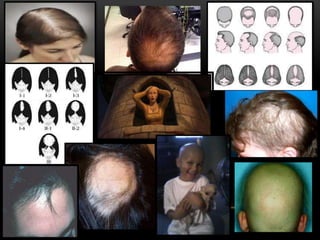
       ALOPECIA
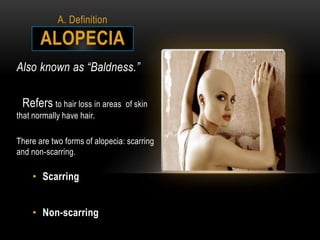
Also known as “Baldness.”

 Refers to hair loss in areas   of skin
that normally have hair.

There are two forms of alopecia: scarring
and non-scarring.

    • Scarring


    • Non-scarring
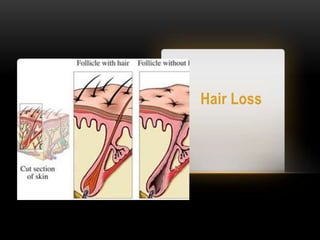
Hair Loss
B. SIGNS AND SYMPTOMS
ALOPECIA SYMPTOMS DEPEND ON THE TYPE OF HAIR LOSS. SOME OF
           THE MORE COMMON SYMPTOMS INCLUDE:


          Male-pattern baldness:                    Female-pattern baldness:
•Hair recedes                            •Hair thins over the entire head
•Hair falls out at the top of the head   •Hair comes out when brushing
                                                    Fungal infections:
•Affects men and women
                                         •Patches of hair loss
          Alopecia areata:
                                         •Black dots in the patches
•Rapid hair loss
                                         •Itching
•Round or oval patches of hair loss      •Scaling
•Sometimes tiny hairs are visible in     •Inflammation (such as redness)
the patches                                           Stress-related:
•Fingernails and toenails with pits      •Gradual shedding
                                         •Hairs come out with gentle pulling
C. DENTAL CORRELATION OF THE DISEASE
          IN DENTAL TREATMENT

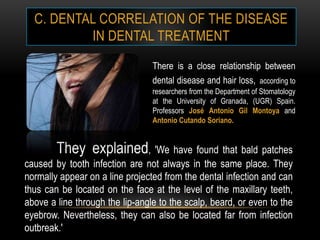
                                 There is a close relationship between
                                 dental disease and hair loss, according to
                                 researchers from the Department of Stomatology
                                 at the University of Granada, (UGR) Spain.
                                 Professors José Antonio Gil Montoya and
                                 Antonio Cutando Soriano.


        They explained, 'We have found that bald patches
caused by tooth infection are not always in the same place. They
normally appear on a line projected from the dental infection and can
thus can be located on the face at the level of the maxillary teeth,
above a line through the lip-angle to the scalp, beard, or even to the
eyebrow. Nevertheless, they can also be located far from infection
outbreak.'
PRECAUTIONS
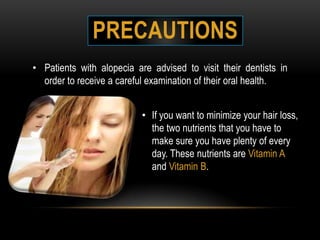
• Patients with alopecia are advised to visit their dentists in
  order to receive a careful examination of their oral health.


                           • If you want to minimize your hair loss,
                             the two nutrients that you have to
                             make sure you have plenty of every
                             day. These nutrients are Vitamin A
                             and Vitamin B.
D. CLASSIFICATION OF THE DISEASE

                           MULTIFACTORIAL
          Martinez-Mir et al. (2007) suggested that alopecia fits the paradigm of a complex or
          multifactorial genetic trait based on several lines of evidence: its prevalence in the
          population of approximately 2%; concordance in twins of 55% (Jackow et al., 1998);
          a Gaussian distribution of severity; a 10-fold increased risk for first-degree relatives
          of affected individuals; and the aggregation of affected individuals in families with no
          clear mendelian pattern of inheritance.
Mapping
Linkage to Chromosome 18

In an effort to define a genetic basis of alopecia, Martinez-Mir et al. (2007) performed a genomewide
search for linkage to 20 families with 102 affected and 118 unaffected individuals from the United
States and Israel. The analysis revealed evidence of at least 4 susceptibility loci on chromosome 6, 10,
16, and 18 using several different statistical approaches. Fine-mapping analysis with additional families
yielded a maximum multipoint lod score of 3.93 on chromosome 18 at marker D18S967 (AA1), a 2-
point affected sib pair (ASP) lod score of 3.11 on chromosome 16 (AA2; 610753), several ASP lod
scores greater than 2.00 on chromosome 6q, and a haplotype-based relative risk lod of 2.00 on
chromosome 6p, in the major histocompatibility complex locus.

15. pasamba alopecia

  • 1.
  • 2.
    A. Definition ALOPECIA Also known as “Baldness.” Refers to hair loss in areas of skin that normally have hair. There are two forms of alopecia: scarring and non-scarring. • Scarring • Non-scarring
  • 3.
  • 4.
    B. SIGNS ANDSYMPTOMS ALOPECIA SYMPTOMS DEPEND ON THE TYPE OF HAIR LOSS. SOME OF THE MORE COMMON SYMPTOMS INCLUDE: Male-pattern baldness: Female-pattern baldness: •Hair recedes •Hair thins over the entire head •Hair falls out at the top of the head •Hair comes out when brushing Fungal infections: •Affects men and women •Patches of hair loss Alopecia areata: •Black dots in the patches •Rapid hair loss •Itching •Round or oval patches of hair loss •Scaling •Sometimes tiny hairs are visible in •Inflammation (such as redness) the patches Stress-related: •Fingernails and toenails with pits •Gradual shedding •Hairs come out with gentle pulling
  • 6.
    C. DENTAL CORRELATIONOF THE DISEASE IN DENTAL TREATMENT There is a close relationship between dental disease and hair loss, according to researchers from the Department of Stomatology at the University of Granada, (UGR) Spain. Professors José Antonio Gil Montoya and Antonio Cutando Soriano. They explained, 'We have found that bald patches caused by tooth infection are not always in the same place. They normally appear on a line projected from the dental infection and can thus can be located on the face at the level of the maxillary teeth, above a line through the lip-angle to the scalp, beard, or even to the eyebrow. Nevertheless, they can also be located far from infection outbreak.'
  • 7.
    PRECAUTIONS • Patients withalopecia are advised to visit their dentists in order to receive a careful examination of their oral health. • If you want to minimize your hair loss, the two nutrients that you have to make sure you have plenty of every day. These nutrients are Vitamin A and Vitamin B.
  • 8.
    D. CLASSIFICATION OFTHE DISEASE MULTIFACTORIAL Martinez-Mir et al. (2007) suggested that alopecia fits the paradigm of a complex or multifactorial genetic trait based on several lines of evidence: its prevalence in the population of approximately 2%; concordance in twins of 55% (Jackow et al., 1998); a Gaussian distribution of severity; a 10-fold increased risk for first-degree relatives of affected individuals; and the aggregation of affected individuals in families with no clear mendelian pattern of inheritance. Mapping Linkage to Chromosome 18 In an effort to define a genetic basis of alopecia, Martinez-Mir et al. (2007) performed a genomewide search for linkage to 20 families with 102 affected and 118 unaffected individuals from the United States and Israel. The analysis revealed evidence of at least 4 susceptibility loci on chromosome 6, 10, 16, and 18 using several different statistical approaches. Fine-mapping analysis with additional families yielded a maximum multipoint lod score of 3.93 on chromosome 18 at marker D18S967 (AA1), a 2- point affected sib pair (ASP) lod score of 3.11 on chromosome 16 (AA2; 610753), several ASP lod scores greater than 2.00 on chromosome 6q, and a haplotype-based relative risk lod of 2.00 on chromosome 6p, in the major histocompatibility complex locus.