Leukaemias
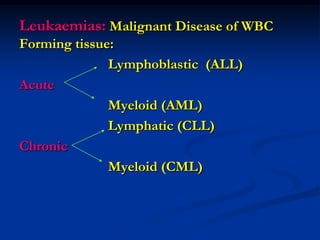
Leukaemias: Malignant Disease of WBC
Forming tissue:
Lymphoblastic (ALL)
Acute
Myeloid (AML)
Lymphatic (CLL)
Chronic
Myeloid (CML)
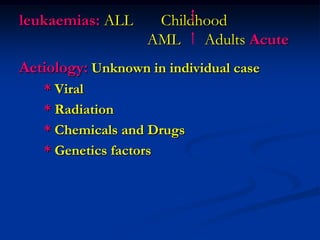
leukaemias: ALL Childhood
AML Adults Acute
Aetiology: Unknown in individual case
* Viral
* Radiation
* Chemicals and Drugs
* Genetics factors
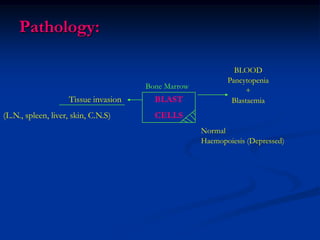
Pathology:
BLAST
CELLS
Tissue invasion
(L.N., spleen, liver, skin, C.N.S)
BLOOD
Pancytopenia
+
Blastaemia
Normal
Haemopoiesis (Depressed)
Bone Marrow
In tumors manifesting as leukemias ,blast
accumulating in the marrow suppress the growth
of normal hemopoietic cells by physical
displacement and by other poorly understood
mechanisms.Eventully this suppresion
manifested as bone marrow failure. Which
account for the major clinical presentation.
Pathogenesis
The principle pathogenic defect in acute leukemia
is a block in differentiation.
This mutation arrest stems from acquired
mutations in specific transcription factors that
regulate the differentiation of immature
lymphoid or myeloid progenitors.
Normal B cell , T cell,and myeloid differentiation
are regulated by different lineage -specific
transcription factors, accordingly, the mutated
transcription factor genes found in acute
leukemias derived from each of these lineages
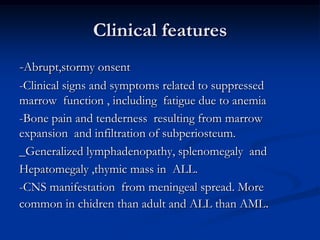
Clinical features
-Abrupt,stormy onsent
-Clinical signs and symptoms related to suppressed
marrow function , including fatigue due to anemia
-Bone pain and tenderness resulting from marrow
expansion and infiltration of subperiosteum.
_Generalized lymphadenopathy, splenomegaly and
Hepatomegaly ,thymic mass in ALL.
-CNS manifestation from meningeal spread. More
common in chidren than adult and ALL than AML.
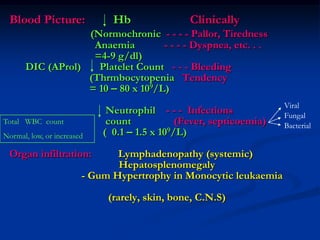
Blood Picture: Hb Clinically
(Normochronic - - - - Pallor, Tiredness
Anaemia - - - - Dyspnea, etc. . .
=4-9 g/dl)
DIC (AProl) Platelet Count - - - Bleeding
(Thrmbocytopenia Tendency
= 10 – 80 x 109/L)
Neutrophil - - - Infections
count (Fever, septicoemia)
( 0.1 – 1.5 x 10⁹/L)
Organ infiltration: Lymphadenopathy (systemic)
Hepatosplenomegaly
- Gum Hypertrophy in Monocytic leukaemia
(rarely, skin, bone, C.N.S)
Viral
Fungal
Bacterial
Total WBC count
Normal, low, or increased
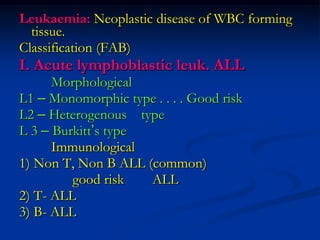
Leukaemia: Neoplastic disease of WBC forming
tissue.
Classification (FAB)
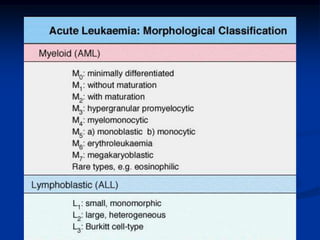
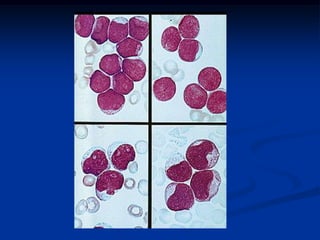
I. Acute lymphoblastic leuk. ALL
Morphological
L1 – Monomorphic type . . . . Good risk
L2 – Heterogenous type
L 3 – Burkitt’s type
Immunological
1) Non T, Non B ALL (common)
good risk ALL
2) T- ALL
3) B- ALL
II. Acute Myeloid Leukaemia (AML)
[ FAB]
M0 AML . . . Poorly differentiated
M1 AML . . . Without Maturation
M2 AML . . . With Maturation
M3 AproL . . . Promyelocytic
M4 AMML . . . MyeloMonocytic
M5 AMOL . . . Monocytic
M6 A. ErythroLeukaemia
M7 A. Megakaryoblastic L
Age groups : ALL – mostly in children
AML – mostly in Adults
Acute leukemia

Acute leukemia

  • 1.
  • 2.
    Leukaemias: Malignant Diseaseof WBC Forming tissue: Lymphoblastic (ALL) Acute Myeloid (AML) Lymphatic (CLL) Chronic Myeloid (CML)
  • 3.
    leukaemias: ALL Childhood AMLAdults Acute Aetiology: Unknown in individual case * Viral * Radiation * Chemicals and Drugs * Genetics factors
  • 4.
    Pathology: BLAST CELLS Tissue invasion (L.N., spleen,liver, skin, C.N.S) BLOOD Pancytopenia + Blastaemia Normal Haemopoiesis (Depressed) Bone Marrow
  • 5.
    In tumors manifestingas leukemias ,blast accumulating in the marrow suppress the growth of normal hemopoietic cells by physical displacement and by other poorly understood mechanisms.Eventully this suppresion manifested as bone marrow failure. Which account for the major clinical presentation.
  • 6.
    Pathogenesis The principle pathogenicdefect in acute leukemia is a block in differentiation. This mutation arrest stems from acquired mutations in specific transcription factors that regulate the differentiation of immature lymphoid or myeloid progenitors. Normal B cell , T cell,and myeloid differentiation are regulated by different lineage -specific transcription factors, accordingly, the mutated transcription factor genes found in acute leukemias derived from each of these lineages
  • 7.
    Clinical features -Abrupt,stormy onsent -Clinicalsigns and symptoms related to suppressed marrow function , including fatigue due to anemia -Bone pain and tenderness resulting from marrow expansion and infiltration of subperiosteum. _Generalized lymphadenopathy, splenomegaly and Hepatomegaly ,thymic mass in ALL. -CNS manifestation from meningeal spread. More common in chidren than adult and ALL than AML.
  • 8.
    Blood Picture: HbClinically (Normochronic - - - - Pallor, Tiredness Anaemia - - - - Dyspnea, etc. . . =4-9 g/dl) DIC (AProl) Platelet Count - - - Bleeding (Thrmbocytopenia Tendency = 10 – 80 x 109/L) Neutrophil - - - Infections count (Fever, septicoemia) ( 0.1 – 1.5 x 10⁹/L) Organ infiltration: Lymphadenopathy (systemic) Hepatosplenomegaly - Gum Hypertrophy in Monocytic leukaemia (rarely, skin, bone, C.N.S) Viral Fungal Bacterial Total WBC count Normal, low, or increased
  • 10.
    Leukaemia: Neoplastic diseaseof WBC forming tissue. Classification (FAB) I. Acute lymphoblastic leuk. ALL Morphological L1 – Monomorphic type . . . . Good risk L2 – Heterogenous type L 3 – Burkitt’s type Immunological 1) Non T, Non B ALL (common) good risk ALL 2) T- ALL 3) B- ALL
  • 11.
    II. Acute MyeloidLeukaemia (AML) [ FAB] M0 AML . . . Poorly differentiated M1 AML . . . Without Maturation M2 AML . . . With Maturation M3 AproL . . . Promyelocytic M4 AMML . . . MyeloMonocytic M5 AMOL . . . Monocytic M6 A. ErythroLeukaemia M7 A. Megakaryoblastic L Age groups : ALL – mostly in children AML – mostly in Adults