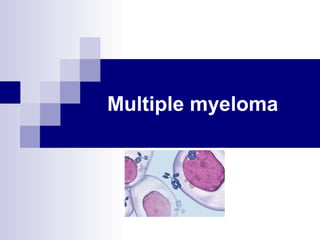
Multiple myeloma
What is multiple myeloma (MM)?
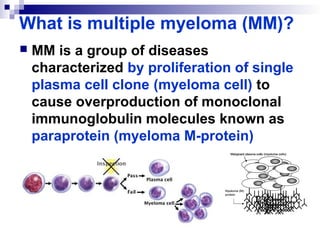
 MM is a group of diseases
characterized by proliferation of single
plasma cell clone (myeloma cell) to
cause overproduction of monoclonal
immunoglobulin molecules known as
paraprotein (myeloma M-protein)
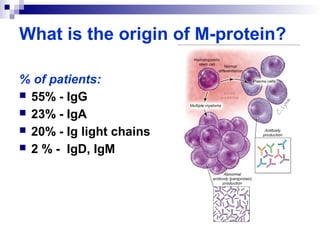
What is the origin of M-protein?
% of patients:
 55% - IgG
 23% - IgA
 20% - Ig light chains
 2 % - IgD, IgM
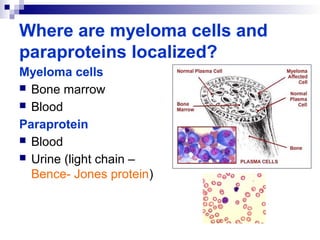
Where are myeloma cells and
paraproteins localized?
Myeloma cells
 Bone marrow
 Blood
Paraprotein
 Blood
 Urine (light chain –
Bence- Jones protein)
What is biochemical profile of
multiple myeloma?
 Plasma cell > 10%
 Serum electrophoresis: M- band
(sharp peak in the gamma-globin
fraction)
 Hypercalciemia
 Normal Alkaline phosphatase
 20% of patients with light chain
paraprotein do not detect it in
serum but show presence of
Bence-Jones protein in the urine
Cytogenetic analysis of
chromosome
What are Bence-Jones proteins?
How are they detected by heating
test?
 The presence of specific
protein in the urine of
patient with MM was first
reported by Bence-Jones
in 1848.
 Bence-Jones protein is
immunoglobulin light
chain.
 Heat test: ppt at 40-50C
but dissolve on further
urine heating to boiling
point
 Henry Bence-Jones
(1813-1873) English
physician and chemist
Clinical features
Bone disease
Impaired renal
function
Anemia
Hypercalciemia
Chronic
infections
Bone disease – lytic lesions of
bone
 Activation of
osteoclasts
(increase
resorption)
 Inhibition of
osteoblasts
(decrease
formation)
 Pain, deformation
Impaired renal function
 Overflow proteinuria
 Multiple myeloma
may cause renal
tubular amyloidosis
 Obstruction of
lumen of nephrons
by paraproteins
Anemia
 Bone marrow erythropoietic cell are
replaced by the plasma cells, resulting
in anemia
Hypercalcemia

Multiple Myeloma

  • 1.
  • 2.
    What is multiplemyeloma (MM)?  MM is a group of diseases characterized by proliferation of single plasma cell clone (myeloma cell) to cause overproduction of monoclonal immunoglobulin molecules known as paraprotein (myeloma M-protein)
  • 3.
    What is theorigin of M-protein? % of patients:  55% - IgG  23% - IgA  20% - Ig light chains  2 % - IgD, IgM
  • 4.
    Where are myelomacells and paraproteins localized? Myeloma cells  Bone marrow  Blood Paraprotein  Blood  Urine (light chain – Bence- Jones protein)
  • 5.
    What is biochemicalprofile of multiple myeloma?  Plasma cell > 10%  Serum electrophoresis: M- band (sharp peak in the gamma-globin fraction)  Hypercalciemia  Normal Alkaline phosphatase  20% of patients with light chain paraprotein do not detect it in serum but show presence of Bence-Jones protein in the urine
  • 7.
  • 8.
    What are Bence-Jonesproteins? How are they detected by heating test?  The presence of specific protein in the urine of patient with MM was first reported by Bence-Jones in 1848.  Bence-Jones protein is immunoglobulin light chain.  Heat test: ppt at 40-50C but dissolve on further urine heating to boiling point  Henry Bence-Jones (1813-1873) English physician and chemist
  • 9.
    Clinical features Bone disease Impairedrenal function Anemia Hypercalciemia Chronic infections
  • 10.
    Bone disease –lytic lesions of bone  Activation of osteoclasts (increase resorption)  Inhibition of osteoblasts (decrease formation)  Pain, deformation
  • 11.
    Impaired renal function Overflow proteinuria  Multiple myeloma may cause renal tubular amyloidosis  Obstruction of lumen of nephrons by paraproteins
  • 12.
    Anemia  Bone marrowerythropoietic cell are replaced by the plasma cells, resulting in anemia
  • 13.