Myeloproliferative
Neoplasms
Presented By:
Ayaz Ahmed
BS-MT, MPH-Fellow
School of Public Health
Dow University of Health Science
Dated: 25 Jan-2018
Objective
 History/Background
 Definition
 Classification/Types
 Sign and Symptoms
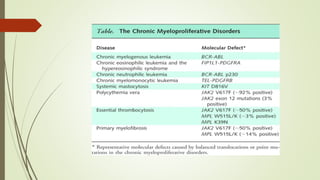
 Causes and genetics of MPNs
 Diagnosis
 Treatment
 Prevalence
 References
MPNs: Background/History
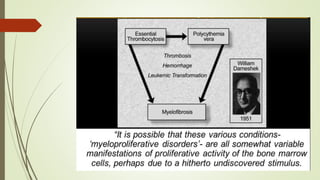
 The concept of myeloproliferative disease was first proposed in 1951 by
the hematologist William Dameshek.
 This reflects the underlying clonal genetic changes that are a salient feature of this
group of disease.
 Pre-Dameshek luminaries who laid the foundation for this unifying concept include
Bennett, Virchow, Heuck, Vaquez, Osler, Di Guglielmo and Epstein.
 In 1960, Nowell and Hungerford discovered the Philadelphia (Ph) chromosome in
CML.
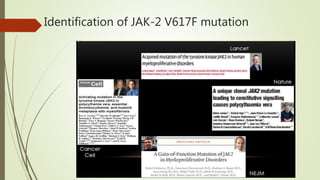
Identification of JAK-2 V617F mutation
History
 In 1967, Fialkow and colleagues used X-linked polymorphisms to establish CML as
a clonal stem cell disease. Also in 1967, the PV Study Group was summoned by
Louis Wasserman to study the natural history of PV and conduct large-scale clinical
trials.
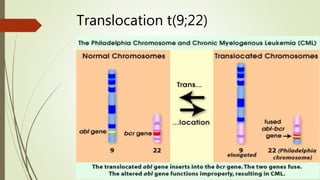
 In 1972, Janet Rowley deciphered the Ph chromosome as a reciprocal translocation
between chromosomes 9 and 22, thus paving the way for its subsequent
characterization as an oncogenic BCR–ABL mutation.
 In 1996, Brian Druker discovered imatinib—a small molecule ABL inhibitor with
exceptional therapeutic activity in CML.
 In 2005, a gain-of function JAK2 mutation (JAK2V617F) was described in BCR–ABL-
negative MPDs, raising the prospect of a CML-like treatment strategy in PV, ET and
PMF.
Terminology
 Neoplasm: “New Growth” due to dysregulated proliferation of transformed cell.
 Growth factors that regulate proliferation are reduced or eliminated by genetic mutation
in transformed cell.
 Benign Neoplasm: differentiated cells that don’t spread or invade surrounding
tissue.
 Can progress with further mutations to a malignant neoplasms.
 Malignant Neoplasm: “Deadly” having potential to produce death.
 Proliferating cells with potential to metastasize.
 Only malignant tumors are correctly termed as cancers.
 Cancer is actually a malignancy of epithelial tissue, it is also commonly used to include all
malignant neoplasms.
MPNs: Definition
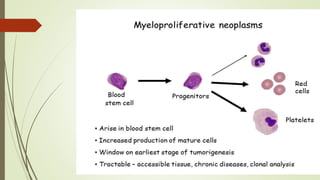
 Myeloproliferative disorders is the general name given to a group of conditions
where there is an overgrowth of cells in the bone marrow, often leading to
increased numbers of cells in the blood.
 The name comes for the Greek word for bone marrow - “myelo”, and
“proliferative” because there is an overgrowth of the cells there.
Or
 MPDs are heterogeneous group of disorders characterized by cellular proliferation
of one or more hematologic line in peripheral blood, distinct from acute leukemia.
MPNs: Classification
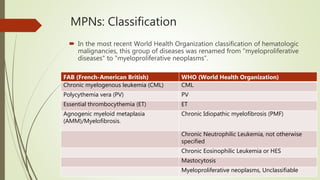
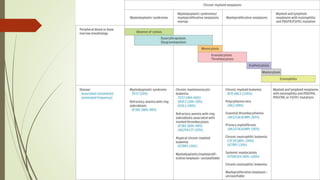
 In the most recent World Health Organization classification of hematologic
malignancies, this group of diseases was renamed from "myeloproliferative
diseases" to "myeloproliferative neoplasms”.
FAB (French-American British) WHO (World Health Organization)
Chronic myelogenous leukemia (CML) CML
Polycythemia vera (PV) PV
Essential thrombocythemia (ET) ET
Agnogenic myeloid metaplasia
(AMM)/Myelofibrosis.
Chronic Idiopathic myelofibrosis (PMF)
Chronic Neutrophilic Leukemia, not otherwise
specified
Chronic Eosinophilic Leukemia or HES
Mastocytosis
Myeloproliferative neoplasms, Unclassifiable
Chronic Myeloid Leukemia
 CML results from a somatic mutation in a pluripotent hematopoietic cell.
 CML is a MPD characterized by increased granulocytic cell line, associated often
with platelet hyperplasia.
 The disease usually involves into an accelerated phase that often terminates in
acute phase.
-chronic phase 3-5 years
-accelerated phase 6-9 months
-blastic phase 3-6 months
Philadelphia Chromosome
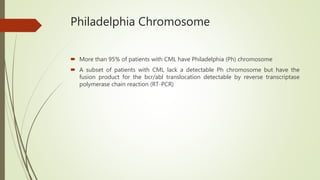
 More than 95% of patients with CML have Philadelphia (Ph) chromosome
 A subset of patients with CML lack a detectable Ph chromosome but have the
fusion product for the bcr/abl translocation detectable by reverse transcriptase
polymerase chain reaction (RT-PCR)
Translocation t(9;22)
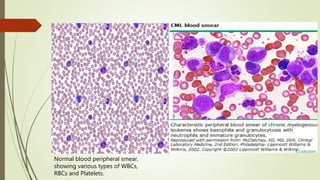
Normal blood peripheral smear,
showing various types of WBCs,
RBCs and Platelets.
Epidemiology
 CML accounts for approximately 15 percent of all cases of leukemia and
approximately 3 percent of childhood leukemias
 The median age of onset is 53 years.
 Second most common leukemia.
 The American Cancer Society estimates that 8820 new cases of chronic
myelogenous leukemia (CML) will be diagnosed in the United States in 2016.
 CML accounts for more than half of myeloproliferative disease cases.
Polycythemia Vera
 Polycythaemia (rubra) vera is a disorder in which too many red cells are produced
in the bone marrow, without any identifiable cause.
 A neoplastic disorder arising from a pluripotent stem cell, generally characterized
by erythrocytosis, with or without thrombocytosis and leukocytosis.
• Incidence 10 new cases per million worldwide.
• Highest incidence in ages 50-75, but 5% occur in pts < 40 y.o.
 The incidence of polycythemia vera in the United States is approximately 5-17
cases per 1 million population per year.
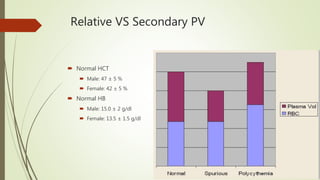
Relative VS Secondary PV
 Normal HCT
 Male: 47 ± 5 %
 Female: 42 ± 5 %
 Normal HB
 Male: 15.0 ± 2 g/dl
 Female: 13.5 ± 1.5 g/dl
Polycythemia Vera
Polycythemia vera
 An uncommon disorder - distinguish from other causes of erythrocytosis.
 Diagnosis depends on knowledge of erythropoiesis.
 Complications most commonly from thrombosis and vascular incidents.
 Long natural history with treatment
PV: Natural History
 Latent phase – asymptomatic.
 Proliferative phase - patients may be hypermetabolic or have sign & symptoms of
hyperviscosity or thrombosis.
 Spent phase - anemia, leukopenia, secondary myelofibrosis, increasing liver and
spleen size.
 Secondary AML
– 1-2% of pts treated with phlebotomy alone
– Certain drug therapies increase risk
Essential Thrombocythemia
 Proliferation of megakaryocytes causing marked increase in circulating platelets
(>1 million)
 morphologically abnormal platelets
 splenomegaly, mucosal hemorrhage, thrombosis
 Incidence: 1.5 per 100,000
 Age at Dx: 60 y/o (~20% <40 y/o)
 F to M ratio: 1.6 : 1
Myelofibrosis
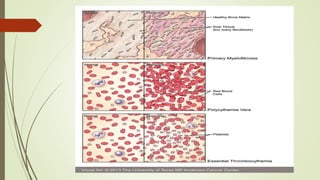
 Primary myelofibrosis (also called chronic idiopathic myelofibrosis, agnogenic
myeloid metaplasia) is a disorder in which normal bone marrow tissue is gradually
replaced with a fibrous scar-like material. Over time, this leads to progressive bone
marrow failure.
 Clonal stem cell disorder affecting megakaryocytes predominantly.
 All myeloproliferative disorders can result in a spent phase which can be difficult to
distinguish from primary MF.
 Myeloid metaplasia refers to earlier proliferative phase where extra-medullary
hematopoiesis predominates.
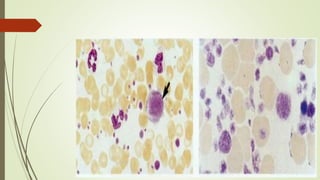
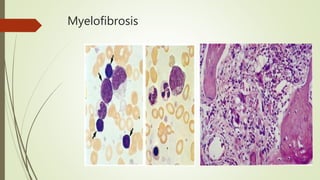
Myelofibrosis
 Bone marrow fibrosis
 fibroblasts may be “innocent bystanders”
 fibrosis probably driven by neoplastic megakaryocytes
 Middle aged adults (50-60 y/o)
 Extra-medullary hematopoiesis (spleen, liver)
 May occur as an extension of CML or PV
 Abnormal peripheral RBCs (“tear-drop” & nucleated RBCs)
 Immature WBC and abnormal platelets
 Infection, thrombosis and hemorrhage as a major complication
Myelofibrosis
Myelofibrosis: Prognosis
 Median survival is 5 years
 Transforms into AML in 5-20%
 >50% patients present with symptoms of anemia and thrombocytopenia.
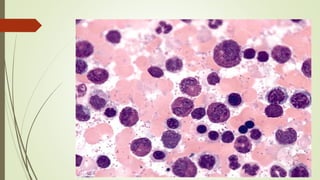
Chronic Neutrophilic Leukemia: CNL
 Chronic neutrophilic leukaemia is another rare myeloproliferative neoplasm in which
too many neutrophils are made in the bone marrow. These cells spill out into the
circulating blood and tend to accumulate in the liver and spleen, which become
enlarged as a result.
 Chronic neutrophilic leukaemia is usually a slowly progressing disease, closely
related to another type of leukaemia called chronic myeloid leukaemia.
 Its natural course can vary considerably between individuals with survival times
ranging from 6 months to over 20 years.
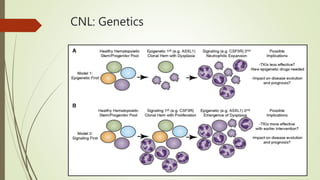
CNL: Genetics
Chronic Eosinophilic Leukemia/HES
 Chronic eosinophilic leukaemia is a rare myeloproliferative neoplasm (blood
cancer) in which too many white blood cells, called eosinophils, are made in the
bone marrow.
 These cells spill out of the bone marrow and accumulate in the blood and other
tissues around the body.
 This disorder is diagnosed by a full blood count showing persistently elevated
numbers of eosinophils (a specialised white blood cell).
 Many patients carry the FIP1L1-PDGFR alpha mutation.
CEL/HES
 Chronic eosinophilic leukaemia is a rare disease and its natural course can vary
considerably between individuals. The disease may remain stable for many years,
even decades, or it may quickly progress and transform to acute leukaemia.
 For this reason, the most appropriate treatment for each patient is decided on an
individual basis.
Secondary causes of Eosinophilia
Mastocytosis
 Systemic mastocytosis or mast cell disease is a disorder that results from the
overproduction of mast cells (a type of white blood cell), in the bone marrow.
 These cells accumulate in the blood, lymph nodes (glands), skin and other body
tissues. Excess numbers of mast cells release large amounts of histamine and other
substances which can cause allergic type reactions in affected tissues.
 For example, when these substances collect in the skin they tend to cause an itchy
rash. Other allergic type symptoms may include abdominal pain and difficulty
breathing.
 Over 90% of patients with systemic mastocytosis carry a mutation in the c-KIT
gene.
Cutaneous and Systemic
MPNs: Sign & Symptoms
 Many people with myeloproliferative disorders have no symptoms when their
doctors first make the diagnosis.
 One symptom shared by all myeloproliferative disorders, with the exception of
essential thrombocytosis, is an enlarged spleen.
 An enlarged spleen can cause abdominal pain and a feeling of fullness.
Sign & Symptoms
Patients may have a history of the following:
 Easy fatigability
 Anorexia, weight loss
 Abdominal discomfort and early satiety
secondary to splenomegaly; Most common in
chronic myelogenous leukemia and agnogenic
myeloid metaplasia
 Easy bruising, bleeding, and/or symptoms of
thrombosis
 Swollen, painful joint(s) secondary to gouty
arthritis that is secondary to hyperuricemia
 Priapism, tinnitus, or stupor from leukostasis
 Left upper quadrant and left shoulder pain as a
consequence of splenic infarction and
perisplenitis
Clinical symptoms can include the
following:
 Pallor (except in patients with
polycythemia vera)
 Plethora secondary to polycythemia
 Petechiae and/or ecchymosis
 Palpable spleen and/or liver
 Occasionally, syndrome of fever
accompanied by painful,
maculopapular, violaceous lesions on
the trunk, arms, legs, and face; this is
called acute febrile neutrophilic
dermatosis, or Sweet syndrome
MPNs: Causes
 All myeloproliferative disorders are caused by overproduction of one or more types
of cells. No one knows what triggers the overproduction of cells, but theories
include:
 Genetics. Some people with CML have an abnormally shortened chromosome
known as the Philadelphia chromosome.
 Environment. Some studies suggest that myeloproliferative disorders may result
from an overexposure to radiation, electrical wiring, or chemicals.
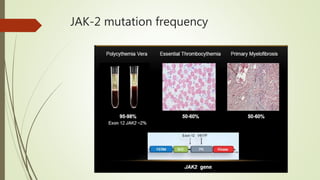
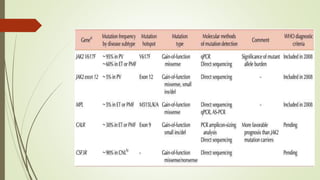
JAK-2 mutation frequency
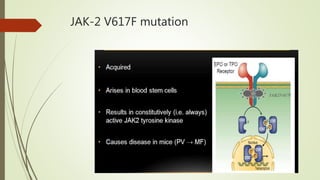
JAK-2 V617F mutation
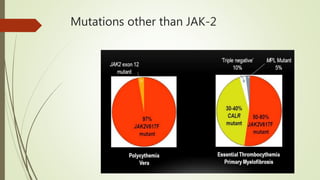
Mutations other than JAK-2
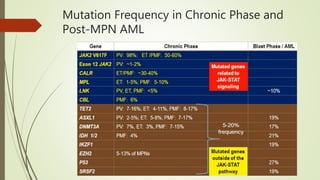
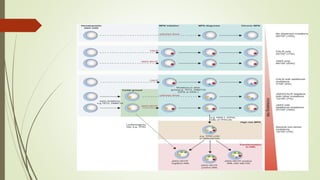
Mutation Frequency in Chronic Phase and
Post-MPN AML
MPNs: Diagnosis
 A sign shared by all myeloproliferative disorders, with the exception of essential
thrombocytosis, is an enlarged spleen. Your doctor may detect an enlarged spleen
during a routine physical examination. In addition to doing a physical exam, the doctor
may also conduct the following tests:
 Blood tests. To find abnormal types or numbers of red or white blood cells. They can also
detect anemia and leukemia.
 Bone marrow biopsy. Your doctor may take a sample of bone marrow after blood tests. It
can show the presence of abnormal types or numbers of red or white blood cells and may
detect certain types of anemia and cancer in the marrow.
 Cytogenetic analysis. Your doctor may view blood or bone marrow are viewed under a
microscope to look for changes in the chromosomes.i.e. philedalphia
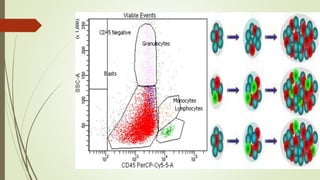
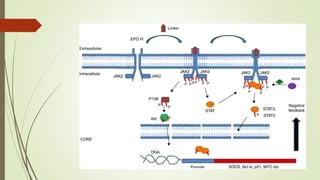
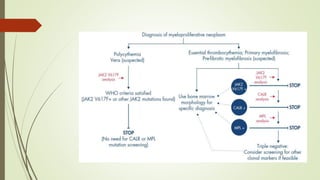
 JAK2 gene mutation test: lab test done on bone marrow or a blood sample to look for a
change (mutation) in a piece of genetic material in your cells (a gene) call JAK2. This is often
found in three of the Myeloproliferative Disorders: polycythemia vera, essential
thrombocytopenia, or primary myelofibrosis.
MPNs: Treatment
 Myeloproliferative disorder is often challenging to treat, and it may require years of
therapy and follow-up care. Treatments for MPD generally are aimed at controlling
disease symptoms, and your symptoms will help the doctor decide which treatment is
best. Therapies may include one or more of the following.
 Medications; Aspirin, hydroxyurea, anagrelide and interferon-alpha are the main medications
for essential thrombocytemia and polycythemia vera. Thalidomide, steroids and other
hormones, and cladribine and busulfan also may be used.
 Blood or platelet transfusion
 Growth factors, which stimulate growth of bone marrow cells, are given as injections under
the skin (Sub-cutaneous) and may benefit patients with low blood cell counts.
 Radiation therapy and Chemotherapy
 Surgical removal of the spleen
 Phlebotomy
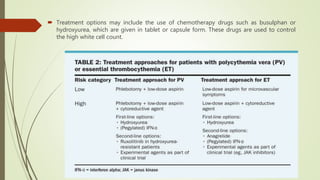
 Treatment options may include the use of chemotherapy drugs such as busulphan or
hydroxyurea, which are given in tablet or capsule form. These drugs are used to control
the high white cell count.
MPNs: Treatment
 BCR-ABL kinase inhibitors
 May not prevent progression to crisis.
 Allogenic BMT
 Most Effective treatment
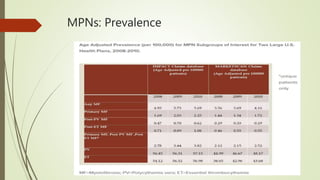
MPNs: Prevalence
References
 World health organization-Cancer-MPNs.
 www.leukaemia.org.au › Blood Cancers › Myeloproliferative neoplasms (MPN).
 http://www.umm.edu/health/medical/altmed/condition/myeloproliferative-
disorders.
 http://emedicine.medscape.com/article/204714-differential?src=refgatesrc1.
 https://www.mdanderson.org/cancer-types/myeloproliferative-disorder.html.
 Mass General Cancer Center, 2015.
Myeloproliferative Neoplasms

Myeloproliferative Neoplasms

  • 1.
    Myeloproliferative Neoplasms Presented By: Ayaz Ahmed BS-MT,MPH-Fellow School of Public Health Dow University of Health Science Dated: 25 Jan-2018
  • 2.
    Objective  History/Background  Definition Classification/Types  Sign and Symptoms  Causes and genetics of MPNs  Diagnosis  Treatment  Prevalence  References
  • 3.
    MPNs: Background/History  Theconcept of myeloproliferative disease was first proposed in 1951 by the hematologist William Dameshek.  This reflects the underlying clonal genetic changes that are a salient feature of this group of disease.  Pre-Dameshek luminaries who laid the foundation for this unifying concept include Bennett, Virchow, Heuck, Vaquez, Osler, Di Guglielmo and Epstein.  In 1960, Nowell and Hungerford discovered the Philadelphia (Ph) chromosome in CML.
  • 5.
  • 6.
    History  In 1967,Fialkow and colleagues used X-linked polymorphisms to establish CML as a clonal stem cell disease. Also in 1967, the PV Study Group was summoned by Louis Wasserman to study the natural history of PV and conduct large-scale clinical trials.  In 1972, Janet Rowley deciphered the Ph chromosome as a reciprocal translocation between chromosomes 9 and 22, thus paving the way for its subsequent characterization as an oncogenic BCR–ABL mutation.  In 1996, Brian Druker discovered imatinib—a small molecule ABL inhibitor with exceptional therapeutic activity in CML.  In 2005, a gain-of function JAK2 mutation (JAK2V617F) was described in BCR–ABL- negative MPDs, raising the prospect of a CML-like treatment strategy in PV, ET and PMF.
  • 7.
    Terminology  Neoplasm: “NewGrowth” due to dysregulated proliferation of transformed cell.  Growth factors that regulate proliferation are reduced or eliminated by genetic mutation in transformed cell.  Benign Neoplasm: differentiated cells that don’t spread or invade surrounding tissue.  Can progress with further mutations to a malignant neoplasms.  Malignant Neoplasm: “Deadly” having potential to produce death.  Proliferating cells with potential to metastasize.  Only malignant tumors are correctly termed as cancers.  Cancer is actually a malignancy of epithelial tissue, it is also commonly used to include all malignant neoplasms.
  • 9.
    MPNs: Definition  Myeloproliferativedisorders is the general name given to a group of conditions where there is an overgrowth of cells in the bone marrow, often leading to increased numbers of cells in the blood.  The name comes for the Greek word for bone marrow - “myelo”, and “proliferative” because there is an overgrowth of the cells there. Or  MPDs are heterogeneous group of disorders characterized by cellular proliferation of one or more hematologic line in peripheral blood, distinct from acute leukemia.
  • 13.
    MPNs: Classification  Inthe most recent World Health Organization classification of hematologic malignancies, this group of diseases was renamed from "myeloproliferative diseases" to "myeloproliferative neoplasms”. FAB (French-American British) WHO (World Health Organization) Chronic myelogenous leukemia (CML) CML Polycythemia vera (PV) PV Essential thrombocythemia (ET) ET Agnogenic myeloid metaplasia (AMM)/Myelofibrosis. Chronic Idiopathic myelofibrosis (PMF) Chronic Neutrophilic Leukemia, not otherwise specified Chronic Eosinophilic Leukemia or HES Mastocytosis Myeloproliferative neoplasms, Unclassifiable
  • 15.
    Chronic Myeloid Leukemia CML results from a somatic mutation in a pluripotent hematopoietic cell.  CML is a MPD characterized by increased granulocytic cell line, associated often with platelet hyperplasia.  The disease usually involves into an accelerated phase that often terminates in acute phase. -chronic phase 3-5 years -accelerated phase 6-9 months -blastic phase 3-6 months
  • 16.
    Philadelphia Chromosome  Morethan 95% of patients with CML have Philadelphia (Ph) chromosome  A subset of patients with CML lack a detectable Ph chromosome but have the fusion product for the bcr/abl translocation detectable by reverse transcriptase polymerase chain reaction (RT-PCR)
  • 17.
  • 18.
    Normal blood peripheralsmear, showing various types of WBCs, RBCs and Platelets.
  • 19.
    Epidemiology  CML accountsfor approximately 15 percent of all cases of leukemia and approximately 3 percent of childhood leukemias  The median age of onset is 53 years.  Second most common leukemia.  The American Cancer Society estimates that 8820 new cases of chronic myelogenous leukemia (CML) will be diagnosed in the United States in 2016.  CML accounts for more than half of myeloproliferative disease cases.
  • 20.
    Polycythemia Vera  Polycythaemia(rubra) vera is a disorder in which too many red cells are produced in the bone marrow, without any identifiable cause.  A neoplastic disorder arising from a pluripotent stem cell, generally characterized by erythrocytosis, with or without thrombocytosis and leukocytosis. • Incidence 10 new cases per million worldwide. • Highest incidence in ages 50-75, but 5% occur in pts < 40 y.o.  The incidence of polycythemia vera in the United States is approximately 5-17 cases per 1 million population per year.
  • 21.
    Relative VS SecondaryPV  Normal HCT  Male: 47 ± 5 %  Female: 42 ± 5 %  Normal HB  Male: 15.0 ± 2 g/dl  Female: 13.5 ± 1.5 g/dl
  • 22.
  • 23.
    Polycythemia vera  Anuncommon disorder - distinguish from other causes of erythrocytosis.  Diagnosis depends on knowledge of erythropoiesis.  Complications most commonly from thrombosis and vascular incidents.  Long natural history with treatment
  • 24.
    PV: Natural History Latent phase – asymptomatic.  Proliferative phase - patients may be hypermetabolic or have sign & symptoms of hyperviscosity or thrombosis.  Spent phase - anemia, leukopenia, secondary myelofibrosis, increasing liver and spleen size.  Secondary AML – 1-2% of pts treated with phlebotomy alone – Certain drug therapies increase risk
  • 25.
    Essential Thrombocythemia  Proliferationof megakaryocytes causing marked increase in circulating platelets (>1 million)  morphologically abnormal platelets  splenomegaly, mucosal hemorrhage, thrombosis  Incidence: 1.5 per 100,000  Age at Dx: 60 y/o (~20% <40 y/o)  F to M ratio: 1.6 : 1
  • 27.
    Myelofibrosis  Primary myelofibrosis(also called chronic idiopathic myelofibrosis, agnogenic myeloid metaplasia) is a disorder in which normal bone marrow tissue is gradually replaced with a fibrous scar-like material. Over time, this leads to progressive bone marrow failure.  Clonal stem cell disorder affecting megakaryocytes predominantly.  All myeloproliferative disorders can result in a spent phase which can be difficult to distinguish from primary MF.  Myeloid metaplasia refers to earlier proliferative phase where extra-medullary hematopoiesis predominates.
  • 28.
    Myelofibrosis  Bone marrowfibrosis  fibroblasts may be “innocent bystanders”  fibrosis probably driven by neoplastic megakaryocytes  Middle aged adults (50-60 y/o)  Extra-medullary hematopoiesis (spleen, liver)  May occur as an extension of CML or PV  Abnormal peripheral RBCs (“tear-drop” & nucleated RBCs)  Immature WBC and abnormal platelets  Infection, thrombosis and hemorrhage as a major complication
  • 29.
  • 30.
    Myelofibrosis: Prognosis  Mediansurvival is 5 years  Transforms into AML in 5-20%  >50% patients present with symptoms of anemia and thrombocytopenia.
  • 31.
    Chronic Neutrophilic Leukemia:CNL  Chronic neutrophilic leukaemia is another rare myeloproliferative neoplasm in which too many neutrophils are made in the bone marrow. These cells spill out into the circulating blood and tend to accumulate in the liver and spleen, which become enlarged as a result.  Chronic neutrophilic leukaemia is usually a slowly progressing disease, closely related to another type of leukaemia called chronic myeloid leukaemia.  Its natural course can vary considerably between individuals with survival times ranging from 6 months to over 20 years.
  • 32.
  • 33.
    Chronic Eosinophilic Leukemia/HES Chronic eosinophilic leukaemia is a rare myeloproliferative neoplasm (blood cancer) in which too many white blood cells, called eosinophils, are made in the bone marrow.  These cells spill out of the bone marrow and accumulate in the blood and other tissues around the body.  This disorder is diagnosed by a full blood count showing persistently elevated numbers of eosinophils (a specialised white blood cell).  Many patients carry the FIP1L1-PDGFR alpha mutation.


  • 34.
    CEL/HES  Chronic eosinophilicleukaemia is a rare disease and its natural course can vary considerably between individuals. The disease may remain stable for many years, even decades, or it may quickly progress and transform to acute leukaemia.  For this reason, the most appropriate treatment for each patient is decided on an individual basis.
  • 36.
    Secondary causes ofEosinophilia
  • 37.
    Mastocytosis  Systemic mastocytosisor mast cell disease is a disorder that results from the overproduction of mast cells (a type of white blood cell), in the bone marrow.  These cells accumulate in the blood, lymph nodes (glands), skin and other body tissues. Excess numbers of mast cells release large amounts of histamine and other substances which can cause allergic type reactions in affected tissues.  For example, when these substances collect in the skin they tend to cause an itchy rash. Other allergic type symptoms may include abdominal pain and difficulty breathing.  Over 90% of patients with systemic mastocytosis carry a mutation in the c-KIT gene.
  • 38.
  • 39.
    MPNs: Sign &Symptoms  Many people with myeloproliferative disorders have no symptoms when their doctors first make the diagnosis.  One symptom shared by all myeloproliferative disorders, with the exception of essential thrombocytosis, is an enlarged spleen.  An enlarged spleen can cause abdominal pain and a feeling of fullness.
  • 40.
    Sign & Symptoms Patientsmay have a history of the following:  Easy fatigability  Anorexia, weight loss  Abdominal discomfort and early satiety secondary to splenomegaly; Most common in chronic myelogenous leukemia and agnogenic myeloid metaplasia  Easy bruising, bleeding, and/or symptoms of thrombosis  Swollen, painful joint(s) secondary to gouty arthritis that is secondary to hyperuricemia  Priapism, tinnitus, or stupor from leukostasis  Left upper quadrant and left shoulder pain as a consequence of splenic infarction and perisplenitis Clinical symptoms can include the following:  Pallor (except in patients with polycythemia vera)  Plethora secondary to polycythemia  Petechiae and/or ecchymosis  Palpable spleen and/or liver  Occasionally, syndrome of fever accompanied by painful, maculopapular, violaceous lesions on the trunk, arms, legs, and face; this is called acute febrile neutrophilic dermatosis, or Sweet syndrome
  • 41.
    MPNs: Causes  Allmyeloproliferative disorders are caused by overproduction of one or more types of cells. No one knows what triggers the overproduction of cells, but theories include:  Genetics. Some people with CML have an abnormally shortened chromosome known as the Philadelphia chromosome.  Environment. Some studies suggest that myeloproliferative disorders may result from an overexposure to radiation, electrical wiring, or chemicals.
  • 42.
  • 43.
  • 44.
  • 47.
    Mutation Frequency inChronic Phase and Post-MPN AML
  • 48.
    MPNs: Diagnosis  Asign shared by all myeloproliferative disorders, with the exception of essential thrombocytosis, is an enlarged spleen. Your doctor may detect an enlarged spleen during a routine physical examination. In addition to doing a physical exam, the doctor may also conduct the following tests:  Blood tests. To find abnormal types or numbers of red or white blood cells. They can also detect anemia and leukemia.  Bone marrow biopsy. Your doctor may take a sample of bone marrow after blood tests. It can show the presence of abnormal types or numbers of red or white blood cells and may detect certain types of anemia and cancer in the marrow.  Cytogenetic analysis. Your doctor may view blood or bone marrow are viewed under a microscope to look for changes in the chromosomes.i.e. philedalphia  JAK2 gene mutation test: lab test done on bone marrow or a blood sample to look for a change (mutation) in a piece of genetic material in your cells (a gene) call JAK2. This is often found in three of the Myeloproliferative Disorders: polycythemia vera, essential thrombocytopenia, or primary myelofibrosis.
  • 52.
    MPNs: Treatment  Myeloproliferativedisorder is often challenging to treat, and it may require years of therapy and follow-up care. Treatments for MPD generally are aimed at controlling disease symptoms, and your symptoms will help the doctor decide which treatment is best. Therapies may include one or more of the following.  Medications; Aspirin, hydroxyurea, anagrelide and interferon-alpha are the main medications for essential thrombocytemia and polycythemia vera. Thalidomide, steroids and other hormones, and cladribine and busulfan also may be used.  Blood or platelet transfusion  Growth factors, which stimulate growth of bone marrow cells, are given as injections under the skin (Sub-cutaneous) and may benefit patients with low blood cell counts.  Radiation therapy and Chemotherapy  Surgical removal of the spleen  Phlebotomy
  • 53.
     Treatment optionsmay include the use of chemotherapy drugs such as busulphan or hydroxyurea, which are given in tablet or capsule form. These drugs are used to control the high white cell count.
  • 54.
    MPNs: Treatment  BCR-ABLkinase inhibitors  May not prevent progression to crisis.  Allogenic BMT  Most Effective treatment
  • 55.
  • 56.
    References  World healthorganization-Cancer-MPNs.  www.leukaemia.org.au › Blood Cancers › Myeloproliferative neoplasms (MPN).  http://www.umm.edu/health/medical/altmed/condition/myeloproliferative- disorders.  http://emedicine.medscape.com/article/204714-differential?src=refgatesrc1.  https://www.mdanderson.org/cancer-types/myeloproliferative-disorder.html.  Mass General Cancer Center, 2015.