Acute CNS infection
• What is it?
• What causes it?
• What happens in the system?
• How to recognize it?
• How to prove it?
• How to treat it?
• How to prevent?
Significance
• Significant morbidity & mortality in
children [1.2m cases worldwide]
• Diagnosis, challenging in young children
• High incidence of sequalae
• Fever with altered sensorium
• Virus > bacteria > fungi & parasite
• Meningitis
• Meningoencephalitis
• Brain abscess
• Common symptoms
photophobia,neckpain/rigidity,stupor,fits
• Diagnosis by CSF
Pyogenic meningitis
Etiology
• < 2months
• Maternal flora; NICU/PNW flora;
• GBS, GDS, gram-ve, listeria, HIB,
• 2m-12m
• Pneumococci, meningococci, HIB[now less]
• Pseudomonos, staph.aureus, CONS.
Reasons for infection
• Less immunity
• Contact with people with invasive disease
• Occult bacteremia [infants]
• Immunodeficiency
• Splenic dysfunction
• CSF leak ,Meningomyelocele
• CSF shunt infection
Risk of infection
• Pneumococci
OM, sinusitis, pneumonia, CSF rhinorrhea.
• Meningococci
contact with adults, nasopharyngeal carriage
• HIB
Contact in daycare centre
Pathogenesis
• Colonisation of nasopharynx
• Prior/concurrent viral URTI
• Bacteremia
• Hematogenous dissemination
• Contiguous spread from sinus, otitis, orbit
vertebral trauma, meningocele.
Why few only get meningitis?
• Defective opsonic phagocytosis
– Developmental defects
– Absent preformed anticapsular antibodies
– Deficient complement/properdin system
– Splenic dysfunction
Pathogenesis
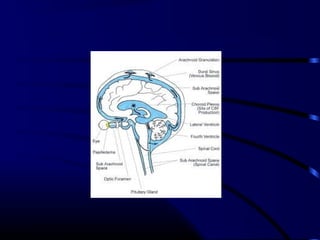
• Bacteria enter through choroid plexus of
LV
• Circulate to extra cerebral CSF &
subarachnoid space
• Rapidly multiply in CSF
• Release of inflammatory mediators
• Neutrophilic infiltrates
• Inc.vascular permeability
• Altered BBB
• Vascular thrombosis
Pathology
• Thick exudate covering all areas
• Ventriculitis, arteritis, thrombosis
• Vascular occlusion, sinus occlusion.
• Cortical necrosis, cerebral infarct
• Subarachnoid hemorrhage
• Hydrocephalus
• ICT, inflammation of spinal nerves
Clinical features
• Nonspecific
– Fever,anorexia,myalgia,arthralgia,headache,
– Purpura , petechiae,rash,photophobia.
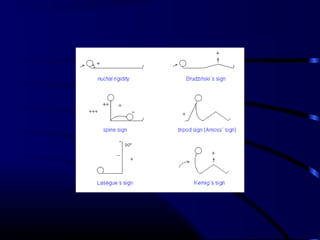
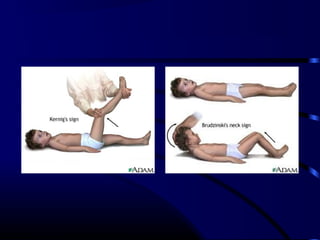
• Meningeal signs
– Neck rigidity, backache.
– Kernig sign
– Brudzinski sign
– Crossed leg sign
ICT signs
 Headache,vomiting,
 Fits
 Ptosis, squint,
 AF bulge, widened sutures
 Hypertension, bradycardia
 Stupor, coma
 Abnormal posturing
 Papilloedema [only in chronic ICT]
• Focal neurological deficit
• Cranial neuropathy
– 3rd
nerve
– 6th
nerve
– 7th
nerve
– 8th
nerve
Diagnosis
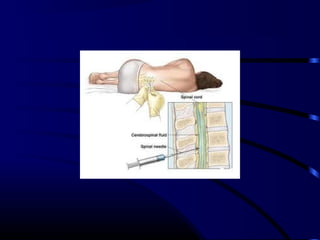
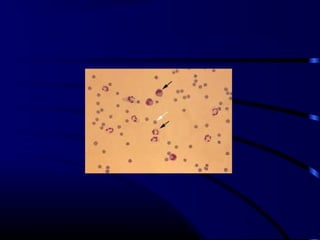
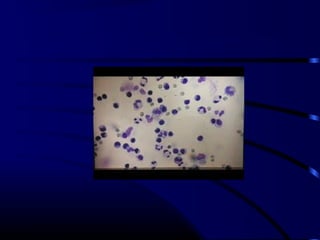
• LP & CSF analysis
– Gram stain
– Culture
– Cell count
– Glucose, protein
– [Contraindications for LP]
• Blood culture
CSF analysis
• Cell count
– Normal
• NB >30/mm3
• Child >5/mm3
– Meningitis >1000/mm3
• Turbid 200-400/mm3
• Early; lymphocytic predominance
• Later; neutrophilic predominance
• low in severe sepsis
CSF analysis in prior antibiotic
therapy
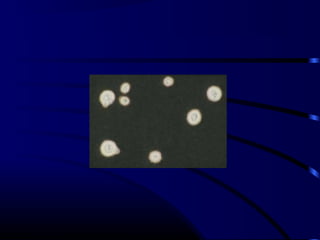
• Culture, gramstain altered
• Pleocytosis, protein, glucose unaltered
Traumatic LP
• Cell count,protein level altered
• Glucose, bacteriology unaltered.
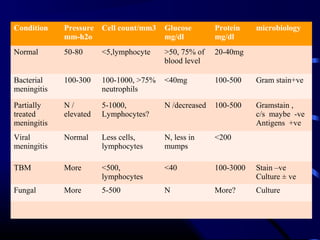
Condition Pressure
mm-h2o
Cell count/mm3 Glucose
mg/dl
Protein
mg/dl
microbiology
Normal 50-80 <5,lymphocyte >50, 75% of
blood level
20-40mg
Bacterial
meningitis
100-300 100-1000, >75%
neutrophils
<40mg 100-500 Gram stain+ve
Partially
treated
meningitis
N /
elevated
5-1000,
Lymphocytes?
N /decreased 100-500 Gramstain ,
c/s maybe -ve
Antigens +ve
Viral
meningitis
Normal Less cells,
lymphocytes
N, less in
mumps
<200
TBM More <500,
lymphocytes
<40 100-3000 Stain –ve
Culture ± ve
Fungal More 5-500 N More? Culture
Treatment
• Rapidly progressive [ ~24h]
LP  antibiotics
ICT , FND  CTbrain & antibiotics
Manage shock, ARDS
• Subacute course [4-7d]
• Assess for ICT, FND
• Antibiotics  CT  LP
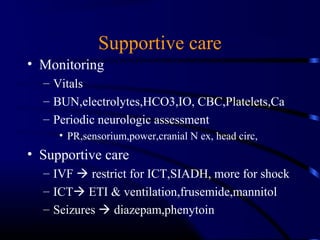
Supportive care
• Monitoring
– Vitals
– BUN,electrolytes,HCO3,IO, CBC,Platelets,Ca
– Periodic neurologic assessment
• PR,sensorium,power,cranial N ex, head circ,
• Supportive care
– IVF  restrict for ICT,SIADH, more for shock
– ICT ETI & ventilation,frusemide,mannitol
– Seizures  diazepam,phenytoin
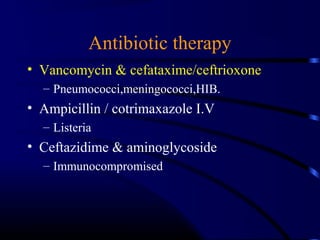
Antibiotic therapy
• Vancomycin & cefataxime/ceftrioxone
– Pneumococci,meningococci,HIB.
• Ampicillin / cotrimaxazole I.V
– Listeria
• Ceftazidime & aminoglycoside
– Immunocompromised
Duration of therapy
 Pneumococci : 7-10 days
 Menigococci: 5-7 days
 HIB; 7-10 days
 E.coli,Pseudomonos ; 3 weeks
 Antibiotics started before LP [partially
treated meningitis] ; ceftrioxone 7-10 days.
Repeat LP
• After 48h
• For ; resistant pneumococci,
gram-ve meningitis
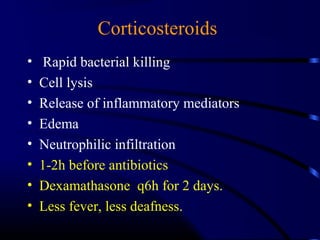
Corticosteroids
• Rapid bacterial killing
• Cell lysis
• Release of inflammatory mediators
• Edema
• Neutrophilic infiltration
• 1-2h before antibiotics
• Dexamathasone q6h for 2 days.
• Less fever, less deafness.
Complications
• ICT, Herniation
• Fits, Cranial N palsy
• Dural V sinus thrombosis
• Subdural effusion
• SIADH
• Pericarditis, Arthritis
• Anemia, DIC
Prognosis
• Mortality >10% [more in pneumococci]
• Prognosis poor in
– Infants
– Fits >4days
– Coma, FND on presentation
• Neurological sequalae 20%
– Behavior changes 50%
– Deafness [pneumo,HIB],visual loss
– MR,fits,
Prevention
• Meningococci
– Rifampacin for close contacts [10mg/kg/day q12h for
2days]
– Quadrivalent vaccine for high risk children
• HIB
– Rifampacin for contacts for 4days
– Conjugate vaccine
• Pneumococci
– Heptavalent conjugate vaccine
TBM
• Subacute / ?chronic meningitis
• From lymphohematogenous dissemination
• Caseous lesion in cortex / meninges
• Discharge of TB bacilli in CSF
• Thick exudate infiltrate blood vessels
• Inflammation,obstruction,infarct.
• Brainstem affected
• Cranial N dysfunction
• Hydrocephalus
• Infarcts
• Cerebral edema
• SIADH
• Dyselectrolytemia
Features
• 6m-4yrs
• 3 stages
• Prodrome stage; 1-2 wks, nonspecific
symptoms, stagnant development
• Abrupt stage;lethargy,fits,meningeal signs
focal ND,cranial neuropathy,hydrocephalus.
Encephalitic picture
• Coma stage; posturing,hemi/paraplegia,poor
vital signs
Diagnosis
• Contact with adult TB
• Mx nonreactive 50%
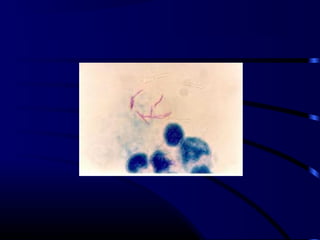
• CSF – lymphocytes
• Glucose <40mg/dl
• Protein high: 400-5000mg/dl
• AFB +ve 30%
Thank you
Meningoencephalitis
• Acute inflammation of meninges & brain
tissue
• CSF – pleocytosis
• Gram stain & culture negative
• Mostly self limiting
Etiology
• Enterovirus
• Arbovirus
• Herpes virus
Pathogenesis
• Direct invasion & destruction by virus
• Host reaction to viral antigens
• Meningeal congestion
• Mononuclear infiltration
• Neuronal disruption
• Neuronophagia
• Demyelination
Structures affected
• HSV; temporal lobe
• Arbovirus; entire brain
• Rabies; basal parts
Clinical features
• Depends on parenchymal involvement
• Preceding mild febrile illness & exantheme
• Acute onset of high fever, headache,
irritability,lethargy,nausea,myalgia
• Convulsions,stupor,coma
• Fluctuating FND,emotional outburst
• Ant.horn cell injuryflaccid paralysis [west
nile,entero virus]
DD
• Meningitis of various organisms
Diagnosis
• CSF: lymphocytic predominance
– Protein: normal,high in HSV
– Glucose: normal,low in mumps
– Culture of organism [entero V]
– Viral antigen by PCR
– Culture from Npswab,feces,urine
• EEG: focal seizures [temporal];HSV
• CT/MRI: swollen brain parenchyma
Treatment
• Acyclovir for HSV
• Non aspirin analgesic
• Nurse in a quiet room

Acute cns infection

  • 1.
  • 2.
    • What isit? • What causes it? • What happens in the system? • How to recognize it? • How to prove it? • How to treat it? • How to prevent?
  • 3.
    Significance • Significant morbidity& mortality in children [1.2m cases worldwide] • Diagnosis, challenging in young children • High incidence of sequalae
  • 4.
    • Fever withaltered sensorium • Virus > bacteria > fungi & parasite • Meningitis • Meningoencephalitis • Brain abscess • Common symptoms photophobia,neckpain/rigidity,stupor,fits • Diagnosis by CSF
  • 6.
  • 7.
    Etiology • < 2months •Maternal flora; NICU/PNW flora; • GBS, GDS, gram-ve, listeria, HIB, • 2m-12m • Pneumococci, meningococci, HIB[now less] • Pseudomonos, staph.aureus, CONS.
  • 8.
    Reasons for infection •Less immunity • Contact with people with invasive disease • Occult bacteremia [infants] • Immunodeficiency • Splenic dysfunction • CSF leak ,Meningomyelocele • CSF shunt infection
  • 9.
    Risk of infection •Pneumococci OM, sinusitis, pneumonia, CSF rhinorrhea. • Meningococci contact with adults, nasopharyngeal carriage • HIB Contact in daycare centre
  • 10.
    Pathogenesis • Colonisation ofnasopharynx • Prior/concurrent viral URTI • Bacteremia • Hematogenous dissemination • Contiguous spread from sinus, otitis, orbit vertebral trauma, meningocele.
  • 11.
    Why few onlyget meningitis? • Defective opsonic phagocytosis – Developmental defects – Absent preformed anticapsular antibodies – Deficient complement/properdin system – Splenic dysfunction
  • 12.
    Pathogenesis • Bacteria enterthrough choroid plexus of LV • Circulate to extra cerebral CSF & subarachnoid space • Rapidly multiply in CSF • Release of inflammatory mediators • Neutrophilic infiltrates • Inc.vascular permeability • Altered BBB • Vascular thrombosis
  • 13.
    Pathology • Thick exudatecovering all areas • Ventriculitis, arteritis, thrombosis • Vascular occlusion, sinus occlusion. • Cortical necrosis, cerebral infarct • Subarachnoid hemorrhage • Hydrocephalus • ICT, inflammation of spinal nerves
  • 14.
    Clinical features • Nonspecific –Fever,anorexia,myalgia,arthralgia,headache, – Purpura , petechiae,rash,photophobia. • Meningeal signs – Neck rigidity, backache. – Kernig sign – Brudzinski sign – Crossed leg sign
  • 17.
    ICT signs  Headache,vomiting, Fits  Ptosis, squint,  AF bulge, widened sutures  Hypertension, bradycardia  Stupor, coma  Abnormal posturing  Papilloedema [only in chronic ICT]
  • 18.
    • Focal neurologicaldeficit • Cranial neuropathy – 3rd nerve – 6th nerve – 7th nerve – 8th nerve
  • 19.
    Diagnosis • LP &CSF analysis – Gram stain – Culture – Cell count – Glucose, protein – [Contraindications for LP] • Blood culture
  • 21.
    CSF analysis • Cellcount – Normal • NB >30/mm3 • Child >5/mm3 – Meningitis >1000/mm3 • Turbid 200-400/mm3 • Early; lymphocytic predominance • Later; neutrophilic predominance • low in severe sepsis
  • 26.
    CSF analysis inprior antibiotic therapy • Culture, gramstain altered • Pleocytosis, protein, glucose unaltered
  • 27.
    Traumatic LP • Cellcount,protein level altered • Glucose, bacteriology unaltered.
  • 28.
    Condition Pressure mm-h2o Cell count/mm3Glucose mg/dl Protein mg/dl microbiology Normal 50-80 <5,lymphocyte >50, 75% of blood level 20-40mg Bacterial meningitis 100-300 100-1000, >75% neutrophils <40mg 100-500 Gram stain+ve Partially treated meningitis N / elevated 5-1000, Lymphocytes? N /decreased 100-500 Gramstain , c/s maybe -ve Antigens +ve Viral meningitis Normal Less cells, lymphocytes N, less in mumps <200 TBM More <500, lymphocytes <40 100-3000 Stain –ve Culture ± ve Fungal More 5-500 N More? Culture
  • 29.
    Treatment • Rapidly progressive[ ~24h] LP  antibiotics ICT , FND  CTbrain & antibiotics Manage shock, ARDS • Subacute course [4-7d] • Assess for ICT, FND • Antibiotics  CT  LP
  • 30.
    Supportive care • Monitoring –Vitals – BUN,electrolytes,HCO3,IO, CBC,Platelets,Ca – Periodic neurologic assessment • PR,sensorium,power,cranial N ex, head circ, • Supportive care – IVF  restrict for ICT,SIADH, more for shock – ICT ETI & ventilation,frusemide,mannitol – Seizures  diazepam,phenytoin
  • 31.
    Antibiotic therapy • Vancomycin& cefataxime/ceftrioxone – Pneumococci,meningococci,HIB. • Ampicillin / cotrimaxazole I.V – Listeria • Ceftazidime & aminoglycoside – Immunocompromised
  • 32.
    Duration of therapy Pneumococci : 7-10 days  Menigococci: 5-7 days  HIB; 7-10 days  E.coli,Pseudomonos ; 3 weeks  Antibiotics started before LP [partially treated meningitis] ; ceftrioxone 7-10 days.
  • 33.
    Repeat LP • After48h • For ; resistant pneumococci, gram-ve meningitis
  • 34.
    Corticosteroids • Rapid bacterialkilling • Cell lysis • Release of inflammatory mediators • Edema • Neutrophilic infiltration • 1-2h before antibiotics • Dexamathasone q6h for 2 days. • Less fever, less deafness.
  • 35.
    Complications • ICT, Herniation •Fits, Cranial N palsy • Dural V sinus thrombosis • Subdural effusion • SIADH • Pericarditis, Arthritis • Anemia, DIC
  • 36.
    Prognosis • Mortality >10%[more in pneumococci] • Prognosis poor in – Infants – Fits >4days – Coma, FND on presentation • Neurological sequalae 20% – Behavior changes 50% – Deafness [pneumo,HIB],visual loss – MR,fits,
  • 37.
    Prevention • Meningococci – Rifampacinfor close contacts [10mg/kg/day q12h for 2days] – Quadrivalent vaccine for high risk children • HIB – Rifampacin for contacts for 4days – Conjugate vaccine • Pneumococci – Heptavalent conjugate vaccine
  • 38.
    TBM • Subacute /?chronic meningitis • From lymphohematogenous dissemination • Caseous lesion in cortex / meninges • Discharge of TB bacilli in CSF • Thick exudate infiltrate blood vessels • Inflammation,obstruction,infarct.
  • 39.
    • Brainstem affected •Cranial N dysfunction • Hydrocephalus • Infarcts • Cerebral edema • SIADH • Dyselectrolytemia
  • 40.
    Features • 6m-4yrs • 3stages • Prodrome stage; 1-2 wks, nonspecific symptoms, stagnant development • Abrupt stage;lethargy,fits,meningeal signs focal ND,cranial neuropathy,hydrocephalus. Encephalitic picture • Coma stage; posturing,hemi/paraplegia,poor vital signs
  • 41.
    Diagnosis • Contact withadult TB • Mx nonreactive 50% • CSF – lymphocytes • Glucose <40mg/dl • Protein high: 400-5000mg/dl • AFB +ve 30%
  • 42.
  • 43.
  • 44.
    • Acute inflammationof meninges & brain tissue • CSF – pleocytosis • Gram stain & culture negative • Mostly self limiting
  • 45.
  • 46.
    Pathogenesis • Direct invasion& destruction by virus • Host reaction to viral antigens • Meningeal congestion • Mononuclear infiltration • Neuronal disruption • Neuronophagia • Demyelination
  • 47.
    Structures affected • HSV;temporal lobe • Arbovirus; entire brain • Rabies; basal parts
  • 48.
    Clinical features • Dependson parenchymal involvement • Preceding mild febrile illness & exantheme • Acute onset of high fever, headache, irritability,lethargy,nausea,myalgia • Convulsions,stupor,coma • Fluctuating FND,emotional outburst • Ant.horn cell injuryflaccid paralysis [west nile,entero virus]
  • 49.
    DD • Meningitis ofvarious organisms
  • 50.
    Diagnosis • CSF: lymphocyticpredominance – Protein: normal,high in HSV – Glucose: normal,low in mumps – Culture of organism [entero V] – Viral antigen by PCR – Culture from Npswab,feces,urine • EEG: focal seizures [temporal];HSV • CT/MRI: swollen brain parenchyma
  • 51.
    Treatment • Acyclovir forHSV • Non aspirin analgesic • Nurse in a quiet room