Creating digital literacy - notes
from the field
Literacy and citizenship in the digital age, seminar
at University of Copenhagen November 10 2017
Kjetil Sandvik, Media, Cognition and Communication, University of
Copenhagen
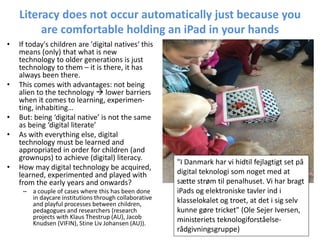
Literacy does not occur automatically just because you
are comfortable holding an iPad in your hands
• If today's children are 'digital natives‘ this
means (only) that what is new
technology to older generations is just
technology to them – it is there, it has
always been there.
• This comes with advantages: not being
alien to the technology  lower barriers
when it comes to learning, experimen-
ting, inhabiting…
• But: being ‘digital native’ is not the same
as being ‘digital literate’
• As with everything else, digital
technology must be learned and
appropriated in order for children (and
grownups) to achieve (digital) literacy.
• How may digital technology be acquired,
learned, experimented and played with
from the early years and onwards?
– a couple of cases where this has been done
in daycare institutions through collaborative
and playful processes between children,
pedagogues and researchers (research
projects with Klaus Thestrup (AU), Jacob
Knudsen (VIFIN), Stine Liv Johansen (AU)).
"I Danmark har vi hidtil fejlagtigt set på
digital teknologi som noget med at
sætte strøm til penalhuset. Vi har bragt
iPads og elektroniske tavler ind i
klasselokalet og troet, at det i sig selv
kunne gøre tricket" (Ole Sejer Iversen,
ministeriets teknologiforståelse-
rådgivningsgruppe)
Approaches to technology
• Institutional
• Formalized, fixed formats
• ‘first we add technology’
• STEM/STEAM oriented
• Tech-fetishism: we must
have… smart boards, iPads,
Chrome Books etc.
• Learning goals-focused:
having decided the
pedagogical use of
technology
• User-centered
• Informal, emergent formats
• ‘first we add people’
• Technology as means not
goals
• pedagogies and practices
need to be developed
• Not strictly focused on
learning goals:
experimenting with the
pedagogical potentials of
technology
OR
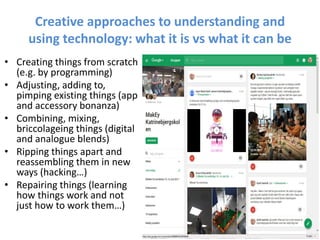
Creative approaches to understanding and
using technology: what it is vs what it can be
• Creating things from scratch
(e.g. by programming)
• Adjusting, adding to,
pimping existing things (app
and accessory bonanza)
• Combining, mixing,
briccolageing things (digital
and analogue blends)
• Ripping things apart and
reassembling them in new
ways (hacking…)
• Repairing things (learning
how things work and not
just how to work them…)
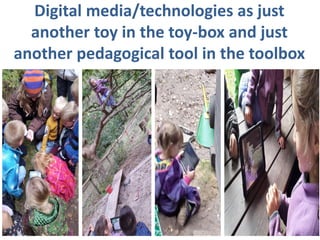
Digital media/technologies as just
another toy in the toy-box and just
another pedagogical tool in the toolbox
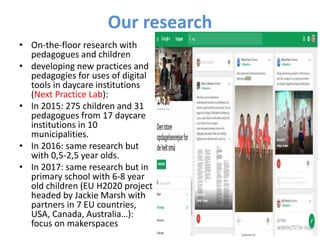
Our research
• On-the-floor research with
pedagogues and children
• developing new practices and
pedagogies for uses of digital
tools in daycare institutions
(Next Practice Lab):
• In 2015: 275 children and 31
pedagogues from 17 daycare
institutions in 10
municipalities.
• In 2016: same research but
with 0,5-2,5 year olds.
• In 2017: same research but in
primary school with 6-8 year
old children (EU H2020 project
headed by Jackie Marsh with
partners in 7 EU countries,
USA, Canada, Australia…):
focus on makerspaces
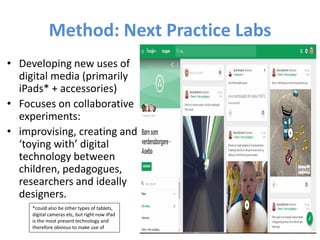
Method: Next Practice Labs
• Developing new uses of
digital media (primarily
iPads* + accessories)
• Focuses on collaborative
experiments:
• improvising, creating and
‘toying with’ digital
technology between
children, pedagogues,
researchers and ideally
designers.
*could also be other types of tablets,
digital cameras etc, but right now iPad
is the most present technology and
therefore obvious to make use of
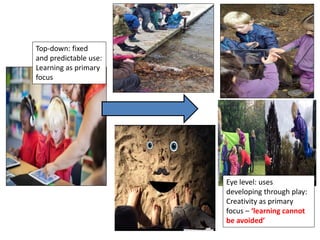
Top-down: fixed
and predictable use:
Learning as primary
focus
Eye level: uses
developing through play:
Creativity as primary
focus – ‘learning cannot
be avoided’
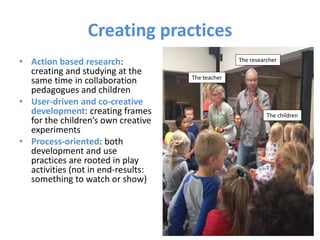
Creating practices
• Action based research:
creating and studying at the
same time in collaboration
pedagogues and children
• User-driven and co-creative
development: creating frames
for the children’s own creative
experiments
• Process-oriented: both
development and use
practices are rooted in play
activities (not in end-results:
something to watch or show)
The teacher
The children
The researcher
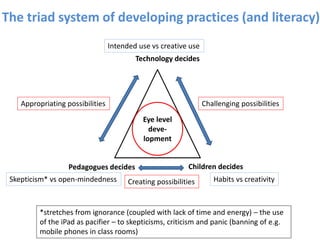
Technology decides
Pedagogues decides Children decides
Intended use vs creative use
Skepticism* vs open-mindedness Habits vs creativity
Appropriating possibilities Challenging possibilities
Eye level
deve-
lopment
The triad system of developing practices (and literacy)
Creating possibilities
*stretches from ignorance (coupled with lack of time and energy) – the use
of the iPad as pacifier – to skepticisms, criticism and panic (banning of e.g.
mobile phones in class rooms)
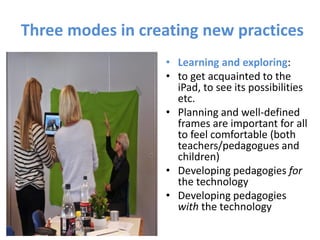
Three modes in creating new practices
• Learning and exploring:
• to get acquainted to the
iPad, to see its possibilities
etc.
• Planning and well-defined
frames are important for all
to feel comfortable (both
teachers/pedagogues and
children)
• Developing pedagogies for
the technology
• Developing pedagogies
with the technology
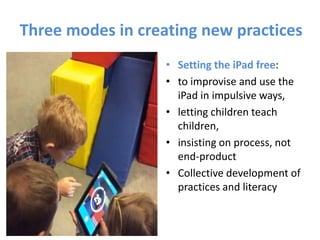
Three modes in creating new practices
• Setting the iPad free:
• to improvise and use the
iPad in impulsive ways,
• letting children teach
children,
• insisting on process, not
end-product
• Collective development of
practices and literacy
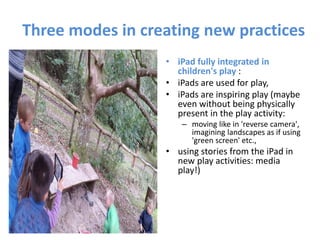
Three modes in creating new practices
• iPad fully integrated in
children's play :
• iPads are used for play,
• iPads are inspiring play (maybe
even without being physically
present in the play activity:
– moving like in 'reverse camera',
imagining landscapes as if using
'green screen' etc.,
• using stories from the iPad in
new play activities: media
play!)
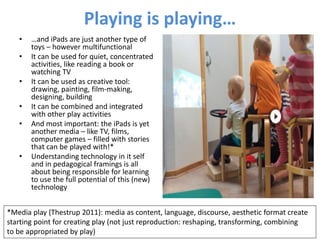
Playing is playing…
• …and iPads are just another type of
toys – however multifunctional
• It can be used for quiet, concentrated
activities, like reading a book or
watching TV
• It can be used as creative tool:
drawing, painting, film-making,
designing, building
• It can be combined and integrated
with other play activities
• And most important: the iPads is yet
another media – like TV, films,
computer games – filled with stories
that can be played with!*
• Understanding technology in it self
and in pedagogical framings is all
about being responsible for learning
to use the full potential of this (new)
technology
*Media play (Thestrup 2011): media as content, language, discourse, aesthetic format create
starting point for creating play (not just reproduction: reshaping, transforming, combining
to be appropriated by play)

Sandvik creating-digital-literacy-101117

  • 1.
    Creating digital literacy- notes from the field Literacy and citizenship in the digital age, seminar at University of Copenhagen November 10 2017 Kjetil Sandvik, Media, Cognition and Communication, University of Copenhagen
  • 2.
    Literacy does notoccur automatically just because you are comfortable holding an iPad in your hands • If today's children are 'digital natives‘ this means (only) that what is new technology to older generations is just technology to them – it is there, it has always been there. • This comes with advantages: not being alien to the technology  lower barriers when it comes to learning, experimen- ting, inhabiting… • But: being ‘digital native’ is not the same as being ‘digital literate’ • As with everything else, digital technology must be learned and appropriated in order for children (and grownups) to achieve (digital) literacy. • How may digital technology be acquired, learned, experimented and played with from the early years and onwards? – a couple of cases where this has been done in daycare institutions through collaborative and playful processes between children, pedagogues and researchers (research projects with Klaus Thestrup (AU), Jacob Knudsen (VIFIN), Stine Liv Johansen (AU)). "I Danmark har vi hidtil fejlagtigt set på digital teknologi som noget med at sætte strøm til penalhuset. Vi har bragt iPads og elektroniske tavler ind i klasselokalet og troet, at det i sig selv kunne gøre tricket" (Ole Sejer Iversen, ministeriets teknologiforståelse- rådgivningsgruppe)
  • 3.
    Approaches to technology •Institutional • Formalized, fixed formats • ‘first we add technology’ • STEM/STEAM oriented • Tech-fetishism: we must have… smart boards, iPads, Chrome Books etc. • Learning goals-focused: having decided the pedagogical use of technology • User-centered • Informal, emergent formats • ‘first we add people’ • Technology as means not goals • pedagogies and practices need to be developed • Not strictly focused on learning goals: experimenting with the pedagogical potentials of technology OR
  • 4.
    Creative approaches tounderstanding and using technology: what it is vs what it can be • Creating things from scratch (e.g. by programming) • Adjusting, adding to, pimping existing things (app and accessory bonanza) • Combining, mixing, briccolageing things (digital and analogue blends) • Ripping things apart and reassembling them in new ways (hacking…) • Repairing things (learning how things work and not just how to work them…)
  • 5.
    Digital media/technologies asjust another toy in the toy-box and just another pedagogical tool in the toolbox
  • 6.
    Our research • On-the-floorresearch with pedagogues and children • developing new practices and pedagogies for uses of digital tools in daycare institutions (Next Practice Lab): • In 2015: 275 children and 31 pedagogues from 17 daycare institutions in 10 municipalities. • In 2016: same research but with 0,5-2,5 year olds. • In 2017: same research but in primary school with 6-8 year old children (EU H2020 project headed by Jackie Marsh with partners in 7 EU countries, USA, Canada, Australia…): focus on makerspaces
  • 7.
    Method: Next PracticeLabs • Developing new uses of digital media (primarily iPads* + accessories) • Focuses on collaborative experiments: • improvising, creating and ‘toying with’ digital technology between children, pedagogues, researchers and ideally designers. *could also be other types of tablets, digital cameras etc, but right now iPad is the most present technology and therefore obvious to make use of
  • 8.
    Top-down: fixed and predictableuse: Learning as primary focus Eye level: uses developing through play: Creativity as primary focus – ‘learning cannot be avoided’
  • 9.
    Creating practices • Actionbased research: creating and studying at the same time in collaboration pedagogues and children • User-driven and co-creative development: creating frames for the children’s own creative experiments • Process-oriented: both development and use practices are rooted in play activities (not in end-results: something to watch or show) The teacher The children The researcher
  • 10.
    Technology decides Pedagogues decidesChildren decides Intended use vs creative use Skepticism* vs open-mindedness Habits vs creativity Appropriating possibilities Challenging possibilities Eye level deve- lopment The triad system of developing practices (and literacy) Creating possibilities *stretches from ignorance (coupled with lack of time and energy) – the use of the iPad as pacifier – to skepticisms, criticism and panic (banning of e.g. mobile phones in class rooms)
  • 11.
    Three modes increating new practices • Learning and exploring: • to get acquainted to the iPad, to see its possibilities etc. • Planning and well-defined frames are important for all to feel comfortable (both teachers/pedagogues and children) • Developing pedagogies for the technology • Developing pedagogies with the technology
  • 12.
    Three modes increating new practices • Setting the iPad free: • to improvise and use the iPad in impulsive ways, • letting children teach children, • insisting on process, not end-product • Collective development of practices and literacy
  • 13.
    Three modes increating new practices • iPad fully integrated in children's play : • iPads are used for play, • iPads are inspiring play (maybe even without being physically present in the play activity: – moving like in 'reverse camera', imagining landscapes as if using 'green screen' etc., • using stories from the iPad in new play activities: media play!)
  • 14.
    Playing is playing… •…and iPads are just another type of toys – however multifunctional • It can be used for quiet, concentrated activities, like reading a book or watching TV • It can be used as creative tool: drawing, painting, film-making, designing, building • It can be combined and integrated with other play activities • And most important: the iPads is yet another media – like TV, films, computer games – filled with stories that can be played with!* • Understanding technology in it self and in pedagogical framings is all about being responsible for learning to use the full potential of this (new) technology *Media play (Thestrup 2011): media as content, language, discourse, aesthetic format create starting point for creating play (not just reproduction: reshaping, transforming, combining to be appropriated by play)