What is Active Matter?
• As opposed to passive matter, it is any system consisting of
  active units with the capability of taking in, employing and
  dissipating energy.

• These often lead to large scale organization.

• They can be considered as a state of matter and some
  condensed matter theory and statistics can be applied to
  them.

• Examples: cytoskeleton with molecular motors, schools of
  fish, flocks of birds.
Criteria for Active Matter
1. The energy input takes place directly at the scale of
   each active particle, and is thus homogeneously
   distributed through the bulk of the system, unlike
   bulk fluids or matter where energy is applied at the
   boundaries.

2. Self-propelled motion is force-free: the forces that
   particle and fluid exert on each other cancel.

3. The direction of self-propelled motion is set by the
   orientation of the particle itself, not fixed by an
   external field.
Flocking: The Vicsek Model
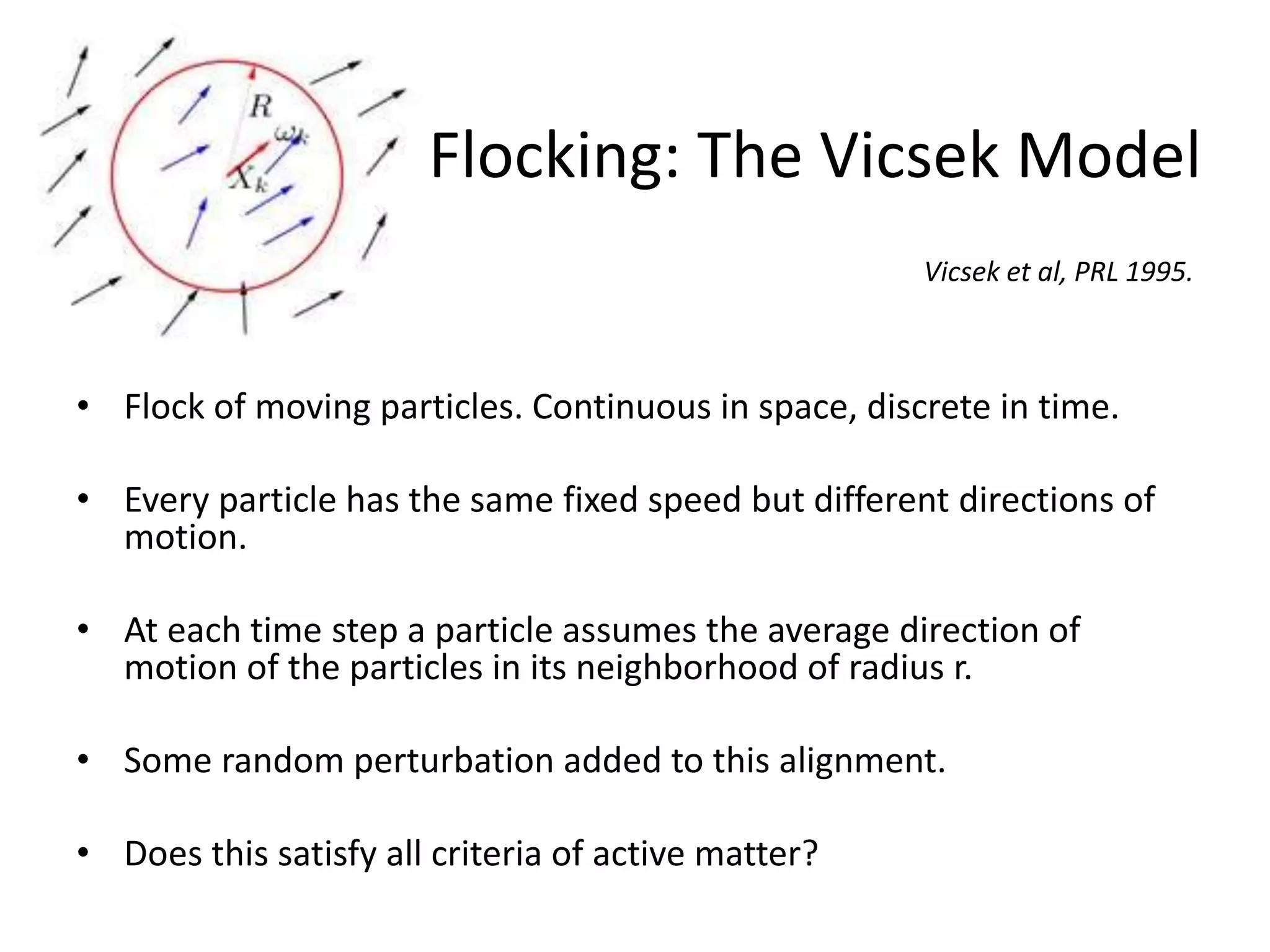
                                                      Vicsek et al, PRL 1995.


• Flock of moving particles. Continuous in space, discrete in time.

• Every particle has the same fixed speed but different directions of
  motion.

• At each time step a particle assumes the average direction of
  motion of the particles in its neighborhood of radius r.

• Some random perturbation added to this alignment.

• Does this satisfy all criteria of active matter?
Vicsek Model: some more specifics
• Starts with random density and directions and
  periodic boundary conditions.
• At every time step, the positions are updated:

• And the directions of motion:


• Statistically, the flow is continuous in space.
• Parameters: η, v (0.003 – 0.3), ρ = N/L2.
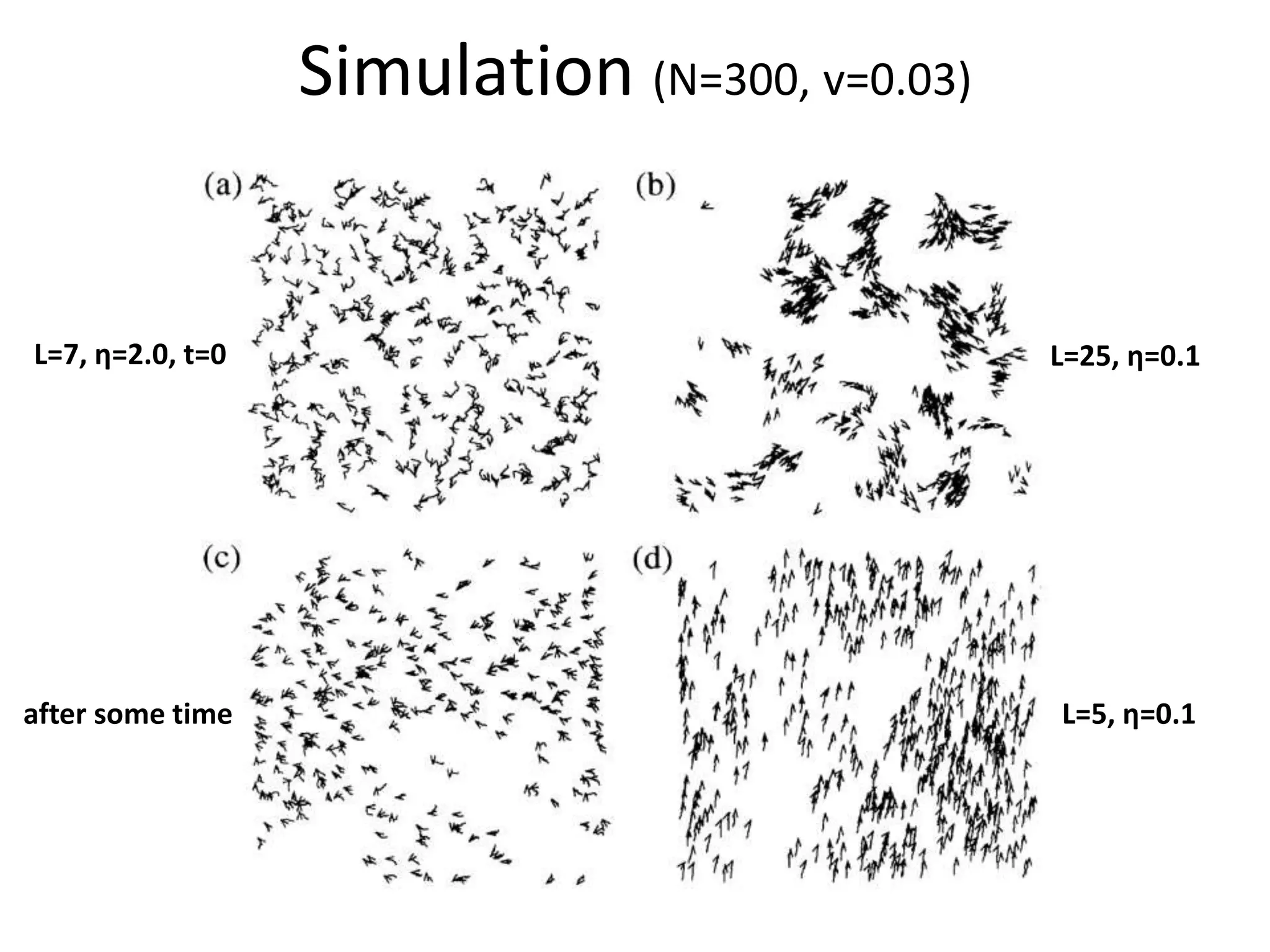
Simulation (N=300, v=0.03)


L=7, η=2.0, t=0                                L=25, η=0.1


after some time                                L=5, η=0.1
Von-Mises Distribution of Velocity


• It is the distribution of a drift-diffusion system on
  a circle with a harmonic potential.
• Parameters: mean velocity direction and density.
Phase Transition
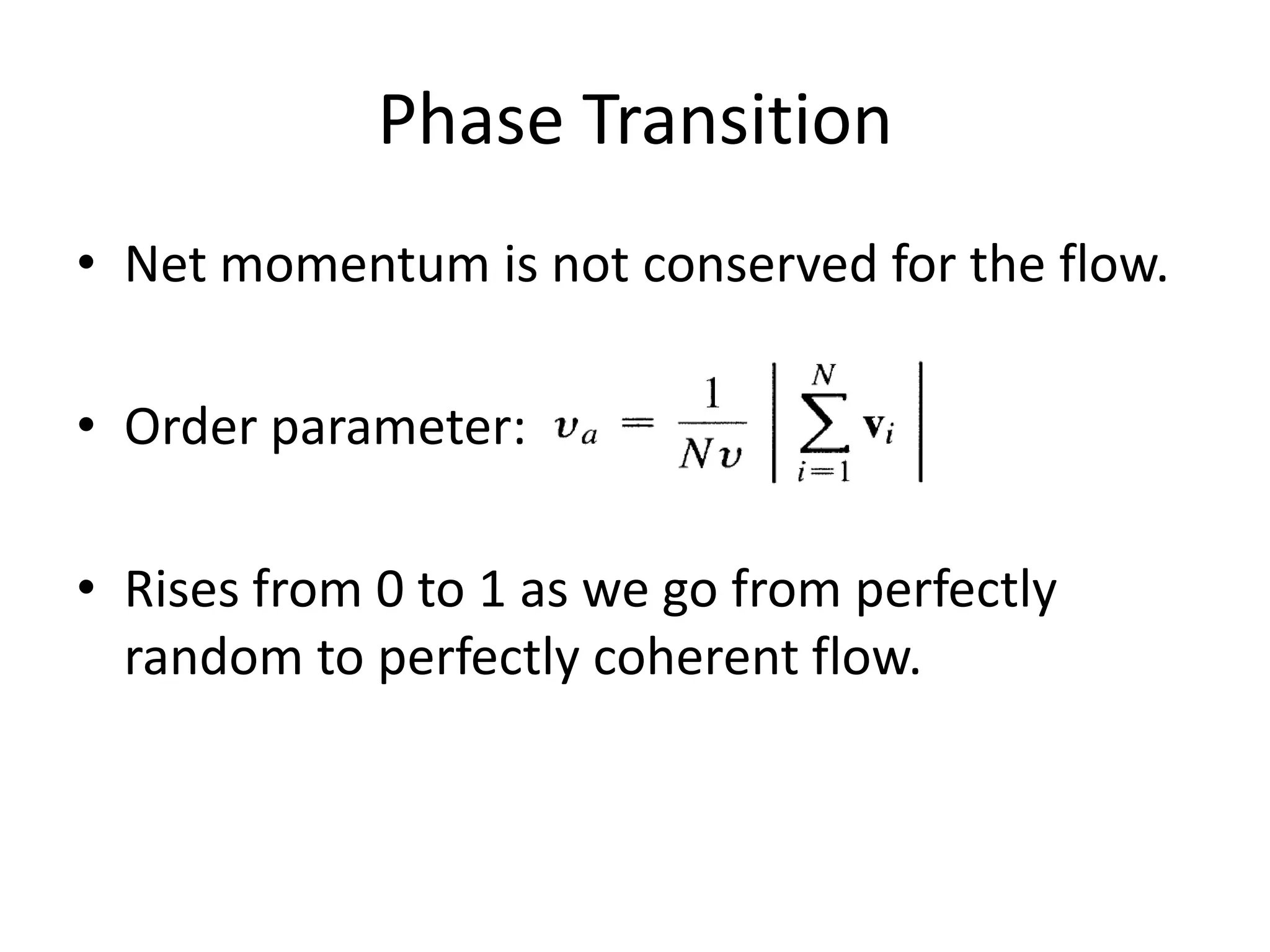
• Net momentum is not conserved for the flow.

• Order parameter:

• Rises from 0 to 1 as we go from perfectly
  random to perfectly coherent flow.
Change of
Order Parameter

• Fixed density: reaches 1
  with lowering η
  (chessboard problem).

• Fixed noise: does not
  reach 1.
Analogy with a Ferromagnetism model
• Similar tendency to locally align spins in the
  same direction.
• Random part of alignment can be connected
  to thermal noise.
• The difference is the motion in the case of the
  flock: equilibrium in ferromagnetism is a static
  uniform alignment, for the flock it is a fixed
  and uniform direction of flow for all particles.
Advantages of the Vicsek Model
• One of the simplest models of a self-driven
  system showing cooperative behaviour.
• Although self-driven systems are unusual in
  Physics, they are common in living systems.
• Transitions have been observed in traffic models
  (cars are self-driven units)
• Behaviour of the order parameter suggests that
  theoretical methods for equilibrium critical
  phenomena can be applied to self-propelled far-
  from-equilibrium systems
Limitations of the Vicsek Model
                Analysis
• It is too minimalistic to model complex living
  systems and requires more control terms.
• Does not explain how living units effect the
  averaging that is key to the working of the
  model.
• The averaging neighbourhood radius R has not
  been tuned (traffic model). This might affect
  the range of observed cooperative flow and
  thus the order parameter.
References
• The Mechanics and Statistics of Active Matter
  Sriram Ramaswamy, arXiv 1004.1993v1

• Novel Type of Phase Transition in a System of
  Self-Driven Particles
  Vicsek et al, Phys. Rev. L. 1995 v 75 no 6

• Webpage of Pierre Degond: Self-Organized
  Hydrodynamics

Active Matter and the Vicsek Model of Flocking

  • 2.
    What is ActiveMatter? • As opposed to passive matter, it is any system consisting of active units with the capability of taking in, employing and dissipating energy. • These often lead to large scale organization. • They can be considered as a state of matter and some condensed matter theory and statistics can be applied to them. • Examples: cytoskeleton with molecular motors, schools of fish, flocks of birds.
  • 3.
    Criteria for ActiveMatter 1. The energy input takes place directly at the scale of each active particle, and is thus homogeneously distributed through the bulk of the system, unlike bulk fluids or matter where energy is applied at the boundaries. 2. Self-propelled motion is force-free: the forces that particle and fluid exert on each other cancel. 3. The direction of self-propelled motion is set by the orientation of the particle itself, not fixed by an external field.
  • 4.
    Flocking: The VicsekModel Vicsek et al, PRL 1995. • Flock of moving particles. Continuous in space, discrete in time. • Every particle has the same fixed speed but different directions of motion. • At each time step a particle assumes the average direction of motion of the particles in its neighborhood of radius r. • Some random perturbation added to this alignment. • Does this satisfy all criteria of active matter?
  • 5.
    Vicsek Model: somemore specifics • Starts with random density and directions and periodic boundary conditions. • At every time step, the positions are updated: • And the directions of motion: • Statistically, the flow is continuous in space. • Parameters: η, v (0.003 – 0.3), ρ = N/L2.
  • 6.
    Simulation (N=300, v=0.03) L=7,η=2.0, t=0 L=25, η=0.1 after some time L=5, η=0.1
  • 7.
    Von-Mises Distribution ofVelocity • It is the distribution of a drift-diffusion system on a circle with a harmonic potential. • Parameters: mean velocity direction and density.
  • 8.
    Phase Transition • Netmomentum is not conserved for the flow. • Order parameter: • Rises from 0 to 1 as we go from perfectly random to perfectly coherent flow.
  • 9.
    Change of Order Parameter •Fixed density: reaches 1 with lowering η (chessboard problem). • Fixed noise: does not reach 1.
  • 10.
    Analogy with aFerromagnetism model • Similar tendency to locally align spins in the same direction. • Random part of alignment can be connected to thermal noise. • The difference is the motion in the case of the flock: equilibrium in ferromagnetism is a static uniform alignment, for the flock it is a fixed and uniform direction of flow for all particles.
  • 11.
    Advantages of theVicsek Model • One of the simplest models of a self-driven system showing cooperative behaviour. • Although self-driven systems are unusual in Physics, they are common in living systems. • Transitions have been observed in traffic models (cars are self-driven units) • Behaviour of the order parameter suggests that theoretical methods for equilibrium critical phenomena can be applied to self-propelled far- from-equilibrium systems
  • 12.
    Limitations of theVicsek Model Analysis • It is too minimalistic to model complex living systems and requires more control terms. • Does not explain how living units effect the averaging that is key to the working of the model. • The averaging neighbourhood radius R has not been tuned (traffic model). This might affect the range of observed cooperative flow and thus the order parameter.
  • 13.
    References • The Mechanicsand Statistics of Active Matter Sriram Ramaswamy, arXiv 1004.1993v1 • Novel Type of Phase Transition in a System of Self-Driven Particles Vicsek et al, Phys. Rev. L. 1995 v 75 no 6 • Webpage of Pierre Degond: Self-Organized Hydrodynamics