
THE MOORE-SPIEGEL
OSCILLATOR


ABHRANIL DAS
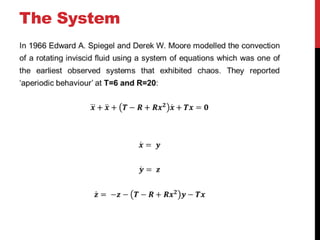
The System
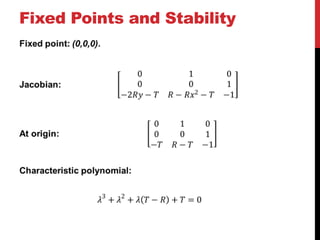
Fixed Points and Stability
Numerical Root-finding
%    Newton-Raphson method to find roots
disp 'Newton-Raphson Method'
syms x;
i=0;
f=input('f: ');                                    %   User inputs function here
y=input('seed x: ');                               %   and seed value here
while (abs(subs(f,x,y)/subs(diff(f),x,y))>1e-15)   %   termination criterion
         y=y-subs(f,x,y)/subs(diff(f),x,y);
         i=i+1;
end
x=y                                                %   print result
i                                                  %   and iterations

%    Bisection method to find roots
disp 'Bisection Method'
a=input('a: ');                                    %   start
b=input('b: ');                                    %   and end of starting interval
j=0;                                               %   iteration count
syms x;
while (b-a>0.000001)                               %   termination criterion
     mid=(a+b)/2;
     if subs(f,x,b)*subs(f,x,mid)<0
          a=mid;
     else
          b=mid;
     end
j=j+1;
end
x=mid
j
Roots for T=6 and R=20


     Root     Seed (Newton-     Interval
                Raphson)      (Bisection)
        3           5              [0,5]
     0.4495         0              [0,1]
    -4.4495         -5            [-5,0]
Phase-Space Plots with RK4/5 (General Code)
   t=10; N=10000; h=float(t)/N; l=range(3)
   T=6; R=20
   x=list(input('Starting x,y,z: '))
   file=open('msplot.txt', 'w')
   def f(x):
       return [x[1], x[2], -x[2]-(T-R+R*x[0]**2)*x[1]-T*x[0]]
   for iter in range(N):
       print>> file, x[0],x[1],x[2]
       k1=[h*f(x)[i] for i in l]
       k2=[h*f([(x[j]+k1[j]/2) for j in l])[i] for i in l]
       k3=[h*f([(x[j]+k2[j]/2) for j in l])[i] for i in l]
       k4=[h*f([(x[j]+k3[j]) for j in l])[i] for i in l]
       x=[x[i]+(k1[i]+2*k2[i]+2*k3[i]+k4[i]) for i in l]
   file.close()
   import Gnuplot
   g=Gnuplot.Gnuplot()
   g('''splot 'msplot.txt' w l''')
   g('pause -1')

   global T;
   global R;
   T=0;
   R=20;
   [tarray,Y] = ode45(@mseq,[0 1000],[-1 1 0]);


   function dy = mseq(t,y)
       global T;
       global R;
       dy = zeros(3,1);
       dy(1) = y(2);
       dy(2) = y(3);
       dy(3) = -y(3)-(T-R+R*y(1)^2)*y(2)-T*y(1);
   end
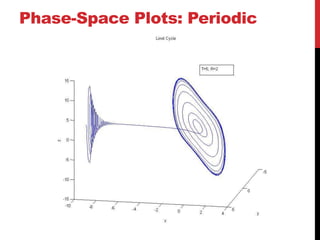
Phase-Space Plots: Periodic
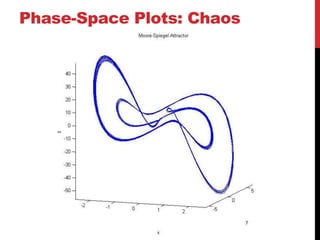
Phase-Space Plots: Chaos
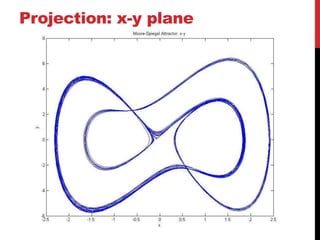
Projection: x-y plane
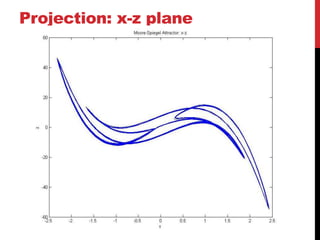
Projection: x-z plane
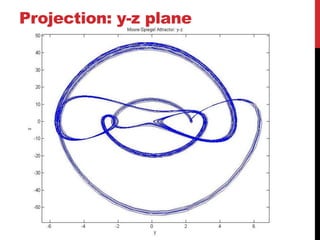
Projection: y-z plane
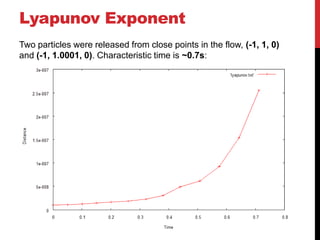
Lyapunov Exponent
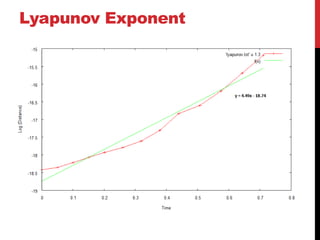
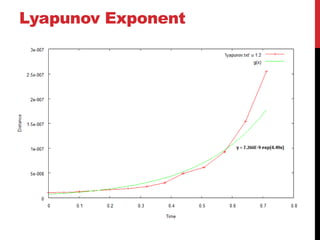
Two particles were released from close points in the flow, (-1, 1, 0)
and (-1, 1.0001, 0). Characteristic time is ~0.7s:
Lyapunov Exponent
Lyapunov Exponent
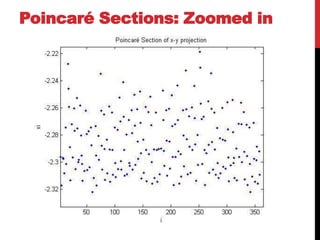
Poincaré Sections of projections
            P=[];
            for i=1:length(Y)-1
                if (Y(i,2))<0 && (Y(i+1,2))>0
                    P(end+1)=Y(i,1);
                end
            end
            P=P';
            plot(P,'.');
Poincaré Sections: Zoomed in
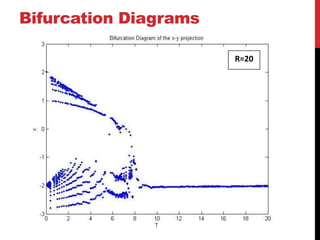
Bifurcation Diagrams


 global T;
 global R;
 T=0;
 R=20;
 B=[];
 while T<20
      [tarray,Y] = ode45(@mseq,[0 1000],[-1 1 0]);
      P=[];
      for i=1:length(Y)-1
          if (Y(i,2))<0 && (Y(i+1,2))>0
              P(end+1)=Y(i,1);
          end
      end
      P=P';
      P=P(end-10:end);
      for i=1:length(P)
          B(end+1,:)=[T P(i)];
      end
      T=T+.1
 end
Bifurcation Diagrams

                       R=20
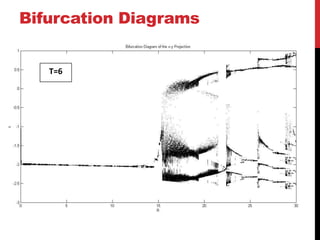
Bifurcation Diagrams


   T=6
Reference
Algebraically Simple Chaotic Flows, J.C. Sprott, S J. Linz,
Intl. J. of Chaos Theory and Applications
A Thermally Excited Non-linear Oscillator, D.W. Moore, E.A.
Spiegel, Astrophysical Journal

The Moore-Spiegel Oscillator

  • 1.
  • 2.
  • 3.
  • 4.
    Numerical Root-finding % Newton-Raphson method to find roots disp 'Newton-Raphson Method' syms x; i=0; f=input('f: '); % User inputs function here y=input('seed x: '); % and seed value here while (abs(subs(f,x,y)/subs(diff(f),x,y))>1e-15) % termination criterion y=y-subs(f,x,y)/subs(diff(f),x,y); i=i+1; end x=y % print result i % and iterations % Bisection method to find roots disp 'Bisection Method' a=input('a: '); % start b=input('b: '); % and end of starting interval j=0; % iteration count syms x; while (b-a>0.000001) % termination criterion mid=(a+b)/2; if subs(f,x,b)*subs(f,x,mid)<0 a=mid; else b=mid; end j=j+1; end x=mid j
  • 5.
    Roots for T=6and R=20 Root Seed (Newton- Interval Raphson) (Bisection) 3 5 [0,5] 0.4495 0 [0,1] -4.4495 -5 [-5,0]
  • 6.
    Phase-Space Plots withRK4/5 (General Code) t=10; N=10000; h=float(t)/N; l=range(3) T=6; R=20 x=list(input('Starting x,y,z: ')) file=open('msplot.txt', 'w') def f(x): return [x[1], x[2], -x[2]-(T-R+R*x[0]**2)*x[1]-T*x[0]] for iter in range(N): print>> file, x[0],x[1],x[2] k1=[h*f(x)[i] for i in l] k2=[h*f([(x[j]+k1[j]/2) for j in l])[i] for i in l] k3=[h*f([(x[j]+k2[j]/2) for j in l])[i] for i in l] k4=[h*f([(x[j]+k3[j]) for j in l])[i] for i in l] x=[x[i]+(k1[i]+2*k2[i]+2*k3[i]+k4[i]) for i in l] file.close() import Gnuplot g=Gnuplot.Gnuplot() g('''splot 'msplot.txt' w l''') g('pause -1') global T; global R; T=0; R=20; [tarray,Y] = ode45(@mseq,[0 1000],[-1 1 0]); function dy = mseq(t,y) global T; global R; dy = zeros(3,1); dy(1) = y(2); dy(2) = y(3); dy(3) = -y(3)-(T-R+R*y(1)^2)*y(2)-T*y(1); end
  • 7.
  • 8.
  • 9.
  • 10.
  • 11.
  • 12.
    Lyapunov Exponent Two particleswere released from close points in the flow, (-1, 1, 0) and (-1, 1.0001, 0). Characteristic time is ~0.7s:
  • 13.
  • 14.
  • 15.
    Poincaré Sections ofprojections P=[]; for i=1:length(Y)-1 if (Y(i,2))<0 && (Y(i+1,2))>0 P(end+1)=Y(i,1); end end P=P'; plot(P,'.');
  • 16.
  • 17.
    Bifurcation Diagrams globalT; global R; T=0; R=20; B=[]; while T<20 [tarray,Y] = ode45(@mseq,[0 1000],[-1 1 0]); P=[]; for i=1:length(Y)-1 if (Y(i,2))<0 && (Y(i+1,2))>0 P(end+1)=Y(i,1); end end P=P'; P=P(end-10:end); for i=1:length(P) B(end+1,:)=[T P(i)]; end T=T+.1 end
  • 18.
  • 19.
  • 20.
    Reference Algebraically Simple ChaoticFlows, J.C. Sprott, S J. Linz, Intl. J. of Chaos Theory and Applications A Thermally Excited Non-linear Oscillator, D.W. Moore, E.A. Spiegel, Astrophysical Journal