1
Title: Slide number:
Introduction 3
Why metals corrode 6
Types of corrosion 7
Prevent corrosion 12
Video 13
2
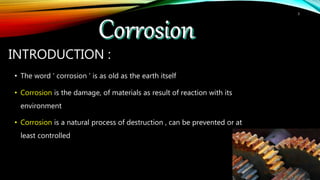
INTRODUCTION :
• The word ' corrosion ' is as old as the earth itself
• Corrosion is the damage, of materials as result of reaction with its
environment
• Corrosion is a natural process of destruction , can be prevented or at
least controlled
3
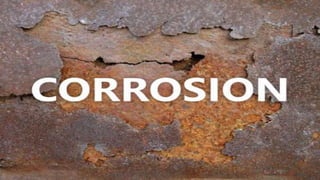
CORROSION
corrosion affect :
• Quality of daily lives.
• Technical of progress.
4
Consequences of corrosion :
 Plant shutdown .
 Loss of product .
 Loss of efficiency .
 Contamination .
 Nuclear hazards.
CORROSION IS A POTENT FORCE WHICH DESTROYS ECONOMY,
DEPLETES RESOURCES AND CAUSES COSTLY AND UNTIMELY FAILURES OF
PLANTS, EQUIPMENT AND COMPONENTS.
Contributors Corrosion Studies
Petroleum Chemical and petrochemical
construction power generation
Public utility manufacturing
Metal indusrial
5
Examples cost
Petroleum $4.1 b
Chemical and
petrochemical
$2.5 b
construction $1.8 b
power
generation
$1.25 b
Public utility $560 m
manufacturing $150m
Metal industrial $110m
2010
Corrosion
WHY METALS CORRODE
1-Metal tend to corrode in order to retain their
natural form (ore)
Metals are usually extracted amd purified from their
ores via high energy input processes
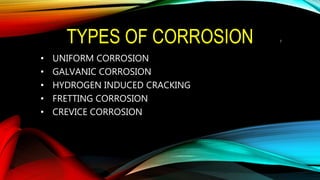
TYPES OF CORROSION
• UNIFORM CORROSION
• GALVANIC CORROSION
• HYDROGEN INDUCED CRACKING
• FRETTING CORROSION
• CREVICE CORROSION
7
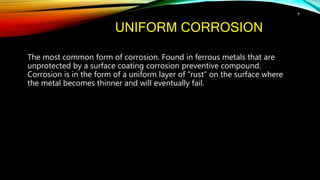
UNIFORM CORROSION
The most common form of corrosion. Found in ferrous metals that are
unprotected by a surface coating corrosion preventive compound.
Corrosion is in the form of a uniform layer of “rust” on the surface where
the metal becomes thinner and will eventually fail.
8
GALVANIC CORROSION
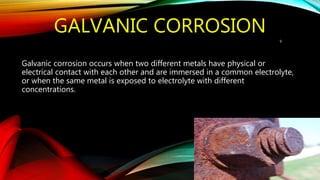
Galvanic corrosion occurs when two different metals have physical or
electrical contact with each other and are immersed in a common electrolyte,
or when the same metal is exposed to electrolyte with different
concentrations.
9
FRETTING CORROSION
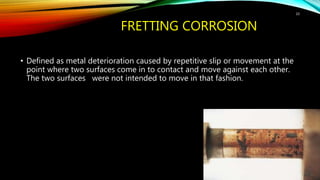
• Defined as metal deterioration caused by repetitive slip or movement at the
point where two surfaces come in to contact and move against each other.
The two surfaces were not intended to move in that fashion.
10
CREVICE CORROSION
is a localized form of corrosion occurring in confined spaces
(crevices), to which the access of the working fluid from the
environment is limited. Formation of a differential aeration cell
leads to corrosion inside the crevices
11
PREVENT CORROSION
• The selection of appropriate materials.
• The design of the product.
• Protective methods (Coatings, anodes, etc.)
• Correct installation and maintenance.
• Research, development and testing.
12
13

Corrosion presentation

  • 1.
  • 2.
    Title: Slide number: Introduction3 Why metals corrode 6 Types of corrosion 7 Prevent corrosion 12 Video 13 2
  • 3.
    INTRODUCTION : • Theword ' corrosion ' is as old as the earth itself • Corrosion is the damage, of materials as result of reaction with its environment • Corrosion is a natural process of destruction , can be prevented or at least controlled 3
  • 4.
    CORROSION corrosion affect : •Quality of daily lives. • Technical of progress. 4 Consequences of corrosion :  Plant shutdown .  Loss of product .  Loss of efficiency .  Contamination .  Nuclear hazards.
  • 5.
    CORROSION IS APOTENT FORCE WHICH DESTROYS ECONOMY, DEPLETES RESOURCES AND CAUSES COSTLY AND UNTIMELY FAILURES OF PLANTS, EQUIPMENT AND COMPONENTS. Contributors Corrosion Studies Petroleum Chemical and petrochemical construction power generation Public utility manufacturing Metal indusrial 5 Examples cost Petroleum $4.1 b Chemical and petrochemical $2.5 b construction $1.8 b power generation $1.25 b Public utility $560 m manufacturing $150m Metal industrial $110m 2010 Corrosion
  • 6.
    WHY METALS CORRODE 1-Metaltend to corrode in order to retain their natural form (ore) Metals are usually extracted amd purified from their ores via high energy input processes
  • 7.
    TYPES OF CORROSION •UNIFORM CORROSION • GALVANIC CORROSION • HYDROGEN INDUCED CRACKING • FRETTING CORROSION • CREVICE CORROSION 7
  • 8.
    UNIFORM CORROSION The mostcommon form of corrosion. Found in ferrous metals that are unprotected by a surface coating corrosion preventive compound. Corrosion is in the form of a uniform layer of “rust” on the surface where the metal becomes thinner and will eventually fail. 8
  • 9.
    GALVANIC CORROSION Galvanic corrosionoccurs when two different metals have physical or electrical contact with each other and are immersed in a common electrolyte, or when the same metal is exposed to electrolyte with different concentrations. 9
  • 10.
    FRETTING CORROSION • Definedas metal deterioration caused by repetitive slip or movement at the point where two surfaces come in to contact and move against each other. The two surfaces were not intended to move in that fashion. 10
  • 11.
    CREVICE CORROSION is alocalized form of corrosion occurring in confined spaces (crevices), to which the access of the working fluid from the environment is limited. Formation of a differential aeration cell leads to corrosion inside the crevices 11
  • 12.
    PREVENT CORROSION • Theselection of appropriate materials. • The design of the product. • Protective methods (Coatings, anodes, etc.) • Correct installation and maintenance. • Research, development and testing. 12
  • 13.