Tassos Bountis
Department of Mathematics and Center for Research
       and Applications of Nonlinear Systems
        http://www.math.upatras.gr/~crans
        University of Patras, Patras GREECE

   Lecture at the OUT OF THE BOX Conference
        Maribor, Slovenia, May 15-17,2012
What is Complexity?
   At the beginning of 21st century we have understood
  that:
• Complexity, is a property of large systems, consisting
  of a huge number of units, involving nonlinearly
  interacting agents, which can exhibit incredibly complex
  behavior.
• New structures can emerge out of non-equilibrium and
  order can be born out of chaos, following a process
  called self-organization. Complex systems in the
  Natural, Life and Social Sciences produce new shapes,
  patterns and forms that cannot be understood by
  studying only their individual parts.
Mathematics has already been quite helpful:

• The Theory of Chaos explores the unpredictable time evolution of
nonlinear dynamical systems like the weather, the electro-
cardiogram and encephalogram, mechanical, chemical and electrical
oscillations, seismic activity and even stock market fluctuations.

• The Geometry of Fractals analyzes the complex spatial structure
of trees and rocks, the dendritic shape of the bronchial “tree” in
the lungs, the cardiac muscle network and the blood circulatory
system.

• Most importantly, we can construct appropriate mathematical
models that: (a) reproduce the main features of a complex system
and (b) provide invaluable insight in revealing some of its
fundamental properties.
Some of the main questions we face today in what is
  called Complexity Science are:

• How do we use Mathematics to observe, measure and
  understand complex phenomena in the Natural, Life and
  Social Sciences?

• Should we only look for universal principles and laws
  expressed by mathematical formulas to understand atoms,
  molecules, cells, trees, forests, living organisms and
  ultimately society?

• How can use our perception and intuition to try to construct
  suitable mathematical models that will help us shed some
  light on the remarkably complex phenomena we observe
  around us?
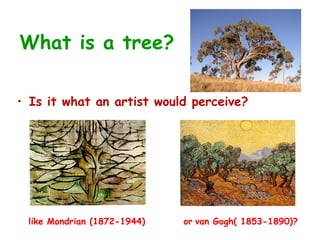
What is a tree?

• Is it what an artist would perceive?


 like Mondrian (1872-1944)   or van Gogh( 1853-1890)?
......or what a biologist would study?


 What is it that impresses us first about a tree?
Could it be a kind of self-
similarity in the way two of its
branches bifurcate out of a
bigger branch so that they are
smaller by a scaling factor?

Observe that besides shortening
the branches at every bifurcation,
we also apply a transformation of
rotation, e.g. by 45ο…

Why not then take advantage
of this observation to construct
a simple mathematical model
that would describe this type
of complexity?
Could we build realistic models of trees and plants, if we
follow a self-similar construction of patterns at smaller and
smaller scales?

                         One answer is revealed by the theory
                         of Iterated Function Systems,
                         introduced by the American
                         Mathematician Michael Barnsley, in the
                         1980’s..
                         Barnsley proved that a sequence of
                         contracting transformations applied to
                         an original shape has always the same
                         limit no matter what the initial shape
                         is.
                         In other words, what matters is the
                         contracting transformations and not the
                         shapes we start with….
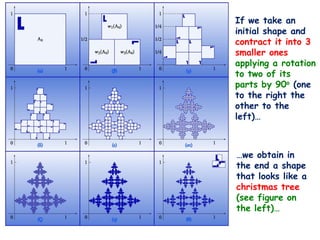
If we take an
initial shape and
contract it into 3
smaller ones
applying a rotation
to two of its
parts by 90ο (one
to the right the
other to the
left)…


…we obtain in
the end a shape
that looks like a
christmas tree
(see figure on
the left)…
…if together
 with rotation
 we also shift
 the top piece
 to the left,
 we may design
 ivy-looking
 plants climbing
 the walls of
 our house…


What other
plants can we
design?
Let us use, for example, 4
such transformations, to
construct the leaf of a fern
plant, with infinitely many
smaller leaves on it:
Start with rectangle 1 for
the main leaf, 2 and 3 for
its two neighbors and 4 for
its very thin stem,….
Now observe what happens
after many iterations of this
process…
Isn’t it fascinating?
We can now start to
imitate Mother
Nature by drawing
pictures of real –
looking plants and
bushes, like
Barnsley’s fern
shown here……

All these objects are
called fractals and obey
a new kind of Geometry,
called Fractal Geometry!
Fractals and Chaos:
               From Geometry to Dynamics!

Chaos is complexity in time, or, in other
words, the extremely sensitive dependence
of the motion on its initial conditions!

The first one who studied it was the French
Mathematician Henri Poincaré (1854 –
1912) shown here on the right.


In fact, Chaos can emerge out of a “fractal tree” of successive
bifurcations as a parameter r increases in a simple model of
population of rabbits living on an island!
As the growth
     parameter r of
     the rabbits
     increases....

Xn


      Here is where
      chaos first
      appears in the
      population....
                       r
The concept of a bifurcation
is a lot more general in
nature. If you introduce
cockroaches in a dish with
two identical shelters, they
will first visit each shelter in
equal percentages, but
eventually, as the shelters’
capacity grows, they will all
end up visiting only one of the
shelters!

Note that this “collective
change of behavior” occurs,
without any apparent
communication between the
cockroaches!

J.-M. Amé, J. Halloy, C. Rivault, C. Detrain, and J.-L. Deneubourg, PNAS 103 (2006) 5835.
COLLECTIVE BEHAVIOR OF BIRDS, FISH,
        TRAFFIC AND PEOPLE?


      Out of chaos, patterns emerge
       due to self - organization...
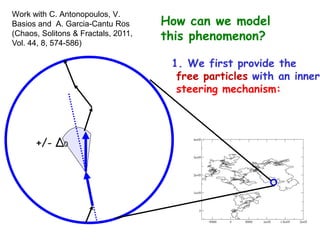
Work with C. Antonopoulos, V.
Basios and A. Garcia-Cantu Ros       How can we model
(Chaos, Solitons & Fractals, 2011,
Vol. 44, 8, 574-586)
                                     this phenomenon?

                                      1. We first provide the
                                       free particles with an inner
                                       steering mechanism:


      +/- ∆0
2. Next, we include interactions with
  nearby flock mates, so that two particles
  interact (avoiding collisions)


3. Finally, we introduce a time-dependent coupling parameter φti from..

                                                  Periodic domain

                                                  Weakly chaotic
                                                  domain


                                                  Strongly
                                                  chaotic domain
       0            φti                   1
We find the following patterns of motion:
(a) Chaotic flight, (b) synchronized rotation or (c) “flocking”,
depending on whether φit belongs to:
(a) The strongly chaotic, (b) periodic or (c) weakly chaotic regimes.


  with random initial conditions and FREE boundary conditions
100 birds starting in the chaotic region, as time passes,
   gather near the domain of weakly chaotic motion
Birds starting with parameters only in the chaotic region
     tend towards the flocking (weak chaos) region!
Do pedestrians behave as individuals or social beings?
   Observe how lanes of uniform walking direction
         emerge due to self-organization.


                       Taken from: Dirk Helbing, Chair of
                       Sociology, in particular of Modeling
                       and Simulation, ETH Zürich
                       www.soms.ethz.ch
Helbing’s Intelligent Driver Model (IDM)


....produces the “waves of
congestion” or “clustering”
of cars we commonly
observe on the highways,
moving backward in time:


Martin Treiber, Ansgar Hennecke, and Dirk Helbing, “Congested Traffic States in Empirical Observations
and Microscopic Simulations”, Phys. Rev. E 62, 1805–1824 (2000)
Recent work of our group in Patras with Prof. Ko van der
Weele connects Granular Transport and…… Traffic Flow !

Q in


                                                 Q out


The dynamics of the grains involves a certain Flux
function F(nk), which must be specified in advance!
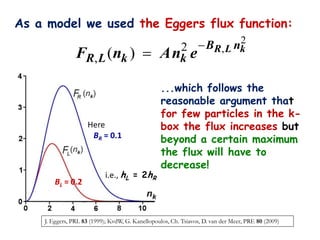
As a model we used the Eggers flux function:
                                                                 2
                                                        BR , L nk
                FR, L (nk )                       2
                                                 Ank e

                                                  ...which follows the
                                                  reasonable argument that
                                                  for few particles in the k-
                     Here                         box the flux increases but
                      BR = 0.1
                                                  beyond a certain maximum
                                                  the flux will have to
                                                  decrease!
                           i.e., hL = 2hR
       BL = 0.2


    J. Eggers, PRL 83 (1999); KvdW, G. Kanellopoulos, Ch. Tsiavos, D. van der Meer, PRE 80 (2009)
Watch how the grain density along a 25-
step staircase becomes unstable as Q grows!

          Q = 1.00 (relatively small)


  Stable dynamic equilibrium: outflow = inflow
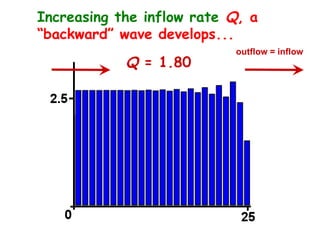
Increasing the inflow rate Q, a
“backward” wave develops...
                           outflow = inflow
            Q = 1.80
… leading to a critical value: Qcrit = 1.8740


                                               outflow
                                               vanishes
….where clustering occurs at the top of the staircase!
Traffic flow: Unidirectional version of the
                    staircase problem
                                                        [veh/ h per lane]
Δx = 500 m


                             with ρk(t) = car density in cell k [veh/km per lane]
    A similar equation is obeyed here as with granular transport:

                      d k
                   x       F ( k 1 )  F ( k )  Qk (t )
                       dt
   time step dt = 12 s (= Δx/vmax)                            in- and outflow
                                                      (only in certain cells k)
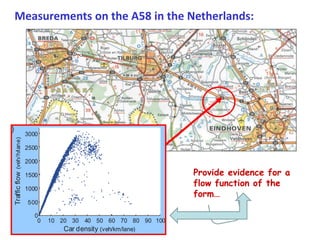
         Now the Flux function F(ρk) is measured by induction loops at
               periodic locations in the asphalt of the highway!
Measurements on the A58 in the Netherlands:


(b)
                                  3000
      Traffic flow (veh/h/lane)


                                  2500

                                  2000

                                  1500                                     Provide evidence for a
                                                                           flow function of the
                                  1000
                                                                           form…
                                  500

                                     0
                                      0   10 20 30 40 50 60 70 80 90 100
                                              Car density (veh/km/lane)
Observe the waves of congestion traveling backward! The front
lane is the slow on (90 km/hr) and the back the fast one (100 km)
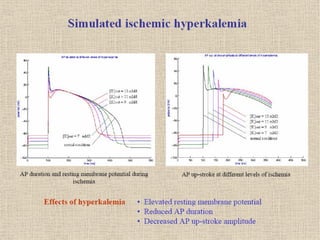
Finally, about Biology: How can we model diseases
 like ischemia or cardiac infarction of the heart?


  Work of Dr. Adi Cimponeriu, T. Bezerianos, F. Starmer and T. Bountis at
          the Department of Medicine of the University of Patras
We can model electrical pulse propagation through ion channels
by a one-dimensional array of electrical oscillators.....


 ....obeying the well-
 known Kirchoff laws:
Normal (healthy) behavior
Non-normal (ischemic) propagation
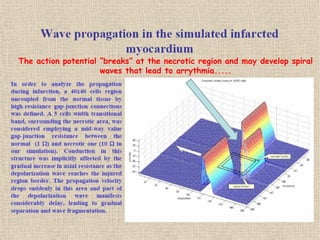
The action potential “breaks” at the necrotic region and may develop spiral
                     waves that lead to arrythmia.....
In conclusion:
Complexity Science:

 Offers a unified methodology to study complex
  physical, biological and social system.
 Familiarizes us with Mathematics, the common
  language of all sciences, through the use of models.
 Proposes new concepts, principles and techniques to
  better understand and perhaps predict and control
  complex phenomena.
 Makes young people enjoy science, because it
  excites their curiosity and imagination and make
  them appreciate the interdisciplinary connections
  between different scientific fields.
Of course, Hamlet may well advise us here:

 «There are many more things on earth and
  heaven, Horatio, than are dreamt in your
              philosophy....»


   Still, Complexity Science through the use
    of mathematical modeling opened a new
    “window” of communication with nature,
 through which we have begun to glimpse the
  “global picture” of ourselves and the world
              that surrounds us…..
References

•    G. Nicolis & I. Prigogine, “Exploring Complexity”
     Freeman, New York (1989)

•    T. Bountis, “The Wonderful World of Fractals” (in Greek),
     Leader Books, Athens (2004).

•    G. Nicolis and C. Nicolis, “Foundations of
     Complex Systems”, World Scientific, Singapore, 2007

•    C. Tsallis, “Introduction to Nonextensive Statistical
     Mechanics: Approaching a Complex World”, Springer, New
     York (2009).

•    T. Bountis and H. Skokos, “Complex Hamiltonian
      Dynamics”, Synergetic Series, Springer (April, 2012).

OBC | Complexity science and the role of mathematical modeling

  • 1.
    Tassos Bountis Department ofMathematics and Center for Research and Applications of Nonlinear Systems http://www.math.upatras.gr/~crans University of Patras, Patras GREECE Lecture at the OUT OF THE BOX Conference Maribor, Slovenia, May 15-17,2012
  • 2.
    What is Complexity? At the beginning of 21st century we have understood that: • Complexity, is a property of large systems, consisting of a huge number of units, involving nonlinearly interacting agents, which can exhibit incredibly complex behavior. • New structures can emerge out of non-equilibrium and order can be born out of chaos, following a process called self-organization. Complex systems in the Natural, Life and Social Sciences produce new shapes, patterns and forms that cannot be understood by studying only their individual parts.
  • 3.
    Mathematics has alreadybeen quite helpful: • The Theory of Chaos explores the unpredictable time evolution of nonlinear dynamical systems like the weather, the electro- cardiogram and encephalogram, mechanical, chemical and electrical oscillations, seismic activity and even stock market fluctuations. • The Geometry of Fractals analyzes the complex spatial structure of trees and rocks, the dendritic shape of the bronchial “tree” in the lungs, the cardiac muscle network and the blood circulatory system. • Most importantly, we can construct appropriate mathematical models that: (a) reproduce the main features of a complex system and (b) provide invaluable insight in revealing some of its fundamental properties.
  • 4.
    Some of themain questions we face today in what is called Complexity Science are: • How do we use Mathematics to observe, measure and understand complex phenomena in the Natural, Life and Social Sciences? • Should we only look for universal principles and laws expressed by mathematical formulas to understand atoms, molecules, cells, trees, forests, living organisms and ultimately society? • How can use our perception and intuition to try to construct suitable mathematical models that will help us shed some light on the remarkably complex phenomena we observe around us?
  • 5.
    What is atree? • Is it what an artist would perceive? like Mondrian (1872-1944) or van Gogh( 1853-1890)?
  • 6.
    ......or what abiologist would study? What is it that impresses us first about a tree?
  • 7.
    Could it bea kind of self- similarity in the way two of its branches bifurcate out of a bigger branch so that they are smaller by a scaling factor? Observe that besides shortening the branches at every bifurcation, we also apply a transformation of rotation, e.g. by 45ο… Why not then take advantage of this observation to construct a simple mathematical model that would describe this type of complexity?
  • 8.
    Could we buildrealistic models of trees and plants, if we follow a self-similar construction of patterns at smaller and smaller scales? One answer is revealed by the theory of Iterated Function Systems, introduced by the American Mathematician Michael Barnsley, in the 1980’s.. Barnsley proved that a sequence of contracting transformations applied to an original shape has always the same limit no matter what the initial shape is. In other words, what matters is the contracting transformations and not the shapes we start with….
  • 9.
    If we takean initial shape and contract it into 3 smaller ones applying a rotation to two of its parts by 90ο (one to the right the other to the left)… …we obtain in the end a shape that looks like a christmas tree (see figure on the left)…
  • 10.
    …if together withrotation we also shift the top piece to the left, we may design ivy-looking plants climbing the walls of our house… What other plants can we design?
  • 11.
    Let us use,for example, 4 such transformations, to construct the leaf of a fern plant, with infinitely many smaller leaves on it: Start with rectangle 1 for the main leaf, 2 and 3 for its two neighbors and 4 for its very thin stem,…. Now observe what happens after many iterations of this process…
  • 12.
    Isn’t it fascinating? Wecan now start to imitate Mother Nature by drawing pictures of real – looking plants and bushes, like Barnsley’s fern shown here…… All these objects are called fractals and obey a new kind of Geometry, called Fractal Geometry!
  • 13.
    Fractals and Chaos: From Geometry to Dynamics! Chaos is complexity in time, or, in other words, the extremely sensitive dependence of the motion on its initial conditions! The first one who studied it was the French Mathematician Henri Poincaré (1854 – 1912) shown here on the right. In fact, Chaos can emerge out of a “fractal tree” of successive bifurcations as a parameter r increases in a simple model of population of rabbits living on an island!
  • 14.
    As the growth parameter r of the rabbits increases.... Xn Here is where chaos first appears in the population.... r
  • 15.
    The concept ofa bifurcation is a lot more general in nature. If you introduce cockroaches in a dish with two identical shelters, they will first visit each shelter in equal percentages, but eventually, as the shelters’ capacity grows, they will all end up visiting only one of the shelters! Note that this “collective change of behavior” occurs, without any apparent communication between the cockroaches! J.-M. Amé, J. Halloy, C. Rivault, C. Detrain, and J.-L. Deneubourg, PNAS 103 (2006) 5835.
  • 16.
    COLLECTIVE BEHAVIOR OFBIRDS, FISH, TRAFFIC AND PEOPLE? Out of chaos, patterns emerge due to self - organization...
  • 17.
    Work with C.Antonopoulos, V. Basios and A. Garcia-Cantu Ros How can we model (Chaos, Solitons & Fractals, 2011, Vol. 44, 8, 574-586) this phenomenon? 1. We first provide the free particles with an inner steering mechanism: +/- ∆0
  • 18.
    2. Next, weinclude interactions with nearby flock mates, so that two particles interact (avoiding collisions) 3. Finally, we introduce a time-dependent coupling parameter φti from.. Periodic domain Weakly chaotic domain Strongly chaotic domain 0 φti 1
  • 19.
    We find thefollowing patterns of motion: (a) Chaotic flight, (b) synchronized rotation or (c) “flocking”, depending on whether φit belongs to: (a) The strongly chaotic, (b) periodic or (c) weakly chaotic regimes. with random initial conditions and FREE boundary conditions
  • 20.
    100 birds startingin the chaotic region, as time passes, gather near the domain of weakly chaotic motion
  • 21.
    Birds starting withparameters only in the chaotic region tend towards the flocking (weak chaos) region!
  • 22.
    Do pedestrians behaveas individuals or social beings? Observe how lanes of uniform walking direction emerge due to self-organization. Taken from: Dirk Helbing, Chair of Sociology, in particular of Modeling and Simulation, ETH Zürich www.soms.ethz.ch
  • 23.
    Helbing’s Intelligent DriverModel (IDM) ....produces the “waves of congestion” or “clustering” of cars we commonly observe on the highways, moving backward in time: Martin Treiber, Ansgar Hennecke, and Dirk Helbing, “Congested Traffic States in Empirical Observations and Microscopic Simulations”, Phys. Rev. E 62, 1805–1824 (2000)
  • 24.
    Recent work ofour group in Patras with Prof. Ko van der Weele connects Granular Transport and…… Traffic Flow ! Q in Q out The dynamics of the grains involves a certain Flux function F(nk), which must be specified in advance!
  • 25.
    As a modelwe used the Eggers flux function: 2  BR , L nk FR, L (nk )  2 Ank e ...which follows the reasonable argument that for few particles in the k- Here box the flux increases but BR = 0.1 beyond a certain maximum the flux will have to decrease! i.e., hL = 2hR BL = 0.2 J. Eggers, PRL 83 (1999); KvdW, G. Kanellopoulos, Ch. Tsiavos, D. van der Meer, PRE 80 (2009)
  • 26.
    Watch how thegrain density along a 25- step staircase becomes unstable as Q grows! Q = 1.00 (relatively small) Stable dynamic equilibrium: outflow = inflow
  • 27.
    Increasing the inflowrate Q, a “backward” wave develops... outflow = inflow Q = 1.80
  • 28.
    … leading toa critical value: Qcrit = 1.8740 outflow vanishes ….where clustering occurs at the top of the staircase!
  • 29.
    Traffic flow: Unidirectionalversion of the staircase problem [veh/ h per lane] Δx = 500 m with ρk(t) = car density in cell k [veh/km per lane] A similar equation is obeyed here as with granular transport: d k x  F ( k 1 )  F ( k )  Qk (t ) dt time step dt = 12 s (= Δx/vmax) in- and outflow (only in certain cells k) Now the Flux function F(ρk) is measured by induction loops at periodic locations in the asphalt of the highway!
  • 30.
    Measurements on theA58 in the Netherlands: (b) 3000 Traffic flow (veh/h/lane) 2500 2000 1500 Provide evidence for a flow function of the 1000 form… 500 0 0 10 20 30 40 50 60 70 80 90 100 Car density (veh/km/lane)
  • 31.
    Observe the wavesof congestion traveling backward! The front lane is the slow on (90 km/hr) and the back the fast one (100 km)
  • 32.
    Finally, about Biology:How can we model diseases like ischemia or cardiac infarction of the heart? Work of Dr. Adi Cimponeriu, T. Bezerianos, F. Starmer and T. Bountis at the Department of Medicine of the University of Patras
  • 33.
    We can modelelectrical pulse propagation through ion channels by a one-dimensional array of electrical oscillators..... ....obeying the well- known Kirchoff laws:
  • 36.
  • 37.
  • 38.
    The action potential“breaks” at the necrotic region and may develop spiral waves that lead to arrythmia.....
  • 39.
    In conclusion: Complexity Science: Offers a unified methodology to study complex physical, biological and social system.  Familiarizes us with Mathematics, the common language of all sciences, through the use of models.  Proposes new concepts, principles and techniques to better understand and perhaps predict and control complex phenomena.  Makes young people enjoy science, because it excites their curiosity and imagination and make them appreciate the interdisciplinary connections between different scientific fields.
  • 40.
    Of course, Hamletmay well advise us here: «There are many more things on earth and heaven, Horatio, than are dreamt in your philosophy....» Still, Complexity Science through the use of mathematical modeling opened a new “window” of communication with nature, through which we have begun to glimpse the “global picture” of ourselves and the world that surrounds us…..
  • 41.
    References • G. Nicolis & I. Prigogine, “Exploring Complexity” Freeman, New York (1989) • T. Bountis, “The Wonderful World of Fractals” (in Greek), Leader Books, Athens (2004). • G. Nicolis and C. Nicolis, “Foundations of Complex Systems”, World Scientific, Singapore, 2007 • C. Tsallis, “Introduction to Nonextensive Statistical Mechanics: Approaching a Complex World”, Springer, New York (2009). • T. Bountis and H. Skokos, “Complex Hamiltonian Dynamics”, Synergetic Series, Springer (April, 2012).