UNIVERSALADAPTIVE
HEADLIGHT SYSTEM
Prepared By :
Syam S
1
CONTENT
 INTRODUCTION
 CONVENTIONAL HEADLIGHT
 NEED FOR ADAPTIVE LIGHTENING SYSTEM
 DEVELOPED SYSTEM ARCHITECTURE
 WORKING
 HARDWARE IMPLEMENTATION
 FUTURE DEVELOPMENT
 ADVANTAGE
 DISADVANTAGE
 CONCLUSION
 REFERENCES
2
INTRODUCTION
 Now a days the use of vehicles are the part of life
 Vehicle reduces the distance and saves time of busy human
life, still it has great drawback that is inevitable
 Road mishaps occurs due to carelessness, condition of roads,
technological fault etc.
 In 2014 around 4.8 lakh road accident occurred in which
4.5lakh people get injured and 1.4 lakh people die every year
due to road accident in India
 Compared to day time risk of accident is three times at night
time
3
CONVENTIONAL HEADLIGHT
4
NEED OF ADAPTIVE LIGHTENING
SYSTEM
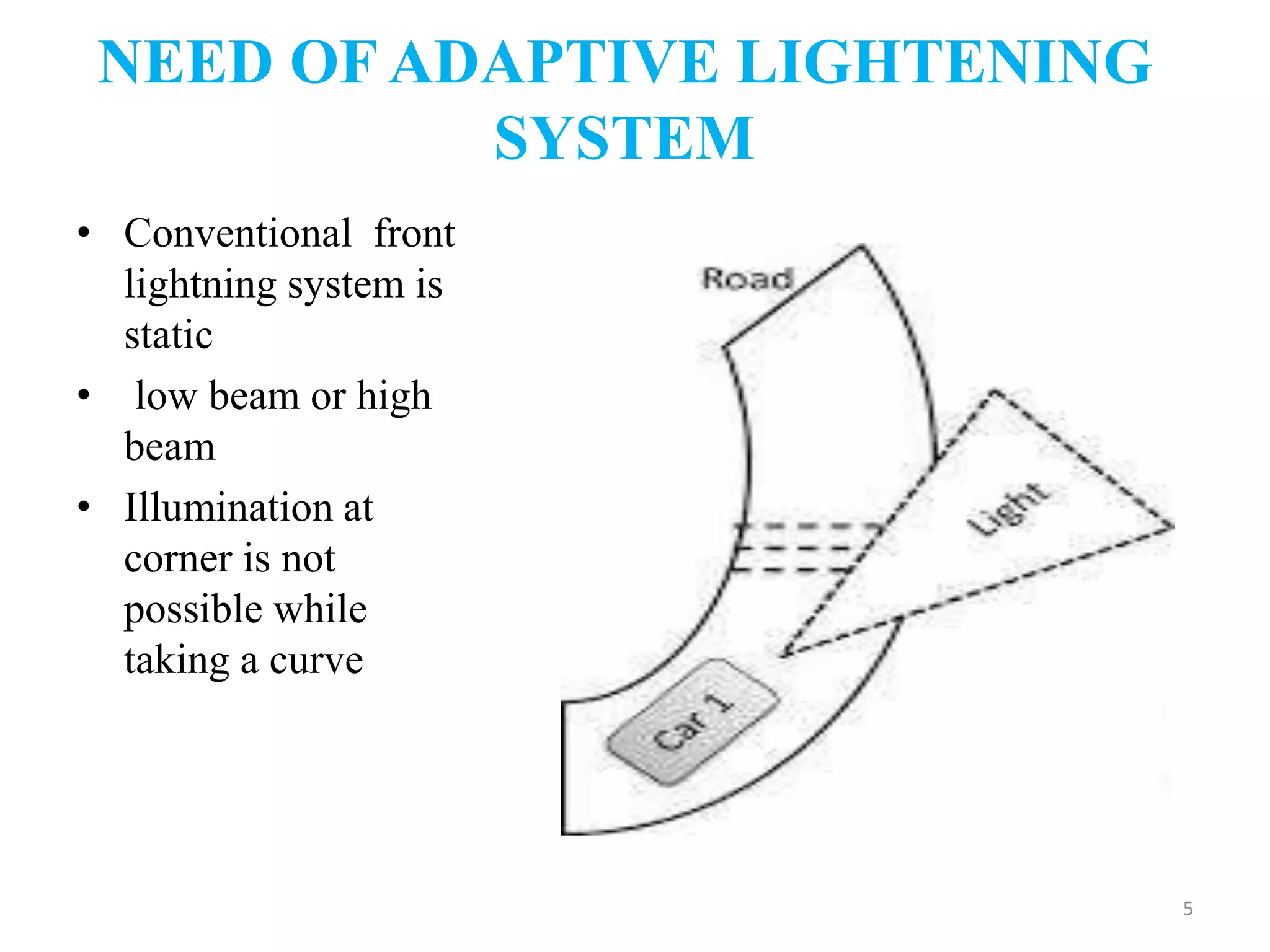
• Conventional front
lightning system is
static
• low beam or high
beam
• Illumination at
corner is not
possible while
taking a curve
5
NEED OF ADAPTIVE LIGHTENING
SYSTEM(Cont…)
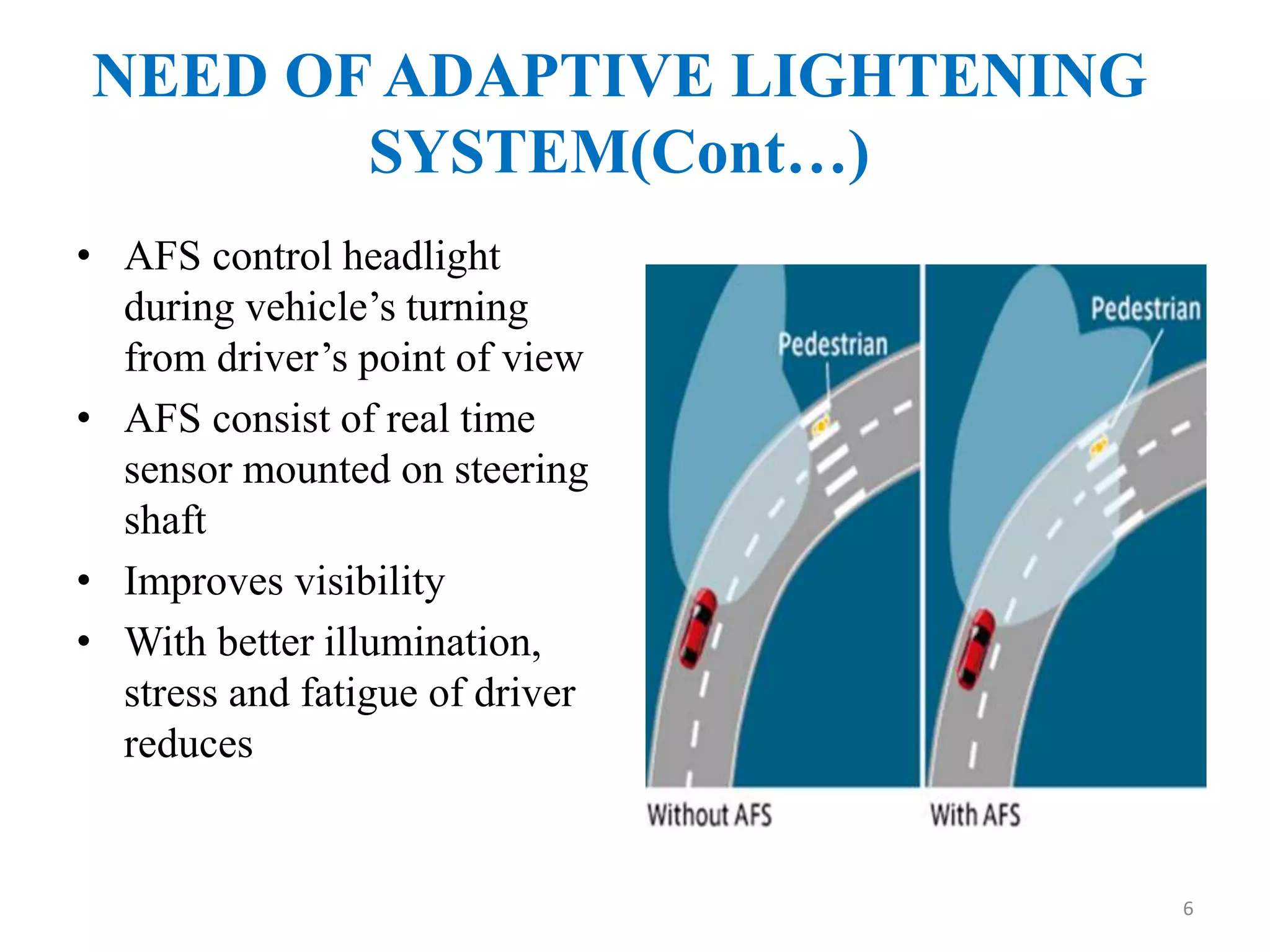
• AFS control headlight
during vehicle’s turning
from driver’s point of view
• AFS consist of real time
sensor mounted on steering
shaft
• Improves visibility
• With better illumination,
stress and fatigue of driver
reduces
6
DEVELOPED SYSTEM ARCHITECTURE
7
WORKING
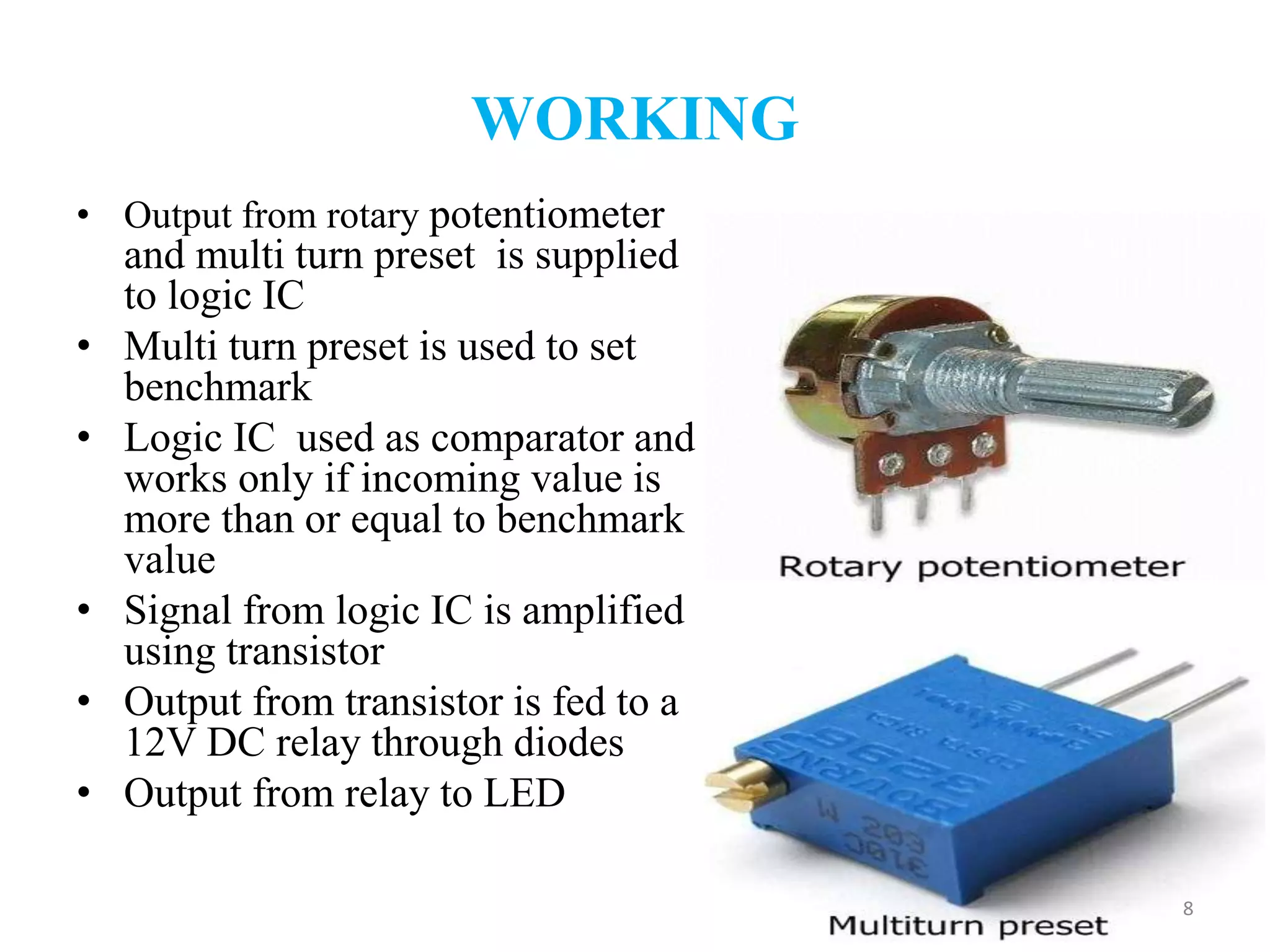
• Output from rotary potentiometer
and multi turn preset is supplied
to logic IC
• Multi turn preset is used to set
benchmark
• Logic IC used as comparator and
works only if incoming value is
more than or equal to benchmark
value
• Signal from logic IC is amplified
using transistor
• Output from transistor is fed to a
12V DC relay through diodes
• Output from relay to LED
8
WORKING(Cont…)
9
HARDWARE IMPLEMENTATION
10
FUTURE DEVELOPMENT
• Common rubber based
platform for holding LED
can be developed
• Microcontroller chip can be
used to compact the design
• Dedicated steering angle
sensor can used instead of
potentiometer
11
ADVANTAGES
 Cost effective solution for the problem of accidents occurring
night time
 It can be easily mounted on cars
 Enhances existing functionality of the headlight system
 Increases visibility of the driver at curves
 Increased safety for drivers and pedestrians
12
DISADVANTAGES
 Continuous power supply for sensor circuit
 Dislocation of LED may happen due to vibration
 Use of potentiometer as angle sensor is not reliable due to its
error causing tendency with time
 Present prototype is needs to be modified to make it
compatible with all power steering based vehicles
13
CONCLUSION
 AFS serves as a reliable and efficient system for efficient
driving at sharp turn
 System is inexpensive, simple and dependable assembly
 Simple comparator based circuit is used ,which uses very
simple logic and makes it most economical to use
 AFS ensures degree of safety in vehicle and assistance to
driver
14
REFERENCES
[1] Gunnar D. Jensen, Cato A. Bjørkli a , Kristina Sakshaug, Terje
Moen, “Behavioral Adaptation to Adaptive Front Lighting Systems
(AFS): A Six Day Driving Simulator Study”, Conference on SINTEF
Transport Safety and Informatics
[2] Christian Jebas, Karsten Klinger, Uli Lemmer, “New headlamp
technologies”, Proc. of SPIE Vol. 7003 70032A-1
[3] Meftah Hrairi and Anwar B. Abu Bakar, ” Development of an
Adaptive Headlamp Systems”, International Conference on Computer
and Communication Engineering (ICCCE 2010), Kuala Lumpur,
Malaysia,11-13 May 2010
[4] Risto Kulmala,“Observations on the use of the accident causation
approach in assessing the safety effects of systems”, VTT Technical
Research Centre of Finland
[5] Mahendra Dassanayake, Robert Miller, Sleiman Abdelnour, , “Adaptive Front
Lighting System for Vehicle”, US patent No. US638B2, 2 June, 2009 15
THANK YOU
16

Universal Adaptive Headlight System

  • 1.
  • 2.
    CONTENT  INTRODUCTION  CONVENTIONALHEADLIGHT  NEED FOR ADAPTIVE LIGHTENING SYSTEM  DEVELOPED SYSTEM ARCHITECTURE  WORKING  HARDWARE IMPLEMENTATION  FUTURE DEVELOPMENT  ADVANTAGE  DISADVANTAGE  CONCLUSION  REFERENCES 2
  • 3.
    INTRODUCTION  Now adays the use of vehicles are the part of life  Vehicle reduces the distance and saves time of busy human life, still it has great drawback that is inevitable  Road mishaps occurs due to carelessness, condition of roads, technological fault etc.  In 2014 around 4.8 lakh road accident occurred in which 4.5lakh people get injured and 1.4 lakh people die every year due to road accident in India  Compared to day time risk of accident is three times at night time 3
  • 4.
  • 5.
    NEED OF ADAPTIVELIGHTENING SYSTEM • Conventional front lightning system is static • low beam or high beam • Illumination at corner is not possible while taking a curve 5
  • 6.
    NEED OF ADAPTIVELIGHTENING SYSTEM(Cont…) • AFS control headlight during vehicle’s turning from driver’s point of view • AFS consist of real time sensor mounted on steering shaft • Improves visibility • With better illumination, stress and fatigue of driver reduces 6
  • 7.
  • 8.
    WORKING • Output fromrotary potentiometer and multi turn preset is supplied to logic IC • Multi turn preset is used to set benchmark • Logic IC used as comparator and works only if incoming value is more than or equal to benchmark value • Signal from logic IC is amplified using transistor • Output from transistor is fed to a 12V DC relay through diodes • Output from relay to LED 8
  • 9.
  • 10.
  • 11.
    FUTURE DEVELOPMENT • Commonrubber based platform for holding LED can be developed • Microcontroller chip can be used to compact the design • Dedicated steering angle sensor can used instead of potentiometer 11
  • 12.
    ADVANTAGES  Cost effectivesolution for the problem of accidents occurring night time  It can be easily mounted on cars  Enhances existing functionality of the headlight system  Increases visibility of the driver at curves  Increased safety for drivers and pedestrians 12
  • 13.
    DISADVANTAGES  Continuous powersupply for sensor circuit  Dislocation of LED may happen due to vibration  Use of potentiometer as angle sensor is not reliable due to its error causing tendency with time  Present prototype is needs to be modified to make it compatible with all power steering based vehicles 13
  • 14.
    CONCLUSION  AFS servesas a reliable and efficient system for efficient driving at sharp turn  System is inexpensive, simple and dependable assembly  Simple comparator based circuit is used ,which uses very simple logic and makes it most economical to use  AFS ensures degree of safety in vehicle and assistance to driver 14
  • 15.
    REFERENCES [1] Gunnar D.Jensen, Cato A. Bjørkli a , Kristina Sakshaug, Terje Moen, “Behavioral Adaptation to Adaptive Front Lighting Systems (AFS): A Six Day Driving Simulator Study”, Conference on SINTEF Transport Safety and Informatics [2] Christian Jebas, Karsten Klinger, Uli Lemmer, “New headlamp technologies”, Proc. of SPIE Vol. 7003 70032A-1 [3] Meftah Hrairi and Anwar B. Abu Bakar, ” Development of an Adaptive Headlamp Systems”, International Conference on Computer and Communication Engineering (ICCCE 2010), Kuala Lumpur, Malaysia,11-13 May 2010 [4] Risto Kulmala,“Observations on the use of the accident causation approach in assessing the safety effects of systems”, VTT Technical Research Centre of Finland [5] Mahendra Dassanayake, Robert Miller, Sleiman Abdelnour, , “Adaptive Front Lighting System for Vehicle”, US patent No. US638B2, 2 June, 2009 15
  • 16.