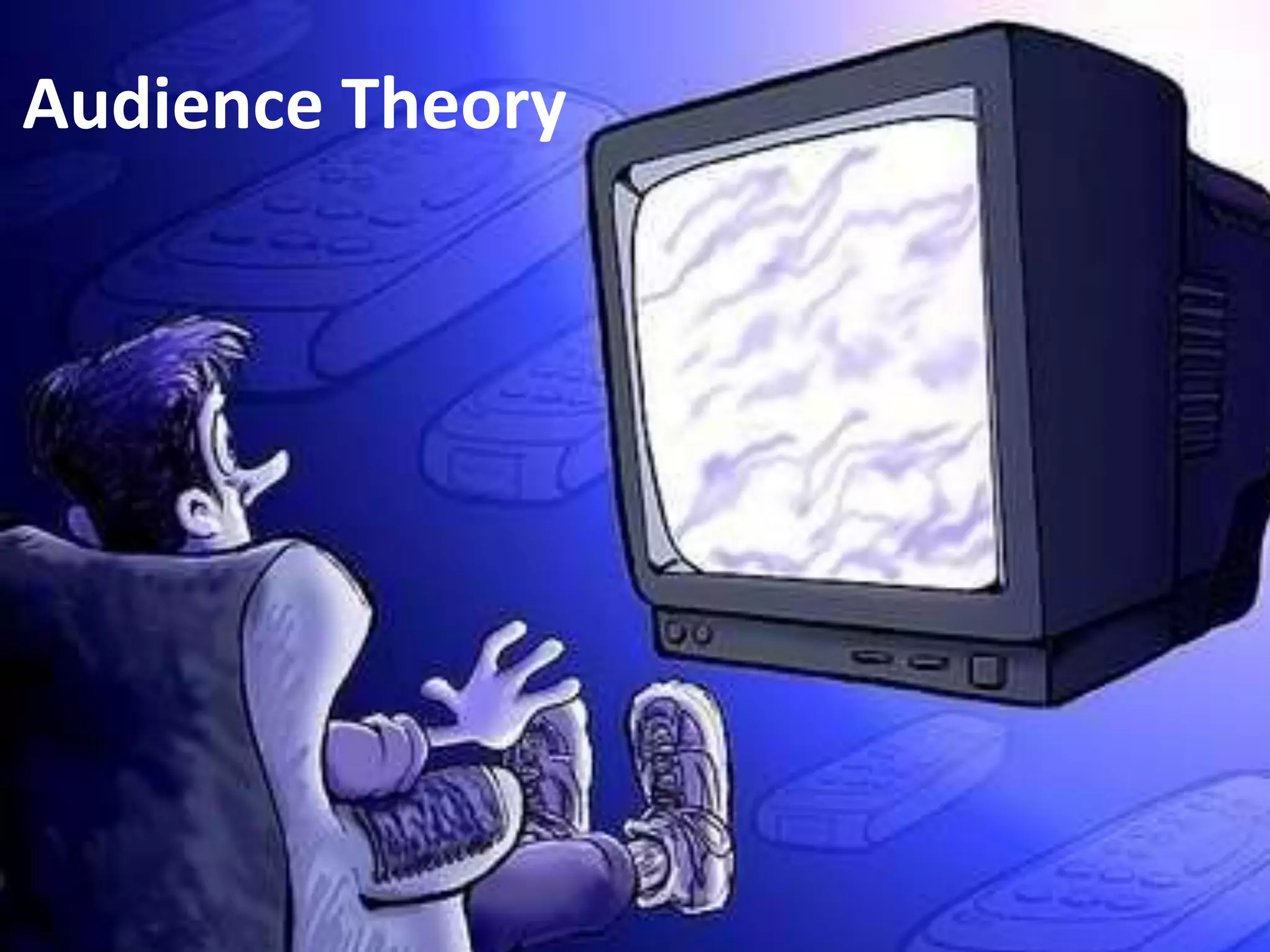
Audience Theory
What is Audience
• All Media products have a target audience.
• They also sometimes (particularly in the case
of propaganda) try to construct an audience.
• Products can have a mass audience or a niche
audience
• The producer of your text (independent or
mainstream ) will be important regarding the
make up of your audience.
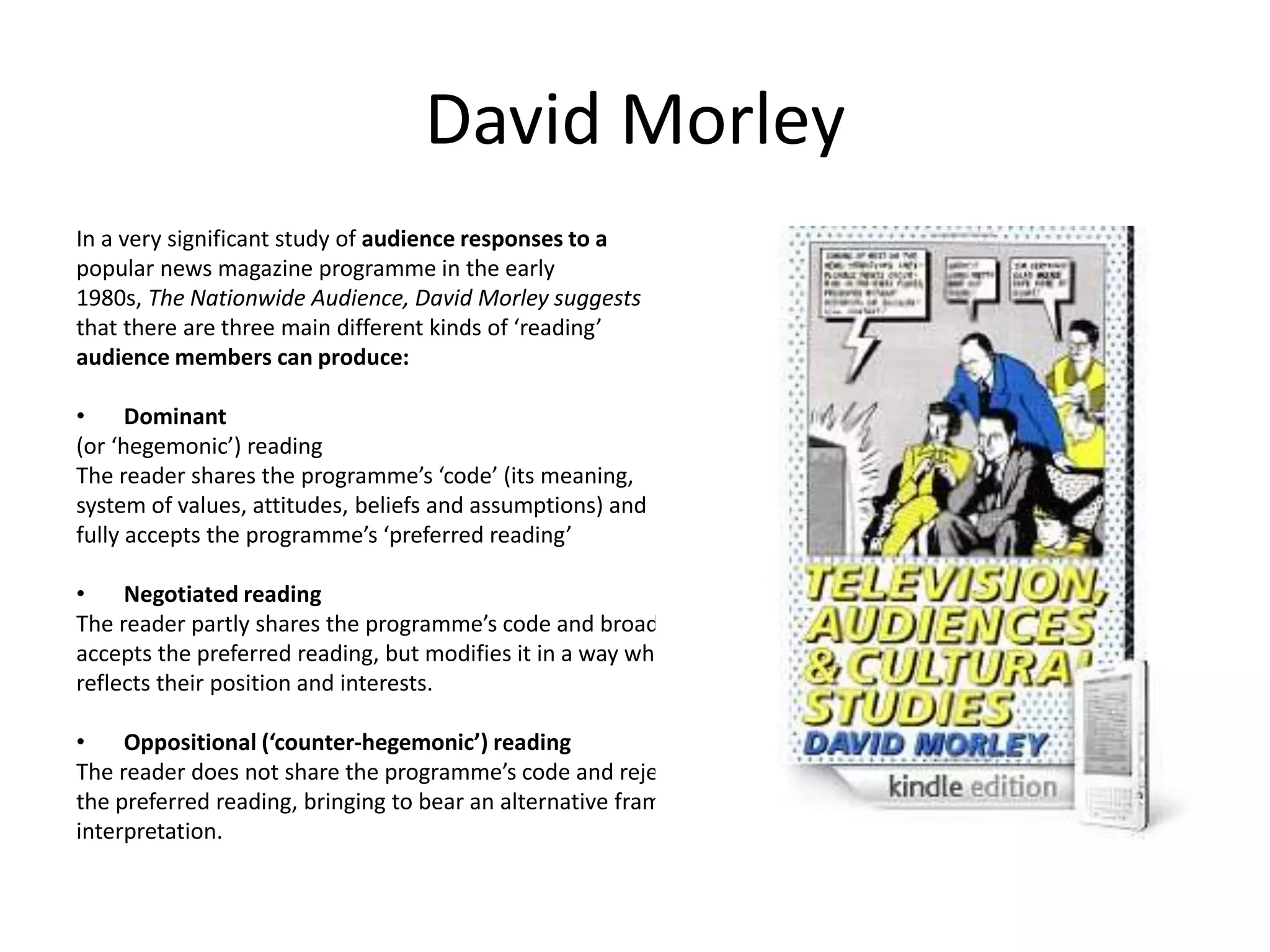
David Morley
In a very significant study of audience responses to a
popular news magazine programme in the early
1980s, The Nationwide Audience, David Morley suggests
that there are three main different kinds of ‘reading’
audience members can produce:
• Dominant
(or ‘hegemonic’) reading
The reader shares the programme’s ‘code’ (its meaning,
system of values, attitudes, beliefs and assumptions) and
fully accepts the programme’s ‘preferred reading’
• Negotiated reading
The reader partly shares the programme’s code and broadly
accepts the preferred reading, but modifies it in a way which
reflects their position and interests.
• Oppositional (‘counter-hegemonic’) reading
The reader does not share the programme’s code and rejects
the preferred reading, bringing to bear an alternative frame of
interpretation.
Hart 1991
• Texts need audiences in order to realise their
potential for meaning. So a text does not have
a single meaning but rather a range of
possibilities which are defined by both the
text and by its audiences. The meaning is not
in the text, but in the reading. (Hart 1991, 60)
Stuart Hall
• Hart’s theory relates to the work of Stuart Hall
which states that texts are encoded with a
preferred meaning by the producer but as
audiences are active that meaning can be
interpreted in various ways.
Structuralism
• A Structuralist would argue that how an audience
member makes sense of a media text is dependent
upon the cultural and moral beliefs.
• Stuart Hall’s work suggests that the audience’s
interpretation is dependant on a number of
frameworks outside the text. These include
socio/economic frameworks such as class, gender, age
education and ethnicity. They include the individual’s
past experiences and also include previous knowledge
and experience of the medium. (reception theory)
Frankfurt School & The Hypodermic
Needle
• The Frankfurt school were concerned about the
possible effects of mass media. They proposed the
"Effects" model, which considered society to be
composed of isolated individuals who were
susceptible to media messages. The Frankfurt school
envisioned the media as a hypodermic syringe.
• The contents of the media were injected into the
thoughts of the audience, who accepted the
attitudes, opinions and beliefs expressed by the
medium without question.
• A potential problem? The Audience are purely
passive
An Alternative
• However, theorists since have thought that media
could not have such direct effects on the
audiences
• Audiences are not blank sheets of paper on which
media messages can be written; members of an
audience will have prior attitudes and beliefs
which will determine how effective media
messages are. (Abercrombie 1996)
• David Gauntlett identifies 10 things wrong with
the effects model.
Uses and Gratifications
• Blumler and Katz (1974) suggested that there
were four main needs of television audiences
that are satisfied by television.
• Diversion
• Personal Relationships
• Personal Identity
• Surveilance
Another Criticism
• Another criticism is that of the tendency to
concentrate solely on why audiences consume
the media rather than extending the
investigation to discover what meanings and
interpretations are produced and in what
circumstances, i.e. how the media are
received. (O’Sullivan, Dutton & Rayner 1994,)
Pick and Mix Readers
• David Gauntlett proposes a pick and mix reader.
• His research stems from primary research with
female magazine readers but his theory, I would
argue, can be applied to any media text.
• Gauntlett suggests that audience members “take
the bits they like and disregard the rest”. Again
this relates back to the work of Stuart Hall and
the criticisms of media effects – social
backgrounds, culture and consumption context
need to be considered.
John Fiske
• Audience Power:
• Fiske also, goes against the notion of the
media indoctrinating audience members. He
argues that “popular culture is made by the
people, not produced by the culture industry”.
• Basically he is suggesting that the power of
audience interpretation far outweighs the
ability of an institution to send a particular
message or ideology.
The Argument
• Frankfurt School
• Media Effects
• Adorno
• The media
indoctrinate the
masses
•Stuart Hall
•Abercrombie
•Gauntlett
•Fiske
•The audience are
active and
interpret their
own meanings.
Your Text
• Think about who would produce your text.
• Who is the target audience.
• How have you attempted to attract that
audience? (micro analysis – draw on genre)
• How could your text be interpreted – engage
in the theoretical debate, providing detailed
examples from your text (micro analysis –
semiotics) to support and challenge.

Audience theory

  • 1.
  • 2.
    What is Audience •All Media products have a target audience. • They also sometimes (particularly in the case of propaganda) try to construct an audience. • Products can have a mass audience or a niche audience • The producer of your text (independent or mainstream ) will be important regarding the make up of your audience.
  • 3.
    David Morley In avery significant study of audience responses to a popular news magazine programme in the early 1980s, The Nationwide Audience, David Morley suggests that there are three main different kinds of ‘reading’ audience members can produce: • Dominant (or ‘hegemonic’) reading The reader shares the programme’s ‘code’ (its meaning, system of values, attitudes, beliefs and assumptions) and fully accepts the programme’s ‘preferred reading’ • Negotiated reading The reader partly shares the programme’s code and broadly accepts the preferred reading, but modifies it in a way which reflects their position and interests. • Oppositional (‘counter-hegemonic’) reading The reader does not share the programme’s code and rejects the preferred reading, bringing to bear an alternative frame of interpretation.
  • 4.
    Hart 1991 • Textsneed audiences in order to realise their potential for meaning. So a text does not have a single meaning but rather a range of possibilities which are defined by both the text and by its audiences. The meaning is not in the text, but in the reading. (Hart 1991, 60)
  • 5.
    Stuart Hall • Hart’stheory relates to the work of Stuart Hall which states that texts are encoded with a preferred meaning by the producer but as audiences are active that meaning can be interpreted in various ways.
  • 6.
    Structuralism • A Structuralistwould argue that how an audience member makes sense of a media text is dependent upon the cultural and moral beliefs. • Stuart Hall’s work suggests that the audience’s interpretation is dependant on a number of frameworks outside the text. These include socio/economic frameworks such as class, gender, age education and ethnicity. They include the individual’s past experiences and also include previous knowledge and experience of the medium. (reception theory)
  • 7.
    Frankfurt School &The Hypodermic Needle • The Frankfurt school were concerned about the possible effects of mass media. They proposed the "Effects" model, which considered society to be composed of isolated individuals who were susceptible to media messages. The Frankfurt school envisioned the media as a hypodermic syringe. • The contents of the media were injected into the thoughts of the audience, who accepted the attitudes, opinions and beliefs expressed by the medium without question. • A potential problem? The Audience are purely passive
  • 8.
    An Alternative • However,theorists since have thought that media could not have such direct effects on the audiences • Audiences are not blank sheets of paper on which media messages can be written; members of an audience will have prior attitudes and beliefs which will determine how effective media messages are. (Abercrombie 1996) • David Gauntlett identifies 10 things wrong with the effects model.
  • 9.
    Uses and Gratifications •Blumler and Katz (1974) suggested that there were four main needs of television audiences that are satisfied by television. • Diversion • Personal Relationships • Personal Identity • Surveilance
  • 10.
    Another Criticism • Anothercriticism is that of the tendency to concentrate solely on why audiences consume the media rather than extending the investigation to discover what meanings and interpretations are produced and in what circumstances, i.e. how the media are received. (O’Sullivan, Dutton & Rayner 1994,)
  • 11.
    Pick and MixReaders • David Gauntlett proposes a pick and mix reader. • His research stems from primary research with female magazine readers but his theory, I would argue, can be applied to any media text. • Gauntlett suggests that audience members “take the bits they like and disregard the rest”. Again this relates back to the work of Stuart Hall and the criticisms of media effects – social backgrounds, culture and consumption context need to be considered.
  • 12.
    John Fiske • AudiencePower: • Fiske also, goes against the notion of the media indoctrinating audience members. He argues that “popular culture is made by the people, not produced by the culture industry”. • Basically he is suggesting that the power of audience interpretation far outweighs the ability of an institution to send a particular message or ideology.
  • 13.
    The Argument • FrankfurtSchool • Media Effects • Adorno • The media indoctrinate the masses •Stuart Hall •Abercrombie •Gauntlett •Fiske •The audience are active and interpret their own meanings.
  • 14.
    Your Text • Thinkabout who would produce your text. • Who is the target audience. • How have you attempted to attract that audience? (micro analysis – draw on genre) • How could your text be interpreted – engage in the theoretical debate, providing detailed examples from your text (micro analysis – semiotics) to support and challenge.