Your Name
Audience theories provide a starting point for many media studies
tasks. If you are constructing a text or analysing one you will need
to consider the target audience for the text and how they will
respond to your text.
• Hypodermic needle effect
• Two-step flow
• Uses and gratifications
• Reception theory
• Cultivation theory
A passive audience is expected to receive the information
without question and will believe all messages in any media
text. These audiences are easily influenced.
Active audience theory argues that media audiences don’t just
receive information passively but are actively involved and will
make sense of the messages given and will often question the
media text.
This is the theory which states that the intended message is
directly received and accepted by the receiver. The idea that
the media text is ‘injected’ into the receiver without them
attempting to process or challenge the data. It suggests that
the audience are easily manipulated by the creators of media
texts and that our thoughts and behavior is easily changed by
media-makes.
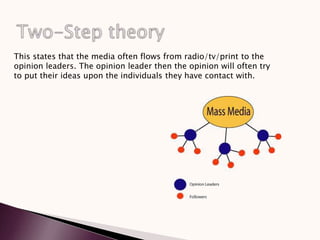
This states that the media often flows from radio/tv/print to the
opinion leaders. The opinion leader then the opinion will often try
to put their ideas upon the individuals they have contact with.
This suggests that media audiences play an active role in interpreting
the media into their own lives. The theory try's to understand why
people actively seek out specific forms of media to fulfill their needs.
There are four different activities audiences are assumed to participate
in:
Diversion- Escaping from everyday problems (Emotional release)
Personal Relationships- Substitution of media for companionship
Personal identity or individual psychology- Self understanding
Surveillance- Using media to find out what is around us.
Preferred reading: The preferred reading is the reading media producers
hope audiences will take from the text
Encoders: Producers create texts with a preferred reading (The meaning
they want the audience to receive) which the audience then decode
Oppositional readings: When someone makes a conscious rejection or
subversion of the preferred meaning
Negotiated readings: when someone understands the meaning but it
doesn't’t relate them so it is of no interest to them to decode them
Aberrant readings: When someone misreads or misunderstands the
message the producers are trying to portray.
This is a social theory which examines the long-term effects of media. It
states that the more you are involved in media the more likely you are to
believe the media.

Audience theories (1)

  • 1.
  • 2.
    Audience theories providea starting point for many media studies tasks. If you are constructing a text or analysing one you will need to consider the target audience for the text and how they will respond to your text. • Hypodermic needle effect • Two-step flow • Uses and gratifications • Reception theory • Cultivation theory
  • 3.
    A passive audienceis expected to receive the information without question and will believe all messages in any media text. These audiences are easily influenced. Active audience theory argues that media audiences don’t just receive information passively but are actively involved and will make sense of the messages given and will often question the media text.
  • 4.
    This is thetheory which states that the intended message is directly received and accepted by the receiver. The idea that the media text is ‘injected’ into the receiver without them attempting to process or challenge the data. It suggests that the audience are easily manipulated by the creators of media texts and that our thoughts and behavior is easily changed by media-makes.
  • 5.
    This states thatthe media often flows from radio/tv/print to the opinion leaders. The opinion leader then the opinion will often try to put their ideas upon the individuals they have contact with.
  • 6.
    This suggests thatmedia audiences play an active role in interpreting the media into their own lives. The theory try's to understand why people actively seek out specific forms of media to fulfill their needs. There are four different activities audiences are assumed to participate in: Diversion- Escaping from everyday problems (Emotional release) Personal Relationships- Substitution of media for companionship Personal identity or individual psychology- Self understanding Surveillance- Using media to find out what is around us.
  • 7.
    Preferred reading: Thepreferred reading is the reading media producers hope audiences will take from the text Encoders: Producers create texts with a preferred reading (The meaning they want the audience to receive) which the audience then decode Oppositional readings: When someone makes a conscious rejection or subversion of the preferred meaning Negotiated readings: when someone understands the meaning but it doesn't’t relate them so it is of no interest to them to decode them Aberrant readings: When someone misreads or misunderstands the message the producers are trying to portray.
  • 8.
    This is asocial theory which examines the long-term effects of media. It states that the more you are involved in media the more likely you are to believe the media.