KNOWLEDGE GAP THEORY
The Knowledge Gap Hypothesis was first proposed in 1970 by Tichenor,
Donohue and OLien. Mostly, it is known as Tichenorl or Tichenor and his
                                                colleagues’ hypothesis.

   This theory is concerned mainly with “information” and “knowledge” and
    emphasizes that knowledge is not distributed equally throughout society.
Content
   Mass Media’s Role


   Knowledge Gap Theory
Mass Media’s Role:-
   One of the great promises of mass communication is
    that it provides people with information they need.
   It has the potential of reaching people who have not
    been reached by other means (poor and undeveloped
    people).
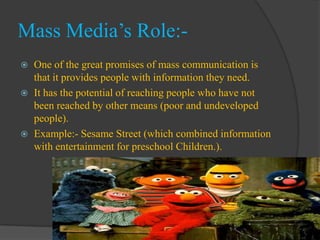
   Example:- Sesame Street (which combined information
    with entertainment for preschool Children.).
Knowledge gap Hypothesis:-
   “As the infusion of mass media information into a
    social system increases, segments of the population
    with higher socio-economic status tend to acquire this
    information at a faster rate than the lower status
    segments, so that the gap in knowledge between these
    two segments tend to increase rather than decrease”.
The hypothesis predicts that:

    People of both high and low socioeconomic statuses
    will gain in knowledge because of the additional
    information, but that persons of higher socioeconomic
    status will gain more.

   This would mean that the relative gap in knowledge
    between the well-to-do and less well-off would
    increase.
Operational forms of the
Hypothesis:
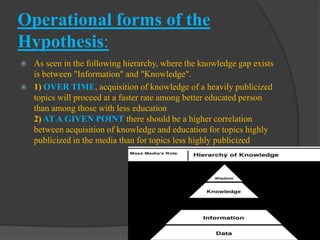
   As seen in the following hierarchy, where the knowledge gap exists
    is between "Information" and "Knowledge".
   1) OVER TIME, acquisition of knowledge of a heavily publicized
    topics will proceed at a faster rate among better educated person
    than among those with less education
    2) AT A GIVEN POINT there should be a higher correlation
    between acquisition of knowledge and education for topics highly
    publicized in the media than for topics less highly publicized
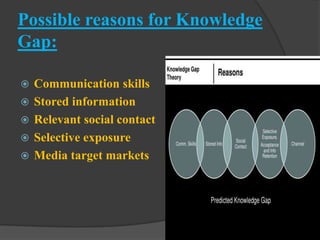
Possible reasons for Knowledge
Gap:

   Communication skills
   Stored information
   Relevant social contact
   Selective exposure
   Media target markets
Knowledge gaps are not
intractable.
Contributory conditions that could reduce
  knowledge gaps: -
 content domains,
 channel influence,
 social conflict and community mobilization,
 the structure of communities,
 individual motivational factors.
Criticism

   Dervin (1980) criticized the KG for being based on the traditional
    source-sending-messages –to-receiver paradigm of
    communication. She recommended that communication campaigns
    and researchers be more user-based and user-constructed
    information.

   Evatt (1998) argued that researchers should be sure that the
    information they are testing is useful and relevant for the audience
    being tested. (Factual versus conceptual knowledge)