Uses and
gratifications model
   Hannah Costello, Jacob
   Gould & Loran Quinn
Definition
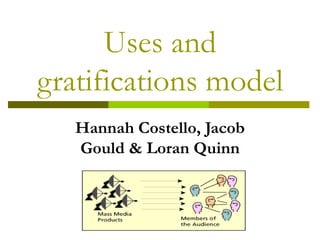
 Uses and Gratifications Theory is an approach to
  understanding why people actively seek out specific
  media outlets and content for gratification purposes.
  The theory discusses how users proactively search for
  media that will not only meet a given need but enhance
  knowledge, social interactions and diversion.
 It assumes that members of the audience are not
  passive but take an active role in interpreting and
  integrating media into their own lives. The approach
  suggests that people use the media to fulfill specific
  gratifications/needs. This would imply that the media
  compete against other information sources for viewers'
  gratification.
Theory
   Blumler and Katz suggested in 1974 that television audiences
    had 4 main needs:
       Diversion (a form of escaping from the pressures of every day)
       Personal Relationships (where the viewer gains companionship,
        either with the television characters, or through conversations with
        others about television)
       Personal Identity (where the viewer is able to compare their life
        with the lives of characters and situations on television, to explore,
        re-affirm or question their personal identity)
       Surveillance (where the media are looked upon for a supply of
        information about what is happening in the world).
Limitations
   While acknowledging that the audience are active and choose
    what to watch, the Uses and Gratifications model also has its
    limitations. The model still implies that messages are packages of
    information that all the audience will read as the same. It does
    not consider how the messages are interpreted or any other
    factors affecting the audience’s interpretation.
   The Uses and Gratification model assumes that the audience’s
    wish for satisfaction results in a media output to fulfil their
    desire, rather than acknowledging that audiences have to enjoy
    whatever is produced by the media.

Uses and gratifications model

  • 1.
    Uses and gratifications model Hannah Costello, Jacob Gould & Loran Quinn
  • 2.
    Definition  Uses andGratifications Theory is an approach to understanding why people actively seek out specific media outlets and content for gratification purposes. The theory discusses how users proactively search for media that will not only meet a given need but enhance knowledge, social interactions and diversion.  It assumes that members of the audience are not passive but take an active role in interpreting and integrating media into their own lives. The approach suggests that people use the media to fulfill specific gratifications/needs. This would imply that the media compete against other information sources for viewers' gratification.
  • 3.
    Theory  Blumler and Katz suggested in 1974 that television audiences had 4 main needs:  Diversion (a form of escaping from the pressures of every day)  Personal Relationships (where the viewer gains companionship, either with the television characters, or through conversations with others about television)  Personal Identity (where the viewer is able to compare their life with the lives of characters and situations on television, to explore, re-affirm or question their personal identity)  Surveillance (where the media are looked upon for a supply of information about what is happening in the world).
  • 4.
    Limitations  While acknowledging that the audience are active and choose what to watch, the Uses and Gratifications model also has its limitations. The model still implies that messages are packages of information that all the audience will read as the same. It does not consider how the messages are interpreted or any other factors affecting the audience’s interpretation.  The Uses and Gratification model assumes that the audience’s wish for satisfaction results in a media output to fulfil their desire, rather than acknowledging that audiences have to enjoy whatever is produced by the media.