Critical Theory and
Media Studies
Approaches to Media Culture
Presented by An Nguyen
Instructed by Mari Maasilta
3 main questions to answer:
What is Critical
Theory?
How Critical Theory
contribute to
Media
Studies/Media
Education?
How the Critical
Theory can benefit
us as media
education students
/media workers?
Critical Theory as a term
In specific, it is the
work of the Frankfurt
School
In general, they are
theories that oppose
to capitalism and
domination in society.
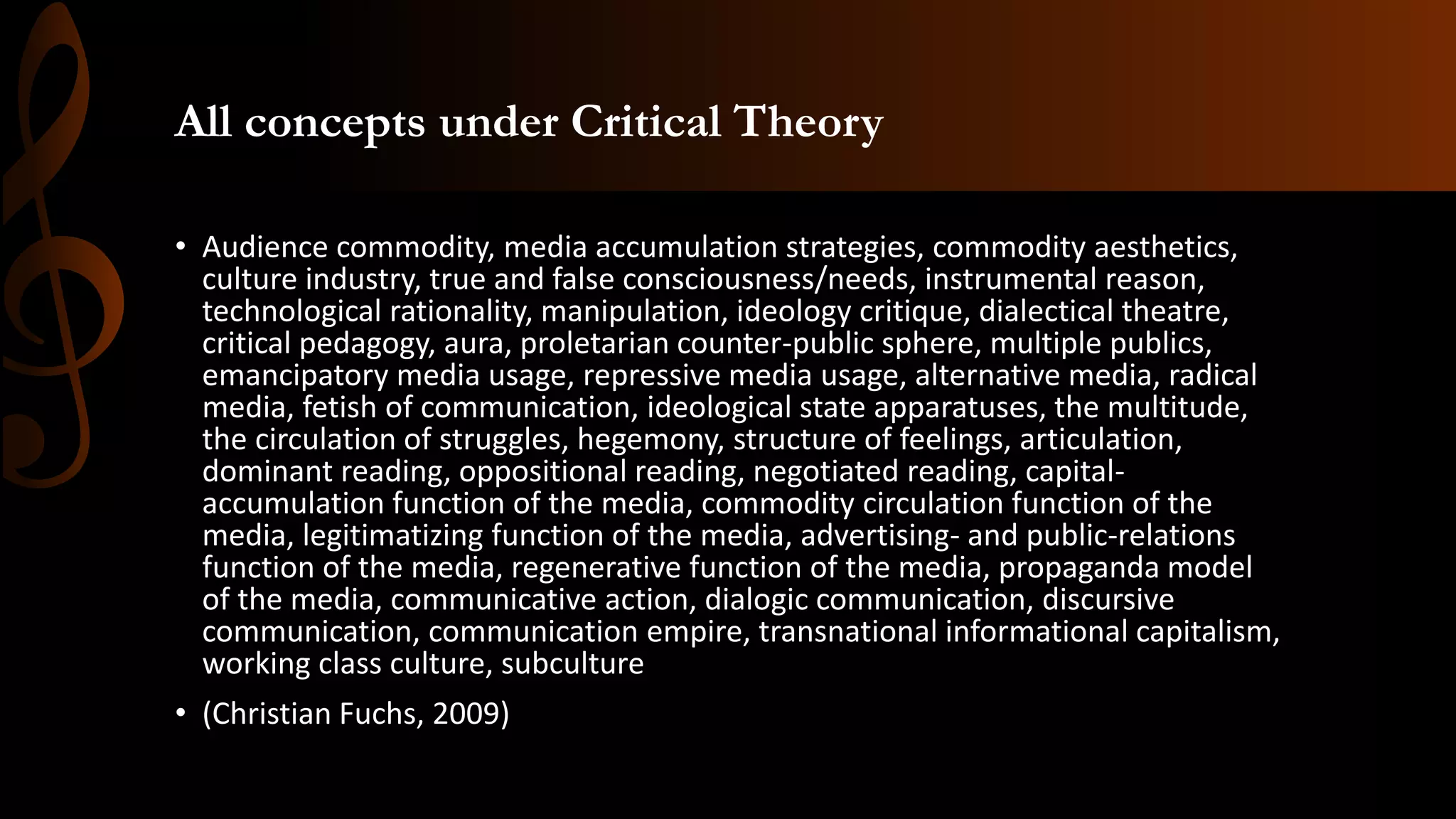
All concepts under Critical Theory
• Audience commodity, media accumulation strategies, commodity aesthetics,
culture industry, true and false consciousness/needs, instrumental reason,
technological rationality, manipulation, ideology critique, dialectical theatre,
critical pedagogy, aura, proletarian counter-public sphere, multiple publics,
emancipatory media usage, repressive media usage, alternative media, radical
media, fetish of communication, ideological state apparatuses, the multitude,
the circulation of struggles, hegemony, structure of feelings, articulation,
dominant reading, oppositional reading, negotiated reading, capital-
accumulation function of the media, commodity circulation function of the
media, legitimatizing function of the media, advertising- and public-relations
function of the media, regenerative function of the media, propaganda model
of the media, communicative action, dialogic communication, discursive
communication, communication empire, transnational informational capitalism,
working class culture, subculture
• (Christian Fuchs, 2009)
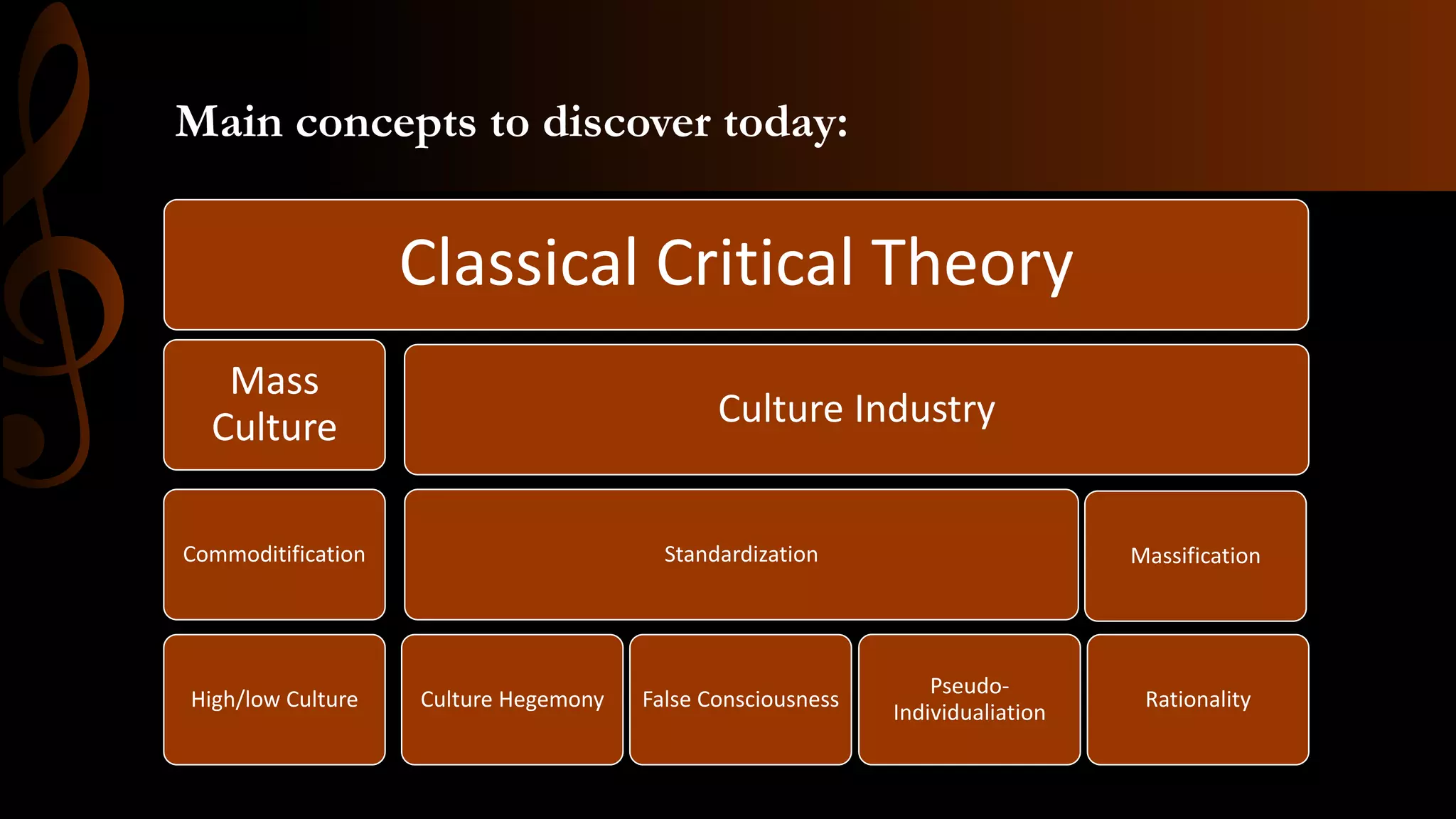
Main concepts to discover today:
Classical Critical Theory
Culture Industry
Standardization
Culture Hegemony False Consciousness Rationality
Commoditification
Pseudo-
Individualiation
Mass
Culture
Massification
High/low Culture
The Frankfurt School and
Classical Critical Theory
Carl Grünberg
Worker Revolution
Max Horkheimer
Culture Industry – Social
Revolution
Walter Benjamin
Aesthetic Theory
Theodor Adorno
Culture Industry
Jürgen Habermas
Social theory & Epistemology
Herbert Marcuse
Politics & Capitalism
Erich Fromm
Human Nature
Established: 1923
Location: Frankfurt
Financed by: Felix Weil (1898–1975)
Aims: Developing Marxism studies
The Frankfurt School
(The Institute of Social Research)
The Origin and
the Development of Critical Theory
Classical
Philoso-
phy
Classical
Marxism
Freudian
Psycho-
analysis
Critical
Theory
Culture
Industry
Culture
Studies
Media
Studies
MEDU
Studies
Check the full map here
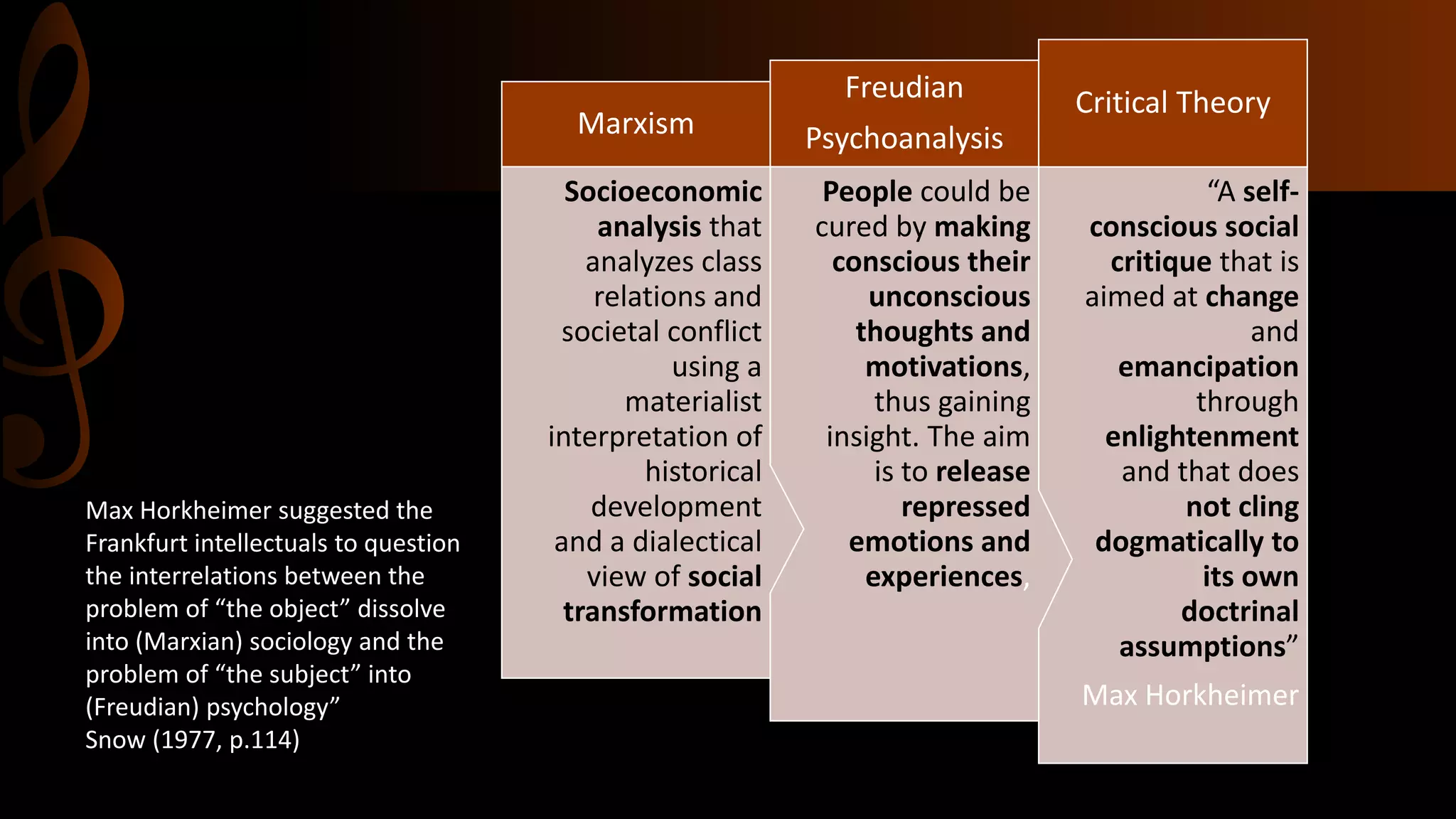
“A self-
conscious social
critique that is
aimed at change
and
emancipation
through
enlightenment
and that does
not cling
dogmatically to
its own
doctrinal
assumptions”
Max Horkheimer
Critical Theory
People could be
cured by making
conscious their
unconscious
thoughts and
motivations,
thus gaining
insight. The aim
is to release
repressed
emotions and
experiences,
Freudian
Psychoanalysis
Socioeconomic
analysis that
analyzes class
relations and
societal conflict
using a
materialist
interpretation of
historical
development
and a dialectical
view of social
transformation
Marxism
Max Horkheimer suggested the
Frankfurt intellectuals to question
the interrelations between the
problem of “the object” dissolve
into (Marxian) sociology and the
problem of “the subject” into
(Freudian) psychology”
Snow (1977, p.114)
Mass Culture and Culture
Industry
Culture
Industry
Mass
Culture
(High/Low
culture)
Commoditification + Standardization + Massification
Culture
CAPITALISM
• The nature of Mass Culture
“Mass culture was the seedbed of
political totalitarianism".
• The nature of Culture Industry:
“The very areas of life within
which many people believe they
are genuinely free – free from the
demands of work for example –
actually perpetuates domination
by denying freedom and
obstructing the development of a
critical consciousness.”
Fagan (2012)
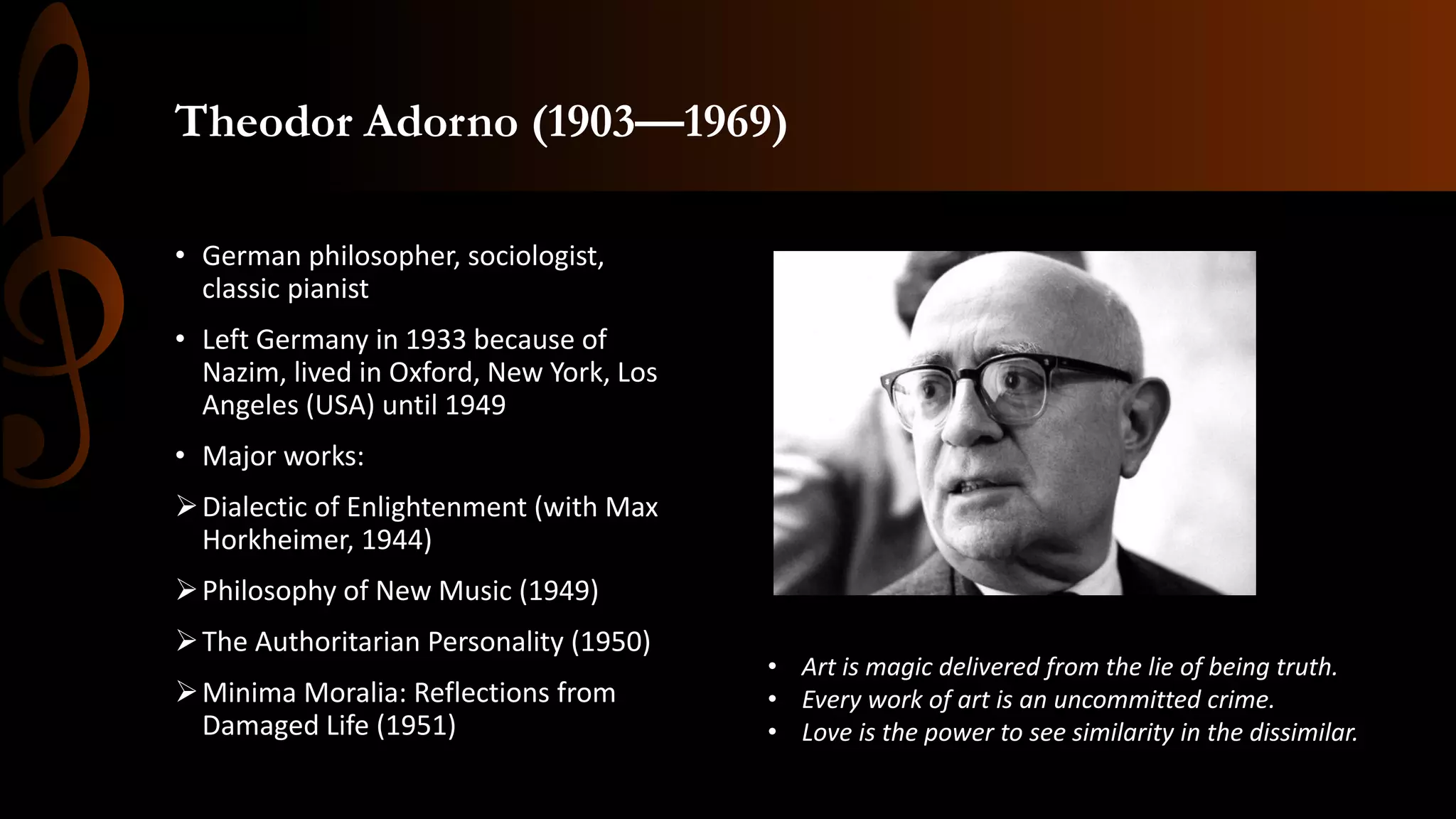
Theodor Adorno (1903—1969)
• German philosopher, sociologist,
classic pianist
• Left Germany in 1933 because of
Nazim, lived in Oxford, New York, Los
Angeles (USA) until 1949
• Major works:
➢Dialectic of Enlightenment (with Max
Horkheimer, 1944)
➢Philosophy of New Music (1949)
➢The Authoritarian Personality (1950)
➢Minima Moralia: Reflections from
Damaged Life (1951)
• Art is magic delivered from the lie of being truth.
• Every work of art is an uncommitted crime.
• Love is the power to see similarity in the dissimilar.
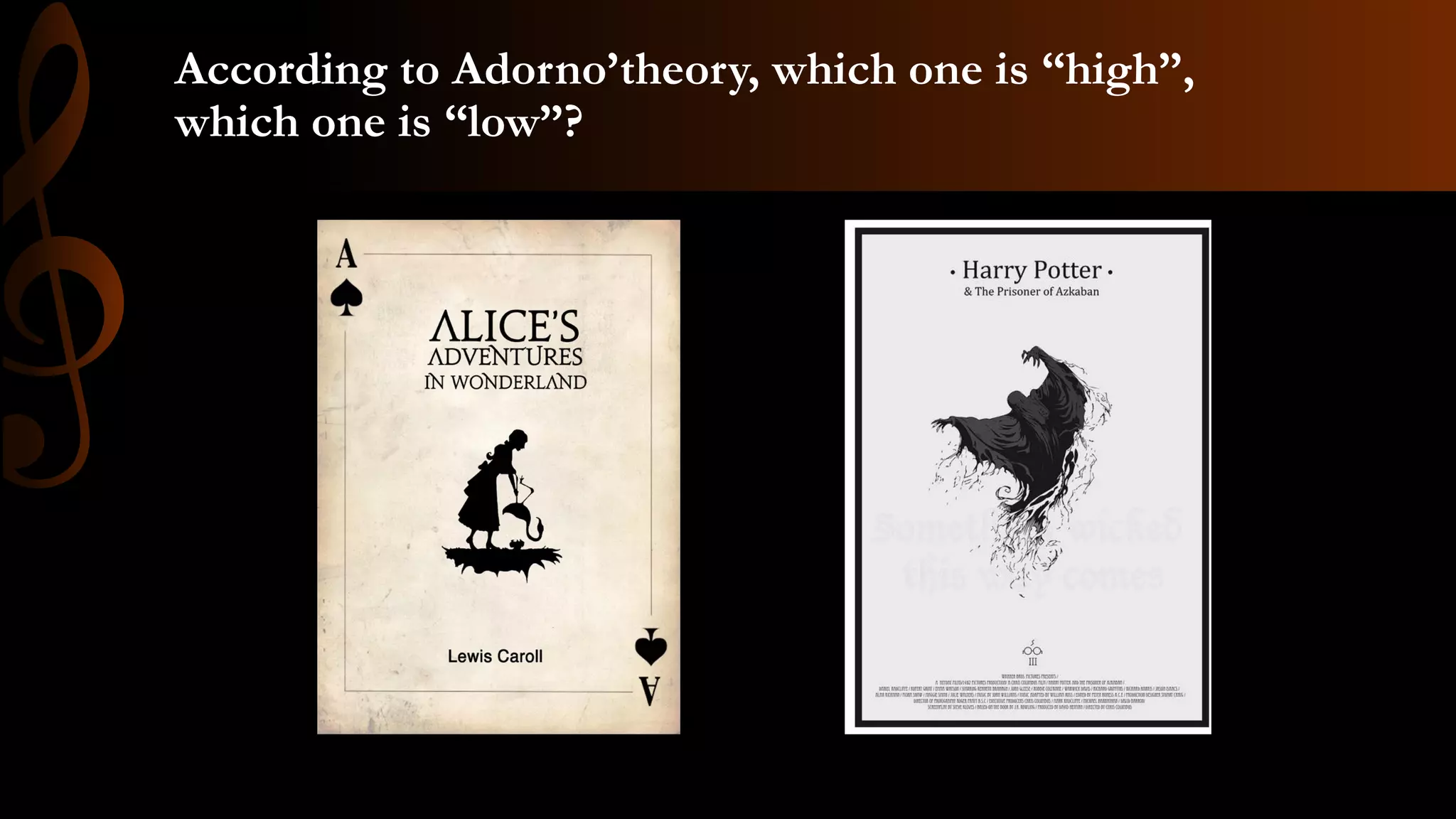
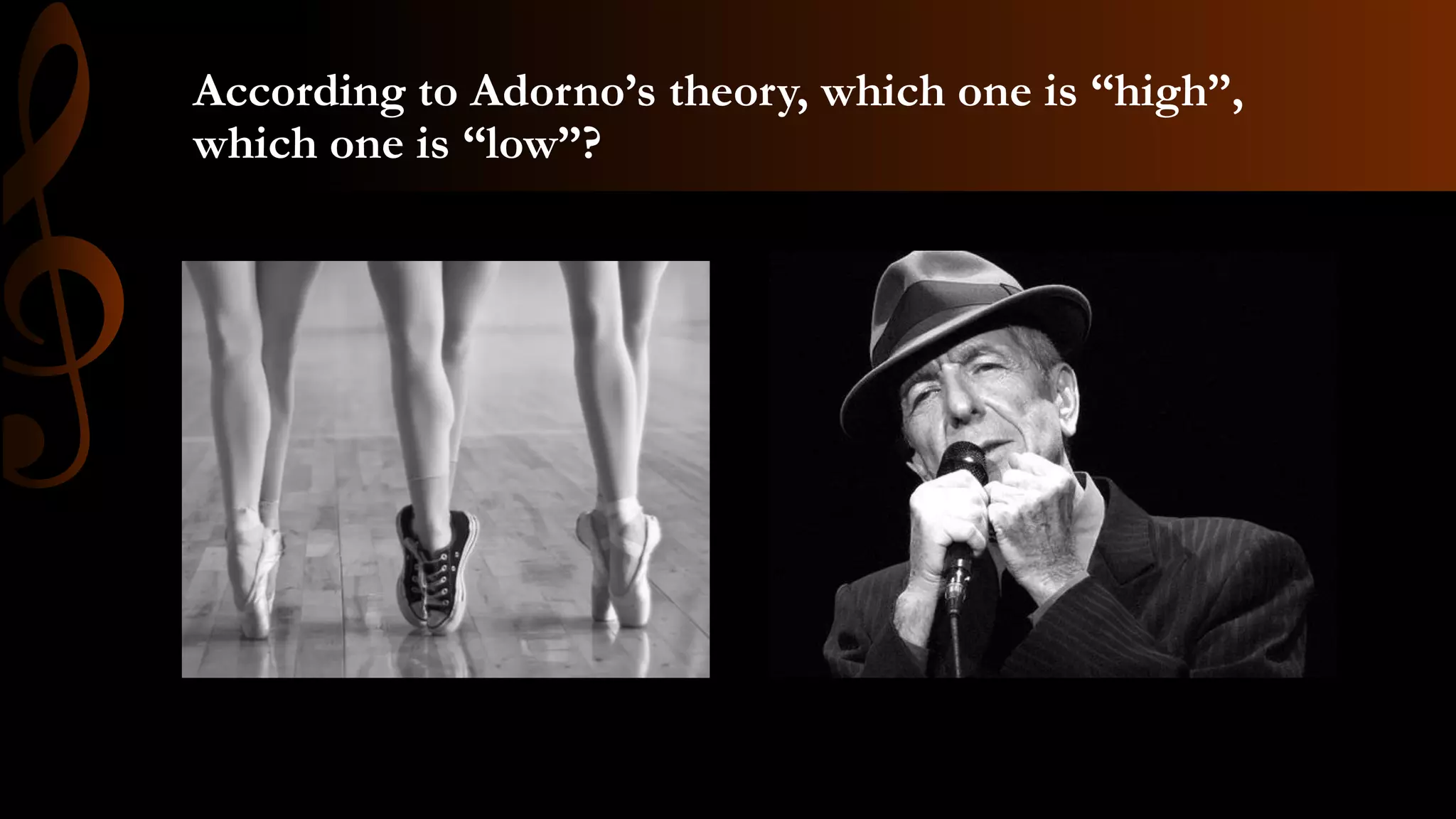
High Culture >< Low Culture
“High” Culture
• Artefacts: Classical music, ballet, fine
art masterpieces
• Consumer: Ruling class
• Characteristic: High “aura”
• Benefits:
• self-consciousness
• critical thinking
• autonomy
“Low” Culture
• Artefacts: Jazz, films, magazines, radio
programs, soap operas, television
serials
• Consumer: Working class
• Characteristic: Low “aura”
• Threats:
• Enslave and entrap working class
• Exploit their leisure time
• Weaken ability to think, act
autonomically
According to Adorno’theory, which one is “high”,
which one is “low”?
According to Adorno’theory, which one is “high”,
which one is “low”?
How Culture
Industry works
CONSUMPTION
DISTRIBUTION
PRODUCTION
STANDARDIZATION
COMMODITIZATION
MASSIFICATION
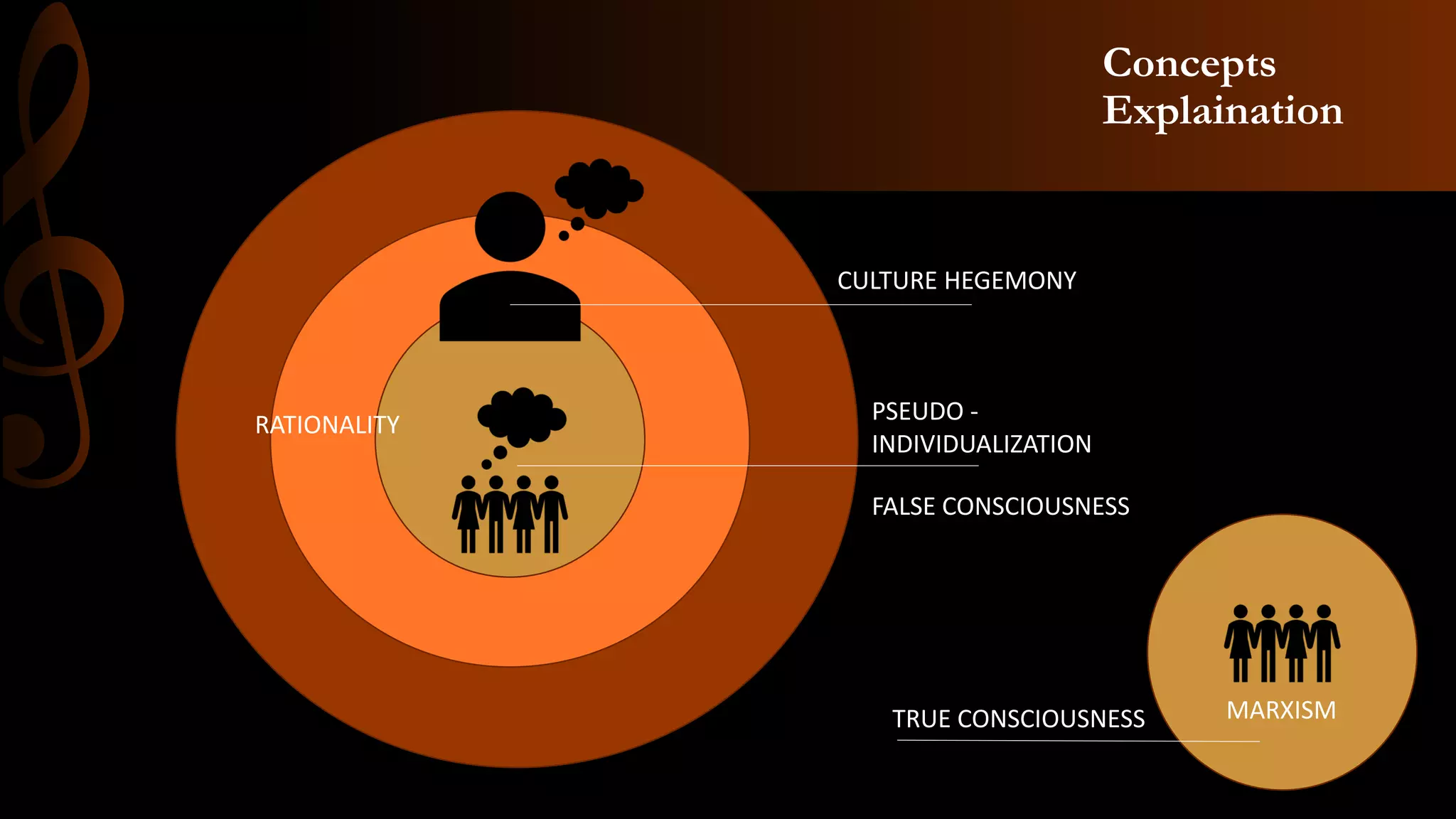
Concepts
Explaination
PSEUDO -
INDIVIDUALIZATION
FALSE CONSCIOUSNESS
CULTURE HEGEMONY
RATIONALITY
TRUE CONSCIOUSNESS MARXISM
According to Adorno’s theory, which one is “high”,
which one is “low”?
Contributions of Critical
Theory today
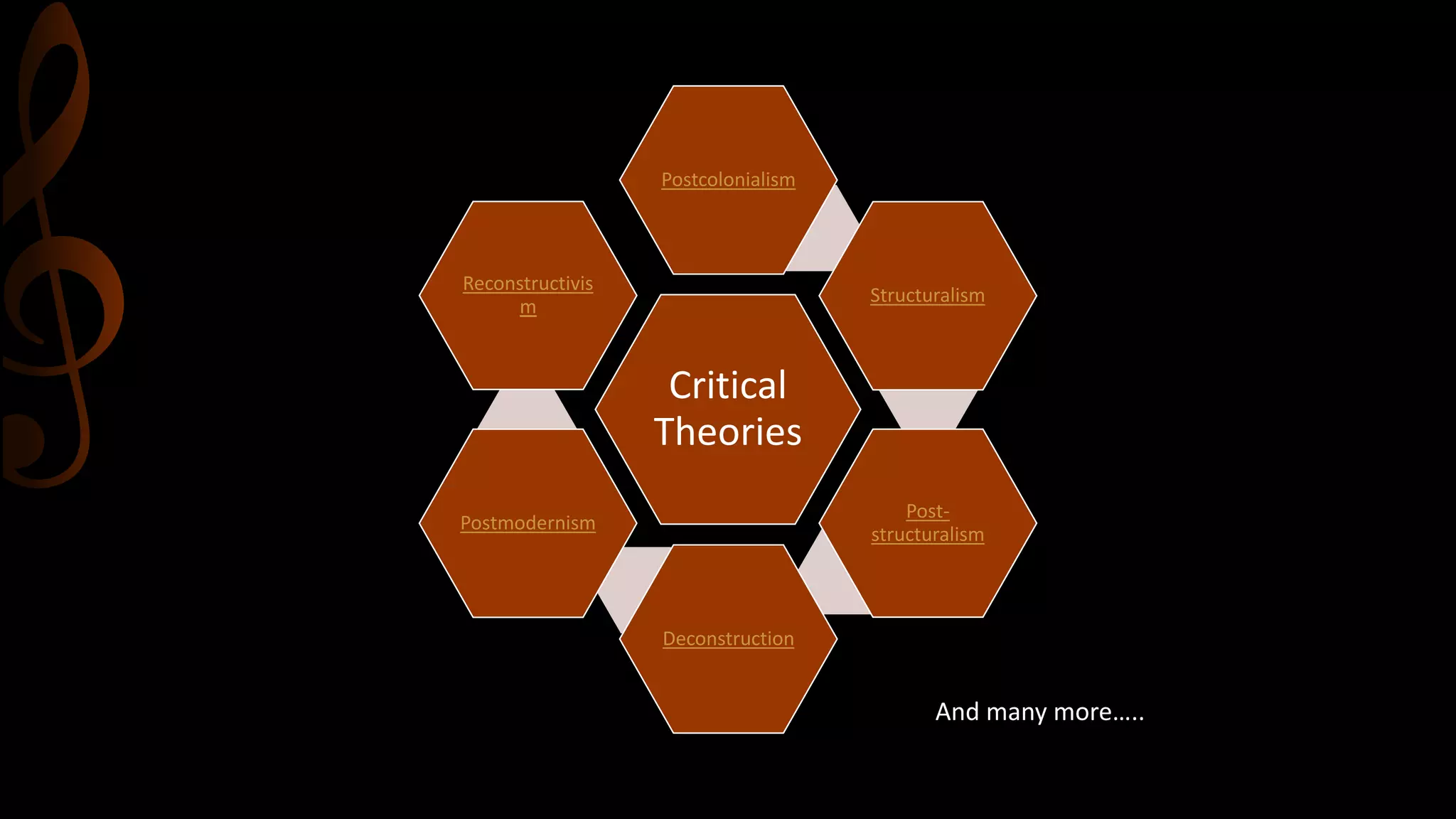
Critical
Theories
Postcolonialism
Structuralism
Post-
structuralism
Deconstruction
Postmodernism
Reconstructivis
m
And many more…..
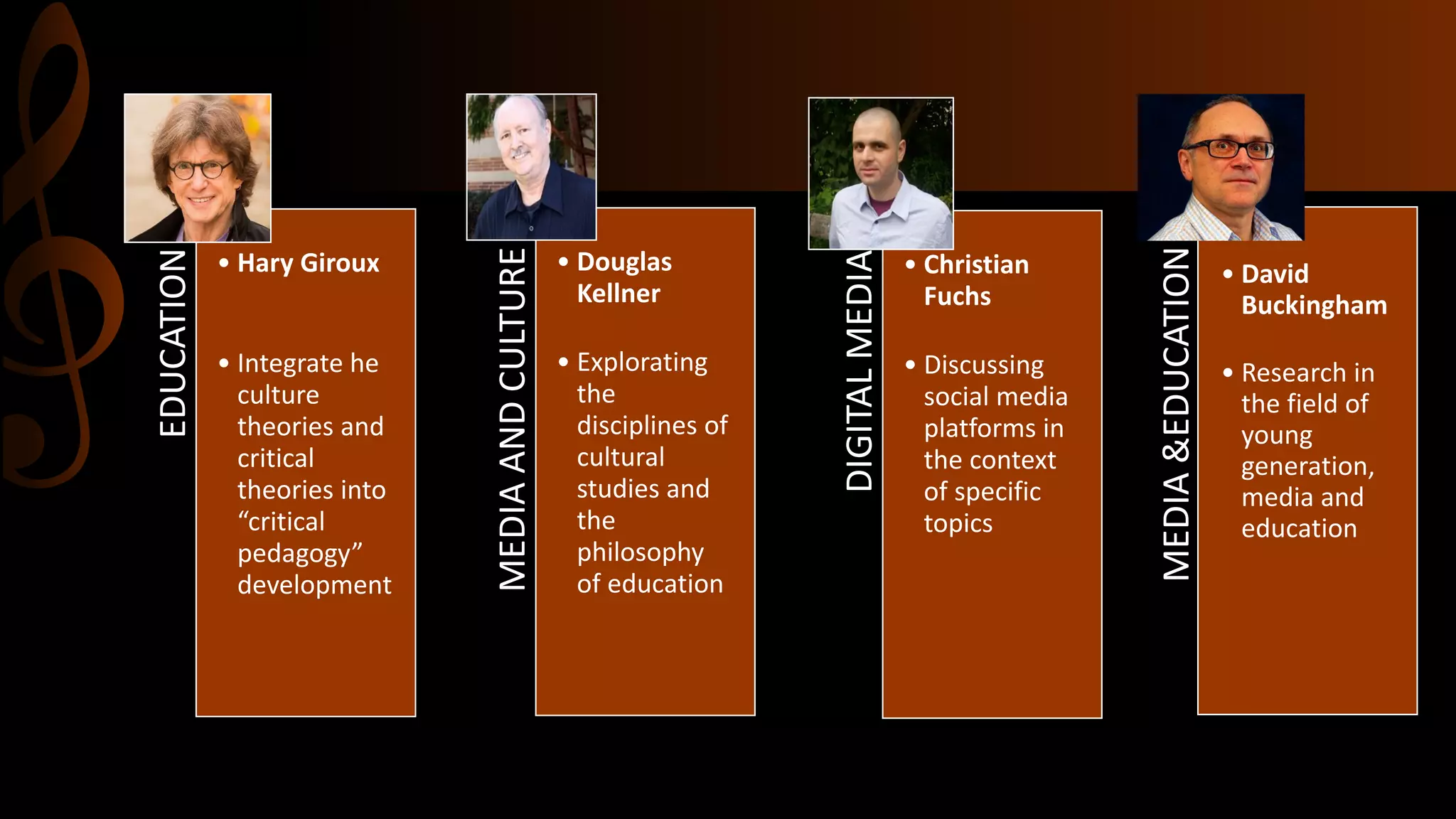
EDUCATION
• Hary Giroux
• Integrate he
culture
theories and
critical
theories into
“critical
pedagogy”
development
MEDIAANDCULTURE
• Douglas
Kellner
• Explorating
the
disciplines of
cultural
studies and
the
philosophy
of education
DIGITALMEDIA
• Christian
Fuchs
• Discussing
social media
platforms in
the context
of specific
topics
• David
Buckingham
• Research in
the field of
young
generation,
media and
education
MEDIA&EDUCATION
What does it means to media educators for being critical?
Discussion
How can media educators benefit from the Critical Theory?
Reading tips for online group discussion
• http://www.uwestminsterpress.co.uk/site/boo
ks/10.16997/book1/
• http://www.heathwoodpress.com/critical-
theory-of-information-communication-media-
technology/
• https://books.google.fi/books/about/Media_c
ultural_Studies.html?id=LSpmn22SqD0C&redir
_esc=y
• https://www.ejumpcut.org/a
rchive/onlinessays/JC20folder
/AdornoMassCult.html
• http://arthistoryunstuffed.co
m/theodor-adorno-and-the-
culture-industry/
• http://www.academia.edu/9
303217/Adorno_Cuture_Indu
stry_and_The_Lion_King
• https://www.slideshare.net/
wairere2/critical-theory-1pdf
Critical Theory and Culture Industry Critical Theory and Media Studies
Thank you so
much for your
attention!

Critical Theory and Media Studies

  • 1.
    Critical Theory and MediaStudies Approaches to Media Culture Presented by An Nguyen Instructed by Mari Maasilta
  • 2.
    3 main questionsto answer: What is Critical Theory? How Critical Theory contribute to Media Studies/Media Education? How the Critical Theory can benefit us as media education students /media workers?
  • 3.
    Critical Theory asa term In specific, it is the work of the Frankfurt School In general, they are theories that oppose to capitalism and domination in society.
  • 4.
    All concepts underCritical Theory • Audience commodity, media accumulation strategies, commodity aesthetics, culture industry, true and false consciousness/needs, instrumental reason, technological rationality, manipulation, ideology critique, dialectical theatre, critical pedagogy, aura, proletarian counter-public sphere, multiple publics, emancipatory media usage, repressive media usage, alternative media, radical media, fetish of communication, ideological state apparatuses, the multitude, the circulation of struggles, hegemony, structure of feelings, articulation, dominant reading, oppositional reading, negotiated reading, capital- accumulation function of the media, commodity circulation function of the media, legitimatizing function of the media, advertising- and public-relations function of the media, regenerative function of the media, propaganda model of the media, communicative action, dialogic communication, discursive communication, communication empire, transnational informational capitalism, working class culture, subculture • (Christian Fuchs, 2009)
  • 5.
    Main concepts todiscover today: Classical Critical Theory Culture Industry Standardization Culture Hegemony False Consciousness Rationality Commoditification Pseudo- Individualiation Mass Culture Massification High/low Culture
  • 6.
    The Frankfurt Schooland Classical Critical Theory
  • 7.
    Carl Grünberg Worker Revolution MaxHorkheimer Culture Industry – Social Revolution Walter Benjamin Aesthetic Theory Theodor Adorno Culture Industry Jürgen Habermas Social theory & Epistemology Herbert Marcuse Politics & Capitalism Erich Fromm Human Nature Established: 1923 Location: Frankfurt Financed by: Felix Weil (1898–1975) Aims: Developing Marxism studies The Frankfurt School (The Institute of Social Research)
  • 8.
    The Origin and theDevelopment of Critical Theory Classical Philoso- phy Classical Marxism Freudian Psycho- analysis Critical Theory Culture Industry Culture Studies Media Studies MEDU Studies Check the full map here
  • 9.
    “A self- conscious social critiquethat is aimed at change and emancipation through enlightenment and that does not cling dogmatically to its own doctrinal assumptions” Max Horkheimer Critical Theory People could be cured by making conscious their unconscious thoughts and motivations, thus gaining insight. The aim is to release repressed emotions and experiences, Freudian Psychoanalysis Socioeconomic analysis that analyzes class relations and societal conflict using a materialist interpretation of historical development and a dialectical view of social transformation Marxism Max Horkheimer suggested the Frankfurt intellectuals to question the interrelations between the problem of “the object” dissolve into (Marxian) sociology and the problem of “the subject” into (Freudian) psychology” Snow (1977, p.114)
  • 10.
    Mass Culture andCulture Industry
  • 11.
  • 12.
    • The natureof Mass Culture “Mass culture was the seedbed of political totalitarianism". • The nature of Culture Industry: “The very areas of life within which many people believe they are genuinely free – free from the demands of work for example – actually perpetuates domination by denying freedom and obstructing the development of a critical consciousness.” Fagan (2012)
  • 13.
    Theodor Adorno (1903—1969) •German philosopher, sociologist, classic pianist • Left Germany in 1933 because of Nazim, lived in Oxford, New York, Los Angeles (USA) until 1949 • Major works: ➢Dialectic of Enlightenment (with Max Horkheimer, 1944) ➢Philosophy of New Music (1949) ➢The Authoritarian Personality (1950) ➢Minima Moralia: Reflections from Damaged Life (1951) • Art is magic delivered from the lie of being truth. • Every work of art is an uncommitted crime. • Love is the power to see similarity in the dissimilar.
  • 14.
    High Culture ><Low Culture “High” Culture • Artefacts: Classical music, ballet, fine art masterpieces • Consumer: Ruling class • Characteristic: High “aura” • Benefits: • self-consciousness • critical thinking • autonomy “Low” Culture • Artefacts: Jazz, films, magazines, radio programs, soap operas, television serials • Consumer: Working class • Characteristic: Low “aura” • Threats: • Enslave and entrap working class • Exploit their leisure time • Weaken ability to think, act autonomically
  • 15.
    According to Adorno’theory,which one is “high”, which one is “low”?
  • 16.
    According to Adorno’theory,which one is “high”, which one is “low”?
  • 17.
  • 18.
  • 19.
    According to Adorno’stheory, which one is “high”, which one is “low”?
  • 20.
  • 21.
  • 22.
    EDUCATION • Hary Giroux •Integrate he culture theories and critical theories into “critical pedagogy” development MEDIAANDCULTURE • Douglas Kellner • Explorating the disciplines of cultural studies and the philosophy of education DIGITALMEDIA • Christian Fuchs • Discussing social media platforms in the context of specific topics • David Buckingham • Research in the field of young generation, media and education MEDIA&EDUCATION
  • 23.
    What does itmeans to media educators for being critical? Discussion How can media educators benefit from the Critical Theory?
  • 24.
    Reading tips foronline group discussion • http://www.uwestminsterpress.co.uk/site/boo ks/10.16997/book1/ • http://www.heathwoodpress.com/critical- theory-of-information-communication-media- technology/ • https://books.google.fi/books/about/Media_c ultural_Studies.html?id=LSpmn22SqD0C&redir _esc=y • https://www.ejumpcut.org/a rchive/onlinessays/JC20folder /AdornoMassCult.html • http://arthistoryunstuffed.co m/theodor-adorno-and-the- culture-industry/ • http://www.academia.edu/9 303217/Adorno_Cuture_Indu stry_and_The_Lion_King • https://www.slideshare.net/ wairere2/critical-theory-1pdf Critical Theory and Culture Industry Critical Theory and Media Studies
  • 25.
    Thank you so muchfor your attention!