THE LEARNING POWER OF ACTION
RESEARCH IN CURRICULUM
DESIGN
AN N E W H I S K E N
ASLA XXIII Biennial
Conference 2013
The learning power of action research in curriculum
design
ASLA XXIII Biennial Conference 2013
2
“I got lots out of this project, in terms of what we did in
the meetings, sharing ideas and gaining insights.
It made me think a lot about my own practice, and it
sort of pushed me into doing a few things differently,
trying to explore different ways of doing things
I thought we cannot just talk, we need to act, and the
action plan was good – because it was like doing a
course” (Whisken, 2010)
The learning power of action research in curriculum
design
ASLA XXIII Biennial Conference 2013
3
“The most interesting thing about the project was working
with my colleagues and that was the big incentive for
getting involved in the project
“there are just not enough opportunities to sit down and
really talk at length and in depth with people about
educational issues and where we are with education”
“it was getting some insight into what other people were
doing in their classrooms and what they thought was
important and how they thought about things” (Whisken, 2010)
The learning power of action research in curriculum
design
ASLA XXIII Biennial Conference 2013
4
“I’ve had time to actually review and look at my
presentation of information and how the kids receive it
and just stop and really think about what I’m doing in
the classroom -
if I hadn’t done this, that wouldn’t have happened”
(Whisken, 2010)
The learning power of action research in curriculum
design
ASLA XXIII Biennial Conference 2013
5
Power of action research for reflective professional
learning and possibilities for leadership by teacher
librarians
Christine Bruce’s Informed Learning model: strategies
for inclusion of information literacy in discipline practice
and learning experiences.
PhD action research project to examine Informed
Learning suitability for secondary schools. Lead by
teacher librarian with 25 teachers.
The learning power of action research in curriculum
design
ASLA XXIII Biennial Conference 2013
6
LEARNING INTENTIONS
1. Use of Informed Learning model for reflection
about embedding information literacy education
into curriculum design
2. Use of Action Research for professional learning in
schools
3. Possibilities for teacher librarians to take an active
role in action research at their schools
The learning power of action research in curriculum
design
ASLA XXIII Biennial Conference 2013
7
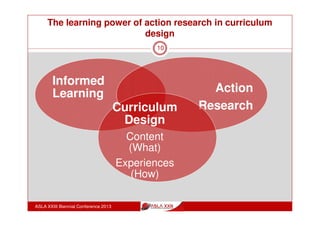
Informed
Learning Action
ResearchCurriculum
Design
Content
(What)
Experiences
(How)
The learning power of action research in curriculum
design
ASLA XXIII Biennial Conference 2013
8
What knowledge about information
literacy education do you bring to this
session?
What is the difference between
information literacy and information
literacy education?
The learning power of action research in curriculum
design
ASLA XXIII Biennial Conference 2013
9
What is information literacy education?
Just as there is a difference between science and
science education, history and history
education, there is a difference between
information literacy and information literacy
education. (Bruce, 2008)
Information literacy education is ‘enabling students
to work with different ways of using information to
learn; the educational framework that makes it
possible for students to experience information
literacy in new ways’ (Bruce, 2008, p. 184)
The learning power of action research in curriculum
design
ASLA XXIII Biennial Conference 2013
10
THINK – PAIR – SHARE
Where does information literacy education
happen at your school? By whom?
What are your information literacy
pedagogies?
The learning power of action research in curriculum
design
ASLA XXIII Biennial Conference 2013
11
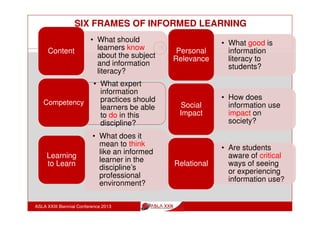
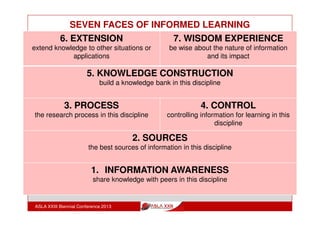
Informed Learning model (Bruce, 2008) is an
information literacy pedagogy for use by
curriculum designers as they build information
literacy education into discipline learning.
To provide expert information practice as part of
expert discipline practice education, teachers
Use the Six Frames checklist to incorporate
information literacy into discipline content
Embed Seven Faces of information use into
the design of discipline learning experiences
SIX FRAMES OF INFORMED LEARNING
ASLA XXIII Biennial Conference 2013
12
• What should
learners know
about the subject
and information
literacy?
Content
• What expert
information
practices should
learners be able
to do in this
discipline?
Competency
• What does it
mean to think
like an informed
learner in the
discipline’s
professional
environment?
Learning
to Learn
• What good is
information
literacy to
students?
Personal
Relevance
• How does
information use
impact on
society?
Social
Impact
• Are students
aware of critical
ways of seeing
or experiencing
information use?
Relational
SEVEN FACES OF INFORMED LEARNING
ASLA XXIII Biennial Conference 2013
13
6. EXTENSION
extend knowledge to other situations or
applications
7. WISDOM EXPERIENCE
be wise about the nature of information
and its impact
5. KNOWLEDGE CONSTRUCTION
build a knowledge bank in this discipline
3. PROCESS
the research process in this discipline
4. CONTROL
controlling information for learning in this
discipline
2. SOURCES
the best sources of information in this discipline
1. INFORMATION AWARENESS
share knowledge with peers in this discipline
The learning power of action research in curriculum
design
ASLA XXIII Biennial Conference 2013
14
2008 - 2009
The Problem, the Research Question, and the
Research Methodology
Problem: Information Literacy education still largely
seen as the preserve of the Library. How could I
do it differently?
The learning power of action research in curriculum
design
ASLA XXIII Biennial Conference 2013
15
‘If you want the same result, keep doing the same
thing’
What is the different thing that can be done to get a
different result?
What if it is possible to talk to teachers from the point
of their focus and have them see the possibility for
including information literacy education in their
discipline practice?
What if teacher practice could provide students with
discipline-based views and experiences of information
literacy?
What if this could be built into curriculum design?
The learning power of action research in curriculum
design
ASLA XXIII Biennial Conference 2013
16
Research Question:
Could Informed Learning concepts provide a bridge
between information literacy theory and practice in
a blended learning environment?
The learning power of action research in curriculum
design
ASLA XXIII Biennial Conference 2013
17
Research Question:
Could Informed Learning concepts provide a bridge
between information literacy theory and practice in
a blended learning environment?
What research methodology would enable
teachers to examine their practice of information
literacy using the conceptual model of Informed
Learning?
The learning power of action research in curriculum
design
ASLA XXIII Biennial Conference 2013
18
Research Methodology: requirements
Owned by participants
Enables researcher to be a participant
Transformative, emancipatory and empowering
Provide for reflection and discussion
Provide for different year level groups
Have structure and validity
The learning power of action research in curriculum
design
ASLA XXIII Biennial Conference 2013
19
Research Methodology:
A combination of case study and action research.
Action research to provide for cycles of reflective
practice which self manage and which have their
own contemporaneous data collection and
analysis processes
Multiple case study to provide for a formalised
data collection and analysis within and across a
number of groups
The learning power of action research in curriculum
design
ASLA XXIII Biennial Conference 2013
20
1. THINK – PAIR – SHARE – SQUARE - REPORT
What knowledge and experience do you bring to
this session about Action Research?
Action Research theory?
Action Research practice in schools?
2. THINK – SQUARE – SHARE
What do you want to know about Action Research?
The learning power of action research in curriculum
design
ASLA XXIII Biennial Conference 2013
21
Action Research theory
Genesis: Work by social psychologist Kurt Lewin and
the Tavistock Institute in early to mid C20th.
Group research process of planning, acting, observing
and reflecting
Provided practitioners with a means of researching their
own practice problems, and became a participatory and
emancipatory approach for individuals and groups to
change their social circumstances. (Kemmis, 1988)
Kemmis and his colleagues in Australia (Kemmis, 2009)
further developed the notion of the power of praxis as a
way of knowing, particularly in education.
The learning power of action research in curriculum
design
ASLA XXIII Biennial Conference 2013
22
Action Research in Education
provides for both individual professional development as
well as collaborative institutional change. (Herr and
Anderson, 2005)
‘ … can be engaged in by an individual teacher, a
collaborative group of colleagues sharing a common
concern, or an entire school faculty. These three different
approaches to organizing for research serve three
compatible, yet distinct, purposes:
Building the reflective practitioner
Making progress on school wide priorities
Building professional cultures.’ (Sangor, 2000)
The learning power of action research in curriculum
design
ASLA XXIII Biennial Conference 2013
23
Action Research in Education
Of the various methods within action research there
is particular relevance for schools in appreciative
inquiry, action learning, co-operative inquiry and
participatory action research.
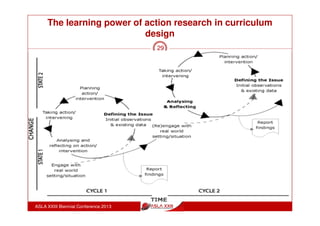
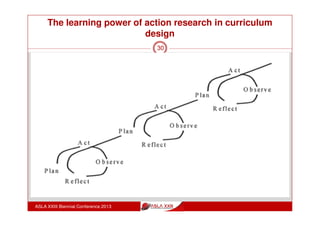
Participative action research (PAR) methodology has
an emphasis on the empowerment of individuals via
attainment and application of knowledge in reflective
action cycles by groups. Distinct stages in the cycles
are reflection, planning, action and observation
(Kemmis & McTaggert, 2005).
The learning power of action research in curriculum
design
ASLA XXIII Biennial Conference 2013
24
How might Action Research work in a
school?
A team of teachers decide on an area they want to explore or
develop and undertake action cycles:
read research material to inform them
plan how they will implement those ideas
take action
progressively report on their actions
reflect and review.
They review and read more, making changes as they go. They
report on the project.
The learning power of action research in curriculum
design
ASLA XXIII Biennial Conference 2013
25
What might it look like?
An example:
ILARC - Informed Learning Action Research – Carey 2010
three groups of teachers used action research to explore the
Informed Learning model of good information practice in their
teaching areas (total 25 teachers)
individual interviews at start and end of project
five meetings of two hours over terms 2 to 4.
Even in a busy schedule, they managed to find
mutually convenient times to meet
time to read the supplied material
time to take actions and reflect
The learning power of action research in curriculum
design
ASLA XXIII Biennial Conference 2013
26
What was the role of the teacher librarian?
Participant researcher and facilitator
Approval of supervising body (CSU) for PhD research
Approval of school administration to conduct research and
recognise the project for professional development points
Design of project including structure, research material,
agendas, minutes, recording and collection of data, report
Full organisation of mutually convenient meeting times
Chair of meetings
The learning power of action research in curriculum
design
ASLA XXIII Biennial Conference 2013
27
How do teachers experience Action
Research?
The ILARC participants stressed benefits of
Structure:
professional development in an ongoing meeting structure,
with a facilitator
Collegiality:
shared reports on application of ideas in teaching
time to talk professionally about their work
The learning power of action research in curriculum
design
ASLA XXIII Biennial Conference 2013
28
Structure:
professional development in an ongoing meeting structure,
with a facilitator
“I have a good model of how action research can work
and I can see that that’s really powerful - and facilitating
as you did where you provided us with an environment
that we could air ideas and it was non judgemental and
that was really great.”
(Whisken, 2010)
The learning power of action research in curriculum
design
ASLA XXIII Biennial Conference 2013
29
“your summaries of the model - I found really useful,
they were interesting, they were engaging and it was
good to talk about these things.”
“I found the practices, the people talking about what
they were doing in the classroom, the challenges they
were facing and the opportunity to exchange ideas
about that, that was I found most useful, most
valuable”
(Whisken, 2010)
The learning power of action research in curriculum
design
ASLA XXIII Biennial Conference 2013
30
“I think the power of it is that it’s over a period of time and
that it’s ongoing. Because you’re reporting back to a
group and because it’s reasonably regular, I think you feel
empowered to go off, give it a whirl, and report back; and
there’s also a level of responsibility.”
(Whisken, 2010)
The learning power of action research in curriculum
design
ASLA XXIII Biennial Conference 2013
31
“I actually think that’s also the power of professional
learning teams, but only if they’re driven by someone
who will make the meetings happen, who will make the
meetings attractive to attend, and who make sure that
the planning is understood.
So that I know that I need to do these things by this date,
and I should stop making excuses because I’m signed
up and I know exactly what to expect along the way.”
(Whisken, 2010)
The learning power of action research in curriculum
design
ASLA XXIII Biennial Conference 2013
32
“in terms of action research, this PD appealed to me - so
often you go to PD and sit and listen and maybe ask a
question,
but this gave us an opportunity to actually think about
doing something that’s connected with what we’ve been
discussing”
“The action research style of learning suits me very well, I
really love and have always loved that opportunity to
work with colleagues on issues” (Whisken, 2010)
The learning power of action research in curriculum
design
ASLA XXIII Biennial Conference 2013
33
“It did make me think a lot more about the use of ICT and I
really did start to investigate a lot more about web 2.0 …
what was out there and what was the real value in using
those modes if you like, as a way of learning,
what kinds of things do students really need to know, what
was the value. That to me was exciting and valuable.”
(Whisken, 2010)
The learning power of action research in curriculum
design
ASLA XXIII Biennial Conference 2013
34
“it gets you looking at the information in a different way,
and then imagining activities that would help your
students have that same experience.
And I think, because the way we approached the project
over time, it wasn’t a one day wonder it was something
that you could consider as you planned a range of units”
(Whisken, 2010)
The learning power of action research in curriculum
design
ASLA XXIII Biennial Conference 2013
35
“Looking at information in different ways, I never thought
about doing that, the way we present information and
the way kids see information and the way we research.
This makes you stop and say, so how do you actually
teach students, what is good what is bad information?
How do you actually evaluate that?
There’s so much information coming in at them, you
actually forget how much information is coming in at
them that we never had to face” (Whisken, 2010)
The learning power of action research in curriculum
design
ASLA XXIII Biennial Conference 2013
36
“I think the main thing I got was I need to be looking at
how I use information and how I use technology in the
classroom and how I model it personally”
“I would think that action research in a group works
better than on an individual basis.
Otherwise I would just go into my little areas and I think
you need to be accountable to a wider group and that
will bring about change in the curriculum”
(Whisken, 2010)
The learning power of action research in curriculum
design
ASLA XXIII Biennial Conference 2013
37
“I’ve become a lot more explicit since doing this course
and thinking about actually having to model it and
explain it through. So not just one or two students pick
up on it, but all of them do it”
“I thought the ideas were interesting and worthwhile:
the different classifications of the things that we do
with information and the ways in which we use
information to transform - that was really, really good”
(Whisken, 2010)
The learning power of action research in curriculum
design
ASLA XXIII Biennial Conference 2013
38
“I always reflect on my teaching but this made me
reflect in a more directed way, because I thought, well I
need to improve a few things”
“I wanted to be committed to the idea of this course and
attending the meetings, doing the reading trying to do
some reflections.”
“it was good, it was a really good experience, and I’m
grateful to you that I was asked to participate .. It made
me a better teacher” (Whisken, 2010)
The learning power of action research in curriculum
design
ASLA XXIII Biennial Conference 2013
39
“what I’m going to do in terms of revamping the middle
school geography course, is to take on more of this
action research. How can we plan things a lot differently
next year and approach things in a different manner.”
(Whisken, 2010)
The learning power of action research in curriculum
design
ASLA XXIII Biennial Conference 2013
40
“the action research was something that’s given me a
new way of thinking, a new way of looking at things a
bit more how can we use that because that’s the big
picture stuff.
The informed learning is the get in the engine room
and do that stuff for me.”
(Whisken, 2010)
The learning power of action research in curriculum
design
ASLA XXIII Biennial Conference 2013
41
Collegiality:
shared reports on application of ideas in teaching
time to talk professionally about their work
“what I really got out of it was the experience of being
with a group of people and meeting on a regular if not
frequent basis and just space in which to talk about
and reflect on teaching practice and I found that very
valuable”
The learning power of action research in curriculum
design
ASLA XXIII Biennial Conference 2013
42
“I think it's a very useful model which I got a lot of
value out of - and what we've done here as a group
meeting and talking about how we’re grappling with
this new concept of informed learning ourselves and
trying to let that inform our own pedagogy.”
(Whisken, 2010)
The learning power of action research in curriculum
design
ASLA XXIII Biennial Conference 2013
43
“I really valued the discussions - what other teachers
were doing in the classroom, the challenges they were
finding, talking about the different strategies, the projects
that they were doing.
I thought that was really, really stimulating and I
expected to get that and I did get it so I was very
pleased with that.
“Its been a wonderful model and how do we take that
and apply that further to our learning as teachers, that
needs to keep going on” (Whisken, 2010)
The learning power of action research in curriculum
design
ASLA XXIII Biennial Conference 2013
44
“Look I found a lot of things that G… was saying about
what she’d like to see done with IT skills, I found that
really interesting
I thought that could be very valuable and applied in
English, the sorts of ideas she talked about - teaching
certain forms that you use in organising your
information in filing, in templates, etc.”
(Whisken, 2010)
The learning power of action research in curriculum
design
ASLA XXIII Biennial Conference 2013
45
“In terms of action research, I thought it is a very
powerful mechanism. I like the fact that it brought a
group of people together who were very open and
supportive of each other and from a range of different
perspectives and experiences and that was good”
(Whisken, 2010)
The learning power of action research in curriculum
design
ASLA XXIII Biennial Conference 2013
46
“the action research was something that’s given me a
new way of thinking, a new way of looking at things -
that’s the big picture stuff. The informed learning is the
get in the engine room and do that stuff for me.”
“being part of the Action Research Project I think was a
really valuable thing for me to do, I really felt that sense
of belonging to a group, sense of being welcomed and
encouraged to participate and to explore ideas.”
(Whisken, 2010)
The learning power of action research in curriculum
design
ASLA XXIII Biennial Conference 2013
47
“I think the most powerful thing was reflecting about
your teaching in light of what other people were talking
about.
the meetings were most powerful, I think, listening to
other people and how they were thinking and what they
were doing in informed learning action research made
me feel that actually, there was more than I originally
anticipated for LOTE, specifically.”
(Whisken, 2010)
The learning power of action research in curriculum
design
ASLA XXIII Biennial Conference 2013
48
“I think the sense of collegiality that was fostered
amongst the group was very beneficial -
particularly because the groups were across a few
learning areas so it was interesting to look at what we
were doing with a common idea across different
learning areas. But also the opportunity to do some
more professional reading I certainly valued that as
well”
(Whisken, 2010)
The learning power of action research in curriculum
design
ASLA XXIII Biennial Conference 2013
49
“I got a fantastic opportunity to share with other staff
that I don’t think we normally get across learning areas
looking at how we handle information in the big picture
sense,
because we never get an opportunity to actually learn
what goes on in other learning areas and I had
insights there that I don’t get any other way, there is no
other way to get them.”
(Whisken, 2010)
The learning power of action research in curriculum
design
ASLA XXIII Biennial Conference 2013
50
“The main areas that it provided for me I think were the
group discussions. I found it fascinating to hear people in
other fields doing similar things that could be done in my
particular subject. I gained a great deal from listening to how
others teach a range of materials.”
“Action research – as a reality I think it’s a really worthwhile
thing to do and it’s been great hearing what other people are
doing in their classes and sharing that in these sessions.
It’s been really stimulating, given me so many ideas myself
for my own practice and helped me become a lot more
reflective and to change what I’m doing.”
(Whisken, 2010)
The learning power of action research in curriculum
design
ASLA XXIII Biennial Conference 2013
51
What was the impact of the Action
Research at my school?
2011 Action Learning Teams: free choice
2012 Action Learning Teams: general
curriculum themes
2013 Action Learning Teams: particular
focus curriculum themes
The learning power of action research in curriculum
design
ASLA XXIII Biennial Conference 2013
52
What was the impact of the Action
Research at my school?
2011 Action Learning Teams: free choice
2012 Action Learning Teams: general
curriculum themes
2013 Action Learning Teams: particular
focus curriculum themes
The learning power of action research in curriculum
design
ASLA XXIII Biennial Conference 2013
53
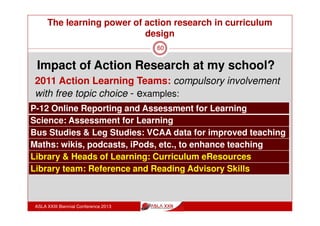
Impact of Action Research at my school?
2011 Action Learning Teams: compulsory involvement
with free topic choice - examples:
P-12 Online Reporting and Assessment for Learning
Science: Assessment for Learning
Bus Studies & Leg Studies: VCAA data for improved teaching
Maths: wikis, podcasts, iPods, etc., to enhance teaching
Library & Heads of Learning: Curriculum eResources
Library team: Reference and Reading Advisory Skills
The learning power of action research in curriculum
design
ASLA XXIII Biennial Conference 2013
54
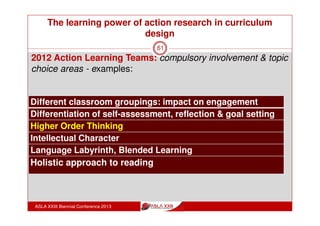
2012 Action Learning Teams: compulsory involvement & topic
choice areas - examples:
Different classroom groupings: impact on engagement
Differentiation of self-assessment, reflection & goal setting
Higher Order Thinking
Intellectual Character
Language Labyrinth, Blended Learning
Holistic approach to reading
The learning power of action research in curriculum
design
ASLA XXIII Biennial Conference 2013
55
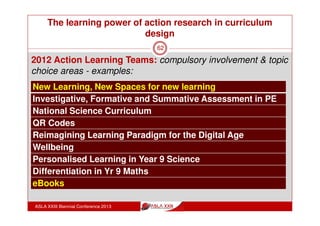
2012 Action Learning Teams: compulsory involvement & topic
choice areas - examples:
Examples:
New Learning, New Spaces for new learning
Investigative, Formative and Summative Assessment in PE
National Science Curriculum
QR Codes
Reimagining Learning Paradigm for the Digital Age
Wellbeing
Personalised Learning in Year 9 Science
Differentiation in Yr 9 Maths
eBooks
The learning power of action research in curriculum
design
ASLA XXIII Biennial Conference 2013
56
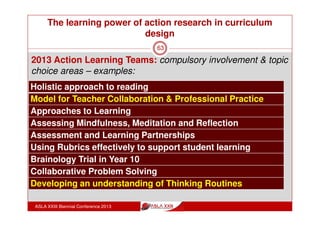
2013 Action Learning Teams: compulsory involvement & topic
choice areas – examples:
Holistic approach to reading
Model for Teacher Collaboration & Professional Practice
Approaches to Learning
Assessing Mindfulness, Meditation and Reflection
Assessment and Learning Partnerships
Using Rubrics effectively to support student learning
Brainology Trial in Year 10
Collaborative Problem Solving
Developing an understanding of Thinking Routines
The learning power of action research in curriculum
design
ASLA XXIII Biennial Conference 2013
57
2013 Action Learning Teams: compulsory involvement &
strategic goals topic choice areas – examples:
Develop an Understanding of Positive Learning
Differentiated Instruction in the Primary Classroom
Differentiation in MS Science
Differentiation in Years 8,9&10 Maths
Differentiation in Y12 Psychology and Biology
Differentiation in the Music Classroom
Implementing Positive Education
Introducing Positive Psychology to English
Mellor Library Data Collection: Know thy impact!
The learning power of action research in curriculum
design
ASLA XXIII Biennial Conference 2013
58
Teacher Librarian and Action Learning Teams: benefits of
involvement
Direct involvement in development and direction of professional
learning across the school
Establishment of common understandings with over 25 teachers
across all year levels and subject areas – and building each
year by involvement in more ALTs about
information literacy practices in each discipline area
research practices
key curriculum goal areas of Visible Thinking, Assessment for
Learning, Differentiation
resources for learning in each discipline area
The learning power of action research in
curriculum design
ASLA XXIII Biennial Conference 2013
59
LEARNING INTENTIONS:
Traffic Light Reflection
1. Use of Informed Learning model for reflection
about embedding information literacy education
into curriculum design
2. Use of Action Research for professional learning in
schools
3. Possibilities for teacher librarians to take an active
role in action research at their schools
The learning power of action research in
curriculum design
ASLA XXIII Biennial Conference 2013
60
LEARNING INTENTIONS:
Traffic Light Reflection
1. Use of Informed Learning model for
reflection about embedding information
literacy education into curriculum design
Understand? Yes Maybe No
Use? Yes Maybe No
The learning power of action research in
curriculum design
ASLA XXIII Biennial Conference 2013
61
LEARNING INTENTIONS:
Traffic Light Reflection
2. Use of Action Research for professional
learning in schools
Understand? Yes Maybe No
Use? Yes Maybe No
The learning power of action research in
curriculum design
ASLA XXIII Biennial Conference 2013
62
LEARNING INTENTIONS:
Traffic Light Reflection
3. Possibilities for teacher librarians to take an
active role in action research at their schools
Understand? Yes Maybe No
Use? Yes Maybe No
The learning power of action research in
curriculum design: References
ASLA XXIII Biennial Conference 2013
63
Bruce, C. (2008). Informed learning. Chicago: Association of College
and Research Libraries
Herr, K., & Anderson, G. L. (2005). The action research dissertation: a
guide for students and faculty. London: SAGE.
Kemmis, S. (1988). Action research in retrospect and prospect. In The
action research reader (pp. 27-39). Victoria: Deakin University Press
Kemmis, S. (2008). Researching for praxis: Knowing doing. . Paper
presented at the ‘Researching practice’ conference sponsored by the
journal Pedagogy, Culture and Society and Gothenburg University.
September 13, 2008.
Kemmis, S. (2009). Action research as a practice-based practice.
Educational Action Research, 17(3), 463-474.
Kemmis, S., & McTaggert, R. (2005). Participatory action research:
communicative action and the public sphere. In Handbook of qualitative
research (pp. 559-602).
Whisken, A. (2010). PhD Data Collection (unpublished). Melbourne.

Action research in curriculum design

  • 1.
    THE LEARNING POWEROF ACTION RESEARCH IN CURRICULUM DESIGN AN N E W H I S K E N ASLA XXIII Biennial Conference 2013
  • 2.
    The learning powerof action research in curriculum design ASLA XXIII Biennial Conference 2013 2 “I got lots out of this project, in terms of what we did in the meetings, sharing ideas and gaining insights. It made me think a lot about my own practice, and it sort of pushed me into doing a few things differently, trying to explore different ways of doing things I thought we cannot just talk, we need to act, and the action plan was good – because it was like doing a course” (Whisken, 2010)
  • 3.
    The learning powerof action research in curriculum design ASLA XXIII Biennial Conference 2013 3 “The most interesting thing about the project was working with my colleagues and that was the big incentive for getting involved in the project “there are just not enough opportunities to sit down and really talk at length and in depth with people about educational issues and where we are with education” “it was getting some insight into what other people were doing in their classrooms and what they thought was important and how they thought about things” (Whisken, 2010)
  • 4.
    The learning powerof action research in curriculum design ASLA XXIII Biennial Conference 2013 4 “I’ve had time to actually review and look at my presentation of information and how the kids receive it and just stop and really think about what I’m doing in the classroom - if I hadn’t done this, that wouldn’t have happened” (Whisken, 2010)
  • 5.
    The learning powerof action research in curriculum design ASLA XXIII Biennial Conference 2013 5 Power of action research for reflective professional learning and possibilities for leadership by teacher librarians Christine Bruce’s Informed Learning model: strategies for inclusion of information literacy in discipline practice and learning experiences. PhD action research project to examine Informed Learning suitability for secondary schools. Lead by teacher librarian with 25 teachers.
  • 6.
    The learning powerof action research in curriculum design ASLA XXIII Biennial Conference 2013 6 LEARNING INTENTIONS 1. Use of Informed Learning model for reflection about embedding information literacy education into curriculum design 2. Use of Action Research for professional learning in schools 3. Possibilities for teacher librarians to take an active role in action research at their schools
  • 7.
    The learning powerof action research in curriculum design ASLA XXIII Biennial Conference 2013 7 Informed Learning Action ResearchCurriculum Design Content (What) Experiences (How)
  • 8.
    The learning powerof action research in curriculum design ASLA XXIII Biennial Conference 2013 8 What knowledge about information literacy education do you bring to this session? What is the difference between information literacy and information literacy education?
  • 9.
    The learning powerof action research in curriculum design ASLA XXIII Biennial Conference 2013 9 What is information literacy education? Just as there is a difference between science and science education, history and history education, there is a difference between information literacy and information literacy education. (Bruce, 2008) Information literacy education is ‘enabling students to work with different ways of using information to learn; the educational framework that makes it possible for students to experience information literacy in new ways’ (Bruce, 2008, p. 184)
  • 10.
    The learning powerof action research in curriculum design ASLA XXIII Biennial Conference 2013 10 THINK – PAIR – SHARE Where does information literacy education happen at your school? By whom? What are your information literacy pedagogies?
  • 11.
    The learning powerof action research in curriculum design ASLA XXIII Biennial Conference 2013 11 Informed Learning model (Bruce, 2008) is an information literacy pedagogy for use by curriculum designers as they build information literacy education into discipline learning. To provide expert information practice as part of expert discipline practice education, teachers Use the Six Frames checklist to incorporate information literacy into discipline content Embed Seven Faces of information use into the design of discipline learning experiences
  • 12.
    SIX FRAMES OFINFORMED LEARNING ASLA XXIII Biennial Conference 2013 12 • What should learners know about the subject and information literacy? Content • What expert information practices should learners be able to do in this discipline? Competency • What does it mean to think like an informed learner in the discipline’s professional environment? Learning to Learn • What good is information literacy to students? Personal Relevance • How does information use impact on society? Social Impact • Are students aware of critical ways of seeing or experiencing information use? Relational
  • 13.
    SEVEN FACES OFINFORMED LEARNING ASLA XXIII Biennial Conference 2013 13 6. EXTENSION extend knowledge to other situations or applications 7. WISDOM EXPERIENCE be wise about the nature of information and its impact 5. KNOWLEDGE CONSTRUCTION build a knowledge bank in this discipline 3. PROCESS the research process in this discipline 4. CONTROL controlling information for learning in this discipline 2. SOURCES the best sources of information in this discipline 1. INFORMATION AWARENESS share knowledge with peers in this discipline
  • 14.
    The learning powerof action research in curriculum design ASLA XXIII Biennial Conference 2013 14 2008 - 2009 The Problem, the Research Question, and the Research Methodology Problem: Information Literacy education still largely seen as the preserve of the Library. How could I do it differently?
  • 15.
    The learning powerof action research in curriculum design ASLA XXIII Biennial Conference 2013 15 ‘If you want the same result, keep doing the same thing’ What is the different thing that can be done to get a different result? What if it is possible to talk to teachers from the point of their focus and have them see the possibility for including information literacy education in their discipline practice? What if teacher practice could provide students with discipline-based views and experiences of information literacy? What if this could be built into curriculum design?
  • 16.
    The learning powerof action research in curriculum design ASLA XXIII Biennial Conference 2013 16 Research Question: Could Informed Learning concepts provide a bridge between information literacy theory and practice in a blended learning environment?
  • 17.
    The learning powerof action research in curriculum design ASLA XXIII Biennial Conference 2013 17 Research Question: Could Informed Learning concepts provide a bridge between information literacy theory and practice in a blended learning environment? What research methodology would enable teachers to examine their practice of information literacy using the conceptual model of Informed Learning?
  • 18.
    The learning powerof action research in curriculum design ASLA XXIII Biennial Conference 2013 18 Research Methodology: requirements Owned by participants Enables researcher to be a participant Transformative, emancipatory and empowering Provide for reflection and discussion Provide for different year level groups Have structure and validity
  • 19.
    The learning powerof action research in curriculum design ASLA XXIII Biennial Conference 2013 19 Research Methodology: A combination of case study and action research. Action research to provide for cycles of reflective practice which self manage and which have their own contemporaneous data collection and analysis processes Multiple case study to provide for a formalised data collection and analysis within and across a number of groups
  • 20.
    The learning powerof action research in curriculum design ASLA XXIII Biennial Conference 2013 20 1. THINK – PAIR – SHARE – SQUARE - REPORT What knowledge and experience do you bring to this session about Action Research? Action Research theory? Action Research practice in schools? 2. THINK – SQUARE – SHARE What do you want to know about Action Research?
  • 21.
    The learning powerof action research in curriculum design ASLA XXIII Biennial Conference 2013 21 Action Research theory Genesis: Work by social psychologist Kurt Lewin and the Tavistock Institute in early to mid C20th. Group research process of planning, acting, observing and reflecting Provided practitioners with a means of researching their own practice problems, and became a participatory and emancipatory approach for individuals and groups to change their social circumstances. (Kemmis, 1988) Kemmis and his colleagues in Australia (Kemmis, 2009) further developed the notion of the power of praxis as a way of knowing, particularly in education.
  • 22.
    The learning powerof action research in curriculum design ASLA XXIII Biennial Conference 2013 22 Action Research in Education provides for both individual professional development as well as collaborative institutional change. (Herr and Anderson, 2005) ‘ … can be engaged in by an individual teacher, a collaborative group of colleagues sharing a common concern, or an entire school faculty. These three different approaches to organizing for research serve three compatible, yet distinct, purposes: Building the reflective practitioner Making progress on school wide priorities Building professional cultures.’ (Sangor, 2000)
  • 23.
    The learning powerof action research in curriculum design ASLA XXIII Biennial Conference 2013 23 Action Research in Education Of the various methods within action research there is particular relevance for schools in appreciative inquiry, action learning, co-operative inquiry and participatory action research. Participative action research (PAR) methodology has an emphasis on the empowerment of individuals via attainment and application of knowledge in reflective action cycles by groups. Distinct stages in the cycles are reflection, planning, action and observation (Kemmis & McTaggert, 2005).
  • 24.
    The learning powerof action research in curriculum design ASLA XXIII Biennial Conference 2013 24 How might Action Research work in a school? A team of teachers decide on an area they want to explore or develop and undertake action cycles: read research material to inform them plan how they will implement those ideas take action progressively report on their actions reflect and review. They review and read more, making changes as they go. They report on the project.
  • 25.
    The learning powerof action research in curriculum design ASLA XXIII Biennial Conference 2013 25 What might it look like? An example: ILARC - Informed Learning Action Research – Carey 2010 three groups of teachers used action research to explore the Informed Learning model of good information practice in their teaching areas (total 25 teachers) individual interviews at start and end of project five meetings of two hours over terms 2 to 4. Even in a busy schedule, they managed to find mutually convenient times to meet time to read the supplied material time to take actions and reflect
  • 26.
    The learning powerof action research in curriculum design ASLA XXIII Biennial Conference 2013 26 What was the role of the teacher librarian? Participant researcher and facilitator Approval of supervising body (CSU) for PhD research Approval of school administration to conduct research and recognise the project for professional development points Design of project including structure, research material, agendas, minutes, recording and collection of data, report Full organisation of mutually convenient meeting times Chair of meetings
  • 27.
    The learning powerof action research in curriculum design ASLA XXIII Biennial Conference 2013 27 How do teachers experience Action Research? The ILARC participants stressed benefits of Structure: professional development in an ongoing meeting structure, with a facilitator Collegiality: shared reports on application of ideas in teaching time to talk professionally about their work
  • 28.
    The learning powerof action research in curriculum design ASLA XXIII Biennial Conference 2013 28 Structure: professional development in an ongoing meeting structure, with a facilitator “I have a good model of how action research can work and I can see that that’s really powerful - and facilitating as you did where you provided us with an environment that we could air ideas and it was non judgemental and that was really great.” (Whisken, 2010)
  • 29.
    The learning powerof action research in curriculum design ASLA XXIII Biennial Conference 2013 29 “your summaries of the model - I found really useful, they were interesting, they were engaging and it was good to talk about these things.” “I found the practices, the people talking about what they were doing in the classroom, the challenges they were facing and the opportunity to exchange ideas about that, that was I found most useful, most valuable” (Whisken, 2010)
  • 30.
    The learning powerof action research in curriculum design ASLA XXIII Biennial Conference 2013 30 “I think the power of it is that it’s over a period of time and that it’s ongoing. Because you’re reporting back to a group and because it’s reasonably regular, I think you feel empowered to go off, give it a whirl, and report back; and there’s also a level of responsibility.” (Whisken, 2010)
  • 31.
    The learning powerof action research in curriculum design ASLA XXIII Biennial Conference 2013 31 “I actually think that’s also the power of professional learning teams, but only if they’re driven by someone who will make the meetings happen, who will make the meetings attractive to attend, and who make sure that the planning is understood. So that I know that I need to do these things by this date, and I should stop making excuses because I’m signed up and I know exactly what to expect along the way.” (Whisken, 2010)
  • 32.
    The learning powerof action research in curriculum design ASLA XXIII Biennial Conference 2013 32 “in terms of action research, this PD appealed to me - so often you go to PD and sit and listen and maybe ask a question, but this gave us an opportunity to actually think about doing something that’s connected with what we’ve been discussing” “The action research style of learning suits me very well, I really love and have always loved that opportunity to work with colleagues on issues” (Whisken, 2010)
  • 33.
    The learning powerof action research in curriculum design ASLA XXIII Biennial Conference 2013 33 “It did make me think a lot more about the use of ICT and I really did start to investigate a lot more about web 2.0 … what was out there and what was the real value in using those modes if you like, as a way of learning, what kinds of things do students really need to know, what was the value. That to me was exciting and valuable.” (Whisken, 2010)
  • 34.
    The learning powerof action research in curriculum design ASLA XXIII Biennial Conference 2013 34 “it gets you looking at the information in a different way, and then imagining activities that would help your students have that same experience. And I think, because the way we approached the project over time, it wasn’t a one day wonder it was something that you could consider as you planned a range of units” (Whisken, 2010)
  • 35.
    The learning powerof action research in curriculum design ASLA XXIII Biennial Conference 2013 35 “Looking at information in different ways, I never thought about doing that, the way we present information and the way kids see information and the way we research. This makes you stop and say, so how do you actually teach students, what is good what is bad information? How do you actually evaluate that? There’s so much information coming in at them, you actually forget how much information is coming in at them that we never had to face” (Whisken, 2010)
  • 36.
    The learning powerof action research in curriculum design ASLA XXIII Biennial Conference 2013 36 “I think the main thing I got was I need to be looking at how I use information and how I use technology in the classroom and how I model it personally” “I would think that action research in a group works better than on an individual basis. Otherwise I would just go into my little areas and I think you need to be accountable to a wider group and that will bring about change in the curriculum” (Whisken, 2010)
  • 37.
    The learning powerof action research in curriculum design ASLA XXIII Biennial Conference 2013 37 “I’ve become a lot more explicit since doing this course and thinking about actually having to model it and explain it through. So not just one or two students pick up on it, but all of them do it” “I thought the ideas were interesting and worthwhile: the different classifications of the things that we do with information and the ways in which we use information to transform - that was really, really good” (Whisken, 2010)
  • 38.
    The learning powerof action research in curriculum design ASLA XXIII Biennial Conference 2013 38 “I always reflect on my teaching but this made me reflect in a more directed way, because I thought, well I need to improve a few things” “I wanted to be committed to the idea of this course and attending the meetings, doing the reading trying to do some reflections.” “it was good, it was a really good experience, and I’m grateful to you that I was asked to participate .. It made me a better teacher” (Whisken, 2010)
  • 39.
    The learning powerof action research in curriculum design ASLA XXIII Biennial Conference 2013 39 “what I’m going to do in terms of revamping the middle school geography course, is to take on more of this action research. How can we plan things a lot differently next year and approach things in a different manner.” (Whisken, 2010)
  • 40.
    The learning powerof action research in curriculum design ASLA XXIII Biennial Conference 2013 40 “the action research was something that’s given me a new way of thinking, a new way of looking at things a bit more how can we use that because that’s the big picture stuff. The informed learning is the get in the engine room and do that stuff for me.” (Whisken, 2010)
  • 41.
    The learning powerof action research in curriculum design ASLA XXIII Biennial Conference 2013 41 Collegiality: shared reports on application of ideas in teaching time to talk professionally about their work “what I really got out of it was the experience of being with a group of people and meeting on a regular if not frequent basis and just space in which to talk about and reflect on teaching practice and I found that very valuable”
  • 42.
    The learning powerof action research in curriculum design ASLA XXIII Biennial Conference 2013 42 “I think it's a very useful model which I got a lot of value out of - and what we've done here as a group meeting and talking about how we’re grappling with this new concept of informed learning ourselves and trying to let that inform our own pedagogy.” (Whisken, 2010)
  • 43.
    The learning powerof action research in curriculum design ASLA XXIII Biennial Conference 2013 43 “I really valued the discussions - what other teachers were doing in the classroom, the challenges they were finding, talking about the different strategies, the projects that they were doing. I thought that was really, really stimulating and I expected to get that and I did get it so I was very pleased with that. “Its been a wonderful model and how do we take that and apply that further to our learning as teachers, that needs to keep going on” (Whisken, 2010)
  • 44.
    The learning powerof action research in curriculum design ASLA XXIII Biennial Conference 2013 44 “Look I found a lot of things that G… was saying about what she’d like to see done with IT skills, I found that really interesting I thought that could be very valuable and applied in English, the sorts of ideas she talked about - teaching certain forms that you use in organising your information in filing, in templates, etc.” (Whisken, 2010)
  • 45.
    The learning powerof action research in curriculum design ASLA XXIII Biennial Conference 2013 45 “In terms of action research, I thought it is a very powerful mechanism. I like the fact that it brought a group of people together who were very open and supportive of each other and from a range of different perspectives and experiences and that was good” (Whisken, 2010)
  • 46.
    The learning powerof action research in curriculum design ASLA XXIII Biennial Conference 2013 46 “the action research was something that’s given me a new way of thinking, a new way of looking at things - that’s the big picture stuff. The informed learning is the get in the engine room and do that stuff for me.” “being part of the Action Research Project I think was a really valuable thing for me to do, I really felt that sense of belonging to a group, sense of being welcomed and encouraged to participate and to explore ideas.” (Whisken, 2010)
  • 47.
    The learning powerof action research in curriculum design ASLA XXIII Biennial Conference 2013 47 “I think the most powerful thing was reflecting about your teaching in light of what other people were talking about. the meetings were most powerful, I think, listening to other people and how they were thinking and what they were doing in informed learning action research made me feel that actually, there was more than I originally anticipated for LOTE, specifically.” (Whisken, 2010)
  • 48.
    The learning powerof action research in curriculum design ASLA XXIII Biennial Conference 2013 48 “I think the sense of collegiality that was fostered amongst the group was very beneficial - particularly because the groups were across a few learning areas so it was interesting to look at what we were doing with a common idea across different learning areas. But also the opportunity to do some more professional reading I certainly valued that as well” (Whisken, 2010)
  • 49.
    The learning powerof action research in curriculum design ASLA XXIII Biennial Conference 2013 49 “I got a fantastic opportunity to share with other staff that I don’t think we normally get across learning areas looking at how we handle information in the big picture sense, because we never get an opportunity to actually learn what goes on in other learning areas and I had insights there that I don’t get any other way, there is no other way to get them.” (Whisken, 2010)
  • 50.
    The learning powerof action research in curriculum design ASLA XXIII Biennial Conference 2013 50 “The main areas that it provided for me I think were the group discussions. I found it fascinating to hear people in other fields doing similar things that could be done in my particular subject. I gained a great deal from listening to how others teach a range of materials.” “Action research – as a reality I think it’s a really worthwhile thing to do and it’s been great hearing what other people are doing in their classes and sharing that in these sessions. It’s been really stimulating, given me so many ideas myself for my own practice and helped me become a lot more reflective and to change what I’m doing.” (Whisken, 2010)
  • 51.
    The learning powerof action research in curriculum design ASLA XXIII Biennial Conference 2013 51 What was the impact of the Action Research at my school? 2011 Action Learning Teams: free choice 2012 Action Learning Teams: general curriculum themes 2013 Action Learning Teams: particular focus curriculum themes
  • 52.
    The learning powerof action research in curriculum design ASLA XXIII Biennial Conference 2013 52 What was the impact of the Action Research at my school? 2011 Action Learning Teams: free choice 2012 Action Learning Teams: general curriculum themes 2013 Action Learning Teams: particular focus curriculum themes
  • 53.
    The learning powerof action research in curriculum design ASLA XXIII Biennial Conference 2013 53 Impact of Action Research at my school? 2011 Action Learning Teams: compulsory involvement with free topic choice - examples: P-12 Online Reporting and Assessment for Learning Science: Assessment for Learning Bus Studies & Leg Studies: VCAA data for improved teaching Maths: wikis, podcasts, iPods, etc., to enhance teaching Library & Heads of Learning: Curriculum eResources Library team: Reference and Reading Advisory Skills
  • 54.
    The learning powerof action research in curriculum design ASLA XXIII Biennial Conference 2013 54 2012 Action Learning Teams: compulsory involvement & topic choice areas - examples: Different classroom groupings: impact on engagement Differentiation of self-assessment, reflection & goal setting Higher Order Thinking Intellectual Character Language Labyrinth, Blended Learning Holistic approach to reading
  • 55.
    The learning powerof action research in curriculum design ASLA XXIII Biennial Conference 2013 55 2012 Action Learning Teams: compulsory involvement & topic choice areas - examples: Examples: New Learning, New Spaces for new learning Investigative, Formative and Summative Assessment in PE National Science Curriculum QR Codes Reimagining Learning Paradigm for the Digital Age Wellbeing Personalised Learning in Year 9 Science Differentiation in Yr 9 Maths eBooks
  • 56.
    The learning powerof action research in curriculum design ASLA XXIII Biennial Conference 2013 56 2013 Action Learning Teams: compulsory involvement & topic choice areas – examples: Holistic approach to reading Model for Teacher Collaboration & Professional Practice Approaches to Learning Assessing Mindfulness, Meditation and Reflection Assessment and Learning Partnerships Using Rubrics effectively to support student learning Brainology Trial in Year 10 Collaborative Problem Solving Developing an understanding of Thinking Routines
  • 57.
    The learning powerof action research in curriculum design ASLA XXIII Biennial Conference 2013 57 2013 Action Learning Teams: compulsory involvement & strategic goals topic choice areas – examples: Develop an Understanding of Positive Learning Differentiated Instruction in the Primary Classroom Differentiation in MS Science Differentiation in Years 8,9&10 Maths Differentiation in Y12 Psychology and Biology Differentiation in the Music Classroom Implementing Positive Education Introducing Positive Psychology to English Mellor Library Data Collection: Know thy impact!
  • 58.
    The learning powerof action research in curriculum design ASLA XXIII Biennial Conference 2013 58 Teacher Librarian and Action Learning Teams: benefits of involvement Direct involvement in development and direction of professional learning across the school Establishment of common understandings with over 25 teachers across all year levels and subject areas – and building each year by involvement in more ALTs about information literacy practices in each discipline area research practices key curriculum goal areas of Visible Thinking, Assessment for Learning, Differentiation resources for learning in each discipline area
  • 59.
    The learning powerof action research in curriculum design ASLA XXIII Biennial Conference 2013 59 LEARNING INTENTIONS: Traffic Light Reflection 1. Use of Informed Learning model for reflection about embedding information literacy education into curriculum design 2. Use of Action Research for professional learning in schools 3. Possibilities for teacher librarians to take an active role in action research at their schools
  • 60.
    The learning powerof action research in curriculum design ASLA XXIII Biennial Conference 2013 60 LEARNING INTENTIONS: Traffic Light Reflection 1. Use of Informed Learning model for reflection about embedding information literacy education into curriculum design Understand? Yes Maybe No Use? Yes Maybe No
  • 61.
    The learning powerof action research in curriculum design ASLA XXIII Biennial Conference 2013 61 LEARNING INTENTIONS: Traffic Light Reflection 2. Use of Action Research for professional learning in schools Understand? Yes Maybe No Use? Yes Maybe No
  • 62.
    The learning powerof action research in curriculum design ASLA XXIII Biennial Conference 2013 62 LEARNING INTENTIONS: Traffic Light Reflection 3. Possibilities for teacher librarians to take an active role in action research at their schools Understand? Yes Maybe No Use? Yes Maybe No
  • 63.
    The learning powerof action research in curriculum design: References ASLA XXIII Biennial Conference 2013 63 Bruce, C. (2008). Informed learning. Chicago: Association of College and Research Libraries Herr, K., & Anderson, G. L. (2005). The action research dissertation: a guide for students and faculty. London: SAGE. Kemmis, S. (1988). Action research in retrospect and prospect. In The action research reader (pp. 27-39). Victoria: Deakin University Press Kemmis, S. (2008). Researching for praxis: Knowing doing. . Paper presented at the ‘Researching practice’ conference sponsored by the journal Pedagogy, Culture and Society and Gothenburg University. September 13, 2008. Kemmis, S. (2009). Action research as a practice-based practice. Educational Action Research, 17(3), 463-474. Kemmis, S., & McTaggert, R. (2005). Participatory action research: communicative action and the public sphere. In Handbook of qualitative research (pp. 559-602). Whisken, A. (2010). PhD Data Collection (unpublished). Melbourne.