Action Research in
Education: A Cyclical
Approach to Better
Teaching or Learning
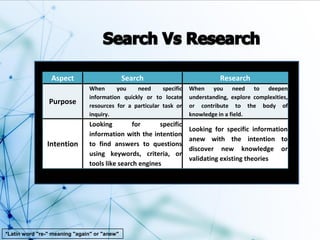
Aspect Search Research
Purpose
When you need specific
information quickly or to locate
resources for a particular task or
inquiry.
When you need to deepen
understanding, explore complexities,
or contribute to the body of
knowledge in a field.
Intention
Looking for specific
information with the intention
to find answers to questions
using keywords, criteria, or
tools like search engines
Looking for specific information
anew with the intention to
discover new knowledge or
validating existing theories
*Latin word "re-" meaning "again" or "anew"
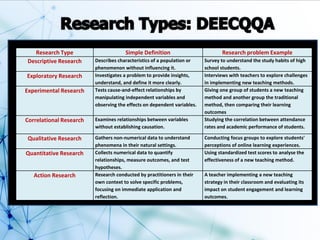
Research Type Simple Definition Research problem Example
Descriptive Research Describes characteristics of a population or
phenomenon without influencing it.
Survey to understand the study habits of high
school students.
Exploratory Research Investigates a problem to provide insights,
understand, and define it more clearly.
Interviews with teachers to explore challenges
in implementing new teaching methods.
Experimental Research Tests cause-and-effect relationships by
manipulating independent variables and
observing the effects on dependent variables.
Giving one group of students a new teaching
method and another group the traditional
method, then comparing their learning
outcomes
Correlational Research Examines relationships between variables
without establishing causation.
Studying the correlation between attendance
rates and academic performance of students.
Qualitative Research Gathers non-numerical data to understand
phenomena in their natural settings.
Conducting focus groups to explore students'
perceptions of online learning experiences.
Quantitative Research Collects numerical data to quantify
relationships, measure outcomes, and test
hypotheses.
Using standardized test scores to analyse the
effectiveness of a new teaching method.
Action Research Research conducted by practitioners in their
own context to solve specific problems,
focusing on immediate application and
reflection.
A teacher implementing a new teaching
strategy in their classroom and evaluating its
impact on student engagement and learning
outcomes.
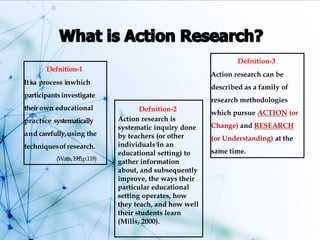
Defnition-1
Iti
sa process inwhich
participantsinvestigate
their own educational
practice systematically
and carefully,using the
techniquesofresearch.
(Watts,1985,p.118)
Defnition-2
Action research is
systematic inquiry done
by teachers (or other
individuals in an
educational setting) to
gather information
about, and subsequently
improve, the ways their
particular educational
setting operates, how
they teach, and how well
their students learn
(Mills, 2000).
Defnition-3
Action research can be
described as a family of
research methodologies
which pursue ACTION (or
Change) and RESEARCH
(or Understanding) at the
same time.
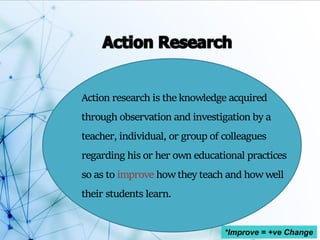
Action research is the knowledge acquired
through observation and investigation by a
teacher, individual, or group of colleagues
regarding his or her own educational practices
so as to improve how they teach and how well
their students learn.
*Improve = +ve Change
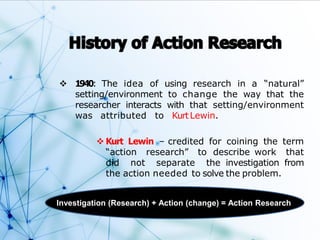
 1940: The idea of using research in a “natural”
setting/environment to change the way that the
researcher interacts with that setting/environment
was attributed to KurtLewin.
 Kurt Lewin – credited for coining the term
“action research” to describe work that
did not separate the investigation from
the action needed to solve the problem.
Investigation (Research) + Action (change) = Action Research
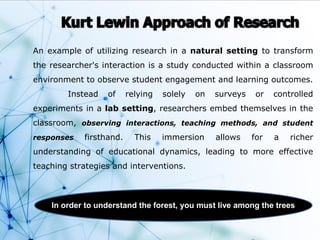
An example of utilizing research in a natural setting to transform
the researcher's interaction is a study conducted within a classroom
environment to observe student engagement and learning outcomes.

Instead of relying solely on surveys or controlled
experiments in a lab setting, researchers embed themselves in the
classroom, observing interactions, teaching methods, and student
responses firsthand. This immersion allows for a richer
understanding of educational dynamics, leading to more effective
teaching strategies and interventions.
In order to understand the forest, you must live among the trees
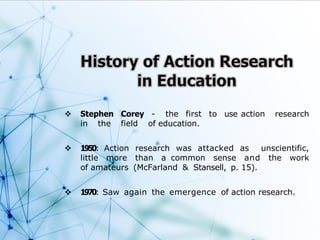
 Stephen Corey - the first to use action research
in the field of education.
 1950: Action research was attacked as unscientific,
little more than a common sense and the work
of amateurs (McFarland & Stansell, p. 15).
 1970: Saw again the emergence of action research.
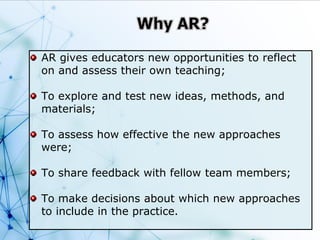
AR gives educators new opportunities to reflect
on and assess their own teaching;
To explore and test new ideas, methods, and
materials;
To assess how effective the new approaches
were;
To share feedback with fellow team members;
To make decisions about which new approaches
to include in the practice.
Action research has the potential to generate genuine and
sustained improvements in schools.
Sometimes, it does not make sense to go to an outsider
,with often shaky or no knowledge of the given situation,
thinking that with a few questions, he/she can get
enlightening answers.
It is difficult to grasp the issues of a group or community by
an outsider who has limited interaction with the group.
1.To solve an educational problem.
2.To help educators reflect on their own
practices
3.To address school-wide problems
4.To help teachers to improve their
educational practices
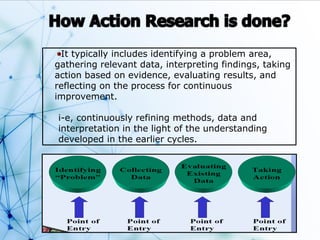
It typically includes identifying a problem area,
gathering relevant data, interpreting findings, taking
action based on evidence, evaluating results, and
reflecting on the process for continuous
improvement.
i-e, continuously refining methods, data and
interpretation in the light of the understanding
developed in the earlier cycles.
 It is self reflective - the educator researcher turns
the lens on his or her own educational classroom,
school, or practices.
 It is an emergent process which takes shape as
understanding increases;
 It is participant-driven; examining and improving
their own practices.
 It is “from within” and not from an external
“Expert’s eye”
 It has Real-world application; Research findings are
directly applied to address issues or challenges
within the educational context.
 It is a cyclical process; Action Research typically
involves iterative cycles of planning, action,
observation, and reflection to inform subsequent
actions.
• Actually try the process to convince yourself that the
investment of time and energy are worth the outcomes.

• Recognize that action research is a process that can be
undertaken without negatively affecting your personal and
professional life.
• Seek support from your professional colleagues
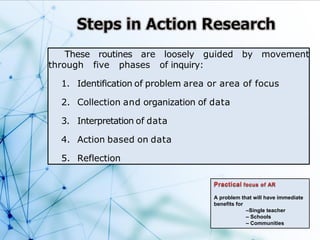
These routines are loosely guided by movement
through five phases of inquiry:
1. Identification of problem area or area of focus
2. Collection and organization of data
3. Interpretation of data
4. Action based on data
5. Reflection
A problem that will have immediate
benefits for
–Single teacher
– Schools
– Communities
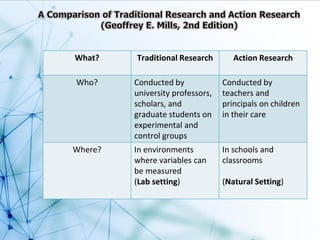
What? Traditional Research Action Research
Who? Conducted by
university professors,
scholars, and
graduate students on
experimental and
control groups
Conducted by
teachers and
principals on children
in their care
Where? In environments
where variables can
be measured
(Lab setting)
In schools and
classrooms
(Natural Setting)
 Action research is not usually comes
to mind when we hear the word
“research.”
 Action research is not a library project
where we learn more about a topic
that interests us.
 It is not problem-solving in the sense
of trying to find out what is wrong, but
rather a quest for knowledge about
how to improve.
 Action research is not about doing
research on or about people, or
finding all available information on a
topic looking for the correct answers.
It involves people working to improve
their skills, techniques, and strategies.
 Action research is not about learning
why we do certain things, but rather
how we can do things better. It is
about how we can change our
instruction to impact students.
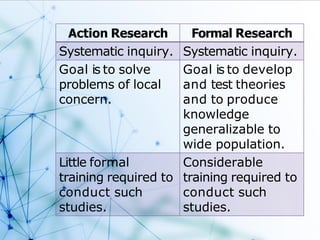
Action Research Formal Research
Systematic inquiry. Systematic inquiry.
Goal is to solve
problems of local
concern.
Goal is to develop
and test theories
and to produce
knowledge
generalizable to
wide population.
Little formal
training required to
conduct such
studies.
Considerable
training required to
conduct such
studies.
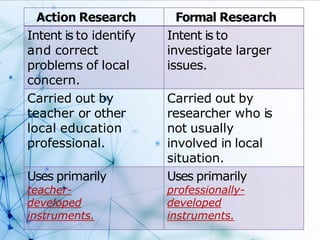
Action Research Formal Research
Intent is to identify
and correct
problems of local
concern.
Intent is to
investigate larger
issues.
Carried out by
teacher or other
local education
professional.
Carried out by
researcher who is
not usually
involved in local
situation.
Uses primarily
teacher-
developed
instruments.
Uses primarily
professionally-
developed
instruments.
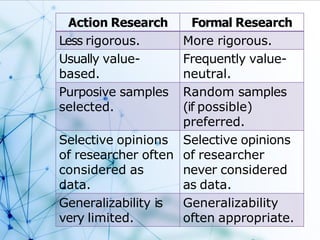
Action Research Formal Research
Less rigorous. More rigorous.
Usually value-
based.
Frequently value-
neutral.
Purposive samples
selected.
Random samples
(if possible)
preferred.
Selective opinions
of researcher often
considered as
data.
Selective opinions
of researcher
never considered
as data.
Generalizability is
very limited.
Generalizability
often appropriate.
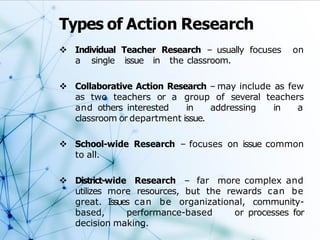
Types of Action Research
 Individual Teacher Research – usually focuses on
a single issue in the classroom.
 Collaborative Action Research – may include as few
as two teachers or a group of several teachers
and others interested in addressing in a
classroom or department issue.
 School-wide Research – focuses on issue common
to all.
 District-wide Research – far more complex and
utilizes more resources, but the rewards can be
great. Issues can be organizational, community-
based, performance-based or processes for
decision making.
Identify
the
Problem
Gather
Data
Interpret
Data
Act/
Action
on
Evidence
Evaluate
Results
Next
Steps
Action Research Cycle
Identify a Problem Area
Teachers often have several
wish to investigate;
questions they
however, it is important to limit the
question to one that is meaningful and
doable in the confines of their daily
work. Careful planning at this first stage
will limit false starts and frustrations.
Identify a Problem Area
There are several criteria to consider
before investing the time and effort in
“researching” a problem. The question
should:
 be a higher-order question- not a
yes/no
 be stated in common language,
avoiding jargon
 be concise
 be meaningful
 not already have an answer
Gather Data
The collection of data is an
important step in deciding what action
needs to be taken. Multiple sources of
data are used to better understand the
scope of happenings in the classroom
or school.
Gather Data
:
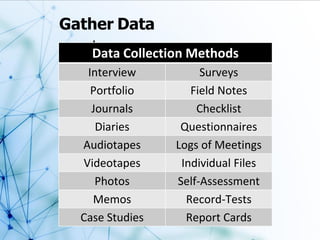
Data Collection Methods
Interview Surveys
Portfolio Field Notes
Journals Checklist
Diaries Questionnaires
Audiotapes Logs of Meetings
Videotapes Individual Files
Photos Self-Assessment
Memos Record-Tests
Case Studies Report Cards
Interpret Data
Analyze and identify major
themes. Depending upon the question,
teachers may wish to use classroom
data, individual data or subgroup data.
Some of the data are quantifiable and
can be analyzed without the use of
statistics or technical assistance.
Act on Evidence
Using the information from the
data collection and review of current
literature, design a plan of action that
will allow you to make a change and to
study that change. It is important that
only one variable be altered.
Evaluate Results
Assess
intervention
the effects of the
to determine if
improvement has occurred. Is there is
improvement, do the data clearly
provide the supporting evidence? If no,
what changes can be made to the
actions to elicit better reults?
Next Steps
As a result of the action research
project, identify additional questions
raised by the data and plan for
additional improvements, revisions and
next steps.
Benefits of Action Research
1. Focus on school issue, problem or
area of collective interest.
2. Form of teacher professional
development.
3. Collegial interactions.
4. Potential to impact school change.
5. Reflect on own practice.
6. Improved communications.
• Statement/Observation: Students do not seem to be
engaged during Social Science class.
– Questions: How can I improve their engagement ?
• Statement. Observation: Students take a lot of time to learn
problem solving in mathematics, but this process doesn’t
appear to transfer to their acquisition of other mathematics
skills and knowledge.
– Question: How can I improve the integration and transfer of
problem-solving skills in mathematics?
• Statement/Observation: Parents are unhappy with
regular parent-teacher conferences
– Question: How can I improve the conferencing process
using student-led conferences?
Guide Questions for
Conducting Action Research
1. What was my concern?
2. Why was Iconcerned?
3. What could Ido?
4. What could help me?
5. What did Ido?
6. How can Ievaluate my work?
Sample Action Research
How can I Improve My Students to Improve in English?
How can I Improve My Students to Improve in English
By Ma Hong
Sample#1
Consider I am a teacher of English in China, I have
been teaching for two years. I undertook
my professional learning within a traditional
context, which emphasized that teachers should
help their student learn correct answers and
achieve a high standard of language proficiency.
This involved using pedagogies that put the
responsibility for success on the teacher’s
teaching, rather than on the student’s learning.
Using this approach also meant that my
students and I were exhausted at the end of
each day. I wondered what I could do about
the situation.
How can I Improve My Students to Improve in English
By Ma Hong (Cont…..)
what I could do?
In 2003, I heard from my colleague, Tao Rui about
the action research approaches she was developing under
the guidance of Moira Laidlaw at the Guyuan Teacher’s
College.so, I asked Moira to help me develop new
pedagogies. Under Moira’s guidance I began my formal
action inquiry within the context of my class of 40 English
major students aged 15-18, of which 80% had failed
the entrance examination for senior middle school. I
met them for a two-hour class three times a week.
This report sets out the action-reflection
steps Itook to develop my inquiry.
What was my concern?
The
students
level of proficiency of
in spoken
80% of the
English was
unsatisfactory. They
and written
had limited vocabulary,
could not pronounce even simple words,
understood little when I used English as my
teaching medium, and could not use the basic
grammar they had learned in junior middle
develop
become
school. I wanted to help them
confidence, show more initiative and
more motivated to learn English.
What was my concern?
I decided to monitor the progress of the
whole class, focusing especially on three
students. Ma Jie, Ma Fei, and Yu Jinghu, whose
level of proficiency was representative of the
low achievers. I felt that if I could help them, I
could help others also.
Why was I concerned?
Three reasons drove my inquiry. The first
was my desire to help the whole class to
concentrate more on their learning, rather than
spend time chatting and wasting time. The
second reason was to improve my own
teaching methods. The students were still in a
traditional mode of learning passively, waiting
to be told what to do, and were unwilling to
answer questions in public for fear of losing face
if they made a mistake.
Why was Iconcerned?
I seemed to be doing the work for them,
rather than enabling them to practice and
think themselves. Third, I could empathize with
the experience of being a less able student
because I had also had that experience at
school and had achieved my current position
through sheer hard work and determination. I
knew how important it was for all students to
feel cared for by their teacher.
What could Ido?
Iwanted to:
 Create a friendly, well-disciplined, united
class spirit;
 Help students develop confidence in
themselves; and
 Encourage them to take more responsibility
for their learning.
What could help me?
I could observe lessons given by Moira,
and colleagues Li Peidiong, Tao Rui, and
others. I could ask them to observe my lessons
and offer critical feedback.
What did Ido?
1. To overcome students’ anxieties about
speaking in front of the class, I divided the
whole class into eight groups. Each group
nominated a leader who was proficient
and confident and proactive. One found
that many students became more
confident and proactive. One of my special
participants, Ma Jie, one day volunteered
to answer a question for the fist time.
What did Ido?
2
. I developed strategies to encourage
students to take the initiative about their
learning, and to ask questions as well as
offer answers.
3
. I paid particular attention encouraging
effort. I praised them publicly and wrote
encouraging comments in their books.
When less able students answered correctly
Igot the whole class applaud them.
What did Ido?
3. I also encouraged them to regard mistakes
as opportunities for learning. It took a long
time to persuade them that I was genuine
about this, because our culture regards
making mistakes as loss of face. This one of
the most difficult aspects of my new
pedagogies, but students responded well.
What did Ido?
4. I also encouraged my students by taking
interest in their family stories. Many less able
students come from rural environments,
where opportunities for schooling are rare.
We talked about how hard their parents and
families worked to make them come to
college, and how important it was for them
to succeed. Ishowed that Iwas prepared to
work as they were.
What did Ido?
4. We developed good relationships, and soon
the spirit of the class became one of
collaborative working through a respectful
atmosphere.
5. I aimed to make my teaching more
interesting. Rather than teaching the rules in
action. Students were asked to listen to the
stories, and work out the rule for themselves.
What did Ido?
5. I set them short exercises, and organized
them into groups to share their learning.
Because of these were new methodologies
for me, Iasked them for feedback, and they
said that they found this way of learning
interesting and enjoyable. I shifted the
emphasis from learning rules to practicing
language. I varied the exercises according
to student’s ability.
What did Ido?
6. Iexpressed my pleasure and gratitude to my
students. I thanked the group leaders for
helping others. They in turn took their duties
seriously, and checked with their peers
whether they had understood that the task
and volunteered extra help when
appropriate. Ivalued this aspect particularly,
because it met my own values of the need
for moral teaching and the value of hard
work and care for others.
How can Ievaluate my work?
to get
I used the following strategies
feedback on the effectiveness of my work.
 I kept field notes about when students
volunteered to speak. I noted much increased
activity and confidence among all the students.
 I invited group leaders to keep journals, and
asked their permission to access their journals
for evidence about my influence. The journals
contain comments such as:
“ Imade progress in dictation this time.”
How can Ievaluate my work?
I have more time to reflect on the record
what happens in class and make an instant
evaluation of my teaching. Though I now do
less speaking in class. I spend more time
preparing, and I ask myself questions such as,
“What do Iwant my students to learn?” “Which
way would be better for them to learn? How
can Ihelp them learn?”.
How can Ievaluate my work?
Interestingly, out of this research a new
problem has arisen. Students who were more
proficient in English seem less motivated than
before. Iam wondering whether it is because of
the attention Ihave paid to the lower-achieving
students. So my next research question will be
about developing differentiated teaching
methodologies that enable all to learn
according to their individual learning strengths.
1. What general ideas do you have for action research?
2. What is your area of focus?
3. Complete the following statement: “The purpose of
the study is to…”
4. Conduct an initial search of the related literature
using ERIC (Educational Resources Information Center) on-
line library.
5. Conduct an action plan that includes an area-of-focus
statement, definitions, research questions, a description of
the intervention, membership of the action research group,
negotiations to be undertaken, a timeline, the necessary
resources for the project, and data collection ideas.
1. Area of Focus
2. Related Literature
3. Defining Variables
4. Research questions
5. Description of the intervention
6. Data collection
7.Data Analysis
8. Action Plan
Ascertaining the readiness for teaching a particular
concept or principle in a particular subject
 Gender difference in interest towards a subject.
 Reasons of shyness in the classroom for a
subject
 Causes of truancy (absenteeism) in a subject.
 Performance of children in a particular subject
with or without private tuition.
 Comparison of performance in a subject of
normal children with those belonging to
disadvantaged groups.
Effect of incentives on the development of improvised
aids in a particular subject.
 Teachers’ problems in teaching a particular subject
in primary / secondary / senior secondary schools.
 Quality of teacher-pupil interaction and pupils’
interest in the learning of a subject.
 Teachers’ personality and teacher-pupil interaction.
 Comparison of quality of interaction in classes of a
particular subject taken by male and female
teachers.
 Teachers’ applying experience gained by them in
inservice training in a particular subject.
Changing sitting order in classroom and span
of attention in solving mathematics
problems.
 Effect of closed and open-air classrooms
on increasing interest in a particular
subject.
 Changing time of mathematics period and
interest of students in mathematics
learning in the class.
Management of classroom activities with
children of wide ranging abilities.
 Pupils’ performance on different types of
test items on the same content areas of a
particular subject.
 Effects of peer teaching on the attainment
of mastery learning.
 Effects of different remedial measures in
removing learning difficulties.
 Does the project clearly address a problem or
issue in practice that needs to be solved?
 Did the action researcher collect sufficient data
to address the problem?
 Did the action researcher collaborate with
others during the study?
 Was there respect for all collaborators?
 Did the plan of action advanced by the
researcher build logically from the data?
 Is there evidence that the plan of action
contributed to the researcher’s reflection
as a professional?
 Has the research enhanced the lives of the
participants by empowering them,
changing them, or providing them with
new understanding?
 Did the action research actually lead to
change or did a solution to a problem
make the difference?
 Was the action research reported to
audiences who might use the information?
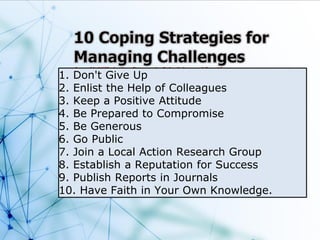
1. Don't Give Up
2. Enlist the Help of Colleagues
3. Keep a Positive Attitude
4. Be Prepared to Compromise
5. Be Generous
6. Go Public
7. Join a Local Action Research Group
8. Establish a Reputation for Success
9. Publish Reports in Journals
10. Have Faith in Your Own Knowledge.
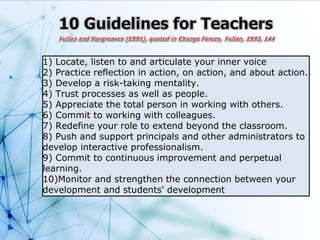
1) Locate, listen to and articulate your inner voice
2) Practice reflection in action, on action, and about action.
3) Develop a risk-taking mentality.
4) Trust processes as well as people.
5) Appreciate the total person in working with others.
6) Commit to working with colleagues.
7) Redefine your role to extend beyond the classroom.
8) Push and support principals and other administrators to
develop interactive professionalism.
9) Commit to continuous improvement and perpetual
learning.
10)Monitor and strengthen the connection between your
development and students' development
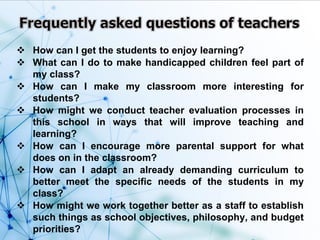
 How can I get the students to enjoy learning?
 What can I do to make handicapped children feel part of
my class?
 How can I make my classroom more interesting for
students?
 How might we conduct teacher evaluation processes in
this school in ways that will improve teaching and
learning?
 How can I encourage more parental support for what
does on in the classroom?
 How can I adapt an already demanding curriculum to
better meet the specific needs of the students in my
class?
 How might we work together better as a staff to establish
such things as school objectives, philosophy, and budget
priorities?
Thank
You
^.^
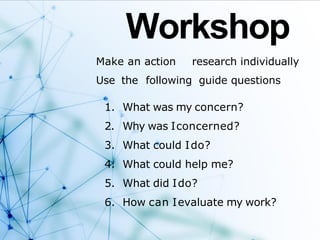
Workshop
Make an action research individually
Use the following guide questions
1. What was my concern?
2. Why was Iconcerned?
3. What could Ido?
4. What could help me?
5. What did Ido?
6. How can Ievaluate my work?
happy
working ^.^

Action_Research_ERSA_Dr_Sajad_JKSCERT.pdf

  • 1.
    Action Research in Education:A Cyclical Approach to Better Teaching or Learning
  • 2.
    Aspect Search Research Purpose Whenyou need specific information quickly or to locate resources for a particular task or inquiry. When you need to deepen understanding, explore complexities, or contribute to the body of knowledge in a field. Intention Looking for specific information with the intention to find answers to questions using keywords, criteria, or tools like search engines Looking for specific information anew with the intention to discover new knowledge or validating existing theories *Latin word "re-" meaning "again" or "anew"
  • 3.
    Research Type SimpleDefinition Research problem Example Descriptive Research Describes characteristics of a population or phenomenon without influencing it. Survey to understand the study habits of high school students. Exploratory Research Investigates a problem to provide insights, understand, and define it more clearly. Interviews with teachers to explore challenges in implementing new teaching methods. Experimental Research Tests cause-and-effect relationships by manipulating independent variables and observing the effects on dependent variables. Giving one group of students a new teaching method and another group the traditional method, then comparing their learning outcomes Correlational Research Examines relationships between variables without establishing causation. Studying the correlation between attendance rates and academic performance of students. Qualitative Research Gathers non-numerical data to understand phenomena in their natural settings. Conducting focus groups to explore students' perceptions of online learning experiences. Quantitative Research Collects numerical data to quantify relationships, measure outcomes, and test hypotheses. Using standardized test scores to analyse the effectiveness of a new teaching method. Action Research Research conducted by practitioners in their own context to solve specific problems, focusing on immediate application and reflection. A teacher implementing a new teaching strategy in their classroom and evaluating its impact on student engagement and learning outcomes.
  • 4.
    Defnition-1 Iti sa process inwhich participantsinvestigate theirown educational practice systematically and carefully,using the techniquesofresearch. (Watts,1985,p.118) Defnition-2 Action research is systematic inquiry done by teachers (or other individuals in an educational setting) to gather information about, and subsequently improve, the ways their particular educational setting operates, how they teach, and how well their students learn (Mills, 2000). Defnition-3 Action research can be described as a family of research methodologies which pursue ACTION (or Change) and RESEARCH (or Understanding) at the same time.
  • 5.
    Action research isthe knowledge acquired through observation and investigation by a teacher, individual, or group of colleagues regarding his or her own educational practices so as to improve how they teach and how well their students learn. *Improve = +ve Change
  • 6.
     1940: Theidea of using research in a “natural” setting/environment to change the way that the researcher interacts with that setting/environment was attributed to KurtLewin.  Kurt Lewin – credited for coining the term “action research” to describe work that did not separate the investigation from the action needed to solve the problem. Investigation (Research) + Action (change) = Action Research
  • 7.
    An example ofutilizing research in a natural setting to transform the researcher's interaction is a study conducted within a classroom environment to observe student engagement and learning outcomes. Instead of relying solely on surveys or controlled experiments in a lab setting, researchers embed themselves in the classroom, observing interactions, teaching methods, and student responses firsthand. This immersion allows for a richer understanding of educational dynamics, leading to more effective teaching strategies and interventions. In order to understand the forest, you must live among the trees
  • 8.
     Stephen Corey- the first to use action research in the field of education.  1950: Action research was attacked as unscientific, little more than a common sense and the work of amateurs (McFarland & Stansell, p. 15).  1970: Saw again the emergence of action research.
  • 9.
    AR gives educatorsnew opportunities to reflect on and assess their own teaching; To explore and test new ideas, methods, and materials; To assess how effective the new approaches were; To share feedback with fellow team members; To make decisions about which new approaches to include in the practice.
  • 10.
    Action research hasthe potential to generate genuine and sustained improvements in schools. Sometimes, it does not make sense to go to an outsider ,with often shaky or no knowledge of the given situation, thinking that with a few questions, he/she can get enlightening answers. It is difficult to grasp the issues of a group or community by an outsider who has limited interaction with the group.
  • 11.
    1.To solve aneducational problem. 2.To help educators reflect on their own practices 3.To address school-wide problems 4.To help teachers to improve their educational practices
  • 12.
    It typically includesidentifying a problem area, gathering relevant data, interpreting findings, taking action based on evidence, evaluating results, and reflecting on the process for continuous improvement. i-e, continuously refining methods, data and interpretation in the light of the understanding developed in the earlier cycles.
  • 14.
     It isself reflective - the educator researcher turns the lens on his or her own educational classroom, school, or practices.  It is an emergent process which takes shape as understanding increases;  It is participant-driven; examining and improving their own practices.  It is “from within” and not from an external “Expert’s eye”  It has Real-world application; Research findings are directly applied to address issues or challenges within the educational context.  It is a cyclical process; Action Research typically involves iterative cycles of planning, action, observation, and reflection to inform subsequent actions.
  • 15.
    • Actually trythe process to convince yourself that the investment of time and energy are worth the outcomes. • Recognize that action research is a process that can be undertaken without negatively affecting your personal and professional life. • Seek support from your professional colleagues
  • 16.
    These routines areloosely guided by movement through five phases of inquiry: 1. Identification of problem area or area of focus 2. Collection and organization of data 3. Interpretation of data 4. Action based on data 5. Reflection A problem that will have immediate benefits for –Single teacher – Schools – Communities
  • 17.
    What? Traditional ResearchAction Research Who? Conducted by university professors, scholars, and graduate students on experimental and control groups Conducted by teachers and principals on children in their care Where? In environments where variables can be measured (Lab setting) In schools and classrooms (Natural Setting)
  • 18.
     Action researchis not usually comes to mind when we hear the word “research.”  Action research is not a library project where we learn more about a topic that interests us.  It is not problem-solving in the sense of trying to find out what is wrong, but rather a quest for knowledge about how to improve.
  • 19.
     Action researchis not about doing research on or about people, or finding all available information on a topic looking for the correct answers. It involves people working to improve their skills, techniques, and strategies.  Action research is not about learning why we do certain things, but rather how we can do things better. It is about how we can change our instruction to impact students.
  • 21.
    Action Research FormalResearch Systematic inquiry. Systematic inquiry. Goal is to solve problems of local concern. Goal is to develop and test theories and to produce knowledge generalizable to wide population. Little formal training required to conduct such studies. Considerable training required to conduct such studies.
  • 22.
    Action Research FormalResearch Intent is to identify and correct problems of local concern. Intent is to investigate larger issues. Carried out by teacher or other local education professional. Carried out by researcher who is not usually involved in local situation. Uses primarily teacher- developed instruments. Uses primarily professionally- developed instruments.
  • 23.
    Action Research FormalResearch Less rigorous. More rigorous. Usually value- based. Frequently value- neutral. Purposive samples selected. Random samples (if possible) preferred. Selective opinions of researcher often considered as data. Selective opinions of researcher never considered as data. Generalizability is very limited. Generalizability often appropriate.
  • 24.
    Types of ActionResearch  Individual Teacher Research – usually focuses on a single issue in the classroom.  Collaborative Action Research – may include as few as two teachers or a group of several teachers and others interested in addressing in a classroom or department issue.  School-wide Research – focuses on issue common to all.  District-wide Research – far more complex and utilizes more resources, but the rewards can be great. Issues can be organizational, community- based, performance-based or processes for decision making.
  • 25.
  • 26.
    Identify a ProblemArea Teachers often have several wish to investigate; questions they however, it is important to limit the question to one that is meaningful and doable in the confines of their daily work. Careful planning at this first stage will limit false starts and frustrations.
  • 27.
    Identify a ProblemArea There are several criteria to consider before investing the time and effort in “researching” a problem. The question should:  be a higher-order question- not a yes/no  be stated in common language, avoiding jargon  be concise  be meaningful  not already have an answer
  • 28.
    Gather Data The collectionof data is an important step in deciding what action needs to be taken. Multiple sources of data are used to better understand the scope of happenings in the classroom or school.
  • 29.
    Gather Data : Data CollectionMethods Interview Surveys Portfolio Field Notes Journals Checklist Diaries Questionnaires Audiotapes Logs of Meetings Videotapes Individual Files Photos Self-Assessment Memos Record-Tests Case Studies Report Cards
  • 30.
    Interpret Data Analyze andidentify major themes. Depending upon the question, teachers may wish to use classroom data, individual data or subgroup data. Some of the data are quantifiable and can be analyzed without the use of statistics or technical assistance.
  • 31.
    Act on Evidence Usingthe information from the data collection and review of current literature, design a plan of action that will allow you to make a change and to study that change. It is important that only one variable be altered.
  • 32.
    Evaluate Results Assess intervention the effectsof the to determine if improvement has occurred. Is there is improvement, do the data clearly provide the supporting evidence? If no, what changes can be made to the actions to elicit better reults?
  • 33.
    Next Steps As aresult of the action research project, identify additional questions raised by the data and plan for additional improvements, revisions and next steps.
  • 34.
    Benefits of ActionResearch 1. Focus on school issue, problem or area of collective interest. 2. Form of teacher professional development. 3. Collegial interactions. 4. Potential to impact school change. 5. Reflect on own practice. 6. Improved communications.
  • 35.
    • Statement/Observation: Studentsdo not seem to be engaged during Social Science class. – Questions: How can I improve their engagement ? • Statement. Observation: Students take a lot of time to learn problem solving in mathematics, but this process doesn’t appear to transfer to their acquisition of other mathematics skills and knowledge. – Question: How can I improve the integration and transfer of problem-solving skills in mathematics? • Statement/Observation: Parents are unhappy with regular parent-teacher conferences – Question: How can I improve the conferencing process using student-led conferences?
  • 36.
    Guide Questions for ConductingAction Research 1. What was my concern? 2. Why was Iconcerned? 3. What could Ido? 4. What could help me? 5. What did Ido? 6. How can Ievaluate my work?
  • 37.
    Sample Action Research Howcan I Improve My Students to Improve in English?
  • 38.
    How can IImprove My Students to Improve in English By Ma Hong Sample#1 Consider I am a teacher of English in China, I have been teaching for two years. I undertook my professional learning within a traditional context, which emphasized that teachers should help their student learn correct answers and achieve a high standard of language proficiency.
  • 39.
    This involved usingpedagogies that put the responsibility for success on the teacher’s teaching, rather than on the student’s learning. Using this approach also meant that my students and I were exhausted at the end of each day. I wondered what I could do about the situation. How can I Improve My Students to Improve in English By Ma Hong (Cont…..)
  • 40.
    what I coulddo? In 2003, I heard from my colleague, Tao Rui about the action research approaches she was developing under the guidance of Moira Laidlaw at the Guyuan Teacher’s College.so, I asked Moira to help me develop new pedagogies. Under Moira’s guidance I began my formal action inquiry within the context of my class of 40 English major students aged 15-18, of which 80% had failed the entrance examination for senior middle school. I met them for a two-hour class three times a week. This report sets out the action-reflection steps Itook to develop my inquiry.
  • 41.
    What was myconcern? The students level of proficiency of in spoken 80% of the English was unsatisfactory. They and written had limited vocabulary, could not pronounce even simple words, understood little when I used English as my teaching medium, and could not use the basic grammar they had learned in junior middle develop become school. I wanted to help them confidence, show more initiative and more motivated to learn English.
  • 42.
    What was myconcern? I decided to monitor the progress of the whole class, focusing especially on three students. Ma Jie, Ma Fei, and Yu Jinghu, whose level of proficiency was representative of the low achievers. I felt that if I could help them, I could help others also.

  • 43.
    Why was Iconcerned? Three reasons drove my inquiry. The first was my desire to help the whole class to concentrate more on their learning, rather than spend time chatting and wasting time. The second reason was to improve my own teaching methods. The students were still in a traditional mode of learning passively, waiting to be told what to do, and were unwilling to answer questions in public for fear of losing face if they made a mistake.
  • 44.
    Why was Iconcerned? Iseemed to be doing the work for them, rather than enabling them to practice and think themselves. Third, I could empathize with the experience of being a less able student because I had also had that experience at school and had achieved my current position through sheer hard work and determination. I knew how important it was for all students to feel cared for by their teacher.
  • 45.
    What could Ido? Iwantedto:  Create a friendly, well-disciplined, united class spirit;  Help students develop confidence in themselves; and  Encourage them to take more responsibility for their learning.
  • 46.
    What could helpme? I could observe lessons given by Moira, and colleagues Li Peidiong, Tao Rui, and others. I could ask them to observe my lessons and offer critical feedback.
  • 47.
    What did Ido? 1.To overcome students’ anxieties about speaking in front of the class, I divided the whole class into eight groups. Each group nominated a leader who was proficient and confident and proactive. One found that many students became more confident and proactive. One of my special participants, Ma Jie, one day volunteered to answer a question for the fist time.
  • 48.
    What did Ido? 2 .I developed strategies to encourage students to take the initiative about their learning, and to ask questions as well as offer answers. 3 . I paid particular attention encouraging effort. I praised them publicly and wrote encouraging comments in their books. When less able students answered correctly Igot the whole class applaud them.
  • 49.
    What did Ido? 3.I also encouraged them to regard mistakes as opportunities for learning. It took a long time to persuade them that I was genuine about this, because our culture regards making mistakes as loss of face. This one of the most difficult aspects of my new pedagogies, but students responded well.
  • 50.
    What did Ido? 4.I also encouraged my students by taking interest in their family stories. Many less able students come from rural environments, where opportunities for schooling are rare. We talked about how hard their parents and families worked to make them come to college, and how important it was for them to succeed. Ishowed that Iwas prepared to work as they were.
  • 51.
    What did Ido? 4.We developed good relationships, and soon the spirit of the class became one of collaborative working through a respectful atmosphere. 5. I aimed to make my teaching more interesting. Rather than teaching the rules in action. Students were asked to listen to the stories, and work out the rule for themselves.
  • 52.
    What did Ido? 5.I set them short exercises, and organized them into groups to share their learning. Because of these were new methodologies for me, Iasked them for feedback, and they said that they found this way of learning interesting and enjoyable. I shifted the emphasis from learning rules to practicing language. I varied the exercises according to student’s ability.
  • 53.
    What did Ido? 6.Iexpressed my pleasure and gratitude to my students. I thanked the group leaders for helping others. They in turn took their duties seriously, and checked with their peers whether they had understood that the task and volunteered extra help when appropriate. Ivalued this aspect particularly, because it met my own values of the need for moral teaching and the value of hard work and care for others.
  • 54.
    How can Ievaluatemy work? to get I used the following strategies feedback on the effectiveness of my work.  I kept field notes about when students volunteered to speak. I noted much increased activity and confidence among all the students.  I invited group leaders to keep journals, and asked their permission to access their journals for evidence about my influence. The journals contain comments such as: “ Imade progress in dictation this time.”
  • 55.
    How can Ievaluatemy work? I have more time to reflect on the record what happens in class and make an instant evaluation of my teaching. Though I now do less speaking in class. I spend more time preparing, and I ask myself questions such as, “What do Iwant my students to learn?” “Which way would be better for them to learn? How can Ihelp them learn?”.
  • 56.
    How can Ievaluatemy work? Interestingly, out of this research a new problem has arisen. Students who were more proficient in English seem less motivated than before. Iam wondering whether it is because of the attention Ihave paid to the lower-achieving students. So my next research question will be about developing differentiated teaching methodologies that enable all to learn according to their individual learning strengths.
  • 57.
    1. What generalideas do you have for action research? 2. What is your area of focus? 3. Complete the following statement: “The purpose of the study is to…” 4. Conduct an initial search of the related literature using ERIC (Educational Resources Information Center) on- line library. 5. Conduct an action plan that includes an area-of-focus statement, definitions, research questions, a description of the intervention, membership of the action research group, negotiations to be undertaken, a timeline, the necessary resources for the project, and data collection ideas.
  • 58.
    1. Area ofFocus 2. Related Literature 3. Defining Variables 4. Research questions 5. Description of the intervention 6. Data collection 7.Data Analysis 8. Action Plan
  • 59.
    Ascertaining the readinessfor teaching a particular concept or principle in a particular subject  Gender difference in interest towards a subject.  Reasons of shyness in the classroom for a subject  Causes of truancy (absenteeism) in a subject.  Performance of children in a particular subject with or without private tuition.  Comparison of performance in a subject of normal children with those belonging to disadvantaged groups.
  • 60.
    Effect of incentiveson the development of improvised aids in a particular subject.  Teachers’ problems in teaching a particular subject in primary / secondary / senior secondary schools.  Quality of teacher-pupil interaction and pupils’ interest in the learning of a subject.  Teachers’ personality and teacher-pupil interaction.  Comparison of quality of interaction in classes of a particular subject taken by male and female teachers.  Teachers’ applying experience gained by them in inservice training in a particular subject.
  • 61.
    Changing sitting orderin classroom and span of attention in solving mathematics problems.  Effect of closed and open-air classrooms on increasing interest in a particular subject.  Changing time of mathematics period and interest of students in mathematics learning in the class.
  • 62.
    Management of classroomactivities with children of wide ranging abilities.  Pupils’ performance on different types of test items on the same content areas of a particular subject.  Effects of peer teaching on the attainment of mastery learning.  Effects of different remedial measures in removing learning difficulties.
  • 63.
     Does theproject clearly address a problem or issue in practice that needs to be solved?  Did the action researcher collect sufficient data to address the problem?  Did the action researcher collaborate with others during the study?  Was there respect for all collaborators?
  • 64.
     Did theplan of action advanced by the researcher build logically from the data?  Is there evidence that the plan of action contributed to the researcher’s reflection as a professional?  Has the research enhanced the lives of the participants by empowering them, changing them, or providing them with new understanding?
  • 65.
     Did theaction research actually lead to change or did a solution to a problem make the difference?  Was the action research reported to audiences who might use the information?
  • 66.
    1. Don't GiveUp 2. Enlist the Help of Colleagues 3. Keep a Positive Attitude 4. Be Prepared to Compromise 5. Be Generous 6. Go Public 7. Join a Local Action Research Group 8. Establish a Reputation for Success 9. Publish Reports in Journals 10. Have Faith in Your Own Knowledge.
  • 67.
    1) Locate, listento and articulate your inner voice 2) Practice reflection in action, on action, and about action. 3) Develop a risk-taking mentality. 4) Trust processes as well as people. 5) Appreciate the total person in working with others. 6) Commit to working with colleagues. 7) Redefine your role to extend beyond the classroom. 8) Push and support principals and other administrators to develop interactive professionalism. 9) Commit to continuous improvement and perpetual learning. 10)Monitor and strengthen the connection between your development and students' development
  • 68.
     How canI get the students to enjoy learning?  What can I do to make handicapped children feel part of my class?  How can I make my classroom more interesting for students?  How might we conduct teacher evaluation processes in this school in ways that will improve teaching and learning?  How can I encourage more parental support for what does on in the classroom?  How can I adapt an already demanding curriculum to better meet the specific needs of the students in my class?  How might we work together better as a staff to establish such things as school objectives, philosophy, and budget priorities?
  • 69.
  • 70.
    Workshop Make an actionresearch individually Use the following guide questions 1. What was my concern? 2. Why was Iconcerned? 3. What could Ido? 4. What could help me? 5. What did Ido? 6. How can Ievaluate my work?
  • 71.