Download to read offline
![Action Learning
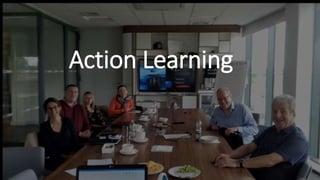
• “People in real trouble can help each other out.”
• “Sets” are the small groups or what Revans called “Comrades in adversity”.
• The “Sets” meet regularly to discuss their own problem; What’s the issue?
What’s stopping me/us? What can I/we do about it?
• There are no outside experts in the room.
• The Advisor is not an expert [not there to solve the problem] but a
facilitator to help members.
• The members of the set help each other out.](https://image.slidesharecdn.com/actionlearning2-190620063653/85/Action-Learning-4-320.jpg)
![1. Facilitator
• Ability to work with the group of people [Action Learning Set] support them in
own learning
• Encouraging right climate, culture and behavior.
• Establish the Group Ground Rules early.
• At Key stages in the meeting to hold up a “mirror” – reflect back how you [the
group] are operating and behaving. Do you need to make some changes to the
way that you are behaving in line with the ground rules?
• Uphold key principles - encouraging the “set” to ask what are they going to do?
To take action [after the meeting] and to share what they have actually done +
• Reflect on the learning – proving powerful insights for others.](https://image.slidesharecdn.com/actionlearning2-190620063653/85/Action-Learning-6-320.jpg)
![1. Facilitator [Cont.]
All Training and Development contains:
1. Obtaining new knowledge [new to you] P is the “Programme” knowledge and
2. Ability to ask questions. - Q is questions [asking questions of the unknown].
3. What you are being instructed to do, and what you need to work out for
yourself.
Ability of Posing Questions – is a key skill of the facilitator. We need to “master the
art of posing questions”.](https://image.slidesharecdn.com/actionlearning2-190620063653/85/Action-Learning-7-320.jpg)
![2. Mobiliser – seeking to gain support for an action learning initiative
[influencing skills, & ability to navigate the politics of the organization, moving
beyond the skills of working with an Action Learning Set]
3. Learning Catalyst – captures the learning and helps the
organisation to apply the learning at a higher level [learning organization] –
learning takes place over time. People in the next group may consider the
same issues – might reinvent the wheel - To bridge and join up individual
learning & sets.](https://image.slidesharecdn.com/actionlearning2-190620063653/85/Action-Learning-8-320.jpg)
![Peter Lawrence [MBA FCIPD], profile picture](https://cdn.slidesharecdn.com/profile-photo-PeterLawrenceFCIPD-48x48.jpg?cb=1694616361)
The document outlines the concept of action learning as developed by Professor Reg Revans, emphasizing the importance of small groups or 'sets' to collaboratively discuss and solve real-world problems without the presence of outside experts. It describes the roles of facilitators, mobilizers, and learning catalysts within these sets, highlighting how they foster a supportive environment for sharing insights and encouraging action. The overall goal is to enable members to learn from each other and implement practical solutions through continuous group interaction.


![Employment Law Update [HR Forum]](https://cdn.slidesharecdn.com/ss_thumbnails/hrforumemploymentlawupdate-181108170037-thumbnail.jpg?width=640&height=640&fit=bounds)


