Introduction to Action
Learning
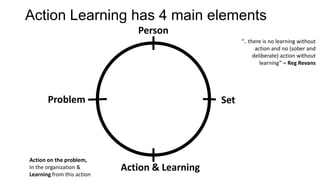
Action Learning has 4 main elements
Person
“.. there is no learning without
action and no (sober and
deliberate) action without
learning” – Reg Revans

Problem

Action on the problem,
In the organization &
Learning from this action

Set

Action & Learning
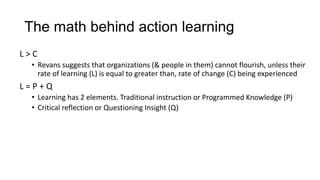
The math behind action learning
L>C
• Revans suggests that organizations (& people in them) cannot flourish, unless their
rate of learning (L) is equal to greater than, rate of change (C) being experienced

L=P+Q
• Learning has 2 elements. Traditional instruction or Programmed Knowledge (P)
• Critical reflection or Questioning Insight (Q)
Action Learning Sets bring 6-8 people
together
• To work on difficult problems of managing & organizing.
• Problems which personally affect a set member
• Situations in which, ‘I am part of the problem, and the problem is part of me’

• This must be a voluntary commitment
•
•
•
•

Check individual perceptions of the problem (this varies across people)
Clarify and render it more manageable
To create & explore, alternatives for action
To take action, in light of new insight

• The Set meets regularly (say once a month, over 4-6 months)
• To share results of actions, for further reflection & exploration
• To provide the balance of support & challenge, to each set member, to act & learn
Side effects of Action Learning
• Set members learn facilitation skills (questioning, listening)
• Set members develop effective teamwork
• Set members learn at 3 levels
• Problem or Opportunity, being tackled
• What is being learnt, about oneself
• Process of Learning (Learning to Learn)
A typical Set meeting ..
Sets develop their own patterns & practices around
• Catching-up – share immediate news & re-integrate from previous
• Agenda Setting – decide batting order (equal time to all is norm)
• Progress reports
• Each person reports progress, since last meeting. Others listen.
• Other set members rely mostly on questions to learn from what happened
and explore options for subsequent action

• Review – Take stock of what worked. Fix next meeting.
Ground rules for Action Learning
• Commitment to attending
• Be punctual
• You must have a really good reason, if you can’t make it

• Everyone has a right to their time
• Everyone should be Listened to
• We agree to offer each other Support & Challenge, but avoid judgment
• It is safe to admit – needs, weaknesses and mistakes

• Confidentiality
• Whatever else, the group agrees, as appropriate
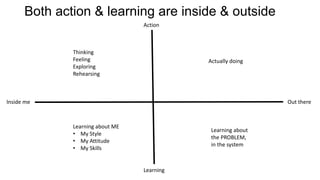
Both action & learning are inside & outside
Action

Thinking
Feeling
Exploring
Rehearsing

Actually doing

Inside me

Out there

Learning about ME
• My Style
• My Attitude
• My Skills

Learning about
the PROBLEM,
in the system

Learning
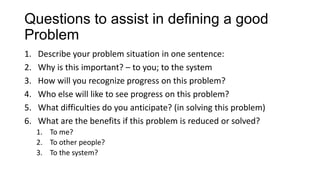
Questions to assist in defining a good
Problem
1.
2.
3.
4.
5.
6.

Describe your problem situation in one sentence:
Why is this important? – to you; to the system
How will you recognize progress on this problem?
Who else will like to see progress on this problem?
What difficulties do you anticipate? (in solving this problem)
What are the benefits if this problem is reduced or solved?
1. To me?
2. To other people?
3. To the system?
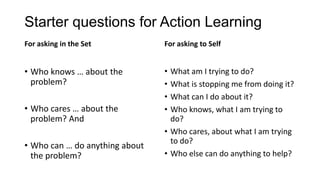
Starter questions for Action Learning
For asking in the Set

For asking to Self

• Who knows … about the
problem?

•
•
•
•

• Who cares … about the
problem? And
• Who can … do anything about
the problem?

What am I trying to do?
What is stopping me from doing it?
What can I do about it?
Who knows, what I am trying to
do?
• Who cares, about what I am trying
to do?
• Who else can do anything to help?
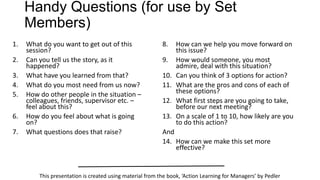
Handy Questions (for use by Set
Members)
1.
2.

3.
4.
5.
6.
7.

What do you want to get out of this
session?
Can you tell us the story, as it
happened?
What have you learned from that?
What do you most need from us now?
How do other people in the situation –
colleagues, friends, supervisor etc. –
feel about this?
How do you feel about what is going
on?
What questions does that raise?

8.
9.

10.
11.
12.

13.

How can we help you move forward on
this issue?
How would someone, you most
admire, deal with this situation?
Can you think of 3 options for action?
What are the pros and cons of each of
these options?
What first steps are you going to take,
before our next meeting?
On a scale of 1 to 10, how likely are you
to do this action?

And
14. How can we make this set more
effective?

This presentation is created using material from the book, ‘Action Learning for Managers’ by Pedler

Introduction to action learning

  • 1.
  • 2.
    Action Learning has4 main elements Person “.. there is no learning without action and no (sober and deliberate) action without learning” – Reg Revans Problem Action on the problem, In the organization & Learning from this action Set Action & Learning
  • 3.
    The math behindaction learning L>C • Revans suggests that organizations (& people in them) cannot flourish, unless their rate of learning (L) is equal to greater than, rate of change (C) being experienced L=P+Q • Learning has 2 elements. Traditional instruction or Programmed Knowledge (P) • Critical reflection or Questioning Insight (Q)
  • 4.
    Action Learning Setsbring 6-8 people together • To work on difficult problems of managing & organizing. • Problems which personally affect a set member • Situations in which, ‘I am part of the problem, and the problem is part of me’ • This must be a voluntary commitment • • • • Check individual perceptions of the problem (this varies across people) Clarify and render it more manageable To create & explore, alternatives for action To take action, in light of new insight • The Set meets regularly (say once a month, over 4-6 months) • To share results of actions, for further reflection & exploration • To provide the balance of support & challenge, to each set member, to act & learn
  • 5.
    Side effects ofAction Learning • Set members learn facilitation skills (questioning, listening) • Set members develop effective teamwork • Set members learn at 3 levels • Problem or Opportunity, being tackled • What is being learnt, about oneself • Process of Learning (Learning to Learn)
  • 6.
    A typical Setmeeting .. Sets develop their own patterns & practices around • Catching-up – share immediate news & re-integrate from previous • Agenda Setting – decide batting order (equal time to all is norm) • Progress reports • Each person reports progress, since last meeting. Others listen. • Other set members rely mostly on questions to learn from what happened and explore options for subsequent action • Review – Take stock of what worked. Fix next meeting.
  • 7.
    Ground rules forAction Learning • Commitment to attending • Be punctual • You must have a really good reason, if you can’t make it • Everyone has a right to their time • Everyone should be Listened to • We agree to offer each other Support & Challenge, but avoid judgment • It is safe to admit – needs, weaknesses and mistakes • Confidentiality • Whatever else, the group agrees, as appropriate
  • 8.
    Both action &learning are inside & outside Action Thinking Feeling Exploring Rehearsing Actually doing Inside me Out there Learning about ME • My Style • My Attitude • My Skills Learning about the PROBLEM, in the system Learning
  • 9.
    Questions to assistin defining a good Problem 1. 2. 3. 4. 5. 6. Describe your problem situation in one sentence: Why is this important? – to you; to the system How will you recognize progress on this problem? Who else will like to see progress on this problem? What difficulties do you anticipate? (in solving this problem) What are the benefits if this problem is reduced or solved? 1. To me? 2. To other people? 3. To the system?
  • 10.
    Starter questions forAction Learning For asking in the Set For asking to Self • Who knows … about the problem? • • • • • Who cares … about the problem? And • Who can … do anything about the problem? What am I trying to do? What is stopping me from doing it? What can I do about it? Who knows, what I am trying to do? • Who cares, about what I am trying to do? • Who else can do anything to help?
  • 11.
    Handy Questions (foruse by Set Members) 1. 2. 3. 4. 5. 6. 7. What do you want to get out of this session? Can you tell us the story, as it happened? What have you learned from that? What do you most need from us now? How do other people in the situation – colleagues, friends, supervisor etc. – feel about this? How do you feel about what is going on? What questions does that raise? 8. 9. 10. 11. 12. 13. How can we help you move forward on this issue? How would someone, you most admire, deal with this situation? Can you think of 3 options for action? What are the pros and cons of each of these options? What first steps are you going to take, before our next meeting? On a scale of 1 to 10, how likely are you to do this action? And 14. How can we make this set more effective? This presentation is created using material from the book, ‘Action Learning for Managers’ by Pedler