Action Learning:
Solving Critical Business
Problems and Developing
Leaders in Real Time
Minnesota OD Network
February 5, 2015
22
“In times of change, the learners
will inherit the world while the
knowers will remain well-
prepared for the world that no
longer exists.”
Eric Hoffer
Objectives
1. Build connections, support and energy
2. Provide an understanding of the principles, practices
and benefits of Action Learning
3. Share examples and success factors
4. Invite to join a new and growing community of practice
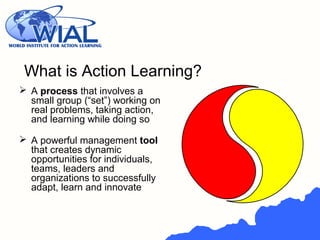
What is Action Learning?
 A process that involves a
small group (“set”) working on
real problems, taking action,
and learning while doing so
 A powerful management tool
that creates dynamic
opportunities for individuals,
teams, leaders and
organizations to successfully
adapt, learn and innovate
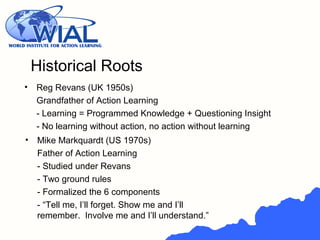
Historical Roots
• Reg Revans (UK 1950s)
Grandfather of Action Learning
- Learning = Programmed Knowledge + Questioning Insight
- No learning without action, no action without learning
• Mike Markquardt (US 1970s)
Father of Action Learning
- Studied under Revans
- Two ground rules
- Formalized the 6 components
- “Tell me, I’ll forget. Show me and I’ll
remember. Involve me and I’ll understand.”
Contrast with typical Problem-solving Groups
1. Learning and team development as important as solving the
problem
2. Groups charged with developing a real solution the organization
can implement
3. Membership not reserved to experts or involved people
4. Questions precede answers; dialogue over discussion and
debate
5. Learning coach with license to interrupt for sake of learning
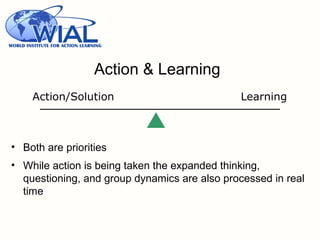
Action & Learning
Action/Solution Learning
• Both are priorities
• While action is being taken the expanded thinking,
questioning, and group dynamics are also processed in real
time
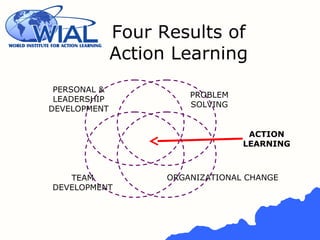
PROBLEM
SOLVING
PERSONAL &
LEADERSHIP
DEVELOPMENT
ORGANIZATIONAL CHANGE
Four Results of
Action Learning
ACTION
LEARNING
TEAM
DEVELOPMENT
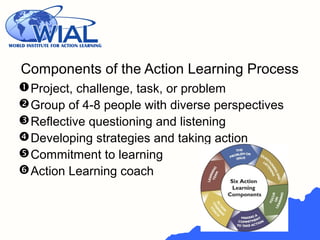
Components of the Action Learning Process
Project, challenge, task, or problem
Group of 4-8 people with diverse perspectives
Reflective questioning and listening
Developing strategies and taking action
Commitment to learning
Action Learning coach
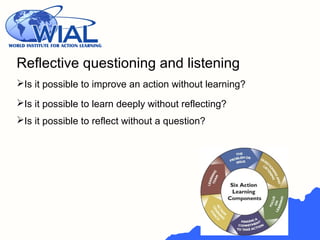
Reflective questioning and listening
Is it possible to improve an action without learning?
Is it possible to learn deeply without reflecting?
Is it possible to reflect without a question?
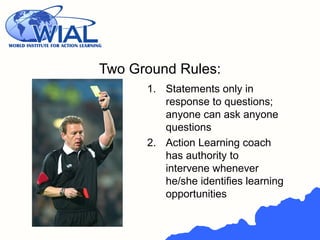
Two Ground Rules:
1. Statements only in
response to questions;
anyone can ask anyone
questions
2. Action Learning coach
has authority to
intervene whenever
he/she identifies learning
opportunities
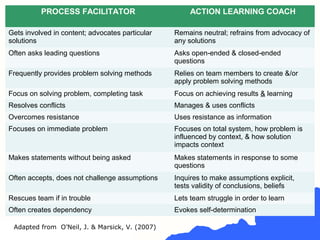
PROCESS FACILITATOR ACTION LEARNING COACH
Gets involved in content; advocates particular
solutions
Remains neutral; refrains from advocacy of
any solutions
Often asks leading questions Asks open-ended & closed-ended
questions
Frequently provides problem solving methods Relies on team members to create &/or
apply problem solving methods
Focus on solving problem, completing task Focus on achieving results & learning
Resolves conflicts Manages & uses conflicts
Overcomes resistance Uses resistance as information
Focuses on immediate problem Focuses on total system, how problem is
influenced by context, & how solution
impacts context
Makes statements without being asked Makes statements in response to some
questions
Often accepts, does not challenge assumptions Inquires to make assumptions explicit,
tests validity of conclusions, beliefs
Rescues team if in trouble Lets team struggle in order to learn
Often creates dependency Evokes self-determination
Adapted from O’Neil, J. & Marsick, V. (2007)
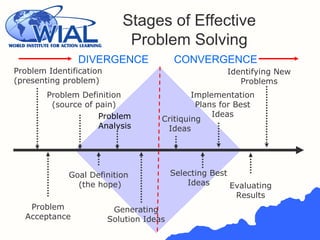
Problem Identification
(presenting problem)
Problem Definition
(source of pain)
Critiquing
Ideas
Generating
Solution Ideas
Selecting Best
Ideas
Implementation
Plans for Best
Ideas
Evaluating
Results
Identifying New
Problems
Problem
Acceptance
DIVERGENCE CONVERGENCE
Stages of Effective
Problem Solving
Goal Definition
(the hope)
Problem
Analysis
• Where are the pain points or needs in
your organization where this might serve?
• What are the loftly goals or aspirations
you hold for OD in your organization
where this might serve?
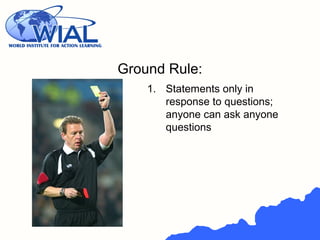
Ground Rule:
1. Statements only in
response to questions;
anyone can ask anyone
questions
AL Hits the Bull’s-eye:
How Action Learning is shaping both
Strategy and Leaders at Target
• Structured vertically, but now must learn how to work
horizontally
• Need greater capability to engage in constructive
candor and dialogue in order to truly innovate
• Must develop and learn how to leverage cross-pyramid
network of peers
• More sophisticated capabilities with problem solving
and setting strategy
• More sophisticated methods of building teams and
developing talent
What were our objectives?
• Highly capable executives learn through peer
interaction, discussion and real-world practice
• Rewarded previously for formulating the tactical plan
and executing on it – must influence and be influenced
on setting the strategy itself
• “Leader as a source of certainty” model is outdated.
Volatility, Uncertainty, Complexity, and Ambiguity
(VUCA) have rendered it so
• Faster pace of change means increasingly less
predictability – organizations must learn to innovate
“on the fly”
Why Action Learning?
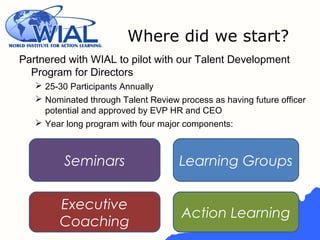
Where did we start?
Partnered with WIAL to pilot with our Talent Development
Program for Directors
 25-30 Participants Annually
 Nominated through Talent Review process as having future officer
potential and approved by EVP HR and CEO
 Year long program with four major components:
Seminars Learning Groups
Executive
Coaching
Action Learning
• “The action learning experience was profoundly impactful
to my development. Solving a relevant business problem
with a group of leaders from different parts of the
business provides so much insight on how to navigate
challenges we face every day. Highly engaging activity!!”
• “The format of having everything being posed in a
question format promoted a broader scope of thought.”
• “I’ve not been this uncomfortable at work in a very long
time – and have not grown this much either.”
• VP Problem Sponsor: “You’d advanced our thinking on
this by about a year and half.”
Testimonials:
• Pitch to solving business issues first
• Consult on selecting, narrowing, and presenting problem
• SME stays with the group throughout
• Define time frame (i.e. 2.5 days)
• Invite stakeholders to attend the solution recommendation
• Pluses/Delta after each round and program year
• Follow up communication with participants and
stakeholders
• High potential participants=future Sr. Leader advocates
• Obtain WIAL certification to run in-house
Success Factors
• Local Community of Practice
• Training, education and certification resources
• Sharing of ideas, learning and success stories
• Sharing of talent resources for occasional scale
• Currently all local/Midwest business goes to non-local
WIAL certified coaches
• Creates opportunity for contributing to the larger
community
Why a WIAL Minnesota Chapter?
• Live Action Learning Demo/Introduction – February 19th
from 5-8pm
• WIAL sponsored and led Certification training offering
in Twin Cities (vs. Washington D.C. or Seattle)
o Foundations course: April 27-28th
(M/Tu)
o Certification CALC I: April 29-30th
(W/Th)
o For more information, visit: www.wial-usa.org
Upcoming MN Chapter Events
Thank you!

World Institute for Action Learning Presentation to MNODN

  • 1.
    Action Learning: Solving CriticalBusiness Problems and Developing Leaders in Real Time Minnesota OD Network February 5, 2015
  • 2.
    22 “In times ofchange, the learners will inherit the world while the knowers will remain well- prepared for the world that no longer exists.” Eric Hoffer
  • 3.
    Objectives 1. Build connections,support and energy 2. Provide an understanding of the principles, practices and benefits of Action Learning 3. Share examples and success factors 4. Invite to join a new and growing community of practice
  • 4.
    What is ActionLearning?  A process that involves a small group (“set”) working on real problems, taking action, and learning while doing so  A powerful management tool that creates dynamic opportunities for individuals, teams, leaders and organizations to successfully adapt, learn and innovate
  • 5.
    Historical Roots • RegRevans (UK 1950s) Grandfather of Action Learning - Learning = Programmed Knowledge + Questioning Insight - No learning without action, no action without learning • Mike Markquardt (US 1970s) Father of Action Learning - Studied under Revans - Two ground rules - Formalized the 6 components - “Tell me, I’ll forget. Show me and I’ll remember. Involve me and I’ll understand.”
  • 6.
    Contrast with typicalProblem-solving Groups 1. Learning and team development as important as solving the problem 2. Groups charged with developing a real solution the organization can implement 3. Membership not reserved to experts or involved people 4. Questions precede answers; dialogue over discussion and debate 5. Learning coach with license to interrupt for sake of learning
  • 7.
    Action & Learning Action/SolutionLearning • Both are priorities • While action is being taken the expanded thinking, questioning, and group dynamics are also processed in real time
  • 8.
    PROBLEM SOLVING PERSONAL & LEADERSHIP DEVELOPMENT ORGANIZATIONAL CHANGE FourResults of Action Learning ACTION LEARNING TEAM DEVELOPMENT
  • 9.
    Components of theAction Learning Process Project, challenge, task, or problem Group of 4-8 people with diverse perspectives Reflective questioning and listening Developing strategies and taking action Commitment to learning Action Learning coach
  • 10.
    Reflective questioning andlistening Is it possible to improve an action without learning? Is it possible to learn deeply without reflecting? Is it possible to reflect without a question?
  • 11.
    Two Ground Rules: 1.Statements only in response to questions; anyone can ask anyone questions 2. Action Learning coach has authority to intervene whenever he/she identifies learning opportunities
  • 12.
    PROCESS FACILITATOR ACTIONLEARNING COACH Gets involved in content; advocates particular solutions Remains neutral; refrains from advocacy of any solutions Often asks leading questions Asks open-ended & closed-ended questions Frequently provides problem solving methods Relies on team members to create &/or apply problem solving methods Focus on solving problem, completing task Focus on achieving results & learning Resolves conflicts Manages & uses conflicts Overcomes resistance Uses resistance as information Focuses on immediate problem Focuses on total system, how problem is influenced by context, & how solution impacts context Makes statements without being asked Makes statements in response to some questions Often accepts, does not challenge assumptions Inquires to make assumptions explicit, tests validity of conclusions, beliefs Rescues team if in trouble Lets team struggle in order to learn Often creates dependency Evokes self-determination Adapted from O’Neil, J. & Marsick, V. (2007)
  • 13.
    Problem Identification (presenting problem) ProblemDefinition (source of pain) Critiquing Ideas Generating Solution Ideas Selecting Best Ideas Implementation Plans for Best Ideas Evaluating Results Identifying New Problems Problem Acceptance DIVERGENCE CONVERGENCE Stages of Effective Problem Solving Goal Definition (the hope) Problem Analysis
  • 14.
    • Where arethe pain points or needs in your organization where this might serve? • What are the loftly goals or aspirations you hold for OD in your organization where this might serve?
  • 15.
    Ground Rule: 1. Statementsonly in response to questions; anyone can ask anyone questions
  • 16.
    AL Hits theBull’s-eye: How Action Learning is shaping both Strategy and Leaders at Target
  • 17.
    • Structured vertically,but now must learn how to work horizontally • Need greater capability to engage in constructive candor and dialogue in order to truly innovate • Must develop and learn how to leverage cross-pyramid network of peers • More sophisticated capabilities with problem solving and setting strategy • More sophisticated methods of building teams and developing talent What were our objectives?
  • 18.
    • Highly capableexecutives learn through peer interaction, discussion and real-world practice • Rewarded previously for formulating the tactical plan and executing on it – must influence and be influenced on setting the strategy itself • “Leader as a source of certainty” model is outdated. Volatility, Uncertainty, Complexity, and Ambiguity (VUCA) have rendered it so • Faster pace of change means increasingly less predictability – organizations must learn to innovate “on the fly” Why Action Learning?
  • 19.
    Where did westart? Partnered with WIAL to pilot with our Talent Development Program for Directors  25-30 Participants Annually  Nominated through Talent Review process as having future officer potential and approved by EVP HR and CEO  Year long program with four major components: Seminars Learning Groups Executive Coaching Action Learning
  • 20.
    • “The actionlearning experience was profoundly impactful to my development. Solving a relevant business problem with a group of leaders from different parts of the business provides so much insight on how to navigate challenges we face every day. Highly engaging activity!!” • “The format of having everything being posed in a question format promoted a broader scope of thought.” • “I’ve not been this uncomfortable at work in a very long time – and have not grown this much either.” • VP Problem Sponsor: “You’d advanced our thinking on this by about a year and half.” Testimonials:
  • 21.
    • Pitch tosolving business issues first • Consult on selecting, narrowing, and presenting problem • SME stays with the group throughout • Define time frame (i.e. 2.5 days) • Invite stakeholders to attend the solution recommendation • Pluses/Delta after each round and program year • Follow up communication with participants and stakeholders • High potential participants=future Sr. Leader advocates • Obtain WIAL certification to run in-house Success Factors
  • 22.
    • Local Communityof Practice • Training, education and certification resources • Sharing of ideas, learning and success stories • Sharing of talent resources for occasional scale • Currently all local/Midwest business goes to non-local WIAL certified coaches • Creates opportunity for contributing to the larger community Why a WIAL Minnesota Chapter?
  • 23.
    • Live ActionLearning Demo/Introduction – February 19th from 5-8pm • WIAL sponsored and led Certification training offering in Twin Cities (vs. Washington D.C. or Seattle) o Foundations course: April 27-28th (M/Tu) o Certification CALC I: April 29-30th (W/Th) o For more information, visit: www.wial-usa.org Upcoming MN Chapter Events
  • 24.

Editor's Notes

  • #2 Bait Pitfall Rescue
  • #3 Conference Board/Right Management Research CCL Whitepaper (Nick Petrie) – Emerging Trends in Leadership Development (AL as an effective tool given our increasingly VUCA world)
  • #10 Give examples for each of the six components.