Action Learning
1
What is Action Learning?
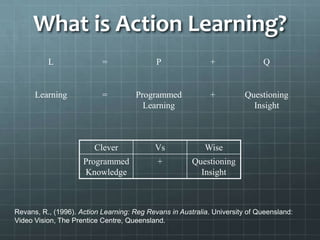
L = P + Q
Learning = Programmed
Learning
+ Questioning
Insight
Clever Vs Wise
Programmed
Knowledge
+ Questioning
Insight
Revans, R., (1996). Action Learning: Reg Revans in Australia. University of Queensland:
Video Vision, The Prentice Centre, Queensland.
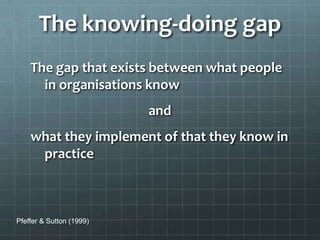
The knowing-doing gap
The gap that exists between what people
in organisations know
and
what they implement of that they know in
practice
Pfeffer & Sutton (1999)
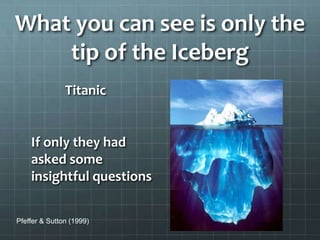
What you can see is only the
tip of the Iceberg
Titanic
If only they had
asked some
insightful questions
Pfeffer & Sutton (1999)
Michael Fullen
Nothing has promised so much and has been
so frustratingly wasteful as the thousands of
workshops and conferences that led to no
significant change in practice when teachers
returned to their classrooms.
Fullan, M., (1991).
What is Action Learning?
Action Learning:
Happens in the workplace
Involves existing staff
Uses teaching as the program material
The Action Learning Model involves groups of
teachers engaged in professional conversations
within supportive collegial networks.
By tackling the issues facing them in their respective
classroom within a supportive learning community,
they will be able to transform, enhance, enrich,
enable or amplify student learning outcomes
What does Action Learning
mean for the Participant?
Participants identify a workplace issue, problem or idea
they want to pursue related to the theme of the Action
learning Program.
Learning events may require reading, substantive
conversations or activities
Action Learning Sets are collegial groups that provide
a forum for facilitated learning and discussion
Celebrate and share the learning
Inspiration
By using the knowledge and experience
of a small group of people combined
with skilled questioning, individuals are
enabled to re-interpret old and familiar
concepts and produce fresh ideas –
often without needing new knowledge
8
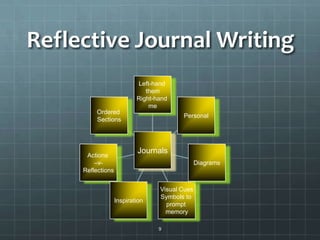
Reflective Journal Writing
Ordered
Sections
Actions
–v-
Reflections
Inspiration
Visual Cues
Symbols to
prompt
memory
Diagrams
Personal
Left-hand
them
Right-hand
me
Journals
9
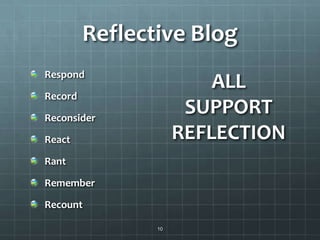
Reflective Blog
Respond
Record
Reconsider
React
Rant
Remember
Recount
ALL
SUPPORT
REFLECTION
10
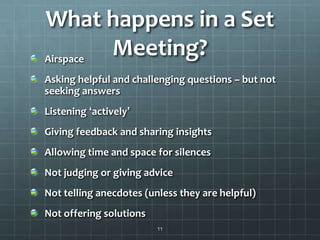
What happens in a Set
Meeting?Airspace
Asking helpful and challenging questions – but not
seeking answers
Listening ‘actively’
Giving feedback and sharing insights
Allowing time and space for silences
Not judging or giving advice
Not telling anecdotes (unless they are helpful)
Not offering solutions
11
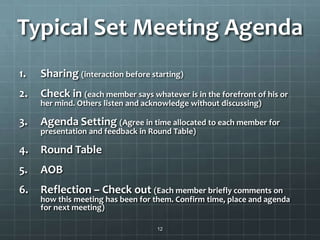
Typical Set Meeting Agenda
1. Sharing (interaction before starting)
2. Check in (each member says whatever is in the forefront of his or
her mind. Others listen and acknowledge without discussing)
3. Agenda Setting (Agree in time allocated to each member for
presentation and feedback in Round Table)
4. Round Table
5. AOB
6. Reflection – Check out (Each member briefly comments on
how this meeting has been for them. Confirm time, place and agenda
for next meeting)
12
Learning Set Protocol
for Round Table
The following steps are repeated for each member of the Learning Set
5-15 mins maximum for each person (negotiated)
One set member acts as timekeeper
One set member acts as scribe so that all ideas are collected for the
presenter
Step 1: The set member shares their idea / progress with the rest of the
group – uninterrupted
Step 2: Clarifying questions from the other Learning Set members
13
Airspace
As you explain things to the set, you hear your own
inconsistencies, the missing elements, the illogicalities.
But you need to do it out loud.
If you only consider ‘internally’, in your own thoughts,
your mind can lead you down all sorts of pathways. But
somehow, as you speak, your voice can give you away.
And others are listening, and can spot the flaws, where
the gaps are, and will pursue you down the alleys you are
following. Eventually the trick is to learn to do this
yourself, though having others listen will always add
another dimension.
14

Action learning

  • 1.
  • 2.
    What is ActionLearning? L = P + Q Learning = Programmed Learning + Questioning Insight Clever Vs Wise Programmed Knowledge + Questioning Insight Revans, R., (1996). Action Learning: Reg Revans in Australia. University of Queensland: Video Vision, The Prentice Centre, Queensland.
  • 3.
    The knowing-doing gap Thegap that exists between what people in organisations know and what they implement of that they know in practice Pfeffer & Sutton (1999)
  • 4.
    What you cansee is only the tip of the Iceberg Titanic If only they had asked some insightful questions Pfeffer & Sutton (1999)
  • 5.
    Michael Fullen Nothing haspromised so much and has been so frustratingly wasteful as the thousands of workshops and conferences that led to no significant change in practice when teachers returned to their classrooms. Fullan, M., (1991).
  • 6.
    What is ActionLearning? Action Learning: Happens in the workplace Involves existing staff Uses teaching as the program material The Action Learning Model involves groups of teachers engaged in professional conversations within supportive collegial networks. By tackling the issues facing them in their respective classroom within a supportive learning community, they will be able to transform, enhance, enrich, enable or amplify student learning outcomes
  • 7.
    What does ActionLearning mean for the Participant? Participants identify a workplace issue, problem or idea they want to pursue related to the theme of the Action learning Program. Learning events may require reading, substantive conversations or activities Action Learning Sets are collegial groups that provide a forum for facilitated learning and discussion Celebrate and share the learning
  • 8.
    Inspiration By using theknowledge and experience of a small group of people combined with skilled questioning, individuals are enabled to re-interpret old and familiar concepts and produce fresh ideas – often without needing new knowledge 8
  • 9.
    Reflective Journal Writing Ordered Sections Actions –v- Reflections Inspiration VisualCues Symbols to prompt memory Diagrams Personal Left-hand them Right-hand me Journals 9
  • 10.
  • 11.
    What happens ina Set Meeting?Airspace Asking helpful and challenging questions – but not seeking answers Listening ‘actively’ Giving feedback and sharing insights Allowing time and space for silences Not judging or giving advice Not telling anecdotes (unless they are helpful) Not offering solutions 11
  • 12.
    Typical Set MeetingAgenda 1. Sharing (interaction before starting) 2. Check in (each member says whatever is in the forefront of his or her mind. Others listen and acknowledge without discussing) 3. Agenda Setting (Agree in time allocated to each member for presentation and feedback in Round Table) 4. Round Table 5. AOB 6. Reflection – Check out (Each member briefly comments on how this meeting has been for them. Confirm time, place and agenda for next meeting) 12
  • 13.
    Learning Set Protocol forRound Table The following steps are repeated for each member of the Learning Set 5-15 mins maximum for each person (negotiated) One set member acts as timekeeper One set member acts as scribe so that all ideas are collected for the presenter Step 1: The set member shares their idea / progress with the rest of the group – uninterrupted Step 2: Clarifying questions from the other Learning Set members 13
  • 14.
    Airspace As you explainthings to the set, you hear your own inconsistencies, the missing elements, the illogicalities. But you need to do it out loud. If you only consider ‘internally’, in your own thoughts, your mind can lead you down all sorts of pathways. But somehow, as you speak, your voice can give you away. And others are listening, and can spot the flaws, where the gaps are, and will pursue you down the alleys you are following. Eventually the trick is to learn to do this yourself, though having others listen will always add another dimension. 14