@MHWILLEKE | GROWTH MINDSET -> LEARNING ORGANISATION -> AGILITY
Growth Mindset -> Learning Organisation-> Agility
MARIAN WILLEKE, PHD
MHWILLEKE.COM /IN/MARIANWILLEKE @MHWILLEKE
AGILE CONFERENCE - ATLANTA GA - #AGILE2016
@MHWILLEKE | GROWTH MINDSET -> LEARNING ORGANISATION -> AGILITY
Focus: Being a Learning Organisation
Achieving continuous improvement…
…To stay competitive in the market.
@MHWILLEKE | GROWTH MINDSET -> LEARNING ORGANISATION -> AGILITY
Our Questions Today
1. Why does agility require a learning mindset?
2. How does growth mindset perpetuate learning?
3. What learning frameworks enhance growth mindset?
4. How can organizations influence a growth mindset?
Collaborative
Reflection
@MHWILLEKE | GROWTH MINDSET -> LEARNING ORGANISATION -> AGILITY
Our Motivation
Why does agility require a culture of learning?
@MHWILLEKE | GROWTH MINDSET -> LEARNING ORGANISATION -> AGILITY
Good Agile Thinking IS about Learning!
Requires Behaviour
 Processes and tools
 Documentation
 Contracts
 Following a plan
Requires Learning Practices
 Individuals and interactions
 Working software
 Collaboration
 Responding to change
http://www.agilemanifesto.org/
We are uncovering better ways of developing software by
doing it and helping others do it.
Through this work we have come to value:
@MHWILLEKE | GROWTH MINDSET -> LEARNING ORGANISATION -> AGILITY
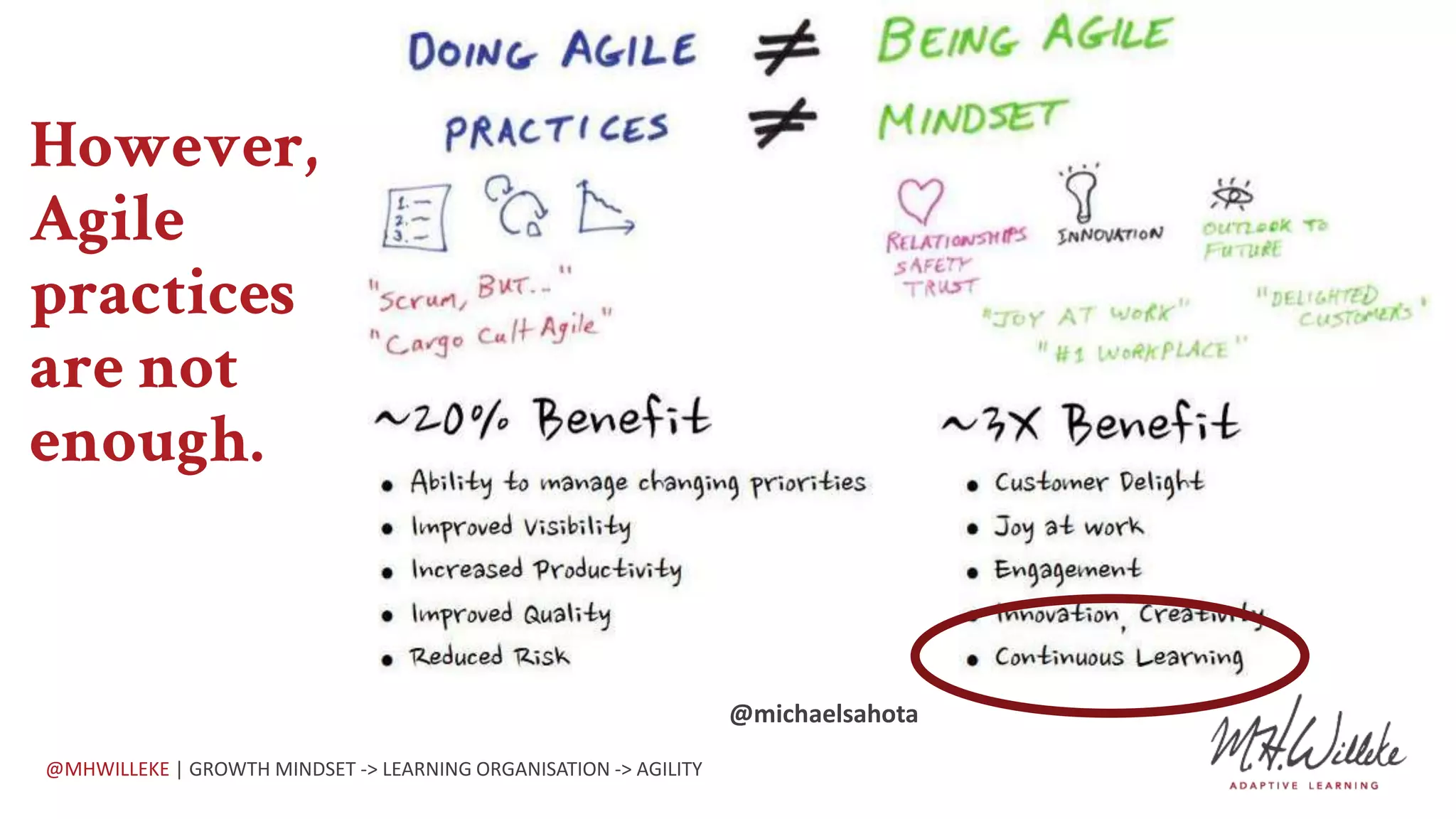
However,
Agile
practices
are not
enough.
@michaelsahota
@MHWILLEKE | GROWTH MINDSET -> LEARNING ORGANISATION -> AGILITY
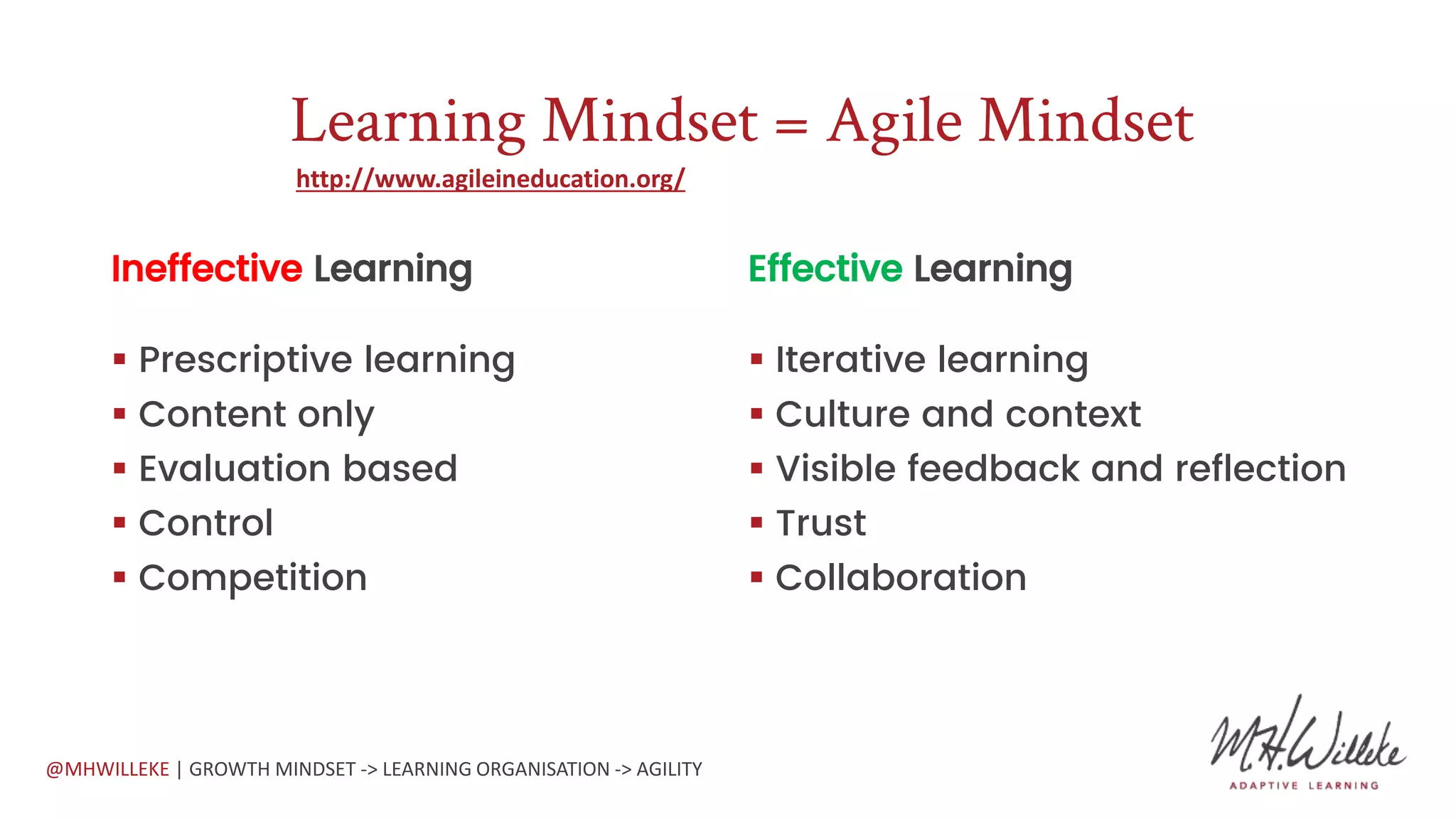
Learning Culture = Agile Values
Ineffective Learning
 Prescriptive learning
 Content only
 Evaluation based
 Control
 Competition
Effective Learning
 Iterative learning
 Culture and context
 Visible feedback and reflection
 Trust
 Collaboration
http://www.agileineducation.org/
@MHWILLEKE | GROWTH MINDSET -> LEARNING ORGANISATION -> AGILITY
Reflection: Our Motivation
Why does agility require a culture of learning?
@MHWILLEKE | GROWTH MINDSET -> LEARNING ORGANISATION -> AGILITY
Growth Mindset
How does growth mindset perpetuate learning?
@MHWILLEKE | GROWTH MINDSET -> LEARNING ORGANISATION -> AGILITY
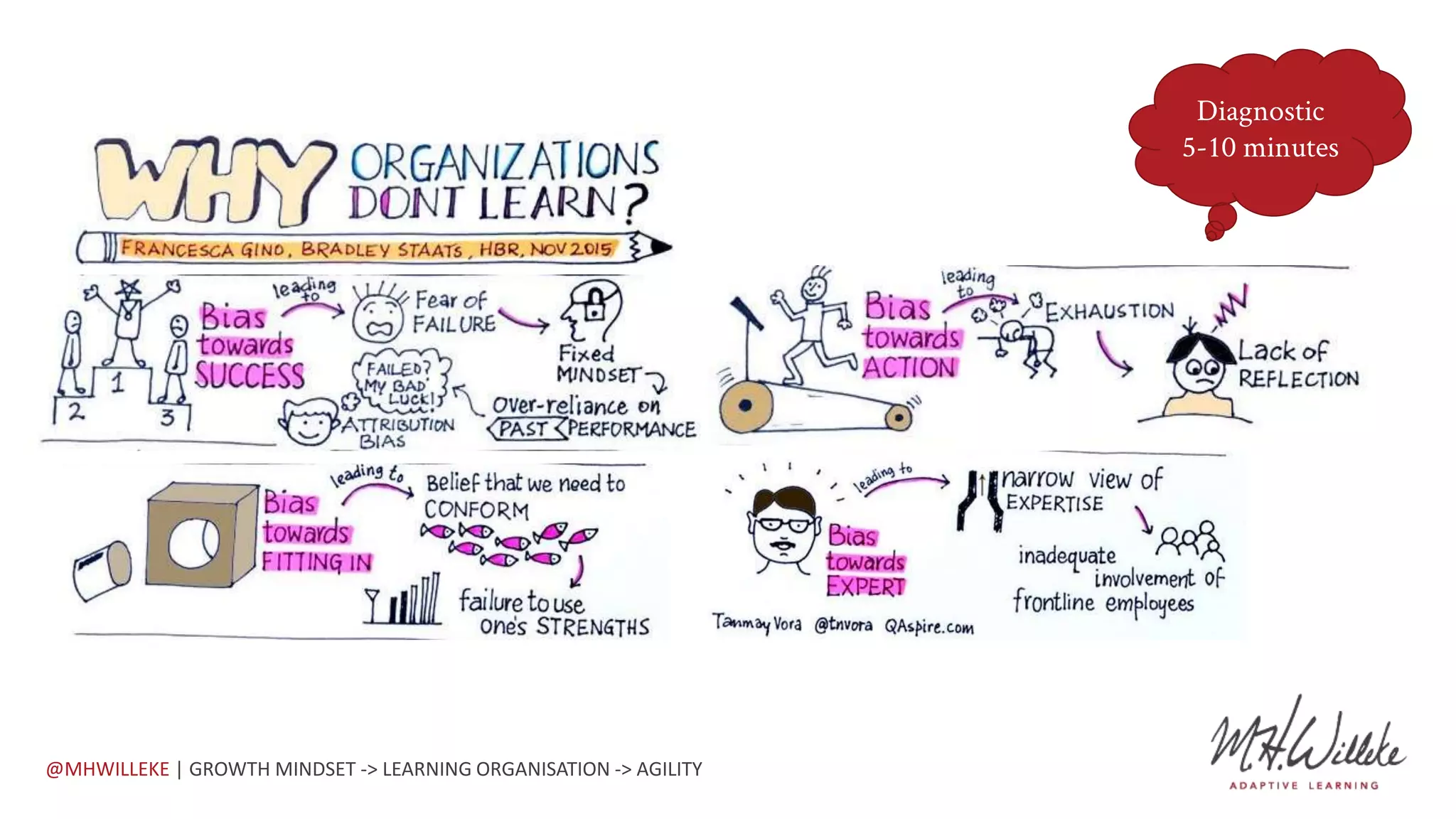
Diagnostic
5-10 minutes
@MHWILLEKE | GROWTH MINDSET -> LEARNING ORGANISATION -> AGILITY
Success Bias
FIXED MINDSET
“I got it done, didn’t I?”
Performance driven
“Why didn’t you deliver?”
Failure is incompetence
“How will we know this is
going to work?”
Low risk oriented
GROWTH MINDSET
Seeks challenges
“This will be fun!”
Failure is learning
“How will we approach
this next time?”
Risk is necessary
“What are the range of
outcomes?
Gino & Staats, 2015
Brain Activity when Making Errors
Moser, Schroder, Heeter, Moran, Lee, 2011
@MHWILLEKE | GROWTH MINDSET -> LEARNING ORGANISATION -> AGILITY
Growth Mindset
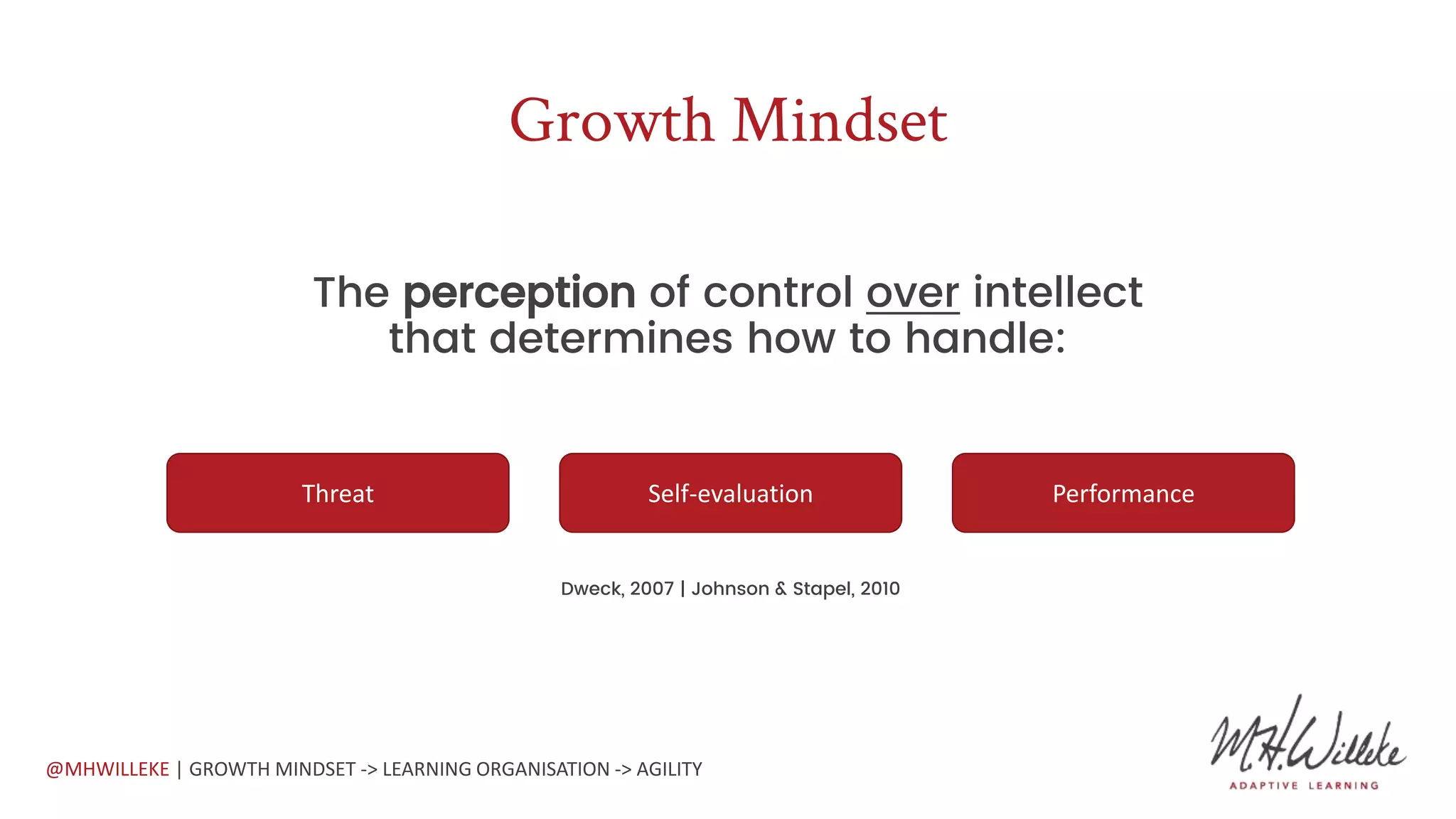
The perception of control over intellect
that determines how to handle:
Threat Self-evaluation Performance
Dweck, 2007 | Johnson & Stapel, 2010
@MHWILLEKE | GROWTH MINDSET -> LEARNING ORGANISATION -> AGILITY
GROWTH
MINDSET
CHALLENGE
PERSISTENCE
MASTERY
LEARNING
Dweck, 2007
@MHWILLEKE | GROWTH MINDSET -> LEARNING ORGANISATION -> AGILITY
GROWTH
MINDSET
FIXED
MINDSET
Avoiding
Challenge Embracing
Challenge
CHALLENGE
PERSISTENCE
Give Up
Challenged by
Setbacks
MASTERY
Efforts are
Valueless
Efforts are a
Journey
@MHWILLEKE | GROWTH MINDSET -> LEARNING ORGANISATION -> AGILITY
GROWTH
MINDSET
FIXED
MINDSET
Dismiss
Criticism Embrace
Criticism
LEARNING
SUB-CONSTRUCTS
Insecure by
Others’ Success Pleased by
Others’ Success
Threatened by
Others Inspired by
Others
@MHWILLEKE | GROWTH MINDSET -> LEARNING ORGANISATION -> AGILITY
Reflection: Growth Mindset
How does growth mindset perpetuate learning?
@MHWILLEKE | GROWTH MINDSET -> LEARNING ORGANISATION -> AGILITY
Learning Frameworks
What learning frameworks enhance growth mindset?
@MHWILLEKE | GROWTH MINDSET -> LEARNING ORGANISATION -> AGILITY
Cognitive Learning
 MEASURABLE
 “FROM THE NECK UP”
Simple recall
Explain in own
words
Perform task
Deconstruct
elements of
system
Critique based
on experience
and theory
Add to
existing
knowledge
Bloom, 1956
@MHWILLEKE | GROWTH MINDSET -> LEARNING ORGANISATION -> AGILITY
Affective Learning
 PERSONAL AWARENESS
 CONNECTION TO PERSONAL
VALUE SYSTEM
Present and
Listening
Actively
Participates
Believes Strongly
Organise Values
into Personal
Value System
Value System
Influences
Others
Krathwohl, Bloom & Masia, 1973
@MHWILLEKE | GROWTH MINDSET -> LEARNING ORGANISATION -> AGILITY
Simple recall
Explain in own
words
Perform task
Deconstruct
elements of
system
Critique based
on experience
and theory
Add to
existing
knowledge
Present and
Listening
Actively
Participates
Believes Strongly
Organise Values
into Personal
Value System
Value System
Influences
Others
Affective learning has been found as a
predictor to attitude and motivation.
@MHWILLEKE | GROWTH MINDSET -> LEARNING ORGANISATION -> AGILITY
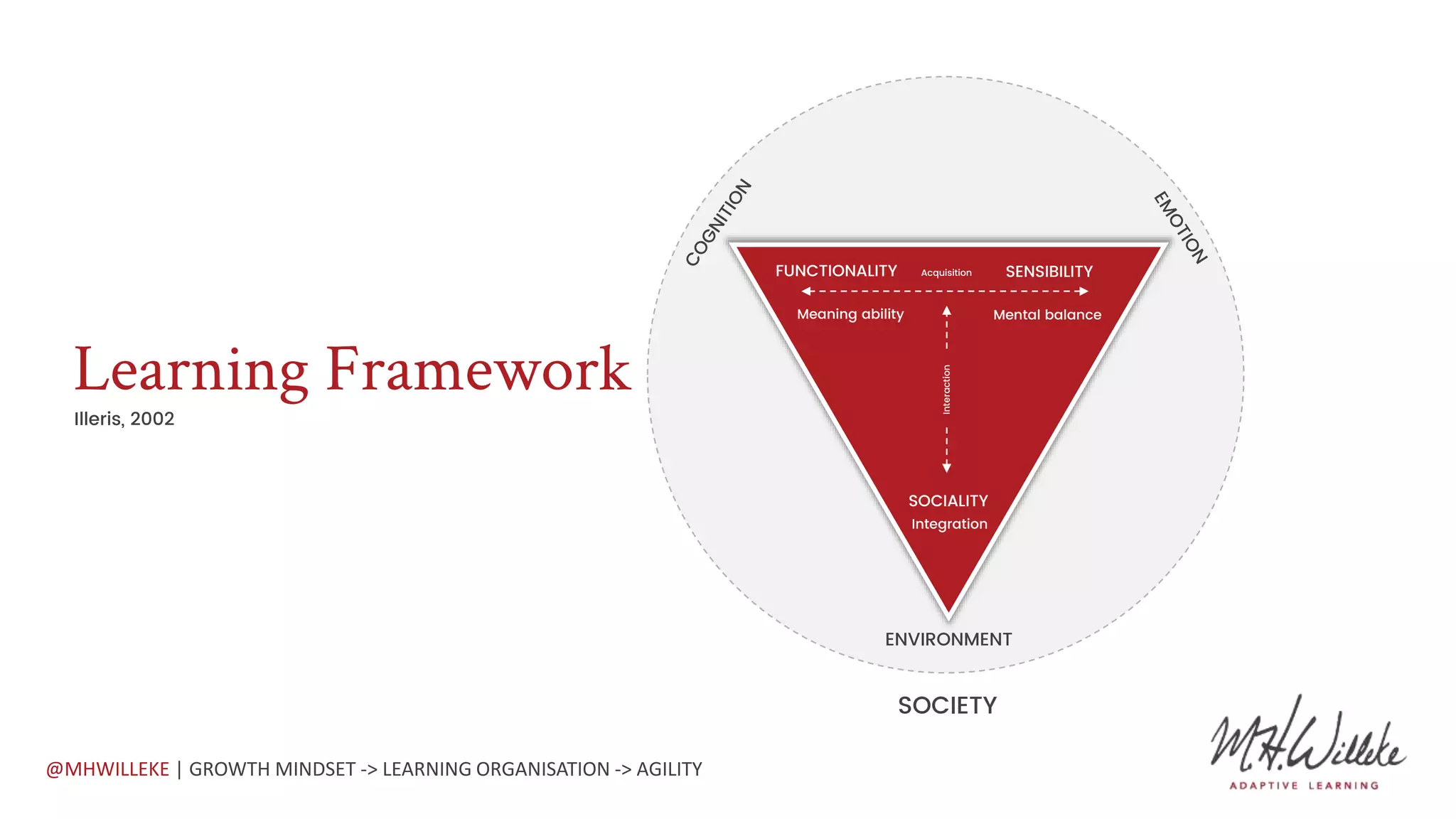
Illeris, 2002
ENVIRONMENT
SOCIETY
FUNCTIONALITY SENSIBILITY
SOCIALITY
Meaning ability Mental balance
Integration
Acquisition
Interaction
Learning Framework
@MHWILLEKE | GROWTH MINDSET -> LEARNING ORGANISATION -> AGILITY
ENVIRONMENT
SOCIETY
FUNCTIONALITY SENSIBILITY
SOCIALITY
Meaning ability Mental balance
Integration
Acquisition
Interaction
Exercise
5-8 minutes
Describe a recent training that did
not meet your expectations.
Analyze if any of these were
missing…
1. Acquired meaningful skills
2. Experienced motivation
3. Collaborated to learn
@MHWILLEKE | GROWTH MINDSET -> LEARNING ORGANISATION -> AGILITY
Employing Illeris’ Model
 What focused skill do you want
them to investigate?
 How are you wanting them to
relate to it?
 What environment are you going
to shape for them to share and
learn?
 Use a model for analyzing a
training experience.
 Engage with peers through a
storytelling experience.
 Integrate other people’s stories
into their own stories through
discussion.
@MHWILLEKE | GROWTH MINDSET -> LEARNING ORGANISATION -> AGILITY
ACT
Concrete Experience
Facts (What Happened?)
Theory of Action
CONCEPTUALIZE
Abstract Conceptualization
Findings (Why Did This Happen?)
Revise Theory
REFLECT
Reflective Observation
Feelings (What Did I Experience?)
Assess Behavior & Consequences
APPLY
Active Experimentation
Futures (What Will I Do?)
Implement Revised Theory
David Kolb Roger Greenaway Chris Argyris & Donald Schon
COMPILED BY ANDREA CORNEY
www.edbatista.com/2007/10/experiential.html
Learning
Cycles
@MHWILLEKE | GROWTH MINDSET -> LEARNING ORGANISATION -> AGILITY
Reflection: Learning Frameworks
What learning frameworks enhance growth mindset?
@MHWILLEKE | GROWTH MINDSET -> LEARNING ORGANISATION -> AGILITY
Our Actions
How can organisations influence a growth mindset?
@MHWILLEKE | GROWTH MINDSET -> LEARNING ORGANISATION -> AGILITY
Incorporating a Learning Mindset Space
 Understand the constraints
 Understand how adults learn
 Understand the value of reflection
@MHWILLEKE | GROWTH MINDSET -> LEARNING ORGANISATION -> AGILITY
 Interruptions … every 5 minutes
 Video attention span … 4 minutes
 Smartphone access … 9x / hour
 You have 5-10 second to get their
attention
 “I don’t have time to do my job”
Constraints
@MHWILLEKE | GROWTH MINDSET -> LEARNING ORGANISATION -> AGILITY
Preparing for Adult Learning
 What are the expectations from the learning?
 How is the learning manifested?
 Do these two things align?
@MHWILLEKE | GROWTH MINDSET -> LEARNING ORGANISATION -> AGILITY
Change a behavior in
specific direction
Create maturity for
autonomous behavior
Develop capacity and
skills for learning
Learning different
roles and behaviors
through social
interaction and
observation
Construct meaning
from experience
Goal
@MHWILLEKE | GROWTH MINDSET -> LEARNING ORGANISATION -> AGILITY
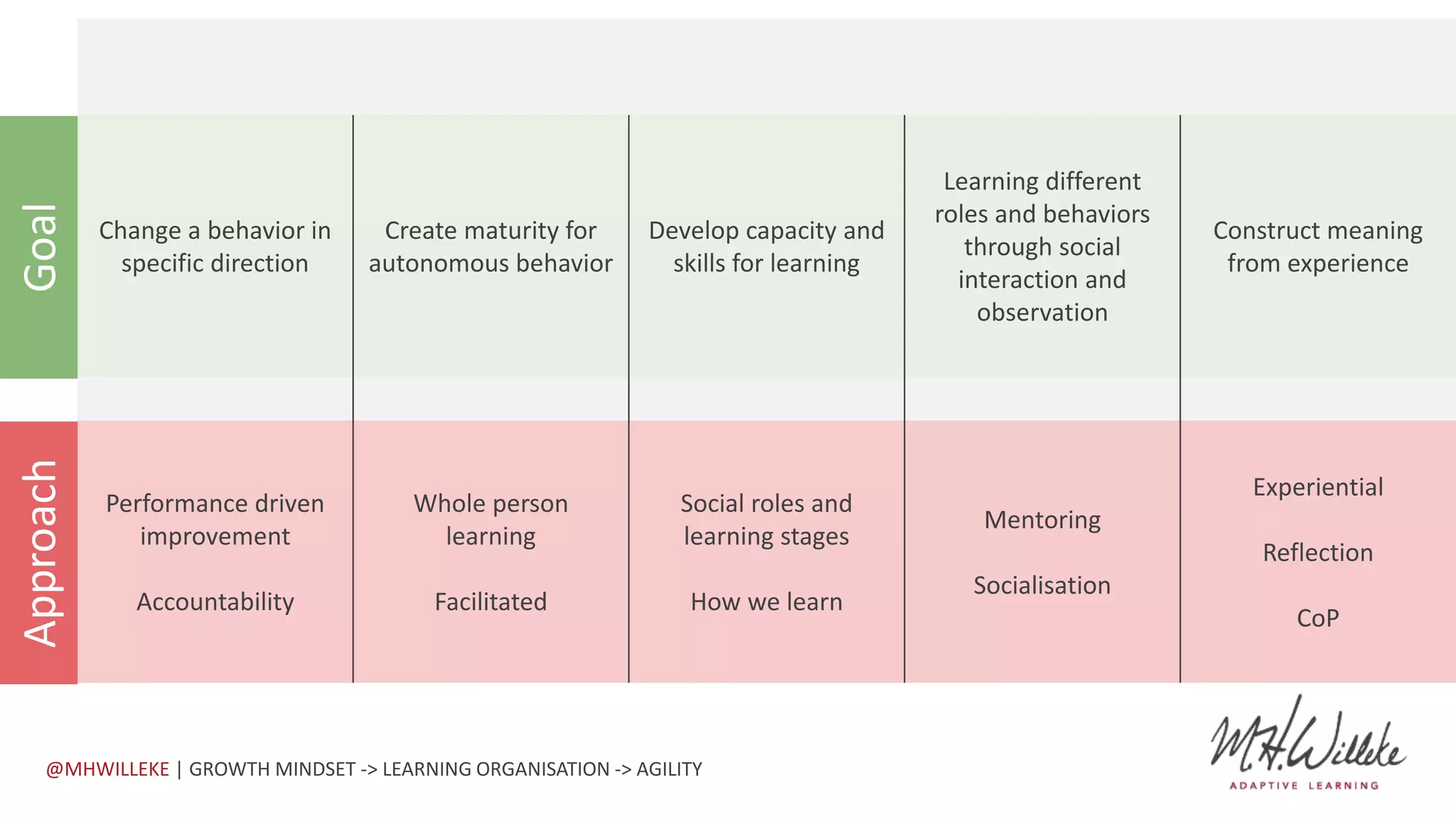
Change a behavior in
specific direction
Create maturity for
autonomous behavior
Develop capacity and
skills for learning
Learning different
roles and behaviors
through social
interaction and
observation
Construct meaning
from experience
Performance driven
improvement
Accountability
Whole person
learning
Facilitated
Social roles and
learning stages
How we learn
Mentoring
Socialisation
Experiential
Reflection
CoP
GoalApproach
@MHWILLEKE | GROWTH MINDSET -> LEARNING ORGANISATION -> AGILITY
Behaviorialism Humanism Cognitivism
Social
Cognitivism
Constructivism
Change a behavior in
specific direction
Create maturity for
autonomous behavior
Develop capacity and
skills for learning
Learning different
roles and behaviors
through social
interaction and
observation
Construct meaning
from experience
Performance driven
improvement
Accountability
Whole person
learning
Facilitated
Social roles and
learning stages
How we learn
Mentoring
Socialisation
Experiential
Reflection
CoP
GoalApproach
@MHWILLEKE | GROWTH MINDSET -> LEARNING ORGANISATION -> AGILITY
Influencing the Learning Mindset Space
 Propel the growth mindset through behavior
 Connect to each individual authentically
 Demonstrate vulnerability in your
developing growth mindset
@MHWILLEKE | GROWTH MINDSET -> LEARNING ORGANISATION -> AGILITY
Shaping Your Behaviour
@MHWILLEKE | GROWTH MINDSET -> LEARNING ORGANISATION -> AGILITY
Connect with Authenticity
 Maintain strong personal self-awareness.
 Be aware of the differences and preferences
of the individuals in your audience.
 Develop unique relationship between each
individual and yourself.
 Be aware of constraints.
 Engage in reflection.
Fostering Authentic
Relationships
with the
Authenticity Model
Cranton, 2006
@MHWILLEKE | GROWTH MINDSET -> LEARNING ORGANISATION -> AGILITY
Understand
Your People
Individuals are shaped by
their backgrounds and
experiences.
Cherish it.
Be vulnerable in this
sharing.
EXCITERS COMFORTS
CHALLENGES FEARS
Eric Willeke
@erwilleke
PositiveFramingNegativeFraming
Active Emotion Passive Emotion
Exercise
5-10 minutes
@MHWILLEKE | GROWTH MINDSET -> LEARNING ORGANISATION -> AGILITY
Reflection: Our Actions
How can organisations influence a growth mindset?
@MHWILLEKE | GROWTH MINDSET -> LEARNING ORGANISATION -> AGILITY
Which Way Are You Going?

Growth mindset - learning organisation - agility

  • 1.
    @MHWILLEKE | GROWTHMINDSET -> LEARNING ORGANISATION -> AGILITY Growth Mindset -> Learning Organisation-> Agility MARIAN WILLEKE, PHD MHWILLEKE.COM /IN/MARIANWILLEKE @MHWILLEKE AGILE CONFERENCE - ATLANTA GA - #AGILE2016
  • 2.
    @MHWILLEKE | GROWTHMINDSET -> LEARNING ORGANISATION -> AGILITY Focus: Being a Learning Organisation Achieving continuous improvement… …To stay competitive in the market.
  • 3.
    @MHWILLEKE | GROWTHMINDSET -> LEARNING ORGANISATION -> AGILITY Our Questions Today 1. Why does agility require a learning mindset? 2. How does growth mindset perpetuate learning? 3. What learning frameworks enhance growth mindset? 4. How can organizations influence a growth mindset? Collaborative Reflection
  • 4.
    @MHWILLEKE | GROWTHMINDSET -> LEARNING ORGANISATION -> AGILITY Our Motivation Why does agility require a culture of learning?
  • 5.
    @MHWILLEKE | GROWTHMINDSET -> LEARNING ORGANISATION -> AGILITY Good Agile Thinking IS about Learning! Requires Behaviour  Processes and tools  Documentation  Contracts  Following a plan Requires Learning Practices  Individuals and interactions  Working software  Collaboration  Responding to change http://www.agilemanifesto.org/ We are uncovering better ways of developing software by doing it and helping others do it. Through this work we have come to value:
  • 6.
    @MHWILLEKE | GROWTHMINDSET -> LEARNING ORGANISATION -> AGILITY However, Agile practices are not enough. @michaelsahota
  • 7.
    @MHWILLEKE | GROWTHMINDSET -> LEARNING ORGANISATION -> AGILITY Learning Culture = Agile Values Ineffective Learning  Prescriptive learning  Content only  Evaluation based  Control  Competition Effective Learning  Iterative learning  Culture and context  Visible feedback and reflection  Trust  Collaboration http://www.agileineducation.org/
  • 8.
    @MHWILLEKE | GROWTHMINDSET -> LEARNING ORGANISATION -> AGILITY Reflection: Our Motivation Why does agility require a culture of learning?
  • 9.
    @MHWILLEKE | GROWTHMINDSET -> LEARNING ORGANISATION -> AGILITY Growth Mindset How does growth mindset perpetuate learning?
  • 10.
    @MHWILLEKE | GROWTHMINDSET -> LEARNING ORGANISATION -> AGILITY Diagnostic 5-10 minutes
  • 11.
    @MHWILLEKE | GROWTHMINDSET -> LEARNING ORGANISATION -> AGILITY Success Bias FIXED MINDSET “I got it done, didn’t I?” Performance driven “Why didn’t you deliver?” Failure is incompetence “How will we know this is going to work?” Low risk oriented GROWTH MINDSET Seeks challenges “This will be fun!” Failure is learning “How will we approach this next time?” Risk is necessary “What are the range of outcomes? Gino & Staats, 2015 Brain Activity when Making Errors Moser, Schroder, Heeter, Moran, Lee, 2011
  • 12.
    @MHWILLEKE | GROWTHMINDSET -> LEARNING ORGANISATION -> AGILITY Growth Mindset The perception of control over intellect that determines how to handle: Threat Self-evaluation Performance Dweck, 2007 | Johnson & Stapel, 2010
  • 13.
    @MHWILLEKE | GROWTHMINDSET -> LEARNING ORGANISATION -> AGILITY GROWTH MINDSET CHALLENGE PERSISTENCE MASTERY LEARNING Dweck, 2007
  • 14.
    @MHWILLEKE | GROWTHMINDSET -> LEARNING ORGANISATION -> AGILITY GROWTH MINDSET FIXED MINDSET Avoiding Challenge Embracing Challenge CHALLENGE PERSISTENCE Give Up Challenged by Setbacks MASTERY Efforts are Valueless Efforts are a Journey
  • 15.
    @MHWILLEKE | GROWTHMINDSET -> LEARNING ORGANISATION -> AGILITY GROWTH MINDSET FIXED MINDSET Dismiss Criticism Embrace Criticism LEARNING SUB-CONSTRUCTS Insecure by Others’ Success Pleased by Others’ Success Threatened by Others Inspired by Others
  • 16.
    @MHWILLEKE | GROWTHMINDSET -> LEARNING ORGANISATION -> AGILITY Reflection: Growth Mindset How does growth mindset perpetuate learning?
  • 17.
    @MHWILLEKE | GROWTHMINDSET -> LEARNING ORGANISATION -> AGILITY Learning Frameworks What learning frameworks enhance growth mindset?
  • 18.
    @MHWILLEKE | GROWTHMINDSET -> LEARNING ORGANISATION -> AGILITY Cognitive Learning  MEASURABLE  “FROM THE NECK UP” Simple recall Explain in own words Perform task Deconstruct elements of system Critique based on experience and theory Add to existing knowledge Bloom, 1956
  • 19.
    @MHWILLEKE | GROWTHMINDSET -> LEARNING ORGANISATION -> AGILITY Affective Learning  PERSONAL AWARENESS  CONNECTION TO PERSONAL VALUE SYSTEM Present and Listening Actively Participates Believes Strongly Organise Values into Personal Value System Value System Influences Others Krathwohl, Bloom & Masia, 1973
  • 20.
    @MHWILLEKE | GROWTHMINDSET -> LEARNING ORGANISATION -> AGILITY Simple recall Explain in own words Perform task Deconstruct elements of system Critique based on experience and theory Add to existing knowledge Present and Listening Actively Participates Believes Strongly Organise Values into Personal Value System Value System Influences Others Affective learning has been found as a predictor to attitude and motivation.
  • 21.
    @MHWILLEKE | GROWTHMINDSET -> LEARNING ORGANISATION -> AGILITY
  • 22.
    @MHWILLEKE | GROWTHMINDSET -> LEARNING ORGANISATION -> AGILITY Illeris, 2002 ENVIRONMENT SOCIETY FUNCTIONALITY SENSIBILITY SOCIALITY Meaning ability Mental balance Integration Acquisition Interaction Learning Framework
  • 23.
    @MHWILLEKE | GROWTHMINDSET -> LEARNING ORGANISATION -> AGILITY ENVIRONMENT SOCIETY FUNCTIONALITY SENSIBILITY SOCIALITY Meaning ability Mental balance Integration Acquisition Interaction Exercise 5-8 minutes Describe a recent training that did not meet your expectations. Analyze if any of these were missing… 1. Acquired meaningful skills 2. Experienced motivation 3. Collaborated to learn
  • 24.
    @MHWILLEKE | GROWTHMINDSET -> LEARNING ORGANISATION -> AGILITY Employing Illeris’ Model  What focused skill do you want them to investigate?  How are you wanting them to relate to it?  What environment are you going to shape for them to share and learn?  Use a model for analyzing a training experience.  Engage with peers through a storytelling experience.  Integrate other people’s stories into their own stories through discussion.
  • 25.
    @MHWILLEKE | GROWTHMINDSET -> LEARNING ORGANISATION -> AGILITY ACT Concrete Experience Facts (What Happened?) Theory of Action CONCEPTUALIZE Abstract Conceptualization Findings (Why Did This Happen?) Revise Theory REFLECT Reflective Observation Feelings (What Did I Experience?) Assess Behavior & Consequences APPLY Active Experimentation Futures (What Will I Do?) Implement Revised Theory David Kolb Roger Greenaway Chris Argyris & Donald Schon COMPILED BY ANDREA CORNEY www.edbatista.com/2007/10/experiential.html Learning Cycles
  • 26.
    @MHWILLEKE | GROWTHMINDSET -> LEARNING ORGANISATION -> AGILITY Reflection: Learning Frameworks What learning frameworks enhance growth mindset?
  • 27.
    @MHWILLEKE | GROWTHMINDSET -> LEARNING ORGANISATION -> AGILITY Our Actions How can organisations influence a growth mindset?
  • 28.
    @MHWILLEKE | GROWTHMINDSET -> LEARNING ORGANISATION -> AGILITY Incorporating a Learning Mindset Space  Understand the constraints  Understand how adults learn  Understand the value of reflection
  • 29.
    @MHWILLEKE | GROWTHMINDSET -> LEARNING ORGANISATION -> AGILITY  Interruptions … every 5 minutes  Video attention span … 4 minutes  Smartphone access … 9x / hour  You have 5-10 second to get their attention  “I don’t have time to do my job” Constraints
  • 30.
    @MHWILLEKE | GROWTHMINDSET -> LEARNING ORGANISATION -> AGILITY Preparing for Adult Learning  What are the expectations from the learning?  How is the learning manifested?  Do these two things align?
  • 31.
    @MHWILLEKE | GROWTHMINDSET -> LEARNING ORGANISATION -> AGILITY Change a behavior in specific direction Create maturity for autonomous behavior Develop capacity and skills for learning Learning different roles and behaviors through social interaction and observation Construct meaning from experience Goal
  • 32.
    @MHWILLEKE | GROWTHMINDSET -> LEARNING ORGANISATION -> AGILITY Change a behavior in specific direction Create maturity for autonomous behavior Develop capacity and skills for learning Learning different roles and behaviors through social interaction and observation Construct meaning from experience Performance driven improvement Accountability Whole person learning Facilitated Social roles and learning stages How we learn Mentoring Socialisation Experiential Reflection CoP GoalApproach
  • 33.
    @MHWILLEKE | GROWTHMINDSET -> LEARNING ORGANISATION -> AGILITY Behaviorialism Humanism Cognitivism Social Cognitivism Constructivism Change a behavior in specific direction Create maturity for autonomous behavior Develop capacity and skills for learning Learning different roles and behaviors through social interaction and observation Construct meaning from experience Performance driven improvement Accountability Whole person learning Facilitated Social roles and learning stages How we learn Mentoring Socialisation Experiential Reflection CoP GoalApproach
  • 34.
    @MHWILLEKE | GROWTHMINDSET -> LEARNING ORGANISATION -> AGILITY Influencing the Learning Mindset Space  Propel the growth mindset through behavior  Connect to each individual authentically  Demonstrate vulnerability in your developing growth mindset
  • 35.
    @MHWILLEKE | GROWTHMINDSET -> LEARNING ORGANISATION -> AGILITY Shaping Your Behaviour
  • 36.
    @MHWILLEKE | GROWTHMINDSET -> LEARNING ORGANISATION -> AGILITY Connect with Authenticity  Maintain strong personal self-awareness.  Be aware of the differences and preferences of the individuals in your audience.  Develop unique relationship between each individual and yourself.  Be aware of constraints.  Engage in reflection. Fostering Authentic Relationships with the Authenticity Model Cranton, 2006
  • 37.
    @MHWILLEKE | GROWTHMINDSET -> LEARNING ORGANISATION -> AGILITY Understand Your People Individuals are shaped by their backgrounds and experiences. Cherish it. Be vulnerable in this sharing. EXCITERS COMFORTS CHALLENGES FEARS Eric Willeke @erwilleke PositiveFramingNegativeFraming Active Emotion Passive Emotion Exercise 5-10 minutes
  • 38.
    @MHWILLEKE | GROWTHMINDSET -> LEARNING ORGANISATION -> AGILITY Reflection: Our Actions How can organisations influence a growth mindset?
  • 39.
    @MHWILLEKE | GROWTHMINDSET -> LEARNING ORGANISATION -> AGILITY Which Way Are You Going?

Editor's Notes

  • #16 Dweck provides us three sub-groups within the Learning construct, centering around how we handle criticism and success. There are, of course, times where criticism is an obvious outlier, or there’s simply nothing you can do when you have the 2 anonymous survey responses that hated everything but provided no comments. However, when you have received contextualised criticism, we should not dismiss it. Perhaps you deem it simply incorrect. But then, you have to ask yourself, why did they perceive it in that way? All the happy feedback is frankly not that useful. An individual on the journey towards growth mindset focuses on the criticism that will provide opportunity to learn. Insecurity is no respecter of persons. The most successful people can have insecurity, but hide it in a plethora of masks or slip in and out of personas. However, there is a very simple way to indicate insecurity, and that is the reaction to somebody else’s success. Ask yourself … was the first reaction to explain your successes too, or to simply, be incredibly pleased for their success? A similar self-test can be administered for threat. Do we feel that threat to our contribution with others’ success? Or does their success inspire you to continue your work and perhaps collaborate with them? Until the needle on these three areas start moving towards growth, our learning capacity will always be inhibited.
  • #26 We’ve seen this learning cycle in so many ways. Agilists call it PDCA (plan, do, check, adjust) ORID (observations, reflections, interpretations, decisions). Educators call it the experiential model. The Lean software world often refers to the theory of action.
  • #31 As we explore incorporating a growth mindset, or learning mindset, we have to understand the nature of our audience’s constraints, learning methods, and need for reflection. These three areas are especially important so that you can make decisions around shaping the learning space to maximise a growth mindset.