Jashapara, Knowledge Management: An Integrated Approach, 2nd Edition, © Pearson Education Limited 2011 
Slide 6.1 
Analysis 1: Evidence and the Nature of 
Knowledge in the Digital Age 
Topic: The Learning Organisation 
Topic Number: 6
Jashapara, Knowledge Management: An Integrated Approach, 2nd Edition, © Pearson Education Limited 2011 
Slide 6.2 
LEARNING OBJECTIVES 
• To explain the differences between organisational 
learning and the learning organisation 
• To describe different models and conceptions of the 
learning organisation 
• To discuss issues of power and politics that may 
affect learning organisations
Jashapara, Knowledge Management: An Integrated Approach, 2nd Edition, © Pearson Education Limited 2011 
Slide 6.3 
Questions to think about during the 
session 
• What is a ‘Learning Company’? 
• How would you recognise one? 
• Why is learning important for a company? 
• Who does the learning – executives, middle 
managers or employees?
Jashapara, Knowledge Management: An Integrated Approach, 2nd Edition, © Pearson Education Limited 2011 
Slide 6.4 
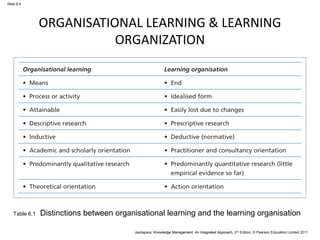
ORGANISATIONAL LEARNING & LEARNING 
ORGANIZATION 
Table 6.1 Distinctions between organisational learning and the learning organisation
Jashapara, Knowledge Management: An Integrated Approach, 2nd Edition, © Pearson Education Limited 2011 
Slide 6.5 
Questions to think about during the 
session 
• Is a continuous learning programme the same as 
learning? 
• What is the incentive for people to learn in a 
company? 
• Can ‘non-learning’ companies be successful? 
• Are there risks to learning?
Jashapara, Knowledge Management: An Integrated Approach, 2nd Edition, © Pearson Education Limited 2011 
Slide 6.6 
Questions to think about during the 
session 
• Can you have too much learning? 
• What should companies learn about? 
• Do training programmes help companies to learn? 
• What are the merits and drawbacks of ‘on-the-job’ 
learning?
Jashapara, Knowledge Management: An Integrated Approach, 2nd Edition, © Pearson Education Limited 2011 
Slide 6.7 
ARIE DE GEUS (1988) 
‘…the ability for a firm to learn faster than its competitors 
may be its only form of sustainable competitive 
advantage’ 
• How do you encourage your employees to learn faster 
than your competitors? 
• Do they know what your competitors are doing?
Jashapara, Knowledge Management: An Integrated Approach, 2nd Edition, © Pearson Education Limited 2011 
Slide 6.8 
ORGANIZATIONAL LEARNING 
(Argyris and Schon, 1978) 
• Single-loop learning 
• Double-loop learning 
• Are there dangers in double-loop learning?
Jashapara, Knowledge Management: An Integrated Approach, 2nd Edition, © Pearson Education Limited 2011 
Slide 6.9 
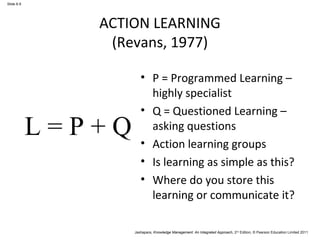
ACTION LEARNING 
(Revans, 1977) 
• P = Programmed Learning – 
highly specialist 
• Q = Questioned Learning – 
asking questions 
• Action learning groups 
• Is learning as simple as this? 
• Where do you store this 
learning or communicate it? 
L = P + Q
Jashapara, Knowledge Management: An Integrated Approach, 2nd Edition, © Pearson Education Limited 2011 
Slide 6.10 
ACTION LEARNING 
(Mumford, 1991: 4 I’s) 
• Interaction with major players 
• Integration – appropriate skills and knowledge 
• Implementation – managers accountable 
• Iteration – view learning as a process 
• Prescriptive? 
• How would you apply it to employees?
Jashapara, Knowledge Management: An Integrated Approach, 2nd Edition, © Pearson Education Limited 2011 
Slide 6.11 
THE FIFTH DISCIPLINE 
(Senge, 1990) 
• Personal Mastery – clarifying what is important 
to us (vision/purpose) 
• Team Learning – Dialogue & Discussion 
• Systems Thinking 
• Mental Models – capacity to reflect on our own 
mental pictures 
• Shared Vision – linked to personal visions 
• Application to an organisation? 
• Development of shared vision?
Jashapara, Knowledge Management: An Integrated Approach, 2nd Edition, © Pearson Education Limited 2011 
Slide 6.12 
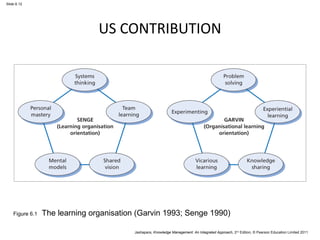
US CONTRIBUTION 
Figure 6.1 The learning organisation (Garvin 1993; Senge 1990)
Jashapara, Knowledge Management: An Integrated Approach, 2nd Edition, © Pearson Education Limited 2011 
Slide 6.13 
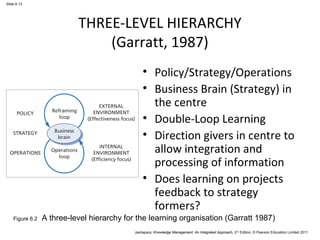
THREE-LEVEL HIERARCHY 
(Garratt, 1987) 
• Policy/Strategy/Operations 
• Business Brain (Strategy) in 
the centre 
• Double-Loop Learning 
• Direction givers in centre to 
allow integration and 
processing of information 
• Does learning on projects 
feedback to strategy 
formers? 
Figure 6.2 A three-level hierarchy for the learning organisation (Garratt 1987)
Jashapara, Knowledge Management: An Integrated Approach, 2nd Edition, © Pearson Education Limited 2011 
Slide 6.14 
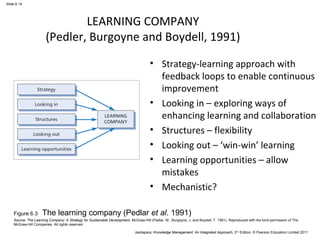
LEARNING COMPANY 
(Pedler, Burgoyne and Boydell, 1991) 
• Strategy-learning approach with 
feedback loops to enable continuous 
improvement 
• Looking in – exploring ways of 
enhancing learning and collaboration 
• Structures – flexibility 
• Looking out – ‘win-win’ learning 
• Learning opportunities – allow 
mistakes 
• Mechanistic? 
Figure 6.3 The learning company (Pedlar et al. 1991) 
Source: The Learning Company: A Strategy for Sustainable Development, McGraw-Hill (Pedlar, M., Burgoyne, J. and Boydell, T. 1991). Reproduced with the kind permission of The 
McGraw-Hill Companies. All rights reserved.
Jashapara, Knowledge Management: An Integrated Approach, 2nd Edition, © Pearson Education Limited 2011 
Slide 6.15 
EXPERIMENTING ORGANISATIONS 
(Easterby-Smith, 1990) 
• Generate creativity and innovation in people 
• Introduce flexibility in structures 
• Not to disadvantage individuals in reward system for 
risk taking 
• Focus on unusual variations in information systems 
• How do you encourage individuals to take risks? 
• What levels of risk are acceptable?
Jashapara, Knowledge Management: An Integrated Approach, 2nd Edition, © Pearson Education Limited 2011 
Slide 6.16 
ENCOURAGING WANTED BEHAVIOURS (Honey, 
1991) 
• Wanted Behaviours – Asking questions, suggesting 
ideas, exploring alternatives, taking risks, being open, 
reflecting etc… 
• Unwanted Behaviours – Acquiesing, rubbishing ideas, 
quick fixes, being cautious, filtering bad news, keeping 
active etc… 
• Who decides on acceptable and unacceptable 
behaviours?
Jashapara, Knowledge Management: An Integrated Approach, 2nd Edition, © Pearson Education Limited 2011 
Slide 6.17 
KNOWLEDGE CREATING COMPANY 
(Nonaka, 1991) 
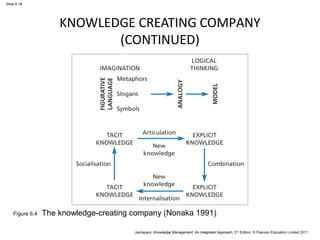
• Articulation – converting tacit to explicit knowledge 
• Internalisation – using explicit knowledge to increase 
one’s tacit base 
• Use of figurative language, symbolism and metaphors 
• How could slogans and metaphors be used to aid 
learning in companies?
Jashapara, Knowledge Management: An Integrated Approach, 2nd Edition, © Pearson Education Limited 2011 
Slide 6.18 
KNOWLEDGE CREATING COMPANY 
(CONTINUED) 
Figure 6.4 The knowledge-creating company (Nonaka 1991)
Jashapara, Knowledge Management: An Integrated Approach, 2nd Edition, © Pearson Education Limited 2011 
Slide 6.19 
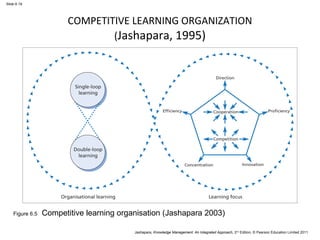
COMPETITIVE LEARNING ORGANIZATION 
(Jashapara, 1995) 
Figure 6.5 Competitive learning organisation (Jashapara 2003)
Jashapara, Knowledge Management: An Integrated Approach, 2nd Edition, © Pearson Education Limited 2011 
Slide 6.20 
COMPETITIVE LEARNING ORGANIZATION 
(Jashapara, 1995) 
• Static/Teaching/Learning organisations 
• Use of benchmarks 
• Contamination – dominant force hindering change 
• Cleavage – 2 or more forces confront each other and 
paralyse organisation
Slide 6.21 
Reading and preparatory work to be done 
Read: 
• Jashapara, A. (2011) “ Knowledge Management: 
An Integrated Approach” Pearson Education, 
Chapter 6 
Work to be done before the seminar: 
• Carry out all the reading above 
• Answer the questions on the handout 
• Bring your work to the seminar 
21 
Jashapara, Knowledge Management: An Integrated Approach, 2nd Edition, © Pearson Education Limited 2011
Jashapara, Knowledge Management: An Integrated Approach, 2nd Edition, © Pearson Education Limited 2011 
Slide 6.22 
Essential work for next week 
• Please consult the OLE for details of: 
– Essential readings* 
– Seminar/workshop preparation work* 
– Recommended further readings 
– Any additional learning 
* Essential readings and preparation work must always be completed in time 
for the next session 
22
Jashapara, Knowledge Management: An Integrated Approach, 2nd Edition, © Pearson Education Limited 2011 
Slide 6.23 
End of presentation 
© Pearson College 2013

Lecture 6 the learning organisation

  • 1.
    Jashapara, Knowledge Management:An Integrated Approach, 2nd Edition, © Pearson Education Limited 2011 Slide 6.1 Analysis 1: Evidence and the Nature of Knowledge in the Digital Age Topic: The Learning Organisation Topic Number: 6
  • 2.
    Jashapara, Knowledge Management:An Integrated Approach, 2nd Edition, © Pearson Education Limited 2011 Slide 6.2 LEARNING OBJECTIVES • To explain the differences between organisational learning and the learning organisation • To describe different models and conceptions of the learning organisation • To discuss issues of power and politics that may affect learning organisations
  • 3.
    Jashapara, Knowledge Management:An Integrated Approach, 2nd Edition, © Pearson Education Limited 2011 Slide 6.3 Questions to think about during the session • What is a ‘Learning Company’? • How would you recognise one? • Why is learning important for a company? • Who does the learning – executives, middle managers or employees?
  • 4.
    Jashapara, Knowledge Management:An Integrated Approach, 2nd Edition, © Pearson Education Limited 2011 Slide 6.4 ORGANISATIONAL LEARNING & LEARNING ORGANIZATION Table 6.1 Distinctions between organisational learning and the learning organisation
  • 5.
    Jashapara, Knowledge Management:An Integrated Approach, 2nd Edition, © Pearson Education Limited 2011 Slide 6.5 Questions to think about during the session • Is a continuous learning programme the same as learning? • What is the incentive for people to learn in a company? • Can ‘non-learning’ companies be successful? • Are there risks to learning?
  • 6.
    Jashapara, Knowledge Management:An Integrated Approach, 2nd Edition, © Pearson Education Limited 2011 Slide 6.6 Questions to think about during the session • Can you have too much learning? • What should companies learn about? • Do training programmes help companies to learn? • What are the merits and drawbacks of ‘on-the-job’ learning?
  • 7.
    Jashapara, Knowledge Management:An Integrated Approach, 2nd Edition, © Pearson Education Limited 2011 Slide 6.7 ARIE DE GEUS (1988) ‘…the ability for a firm to learn faster than its competitors may be its only form of sustainable competitive advantage’ • How do you encourage your employees to learn faster than your competitors? • Do they know what your competitors are doing?
  • 8.
    Jashapara, Knowledge Management:An Integrated Approach, 2nd Edition, © Pearson Education Limited 2011 Slide 6.8 ORGANIZATIONAL LEARNING (Argyris and Schon, 1978) • Single-loop learning • Double-loop learning • Are there dangers in double-loop learning?
  • 9.
    Jashapara, Knowledge Management:An Integrated Approach, 2nd Edition, © Pearson Education Limited 2011 Slide 6.9 ACTION LEARNING (Revans, 1977) • P = Programmed Learning – highly specialist • Q = Questioned Learning – asking questions • Action learning groups • Is learning as simple as this? • Where do you store this learning or communicate it? L = P + Q
  • 10.
    Jashapara, Knowledge Management:An Integrated Approach, 2nd Edition, © Pearson Education Limited 2011 Slide 6.10 ACTION LEARNING (Mumford, 1991: 4 I’s) • Interaction with major players • Integration – appropriate skills and knowledge • Implementation – managers accountable • Iteration – view learning as a process • Prescriptive? • How would you apply it to employees?
  • 11.
    Jashapara, Knowledge Management:An Integrated Approach, 2nd Edition, © Pearson Education Limited 2011 Slide 6.11 THE FIFTH DISCIPLINE (Senge, 1990) • Personal Mastery – clarifying what is important to us (vision/purpose) • Team Learning – Dialogue & Discussion • Systems Thinking • Mental Models – capacity to reflect on our own mental pictures • Shared Vision – linked to personal visions • Application to an organisation? • Development of shared vision?
  • 12.
    Jashapara, Knowledge Management:An Integrated Approach, 2nd Edition, © Pearson Education Limited 2011 Slide 6.12 US CONTRIBUTION Figure 6.1 The learning organisation (Garvin 1993; Senge 1990)
  • 13.
    Jashapara, Knowledge Management:An Integrated Approach, 2nd Edition, © Pearson Education Limited 2011 Slide 6.13 THREE-LEVEL HIERARCHY (Garratt, 1987) • Policy/Strategy/Operations • Business Brain (Strategy) in the centre • Double-Loop Learning • Direction givers in centre to allow integration and processing of information • Does learning on projects feedback to strategy formers? Figure 6.2 A three-level hierarchy for the learning organisation (Garratt 1987)
  • 14.
    Jashapara, Knowledge Management:An Integrated Approach, 2nd Edition, © Pearson Education Limited 2011 Slide 6.14 LEARNING COMPANY (Pedler, Burgoyne and Boydell, 1991) • Strategy-learning approach with feedback loops to enable continuous improvement • Looking in – exploring ways of enhancing learning and collaboration • Structures – flexibility • Looking out – ‘win-win’ learning • Learning opportunities – allow mistakes • Mechanistic? Figure 6.3 The learning company (Pedlar et al. 1991) Source: The Learning Company: A Strategy for Sustainable Development, McGraw-Hill (Pedlar, M., Burgoyne, J. and Boydell, T. 1991). Reproduced with the kind permission of The McGraw-Hill Companies. All rights reserved.
  • 15.
    Jashapara, Knowledge Management:An Integrated Approach, 2nd Edition, © Pearson Education Limited 2011 Slide 6.15 EXPERIMENTING ORGANISATIONS (Easterby-Smith, 1990) • Generate creativity and innovation in people • Introduce flexibility in structures • Not to disadvantage individuals in reward system for risk taking • Focus on unusual variations in information systems • How do you encourage individuals to take risks? • What levels of risk are acceptable?
  • 16.
    Jashapara, Knowledge Management:An Integrated Approach, 2nd Edition, © Pearson Education Limited 2011 Slide 6.16 ENCOURAGING WANTED BEHAVIOURS (Honey, 1991) • Wanted Behaviours – Asking questions, suggesting ideas, exploring alternatives, taking risks, being open, reflecting etc… • Unwanted Behaviours – Acquiesing, rubbishing ideas, quick fixes, being cautious, filtering bad news, keeping active etc… • Who decides on acceptable and unacceptable behaviours?
  • 17.
    Jashapara, Knowledge Management:An Integrated Approach, 2nd Edition, © Pearson Education Limited 2011 Slide 6.17 KNOWLEDGE CREATING COMPANY (Nonaka, 1991) • Articulation – converting tacit to explicit knowledge • Internalisation – using explicit knowledge to increase one’s tacit base • Use of figurative language, symbolism and metaphors • How could slogans and metaphors be used to aid learning in companies?
  • 18.
    Jashapara, Knowledge Management:An Integrated Approach, 2nd Edition, © Pearson Education Limited 2011 Slide 6.18 KNOWLEDGE CREATING COMPANY (CONTINUED) Figure 6.4 The knowledge-creating company (Nonaka 1991)
  • 19.
    Jashapara, Knowledge Management:An Integrated Approach, 2nd Edition, © Pearson Education Limited 2011 Slide 6.19 COMPETITIVE LEARNING ORGANIZATION (Jashapara, 1995) Figure 6.5 Competitive learning organisation (Jashapara 2003)
  • 20.
    Jashapara, Knowledge Management:An Integrated Approach, 2nd Edition, © Pearson Education Limited 2011 Slide 6.20 COMPETITIVE LEARNING ORGANIZATION (Jashapara, 1995) • Static/Teaching/Learning organisations • Use of benchmarks • Contamination – dominant force hindering change • Cleavage – 2 or more forces confront each other and paralyse organisation
  • 21.
    Slide 6.21 Readingand preparatory work to be done Read: • Jashapara, A. (2011) “ Knowledge Management: An Integrated Approach” Pearson Education, Chapter 6 Work to be done before the seminar: • Carry out all the reading above • Answer the questions on the handout • Bring your work to the seminar 21 Jashapara, Knowledge Management: An Integrated Approach, 2nd Edition, © Pearson Education Limited 2011
  • 22.
    Jashapara, Knowledge Management:An Integrated Approach, 2nd Edition, © Pearson Education Limited 2011 Slide 6.22 Essential work for next week • Please consult the OLE for details of: – Essential readings* – Seminar/workshop preparation work* – Recommended further readings – Any additional learning * Essential readings and preparation work must always be completed in time for the next session 22
  • 23.
    Jashapara, Knowledge Management:An Integrated Approach, 2nd Edition, © Pearson Education Limited 2011 Slide 6.23 End of presentation © Pearson College 2013