The Synthesis of Dithiocarbamates through the Halogenation of Amines
Holly Kraus, Victoria Hall, Dr. Mary RailingHolly Kraus, Victoria Hall, Dr. Mary Railing
Wheeling Jesuit University, Wheeling, WVWheeling Jesuit University, Wheeling, WV
Acknowledgements
Future Work
 WJU Chemistry Department
NASA and West Virginia Space Grant Consortium
References
1.Adapa, S.R.; Nuvula, S.; Varala, R. J. Org. Chem. American Chemical Society: 2006, 71; 8283-8286.
2.Freeman, A.; Kalm, S.W. Organic Syntheses. 1958, 38, 47.
3.Li, J.; Sha, Y. A Convenient Synthesis of Amino Acid Methyl Esters. Molecules 2008, 13, 1111-1119.
4.Myers, A.G.; Gleason, J.L. Organic Syntheses. 1999, 76, 57-76.
 Deprotection of the amine-Boc and conversion to the dithiocarbamate.
Synthesis of metal complexes of the amino acids, the amino esters and
the bromoamino esters.
Objective
Introduction Amine Synthesis NMR Spectra
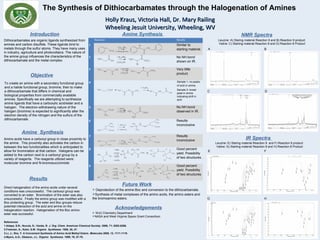
Leucine: A) Staring material Reaction 9 and B) Reaction 9 product
Valine: C) Starting material Reaction 8 and D) Reaction 8 Product
Dithiocarbamates are organic ligands synthesized from
amines and carbon disulfide. These ligands bind to
metals through the sulfur atoms. They have many uses
in industry, agriculture and photovoltaics. The nature of
the amine group influences the characteristics of the
dithiocarbamate and the metal complex.
To create an amine with a secondary functional group
and a halide functional group, bromine, then to make
a dithiocarbamate that differs in chemical and
biological properties from commercially available
amines. Specifically we are attempting to synthesize
amine ligands that have a carboxylic acid/ester and a
halogen. The electron-withdrawing nature of the
halogen (bromine) is expected to significantly alter the
electron density of the nitrogen and the sulfurs of the
dithiocarbamate.
Amine Synthesis
Amino acids have a carboxyl group in close proximity to
the amine. This proximity also activates the carbon in
between the two functionalities which is anticipated to
allow for bromination at that carbon. Halogens can be
added to the carbon next to a carbonyl group by a
variety of reagents. The reagents utilized were:
molecular bromine and N-bromosuccinimide
IR Spectra
Leucine: E) Staring material Reaction 9 and F) Reaction 9 product
Valine: G) Starting material Reaction 8 and H) Reaction 8 Product
Reaction Results
1 Similar to
starting material.
2 No NH bond
shown on IR.
3 Very little
product.
4 Sample 1- no peaks
of acid or amine.
Sample 2- broad
peak in amine
indicating shift in
acid.
5 No NH bond
observed in IR.
6 Results
inconclusive
7 Results
inconclusive
8 Good percent
yield. Possibility
of two structures.
9 Good percent
yield. Possibility
of two structures.
Results
Direct halogenation of the amino acids under several
conditions was unsuccessful. The carboxyl group was
converted to an ester. Bromination of the ester was also
unsuccessful. Finally the amino group was modified with a
Boc protecting group. The ester and Boc groups reduce
potential interaction of the acid and amine on the
halogenation reaction. Halogenation of the Boc amino
ester was successful.
A
E
B
F
C
H
D
G

acs poster 2015

  • 1.
    The Synthesis ofDithiocarbamates through the Halogenation of Amines Holly Kraus, Victoria Hall, Dr. Mary RailingHolly Kraus, Victoria Hall, Dr. Mary Railing Wheeling Jesuit University, Wheeling, WVWheeling Jesuit University, Wheeling, WV Acknowledgements Future Work  WJU Chemistry Department NASA and West Virginia Space Grant Consortium References 1.Adapa, S.R.; Nuvula, S.; Varala, R. J. Org. Chem. American Chemical Society: 2006, 71; 8283-8286. 2.Freeman, A.; Kalm, S.W. Organic Syntheses. 1958, 38, 47. 3.Li, J.; Sha, Y. A Convenient Synthesis of Amino Acid Methyl Esters. Molecules 2008, 13, 1111-1119. 4.Myers, A.G.; Gleason, J.L. Organic Syntheses. 1999, 76, 57-76.  Deprotection of the amine-Boc and conversion to the dithiocarbamate. Synthesis of metal complexes of the amino acids, the amino esters and the bromoamino esters. Objective Introduction Amine Synthesis NMR Spectra Leucine: A) Staring material Reaction 9 and B) Reaction 9 product Valine: C) Starting material Reaction 8 and D) Reaction 8 Product Dithiocarbamates are organic ligands synthesized from amines and carbon disulfide. These ligands bind to metals through the sulfur atoms. They have many uses in industry, agriculture and photovoltaics. The nature of the amine group influences the characteristics of the dithiocarbamate and the metal complex. To create an amine with a secondary functional group and a halide functional group, bromine, then to make a dithiocarbamate that differs in chemical and biological properties from commercially available amines. Specifically we are attempting to synthesize amine ligands that have a carboxylic acid/ester and a halogen. The electron-withdrawing nature of the halogen (bromine) is expected to significantly alter the electron density of the nitrogen and the sulfurs of the dithiocarbamate. Amine Synthesis Amino acids have a carboxyl group in close proximity to the amine. This proximity also activates the carbon in between the two functionalities which is anticipated to allow for bromination at that carbon. Halogens can be added to the carbon next to a carbonyl group by a variety of reagents. The reagents utilized were: molecular bromine and N-bromosuccinimide IR Spectra Leucine: E) Staring material Reaction 9 and F) Reaction 9 product Valine: G) Starting material Reaction 8 and H) Reaction 8 Product Reaction Results 1 Similar to starting material. 2 No NH bond shown on IR. 3 Very little product. 4 Sample 1- no peaks of acid or amine. Sample 2- broad peak in amine indicating shift in acid. 5 No NH bond observed in IR. 6 Results inconclusive 7 Results inconclusive 8 Good percent yield. Possibility of two structures. 9 Good percent yield. Possibility of two structures. Results Direct halogenation of the amino acids under several conditions was unsuccessful. The carboxyl group was converted to an ester. Bromination of the ester was also unsuccessful. Finally the amino group was modified with a Boc protecting group. The ester and Boc groups reduce potential interaction of the acid and amine on the halogenation reaction. Halogenation of the Boc amino ester was successful. A E B F C H D G