Acid-Base Disorders
By Dr. Yusuf
CINGIRLAR
Aim of Presentation
• Examine the pH.
• Determine the primery disorder.
• Calculate the anion gap.
• Assess compensation.
• Define the disorder and treatment.
Introduction
• Like body temperature, blood pressure, osmolality, and
many other physiological parameters, the human body
strivers to keep its acid-base balance within tightly
controlled limits.
• The body’s ability to maintain acid-base homeostasis is
based on a complex set of interaction between the
respiratory and metabolic systems.
• Acid-base homeostasis critically affects tissue and organ
performance.
• Extreme ranges of pH are potentially life threatening as can
cause disruption of many vital cellular enzymatic reactions
and physiological processes.
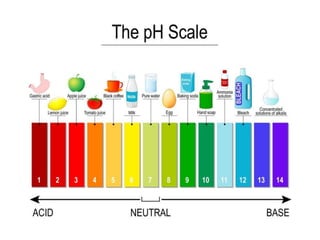
What is pH?
•The precise definition of pH is…
pH = - log 10 ([H+])
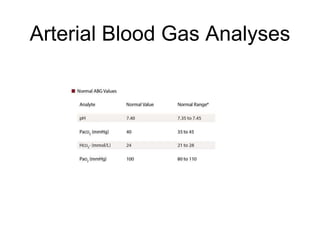
Arterial Blood Gas Analyses
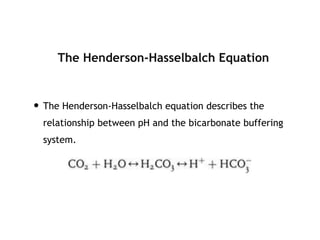
The Henderson-Hasselbalch Equation
• The Henderson-Hasselbalch equation describes the
relationship between pH and the bicarbonate buffering
system.
The Anion Gap
• A patient with metabolic acidosis requires additional evaluation to
determine the nature of the acidosis.
• Consider again the bicarbonate buffer equation.
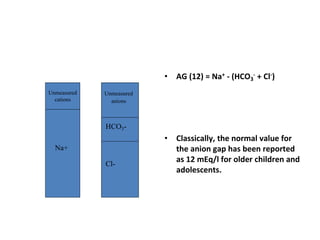
• AG (12) = Na+ - (HCO3
- + Cl-)
• Classically, the normal value for
the anion gap has been reported
as 12 mEq/l for older children and
adolescents.
Na+
Cl-
HCO3-
Unmeasured
anions
Unmeasured
cations
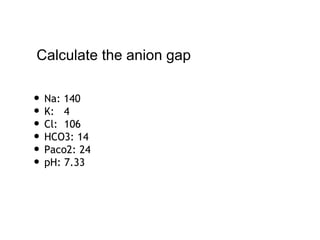
Calculate the anion gap
• Na: 140
• K: 4
• Cl: 106
• HCO3: 14
• Paco2: 24
• pH: 7.33
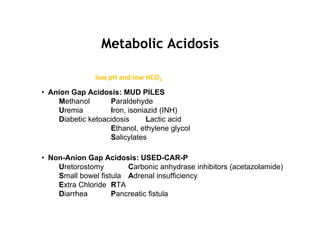
Metabolic Acidosis
low pH and low HCO3
• Anion Gap Acidosis: MUD PILES
Methanol Paraldehyde
Uremia Iron, isoniazid (INH)
Diabetic ketoacidosis Lactic acid
Ethanol, ethylene glycol
Salicylates
• Non-Anion Gap Acidosis: USED-CAR-P
Uretorostomy Carbonic anhydrase inhibitors (acetazolamide)
Small bowel fistula Adrenal insufficiency
Extra Chloride RTA
Diarrhea Pancreatic fistula
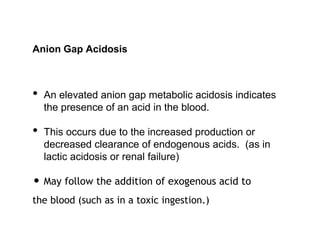
Anion Gap Acidosis
• An elevated anion gap metabolic acidosis indicates
the presence of an acid in the blood.
• This occurs due to the increased production or
decreased clearance of endogenous acids. (as in
lactic acidosis or renal failure)
• May follow the addition of exogenous acid to
the blood (such as in a toxic ingestion.)
• In ketoacidosis, excessive endogenous production
of ketone bodies cause acidosis.
• The most feared cause of anion gap acidosis in
paediatrics is L-lactic acidosis, typically
associated with hypoperfusion.
• Lactic acidosis can occur in children with short
bowelsyndrome due to fermentation of
carbohydrates by bacterial overgrowth.
• Both accidental and deliberate toxic
ingestions are common in paediatric patients.
• Drugs capable of causing metabolic acidosis
are similarly readily available to children.
• Such as salicylates (Aspirin)
paracetamol,iburofen,metformin.
• Toxic alcohol ingestions are an uncommon but
important cause of acidosis.
• Ingestions of methanol and ethylene glycol
occur most frequently.
• Even a very small dose of methanol or ethylene
glycol (<5 ml) can be lethal for a toddler.
Normal Anion Gap Metabolic Acidosis
• Metabolic acidosis with a normal anion gap is
also called hyperchloraemic acidosis.
• Decrease in bicarbonate is made up for by an
increase in the chloride.
• This situation most frequently occurs due to the
loss of bicarbonate, either in the gastrointestinal
tract (diarrhoea) or in urine (renal tubular
acidosis).
Symtoms of Metabolic Acidosis
• Rapid and shallow breathing (Kusmaull)
• Confusion
• Hypotension
• Fatigue
• Headache
• Sleepiness
• Ataxia
• Slurred Speech
Respiratory Compensation
•When exposed to a low pH from metabolic acidosis, the
body responds with an alkalotic respiratory state through
hyperventilation.
•This response can occur over minutes to hours.
•Through hyperventilation, the body reduces the
Pco2 within the system,thereby creating respiratory
alkalosis.
•Works to return the body’s pH back to normal.
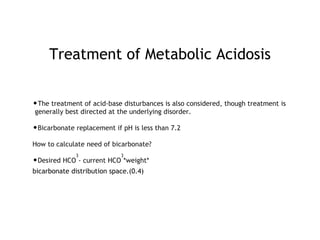
Treatment of Metabolic Acidosis
•The treatment of acid-base disturbances is also considered, though treatment is
generally best directed at the underlying disorder.
•Bicarbonate replacement if pH is less than 7.2
How to calculate need of bicarbonate?
•Desired HCO
3
- current HCO
3
*weight*
bicarbonate distribution space.(0.4)
Respiratory Acidosis
low pH and high pCO2
• Respiratory acidosis is caused by retention of CO2 from
inadequate ventilation, which can occur from a variety of causes.
• Decrease PCO2 excretion via hypoventilation.
• Bicarbonate and base excess are normal.
Causes of Respiratory Acidosis
•Hypoventilation
– CNS depression (drugs, CNS insult); neuromuscular
disorders.
•Intrinsic lung disease
– Severe pneumonia, pulmonary oedema, pulmonary haemorrhage.
•Upper airway obstruction
– Laryngotracheobronchitis (croup), aspirated foreign body.
•Lower airway obstruction
– Bronchiolitis, asthma
Treatment of Respiratory Acidosis
•Treatment of respiratory acidosis is primarily directed at the underlying disorder or pathophysiologic
process.
•Open air ways.
•Bronchodilators.
•Respiratory stimulants.
•Inhalation therapy.
Metabolic Alkalosis
High pH and High HCO3
•Metabolic alkalosis can occur following excessive administration of alkali, as
occurs in the milk-alkali syndrome or after massive transfusion of citrate
containing blood products, as in exchange transfusion.
•Alkalosis more frequently occurs due to loss of chloride. This occurs most
commonly in either the upper gastrointestinal tract (vomiting or nasogastric
suctioning) or urine (diuretics, hyperaldosteronism, congenital defects in
chloride reabsorption ).
Cause of Metabolic Alkalosis
•Low Cl (<25 mEq/l)
– Vomiting
– Nasogastric suction
– Diuretics (late)
– Posthypercapnia
– Cystic fibrosis
– Congenital chloride diarrhoea
•High Cl(>40 mEq/l)
– Hyperaldosteronism
– Bartter or Gitelman syndromes
– Severe hypokalaemia
– Cushing syndrome
– Milk-alkali syndrome
– Diuretics
Symtoms of Metabolic Alkalosis
• Confusion (can progress to stupor or coma)
• Hand tremor.
• Muscle twitching.
• Nausea,vomiting.
• Numbness or tingling in the face, hands, or feet.
• Prolonged muscle spasms (tetany).
Treatment of Metabolic Alkalosis
•Underlying conditions are treated, with particular attention paid
to correction of hypovolemia and hypokalemia.
•IV 0.9% saline solution for chloride-responsive metabolic alkalosis.
• Replecement of Cl and Ka.
Respiratory Alkalosis
high pH and low pCO2
• Respiratory alkalosis occurs due to excessive
ventilation and removal of CO2,and can be
caused by any process that increases the
respiratory rate or tidal volume.
Causes of Respiratory Alkalosis
•Ammonia (urea cycle defect, hepatic encephalopathy)
•Anxiety.
•Medications (progesterone, salicylates).
•Increased intracranial pressure.
•Sepsis.
•Hypoxemia, hyperthermia.
Symptoms of Respiratory Alkalosis
•The hyperventilation syndrome can mimic many conditions that are more
serious.
•Symptoms may include paresthesias
•circumoral numbness
•chest pain or tightness
•dyspnea
•tetany
Treatment of Respiratory Alkalosis
•The treatment of respiratory alkalosis is primarily
directed at correcting the underlying disorder.
•Respiratory alkalosis itself is rarely life threatening.
•Therefore, emergent treatment is usually not
indicated unless the pH level is greater than 7.5.
A 16-year-old girl with a history of poorly controlled asthma presents with worsening
shortness of breath. She is in moderate respiratory distress, and an arterial blood gas
test indicates a pH of 7.54, pO2 of 60 mmHg and a pCO2 of 29 mmHg; a chemistry panel
demonstrates a sodium level of 138 mEq/L, chloride level of 103 mEq/L and a
bicarbonate level of 25 mEq/L.
Which of the following acid-base abnormalities is present in this patient?
a.Respiratory acidosis
b.Respiratory alkalosis
c.Metabolic acidosis
d.Metabolic alkalosis
THANK YOU
REFERENCES
• TUS Data,Pediatri P-143-147 Acid-base disturbance
• Dawson-Saunders B, Feltovich PJ, Coulson RL, et al.
Acad Med.
• Berend K,Physiological approach to assessment of acid-base disturbances. N Engl J
Med. 2014;371(15):1434–1445
• Schwaderer AL, Schwartz GJ. Back to basics: acidosis and alkalosis. Pediatr Rev
• Kraut JA, Kurtz I. Toxic alcohol ingestions: clinical features, diagnosis, and
management. Clin J Am Soc Nephrol.

Acid base disorder

  • 1.
  • 2.
    Aim of Presentation •Examine the pH. • Determine the primery disorder. • Calculate the anion gap. • Assess compensation. • Define the disorder and treatment.
  • 3.
    Introduction • Like bodytemperature, blood pressure, osmolality, and many other physiological parameters, the human body strivers to keep its acid-base balance within tightly controlled limits. • The body’s ability to maintain acid-base homeostasis is based on a complex set of interaction between the respiratory and metabolic systems.
  • 4.
    • Acid-base homeostasiscritically affects tissue and organ performance. • Extreme ranges of pH are potentially life threatening as can cause disruption of many vital cellular enzymatic reactions and physiological processes.
  • 5.
    What is pH? •Theprecise definition of pH is… pH = - log 10 ([H+])
  • 7.
  • 8.
    The Henderson-Hasselbalch Equation •The Henderson-Hasselbalch equation describes the relationship between pH and the bicarbonate buffering system.
  • 9.
    The Anion Gap •A patient with metabolic acidosis requires additional evaluation to determine the nature of the acidosis. • Consider again the bicarbonate buffer equation.
  • 10.
    • AG (12)= Na+ - (HCO3 - + Cl-) • Classically, the normal value for the anion gap has been reported as 12 mEq/l for older children and adolescents. Na+ Cl- HCO3- Unmeasured anions Unmeasured cations
  • 11.
    Calculate the aniongap • Na: 140 • K: 4 • Cl: 106 • HCO3: 14 • Paco2: 24 • pH: 7.33
  • 12.
    Metabolic Acidosis low pHand low HCO3 • Anion Gap Acidosis: MUD PILES Methanol Paraldehyde Uremia Iron, isoniazid (INH) Diabetic ketoacidosis Lactic acid Ethanol, ethylene glycol Salicylates • Non-Anion Gap Acidosis: USED-CAR-P Uretorostomy Carbonic anhydrase inhibitors (acetazolamide) Small bowel fistula Adrenal insufficiency Extra Chloride RTA Diarrhea Pancreatic fistula
  • 13.
    Anion Gap Acidosis •An elevated anion gap metabolic acidosis indicates the presence of an acid in the blood. • This occurs due to the increased production or decreased clearance of endogenous acids. (as in lactic acidosis or renal failure) • May follow the addition of exogenous acid to the blood (such as in a toxic ingestion.)
  • 14.
    • In ketoacidosis,excessive endogenous production of ketone bodies cause acidosis. • The most feared cause of anion gap acidosis in paediatrics is L-lactic acidosis, typically associated with hypoperfusion. • Lactic acidosis can occur in children with short bowelsyndrome due to fermentation of carbohydrates by bacterial overgrowth.
  • 15.
    • Both accidentaland deliberate toxic ingestions are common in paediatric patients. • Drugs capable of causing metabolic acidosis are similarly readily available to children. • Such as salicylates (Aspirin) paracetamol,iburofen,metformin.
  • 16.
    • Toxic alcoholingestions are an uncommon but important cause of acidosis. • Ingestions of methanol and ethylene glycol occur most frequently. • Even a very small dose of methanol or ethylene glycol (<5 ml) can be lethal for a toddler.
  • 17.
    Normal Anion GapMetabolic Acidosis • Metabolic acidosis with a normal anion gap is also called hyperchloraemic acidosis. • Decrease in bicarbonate is made up for by an increase in the chloride. • This situation most frequently occurs due to the loss of bicarbonate, either in the gastrointestinal tract (diarrhoea) or in urine (renal tubular acidosis).
  • 18.
    Symtoms of MetabolicAcidosis • Rapid and shallow breathing (Kusmaull) • Confusion • Hypotension • Fatigue • Headache • Sleepiness • Ataxia • Slurred Speech
  • 19.
    Respiratory Compensation •When exposedto a low pH from metabolic acidosis, the body responds with an alkalotic respiratory state through hyperventilation. •This response can occur over minutes to hours.
  • 20.
    •Through hyperventilation, thebody reduces the Pco2 within the system,thereby creating respiratory alkalosis. •Works to return the body’s pH back to normal.
  • 21.
    Treatment of MetabolicAcidosis •The treatment of acid-base disturbances is also considered, though treatment is generally best directed at the underlying disorder. •Bicarbonate replacement if pH is less than 7.2 How to calculate need of bicarbonate? •Desired HCO 3 - current HCO 3 *weight* bicarbonate distribution space.(0.4)
  • 22.
    Respiratory Acidosis low pHand high pCO2 • Respiratory acidosis is caused by retention of CO2 from inadequate ventilation, which can occur from a variety of causes. • Decrease PCO2 excretion via hypoventilation. • Bicarbonate and base excess are normal.
  • 23.
    Causes of RespiratoryAcidosis •Hypoventilation – CNS depression (drugs, CNS insult); neuromuscular disorders. •Intrinsic lung disease – Severe pneumonia, pulmonary oedema, pulmonary haemorrhage. •Upper airway obstruction – Laryngotracheobronchitis (croup), aspirated foreign body. •Lower airway obstruction – Bronchiolitis, asthma
  • 24.
    Treatment of RespiratoryAcidosis •Treatment of respiratory acidosis is primarily directed at the underlying disorder or pathophysiologic process. •Open air ways. •Bronchodilators. •Respiratory stimulants. •Inhalation therapy.
  • 25.
    Metabolic Alkalosis High pHand High HCO3 •Metabolic alkalosis can occur following excessive administration of alkali, as occurs in the milk-alkali syndrome or after massive transfusion of citrate containing blood products, as in exchange transfusion. •Alkalosis more frequently occurs due to loss of chloride. This occurs most commonly in either the upper gastrointestinal tract (vomiting or nasogastric suctioning) or urine (diuretics, hyperaldosteronism, congenital defects in chloride reabsorption ).
  • 26.
    Cause of MetabolicAlkalosis •Low Cl (<25 mEq/l) – Vomiting – Nasogastric suction – Diuretics (late) – Posthypercapnia – Cystic fibrosis – Congenital chloride diarrhoea •High Cl(>40 mEq/l) – Hyperaldosteronism – Bartter or Gitelman syndromes – Severe hypokalaemia – Cushing syndrome – Milk-alkali syndrome – Diuretics
  • 27.
    Symtoms of MetabolicAlkalosis • Confusion (can progress to stupor or coma) • Hand tremor. • Muscle twitching. • Nausea,vomiting. • Numbness or tingling in the face, hands, or feet. • Prolonged muscle spasms (tetany).
  • 28.
    Treatment of MetabolicAlkalosis •Underlying conditions are treated, with particular attention paid to correction of hypovolemia and hypokalemia. •IV 0.9% saline solution for chloride-responsive metabolic alkalosis. • Replecement of Cl and Ka.
  • 29.
    Respiratory Alkalosis high pHand low pCO2 • Respiratory alkalosis occurs due to excessive ventilation and removal of CO2,and can be caused by any process that increases the respiratory rate or tidal volume.
  • 30.
    Causes of RespiratoryAlkalosis •Ammonia (urea cycle defect, hepatic encephalopathy) •Anxiety. •Medications (progesterone, salicylates). •Increased intracranial pressure. •Sepsis. •Hypoxemia, hyperthermia.
  • 31.
    Symptoms of RespiratoryAlkalosis •The hyperventilation syndrome can mimic many conditions that are more serious. •Symptoms may include paresthesias •circumoral numbness •chest pain or tightness •dyspnea •tetany
  • 32.
    Treatment of RespiratoryAlkalosis •The treatment of respiratory alkalosis is primarily directed at correcting the underlying disorder. •Respiratory alkalosis itself is rarely life threatening. •Therefore, emergent treatment is usually not indicated unless the pH level is greater than 7.5.
  • 33.
    A 16-year-old girlwith a history of poorly controlled asthma presents with worsening shortness of breath. She is in moderate respiratory distress, and an arterial blood gas test indicates a pH of 7.54, pO2 of 60 mmHg and a pCO2 of 29 mmHg; a chemistry panel demonstrates a sodium level of 138 mEq/L, chloride level of 103 mEq/L and a bicarbonate level of 25 mEq/L. Which of the following acid-base abnormalities is present in this patient? a.Respiratory acidosis b.Respiratory alkalosis c.Metabolic acidosis d.Metabolic alkalosis
  • 34.
  • 35.
    REFERENCES • TUS Data,PediatriP-143-147 Acid-base disturbance • Dawson-Saunders B, Feltovich PJ, Coulson RL, et al. Acad Med. • Berend K,Physiological approach to assessment of acid-base disturbances. N Engl J Med. 2014;371(15):1434–1445 • Schwaderer AL, Schwartz GJ. Back to basics: acidosis and alkalosis. Pediatr Rev • Kraut JA, Kurtz I. Toxic alcohol ingestions: clinical features, diagnosis, and management. Clin J Am Soc Nephrol.