Acid Base Imbalance -2
Acidosis :pH< 7.35,
a state of excess H+
Acidemia :blood pH is
<7.35
Alkalosis : pH > 7.45,
a state of excess HCO3
-
Alkalemia :blood pH is
>7.45
Acid-base imbalances
The body response to
acid-base imbalance is
called compensation
May be complete if
brought back within
normal limits
4
Compensation of Acid-Base Imbalances
If underlying problem is metabolic, hyperventilation or
hypoventilation can adjust by respiratory
compensation.
If problem is respiratory, renal mechanisms can bring
about metabolic compensation.
5
Compensation
pH = pKₐ + log([A⁻]/[HA])
[A-
] = conjugate base or salt
[HA] = acid
Henderson–Hasselbalch equation
when the ratio of HCO3
−
to CO2
in the
extracellular fluid
decreases, decreasing pH .
Metabolic acidosis:
If this ratio
decreases because
of a fall in HCO3
−
.
Respiratory
acidosis: If ratio
falls because of an
increase in PCO2
Acidosis
Decrease in the ratio of HCO3
-
to H+
in
renal tubular fluid
Excess H+
in the renal tubules, complete
reabsorption of HCO3
-
additional H+
available to combine with
the urinary buffers NH4
+
and HPO4
-
kidneys reabsorb all the filtered HCO3
-
contribute new HCO3
-
through the
formation of NH4
+
and titratable acid
Respiratory and Metabolic Acidosis
Metabolic acidosis
excess of H+
over HCO3
-
occurs in the tubular fluid
primarily due to decreased
filtration of HCO3
-
caused mainly by a
decrease in the
extracellular fluid
concentration of HCO3
-
Respiratory acidosis
excess H+
in the tubular
fluid due mainly to the rise
in extracellular fluid
Pco2
, which stimulates H+
secretion
11
https://www.youtube.com/watch?v=VwbG_gjJ
j8w
Principal effect:
depression of the CNS
through ↓ in synaptic
transmission.
Generalized weakness
Severe acidosis causes
◦Disorientation
◦coma
◦death
13
Acidosis
Acid-base disturbance Disorder type
Primary change in HCO3
- → Metabolic disorder
Primary change in blood pCO2 → Respiratory disorder
Reduction in pH and
increase in extracellular fluid H+
concentration increase in Pco2
Compensatory response :
Increase in plasma HCO3
−
by the addition of new HCO3
−
to the
extracellular fluid by the kidneys.
Rise in HCO3
−
helps balances the
increase in Pco2
returning the plasma
pH toward normal.
Respiratory acidosis & its compensation
Respiratory acidosis
Reduction in pH Increase in Pco2
CO2
combines with H2
O to form carbonic
acid (H2
CO3
).
Increase in extracellular fluid H+
concentration
Depression of respiratory
center :
Decreased ability of the lungs
to eliminate CO2
Diseases of the airway :
Causes of Respiratory acidosis
damage to respiratory center in
medulla oblongata
stroke
infection
narcotic poisoning
asthma pneumonia
emphysema
chronic
obstructive lung
disease
airway
obstruction
diseases of
pleura
pain killers, benzodiazepines
with alcohol, anesthesia,
barbiturates, muscle relaxants
Decreased ability of the lungs to eliminate CO2
:
Causes of Respiratory acidosis
Diseases of the chest : scoliosis,
thoracotomy
Pulmonary edema, stroke
Severe obesity
Inadequate ventilation with respiratory or skeletal muscle
weakness: poliomyelitis, myasthenia, muscular dystrophies
Arteriovenous shunting in poorly ventilated segments of lungs
:atelectasis or pneumonitis
Treatment :
Compensatory responses in
respiratory acidosis
Buffers of the body fluids
Kidneys, require several days to compensate for the disorder
• increased reabsorption of HCO3
-
by kidneys
• increase in plasma HCO3
-
• rise in HCO3
-
balances the increase in Pco2
, returning the plasma pH
toward normal.
Administer
oxygen
Artificial
respiration
Stimulants of
respiratory center
Decrease in pH
Rise in extracellular fluid H+
concentration
All types of acidosis due to abnormal accumulation of nonvolatile
acids in body fluids
Primary abnormality : decrease in plasma or ECF HCO3
−
.
Blood concentrations of bicarbonate :< 24mEq/L
Metabolic acidosis
Failure of the kidneys to excrete metabolic acids
normally formed in the body
Formation of excess quantities of metabolic acids in
the body
Addition of metabolic acids to the body by ingestion
or infusion of acids
Loss of base from the body fluids, same effect as
adding an acid to the body fluids.
Causes of Metabolic Acidosis
Specific causes of Metabolic Acidosis
Renal Tubular Acidosis Chronic renal failure
Addison’s disease -insufficient
aldosterone secretion
hereditary and acquired disorders
that impair tubular function
-Fanconi’s syndrome
Diarrhea
Diabetes Mellitus
Starvation Ketoacidosis
Hypoxia - lactic acidosis
severe muscular exercise
cancer
shock
drugs e.g phenformin, fructose infusion, adrenaline infusion
Intake of substances producing acids : methanol, ethylene glycol,
acetylsalicylic acid (aspirin)
Carbonic anhydrase inhibitors: acetazolamide (Diamox)
NH4
Cl
Specific causes of Metabolic Acidosis
Decrease in pH ,rise in H+
concentration.
Primary abnormality : decrease in plasma HCO3
−
Compensations :
Respiratory compensation : hyperventilation ( Kussmaul
breathing) reduces Pco2
Renal compensation : Complete reabsorption of HCO3
−
from
renal tubules to the extracellular fluid, helps minimize the
initial fall in extracellular HCO3
−
concentration
adding new HCO3
−
to the extracellular fluid, minimize initial
fall in extracellular HCO3
−
concentration
Metabolic acidosis and its compensation
Treatment:
Administer I/V sodium bicarbonate
Correct cause of acidosis
Metabolic Acidosis
ratio of HCO3
-
to CO2
in the extracellular fluid
increases a rise in pH a decrease in H+
concentration
an increase in the ratio of HCO3
-
to H+
in the renal
tubular fluid.
excess of HCO3
-
cannot be reabsorbed from the
tubules, excreted in the urine.
Alkalosis
over excitability of the
central and peripheral
nervous systems.
Numbness
Lightheadedness
◦ Nervousness
◦ Muscle spasms or tetany
◦ Convulsions
◦ Loss of consciousness
◦ Death
29
Alkalosis
Increase pH due to loss of CO2
from body
Excessive ventilation by the lungs
low Pco2
and carbonic acid in systemic arterial blood
Decrease in H+
concentration due to a decrease in plasma Pco2
and H2
CO3
caused by hyperventilation.
Compensation: Chemical buffers of the body fluids
Reduction in plasma HCO3
-
concentration due to increased renal excretion of
HCO3
-
Reduction in Pco2
decreased rate of H+
secretion by the renal tubules.
reduced amount of H+
in the renal tubular fluid to react with all HCO3
-
that is
filtered
HCO3
-
excreted in urine ,decreased plasma HCO3
-
concentration and
correction of alkalosis
Increased distal tubular reabsorption of Cl-
Increased secretion of K +
into tubular lumen
Respiratory alkalosis
Treatment
◦ One simple treatment to breathe into paper bag for
short time
◦ Reassurance and psychological support
Psychoneurosis most common
High altitude ( physiologic type)
Hypoxia :
i. acute :asthma, pneumonia , pulmonary edema, hypotension
ii. chronic : pulmonary fibrosis, severe anemia ,cyanotic heart
disease
Respiratory center stimulation:
i. Apprehension , Severe anxiety, hysteria , tension, pain
ii. Hepatic failure
iii. Head injury, CNS tumors
iv. Aspirin overdose/salicylate poisoning
v. Septicemia, fever, heat exposure
vi. Pregnancy
Excessive mechanical ventilation
Causes of Respiratory Alkalosis
Copyright 2009, John Wiley &
Sons, Inc.
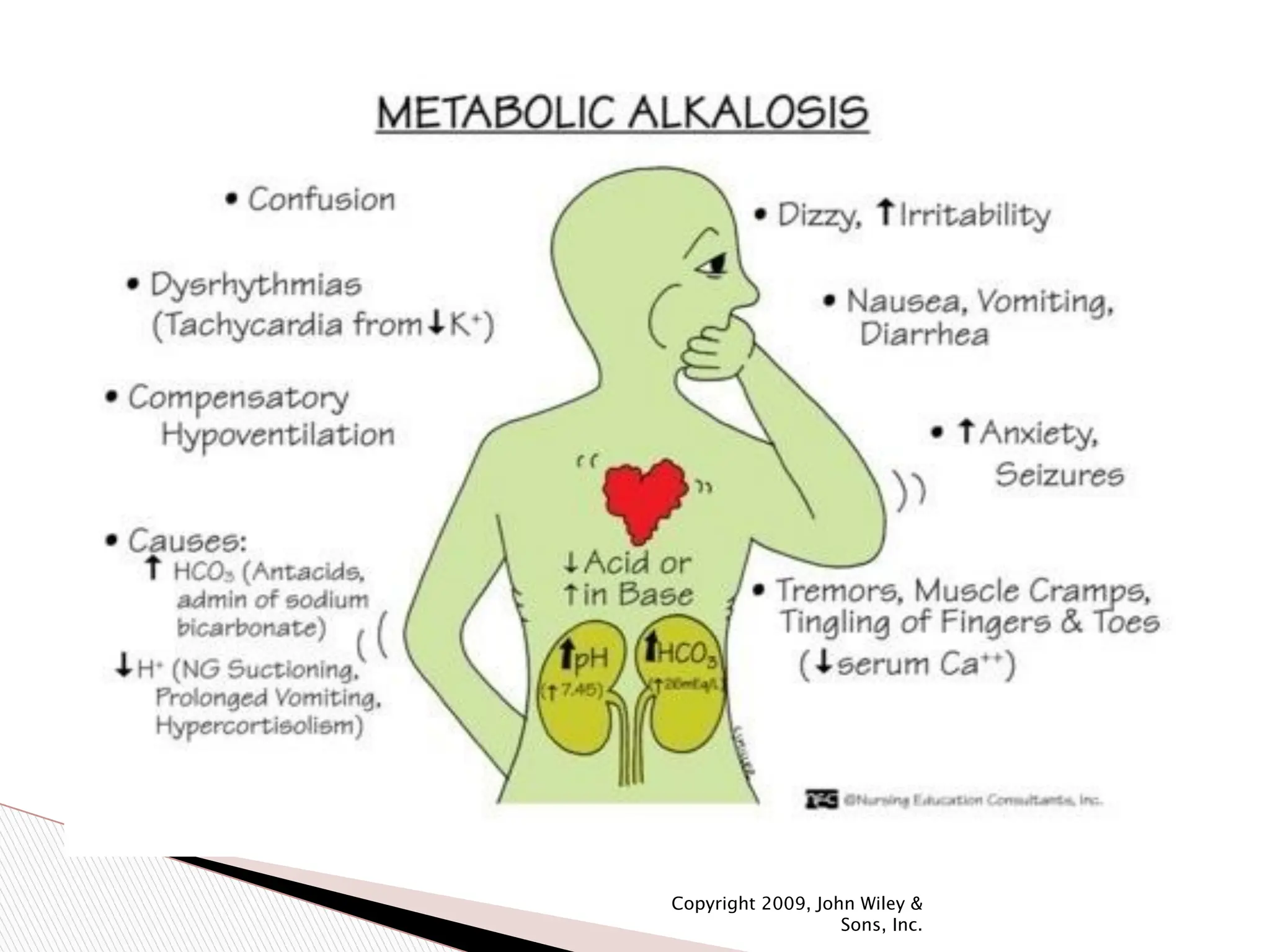
Increase in pH
Decreased plasma H+
concentration
Primary cause :Increase in the extracellular fluid
HCO3
−
concentration
Excess retention of HCO3
−
or loss of H+
from body
Hypochloremia
Hypokalemia
Bicarbonate excess -concentration in blood >
26mEq/L
Metabolic alkalosis
Respiratory compensation : decreased ventilation, which
increases Pco2
returns ECF pH towards normal
Increased ECF HCO3
−
Increased filtered load of HCO3
−
Excess HCO3
−
over H+
secreted in renal tubular fluid
Excess HCO3
−
in renal tubular fluid fails to be reabsorbed as
there is no H+
to react with it and is excreted in urine
Increased renal HCO3
−
excretion compensating initial rise
in ECF HCO3
−
concentration
Compensation of metabolic alkalosis
Treatment :
Correct cause of alkalosis
Give fluid solutions to correct Cl-, K+ and other electrolyte
deficiencies
Metabolic alkalosis
Use of diuretics except carbonic anhydrase inhibitors
Vomiting of acidic stomach contents or gastric drainage
Excess aldosterone:primary aldosteronism, administration
of steroids , Cushing syndrome
Excessive intake of alkaline drugs like antacids
Potassium deficiency
Severe dehydration
Excessive sodium citrate administration in multiple blood
transfusions
37
Causes of metabolic Alkalosis
Copyright 2009, John Wiley &
Sons, Inc.
Evaluate
◦ systemic arterial blood pH
◦ concentration of bicarbonate
(too low or too high)
◦ PCO2
(too low or too high)
Solutions
◦ if problem is respiratory, the
pCO2
will not be normal
◦ if problem is metabolic, the
bicarbonate level will not be
normal
Principles of Human Anatomy and
Physiology, 11e 39
Diagnosis of Acid-Base Imbalances
Anion gap : difference between unmeasured anions and
unmeasured cations (only a diagnostic concept)
Plasma anion gap = [Na+
] - [HCO3
-
] - [Cl-
]
= 144 - 24 - 108
= 12 mEq/L
Concentration units : mEq/L or in mmol/L
Anion gap increase if unmeasured anions rise or if unmeasured
cations fall.
Major unmeasured cations :Ca++
,Mg+2
,K+
, gamma globulins
Major unmeasured anions : albumin , phosphate, sulfate, lactate
& other organic anions.
Anion gap range : 8 -16 mEq/L as unmeasured anions exceed
unmeasured cations
Anion gap
Calculation of anion gap: calculated by subtracting the serum
concentrations of chloride and bicarbonate (anions) from the
concentrations of sodium and potassium (cations):
= ( [Na+
]+[K+
] ) − ( [Cl−
]+[HCO3
−
] )
Without potassium (daily practice)
Because potassium concentrations are very low, they usually
have little effect on the calculated gap. omission of potassium
has become widely accepted. This leaves the following equation:
= ( [Na+
] ) − ( [Cl−
]+[HCO3
−
] )
average anion gap for healthy adults : 8-12 mEq/L
Use of anion gap
Diagnose different causes of metabolic acidosis
Increased Anion Gap (Normochloremia) Normal Anion Gap (Hyperchloremia)
Diabetes mellitus (ketoacidosis) ,Starvation Diarrhea
Lactic acidosis Renal tubular acidosis
Chronic renal failure Carbonic anhydrase inhibitors
Aspirin (acetylsalicylic acid) poisoning Addison’s disease
Methanol poisoning
Ethylene glycol poisoning
In metabolic acidosis, plasma HCO3
−
reduced.
If the plasma sodium concentration unchanged, the
concentration of anions (either Cl −
or an unmeasured anion) must
increase to maintain electroneutrality.
Hyperchloremic metabolic acidosis: If plasma Cl −
increases in
proportion to the fall in plasma HCO3
−
, the anion gap will
remain normal.
Normochloremic metabolic acidosis :If the decrease in plasma
HCO3 −
is not accompanied by increased Cl −
, there must be
increased levels of unmeasured anions and an increase in the
calculated anion gap.
Metabolic acidosis caused by excess nonvolatile acids (besides
HCl), such as lactic acid or ketoacids, associated with an
increased plasma anion gap because the fall in HCO3
−
is not
matched by an equal increase in Cl −
.
Excess of phosphate, sulfate, acetoacetate, lactate
Organic anions in uremic patients
Salicylates
Lithium intoxication
Presence of cationic proteins-immunoglobulins
Decrease of serum albumin-nephrotic syndrome
Factors affecting anion gap
Base excess and Base deficit refer to an excess or
deficit, respectively, in the amount of base present
in the blood.
Concentration units : mEq/L, with positive numbers
indicating an excess of base and negative a deficit.
A typical reference range for base excess:
−2 to +2 mEq/L
Base excess
Predominant base in base excess: bicarbonate
Base excess : amount of strong acid that must be added
to each liter of fully oxygenated blood to return the pH
to 7.40 at a temperature of 37°C and a pCO2
of
40 mmHg .
Base deficit (i.e., a negative base excess)
correspondingly defined in terms of the amount of
strong base that must be added.
Q. A 15 year old boy presents with acute breathlessness. Lab report shows :
Blood Reference Range
pH 7.10 7.35-7.45
pCO₂ 12.2 4.6--- 6.0 kPa
pO₂ 10.1 12-16 kPa
Actual Bicarbonate 22 22-30mmol/l
Interpret the above case and justify the type of acid base disorder the patient is suffering
from.
Q. What is the role of renal buffers in maintaining plasma pH?
Q. ** Write down the various roles of kidney in acid base balance.
Q. Renal mechanisms in acid base balance.
Q. How the hemoglobin in RBC regulates acid base balance?
Q. Bicarbonate is the major buffer component of plasma. Give the role of kidney in relation
to reabsorption and synthesis of bicarbonate.
Important questions
Q. A 24-year-old diabetic male was brought to emergency room.
His blood glucose level on arrival was 780mg%.He had been
started on an insulin drip and had received one amp. of
bicarbonate. ABG results are :
pH= 7.33 (N:7.34-7.45) paCO₂= 25 (N:35-45)
HCO₃ =12 (N:22-26) PaO₂ = 89
i-What acid base imbalance is this patient suffering from?
ii. Is it compensated? Justify your answer.
Q. What is anion gap? What is its normal value?
Important questions
Q. A young male was admitted in emergency room of a hospital with severe chest injury
after a road traffic accident.
i-what kind of acid base problem can be faced by him due to difficulty in chest movement
caused by severe pain?
ii. Explain the reason of this problem.
Q. A 24 year old girl presented to emergency room with a panic attack. She had noticed
perioral anesthesia. On examination she was found to be hyperventilating. Her ABG
results suggested that she had developed Respiratory Alkalosis.
i. Enlist any four causes of Respiratory Alkalosis .How it is compensated ?
ii. What is plasma anion gap?
Q. What are various types of acids present in body?
Q. What is chloride shift, give its importance?
Important questions
Q. A 52 year old male patient enters the emergency department
complaining of shortness of breath and tingling in fingers .His breathing
is shallow and rapid. He denies diabetes ; blood sugar is normal. He has
no significant respiratory or cardiac history .He takes several
antianxiety medications . he says he has had anxiety attacks before
.While being worked up for chest pain an ABG is done and results are :
pH = 7.48 (N = 7.34 -7.45 ),PaCO2 =
28mmHg (N=35-45 mmHg)
HCO3 = 22mEq/L(22-26 mEq/L) ,paO2
= 85 mmHg
He has acid base imbalance .Give your diagnosis .
Define alkaline tide?
Important questions
Q. A 21 year old girl was admitted to the casualty department with a history of
excessive panadol intake .On examination found to be hyperventilating .Blood
results are as follows :
Plasma sodium 134 mmol/l,Potassium 6 mmol/l, bicarbonate 10mmol/l, chloride 93
mmol/l ,Glucose 3.5 – 6.0 mmol/l ,pH 7.35 -7.45 ,Pa CO2 4.6-6.0 ,3.18 kPa, PaO2 9.3
– 13.33.18 kPa.
What is the most probable diagnosis ?
Calculate anion gap .
Q. A patient of chronic asthma is presented to OPD. Her arterial blood gas analysis
showed pH= 7.08 (7.37 to 7.43), pCO2= 38mmHg (37 to 43 mmHg) and HCO3=
18mEq/L (24 to 28 mEq/L). what acid base imbalance this patient is having? What is
the reason of low HCO3 levels?
Paracetamol is a regularly prescribed analgesic and antipyretic
due to its low side-effect profile; however it can result
in accumulation of 5-oxoproline in individuals who are
predisposed to reduced glutathione levels, leading to high
anion gap metabolic acidosis.
The “alkaline tide” that occurs
after a meal refers to the
transient rise in plasma and
urinary pH resulting from
efflux of HCO3− from parietal
cells into blood in exchange for
Cl−, then secretion of HCl into
the stomach lumen during
gastric secretion.
The “alkaline tide” (and by
extension, the “acidic
tide”) may serve as a signaling
mechanism to prime other parts
of the body to deal with the
consequences of feeding.
Alkaline Tide

Acid base imbalance , compensations , causes

  • 1.
  • 2.
    Acidosis :pH< 7.35, astate of excess H+ Acidemia :blood pH is <7.35 Alkalosis : pH > 7.45, a state of excess HCO3 - Alkalemia :blood pH is >7.45 Acid-base imbalances
  • 4.
    The body responseto acid-base imbalance is called compensation May be complete if brought back within normal limits 4 Compensation of Acid-Base Imbalances
  • 5.
    If underlying problemis metabolic, hyperventilation or hypoventilation can adjust by respiratory compensation. If problem is respiratory, renal mechanisms can bring about metabolic compensation. 5 Compensation
  • 6.
    pH = pKₐ+ log([A⁻]/[HA]) [A- ] = conjugate base or salt [HA] = acid Henderson–Hasselbalch equation
  • 7.
    when the ratioof HCO3 − to CO2 in the extracellular fluid decreases, decreasing pH . Metabolic acidosis: If this ratio decreases because of a fall in HCO3 − . Respiratory acidosis: If ratio falls because of an increase in PCO2 Acidosis
  • 8.
    Decrease in theratio of HCO3 - to H+ in renal tubular fluid Excess H+ in the renal tubules, complete reabsorption of HCO3 - additional H+ available to combine with the urinary buffers NH4 + and HPO4 - kidneys reabsorb all the filtered HCO3 - contribute new HCO3 - through the formation of NH4 + and titratable acid Respiratory and Metabolic Acidosis
  • 9.
    Metabolic acidosis excess ofH+ over HCO3 - occurs in the tubular fluid primarily due to decreased filtration of HCO3 - caused mainly by a decrease in the extracellular fluid concentration of HCO3 - Respiratory acidosis excess H+ in the tubular fluid due mainly to the rise in extracellular fluid Pco2 , which stimulates H+ secretion
  • 11.
  • 12.
  • 13.
    Principal effect: depression ofthe CNS through ↓ in synaptic transmission. Generalized weakness Severe acidosis causes ◦Disorientation ◦coma ◦death 13 Acidosis
  • 14.
    Acid-base disturbance Disordertype Primary change in HCO3 - → Metabolic disorder Primary change in blood pCO2 → Respiratory disorder
  • 15.
    Reduction in pHand increase in extracellular fluid H+ concentration increase in Pco2 Compensatory response : Increase in plasma HCO3 − by the addition of new HCO3 − to the extracellular fluid by the kidneys. Rise in HCO3 − helps balances the increase in Pco2 returning the plasma pH toward normal. Respiratory acidosis & its compensation
  • 16.
    Respiratory acidosis Reduction inpH Increase in Pco2 CO2 combines with H2 O to form carbonic acid (H2 CO3 ). Increase in extracellular fluid H+ concentration
  • 17.
    Depression of respiratory center: Decreased ability of the lungs to eliminate CO2 Diseases of the airway : Causes of Respiratory acidosis damage to respiratory center in medulla oblongata stroke infection narcotic poisoning asthma pneumonia emphysema chronic obstructive lung disease airway obstruction diseases of pleura pain killers, benzodiazepines with alcohol, anesthesia, barbiturates, muscle relaxants
  • 18.
    Decreased ability ofthe lungs to eliminate CO2 : Causes of Respiratory acidosis Diseases of the chest : scoliosis, thoracotomy Pulmonary edema, stroke Severe obesity Inadequate ventilation with respiratory or skeletal muscle weakness: poliomyelitis, myasthenia, muscular dystrophies Arteriovenous shunting in poorly ventilated segments of lungs :atelectasis or pneumonitis
  • 20.
    Treatment : Compensatory responsesin respiratory acidosis Buffers of the body fluids Kidneys, require several days to compensate for the disorder • increased reabsorption of HCO3 - by kidneys • increase in plasma HCO3 - • rise in HCO3 - balances the increase in Pco2 , returning the plasma pH toward normal. Administer oxygen Artificial respiration Stimulants of respiratory center
  • 21.
    Decrease in pH Risein extracellular fluid H+ concentration All types of acidosis due to abnormal accumulation of nonvolatile acids in body fluids Primary abnormality : decrease in plasma or ECF HCO3 − . Blood concentrations of bicarbonate :< 24mEq/L Metabolic acidosis
  • 22.
    Failure of thekidneys to excrete metabolic acids normally formed in the body Formation of excess quantities of metabolic acids in the body Addition of metabolic acids to the body by ingestion or infusion of acids Loss of base from the body fluids, same effect as adding an acid to the body fluids. Causes of Metabolic Acidosis
  • 23.
    Specific causes ofMetabolic Acidosis Renal Tubular Acidosis Chronic renal failure Addison’s disease -insufficient aldosterone secretion hereditary and acquired disorders that impair tubular function -Fanconi’s syndrome Diarrhea Diabetes Mellitus Starvation Ketoacidosis
  • 24.
    Hypoxia - lacticacidosis severe muscular exercise cancer shock drugs e.g phenformin, fructose infusion, adrenaline infusion Intake of substances producing acids : methanol, ethylene glycol, acetylsalicylic acid (aspirin) Carbonic anhydrase inhibitors: acetazolamide (Diamox) NH4 Cl Specific causes of Metabolic Acidosis
  • 25.
    Decrease in pH,rise in H+ concentration. Primary abnormality : decrease in plasma HCO3 − Compensations : Respiratory compensation : hyperventilation ( Kussmaul breathing) reduces Pco2 Renal compensation : Complete reabsorption of HCO3 − from renal tubules to the extracellular fluid, helps minimize the initial fall in extracellular HCO3 − concentration adding new HCO3 − to the extracellular fluid, minimize initial fall in extracellular HCO3 − concentration Metabolic acidosis and its compensation
  • 26.
    Treatment: Administer I/V sodiumbicarbonate Correct cause of acidosis Metabolic Acidosis
  • 28.
    ratio of HCO3 - toCO2 in the extracellular fluid increases a rise in pH a decrease in H+ concentration an increase in the ratio of HCO3 - to H+ in the renal tubular fluid. excess of HCO3 - cannot be reabsorbed from the tubules, excreted in the urine. Alkalosis
  • 29.
    over excitability ofthe central and peripheral nervous systems. Numbness Lightheadedness ◦ Nervousness ◦ Muscle spasms or tetany ◦ Convulsions ◦ Loss of consciousness ◦ Death 29 Alkalosis
  • 30.
    Increase pH dueto loss of CO2 from body Excessive ventilation by the lungs low Pco2 and carbonic acid in systemic arterial blood Decrease in H+ concentration due to a decrease in plasma Pco2 and H2 CO3 caused by hyperventilation. Compensation: Chemical buffers of the body fluids Reduction in plasma HCO3 - concentration due to increased renal excretion of HCO3 - Reduction in Pco2 decreased rate of H+ secretion by the renal tubules. reduced amount of H+ in the renal tubular fluid to react with all HCO3 - that is filtered HCO3 - excreted in urine ,decreased plasma HCO3 - concentration and correction of alkalosis Increased distal tubular reabsorption of Cl- Increased secretion of K + into tubular lumen Respiratory alkalosis
  • 31.
    Treatment ◦ One simpletreatment to breathe into paper bag for short time ◦ Reassurance and psychological support
  • 32.
    Psychoneurosis most common Highaltitude ( physiologic type) Hypoxia : i. acute :asthma, pneumonia , pulmonary edema, hypotension ii. chronic : pulmonary fibrosis, severe anemia ,cyanotic heart disease Respiratory center stimulation: i. Apprehension , Severe anxiety, hysteria , tension, pain ii. Hepatic failure iii. Head injury, CNS tumors iv. Aspirin overdose/salicylate poisoning v. Septicemia, fever, heat exposure vi. Pregnancy Excessive mechanical ventilation Causes of Respiratory Alkalosis
  • 33.
    Copyright 2009, JohnWiley & Sons, Inc.
  • 34.
    Increase in pH Decreasedplasma H+ concentration Primary cause :Increase in the extracellular fluid HCO3 − concentration Excess retention of HCO3 − or loss of H+ from body Hypochloremia Hypokalemia Bicarbonate excess -concentration in blood > 26mEq/L Metabolic alkalosis
  • 35.
    Respiratory compensation :decreased ventilation, which increases Pco2 returns ECF pH towards normal Increased ECF HCO3 − Increased filtered load of HCO3 − Excess HCO3 − over H+ secreted in renal tubular fluid Excess HCO3 − in renal tubular fluid fails to be reabsorbed as there is no H+ to react with it and is excreted in urine Increased renal HCO3 − excretion compensating initial rise in ECF HCO3 − concentration Compensation of metabolic alkalosis
  • 36.
    Treatment : Correct causeof alkalosis Give fluid solutions to correct Cl-, K+ and other electrolyte deficiencies Metabolic alkalosis
  • 37.
    Use of diureticsexcept carbonic anhydrase inhibitors Vomiting of acidic stomach contents or gastric drainage Excess aldosterone:primary aldosteronism, administration of steroids , Cushing syndrome Excessive intake of alkaline drugs like antacids Potassium deficiency Severe dehydration Excessive sodium citrate administration in multiple blood transfusions 37 Causes of metabolic Alkalosis
  • 38.
    Copyright 2009, JohnWiley & Sons, Inc.
  • 39.
    Evaluate ◦ systemic arterialblood pH ◦ concentration of bicarbonate (too low or too high) ◦ PCO2 (too low or too high) Solutions ◦ if problem is respiratory, the pCO2 will not be normal ◦ if problem is metabolic, the bicarbonate level will not be normal Principles of Human Anatomy and Physiology, 11e 39 Diagnosis of Acid-Base Imbalances
  • 41.
    Anion gap :difference between unmeasured anions and unmeasured cations (only a diagnostic concept) Plasma anion gap = [Na+ ] - [HCO3 - ] - [Cl- ] = 144 - 24 - 108 = 12 mEq/L Concentration units : mEq/L or in mmol/L Anion gap increase if unmeasured anions rise or if unmeasured cations fall. Major unmeasured cations :Ca++ ,Mg+2 ,K+ , gamma globulins Major unmeasured anions : albumin , phosphate, sulfate, lactate & other organic anions. Anion gap range : 8 -16 mEq/L as unmeasured anions exceed unmeasured cations Anion gap
  • 42.
    Calculation of aniongap: calculated by subtracting the serum concentrations of chloride and bicarbonate (anions) from the concentrations of sodium and potassium (cations): = ( [Na+ ]+[K+ ] ) − ( [Cl− ]+[HCO3 − ] ) Without potassium (daily practice) Because potassium concentrations are very low, they usually have little effect on the calculated gap. omission of potassium has become widely accepted. This leaves the following equation: = ( [Na+ ] ) − ( [Cl− ]+[HCO3 − ] ) average anion gap for healthy adults : 8-12 mEq/L
  • 43.
    Use of aniongap Diagnose different causes of metabolic acidosis Increased Anion Gap (Normochloremia) Normal Anion Gap (Hyperchloremia) Diabetes mellitus (ketoacidosis) ,Starvation Diarrhea Lactic acidosis Renal tubular acidosis Chronic renal failure Carbonic anhydrase inhibitors Aspirin (acetylsalicylic acid) poisoning Addison’s disease Methanol poisoning Ethylene glycol poisoning
  • 44.
    In metabolic acidosis,plasma HCO3 − reduced. If the plasma sodium concentration unchanged, the concentration of anions (either Cl − or an unmeasured anion) must increase to maintain electroneutrality. Hyperchloremic metabolic acidosis: If plasma Cl − increases in proportion to the fall in plasma HCO3 − , the anion gap will remain normal. Normochloremic metabolic acidosis :If the decrease in plasma HCO3 − is not accompanied by increased Cl − , there must be increased levels of unmeasured anions and an increase in the calculated anion gap. Metabolic acidosis caused by excess nonvolatile acids (besides HCl), such as lactic acid or ketoacids, associated with an increased plasma anion gap because the fall in HCO3 − is not matched by an equal increase in Cl − .
  • 45.
    Excess of phosphate,sulfate, acetoacetate, lactate Organic anions in uremic patients Salicylates Lithium intoxication Presence of cationic proteins-immunoglobulins Decrease of serum albumin-nephrotic syndrome Factors affecting anion gap
  • 46.
    Base excess andBase deficit refer to an excess or deficit, respectively, in the amount of base present in the blood. Concentration units : mEq/L, with positive numbers indicating an excess of base and negative a deficit. A typical reference range for base excess: −2 to +2 mEq/L Base excess
  • 47.
    Predominant base inbase excess: bicarbonate Base excess : amount of strong acid that must be added to each liter of fully oxygenated blood to return the pH to 7.40 at a temperature of 37°C and a pCO2 of 40 mmHg . Base deficit (i.e., a negative base excess) correspondingly defined in terms of the amount of strong base that must be added.
  • 48.
    Q. A 15year old boy presents with acute breathlessness. Lab report shows : Blood Reference Range pH 7.10 7.35-7.45 pCO₂ 12.2 4.6--- 6.0 kPa pO₂ 10.1 12-16 kPa Actual Bicarbonate 22 22-30mmol/l Interpret the above case and justify the type of acid base disorder the patient is suffering from. Q. What is the role of renal buffers in maintaining plasma pH? Q. ** Write down the various roles of kidney in acid base balance. Q. Renal mechanisms in acid base balance. Q. How the hemoglobin in RBC regulates acid base balance? Q. Bicarbonate is the major buffer component of plasma. Give the role of kidney in relation to reabsorption and synthesis of bicarbonate. Important questions
  • 49.
    Q. A 24-year-olddiabetic male was brought to emergency room. His blood glucose level on arrival was 780mg%.He had been started on an insulin drip and had received one amp. of bicarbonate. ABG results are : pH= 7.33 (N:7.34-7.45) paCO₂= 25 (N:35-45) HCO₃ =12 (N:22-26) PaO₂ = 89 i-What acid base imbalance is this patient suffering from? ii. Is it compensated? Justify your answer. Q. What is anion gap? What is its normal value? Important questions
  • 50.
    Q. A youngmale was admitted in emergency room of a hospital with severe chest injury after a road traffic accident. i-what kind of acid base problem can be faced by him due to difficulty in chest movement caused by severe pain? ii. Explain the reason of this problem. Q. A 24 year old girl presented to emergency room with a panic attack. She had noticed perioral anesthesia. On examination she was found to be hyperventilating. Her ABG results suggested that she had developed Respiratory Alkalosis. i. Enlist any four causes of Respiratory Alkalosis .How it is compensated ? ii. What is plasma anion gap? Q. What are various types of acids present in body? Q. What is chloride shift, give its importance? Important questions
  • 51.
    Q. A 52year old male patient enters the emergency department complaining of shortness of breath and tingling in fingers .His breathing is shallow and rapid. He denies diabetes ; blood sugar is normal. He has no significant respiratory or cardiac history .He takes several antianxiety medications . he says he has had anxiety attacks before .While being worked up for chest pain an ABG is done and results are : pH = 7.48 (N = 7.34 -7.45 ),PaCO2 = 28mmHg (N=35-45 mmHg) HCO3 = 22mEq/L(22-26 mEq/L) ,paO2 = 85 mmHg He has acid base imbalance .Give your diagnosis . Define alkaline tide? Important questions
  • 52.
    Q. A 21year old girl was admitted to the casualty department with a history of excessive panadol intake .On examination found to be hyperventilating .Blood results are as follows : Plasma sodium 134 mmol/l,Potassium 6 mmol/l, bicarbonate 10mmol/l, chloride 93 mmol/l ,Glucose 3.5 – 6.0 mmol/l ,pH 7.35 -7.45 ,Pa CO2 4.6-6.0 ,3.18 kPa, PaO2 9.3 – 13.33.18 kPa. What is the most probable diagnosis ? Calculate anion gap . Q. A patient of chronic asthma is presented to OPD. Her arterial blood gas analysis showed pH= 7.08 (7.37 to 7.43), pCO2= 38mmHg (37 to 43 mmHg) and HCO3= 18mEq/L (24 to 28 mEq/L). what acid base imbalance this patient is having? What is the reason of low HCO3 levels?
  • 53.
    Paracetamol is aregularly prescribed analgesic and antipyretic due to its low side-effect profile; however it can result in accumulation of 5-oxoproline in individuals who are predisposed to reduced glutathione levels, leading to high anion gap metabolic acidosis.
  • 54.
    The “alkaline tide”that occurs after a meal refers to the transient rise in plasma and urinary pH resulting from efflux of HCO3− from parietal cells into blood in exchange for Cl−, then secretion of HCl into the stomach lumen during gastric secretion. The “alkaline tide” (and by extension, the “acidic tide”) may serve as a signaling mechanism to prime other parts of the body to deal with the consequences of feeding. Alkaline Tide