Dr. Bikal Lamichhane
NAMS, Internal Medicine
Approach to microcytic anemia
Microcytosis can be documented from
1. the mean cell volume (MCV) on an automated hematology instrument (ie, MCV
below 80 femtoliters [fL] for an adult or below the age-appropriate value for children) or
2. from examination of the peripheral blood smear. Variation in cell size can be
assessed from the red blood cell (RBC) distribution width (RDW) or
3. from observing the degree of anisocytosis on the blood smear.
IRON DEFICIENCY ANEMIA
 Occurs when the absorption of iron through dietary
intake does not match the needs of the body.
 The mismatch occurs from inadequate dietary intake or
increased needs, which usually cause only mild anemia,
or from blood loss or malabsorption, which can lead to
more significant anemia.
 Young children, women of childbearing age, and
pregnant women have the highest prevalence of the
condition.
 Complications include developmental delays and
behavior disturbances in children and preterm delivery in
pregnant women.
 Heavy menstrual losses leading to significant anemia
warrant additional evaluation for clotting disorders (e.g.,
THALASSEMIA
 Beta-thalassemia :-
 an autosomal recessive genetic condition in which
the normal beta globin chains that make up
hemoglobin are underproduced.
 Beta-thalassemia trait is the heterozygous form of
the disease.
 Beta- thalassemia major (also known as Cooley
anemia) is the homozygous form. Both are more
common in black persons, and in persons of
Southeast Asian, Greek, Italian, or Mediterranean
THALASSEMIA:-
 Most patients with beta-thalassemia trait have mild
anemia (hemoglobin level is rarely less than 9.3 g per
dL [93 g per L]).
 In addition, the mean corpuscular volume can
sometimes reach much lower levels than with iron
deficiency anemia alone.
 Ultimately, the diagnosis of beta-thalassemia trait is
made when hemoglobin electrophoresis shows a
slight increase in hemoglobin A2.
 Coexisting iron deficiency anemia can lower
hemoglobin A2 levels; therefore, iron deficiency
anemia must be corrected before hemoglobin
electrophoresis results can be appropriately
evaluated.
 Alpha-thalassemia is caused by an underproduction of alpha
globin chains, and is most prevalent in persons of African or
Southeast Asian descent.
 The production of alpha globin chains is controlled by four
genes on two chromosomes.
 One gene deletion results in a silent carrier status with normal
hematologic findings.
 Two gene deletions result in alpha-thalassemia trait, which
usually leads to microcytosis without anemia.
 Hemoglobin electrophoresis is often normal in patients with
silent carrier status or with alpha-thalassemia trait.
 The diagnosis is usually one of exclusion.
ANEMIA OF CHRONIC DISEASE
 Caused by chronic infections or inflammatory processes.
 Increased levels of cytokines cause a decrease in
erythropoietin production, a decreased response to
erythropoietin, and interference with iron metabolism.
 Although anemia of chronic disease is usually normocytic,
about one fourth to one third of cases are mildly microcytic.
 The anemia is usually mild and not progressive.
 Additionally, although serum iron levels are decreased in
anemia of chronic disease (similar to iron deficiency
anemia), ferritin levels are increased because ferritin is an
acute phase reactant
Other causes:-
Rare acquired causes of
microcytosis include the
following:-
•Lead poisoning.
•Copper or zinc deficiency
•Some forms of drug-induced
anemia
•Inherited syndromes of
defective iron metabolism
•Myelodysplastic syndrome
(MDS)
Rare inherited microcytic anemias
include:-
•X-linked and other types of
sideroblastic anemia
•Hereditary hypotransferrinemia
•Hereditary aceruloplasminemia
•Erythropoietic protoporphyria
•Iron-refractory iron deficiency
anemia
•Other thalassemic mutations
such as hemoglobin E disease
History and Physical Examination
 Important history information includes
 Nutritional intake (especially whole milk intake in children); pica or
cravings for ice, which are symptoms of iron deficiency anemia;
 Occupational or residential exposure to toxins, such as lead;
 Family history of anemia or ethnicity suggestive of anemia due to an
underlying hemoglobinopathy; and
 Systemic symptoms of an underlying chronic infectious or
inflammatory process.
 Review of gastrointestinal symptoms, including abdominal
discomfort, hematochezia, and bright red rectal bleeding, is warranted
in adults, and
 Menstrual history should be obtained in menstruating women.
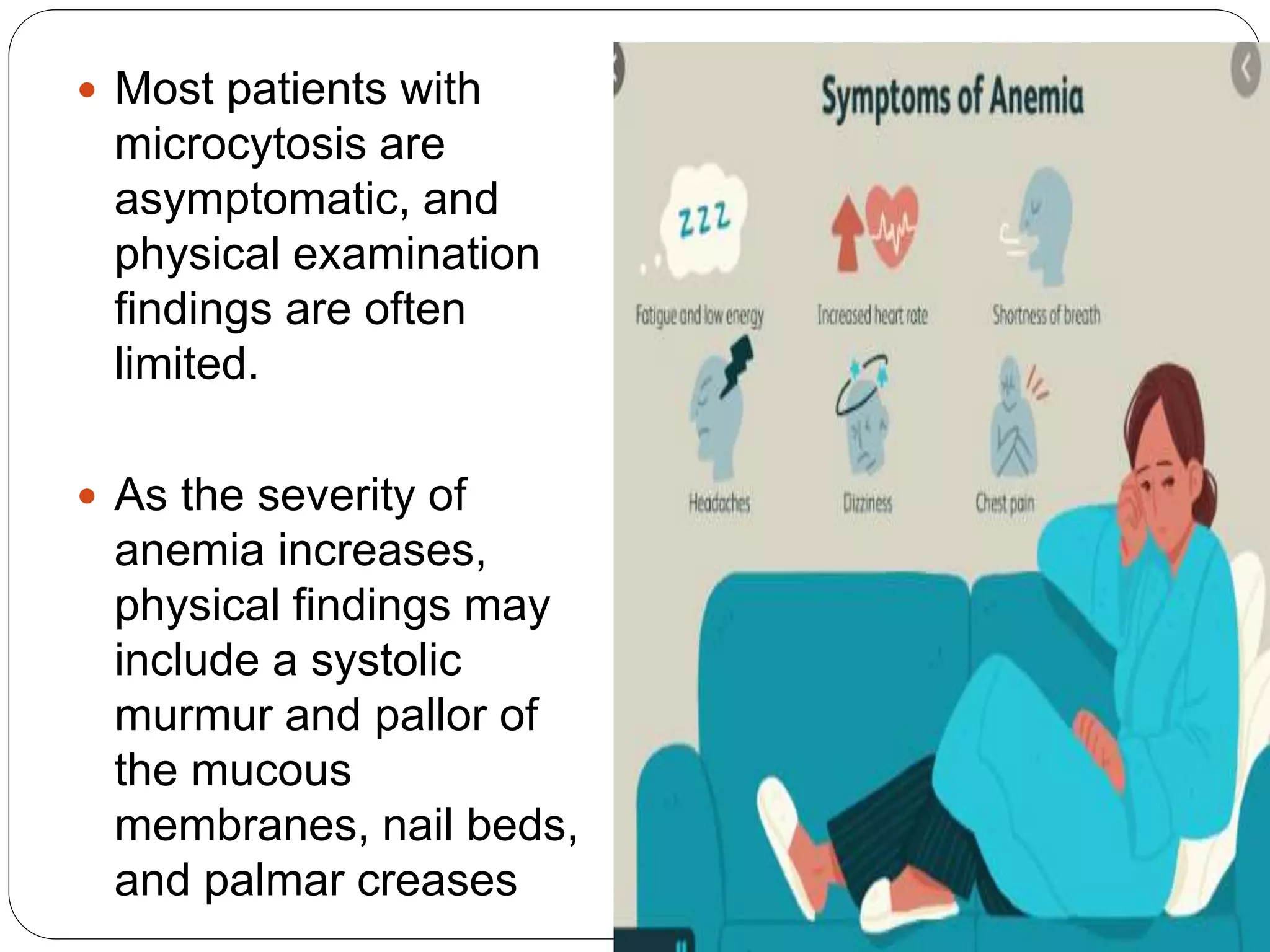
 Most patients with
microcytosis are
asymptomatic, and
physical examination
findings are often
limited.
 As the severity of
anemia increases,
physical findings may
include a systolic
murmur and pallor of
the mucous
membranes, nail beds,
and palmar creases
Laboratory Evaluation
 MCV
 Red blood cell distribution width
using the CBC,
 Serum iron levels,
 Serum ferritin levels,
 Total iron-binding capacity (TIBC),
 Transferrin saturation,
 Hemoglobin electrophoresis, and
 Reticulocyte blood count and
 Peripheral blood smears.
 Stool RME
 Endoscopy
 Colonoscopy
 Tissue transglutaminase
antibody
Red blood cell distribution width
 Measures the variation in red blood cell size
 Is often increased in persons with iron deficiency, but
normal in those with anemia of chronic disease.
 However, this measurement is not sensitive or
specific enough to differentiate iron deficiency and
beta-thalassemia trait.
 The red blood cell count can help differentiate the two
causes because it is often in the high to normal range
with beta-thalassemia trait
Serum iron levels
 Decreased in iron deficiency anemia and, to a
lesser extent, in anemia of chronic disease.
 Serum iron levels can have diurnal variations
with higher concentrations later in the day.
 Transient increases in serum iron levels may
occur with meat ingestion or iron
supplementation, but do not represent an
increase in true iron stores
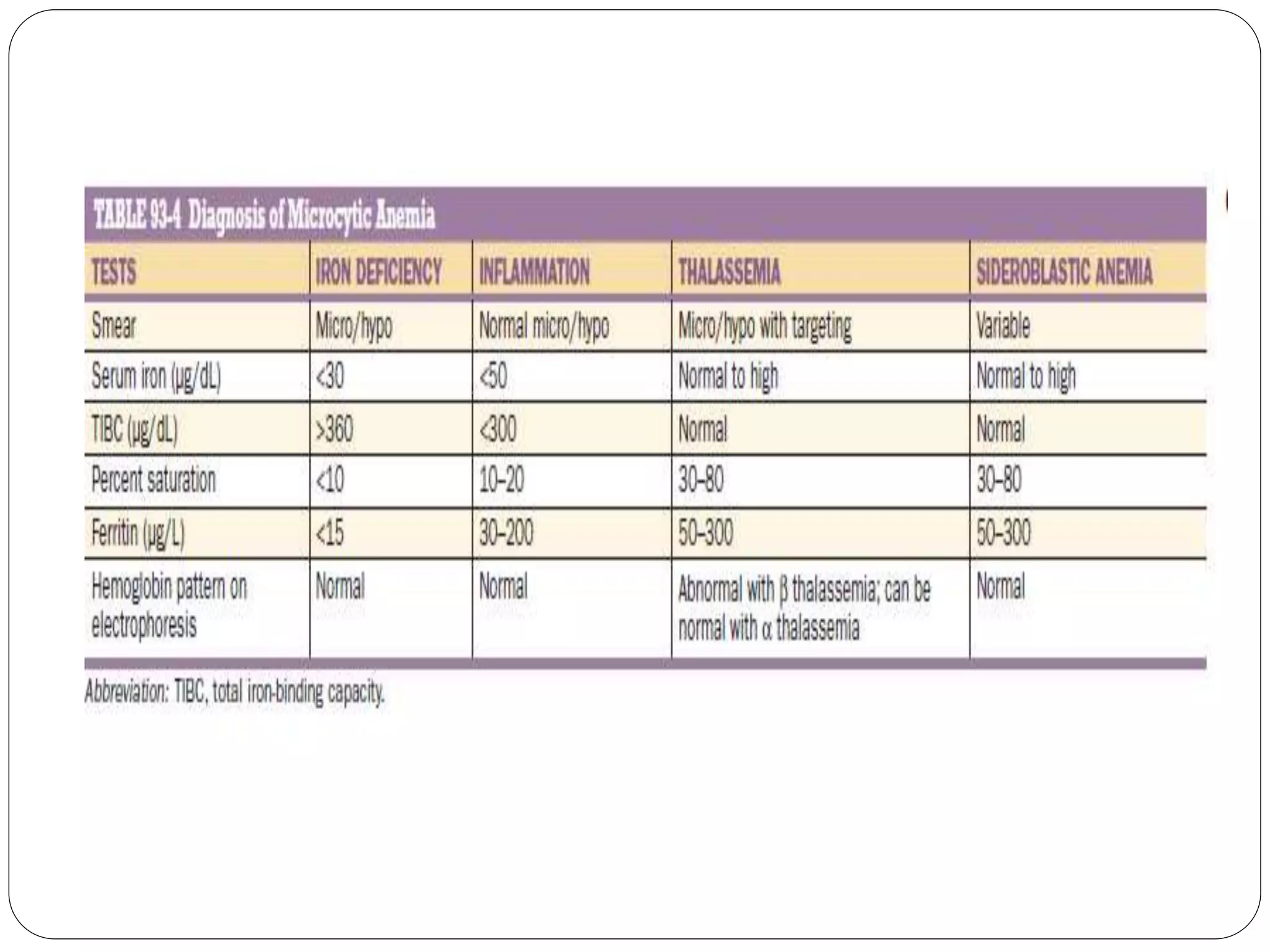
Ferritin , transferrin saturation levels
and TIBC
 Ferritin and transferrin saturation levels and TIBC are
useful in differentiating iron deficiency anemia and
anemia of chronic disease when the serum iron level
is decreased.
 TIBC refers to the ability of unsaturated transferrin, the
transport protein for iron, to bind to iron.
 This measure is usually increased in iron deficiency,
decreased in anemia of chronic disease, and normal
in the less severe thalassemias. Similar to iron, TIBC
 Transferrin saturation is a percentage calculated
as
 serum iron concentration/TIBC × 100.
 Levels indicate the number of free binding sites on
transferrin.
 A value less than 16 percent is often indicative of
iron deficiency anemia
Ferritin
 Complex of iron and the binding protein apoferritin.
 Reflects true iron stores and is not susceptible to the
short-term variations that occur with serum iron levels
and TIBC.
 Also an acute phase reactant and can be elevated with
liver disease, malignancy, and chronic renal disease.
 Iron deficiency anemia is likely if the ferritin level is less
than 15 ng per mL (15 mcg per L) in an otherwise
healthy person, or less than 50 ng mL (50 mcg per L) in
a person with an underlying source of chronic
inflammation.
 Iron deficiency can usually be excluded when the ferritin
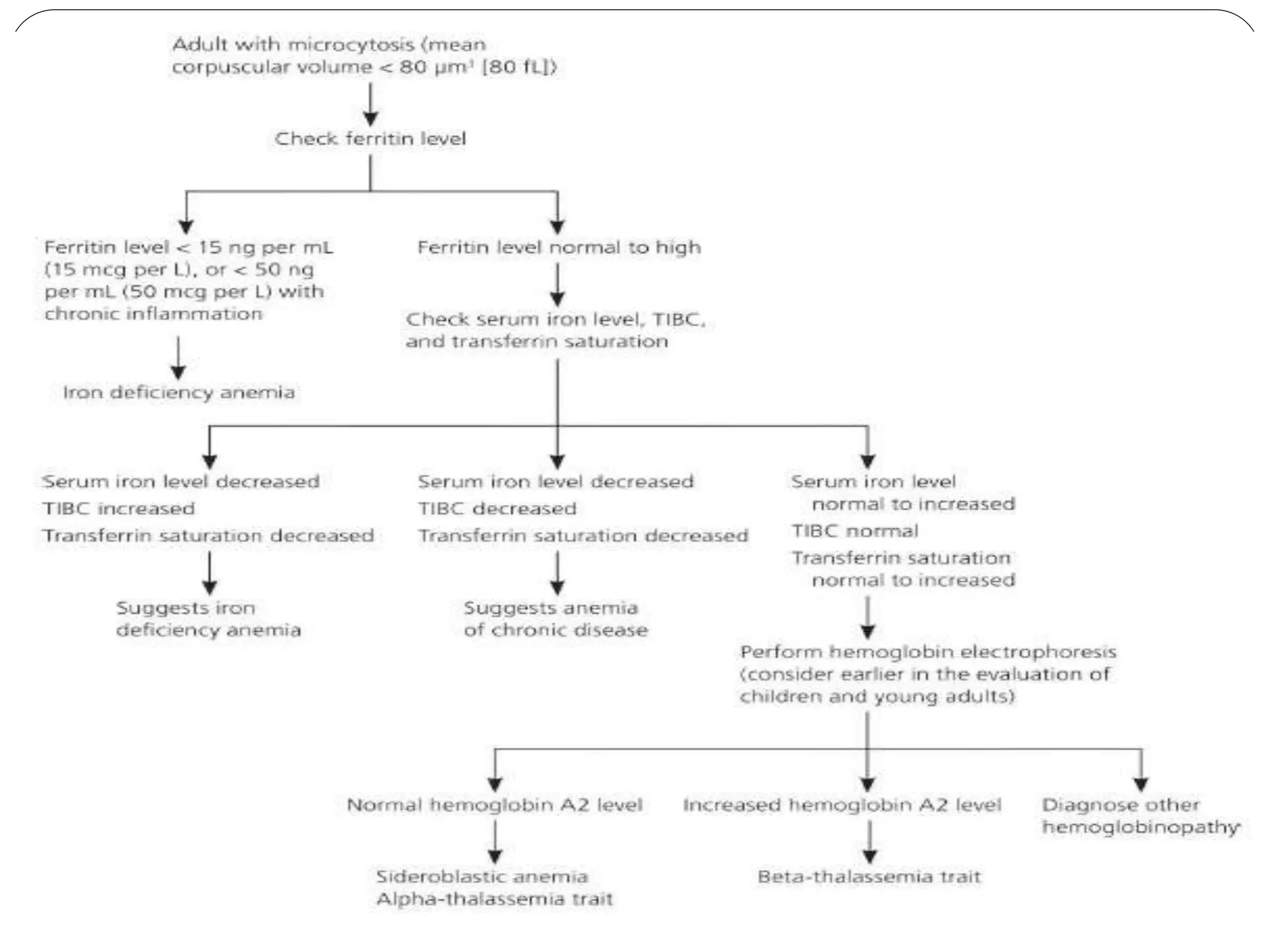
Diagnostic Strategy
 After confirmation of microcytosis on CBC, physicians
should first order a serum ferritin level.
 If the ferritin level is consistent with iron deficiency
anemia, identifying the underlying cause of the
anemia is the priority.
 It is critical to exclude gastrointestinal malignancy in
men and nonmenstruating women.
 Gastrointestinal sources of blood loss should also be
considered in menstruating women and adolescent
girls when the anemia is refractory to iron treatment or
when gastrointestinal symptoms are present
 MANAGEMENT
 The severity and cause of iron-deficiency anemia will determine the
appropriate approach to treatment.
 For the majority of cases of iron deficiency (pregnant women,
growing children and adolescents, patients with infrequent episodes
of bleeding, and those with inadequate dietary intake of iron), oral
iron therapy will suffice.
 For patients with unusual blood loss or malabsorption, specific
diagnostic tests and appropriate therapy take priority.
 Once the diagnosis of iron-deficiency anemia and its cause is made,
there are three major therapeutic approaches.
 RED CELL TRANSFUSION
 Transfusion therapy is reserved for individuals who have symptoms of anemia,
cardiovascular instability, and continued and excessive blood loss from
whatever source and who require immediate intervention.
 Intravenous iron
 can be given to patients who are unable to tolerate oral iron; whose needs are
relatively acute; or who need iron on an ongoing basis, usually due to
persistent gastrointestinal or menstrual blood loss
 The amount of iron needed by PARENTERAL IRON THERAPY
an individual patient is calculated by the following formula:
(Body weight (kg) × 2.3 × (15 – patient’s hemoglobin, g/dL) + 500 or
1000 mg (for stores).
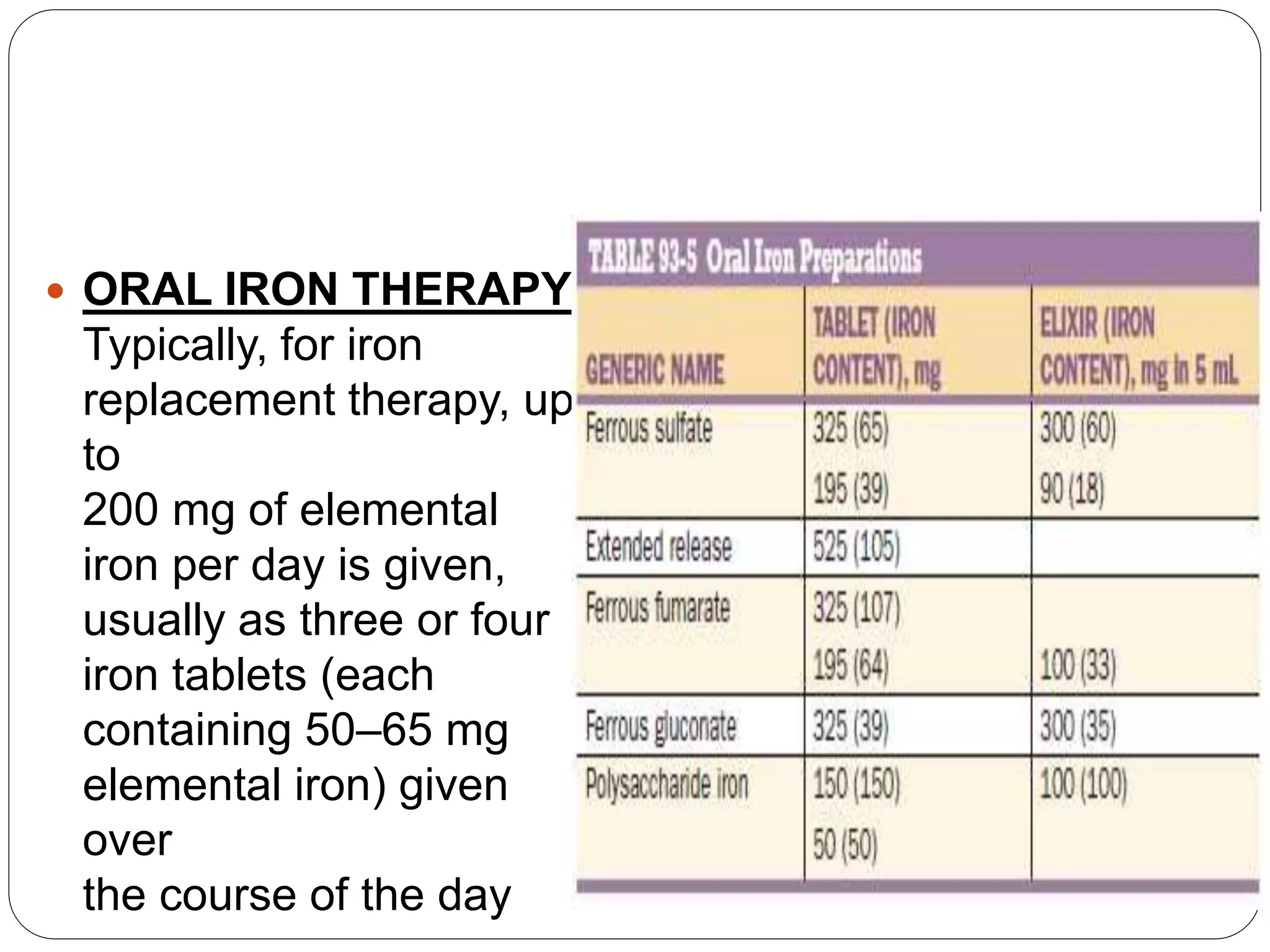
 ORAL IRON THERAPY
Typically, for iron
replacement therapy, up
to
200 mg of elemental
iron per day is given,
usually as three or four
iron tablets (each
containing 50–65 mg
elemental iron) given
over
the course of the day

Approach to microcytic anemia

  • 1.
    Dr. Bikal Lamichhane NAMS,Internal Medicine Approach to microcytic anemia
  • 2.
    Microcytosis can bedocumented from 1. the mean cell volume (MCV) on an automated hematology instrument (ie, MCV below 80 femtoliters [fL] for an adult or below the age-appropriate value for children) or 2. from examination of the peripheral blood smear. Variation in cell size can be assessed from the red blood cell (RBC) distribution width (RDW) or 3. from observing the degree of anisocytosis on the blood smear.
  • 3.
    IRON DEFICIENCY ANEMIA Occurs when the absorption of iron through dietary intake does not match the needs of the body.  The mismatch occurs from inadequate dietary intake or increased needs, which usually cause only mild anemia, or from blood loss or malabsorption, which can lead to more significant anemia.  Young children, women of childbearing age, and pregnant women have the highest prevalence of the condition.  Complications include developmental delays and behavior disturbances in children and preterm delivery in pregnant women.  Heavy menstrual losses leading to significant anemia warrant additional evaluation for clotting disorders (e.g.,
  • 5.
    THALASSEMIA  Beta-thalassemia :- an autosomal recessive genetic condition in which the normal beta globin chains that make up hemoglobin are underproduced.  Beta-thalassemia trait is the heterozygous form of the disease.  Beta- thalassemia major (also known as Cooley anemia) is the homozygous form. Both are more common in black persons, and in persons of Southeast Asian, Greek, Italian, or Mediterranean
  • 7.
    THALASSEMIA:-  Most patientswith beta-thalassemia trait have mild anemia (hemoglobin level is rarely less than 9.3 g per dL [93 g per L]).  In addition, the mean corpuscular volume can sometimes reach much lower levels than with iron deficiency anemia alone.  Ultimately, the diagnosis of beta-thalassemia trait is made when hemoglobin electrophoresis shows a slight increase in hemoglobin A2.  Coexisting iron deficiency anemia can lower hemoglobin A2 levels; therefore, iron deficiency anemia must be corrected before hemoglobin electrophoresis results can be appropriately evaluated.
  • 8.
     Alpha-thalassemia iscaused by an underproduction of alpha globin chains, and is most prevalent in persons of African or Southeast Asian descent.  The production of alpha globin chains is controlled by four genes on two chromosomes.  One gene deletion results in a silent carrier status with normal hematologic findings.  Two gene deletions result in alpha-thalassemia trait, which usually leads to microcytosis without anemia.  Hemoglobin electrophoresis is often normal in patients with silent carrier status or with alpha-thalassemia trait.  The diagnosis is usually one of exclusion.
  • 9.
    ANEMIA OF CHRONICDISEASE  Caused by chronic infections or inflammatory processes.  Increased levels of cytokines cause a decrease in erythropoietin production, a decreased response to erythropoietin, and interference with iron metabolism.  Although anemia of chronic disease is usually normocytic, about one fourth to one third of cases are mildly microcytic.  The anemia is usually mild and not progressive.  Additionally, although serum iron levels are decreased in anemia of chronic disease (similar to iron deficiency anemia), ferritin levels are increased because ferritin is an acute phase reactant
  • 10.
    Other causes:- Rare acquiredcauses of microcytosis include the following:- •Lead poisoning. •Copper or zinc deficiency •Some forms of drug-induced anemia •Inherited syndromes of defective iron metabolism •Myelodysplastic syndrome (MDS) Rare inherited microcytic anemias include:- •X-linked and other types of sideroblastic anemia •Hereditary hypotransferrinemia •Hereditary aceruloplasminemia •Erythropoietic protoporphyria •Iron-refractory iron deficiency anemia •Other thalassemic mutations such as hemoglobin E disease
  • 11.
    History and PhysicalExamination  Important history information includes  Nutritional intake (especially whole milk intake in children); pica or cravings for ice, which are symptoms of iron deficiency anemia;  Occupational or residential exposure to toxins, such as lead;  Family history of anemia or ethnicity suggestive of anemia due to an underlying hemoglobinopathy; and  Systemic symptoms of an underlying chronic infectious or inflammatory process.  Review of gastrointestinal symptoms, including abdominal discomfort, hematochezia, and bright red rectal bleeding, is warranted in adults, and  Menstrual history should be obtained in menstruating women.
  • 12.
     Most patientswith microcytosis are asymptomatic, and physical examination findings are often limited.  As the severity of anemia increases, physical findings may include a systolic murmur and pallor of the mucous membranes, nail beds, and palmar creases
  • 13.
    Laboratory Evaluation  MCV Red blood cell distribution width using the CBC,  Serum iron levels,  Serum ferritin levels,  Total iron-binding capacity (TIBC),  Transferrin saturation,  Hemoglobin electrophoresis, and  Reticulocyte blood count and  Peripheral blood smears.  Stool RME  Endoscopy  Colonoscopy  Tissue transglutaminase antibody
  • 15.
    Red blood celldistribution width  Measures the variation in red blood cell size  Is often increased in persons with iron deficiency, but normal in those with anemia of chronic disease.  However, this measurement is not sensitive or specific enough to differentiate iron deficiency and beta-thalassemia trait.  The red blood cell count can help differentiate the two causes because it is often in the high to normal range with beta-thalassemia trait
  • 16.
    Serum iron levels Decreased in iron deficiency anemia and, to a lesser extent, in anemia of chronic disease.  Serum iron levels can have diurnal variations with higher concentrations later in the day.  Transient increases in serum iron levels may occur with meat ingestion or iron supplementation, but do not represent an increase in true iron stores
  • 17.
    Ferritin , transferrinsaturation levels and TIBC  Ferritin and transferrin saturation levels and TIBC are useful in differentiating iron deficiency anemia and anemia of chronic disease when the serum iron level is decreased.  TIBC refers to the ability of unsaturated transferrin, the transport protein for iron, to bind to iron.  This measure is usually increased in iron deficiency, decreased in anemia of chronic disease, and normal in the less severe thalassemias. Similar to iron, TIBC
  • 18.
     Transferrin saturationis a percentage calculated as  serum iron concentration/TIBC × 100.  Levels indicate the number of free binding sites on transferrin.  A value less than 16 percent is often indicative of iron deficiency anemia
  • 19.
    Ferritin  Complex ofiron and the binding protein apoferritin.  Reflects true iron stores and is not susceptible to the short-term variations that occur with serum iron levels and TIBC.  Also an acute phase reactant and can be elevated with liver disease, malignancy, and chronic renal disease.  Iron deficiency anemia is likely if the ferritin level is less than 15 ng per mL (15 mcg per L) in an otherwise healthy person, or less than 50 ng mL (50 mcg per L) in a person with an underlying source of chronic inflammation.  Iron deficiency can usually be excluded when the ferritin
  • 21.
    Diagnostic Strategy  Afterconfirmation of microcytosis on CBC, physicians should first order a serum ferritin level.  If the ferritin level is consistent with iron deficiency anemia, identifying the underlying cause of the anemia is the priority.  It is critical to exclude gastrointestinal malignancy in men and nonmenstruating women.  Gastrointestinal sources of blood loss should also be considered in menstruating women and adolescent girls when the anemia is refractory to iron treatment or when gastrointestinal symptoms are present
  • 23.
     MANAGEMENT  Theseverity and cause of iron-deficiency anemia will determine the appropriate approach to treatment.  For the majority of cases of iron deficiency (pregnant women, growing children and adolescents, patients with infrequent episodes of bleeding, and those with inadequate dietary intake of iron), oral iron therapy will suffice.  For patients with unusual blood loss or malabsorption, specific diagnostic tests and appropriate therapy take priority.  Once the diagnosis of iron-deficiency anemia and its cause is made, there are three major therapeutic approaches.
  • 24.
     RED CELLTRANSFUSION  Transfusion therapy is reserved for individuals who have symptoms of anemia, cardiovascular instability, and continued and excessive blood loss from whatever source and who require immediate intervention.  Intravenous iron  can be given to patients who are unable to tolerate oral iron; whose needs are relatively acute; or who need iron on an ongoing basis, usually due to persistent gastrointestinal or menstrual blood loss  The amount of iron needed by PARENTERAL IRON THERAPY an individual patient is calculated by the following formula: (Body weight (kg) × 2.3 × (15 – patient’s hemoglobin, g/dL) + 500 or 1000 mg (for stores).
  • 25.
     ORAL IRONTHERAPY Typically, for iron replacement therapy, up to 200 mg of elemental iron per day is given, usually as three or four iron tablets (each containing 50–65 mg elemental iron) given over the course of the day