





Achieving compute and storage
independence for data-driven workloads
Two SigmaOpen Source Meetup
Wenbo Zhao | Software Engineer |Two Sigma
Bin Fan | Founding Engineer &VP, Open Source | Alluxio
Agenda
Why storage-independent compute?
Alluxio Overview
Demo: Spark + Alluxio + S3
Future work
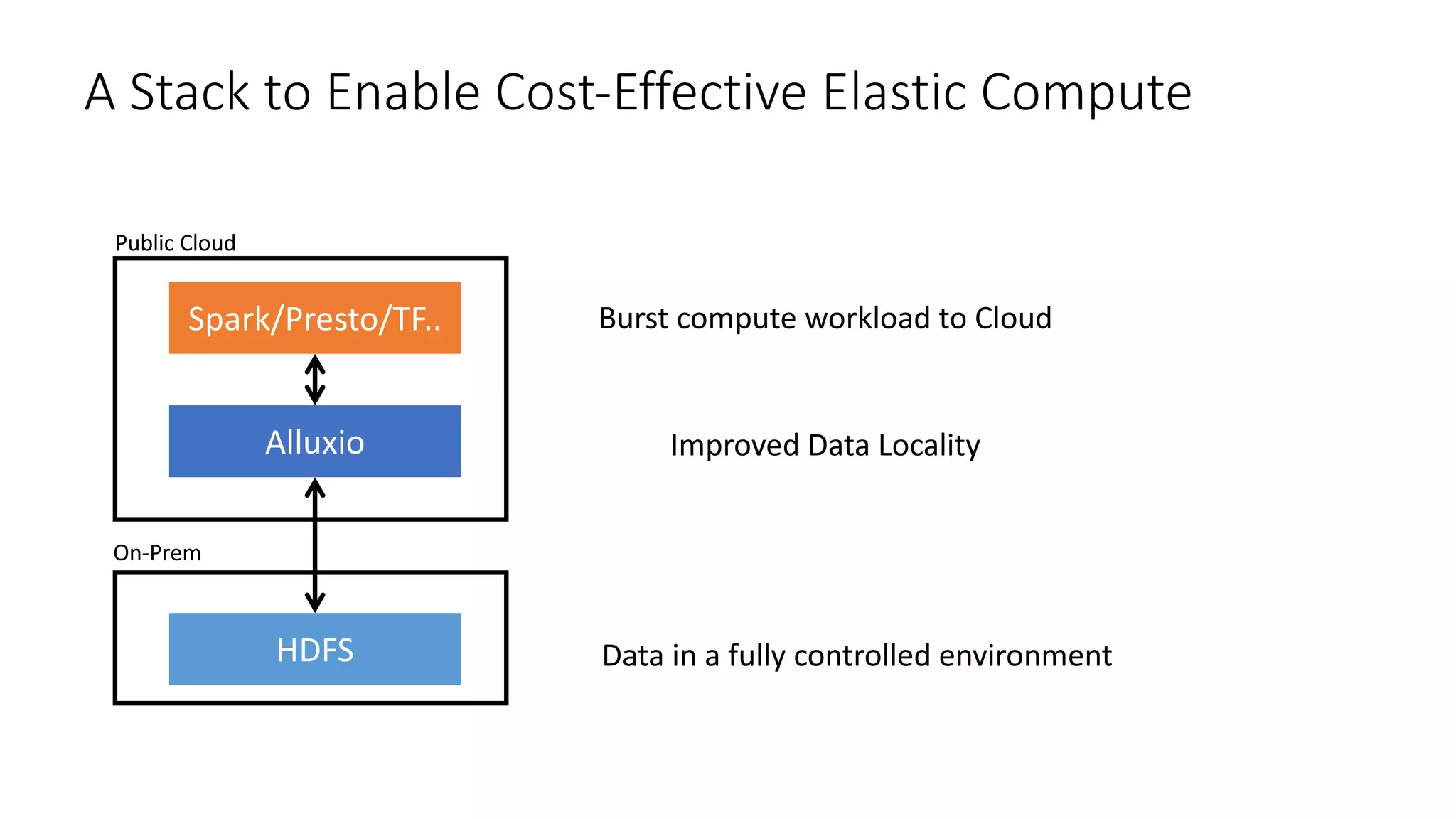
A Stack to Enable Cost-Effective Elastic Compute
Spark/Presto/TF..
Alluxio
HDFS
Public Cloud
On-Prem
Burst compute workload to Cloud
Data in a fully controlled environment
Improved Data Locality
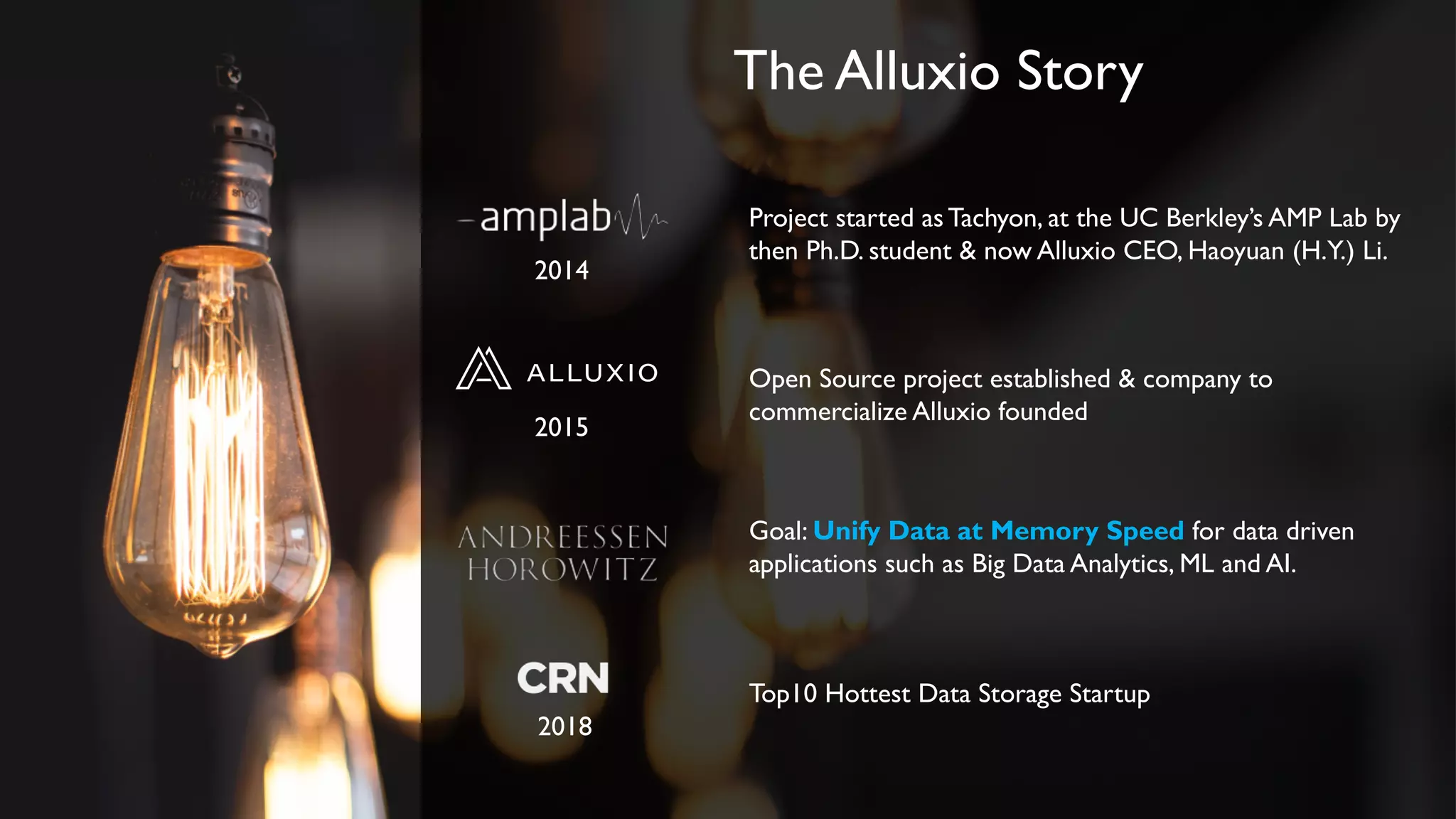
The Alluxio Story
Project started asTachyon, at the UC Berkley’s AMP Lab by
then Ph.D. student & now Alluxio CEO, Haoyuan (H.Y.) Li.
2014
2015
Open Source project established & company to
commercialize Alluxio founded
Goal: Unify Data at Memory Speed for data driven
applications such as Big Data Analytics, ML and AI.
2018
Top10 Hottest Data Storage Startup
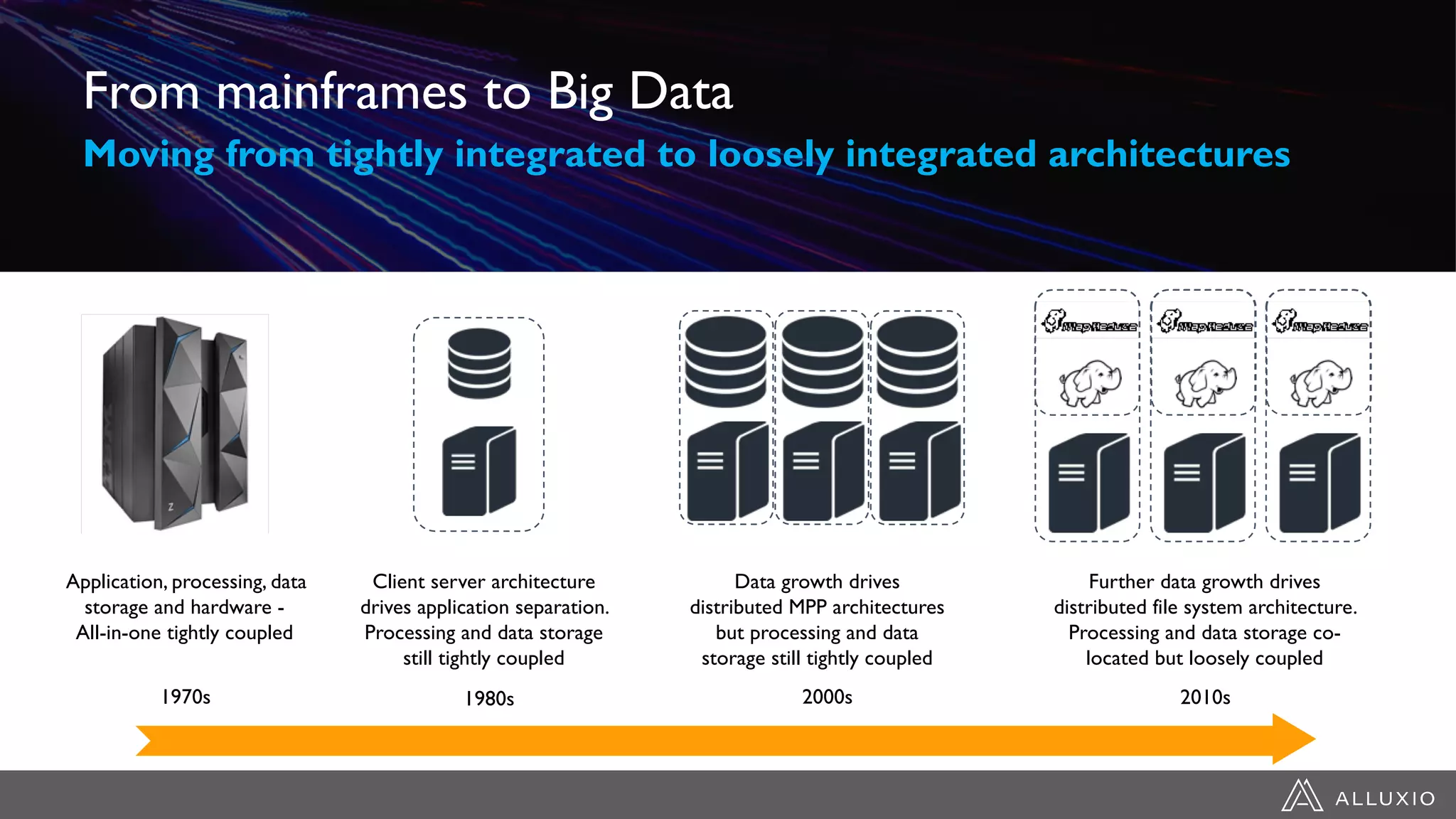
From mainframes to Big Data
Moving from tightly integrated to loosely integrated architectures
Application, processing, data
storage and hardware -
All-in-one tightly coupled
Client server architecture
drives application separation.
Processing and data storage
still tightly coupled
Data growth drives
distributed MPP architectures
but processing and data
storage still tightly coupled
Further data growth drives
distributed file system architecture.
Processing and data storage co-
located but loosely coupled
1970s 1980s 2000s 2010s
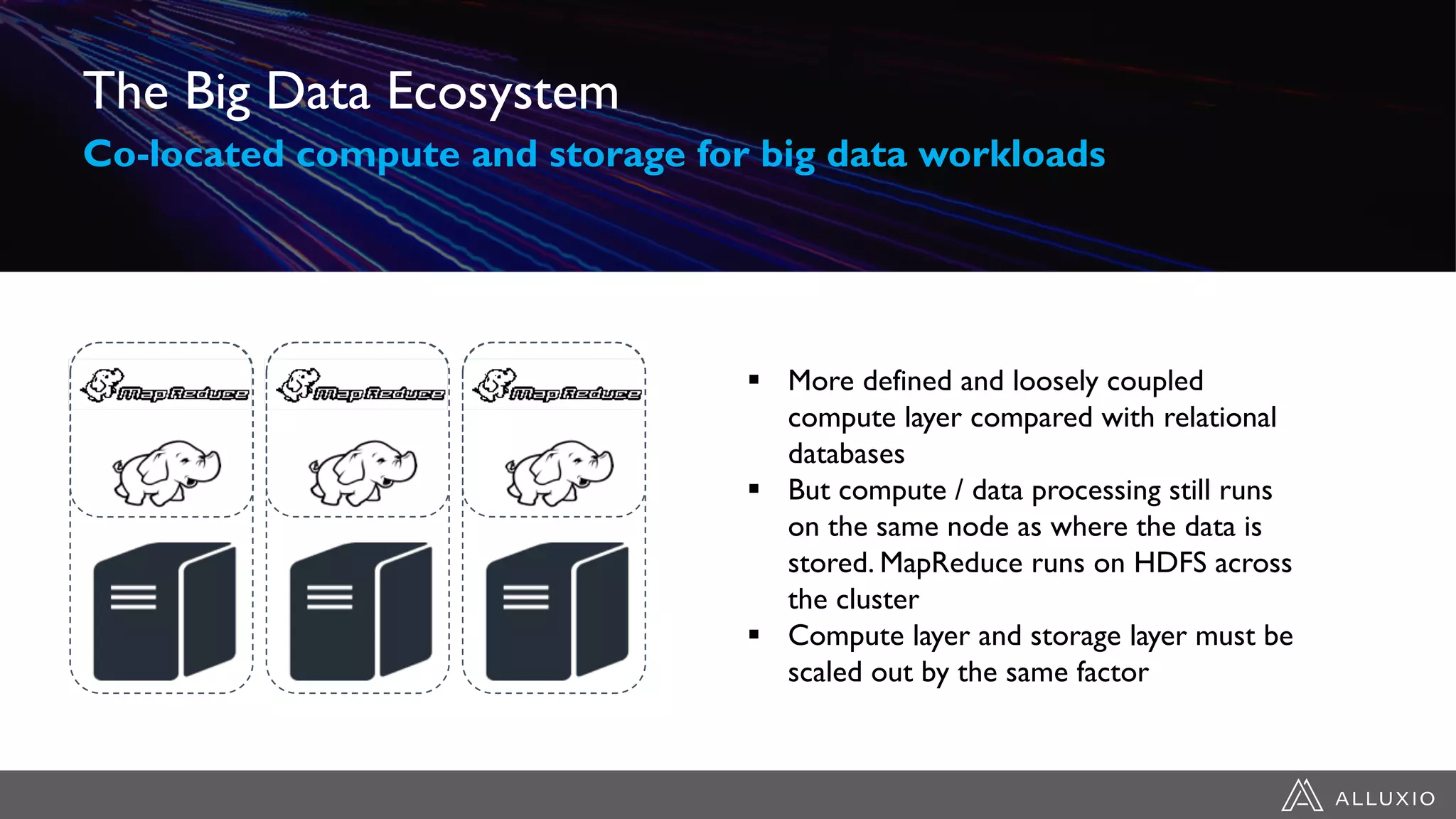
The Big Data Ecosystem
Co-located compute and storage for big data workloads
§ More defined and loosely coupled
compute layer compared with relational
databases
§ But compute / data processing still runs
on the same node as where the data is
stored. MapReduce runs on HDFS across
the cluster
§ Compute layer and storage layer must be
scaled out by the same factor
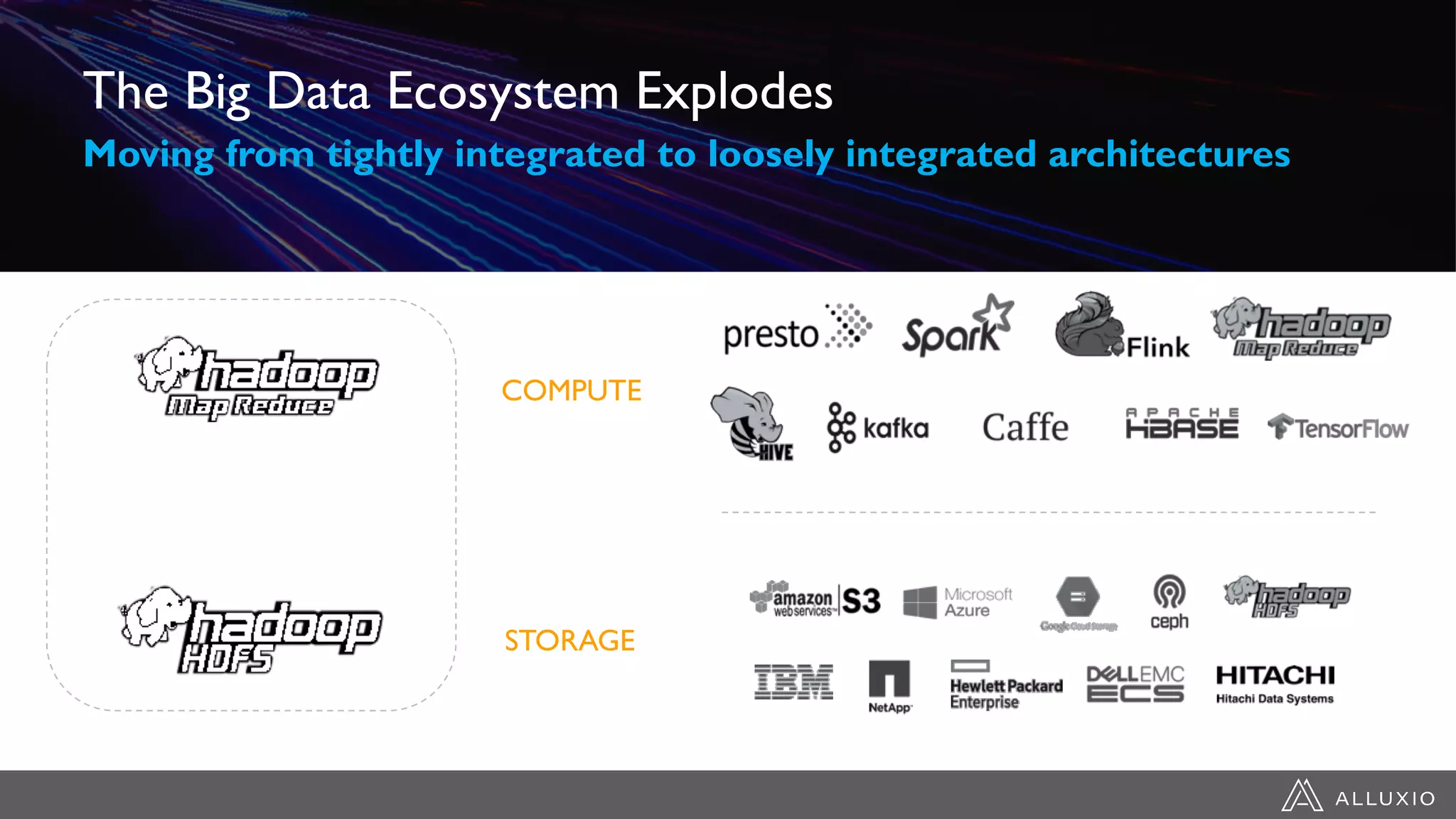
The Big Data Ecosystem Explodes
Moving from tightly integrated to loosely integrated architectures
STORAGE
COMPUTE
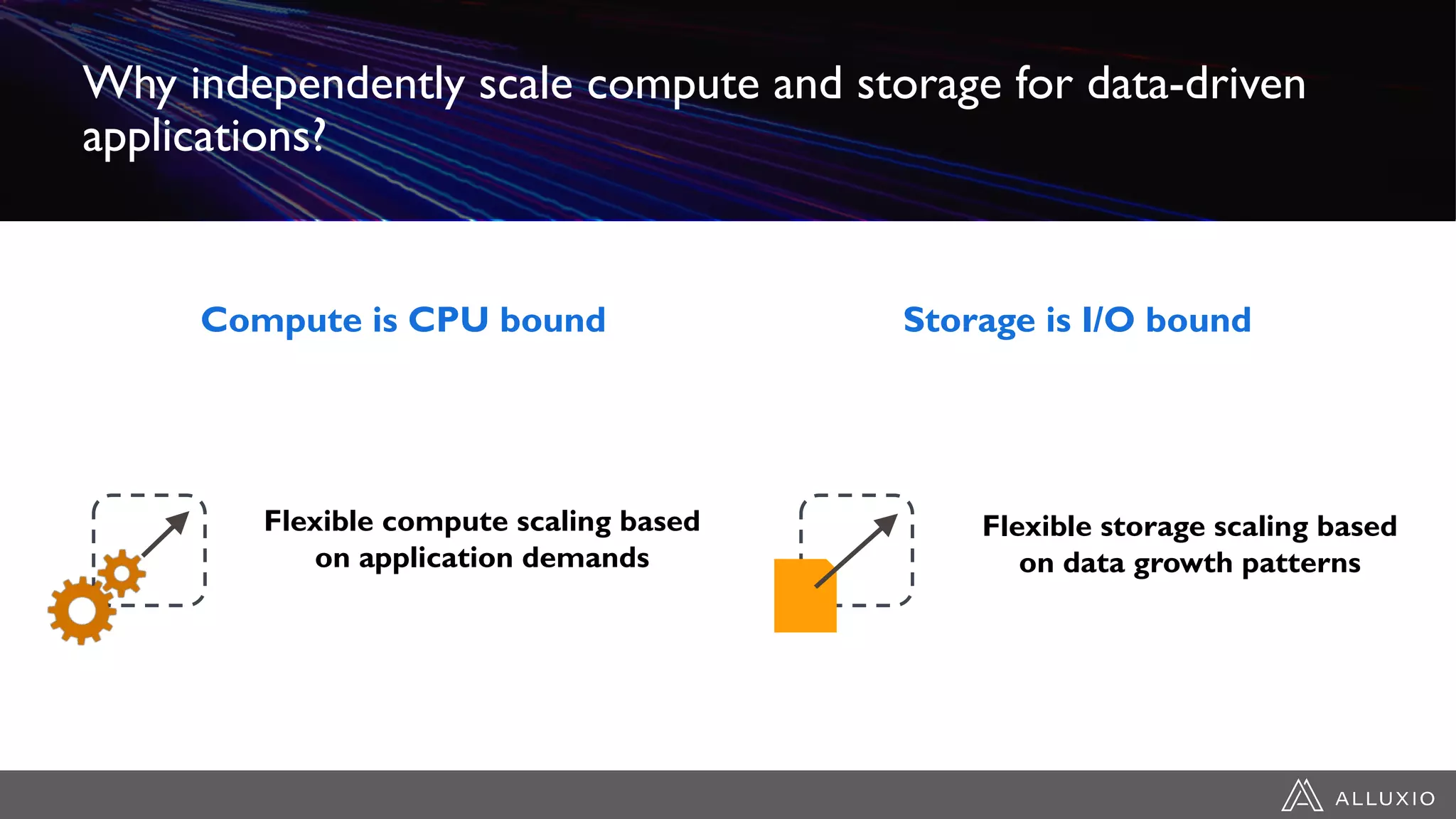
Why independently scale compute and storage for data-driven
applications?
Flexible compute scaling based
on application demands
Flexible storage scaling based
on data growth patterns
Compute is CPU bound Storage is I/O bound
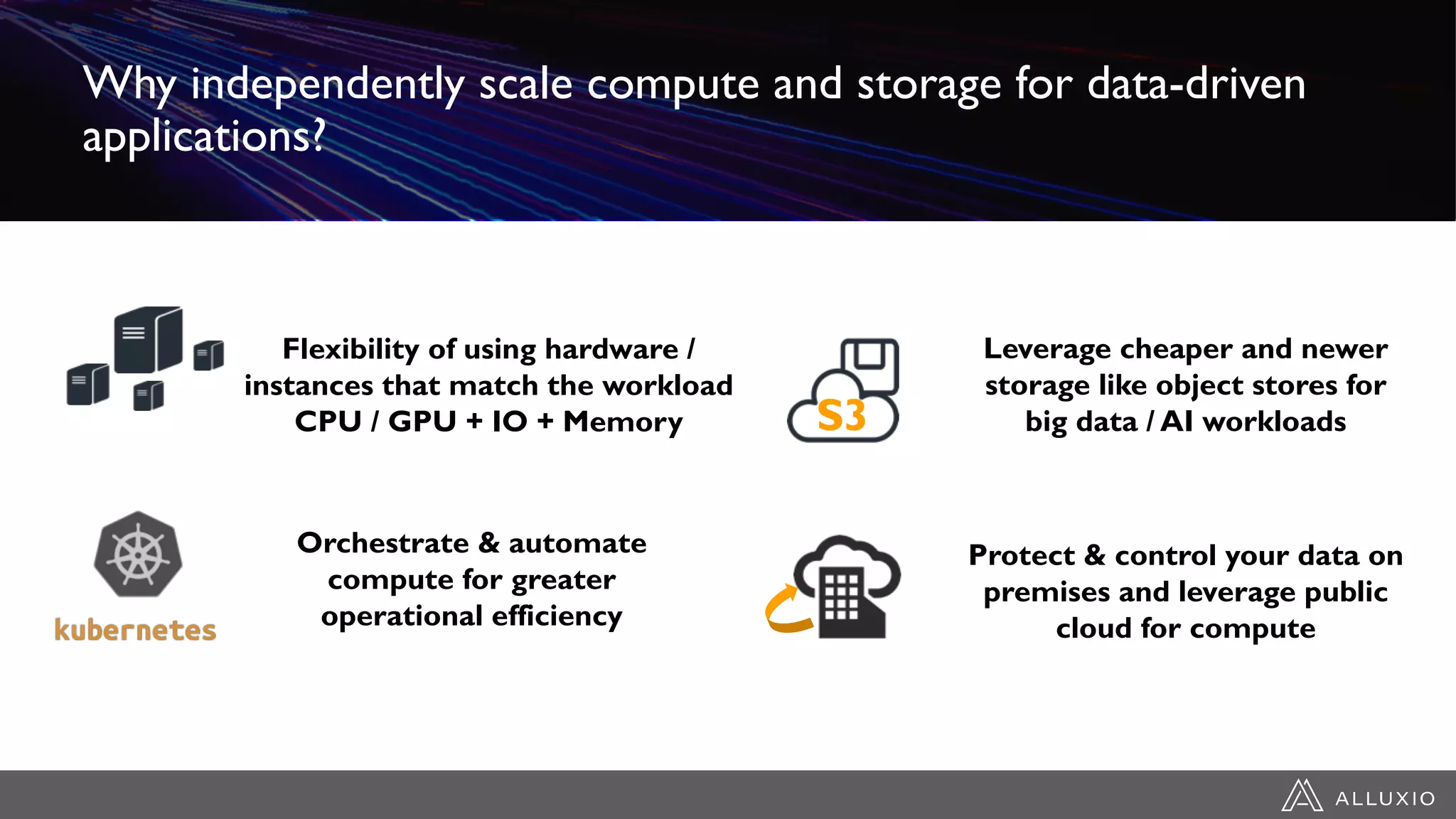
Why independently scale compute and storage for data-driven
applications?
Flexibility of using hardware /
instances that match the workload
CPU / GPU + IO + Memory S3
Leverage cheaper and newer
storage like object stores for
big data / AI workloads
Orchestrate & automate
compute for greater
operational efficiency
Protect & control your data on
premises and leverage public
cloud for compute
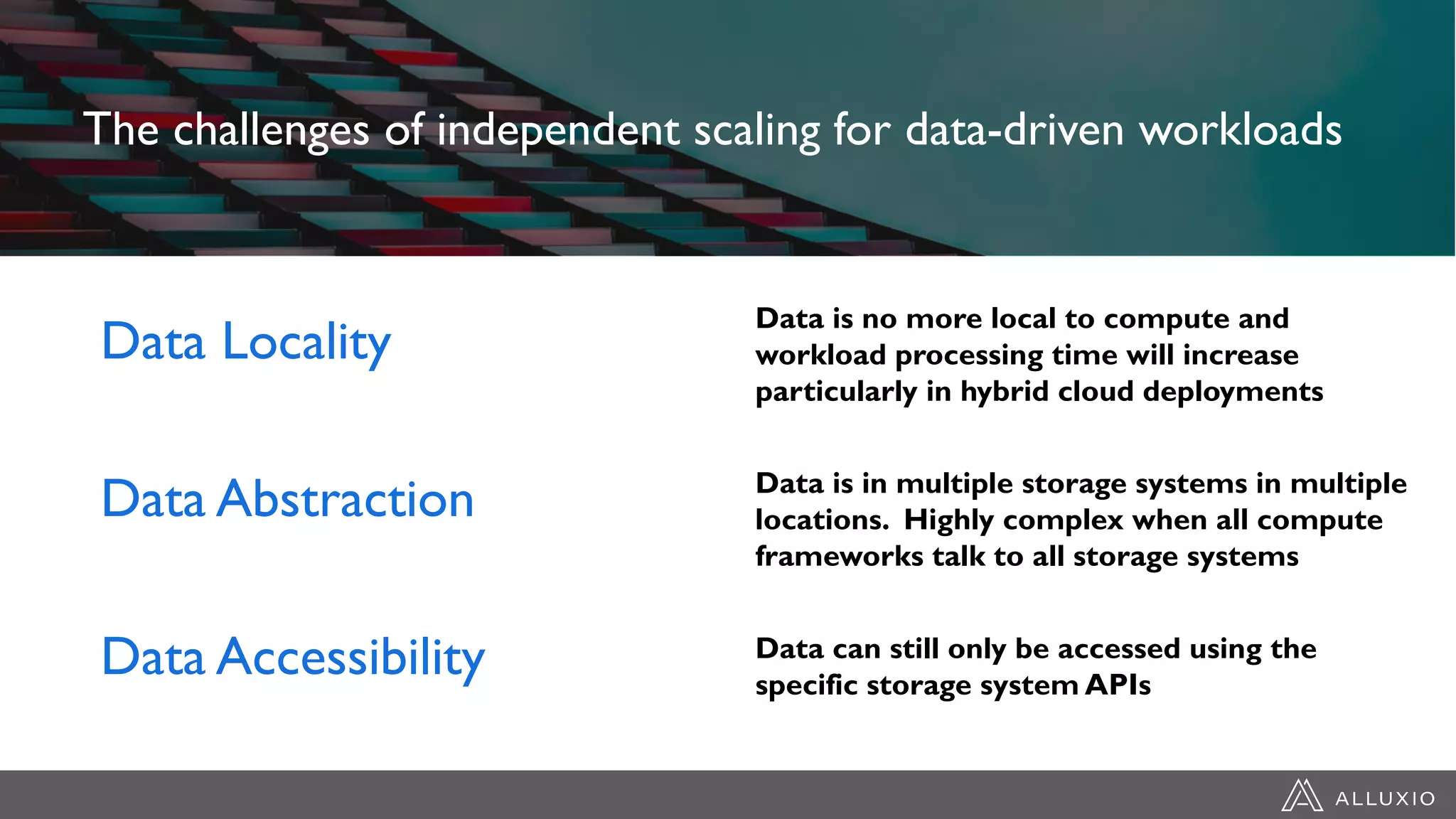
The challenges of independent scaling for data-driven workloads
Data Locality
Data Accessibility
Data Abstraction
Data is no more local to compute and
workload processing time will increase
particularly in hybrid cloud deployments
Data is in multiple storage systems in multiple
locations. Highly complex when all compute
frameworks talk to all storage systems
Data can still only be accessed using the
specific storage system APIs
Java File API HDFS Interface S3 Interface REST APIPOSIX Interface
HDFS Driver Swift Driver S3 Driver NFS Driver
Alluxio Key Innovations
Unified
Namespace
Bring all files into a
single interface
Interact with data
using any API
Accelerate & tier
data transparently
API
Translation
Intelligent
Multi-tiering
Key Innovations of theVirtual Unified File System
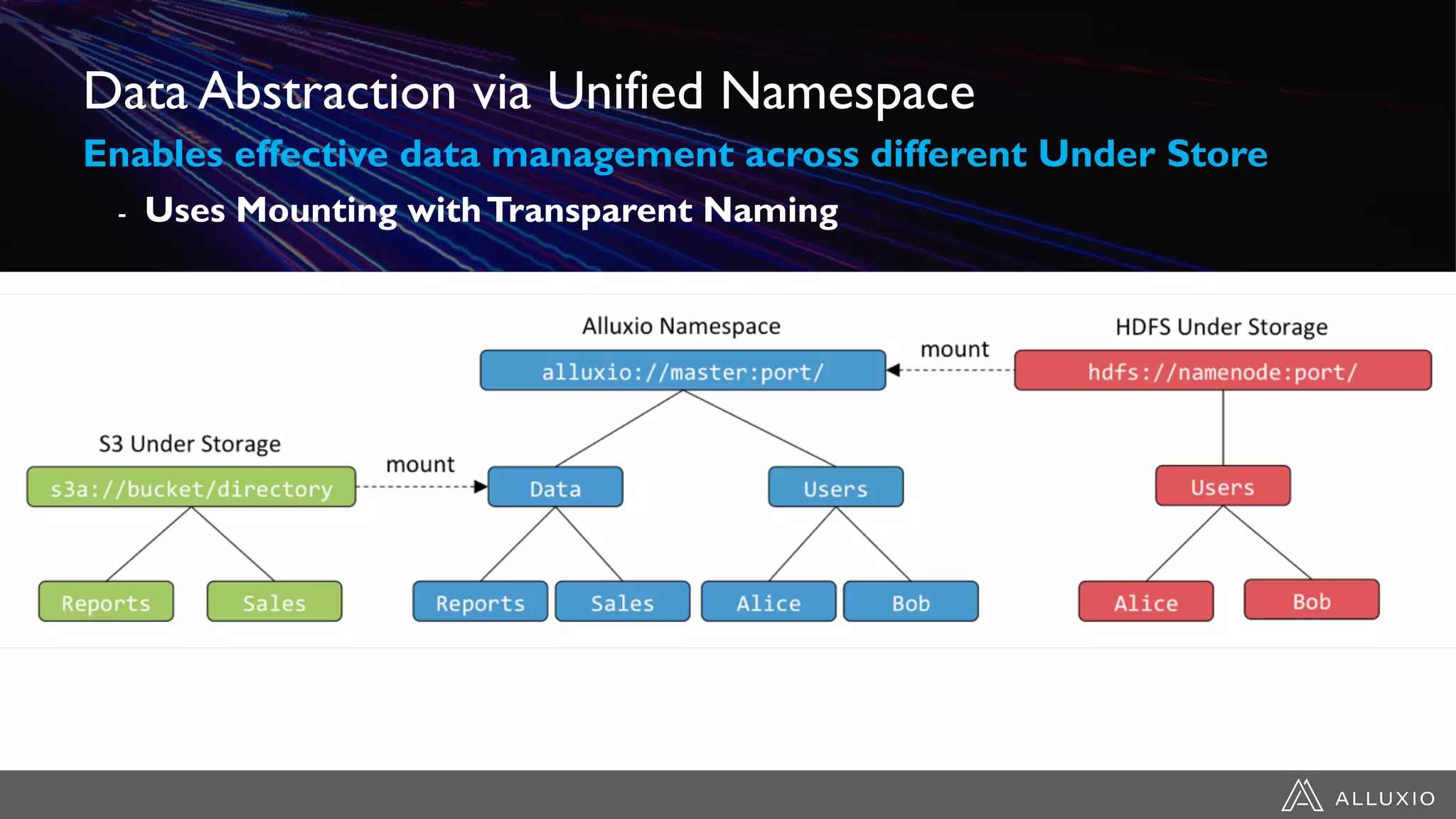
Data Abstraction via Unified Namespace
Enables effective data management across different Under Store
- Uses Mounting withTransparent Naming
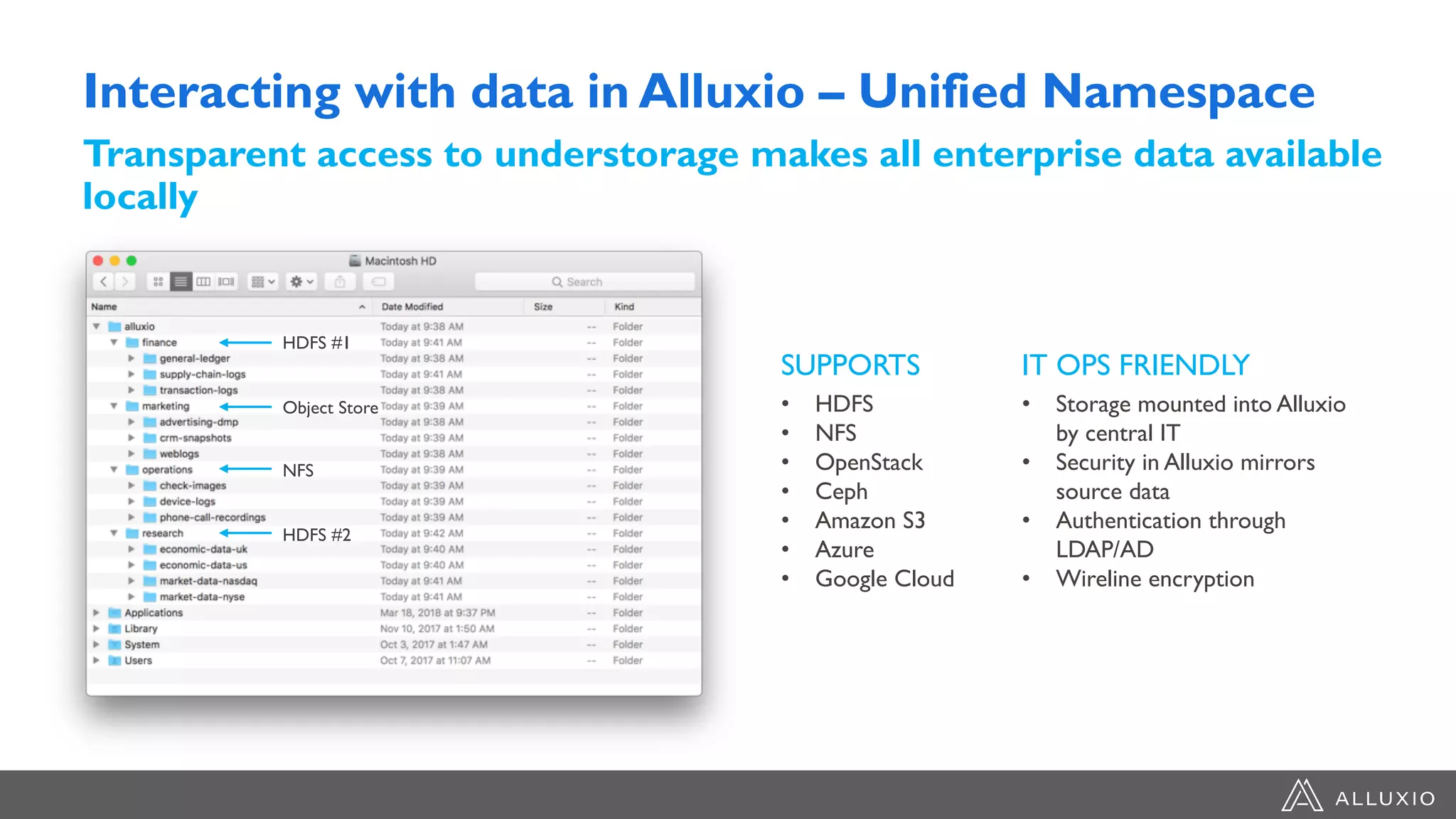
Unified Namespace: Global Data Accessibility
Transparent access to understorage makes all enterprise data available
locally
SUPPORTS
• HDFS
• NFS
• OpenStack
• Ceph
• Amazon S3
• Azure
• Google Cloud
IT OPS FRIENDLY
• Storage mounted into Alluxio
by central IT
• Security in Alluxio mirrors
source data
• Authentication through
LDAP/AD
• Wireline encryption
HDFS #1
Object Store
NFS
HDFS #2
Interacting with data in Alluxio – Unified Namespace
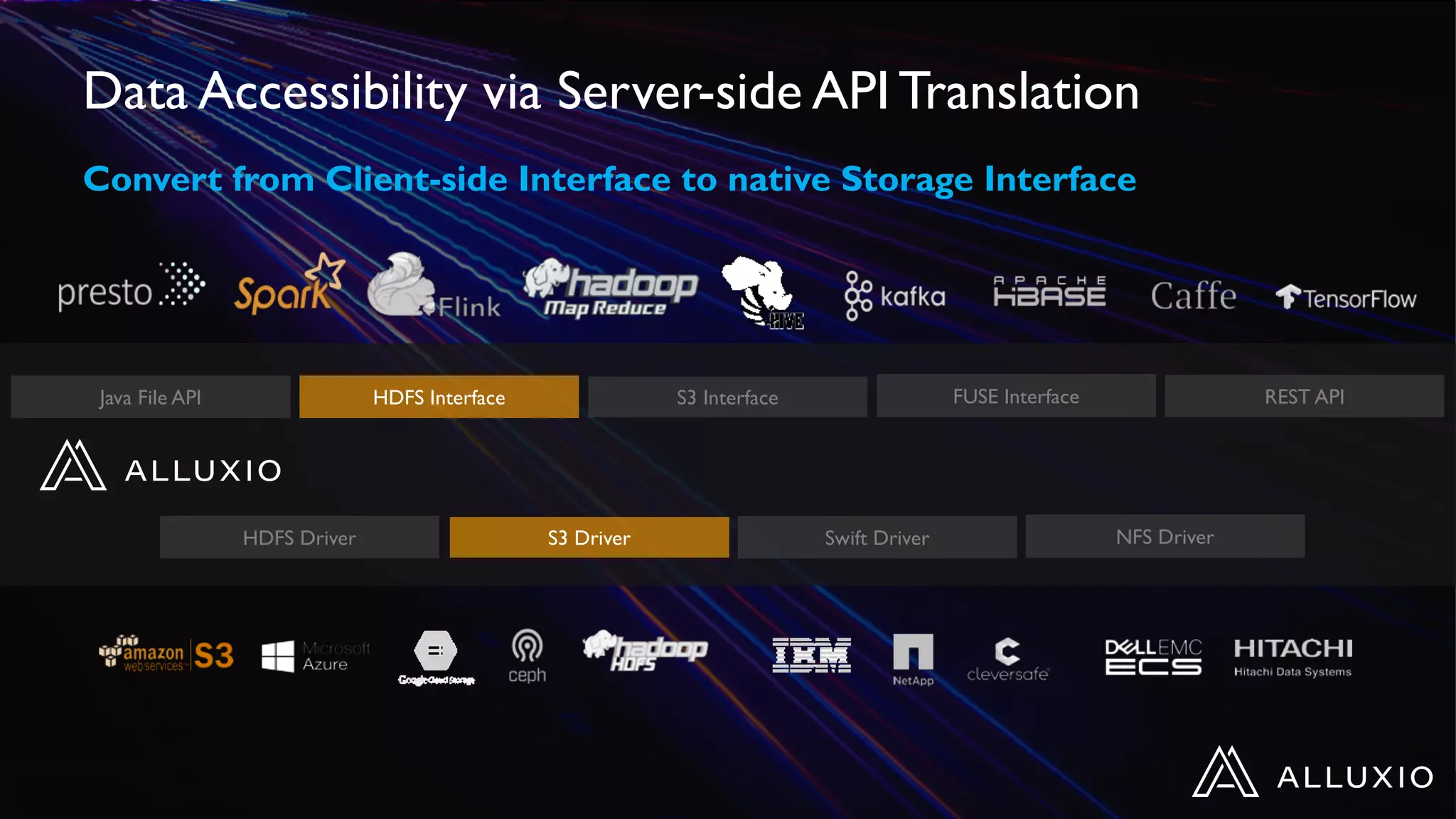
Data Accessibility via Server-side API Translation
Convert from Client-side Interface to native Storage Interface
Java File API HDFS Interface S3 Interface REST APIFUSE Interface
HDFS Driver Swift DriverS3 Driver NFS Driver
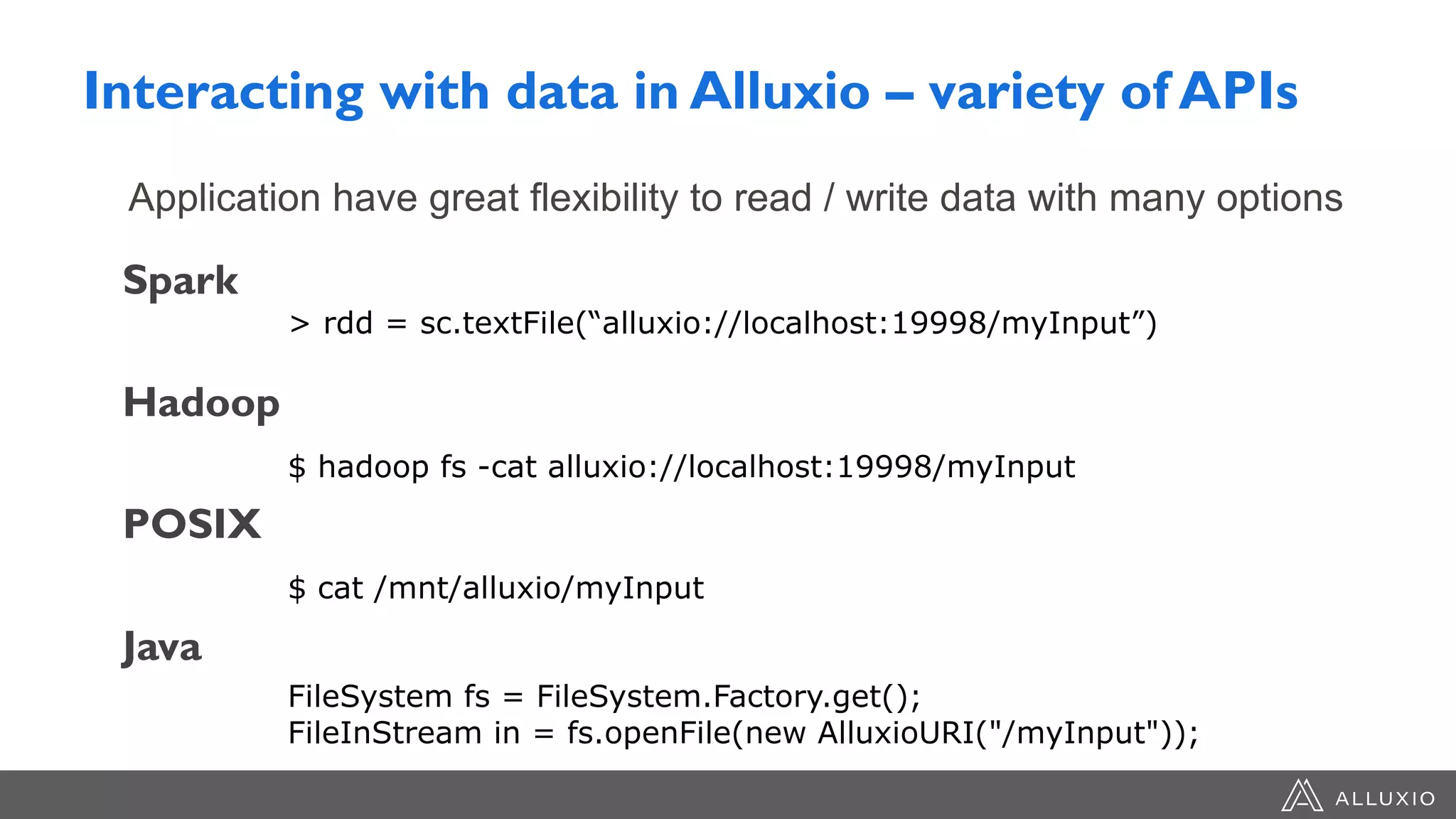
Interacting with data in Alluxio – variety of APIs
Spark
Hadoop
POSIX
Java
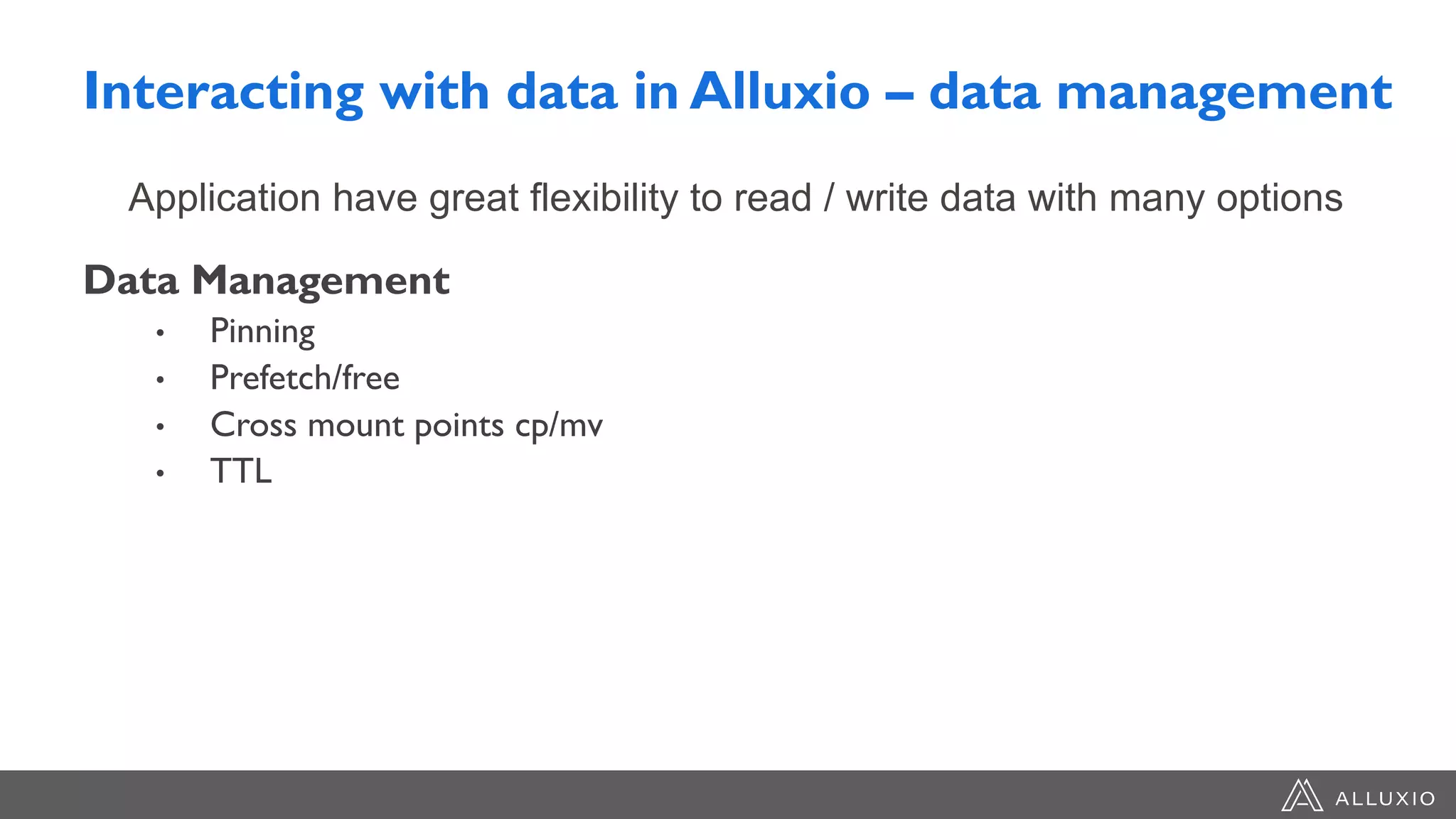
Application have great flexibility to read / write data with many options
> rdd = sc.textFile(“alluxio://localhost:19998/myInput”)
$ hadoop fs -cat alluxio://localhost:19998/myInput
$ cat /mnt/alluxio/myInput
FileSystem fs = FileSystem.Factory.get();
FileInStream in = fs.openFile(new AlluxioURI("/myInput"));
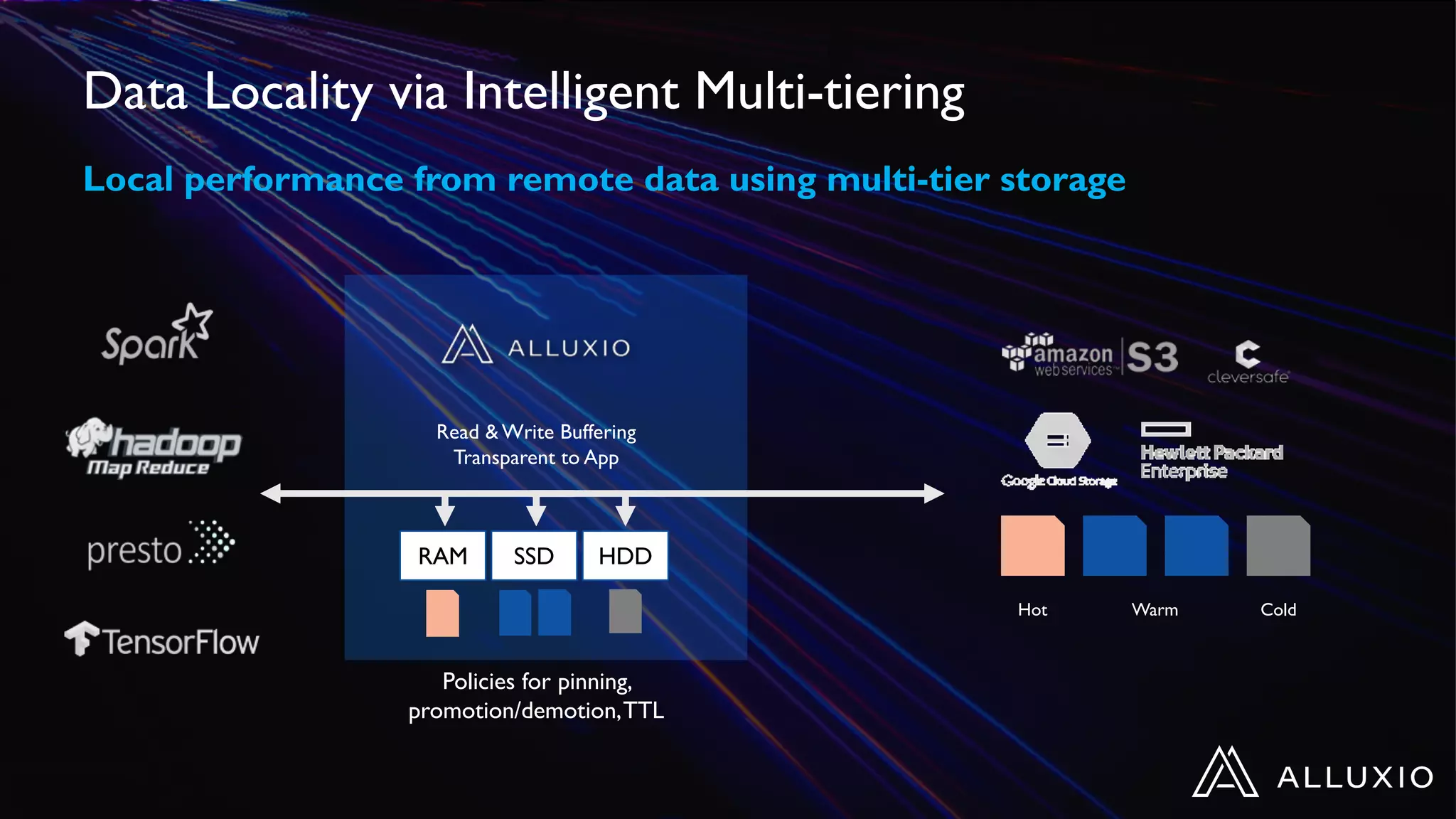
Data Locality via Intelligent Multi-tiering
Local performance from remote data using multi-tier storage
Hot Warm Cold
RAM SSD HDD
Read & Write Buffering
Transparent to App
Policies for pinning,
promotion/demotion,TTL
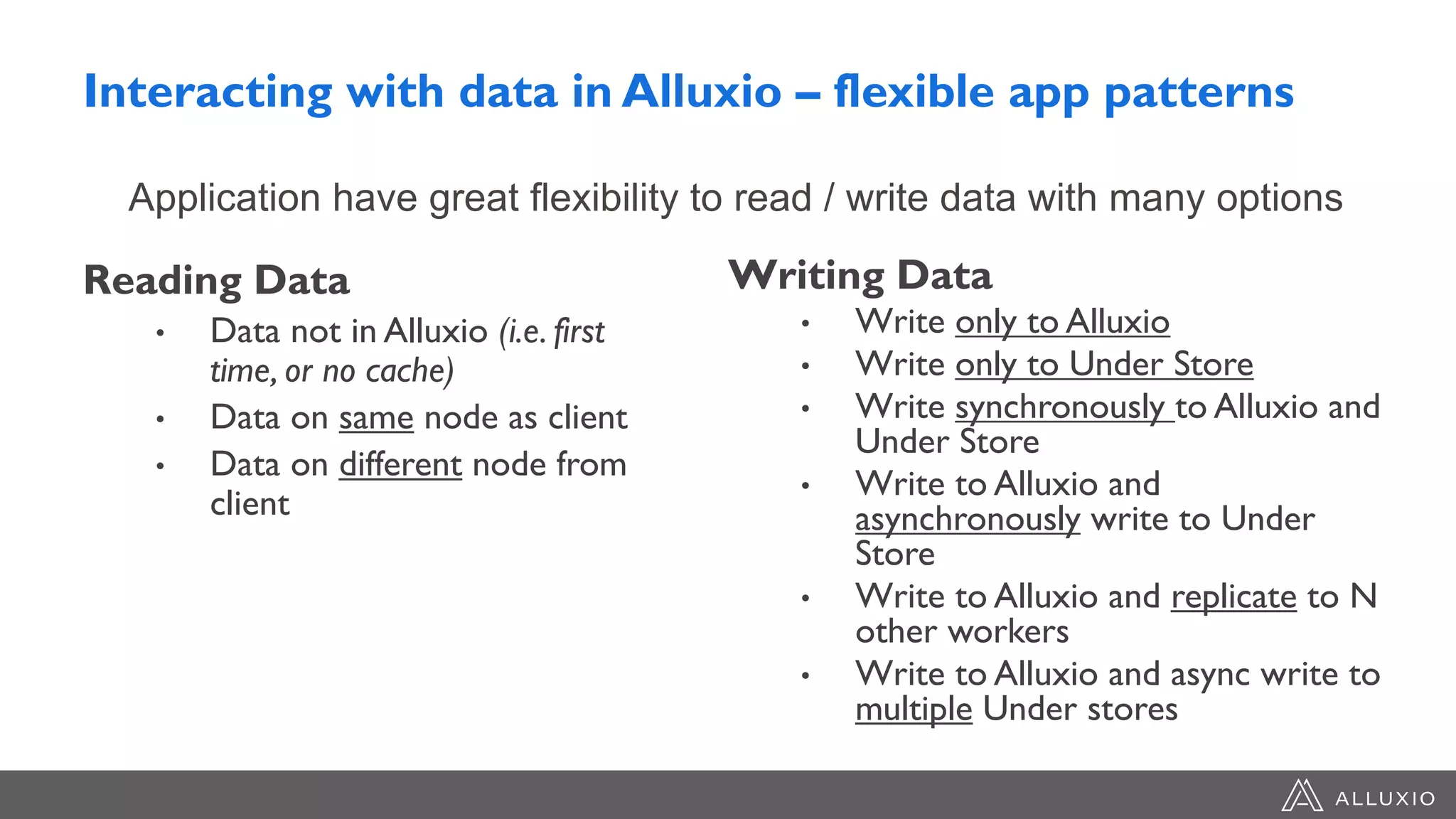
Interacting with data in Alluxio – flexible app patterns
Reading Data
• Data not in Alluxio (i.e. first
time, or no cache)
• Data on same node as client
• Data on different node from
client
Writing Data
• Write only to Alluxio
• Write only to Under Store
• Write synchronously to Alluxio and
Under Store
• Write to Alluxio and
asynchronously write to Under
Store
• Write to Alluxio and replicate to N
other workers
• Write to Alluxio and async write to
multiple Under stores
Application have great flexibility to read / write data with many options
Interacting with data in Alluxio – data management
Data Management
• Pinning
• Prefetch/free
• Cross mount points cp/mv
• TTL
Application have great flexibility to read / write data with many options
Demo: Spark + Alluxio + S3
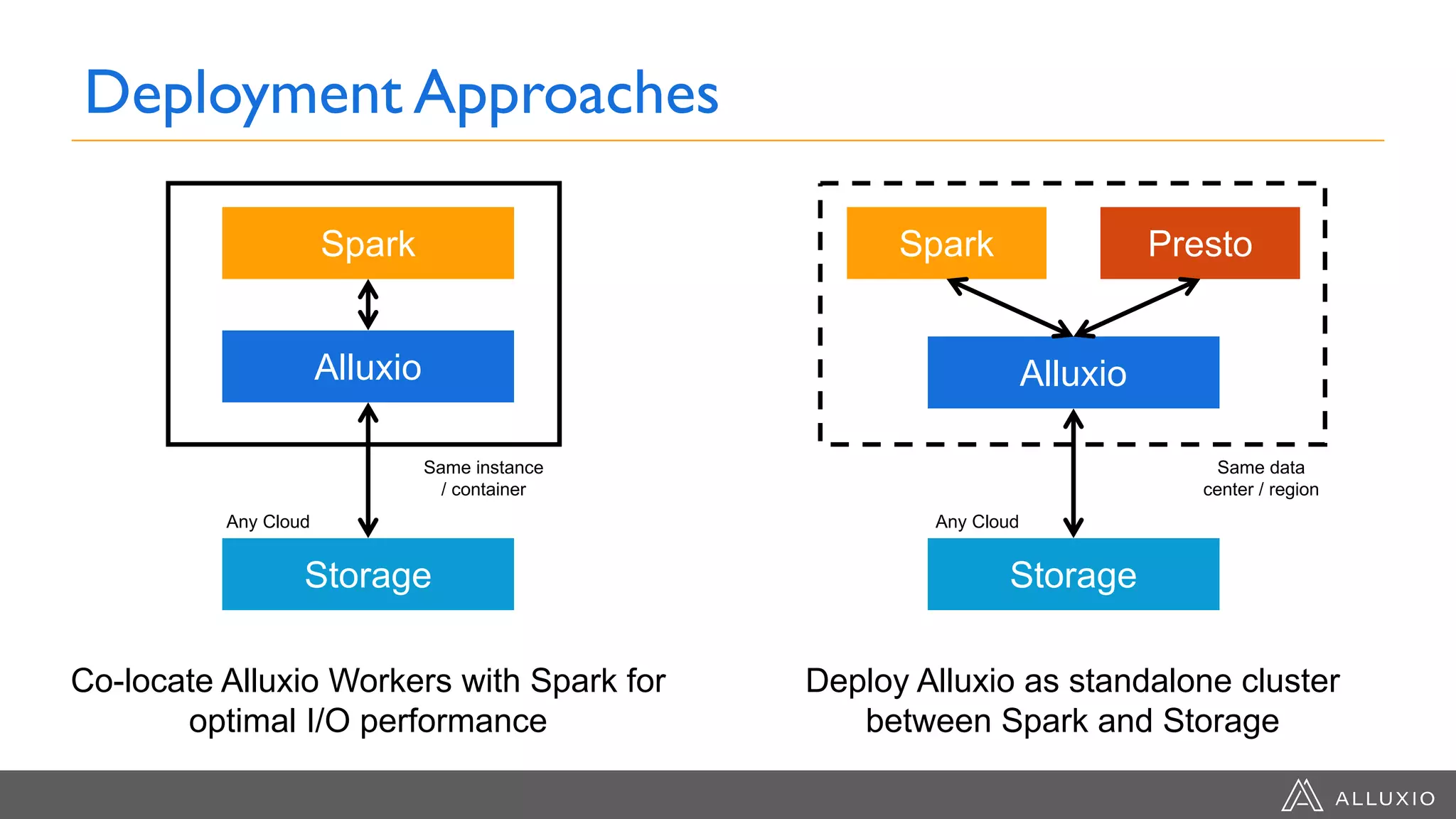
Deployment Approaches
Spark
Alluxio
Storage
Co-locate Alluxio Workers with Spark for
optimal I/O performance
Any Cloud
Same instance
/ container
Spark
Alluxio
Storage
Deploy Alluxio as standalone cluster
between Spark and Storage
Any Cloud
Same data
center / region
Presto
Alluxio
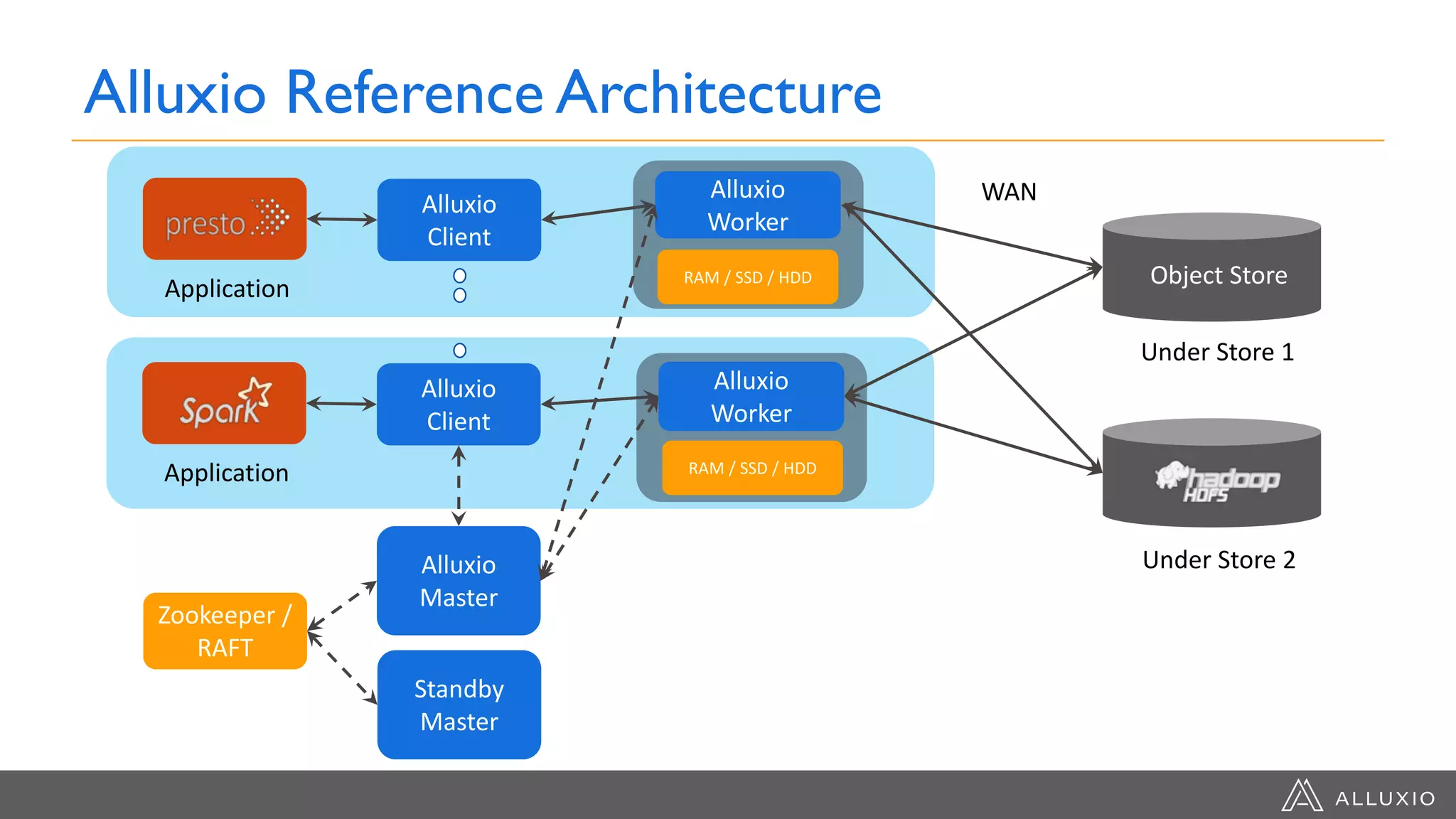
Master
Zookeeper /
RAFT
Standby
Master
Under Store 1
Under Store 2
WANAlluxio
Client
Application Object Store
Alluxio
Client
Application
Alluxio
Worker
RAM / SSD / HDD
Alluxio
Worker
RAM / SSD / HDD
Alluxio Reference Architecture
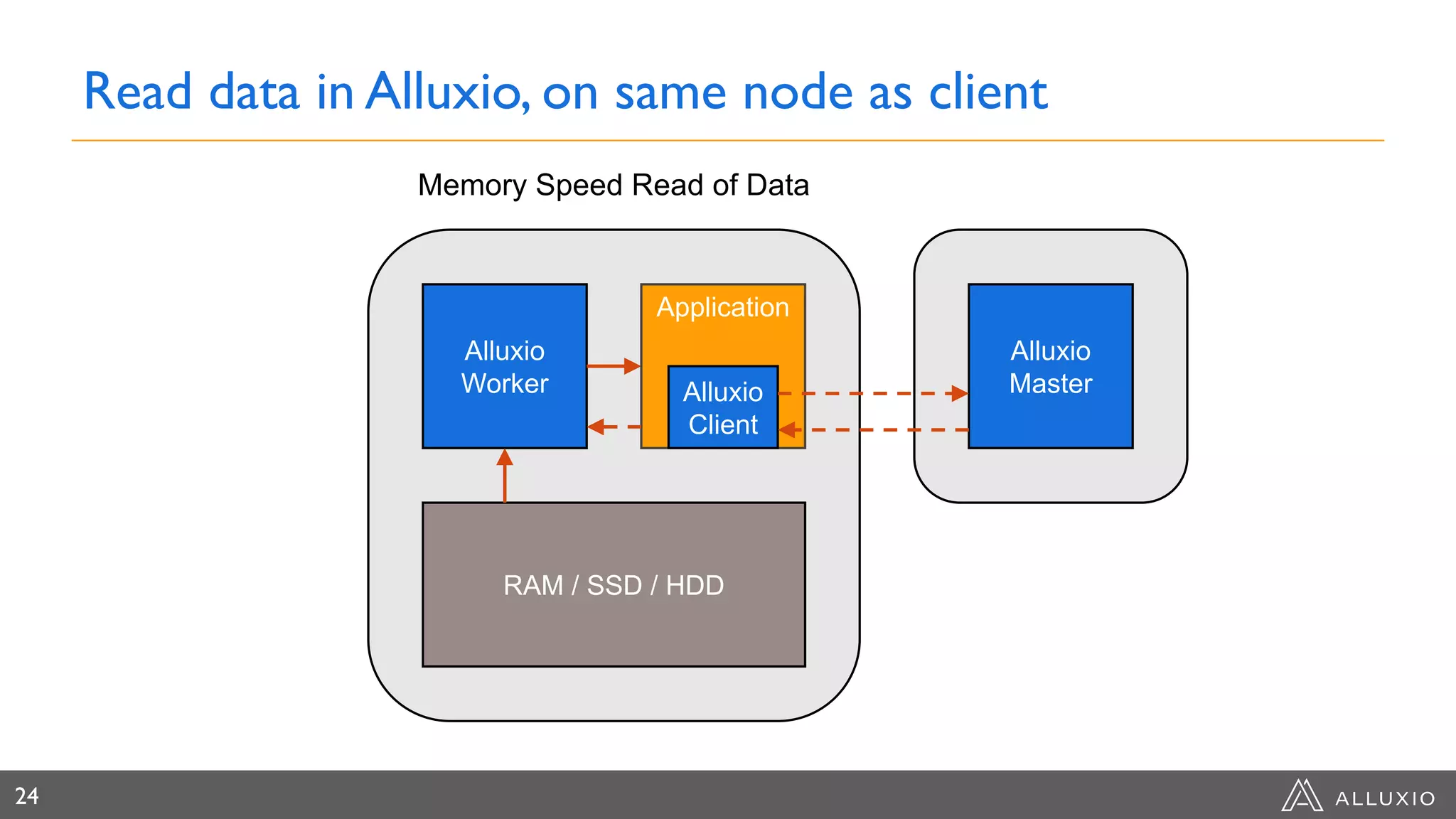
Read data in Alluxio, on same node as client
24
Alluxio
Worker
RAM / SSD / HDD
Memory Speed Read of Data
Application
Alluxio
Client
Alluxio
Master
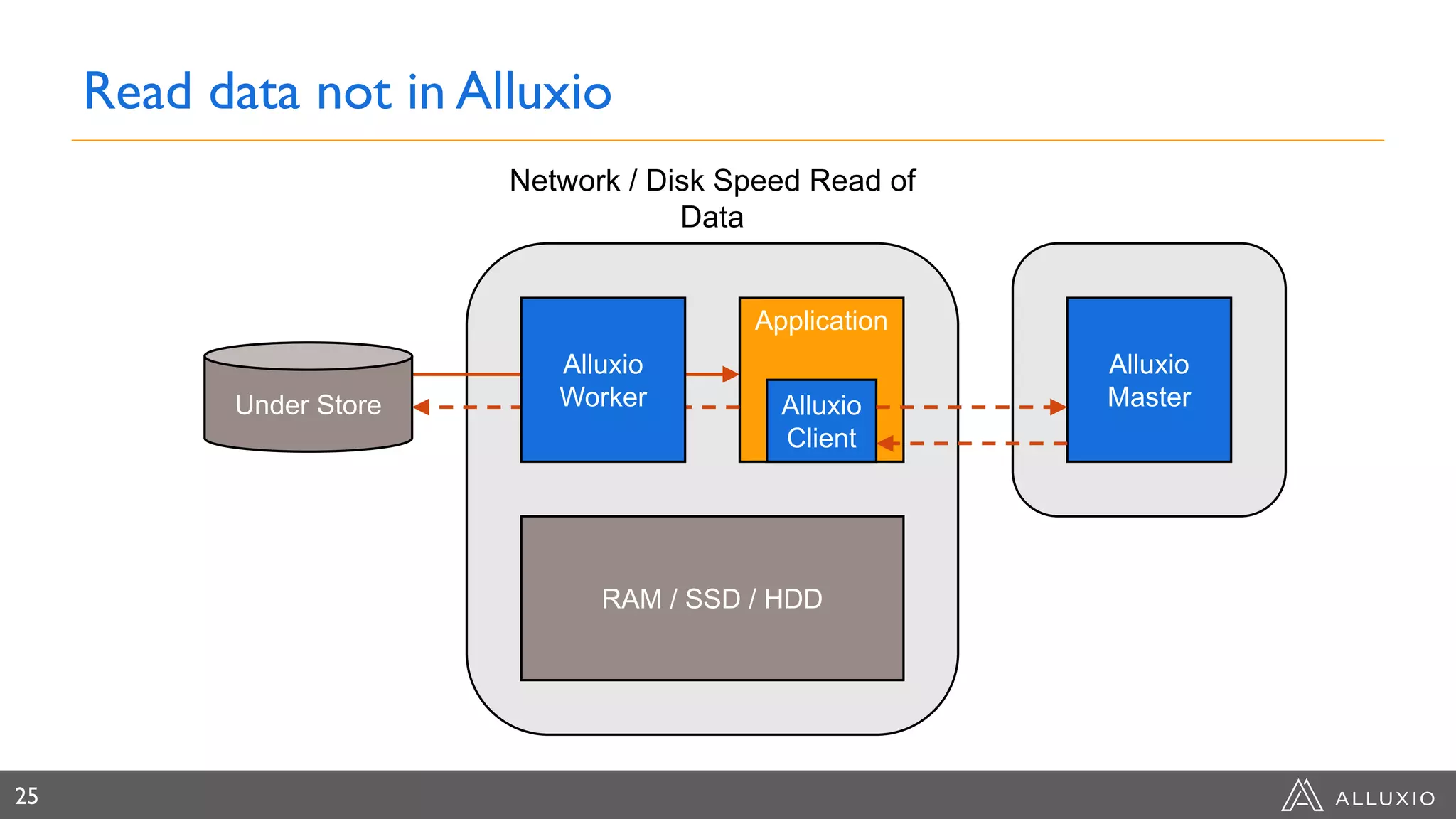
Read data not in Alluxio
25
RAM / SSD / HDD
Network / Disk Speed Read of
Data
Application
Alluxio
Client
Alluxio
Master
Alluxio
WorkerUnder Store
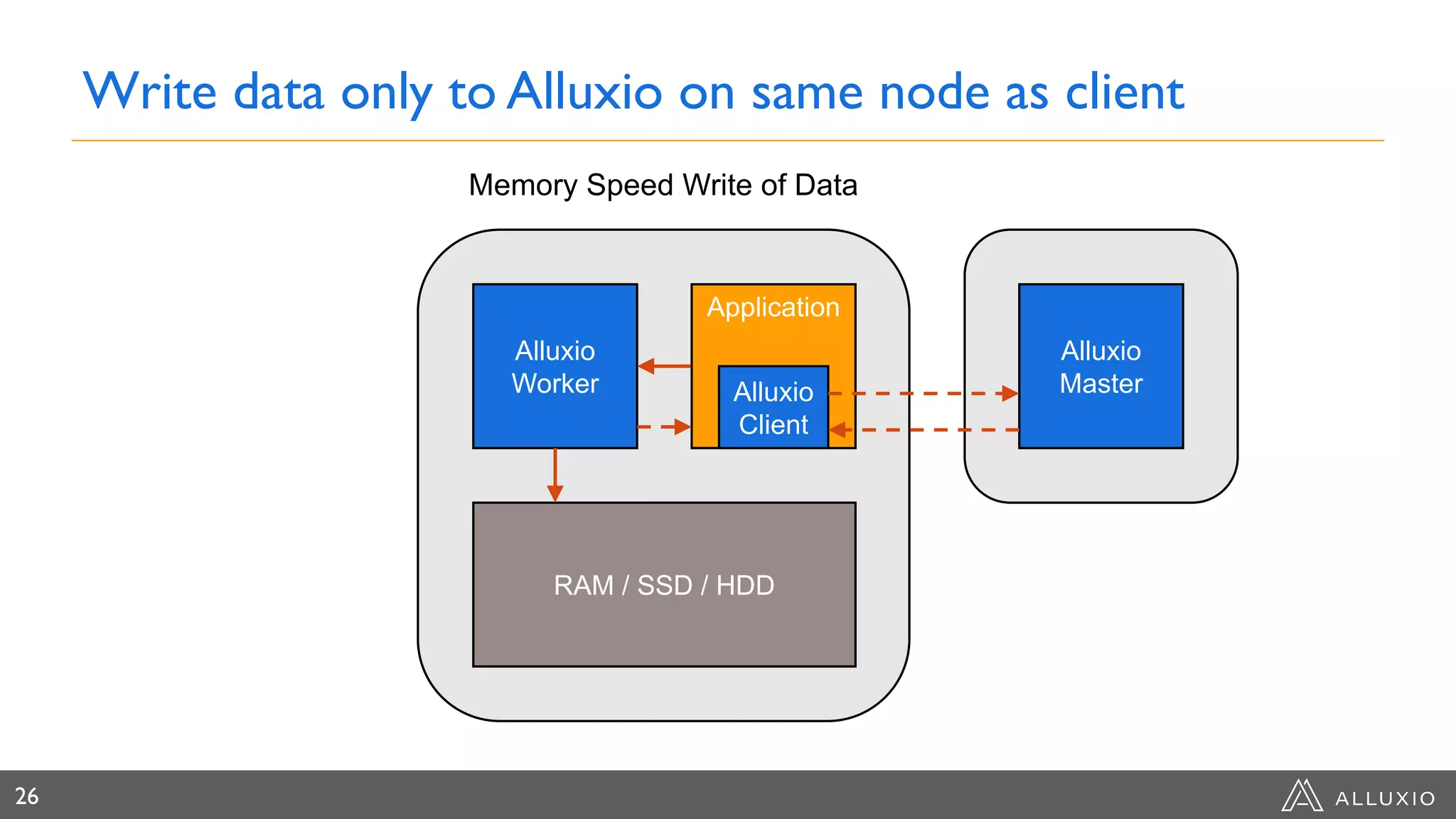
Write data only to Alluxio on same node as client
26
Alluxio
Worker
RAM / SSD / HDD
Memory Speed Write of Data
Application
Alluxio
Client
Alluxio
Master
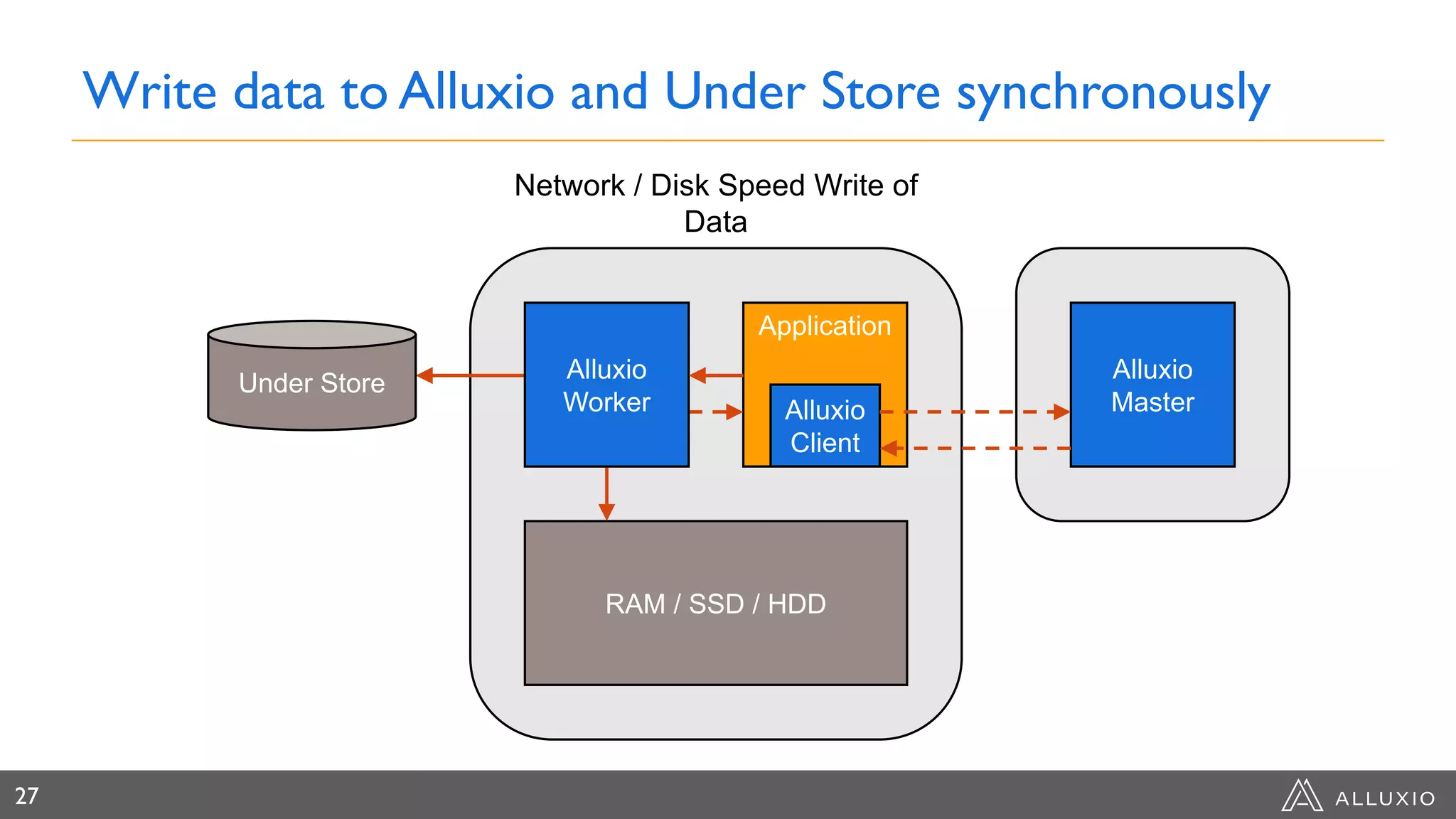
Write data to Alluxio and Under Store synchronously
27
RAM / SSD / HDD
Network / Disk Speed Write of
Data
Application
Alluxio
Client
Alluxio
Master
Alluxio
Worker
Under Store
Real world Use cases
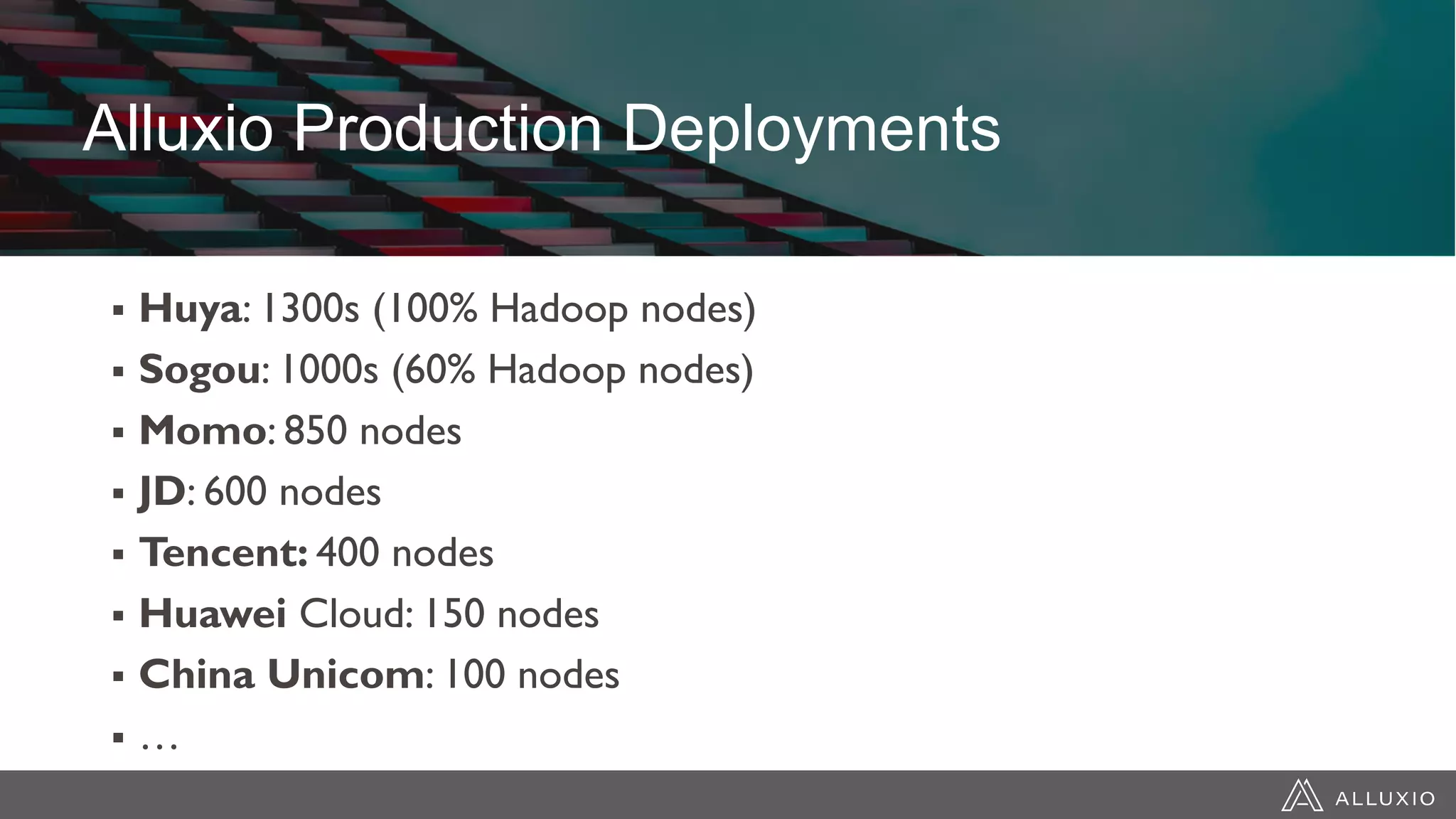
§ Huya: 1300s (100% Hadoop nodes)
§ Sogou: 1000s (60% Hadoop nodes)
§ Momo: 850 nodes
§ JD: 600 nodes
§ Tencent: 400 nodes
§ Huawei Cloud: 150 nodes
§ China Unicom: 100 nodes
§ …
Truly independent scaling of the data stack
Alluxio Production Deployments
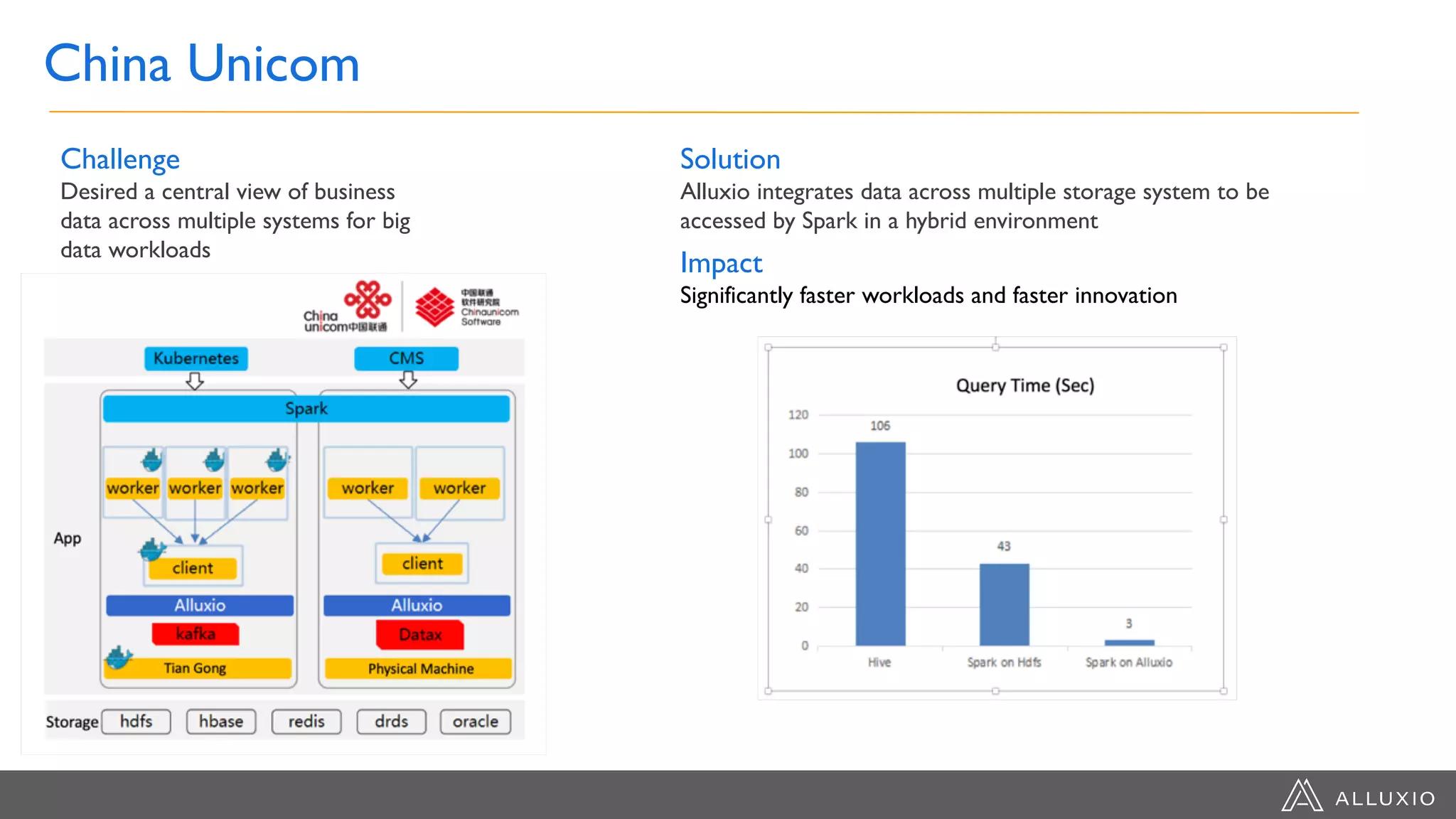
China Unicom
Challenge
Desired a central view of business
data across multiple systems for big
data workloads
Solution
Alluxio integrates data across multiple storage system to be
accessed by Spark in a hybrid environment
Impact
Significantly faster workloads and faster innovation
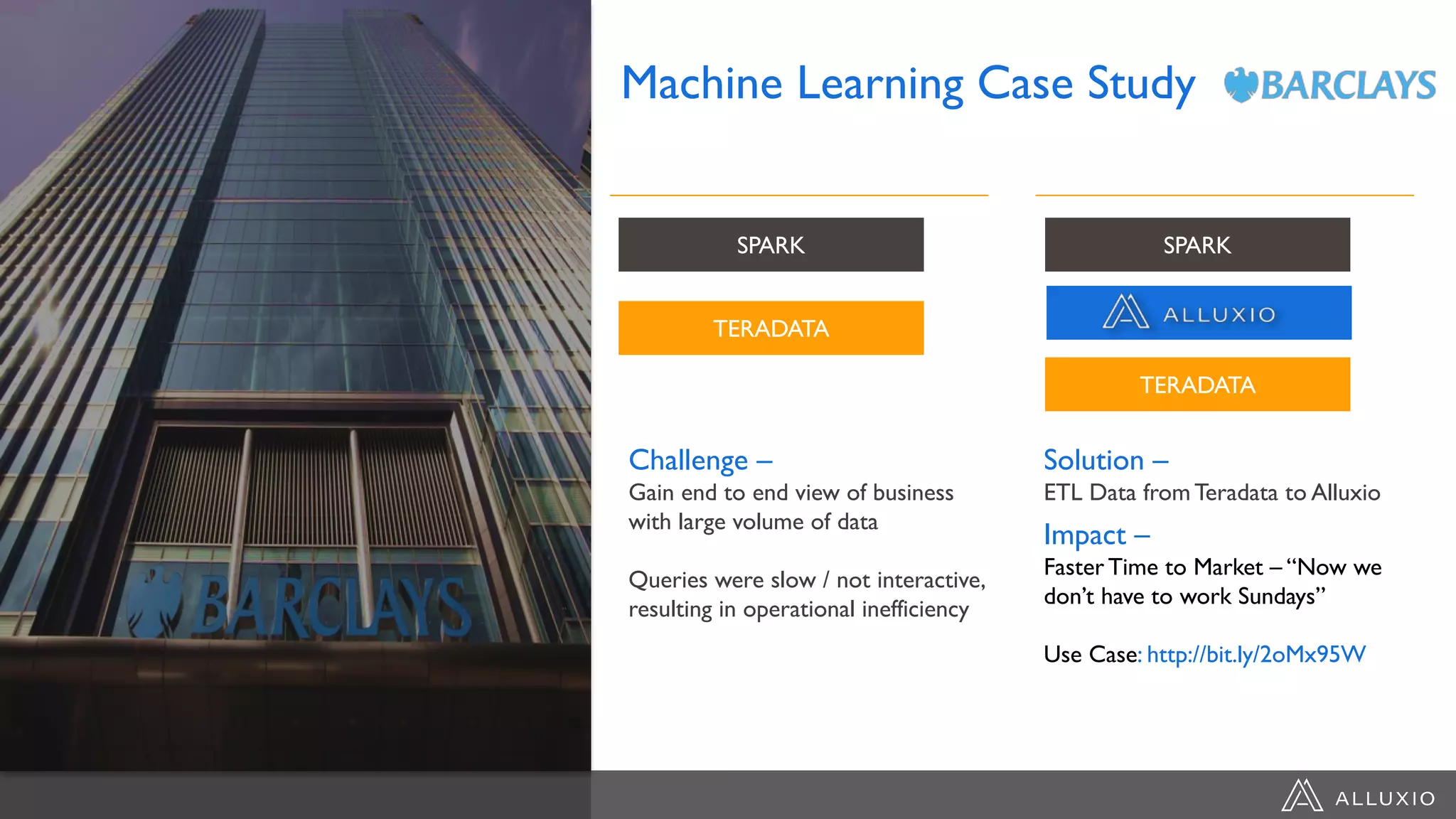
Machine Learning Case Study
Challenge –
Gain end to end view of business
with large volume of data
Queries were slow / not interactive,
resulting in operational inefficiency
Solution –
ETL Data from Teradata to Alluxio
Impact –
Faster Time to Market – “Now we
don’t have to work Sundays”
Use Case: http://bit.ly/2oMx95W
SPARK
TERADATA
SPARK
TERADATA
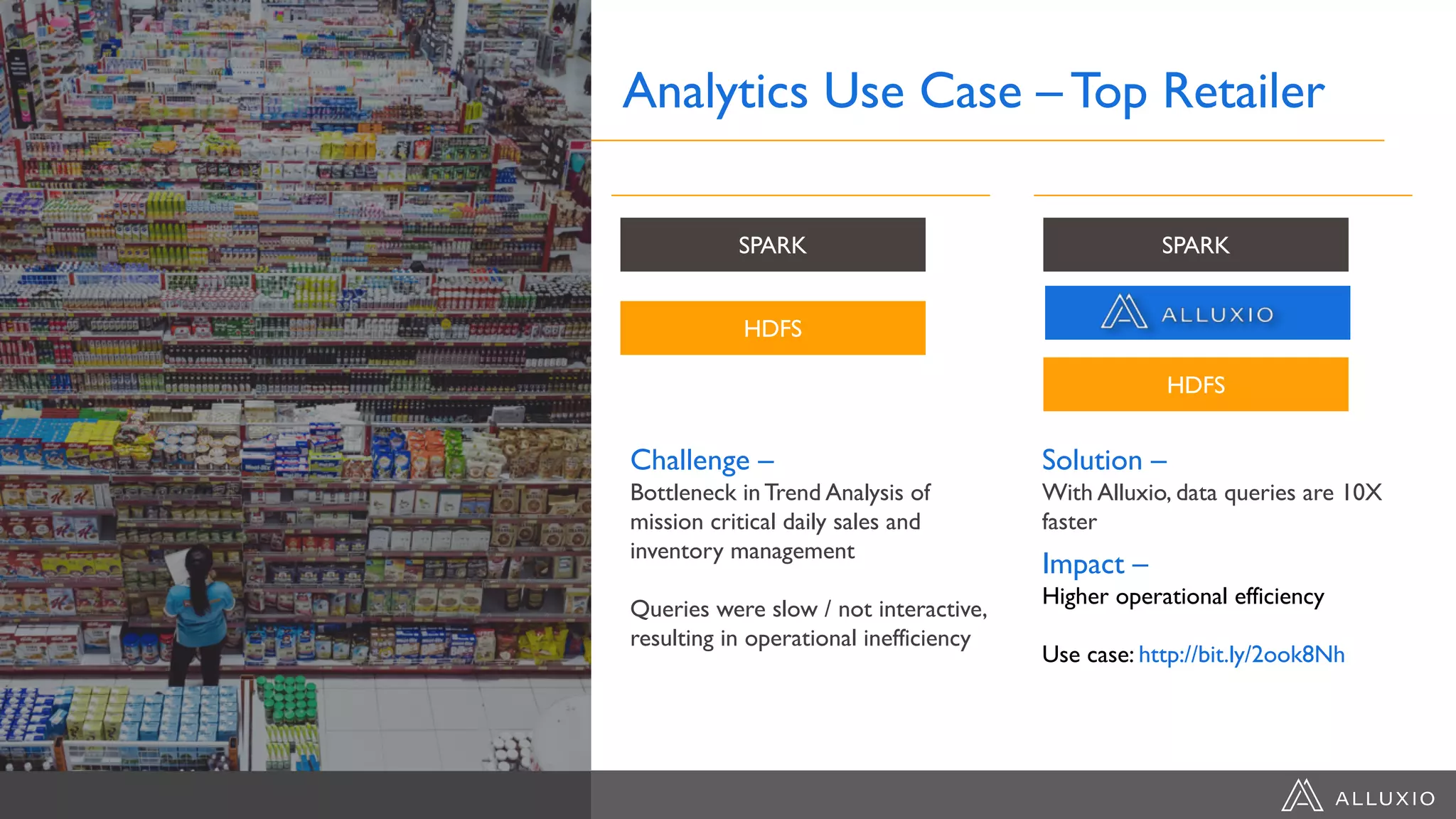
Analytics Use Case – Top Retailer
Challenge –
Bottleneck in Trend Analysis of
mission critical daily sales and
inventory management
Queries were slow / not interactive,
resulting in operational inefficiency
Solution –
With Alluxio, data queries are 10X
faster
Impact –
Higher operational efficiency
Use case: http://bit.ly/2ook8Nh
SPARK
HDFS
SPARK
HDFS
Truly independent scaling of the data stack
Coming Online Events: POSIX API & 2.0 Preview
https://go.alluxio.org/OH-Running-Tensorflow-Alluxio-S3 https://go.alluxio.com/webinar-alluxio-preview-release
Incredible Open Source Momentum with growing community
900+ contributors &
growing
3900+ Git Stars
Apache 2.0 Licensed
Hundreds of thousands
of downloads
https://www.alluxio.org/slack

Achieving compute and storage independence for data-driven workloads

  • 1.
    Achieving compute andstorage independence for data-driven workloads Two SigmaOpen Source Meetup Wenbo Zhao | Software Engineer |Two Sigma Bin Fan | Founding Engineer &VP, Open Source | Alluxio
  • 2.
    Agenda Why storage-independent compute? AlluxioOverview Demo: Spark + Alluxio + S3 Future work
  • 3.
    A Stack toEnable Cost-Effective Elastic Compute Spark/Presto/TF.. Alluxio HDFS Public Cloud On-Prem Burst compute workload to Cloud Data in a fully controlled environment Improved Data Locality
  • 4.
    The Alluxio Story Projectstarted asTachyon, at the UC Berkley’s AMP Lab by then Ph.D. student & now Alluxio CEO, Haoyuan (H.Y.) Li. 2014 2015 Open Source project established & company to commercialize Alluxio founded Goal: Unify Data at Memory Speed for data driven applications such as Big Data Analytics, ML and AI. 2018 Top10 Hottest Data Storage Startup
  • 5.
    From mainframes toBig Data Moving from tightly integrated to loosely integrated architectures Application, processing, data storage and hardware - All-in-one tightly coupled Client server architecture drives application separation. Processing and data storage still tightly coupled Data growth drives distributed MPP architectures but processing and data storage still tightly coupled Further data growth drives distributed file system architecture. Processing and data storage co- located but loosely coupled 1970s 1980s 2000s 2010s
  • 6.
    The Big DataEcosystem Co-located compute and storage for big data workloads § More defined and loosely coupled compute layer compared with relational databases § But compute / data processing still runs on the same node as where the data is stored. MapReduce runs on HDFS across the cluster § Compute layer and storage layer must be scaled out by the same factor
  • 7.
    The Big DataEcosystem Explodes Moving from tightly integrated to loosely integrated architectures STORAGE COMPUTE
  • 8.
    Why independently scalecompute and storage for data-driven applications? Flexible compute scaling based on application demands Flexible storage scaling based on data growth patterns Compute is CPU bound Storage is I/O bound
  • 9.
    Why independently scalecompute and storage for data-driven applications? Flexibility of using hardware / instances that match the workload CPU / GPU + IO + Memory S3 Leverage cheaper and newer storage like object stores for big data / AI workloads Orchestrate & automate compute for greater operational efficiency Protect & control your data on premises and leverage public cloud for compute
  • 10.
    The challenges ofindependent scaling for data-driven workloads Data Locality Data Accessibility Data Abstraction Data is no more local to compute and workload processing time will increase particularly in hybrid cloud deployments Data is in multiple storage systems in multiple locations. Highly complex when all compute frameworks talk to all storage systems Data can still only be accessed using the specific storage system APIs
  • 11.
    Java File APIHDFS Interface S3 Interface REST APIPOSIX Interface HDFS Driver Swift Driver S3 Driver NFS Driver
  • 12.
  • 13.
    Unified Namespace Bring all filesinto a single interface Interact with data using any API Accelerate & tier data transparently API Translation Intelligent Multi-tiering Key Innovations of theVirtual Unified File System
  • 14.
    Data Abstraction viaUnified Namespace Enables effective data management across different Under Store - Uses Mounting withTransparent Naming
  • 15.
    Unified Namespace: GlobalData Accessibility Transparent access to understorage makes all enterprise data available locally SUPPORTS • HDFS • NFS • OpenStack • Ceph • Amazon S3 • Azure • Google Cloud IT OPS FRIENDLY • Storage mounted into Alluxio by central IT • Security in Alluxio mirrors source data • Authentication through LDAP/AD • Wireline encryption HDFS #1 Object Store NFS HDFS #2 Interacting with data in Alluxio – Unified Namespace
  • 16.
    Data Accessibility viaServer-side API Translation Convert from Client-side Interface to native Storage Interface Java File API HDFS Interface S3 Interface REST APIFUSE Interface HDFS Driver Swift DriverS3 Driver NFS Driver
  • 17.
    Interacting with datain Alluxio – variety of APIs Spark Hadoop POSIX Java Application have great flexibility to read / write data with many options > rdd = sc.textFile(“alluxio://localhost:19998/myInput”) $ hadoop fs -cat alluxio://localhost:19998/myInput $ cat /mnt/alluxio/myInput FileSystem fs = FileSystem.Factory.get(); FileInStream in = fs.openFile(new AlluxioURI("/myInput"));
  • 18.
    Data Locality viaIntelligent Multi-tiering Local performance from remote data using multi-tier storage Hot Warm Cold RAM SSD HDD Read & Write Buffering Transparent to App Policies for pinning, promotion/demotion,TTL
  • 19.
    Interacting with datain Alluxio – flexible app patterns Reading Data • Data not in Alluxio (i.e. first time, or no cache) • Data on same node as client • Data on different node from client Writing Data • Write only to Alluxio • Write only to Under Store • Write synchronously to Alluxio and Under Store • Write to Alluxio and asynchronously write to Under Store • Write to Alluxio and replicate to N other workers • Write to Alluxio and async write to multiple Under stores Application have great flexibility to read / write data with many options
  • 20.
    Interacting with datain Alluxio – data management Data Management • Pinning • Prefetch/free • Cross mount points cp/mv • TTL Application have great flexibility to read / write data with many options
  • 21.
    Demo: Spark +Alluxio + S3
  • 22.
    Deployment Approaches Spark Alluxio Storage Co-locate AlluxioWorkers with Spark for optimal I/O performance Any Cloud Same instance / container Spark Alluxio Storage Deploy Alluxio as standalone cluster between Spark and Storage Any Cloud Same data center / region Presto
  • 23.
    Alluxio Master Zookeeper / RAFT Standby Master Under Store1 Under Store 2 WANAlluxio Client Application Object Store Alluxio Client Application Alluxio Worker RAM / SSD / HDD Alluxio Worker RAM / SSD / HDD Alluxio Reference Architecture
  • 24.
    Read data inAlluxio, on same node as client 24 Alluxio Worker RAM / SSD / HDD Memory Speed Read of Data Application Alluxio Client Alluxio Master
  • 25.
    Read data notin Alluxio 25 RAM / SSD / HDD Network / Disk Speed Read of Data Application Alluxio Client Alluxio Master Alluxio WorkerUnder Store
  • 26.
    Write data onlyto Alluxio on same node as client 26 Alluxio Worker RAM / SSD / HDD Memory Speed Write of Data Application Alluxio Client Alluxio Master
  • 27.
    Write data toAlluxio and Under Store synchronously 27 RAM / SSD / HDD Network / Disk Speed Write of Data Application Alluxio Client Alluxio Master Alluxio Worker Under Store
  • 28.
  • 29.
    § Huya: 1300s(100% Hadoop nodes) § Sogou: 1000s (60% Hadoop nodes) § Momo: 850 nodes § JD: 600 nodes § Tencent: 400 nodes § Huawei Cloud: 150 nodes § China Unicom: 100 nodes § … Truly independent scaling of the data stack Alluxio Production Deployments
  • 30.
    China Unicom Challenge Desired acentral view of business data across multiple systems for big data workloads Solution Alluxio integrates data across multiple storage system to be accessed by Spark in a hybrid environment Impact Significantly faster workloads and faster innovation
  • 31.
    Machine Learning CaseStudy Challenge – Gain end to end view of business with large volume of data Queries were slow / not interactive, resulting in operational inefficiency Solution – ETL Data from Teradata to Alluxio Impact – Faster Time to Market – “Now we don’t have to work Sundays” Use Case: http://bit.ly/2oMx95W SPARK TERADATA SPARK TERADATA
  • 32.
    Analytics Use Case– Top Retailer Challenge – Bottleneck in Trend Analysis of mission critical daily sales and inventory management Queries were slow / not interactive, resulting in operational inefficiency Solution – With Alluxio, data queries are 10X faster Impact – Higher operational efficiency Use case: http://bit.ly/2ook8Nh SPARK HDFS SPARK HDFS
  • 33.
    Truly independent scalingof the data stack Coming Online Events: POSIX API & 2.0 Preview https://go.alluxio.org/OH-Running-Tensorflow-Alluxio-S3 https://go.alluxio.com/webinar-alluxio-preview-release
  • 34.
    Incredible Open SourceMomentum with growing community 900+ contributors & growing 3900+ Git Stars Apache 2.0 Licensed Hundreds of thousands of downloads https://www.alluxio.org/slack