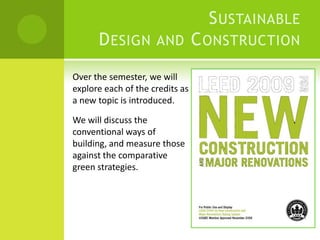
Sustainability and the LEED Rating System
What is Sustainability?maintain  support  endurea means of configuring civilization and human activity so that society, its members and its economies are able to meet their needs and express their greatest potential in the present, while preserving biodiversity and natural ecosystems, planning and acting for the ability to maintain these ideals in the very long termSource: wiktionary.com
What is Sustainability?Sustainability has MANY             diverse and universally                  accepted definitionsThere is not ONE definition that clearly characterizes the term:SUSTAINABILITY
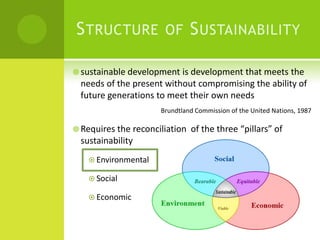
Structure of Sustainabilitysustainable development is development that meets the needs of the present without compromising the ability of future generations to meet their own needs	Brundtland Commission of the United Nations, 1987Requires the reconciliation  of the three “pillars” of sustainabilityEnvironmentalSocialEconomic
Structure of Sustainability1st Pillar: EnvironmentalHealthy ecosystems provide vital goods and services to humans and other organisms. There are two major ways of reducing negative human impact and enhancing ecosystem services:Environmental Managementdirect approach based largely on information gained from earth science, environmental science and conservation biologyManagement of Human Consumptionindirect approach based largely on information gained from economics
Structure of Sustainability1st Pillar: Environmental	Environmental ManagementOceansFreshwater systemsAtmosphereForestsLandCultivated Land (Agriculture)Biological InvasionsLecture Notes expand on each of these points.
Structure of Sustainability1st Pillar: EnvironmentalHealthy ecosystems provide vital goods and services to humans and other organisms. There are two major ways of reducing negative human impact and enhancing ecosystem services:Environmental Managementdirect approach based largely on information gained from earth science, environmental science and conservation biologyManagement of Human Consumptionindirect approach based largely on information gained from economics
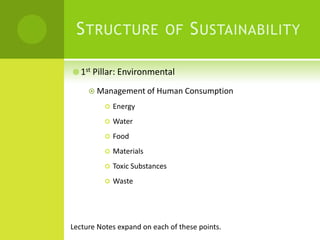
1st Pillar: Environmental	Management of Human ConsumptionEnergy WaterFoodMaterialsToxic Substances WasteStructure of SustainabilityLecture Notes expand on each of these points.
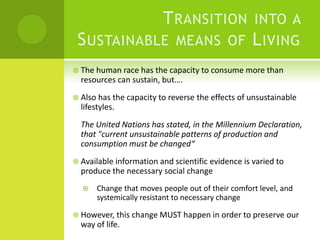
Transition into a Sustainable means of LivingThe human race has the capacity to consume more than resources can sustain, but….Also has the capacity to reverse the effects of unsustainable lifestyles.The United Nations has stated, in the Millennium Declaration, that "current unsustainable patterns of production and consumption must be changed“Available information and scientific evidence is varied to produce the necessary social changeChange that moves people out of their comfort level, and systemically resistant to necessary changeHowever, this change MUST happen in order to preserve our way of life.
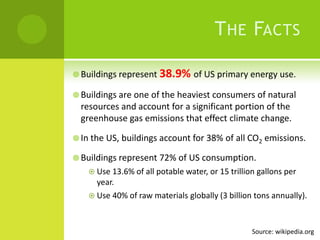
The FactsBuildings represent 38.9% of US primary energy use.Buildings are one of the heaviest consumers of natural resources and account for a significant portion of the greenhouse gas emissions that effect climate change. In the US, buildings account for 38% of all CO2 emissions.Buildings represent 72% of US consumption. Use 13.6% of all potable water, or 15 trillion gallons per year. Use 40% of raw materials globally (3 billion tons annually).Source: wikipedia.org
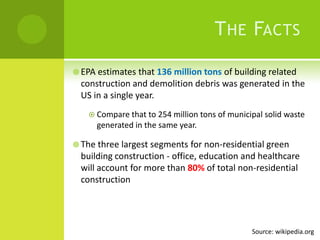
The FactsEPA estimates that 136 million tons of building related construction and demolition debris was generated in the US in a single year. Compare that to 254 million tons of municipal solid waste generated in the same year. The three largest segments for non-residential green building construction - office, education and healthcare will account for more than 80% of total non-residential constructionSource: wikipedia.org
OpinionIf video is not available, refer to ANGEL website under RESOURCES in Module #2Building green is a very politically-charged topic.The DesignVote08 team recently completed a "Man on the Street," interview-style video narrated by DesignVote08 National Chair Mickey Jacob, AIA. In the video, voters were asked questions about how the country can save energy and reduce carbon emissions. Source: www.youtube.com
How the Design and Building Community is Contributing Understanding of the structure of matter and the material worldLaws of thermodynamics, which all matter obeys regardless of size and contextThinking about the way matter works contributes to the understanding of how things are builtNature’s conscious representativesWe are not separate from nature, and cannot consciously part ourselves from itHumans, as the only species conscious of our actions on our environments, MUST behave in a way the preserves the natural resources for future generations
How the Design and Building Community is Contributing Imposing Generative versus Degenerative DesignGenerative: having the power to produce or originate In the built environment, everything is treated as a resource, and the end-life of all products and byproducts are valued as suchThey are designed to be used in a new wayDegenerative: something that is designed to have one life, and at the end of its life, it is disposed. Designers/Architects are taking generative design that occurs naturally and incorporating it into the built environment producing projects that live within their means of water and energy use.
How the Design and Building Community is Contributing Incorporation of Whole Systems ThinkingRedirected away from thinking from parts of design and construction are unconnected, creates problemsConventional building process is financially and environmentally costlyWhole systems approach involves asking as many questions upfront What are the natural ecosystems present?How can the building contribute and benefit those ecosystems?What was the carbon footprint of the land before development?What existed on the land? What flourished and why?How much water did the land absorb?How much sun and CO2 was absorbed? Oxygen generated?How can we ensure that the structure will live within its water and energy means?
How the Design and Building Community is Contributing Team collaboration as sustainability in actionAll team members think in sustainable terms in regards to design, integration, construction and implementationCharacteristics of individuals within the team:Think in terms of whole systemsGood listeners, deeply and openlyAspirationPersonal mastery Ability to understand complexityHave reflective conversations using both mental models and dialogue
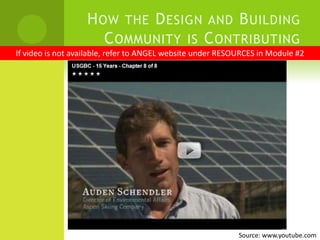
How the Design and Building Community is Contributing Source: www.youtube.com
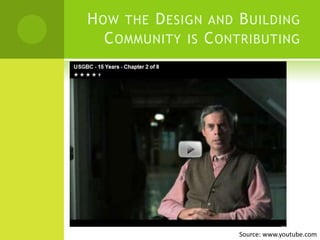
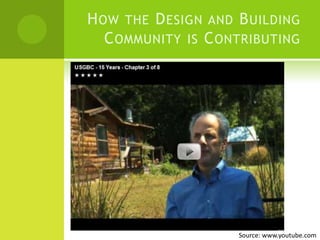
How the Design and Building Community is Contributing If video is not available, refer to ANGEL website under RESOURCES in Module #2Source: www.youtube.com
Sustainable Design and Construction To answer the growing need to govern sustainable design and construction methodology & practices, a group was formed to spearhead a grassroots movementUnited States Green Building Council Founded in 1993Non-profit trade organizationMain initiative: promotion of sustainability in how buildings are designed, constructed and operated. promotes buildings that are environmentally responsible, profitable and healthy places to live and work.Educates building professionals on different elements of the green building industry, at all levels.
The U.S. Green Building Council (USGBC)is a Washington, D.C.-based 501(c)(3) nonprofit organization committed to a prosperous and sustainable future for our nation through cost-efficient and energy-saving green buildings. USGBC works toward its mission of market transformation through its LEED green building certification program, robust educational offerings, a nationwide network of chapters and affiliates, the annual Greenbuild International Conference & Expo, and advocacy in support of public policy that encourages and enables green buildings and communities.Source: www.usgbc.org
Sustainable Design and Construction USGBC developed and maintains two areas of concentration within the green building industryBuildingsThe LEED® green building certification program is a voluntary, consensus-based national rating system for buildings designed, constructed and operated for improved environmental and human health performance. LEED addresses all building types and emphasizes state-of-the-art strategies in five areas: sustainable site development, water savings, energy efficiency, materials and resources selection, and indoor environmental quality.ProfessionalsLEED Professional Credentials (LEED AP and Green Associate) recognize professionals who have demonstrated a thorough understanding of green building techniques, the LEED green building rating systems, and the certification process. The LEED Professional Credentials program is administered by the Green Building Certification Institute (GBCI), which was established with the support of USGBC to allow for objective, balanced management of the credential program.Source: www.usgbc.org
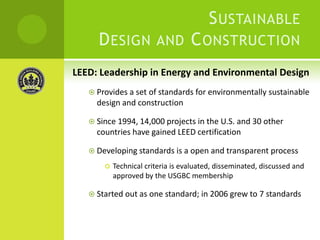
LEED: Leadership in Energy and Environmental DesignProvides a set of standards for environmentally sustainable design and constructionSince 1994, 14,000 projects in the U.S. and 30 other countries have gained LEED certificationDeveloping standards is a open and transparent processTechnical criteria is evaluated, disseminated, discussed and approved by the USGBC membershipStarted out as one standard; in 2006 grew to 7 standardsSustainable Design and Construction
OpinionIf video is not available, refer to ANGEL website under RESOURCES in Module #2Rob Watson is CEO of EcoTech International and the Founding Chairman (1994-2005) of the LEED Green Building Rating System of the U.S. Green Building Council. In this compelling interview, Rob discusses green buildings, LEED and what people can and should do now to reduce the impact of buildings on our environmentSource: www.youtube.com
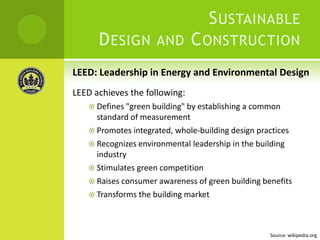
LEED: Leadership in Energy and Environmental DesignLEED achieves the following:Defines "green building" by establishing a common standard of measurementPromotes integrated, whole-building design practicesRecognizes environmental leadership in the building industryStimulates green competitionRaises consumer awareness of green building benefitsTransforms the building marketSustainable Design and Construction Source: wikipedia.org
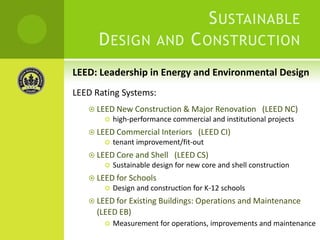
Sustainable Design and Construction LEED: Leadership in Energy and Environmental DesignLEED Rating Systems:LEED New Construction & Major Renovation   (LEED NC)high-performance commercial and institutional projectsLEED Commercial Interiors   (LEED CI)tenant improvement/fit-outLEED Core and Shell   (LEED CS)Sustainable design for new core and shell constructionLEED for Schools Design and construction for K-12 schoolsLEED for Existing Buildings: Operations and Maintenance(LEED EB)Measurement for operations, improvements and maintenance
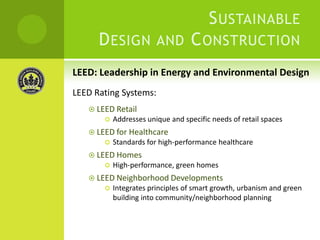
Sustainable Design and Construction LEED: Leadership in Energy and Environmental DesignLEED Rating Systems:LEED RetailAddresses unique and specific needs of retail spacesLEED for HealthcareStandards for high-performance healthcareLEED HomesHigh-performance, green homesLEED Neighborhood DevelopmentsIntegrates principles of smart growth, urbanism and green building into community/neighborhood planning
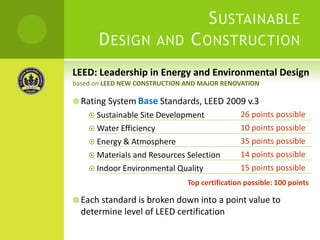
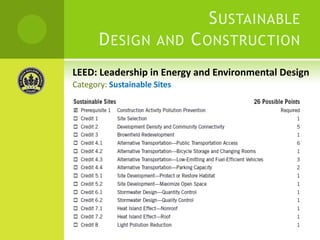
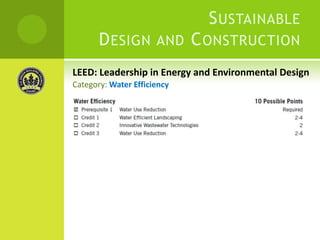
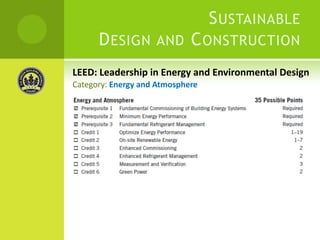
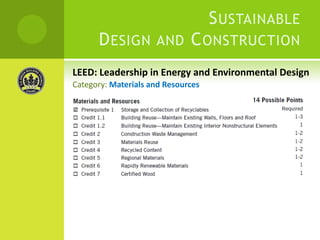
Sustainable Design and Construction LEED: Leadership in Energy and Environmental Design26 points possible10 points possible35 points possible14 points possible15 points possiblebased on LEED NEW CONSTRUCTION AND MAJOR RENOVATIONBaseRating System Base Standards, LEED 2009 v.3
Sustainable Site Development
Water Efficiency
Energy & Atmosphere
Materials and Resources Selection
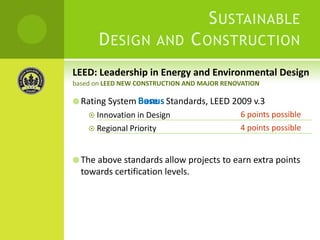
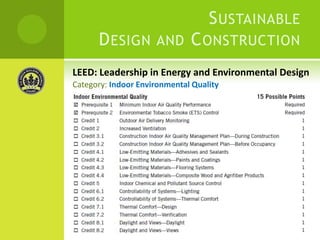
Indoor Environmental QualityTop certification possible: 100 pointsEach standard is broken down into a point value to determine level of LEED certificationSustainable Design and Construction LEED: Leadership in Energy and Environmental Design6 points possible4 points possiblebased on LEED NEW CONSTRUCTION AND MAJOR RENOVATIONBonusBaseRating System BonusStandards, LEED 2009 v.3
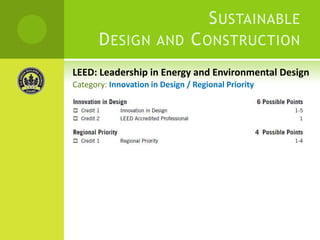
Innovation in Design
Regional Priority
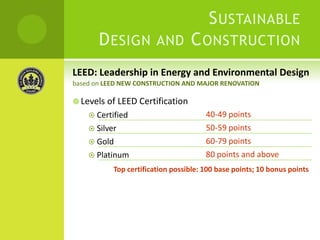
The above standards allow projects to earn extra points towards certification levels.Sustainable Design and Construction LEED: Leadership in Energy and Environmental Design40-49 points50-59 points60-79 points80 points and abovebased on LEED NEW CONSTRUCTION AND MAJOR RENOVATIONLevels of LEED Certification
Certified
Silver
Gold
PlatinumTop certification possible: 100 base points; 10 bonus points
Sustainable Design and Construction LEED: Leadership in Energy and Environmental DesignCategory: Sustainable Sites

ACH 122 Lecture 02 (Sustainability Leed)

  • 1.
    Sustainability and theLEED Rating System
  • 2.
    What is Sustainability?maintain support  endurea means of configuring civilization and human activity so that society, its members and its economies are able to meet their needs and express their greatest potential in the present, while preserving biodiversity and natural ecosystems, planning and acting for the ability to maintain these ideals in the very long termSource: wiktionary.com
  • 3.
    What is Sustainability?Sustainabilityhas MANY diverse and universally accepted definitionsThere is not ONE definition that clearly characterizes the term:SUSTAINABILITY
  • 4.
    Structure of Sustainabilitysustainabledevelopment is development that meets the needs of the present without compromising the ability of future generations to meet their own needs Brundtland Commission of the United Nations, 1987Requires the reconciliation of the three “pillars” of sustainabilityEnvironmentalSocialEconomic
  • 5.
    Structure of Sustainability1stPillar: EnvironmentalHealthy ecosystems provide vital goods and services to humans and other organisms. There are two major ways of reducing negative human impact and enhancing ecosystem services:Environmental Managementdirect approach based largely on information gained from earth science, environmental science and conservation biologyManagement of Human Consumptionindirect approach based largely on information gained from economics
  • 6.
    Structure of Sustainability1stPillar: Environmental Environmental ManagementOceansFreshwater systemsAtmosphereForestsLandCultivated Land (Agriculture)Biological InvasionsLecture Notes expand on each of these points.
  • 7.
    Structure of Sustainability1stPillar: EnvironmentalHealthy ecosystems provide vital goods and services to humans and other organisms. There are two major ways of reducing negative human impact and enhancing ecosystem services:Environmental Managementdirect approach based largely on information gained from earth science, environmental science and conservation biologyManagement of Human Consumptionindirect approach based largely on information gained from economics
  • 8.
    1st Pillar: Environmental Managementof Human ConsumptionEnergy WaterFoodMaterialsToxic Substances WasteStructure of SustainabilityLecture Notes expand on each of these points.
  • 9.
    Transition into aSustainable means of LivingThe human race has the capacity to consume more than resources can sustain, but….Also has the capacity to reverse the effects of unsustainable lifestyles.The United Nations has stated, in the Millennium Declaration, that "current unsustainable patterns of production and consumption must be changed“Available information and scientific evidence is varied to produce the necessary social changeChange that moves people out of their comfort level, and systemically resistant to necessary changeHowever, this change MUST happen in order to preserve our way of life.
  • 10.
    The FactsBuildings represent38.9% of US primary energy use.Buildings are one of the heaviest consumers of natural resources and account for a significant portion of the greenhouse gas emissions that effect climate change. In the US, buildings account for 38% of all CO2 emissions.Buildings represent 72% of US consumption. Use 13.6% of all potable water, or 15 trillion gallons per year. Use 40% of raw materials globally (3 billion tons annually).Source: wikipedia.org
  • 11.
    The FactsEPA estimatesthat 136 million tons of building related construction and demolition debris was generated in the US in a single year. Compare that to 254 million tons of municipal solid waste generated in the same year. The three largest segments for non-residential green building construction - office, education and healthcare will account for more than 80% of total non-residential constructionSource: wikipedia.org
  • 12.
    OpinionIf video isnot available, refer to ANGEL website under RESOURCES in Module #2Building green is a very politically-charged topic.The DesignVote08 team recently completed a "Man on the Street," interview-style video narrated by DesignVote08 National Chair Mickey Jacob, AIA. In the video, voters were asked questions about how the country can save energy and reduce carbon emissions. Source: www.youtube.com
  • 13.
    How the Designand Building Community is Contributing Understanding of the structure of matter and the material worldLaws of thermodynamics, which all matter obeys regardless of size and contextThinking about the way matter works contributes to the understanding of how things are builtNature’s conscious representativesWe are not separate from nature, and cannot consciously part ourselves from itHumans, as the only species conscious of our actions on our environments, MUST behave in a way the preserves the natural resources for future generations
  • 14.
    How the Designand Building Community is Contributing Imposing Generative versus Degenerative DesignGenerative: having the power to produce or originate In the built environment, everything is treated as a resource, and the end-life of all products and byproducts are valued as suchThey are designed to be used in a new wayDegenerative: something that is designed to have one life, and at the end of its life, it is disposed. Designers/Architects are taking generative design that occurs naturally and incorporating it into the built environment producing projects that live within their means of water and energy use.
  • 15.
    How the Designand Building Community is Contributing Incorporation of Whole Systems ThinkingRedirected away from thinking from parts of design and construction are unconnected, creates problemsConventional building process is financially and environmentally costlyWhole systems approach involves asking as many questions upfront What are the natural ecosystems present?How can the building contribute and benefit those ecosystems?What was the carbon footprint of the land before development?What existed on the land? What flourished and why?How much water did the land absorb?How much sun and CO2 was absorbed? Oxygen generated?How can we ensure that the structure will live within its water and energy means?
  • 16.
    How the Designand Building Community is Contributing Team collaboration as sustainability in actionAll team members think in sustainable terms in regards to design, integration, construction and implementationCharacteristics of individuals within the team:Think in terms of whole systemsGood listeners, deeply and openlyAspirationPersonal mastery Ability to understand complexityHave reflective conversations using both mental models and dialogue
  • 17.
    How the Designand Building Community is Contributing Source: www.youtube.com
  • 18.
    How the Designand Building Community is Contributing Source: www.youtube.com
  • 19.
    How the Designand Building Community is Contributing Source: www.youtube.com
  • 20.
    How the Designand Building Community is Contributing Source: www.youtube.com
  • 21.
    How the Designand Building Community is Contributing If video is not available, refer to ANGEL website under RESOURCES in Module #2Source: www.youtube.com
  • 22.
    How the Designand Building Community is Contributing If video is not available, refer to ANGEL website under RESOURCES in Module #2Source: www.youtube.com
  • 23.
    How the Designand Building Community is Contributing If video is not available, refer to ANGEL website under RESOURCES in Module #2Source: www.youtube.com
  • 24.
    How the Designand Building Community is Contributing If video is not available, refer to ANGEL website under RESOURCES in Module #2Source: www.youtube.com
  • 25.
    Sustainable Design andConstruction To answer the growing need to govern sustainable design and construction methodology & practices, a group was formed to spearhead a grassroots movementUnited States Green Building Council Founded in 1993Non-profit trade organizationMain initiative: promotion of sustainability in how buildings are designed, constructed and operated. promotes buildings that are environmentally responsible, profitable and healthy places to live and work.Educates building professionals on different elements of the green building industry, at all levels.
  • 26.
    The U.S. GreenBuilding Council (USGBC)is a Washington, D.C.-based 501(c)(3) nonprofit organization committed to a prosperous and sustainable future for our nation through cost-efficient and energy-saving green buildings. USGBC works toward its mission of market transformation through its LEED green building certification program, robust educational offerings, a nationwide network of chapters and affiliates, the annual Greenbuild International Conference & Expo, and advocacy in support of public policy that encourages and enables green buildings and communities.Source: www.usgbc.org
  • 27.
    Sustainable Design andConstruction USGBC developed and maintains two areas of concentration within the green building industryBuildingsThe LEED® green building certification program is a voluntary, consensus-based national rating system for buildings designed, constructed and operated for improved environmental and human health performance. LEED addresses all building types and emphasizes state-of-the-art strategies in five areas: sustainable site development, water savings, energy efficiency, materials and resources selection, and indoor environmental quality.ProfessionalsLEED Professional Credentials (LEED AP and Green Associate) recognize professionals who have demonstrated a thorough understanding of green building techniques, the LEED green building rating systems, and the certification process. The LEED Professional Credentials program is administered by the Green Building Certification Institute (GBCI), which was established with the support of USGBC to allow for objective, balanced management of the credential program.Source: www.usgbc.org
  • 28.
    LEED: Leadership inEnergy and Environmental DesignProvides a set of standards for environmentally sustainable design and constructionSince 1994, 14,000 projects in the U.S. and 30 other countries have gained LEED certificationDeveloping standards is a open and transparent processTechnical criteria is evaluated, disseminated, discussed and approved by the USGBC membershipStarted out as one standard; in 2006 grew to 7 standardsSustainable Design and Construction
  • 29.
    OpinionIf video isnot available, refer to ANGEL website under RESOURCES in Module #2Rob Watson is CEO of EcoTech International and the Founding Chairman (1994-2005) of the LEED Green Building Rating System of the U.S. Green Building Council. In this compelling interview, Rob discusses green buildings, LEED and what people can and should do now to reduce the impact of buildings on our environmentSource: www.youtube.com
  • 30.
    LEED: Leadership inEnergy and Environmental DesignLEED achieves the following:Defines "green building" by establishing a common standard of measurementPromotes integrated, whole-building design practicesRecognizes environmental leadership in the building industryStimulates green competitionRaises consumer awareness of green building benefitsTransforms the building marketSustainable Design and Construction Source: wikipedia.org
  • 31.
    Sustainable Design andConstruction LEED: Leadership in Energy and Environmental DesignLEED Rating Systems:LEED New Construction & Major Renovation (LEED NC)high-performance commercial and institutional projectsLEED Commercial Interiors (LEED CI)tenant improvement/fit-outLEED Core and Shell (LEED CS)Sustainable design for new core and shell constructionLEED for Schools Design and construction for K-12 schoolsLEED for Existing Buildings: Operations and Maintenance(LEED EB)Measurement for operations, improvements and maintenance
  • 32.
    Sustainable Design andConstruction LEED: Leadership in Energy and Environmental DesignLEED Rating Systems:LEED RetailAddresses unique and specific needs of retail spacesLEED for HealthcareStandards for high-performance healthcareLEED HomesHigh-performance, green homesLEED Neighborhood DevelopmentsIntegrates principles of smart growth, urbanism and green building into community/neighborhood planning
  • 33.
    Sustainable Design andConstruction LEED: Leadership in Energy and Environmental Design26 points possible10 points possible35 points possible14 points possible15 points possiblebased on LEED NEW CONSTRUCTION AND MAJOR RENOVATIONBaseRating System Base Standards, LEED 2009 v.3
  • 34.
  • 35.
  • 36.
  • 37.
  • 38.
    Indoor Environmental QualityTopcertification possible: 100 pointsEach standard is broken down into a point value to determine level of LEED certificationSustainable Design and Construction LEED: Leadership in Energy and Environmental Design6 points possible4 points possiblebased on LEED NEW CONSTRUCTION AND MAJOR RENOVATIONBonusBaseRating System BonusStandards, LEED 2009 v.3
  • 39.
  • 40.
  • 41.
    The above standardsallow projects to earn extra points towards certification levels.Sustainable Design and Construction LEED: Leadership in Energy and Environmental Design40-49 points50-59 points60-79 points80 points and abovebased on LEED NEW CONSTRUCTION AND MAJOR RENOVATIONLevels of LEED Certification
  • 42.
  • 43.
  • 44.
  • 45.
    PlatinumTop certification possible:100 base points; 10 bonus points
  • 46.
    Sustainable Design andConstruction LEED: Leadership in Energy and Environmental DesignCategory: Sustainable Sites

Editor's Notes

  • #26 The U.S. Green Building Council (USGBC), founded in 1993, is a non-profit trade organization that promotes sustainability in how buildings are designed, built and operated. The USGBC is best known for the development of the Leadership in Energy and Environmental Design (LEED) rating system and Greenbuild, a green building conference that promotes the green building industry, including environmentally responsible materials, sustainable architecture techniques and public policy.USGBC has more than 15,000 member organizations from every sector of the building industry and works to promote buildings that are environmentally responsible, profitable and healthy places to live and work. To achieve this it has developed a variety of programs and services, and works closely with key industry and research organizations and federal, state and local government agencies.
  • #29 LEED began its development in 1994 spearheaded by Natural Resources Defense Council (NRDC) senior scientist Robert K. Watson who, as founding chairman of the LEED Steering Committee until 2006, led a broad-based consensus process which included non-profit organizations, government agencies, architects, engineers, developers, builders, product manufacturers and other industry leaders.