Building Codes  and   Regulatory Requirements Building Codes & Life Safety Code Development Zoning Ordinances Legal Constraints
The Beginning of a Building โ€ข  an idea in someoneโ€™s mind โ€ข  a desire for something new and accommodating โ€ข  an element for society and history
The Beginning of a Building Get the money Find a lending institution Match with a financial representative Secure a loan Credit check is performed Investors may be needed Collateral may be required Monies are released in payment to owner; not one lump sum
Hire the professionals Architect/Engineer Construction Manager Design-Build Firm General Contractor Consultants The Beginning of a Building
Architect develops design Takes ownerโ€™s needs & wants Combines with architectโ€™s ideas Conforms to building codes & zoning ordinances Works out details for necessary building components Structural system Mechanical/Electrical system Enclosure system The Beginning of a Building
Code Compliance Drawings and Specifications are submitted to permit office in local jurisdiction Qualified Building Inspectors examine documents for code compliance Once inspector and architect agree on the questionable code items, permit is issued. Building Inspector will make frequent visits to site during construction for code conformance. (also called โ€œsigning offโ€) The Beginning of a Building
Bidding, Negotiation & Award Putting the word out that the building needs to be built Invitation to Bid Instructions to Bidders Bid Form Bid Security AWARD to General Contractor!!! They hire subcontractors They get materials/labor from vendors & suppliers The Beginning of a Building
LET THE CONSTRUCTION BEGIN
But..........Wait a minute...... It's a lot more complicated than that!!
Selection Considerations for  Building Materials Suitability Availability Cost Appearance Preference Building Constraints
Building System Choices Required functional performance? Desired aesthetics / appearance? Legally possible (building regulations)? Most economical? (1 st  cost, life cycle) What is best for environment?
Performance Vs. Construction Design & Performance Issues Evaluated on Every Building Visual, functional, technical, sustainability, physical limitations, & legal considerations May Involve Trade-offs - Time, Cost, Quality Construction Issues Deal with Actual Construction Relate to Means and Methods
Who Has Primary Responsibility for  Building Material Selection? DEPENDS on Contractual Arrangements, often Designer/Architect, with input from the Owner for Appearance and/or Performance & the Contractor for Cost, Availability, & Constructability
Who is Primarily Responsible for  Construction Methods? AIA 201; The  contractor  shall be solely responsible for and have control over means, methods, techniques, sequences and procedures and for coordinating all portions of the Work under the contract ( unless instructed otherwise )
Building Constraints Material Limitations Availability Costs Site Limitations Type of Soil Topography/Grading Structural Feasibilities How well a specific material will perform in a given environment
Building Constraints Labor Constraints Skilled construction workers Availability Construction Budget  (MONEY!!) How much is there to spend Who will lend it to you or invest
Additional  Building Constraints ๏ƒ˜   Building Codes ๏ƒ˜   Zoning Ordinances ๏ƒ˜   Legal Constraints
Building Codes To protect public health and safety by setting a  minimum  standard of quality Codes are to be followed & maintained, but are to be used as  basic  foundations for quality Codes do place limitations on design and aesthetics โ€œโ€ฆ  establish minimum construction standards for the  protection of life, health, and welfare of the public.โ€
Building Codes model building codes Codes are Nationally and Internationally Developed These are the basis in which all codes are standardized in the United States Prepared by a National Group of Code Administrators that organize locally Adopted by local jurisdictions Townships, Counties, States, Etcโ€ฆ Local amendments may be issued to make certain restrictions either more strict or lax They are regulations based on construction type
Types of building codes IBC 2000 & IBC 2003 - International Building Code Developed by the International Code Council (ICC) Used by most jurisdictions throughout the United States. First unified code in history. Site, Construction, Mechanical, Electrical, Etcโ€ฆ IBC has both standard and residential code restrictions. Addresses construction standards and life safety IRC 2003 โ€“ International Residential Code Focuses primarily on residential dwellings One, two-story dwellings, townhouses, condos/apartments Building Codes
Types of building codes Life Safety 2003 โ€“ More specific towards safety of occupants  (NFPA 101) Developed by  National Fire Protection Agency Also adopted by most jurisdictions Addresses design decisions that are essential to the life safety of building occupants, general public, and first responders. Minimum criteria for the egress of facilities. Addresses minimum construction performance in the event of an emergency. Building Codes
What happens when both codes have different minimum requirements? Select the most restrictive of the two OR Consult with local code official for their interpretation Building Codes
Older Codes Areโ€ฆ Building Officials and Code Administrators (BOCA - 1996) Uniform Building Code (UBC) Standard Building Code (SBC) Council of American Building Officials (CABO) BOCA, UBC and SBC codes are not as commonly used today as they were in the past. CABO One- and Two-Dwelling Code of 1995 was replaced by IRC Building Codes
Life Safety & Building Code Issues Means of Egress Methods of exiting the building in the event of an emergency Exit Access (doors, windows) Exit (halls, stairs) Exit Discharge (outside) Points of Refuge (safe places for people to go) Occupancy Loads More people may require more exits and fire protection. Hourly Ratings The minimum amount of time an object or construction assembly must last until the fire burns through.
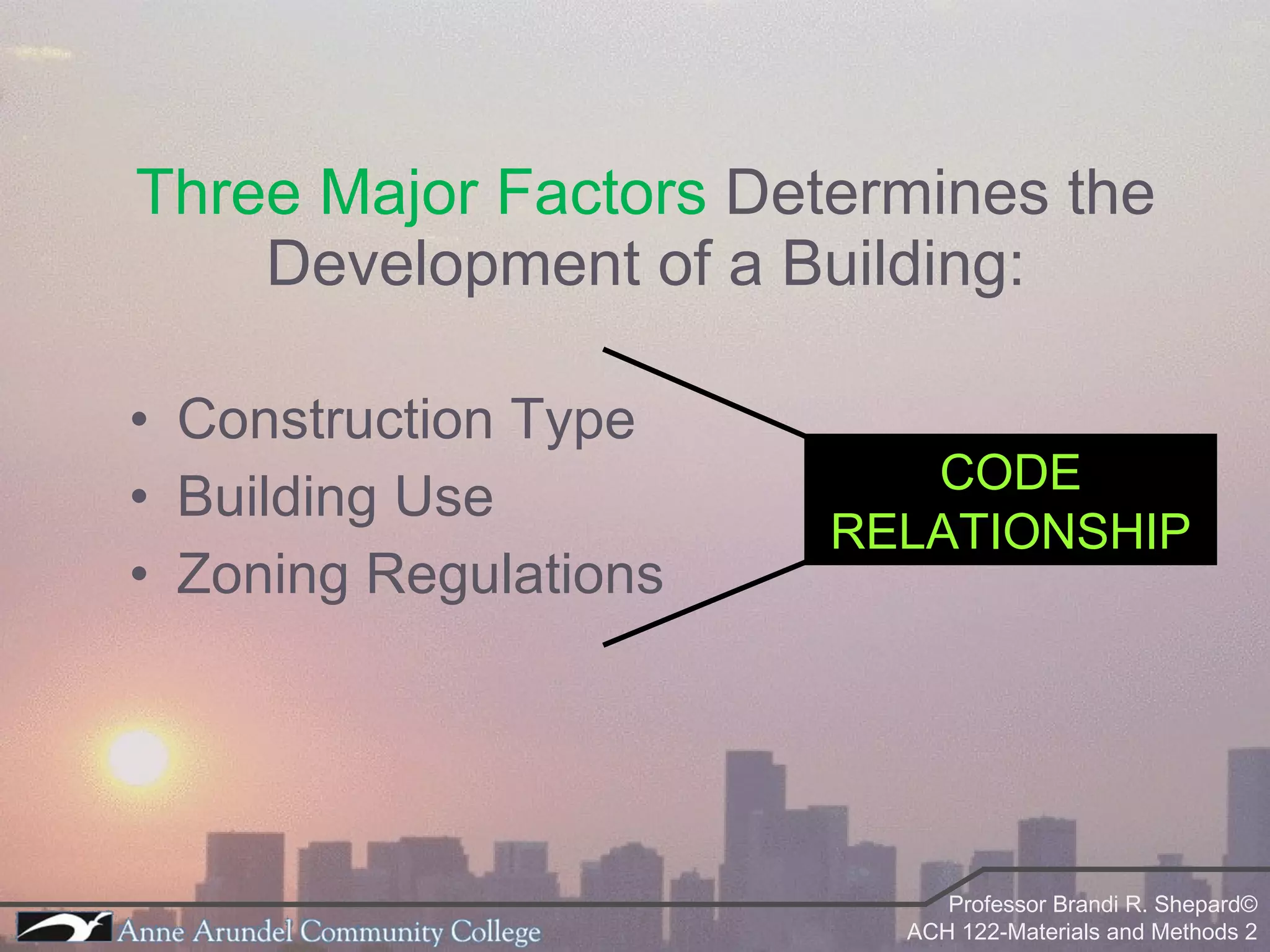
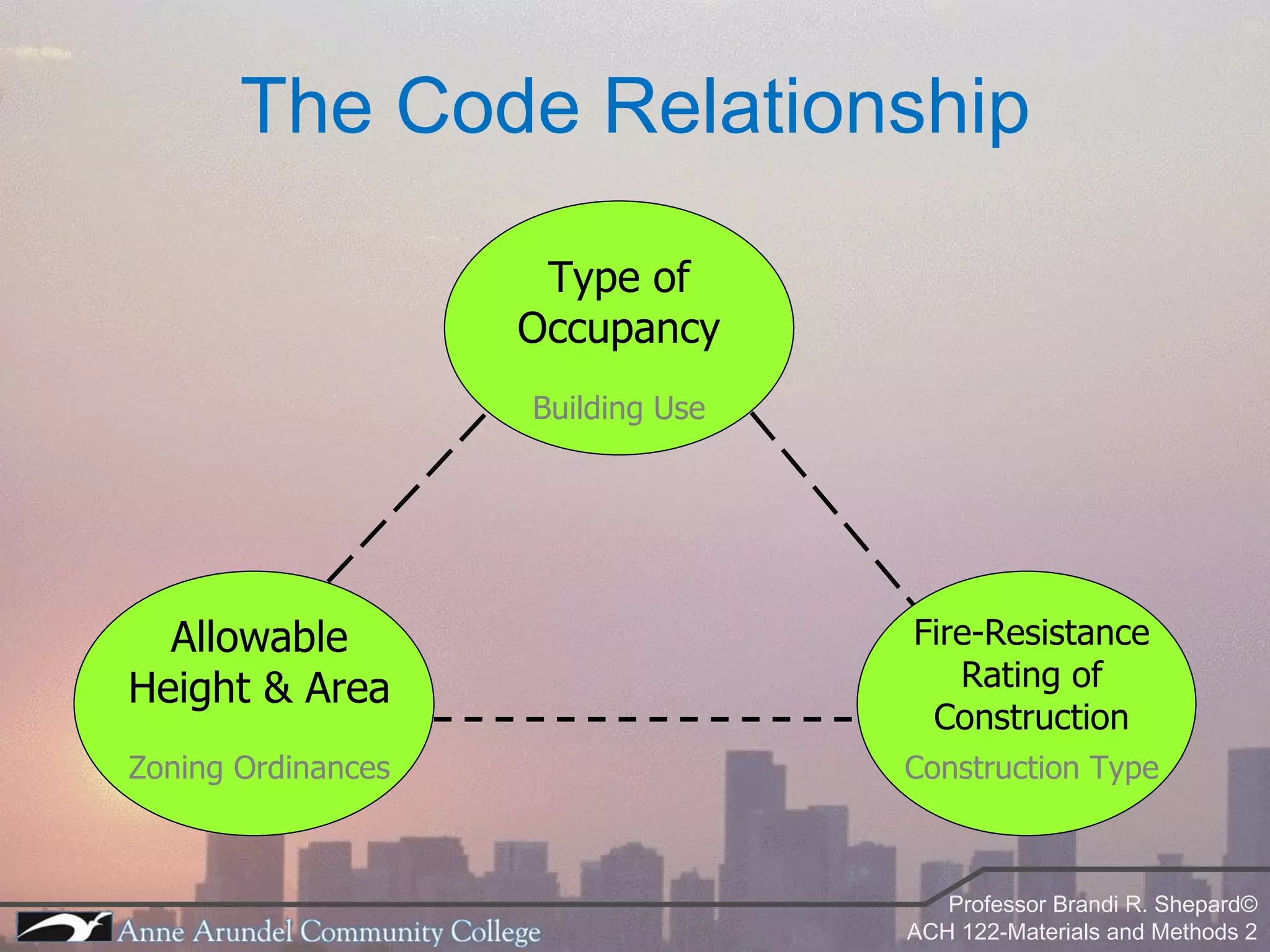
Three Major Factors  Determines the Development of a Building: Construction Type Building Use Zoning Regulations CODE RELATIONSHIP
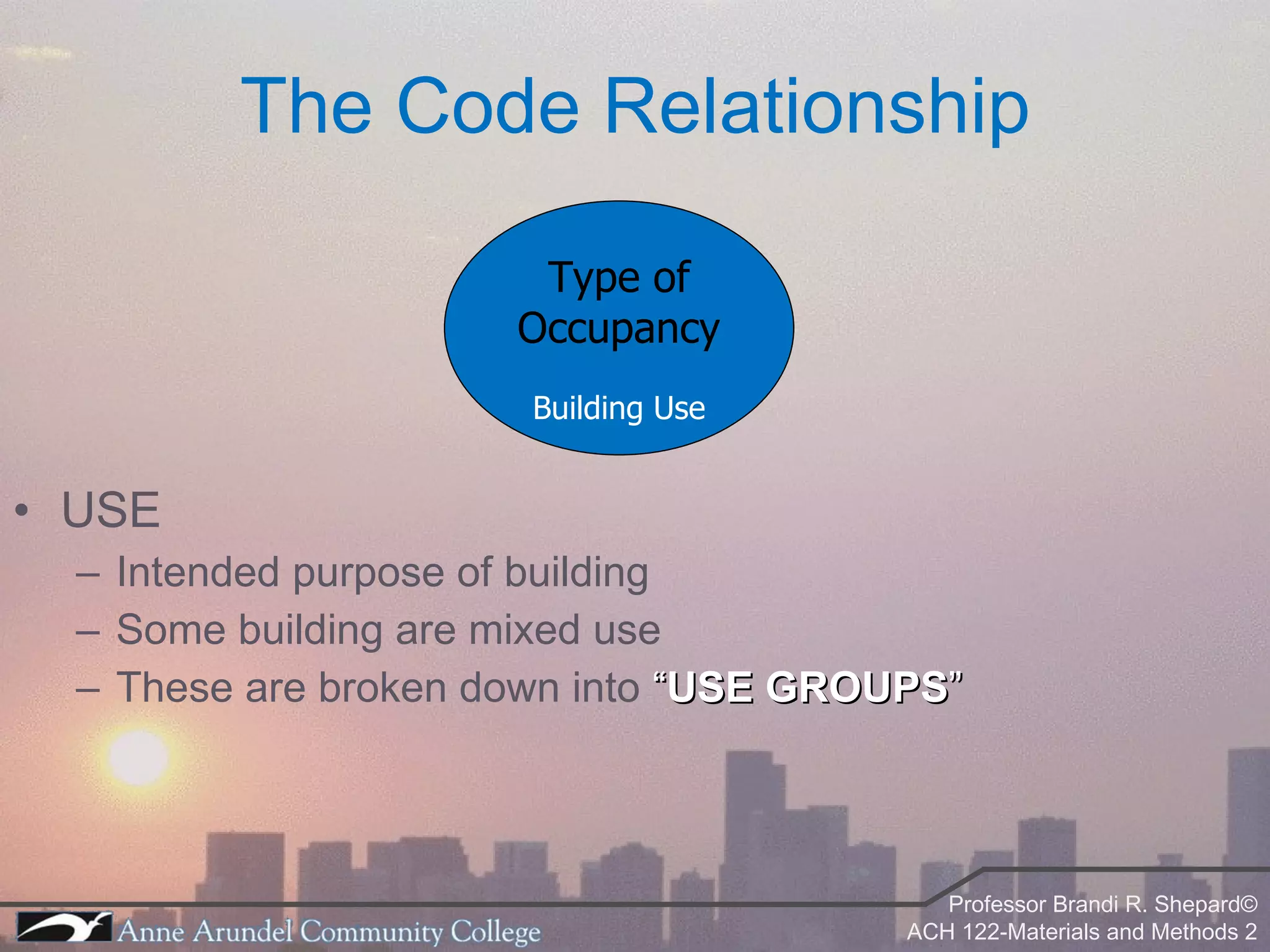
The Code Relationship USE Intended purpose of building Some building are mixed use These are broken down into  โ€œ USE GROUPS โ€ Type of Occupancy Building Use
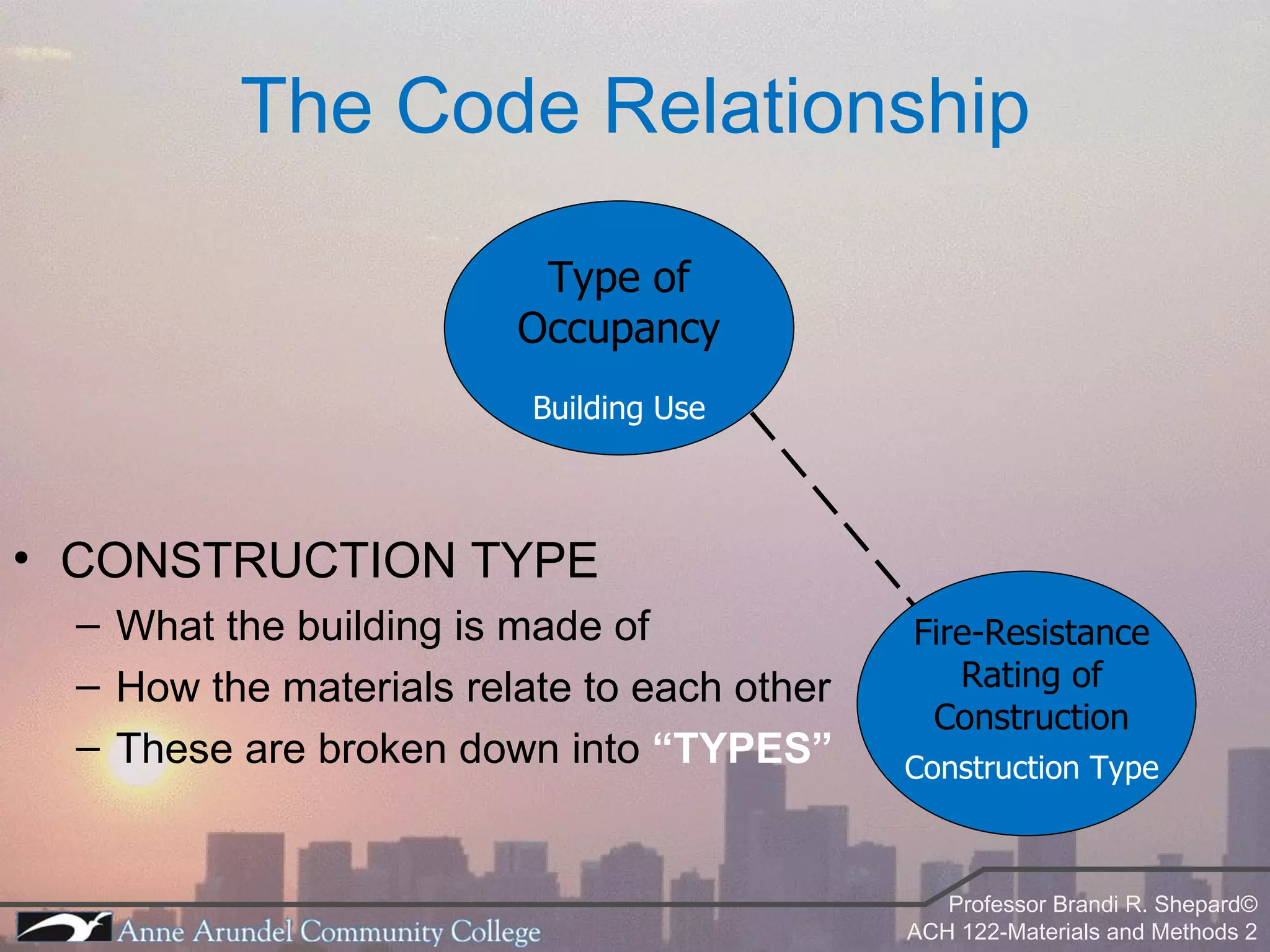
The Code Relationship CONSTRUCTION TYPE What the building is made of How the materials relate to each other These are broken down into  โ€œTYPESโ€ Type of Occupancy Building Use Fire-Resistance Rating of Construction Construction Type
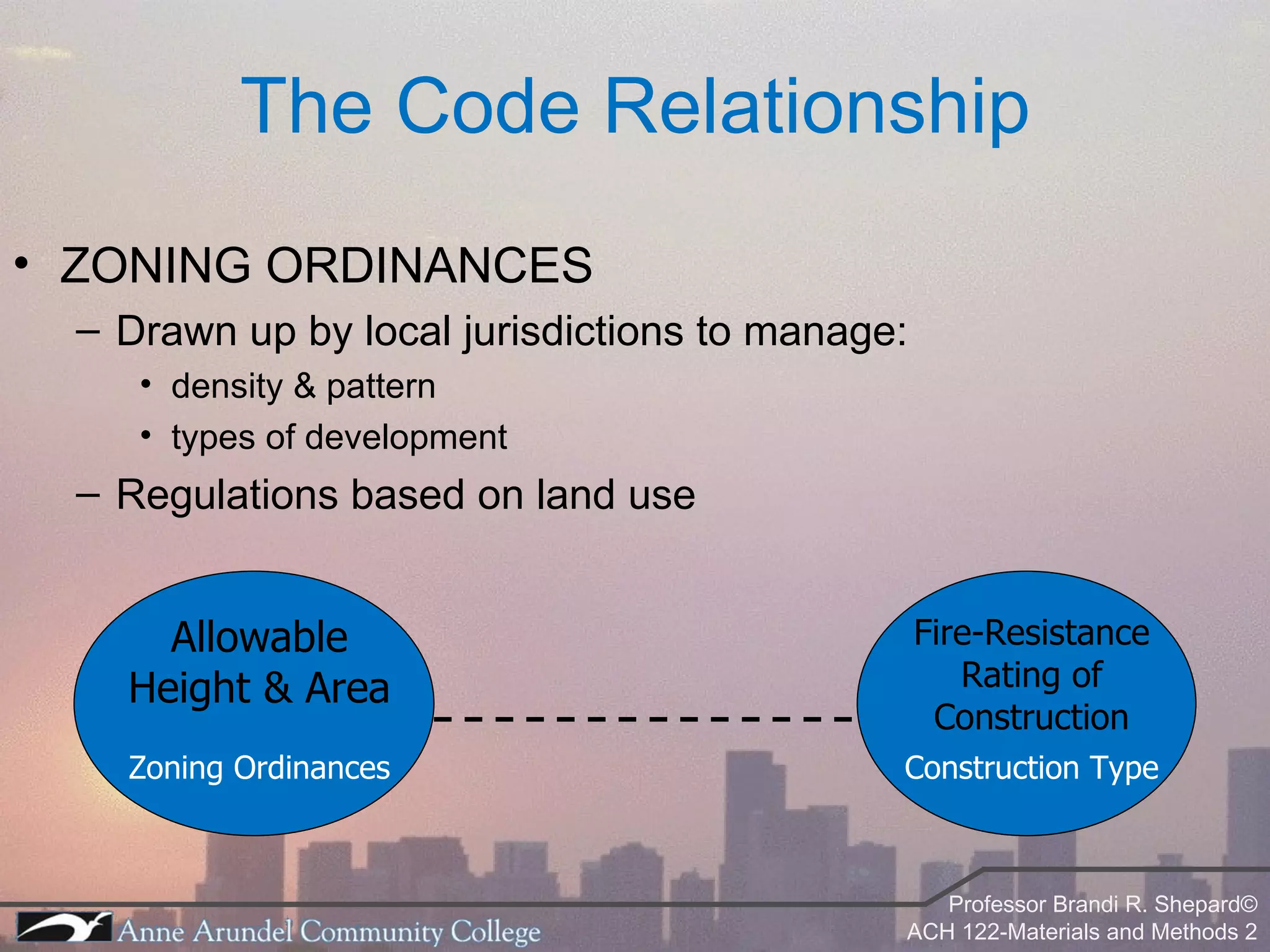
The Code Relationship ZONING ORDINANCES  Drawn up by local jurisdictions to manage:  density & pattern  types of development Regulations based on land use Allowable Height & Area Zoning Ordinances Fire-Resistance Rating of Construction Construction Type
The Code Relationship Type of Occupancy Building Use Allowable Height & Area Zoning Ordinances Fire-Resistance Rating of Construction Construction Type
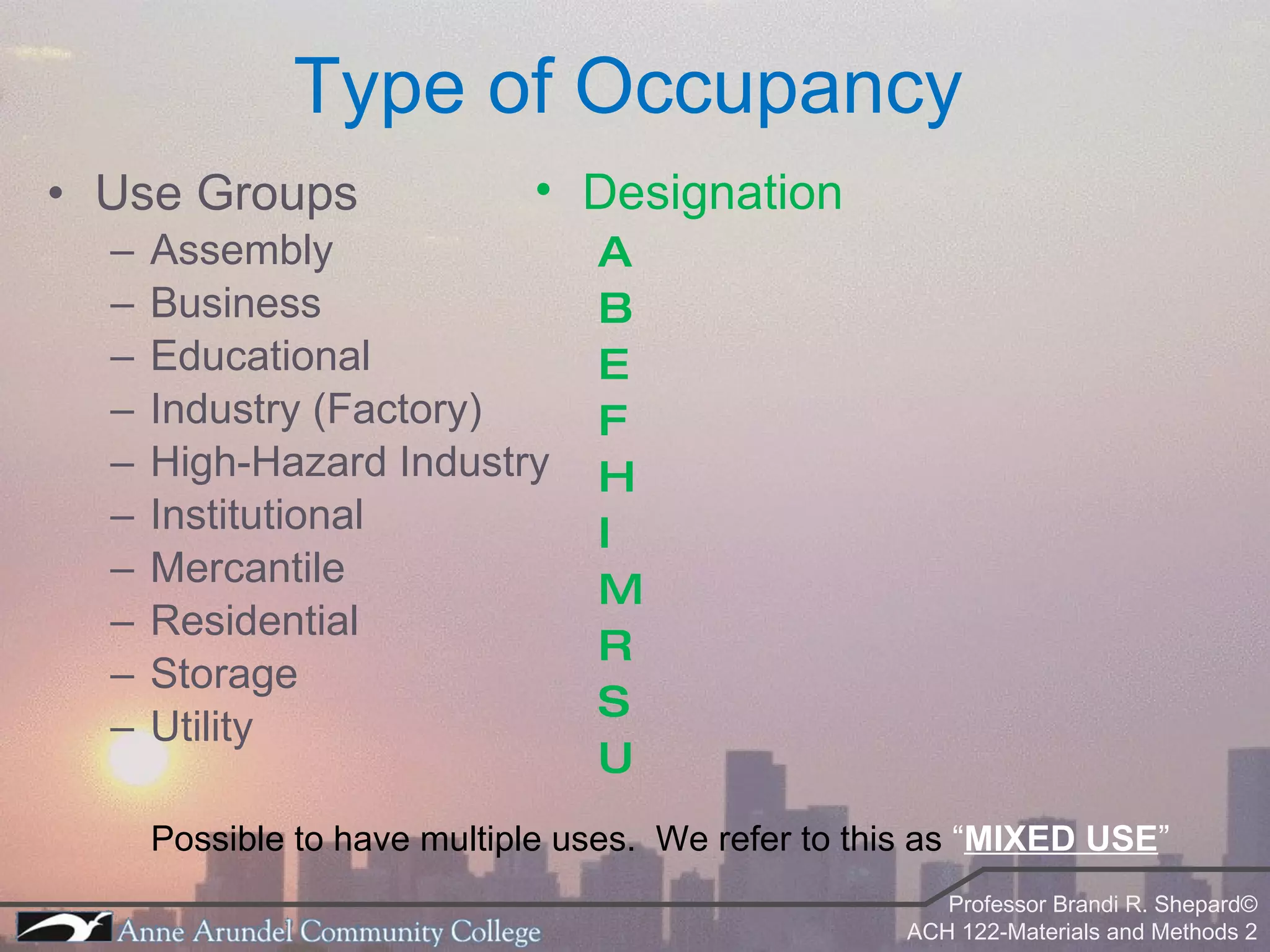
Type of Occupancy Use Groups Assembly Business Educational  Industry (Factory) High-Hazard Industry Institutional Mercantile  Residential Storage Utility Possible to have multiple uses.  We refer to this as  โ€œ MIXED USE โ€ Designation A B E F H I M R S U
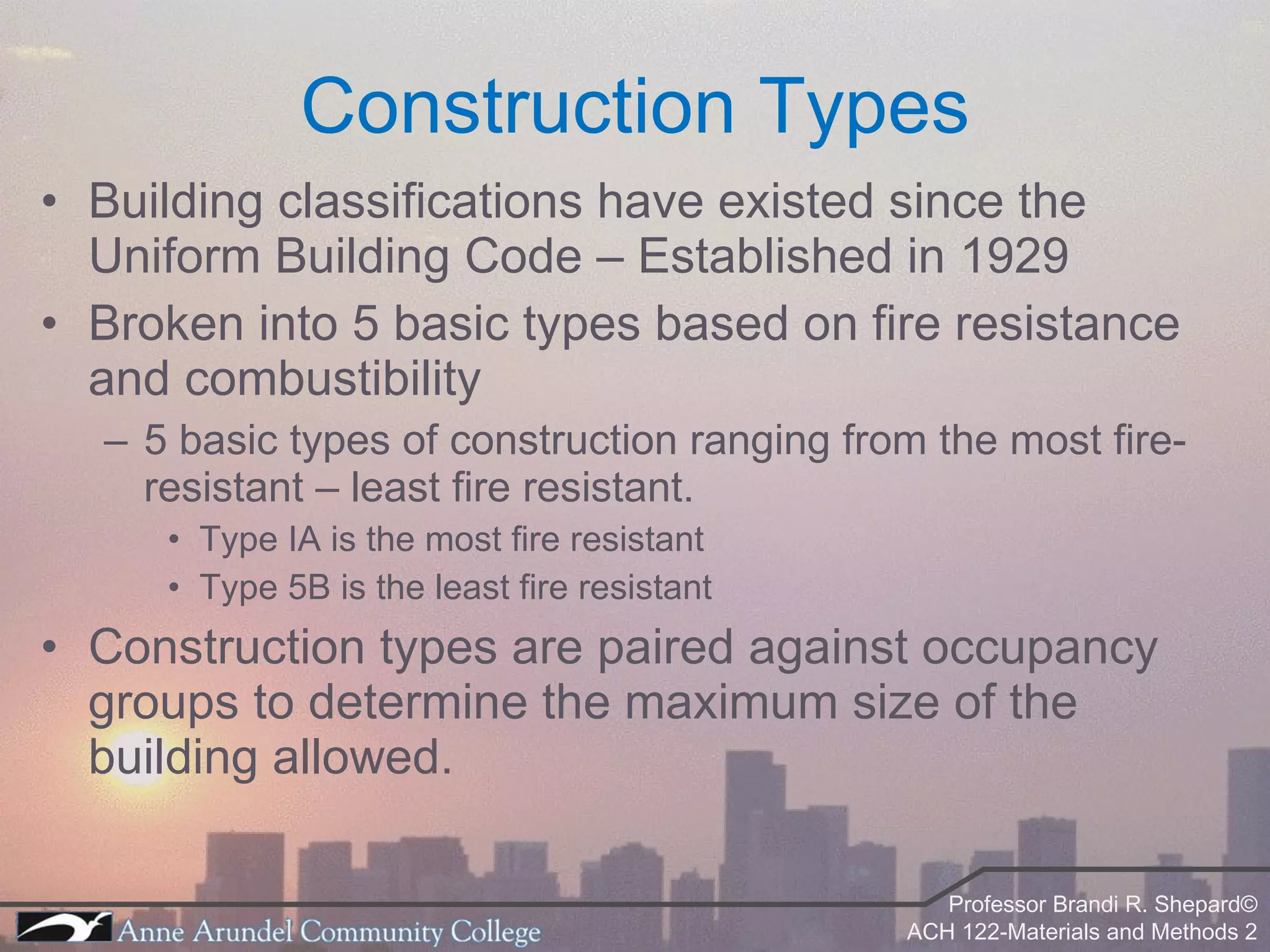
Building classifications have existed since the Uniform Building Code โ€“ Established in 1929 Broken into 5 basic types based on fire resistance and combustibility 5 basic types of construction ranging from the most fire-resistant โ€“ least fire resistant. Type IA is the most fire resistant Type 5B is the least fire resistant Construction types are paired against occupancy groups to determine the maximum size of the building allowed. Construction Types
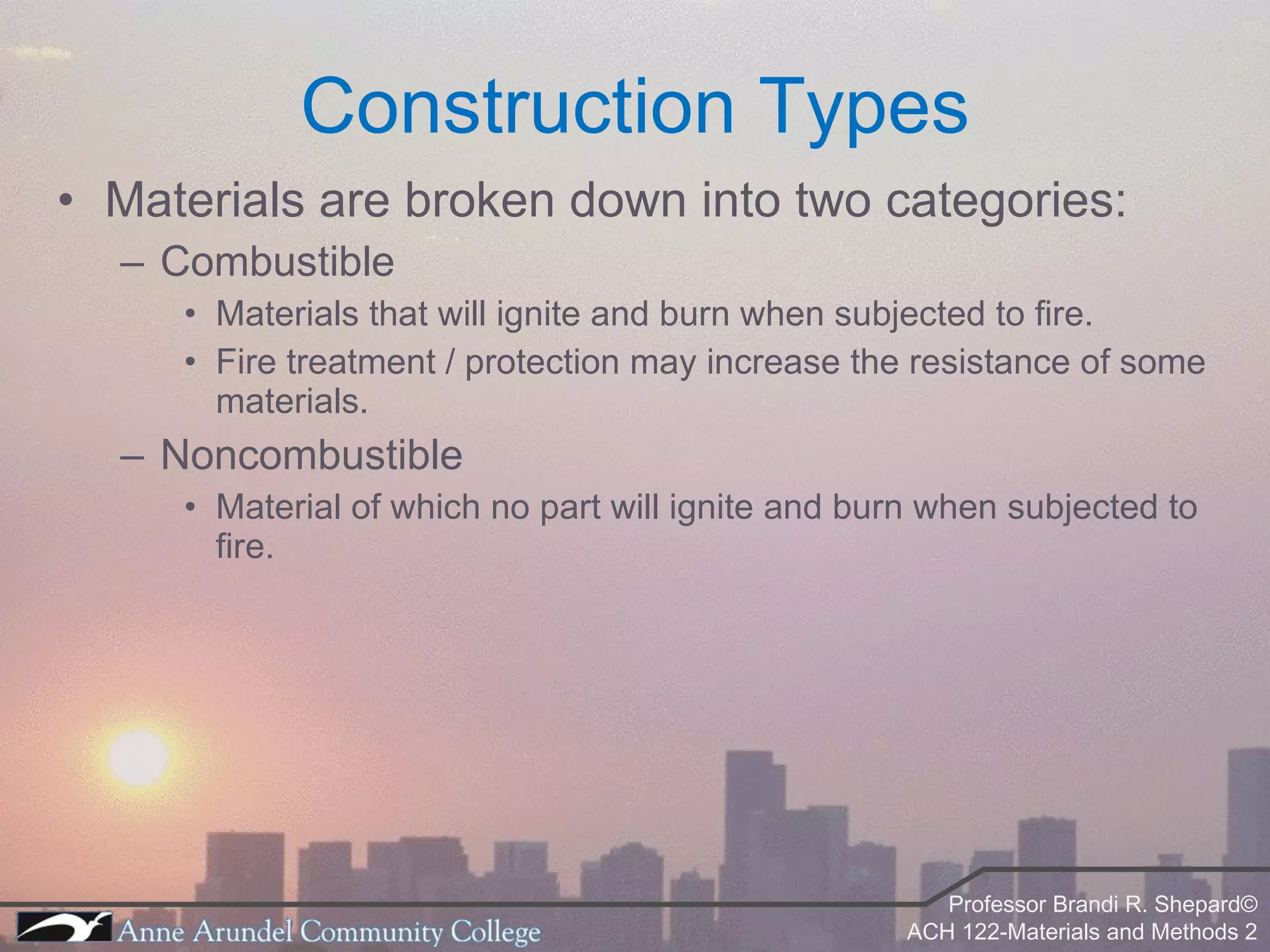
Materials are broken down into two categories: Combustible Materials that will ignite and burn when subjected to fire. Fire treatment / protection may increase the resistance of some materials. Noncombustible Material of which no part will ignite and burn when subjected to fire. Construction Types
Construction types are further broken down into sub-categories designating their fire protection: #A = Protected #B = Unprotected The more fire protection, the larger you can build Even buildings constructed in steel have both classifications because steel will melt and deflect under extreme heat. Construction Types
The principal elements of type I & II construction are made of noncombustible materials. Principal elements generally refers to the structure Type I & II generally relies on steel, concrete of masonry for its structure. Construction Types Section 402.0 TYPE 1 CONSTRUCTION 402.1 General: Buildings and structures of Type 1 construction are those in which the walls, partitions, structural elements, floors, ceilings, roofs and the  exits  are constructed of approved  non-combustible  materials and  protected  to afford the fire resistance rating specified in Table 401.  Buildings are Type 1 construction shall be further classified as Type 1A or 1B. Same description as Type II
Type III buildings area  mix of both combustible and noncombustible materials. Noncombustible exterior walls Combustible interior structure Designed to prevent fires from spreading from one structure to another Ex.: a Wood Frame Building with a brick veneer on all sides. Construction Types Section 404.0 TYPE 3 CONSTRUCTION 404.1 General: Buildings and structures of Type 3 construction are those in which the exterior, fire walls, and party walls are constructed of masonry or other approved  non-combustible  materials of the required fire resistance rating and structural properties; the floors, roofs and interior framing are wholly or partly constructed of wood, metal, or other approved construction; โ€ฆโ€ฆ..
Type IV buildings addresses heavy timber construction. Heavy timber members begin to flame and char at about 400 degrees. As charring continues, it begins to act as a fire protection by insulating the interior of the wood members. Construction Types Section 405.0 TYPE 4 CONSTRUCTION 405.1 General: Buildings and structures of Type 4 construction are those in which the exterior walls are constructed of  non-combustible  materials having a  fire resistance rating not less than that specified in Table 401 and the interior structural members are of solid or laminated wood without concealed spaces.
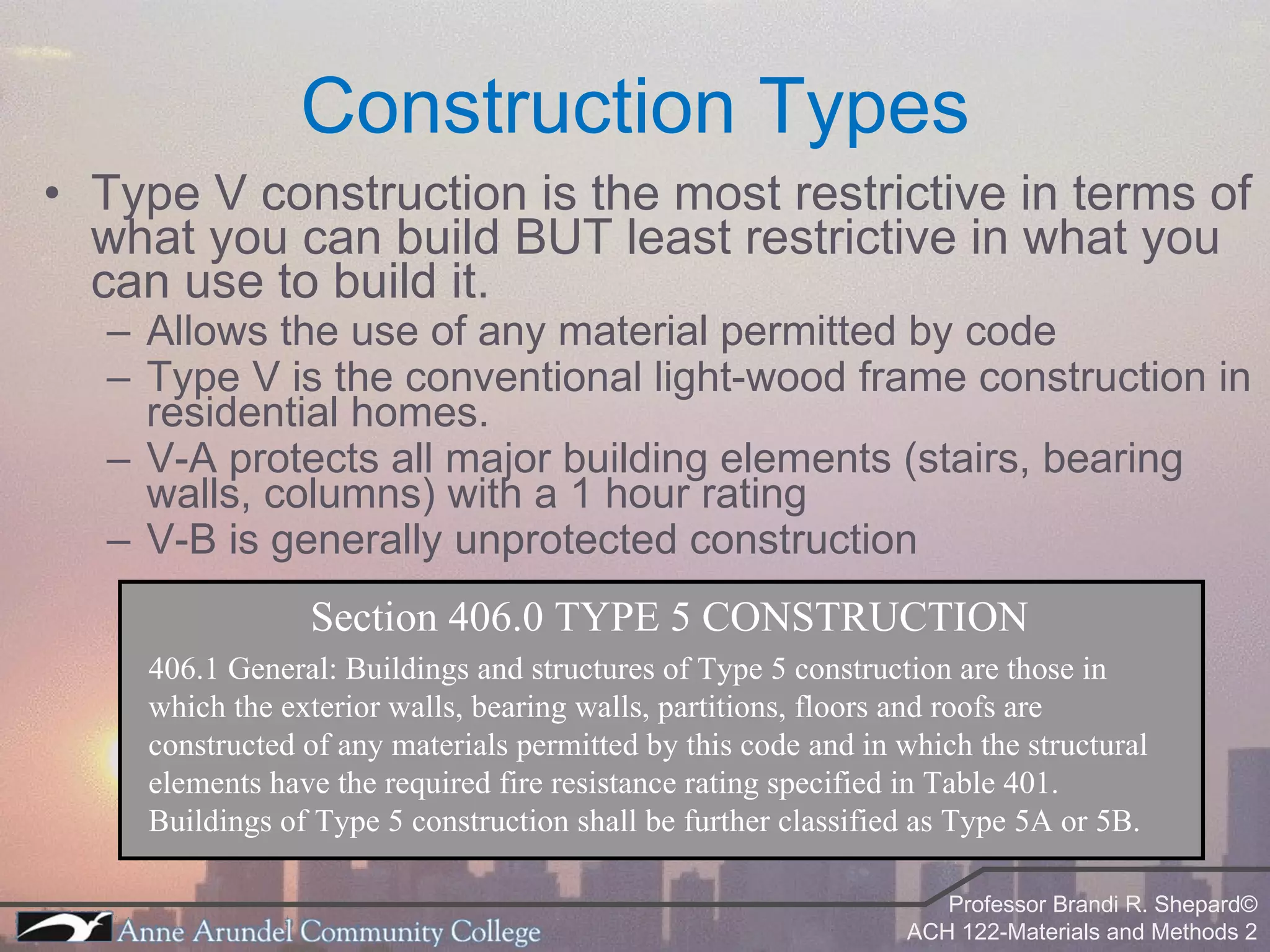
Type V construction is the most restrictive in terms of what you can build BUT least restrictive in what you can use to build it. Allows the use of any material permitted by code Type V is the conventional light-wood frame construction in residential homes. V-A protects all major building elements (stairs, bearing walls, columns) with a 1 hour rating V-B is generally unprotected construction Construction Types Section 406.0 TYPE 5 CONSTRUCTION 406.1 General: Buildings and structures of Type 5 construction are those in which the exterior walls, bearing walls, partitions, floors and roofs are constructed of any materials permitted by this code and in which the structural elements have the required fire resistance rating specified in Table 401. Buildings of Type 5 construction shall be further classified as Type 5A or 5B.
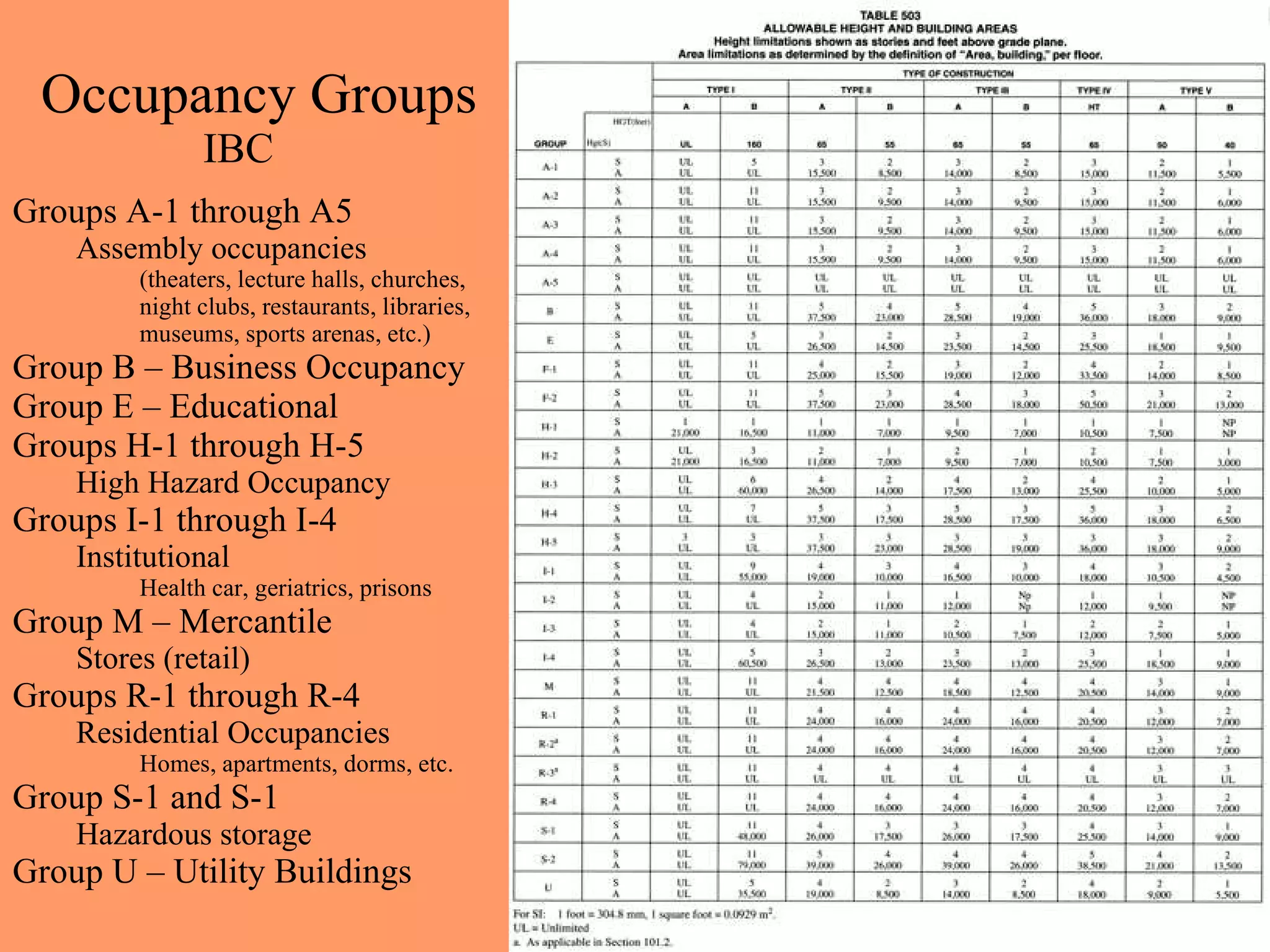
Occupancy Groups IBC Groups A-1 through A5 Assembly occupancies (theaters, lecture halls, churches, night clubs, restaurants, libraries, museums, sports arenas, etc.) Group B โ€“ Business Occupancy Group E โ€“ Educational  Groups H-1 through H-5 High Hazard Occupancy Groups I-1 through I-4 Institutional Health car, geriatrics, prisons Group M โ€“ Mercantile  Stores (retail) Groups R-1 through R-4 Residential Occupancies Homes, apartments, dorms, etc. Group S-1 and S-1 Hazardous storage Group U โ€“ Utility Buildings
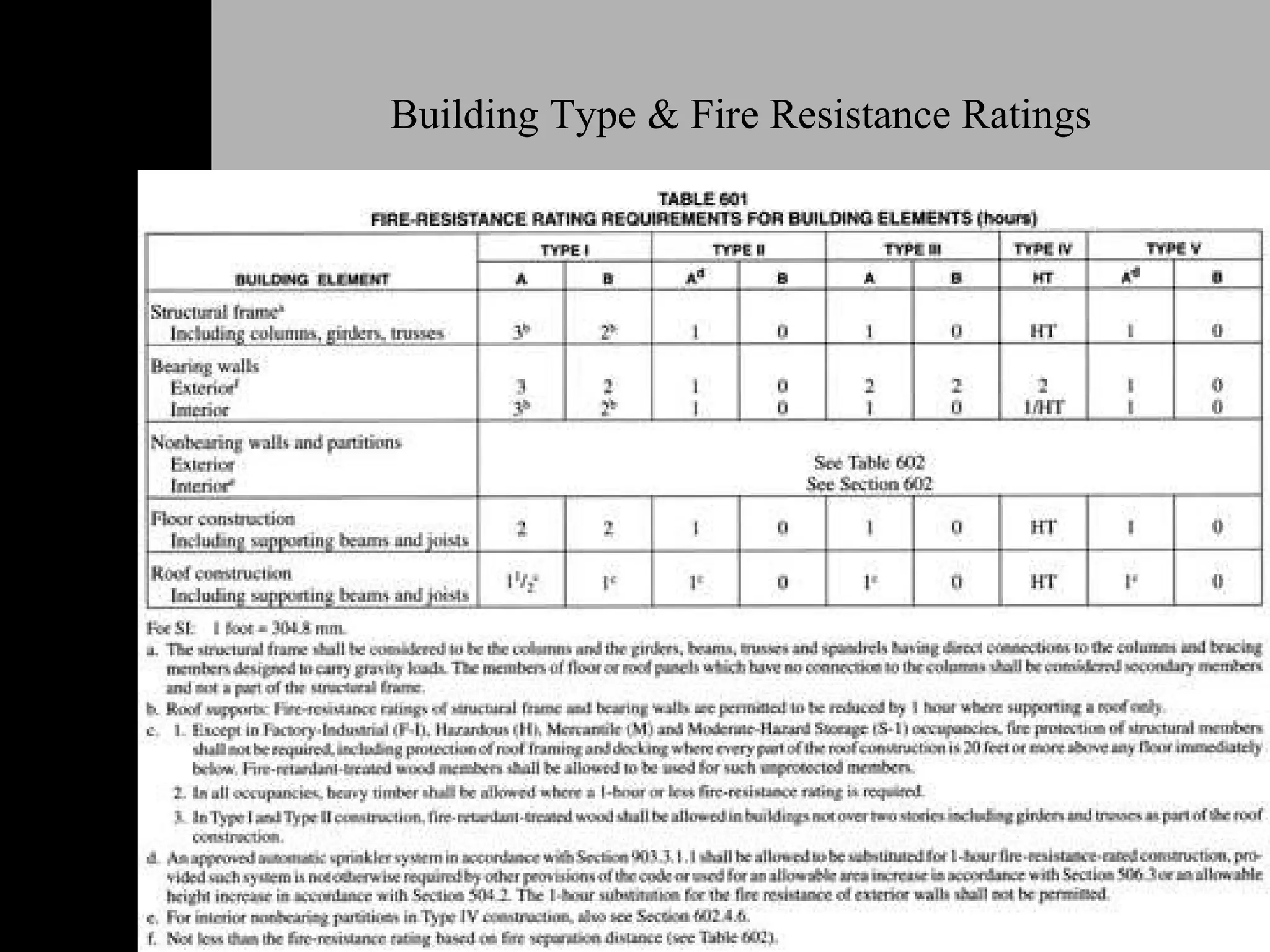
Building Type & Fire Resistance Ratings
Other Codes Affecting Buildings Plumbing Code Electrical Code Mechanical & Energy Code Elevator Code Life Safety Code (NFPA 101) Focuses its regulations on the building inhabitants
Fire Resistance Ratings MANY CODE REQUIREMENTS HAVE TO DO WITH โ€œFIRE RATINGโ€ REQUIREMENTS Measured in Hours (or fraction thereof) Typically, increased Fire Resistance  results  in increased construction cost INCREASED RATING - GENERALLY INCREASED SAFETY, BUT ALSO INCREASED COST THEREFORE OFTEN BUILD TO LOWEST ACCEPTABLE RATING.  WHY??? OWNERS WANT TO BE UNSAFE??? NO, OWNERS WANT TO BE COMPETITIVE
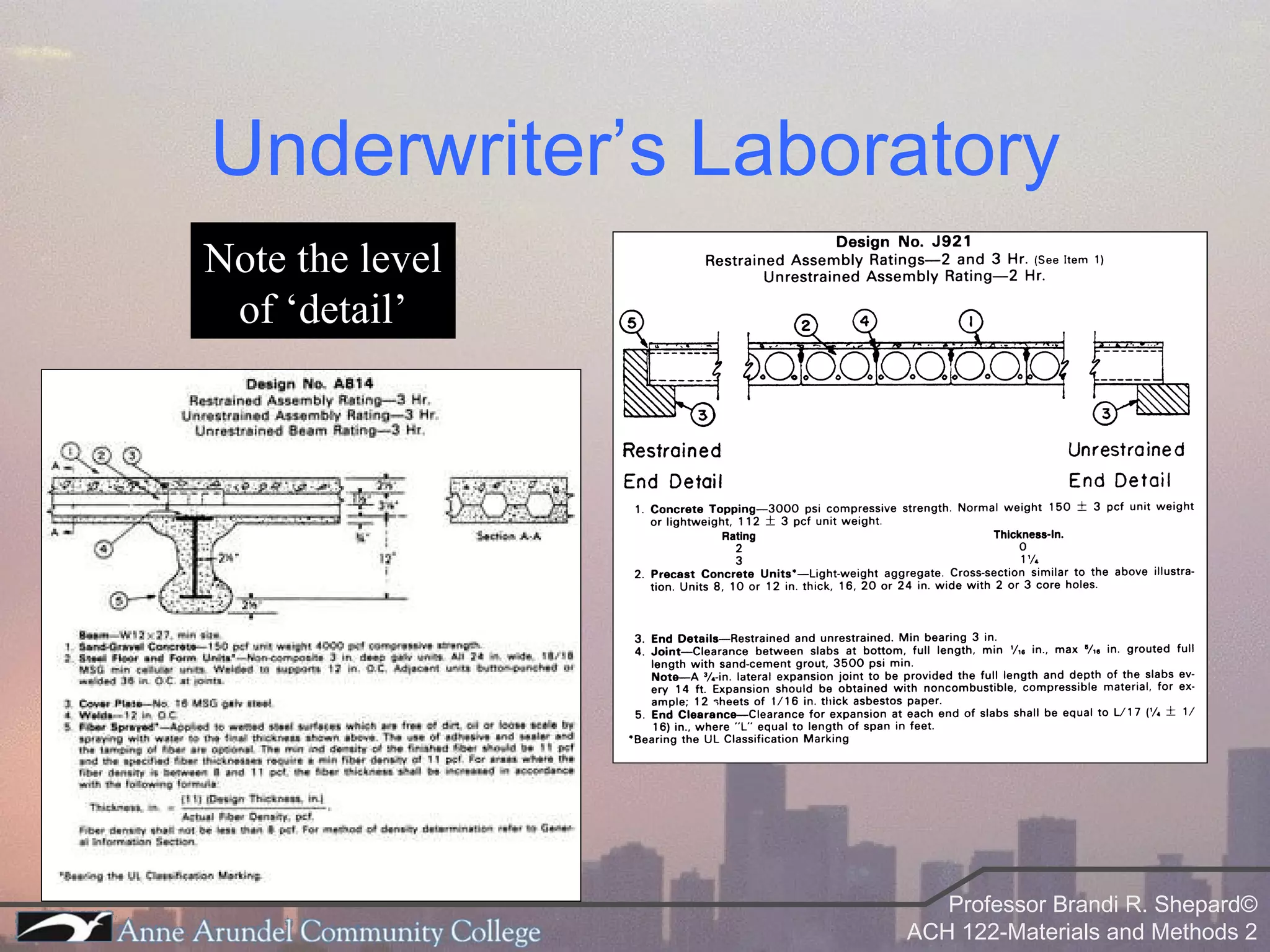
Establishing Fire Ratings Full Scale Laboratory Tests - Often UL MOCKUP,  ACTUAL COMPONENTS TEST TO DESTRUCTION Published Ratings  (by various industry groups) Tables/Standards are published  Component(s) - Material Specifications Construction โ€œdetailsโ€ / Requirements
Fire Ratings Issued by: Who typically pays for tests to rate materials and assemblies?  Building Material Manufacturerโ€™s  WHY?  So that their product is specified Construction Trade Organizations TYPICALLY - MANUFACTURERS ORGANIZATIONS APA, ACI, CRSI (Conc. Reinforcement Steel Institute)
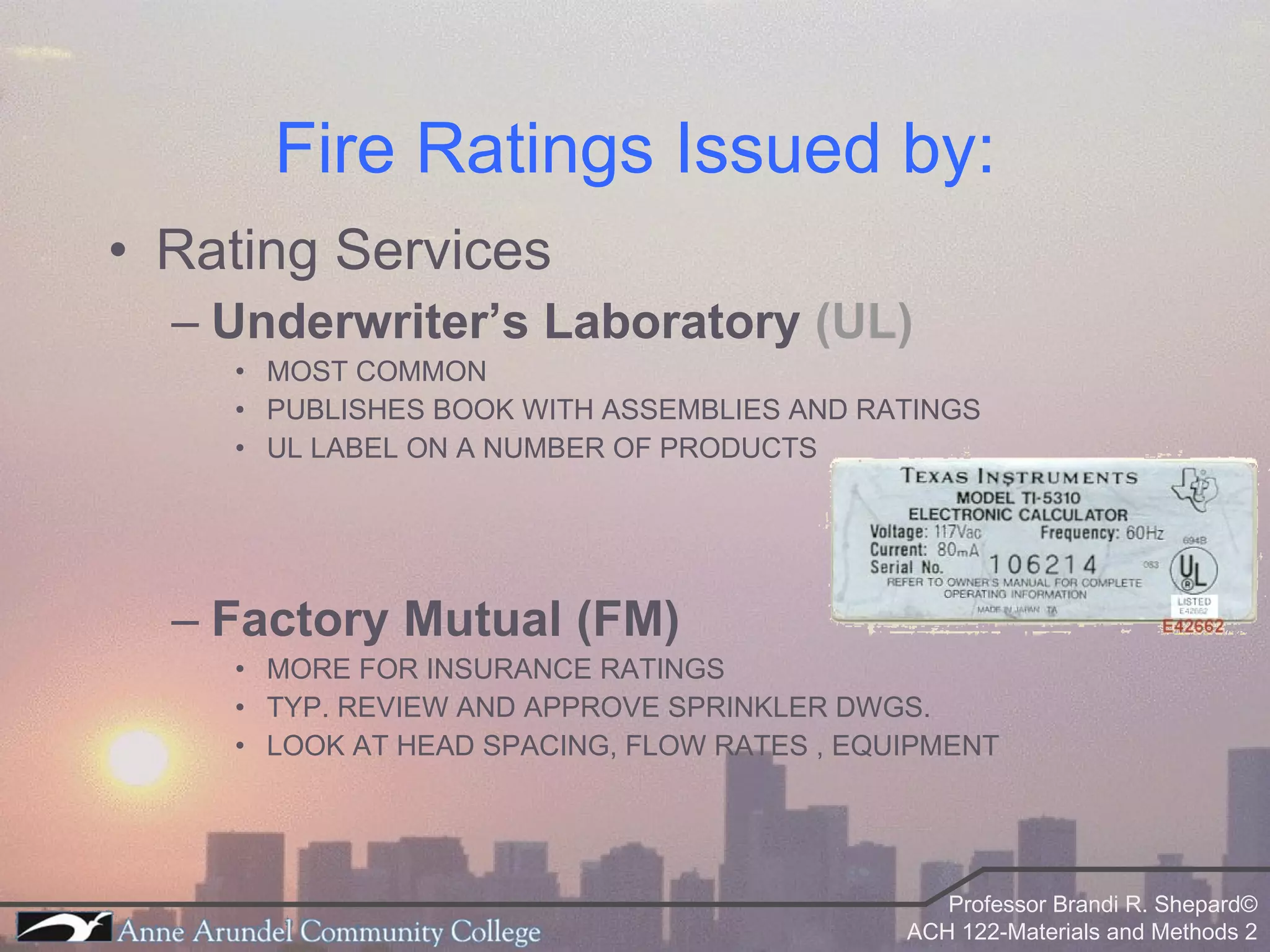
Fire Ratings Issued by: Rating Services Underwriterโ€™s Laboratory  (UL) MOST COMMON PUBLISHES BOOK WITH ASSEMBLIES AND RATINGS UL LABEL ON A NUMBER OF PRODUCTS  Factory Mutual (FM) MORE FOR INSURANCE RATINGS TYP. REVIEW AND APPROVE SPRINKLER DWGS. LOOK AT HEAD SPACING, FLOW RATES , EQUIPMENT
Underwriterโ€™s Laboratory Note the level of โ€˜detailโ€™
Zoning Ordinances Regulations based on land use What types of activities may take place on specified land How much building can cover land Total floor area that can be covered Height restrictions on building How far building needs to be set back from property/land boundary Locally developed
Legal Constraints American with Disabilities Act (ADA) Civil rights law enacted in 1990 Makes it legally binding that all buildings provide accessibility means to the physically handicapped Access standards regulate design for Entrances Stairs Doorways Elevators Toilet facilities Provides guidelines in construction to accommodate the physically handicap
Legal Constraints Occupational Safety and Health Administration (OSHA) Governed by the Department of Labor Controls the design of workplaces to minimize the possible health and safety risks to workers Most prominent in industrial buildings Watchdog group for construction safety
Additional Building Standards Info Testing & Certification Standards Underwriters Laboratories (UL) American Society for Testing and Materials (ASTM) American National Standards Institute (ANSI) Professional Trade Associations and Organizations Construction Specifications Institute (CSI) Independent and specific trade organizations for individual trades and materials These organizations publish supplemental information for quality recommendations
Testing & Certification Standards American Society for Testing and Materials (ASTM) Establishes โ€œstandardโ€ specifications for commonly used materials Designated by a number (i.e., ASTM C150) Specifies a โ€œqualityโ€ that a certain material should meet Additional Building Standards Info
Testing & Certification Standards American National Standards Institute (ANSI) Develops standards for industrial products Mechanical components (HVAC) Energy Efficiency components (windows, glass) Additional Building Standards Info
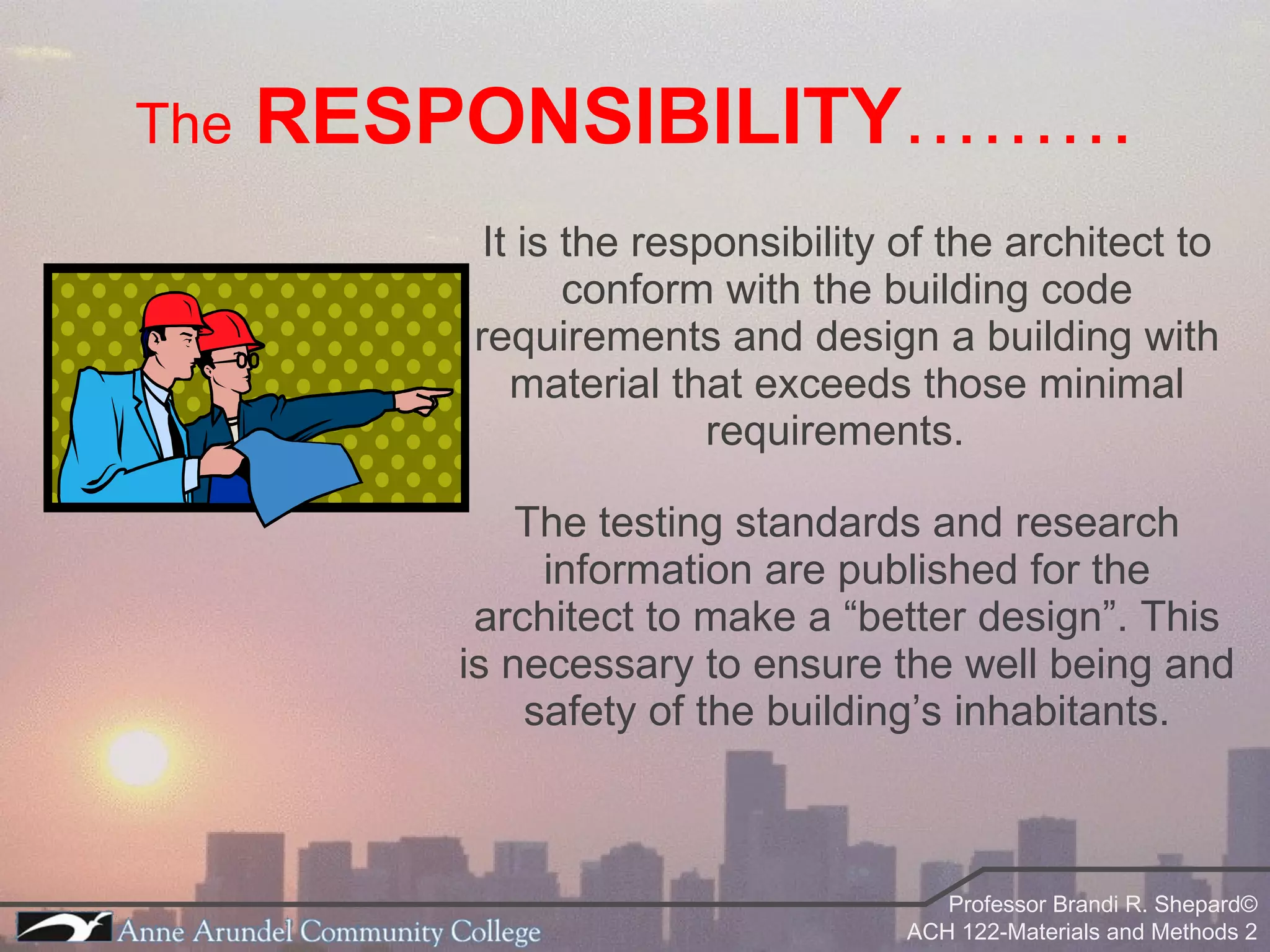
The   RESPONSIBILITY โ€ฆโ€ฆโ€ฆ It is the responsibility of the architect to conform with the building code requirements and design a building with material that exceeds those minimal requirements.  The testing standards and research information are published for the architect to make a โ€œbetter designโ€. This is necessary to ensure the well being and safety of the buildingโ€™s inhabitants.
NEXT LECTURE Sustainability and the LEED Rating System

ACH 122 Lecture 01 (Bldg Codes)

  • 1.
    Building Codes and Regulatory Requirements Building Codes & Life Safety Code Development Zoning Ordinances Legal Constraints
  • 2.
    The Beginning ofa Building โ€ข an idea in someoneโ€™s mind โ€ข a desire for something new and accommodating โ€ข an element for society and history
  • 3.
    The Beginning ofa Building Get the money Find a lending institution Match with a financial representative Secure a loan Credit check is performed Investors may be needed Collateral may be required Monies are released in payment to owner; not one lump sum
  • 4.
    Hire the professionalsArchitect/Engineer Construction Manager Design-Build Firm General Contractor Consultants The Beginning of a Building
  • 5.
    Architect develops designTakes ownerโ€™s needs & wants Combines with architectโ€™s ideas Conforms to building codes & zoning ordinances Works out details for necessary building components Structural system Mechanical/Electrical system Enclosure system The Beginning of a Building
  • 6.
    Code Compliance Drawingsand Specifications are submitted to permit office in local jurisdiction Qualified Building Inspectors examine documents for code compliance Once inspector and architect agree on the questionable code items, permit is issued. Building Inspector will make frequent visits to site during construction for code conformance. (also called โ€œsigning offโ€) The Beginning of a Building
  • 7.
    Bidding, Negotiation &Award Putting the word out that the building needs to be built Invitation to Bid Instructions to Bidders Bid Form Bid Security AWARD to General Contractor!!! They hire subcontractors They get materials/labor from vendors & suppliers The Beginning of a Building
  • 8.
  • 9.
    But..........Wait a minute......It's a lot more complicated than that!!
  • 10.
    Selection Considerations for Building Materials Suitability Availability Cost Appearance Preference Building Constraints
  • 11.
    Building System ChoicesRequired functional performance? Desired aesthetics / appearance? Legally possible (building regulations)? Most economical? (1 st cost, life cycle) What is best for environment?
  • 12.
    Performance Vs. ConstructionDesign & Performance Issues Evaluated on Every Building Visual, functional, technical, sustainability, physical limitations, & legal considerations May Involve Trade-offs - Time, Cost, Quality Construction Issues Deal with Actual Construction Relate to Means and Methods
  • 13.
    Who Has PrimaryResponsibility for Building Material Selection? DEPENDS on Contractual Arrangements, often Designer/Architect, with input from the Owner for Appearance and/or Performance & the Contractor for Cost, Availability, & Constructability
  • 14.
    Who is PrimarilyResponsible for Construction Methods? AIA 201; The contractor shall be solely responsible for and have control over means, methods, techniques, sequences and procedures and for coordinating all portions of the Work under the contract ( unless instructed otherwise )
  • 15.
    Building Constraints MaterialLimitations Availability Costs Site Limitations Type of Soil Topography/Grading Structural Feasibilities How well a specific material will perform in a given environment
  • 16.
    Building Constraints LaborConstraints Skilled construction workers Availability Construction Budget (MONEY!!) How much is there to spend Who will lend it to you or invest
  • 17.
    Additional BuildingConstraints ๏ƒ˜ Building Codes ๏ƒ˜ Zoning Ordinances ๏ƒ˜ Legal Constraints
  • 18.
    Building Codes Toprotect public health and safety by setting a minimum standard of quality Codes are to be followed & maintained, but are to be used as basic foundations for quality Codes do place limitations on design and aesthetics โ€œโ€ฆ establish minimum construction standards for the protection of life, health, and welfare of the public.โ€
  • 19.
    Building Codes modelbuilding codes Codes are Nationally and Internationally Developed These are the basis in which all codes are standardized in the United States Prepared by a National Group of Code Administrators that organize locally Adopted by local jurisdictions Townships, Counties, States, Etcโ€ฆ Local amendments may be issued to make certain restrictions either more strict or lax They are regulations based on construction type
  • 20.
    Types of buildingcodes IBC 2000 & IBC 2003 - International Building Code Developed by the International Code Council (ICC) Used by most jurisdictions throughout the United States. First unified code in history. Site, Construction, Mechanical, Electrical, Etcโ€ฆ IBC has both standard and residential code restrictions. Addresses construction standards and life safety IRC 2003 โ€“ International Residential Code Focuses primarily on residential dwellings One, two-story dwellings, townhouses, condos/apartments Building Codes
  • 21.
    Types of buildingcodes Life Safety 2003 โ€“ More specific towards safety of occupants (NFPA 101) Developed by National Fire Protection Agency Also adopted by most jurisdictions Addresses design decisions that are essential to the life safety of building occupants, general public, and first responders. Minimum criteria for the egress of facilities. Addresses minimum construction performance in the event of an emergency. Building Codes
  • 22.
    What happens whenboth codes have different minimum requirements? Select the most restrictive of the two OR Consult with local code official for their interpretation Building Codes
  • 23.
    Older Codes Areโ€ฆBuilding Officials and Code Administrators (BOCA - 1996) Uniform Building Code (UBC) Standard Building Code (SBC) Council of American Building Officials (CABO) BOCA, UBC and SBC codes are not as commonly used today as they were in the past. CABO One- and Two-Dwelling Code of 1995 was replaced by IRC Building Codes
  • 24.
    Life Safety &Building Code Issues Means of Egress Methods of exiting the building in the event of an emergency Exit Access (doors, windows) Exit (halls, stairs) Exit Discharge (outside) Points of Refuge (safe places for people to go) Occupancy Loads More people may require more exits and fire protection. Hourly Ratings The minimum amount of time an object or construction assembly must last until the fire burns through.
  • 25.
    Three Major Factors Determines the Development of a Building: Construction Type Building Use Zoning Regulations CODE RELATIONSHIP
  • 26.
    The Code RelationshipUSE Intended purpose of building Some building are mixed use These are broken down into โ€œ USE GROUPS โ€ Type of Occupancy Building Use
  • 27.
    The Code RelationshipCONSTRUCTION TYPE What the building is made of How the materials relate to each other These are broken down into โ€œTYPESโ€ Type of Occupancy Building Use Fire-Resistance Rating of Construction Construction Type
  • 28.
    The Code RelationshipZONING ORDINANCES Drawn up by local jurisdictions to manage: density & pattern types of development Regulations based on land use Allowable Height & Area Zoning Ordinances Fire-Resistance Rating of Construction Construction Type
  • 29.
    The Code RelationshipType of Occupancy Building Use Allowable Height & Area Zoning Ordinances Fire-Resistance Rating of Construction Construction Type
  • 30.
    Type of OccupancyUse Groups Assembly Business Educational Industry (Factory) High-Hazard Industry Institutional Mercantile Residential Storage Utility Possible to have multiple uses. We refer to this as โ€œ MIXED USE โ€ Designation A B E F H I M R S U
  • 31.
    Building classifications haveexisted since the Uniform Building Code โ€“ Established in 1929 Broken into 5 basic types based on fire resistance and combustibility 5 basic types of construction ranging from the most fire-resistant โ€“ least fire resistant. Type IA is the most fire resistant Type 5B is the least fire resistant Construction types are paired against occupancy groups to determine the maximum size of the building allowed. Construction Types
  • 32.
    Materials are brokendown into two categories: Combustible Materials that will ignite and burn when subjected to fire. Fire treatment / protection may increase the resistance of some materials. Noncombustible Material of which no part will ignite and burn when subjected to fire. Construction Types
  • 33.
    Construction types arefurther broken down into sub-categories designating their fire protection: #A = Protected #B = Unprotected The more fire protection, the larger you can build Even buildings constructed in steel have both classifications because steel will melt and deflect under extreme heat. Construction Types
  • 34.
    The principal elementsof type I & II construction are made of noncombustible materials. Principal elements generally refers to the structure Type I & II generally relies on steel, concrete of masonry for its structure. Construction Types Section 402.0 TYPE 1 CONSTRUCTION 402.1 General: Buildings and structures of Type 1 construction are those in which the walls, partitions, structural elements, floors, ceilings, roofs and the exits are constructed of approved non-combustible materials and protected to afford the fire resistance rating specified in Table 401. Buildings are Type 1 construction shall be further classified as Type 1A or 1B. Same description as Type II
  • 35.
    Type III buildingsarea mix of both combustible and noncombustible materials. Noncombustible exterior walls Combustible interior structure Designed to prevent fires from spreading from one structure to another Ex.: a Wood Frame Building with a brick veneer on all sides. Construction Types Section 404.0 TYPE 3 CONSTRUCTION 404.1 General: Buildings and structures of Type 3 construction are those in which the exterior, fire walls, and party walls are constructed of masonry or other approved non-combustible materials of the required fire resistance rating and structural properties; the floors, roofs and interior framing are wholly or partly constructed of wood, metal, or other approved construction; โ€ฆโ€ฆ..
  • 36.
    Type IV buildingsaddresses heavy timber construction. Heavy timber members begin to flame and char at about 400 degrees. As charring continues, it begins to act as a fire protection by insulating the interior of the wood members. Construction Types Section 405.0 TYPE 4 CONSTRUCTION 405.1 General: Buildings and structures of Type 4 construction are those in which the exterior walls are constructed of non-combustible materials having a fire resistance rating not less than that specified in Table 401 and the interior structural members are of solid or laminated wood without concealed spaces.
  • 37.
    Type V constructionis the most restrictive in terms of what you can build BUT least restrictive in what you can use to build it. Allows the use of any material permitted by code Type V is the conventional light-wood frame construction in residential homes. V-A protects all major building elements (stairs, bearing walls, columns) with a 1 hour rating V-B is generally unprotected construction Construction Types Section 406.0 TYPE 5 CONSTRUCTION 406.1 General: Buildings and structures of Type 5 construction are those in which the exterior walls, bearing walls, partitions, floors and roofs are constructed of any materials permitted by this code and in which the structural elements have the required fire resistance rating specified in Table 401. Buildings of Type 5 construction shall be further classified as Type 5A or 5B.
  • 38.
    Occupancy Groups IBCGroups A-1 through A5 Assembly occupancies (theaters, lecture halls, churches, night clubs, restaurants, libraries, museums, sports arenas, etc.) Group B โ€“ Business Occupancy Group E โ€“ Educational Groups H-1 through H-5 High Hazard Occupancy Groups I-1 through I-4 Institutional Health car, geriatrics, prisons Group M โ€“ Mercantile Stores (retail) Groups R-1 through R-4 Residential Occupancies Homes, apartments, dorms, etc. Group S-1 and S-1 Hazardous storage Group U โ€“ Utility Buildings
  • 39.
    Building Type &Fire Resistance Ratings
  • 40.
    Other Codes AffectingBuildings Plumbing Code Electrical Code Mechanical & Energy Code Elevator Code Life Safety Code (NFPA 101) Focuses its regulations on the building inhabitants
  • 41.
    Fire Resistance RatingsMANY CODE REQUIREMENTS HAVE TO DO WITH โ€œFIRE RATINGโ€ REQUIREMENTS Measured in Hours (or fraction thereof) Typically, increased Fire Resistance results in increased construction cost INCREASED RATING - GENERALLY INCREASED SAFETY, BUT ALSO INCREASED COST THEREFORE OFTEN BUILD TO LOWEST ACCEPTABLE RATING. WHY??? OWNERS WANT TO BE UNSAFE??? NO, OWNERS WANT TO BE COMPETITIVE
  • 42.
    Establishing Fire RatingsFull Scale Laboratory Tests - Often UL MOCKUP, ACTUAL COMPONENTS TEST TO DESTRUCTION Published Ratings (by various industry groups) Tables/Standards are published Component(s) - Material Specifications Construction โ€œdetailsโ€ / Requirements
  • 43.
    Fire Ratings Issuedby: Who typically pays for tests to rate materials and assemblies? Building Material Manufacturerโ€™s WHY? So that their product is specified Construction Trade Organizations TYPICALLY - MANUFACTURERS ORGANIZATIONS APA, ACI, CRSI (Conc. Reinforcement Steel Institute)
  • 44.
    Fire Ratings Issuedby: Rating Services Underwriterโ€™s Laboratory (UL) MOST COMMON PUBLISHES BOOK WITH ASSEMBLIES AND RATINGS UL LABEL ON A NUMBER OF PRODUCTS Factory Mutual (FM) MORE FOR INSURANCE RATINGS TYP. REVIEW AND APPROVE SPRINKLER DWGS. LOOK AT HEAD SPACING, FLOW RATES , EQUIPMENT
  • 45.
    Underwriterโ€™s Laboratory Notethe level of โ€˜detailโ€™
  • 46.
    Zoning Ordinances Regulationsbased on land use What types of activities may take place on specified land How much building can cover land Total floor area that can be covered Height restrictions on building How far building needs to be set back from property/land boundary Locally developed
  • 47.
    Legal Constraints Americanwith Disabilities Act (ADA) Civil rights law enacted in 1990 Makes it legally binding that all buildings provide accessibility means to the physically handicapped Access standards regulate design for Entrances Stairs Doorways Elevators Toilet facilities Provides guidelines in construction to accommodate the physically handicap
  • 48.
    Legal Constraints OccupationalSafety and Health Administration (OSHA) Governed by the Department of Labor Controls the design of workplaces to minimize the possible health and safety risks to workers Most prominent in industrial buildings Watchdog group for construction safety
  • 49.
    Additional Building StandardsInfo Testing & Certification Standards Underwriters Laboratories (UL) American Society for Testing and Materials (ASTM) American National Standards Institute (ANSI) Professional Trade Associations and Organizations Construction Specifications Institute (CSI) Independent and specific trade organizations for individual trades and materials These organizations publish supplemental information for quality recommendations
  • 50.
    Testing & CertificationStandards American Society for Testing and Materials (ASTM) Establishes โ€œstandardโ€ specifications for commonly used materials Designated by a number (i.e., ASTM C150) Specifies a โ€œqualityโ€ that a certain material should meet Additional Building Standards Info
  • 51.
    Testing & CertificationStandards American National Standards Institute (ANSI) Develops standards for industrial products Mechanical components (HVAC) Energy Efficiency components (windows, glass) Additional Building Standards Info
  • 52.
    The RESPONSIBILITY โ€ฆโ€ฆโ€ฆ It is the responsibility of the architect to conform with the building code requirements and design a building with material that exceeds those minimal requirements. The testing standards and research information are published for the architect to make a โ€œbetter designโ€. This is necessary to ensure the well being and safety of the buildingโ€™s inhabitants.
  • 53.
    NEXT LECTURE Sustainabilityand the LEED Rating System

Editor's Notes

  • #3ย Introduction to purpose for building
  • #11ย Suitability: PRIMARY FOCUS OF THIS COURSE SUITABLE FOR THE USE INTENDED EXAMPLES: CARRY THE LOADS, PROVIDE THE REQUIRED FUCTION, SUITABLE WITH ENVIRONMENT Availability; CAN YOU OBTAIN IT? IN THE TIME NEEDED? Cost; MOST ALWAYS A โ€œPRIMEโ€ CONSIDERATION OFTEN THE PRIMARY RESTRAINT Appearance; DESIGN (AND TASTE) CONSIDERATION, subjective ARCHITECT AND OWNER Preference; SUBJECTIVE CONSIDERATION - A/E & OWNER
  • #13ย Building Performance Issues ITEMS SUCH AS FUNCTION, AESTHETICS DURABILITY, LIFE, expansion/contraction, heat flow โ€œ STRUCTURALโ€ Design CONSIDERATIONS MAINTAINANCE MARKET ATTRACTING FIRE SAFETY, ETC. INITIAL COST, LIFE CYCLE COST Evaluated on Every Building CONFRONTED DURING DESIGN Involve โ€œTrade-offsโ€ - Time, Cost, Quality Construction Issues Deal with Actual Construction Relate to Means and Methods ITEMS SUCH AS: SAFETY, SCHEDULE, COST, QUALITY, OPTIMUM USE OF TRADES, WEATHER, ACTIVITY SEQUENCING, PRODUCTIVITY
  • #14ย Contractual Arrangements; TRADITIONAL OAC?, DESIGN BUILD?, DBO?? A/E STILL INVOLVED - DEGREE OF INVOLVEMโ€™T Designer/Architect TYP.-PRIMARY INVOLVEMENT/RESPONSIBILITY WITH INPUT FROM; Owner for suitability, appearance & preference AND Contractor on cost and availability AND SOMETIMES SUITABILITY WHY SHOULD A CONTRACTOR BE FAMILIAR WITH MATERIALS? HAVE KNOWLEDGE OF COST, AVAILABILITY, INSTALLATION REQUIRMENTS - TO BE AN EXPERT/SOMEONE WHO CAN ASSIST THE THE OWNER AND A/E
  • #15ย EXPLAIN AIA 201 (CONTRACTUAL CONDITIONS) WHY IS CONTRACTOR RESPONSIBLE? (& NOT A/E, ETC) Most Knowledgeable, โ€œcontrolsโ€ the site operations Method/means affects price, & time What the contractor should best know HOW OFTEN IS CONTRACTOR โ€œ instructed otherwise โ€? WHY HOW DO CONTRACTORS GET IN TROUBLE? USING โ€œNON-APPROVED(SPEC.) MATERIALS NOT FOLLOWING MANUF. RECOMMENDATIONS EXAMPLES; WP CURING TIME, HOW TO AVOID PROBLEMS FOLLOW PROJECT SPECIFICATIONS, MANUFACTURERS INSTRUCTIONS/RECOMMENDATIOS
  • #42ย MANY CODE REQUIREMENTS HAVE TO DO WITH โ€œFIRE RATINGโ€ REQUIREMENTS Measured in Hours (or fraction thereof) Typically - Increased Fire Resistance results in Increased Construction Cost INCREASED RATING - GENERALLY INCREASED SAFETY, BUT ALSO INCREASED COST THEREFORE OFTEN BUILD YTO LOWEST ACCEPTABLE RATING. WHY??? OWNERS WANT TO BE UNSAFE??? NO, OWNERS WANT TO BE COMPETITIVE
  • #43ย Full Scale Laboratory Tests MOCKUP, ACTUAL COMPONENTS TEST TO DESTRUCTION Identification of Components TABLES / STANDARDS PUBLISHED MUST BUILT TO / DUPLICATE TO MAINTAIN RATING American Society for Testing and Materials (ASTM) AS WITH A NUMBER OF CONSTRUCTION TESTS, ESTABLISHES TESTING STANDARDS
  • #44ย Building Material Manufacturer WHY? SO that their product can be used. Construction Trade Organizations TYPICALLY - MANUFACTURERS ORGANIZATIONS APA, ACI, CRSI (Conc. Reinf. Steel Institute) Rating Services Underwriterโ€™s Laboratory (UL) MOST COMMON PUBLISHES BOOK WITH ASSEMBLIES AND RATINGS UL LABEL ON A NUMBER OF PRODUCTS ( SHOW UL BOOK) Factory Mutual (FM) MORE FOR INSURANCE RATINGS TYP. REVIEW AND APPROVE SPRINKLER DWGS. LOOK AT HEAD SPACING, FLOW RATES , EQUIPMENT
  • #45ย Building Material Manufacturer WHY? SO that their product can be used. Construction Trade Organizations TYPICALLY - MANUFACTURERS ORGANIZATIONS APA, ACI, CRSI (Conc. Reinf. Steel Institute) Rating Services Underwriterโ€™s Laboratory (UL) MOST COMMON PUBLISHES BOOK WITH ASSEMBLIES AND RATINGS UL LABEL ON A NUMBER OF PRODUCTS ( SHOW UL BOOK) Factory Mutual (FM) MORE FOR INSURANCE RATINGS TYP. REVIEW AND APPROVE SPRINKLER DWGS. LOOK AT HEAD SPACING, FLOW RATES , EQUIPMENT