Decoding What ProjectFinancial
Management Is!
Source: Image by ngampolthongsai
Today, companies have become project-based; many projects are provided for various
departments and teams as per the client’s requirements. The resource that keeps the
project going is the financial aspect of the project; the Right amount of funds can help you
get better results, which will satisfy the requirements of clients. The profit margin target
also needs to be taken care of. Just when one of the brilliant projects is sailing smoothly, it
gets hit by an iceberg of unexpected costs. Even while launching a new initiative that has
great potential, it might often get tangled in a web of financial crises.
These situations are unavoidable, but can be precise with the help of project financial
management. It is not just about tracking numbers, but it also helps you navigate toward
success by offering better outcomes to clients within budget and with optimal resource
usage. There are interesting insights about this project. We will decode the process and
also simplify it by making this engaging.
2.
In this article,we will learn about what project financial management is, along with the
project lifecycle and challenges in this process.
What is project financial management? And understanding the
project lifecycle.
Project financial management is managing any aspect of a project involving finances, such
as costs, revenue, and profit. One can control and improve this for a better company
outcome. Planning, estimating, budgeting, funding, managing project expenses, and billing
are the core requirements of this process. The project management office (PMO) of any
organization often supervises or oversees this. The goal is to keep the project costs within
the planned budget, not even lower. Resulting in hitting profit margin targets, which leads to
the client being happy. Let’s understand more about the factors and elements of project
financial management.
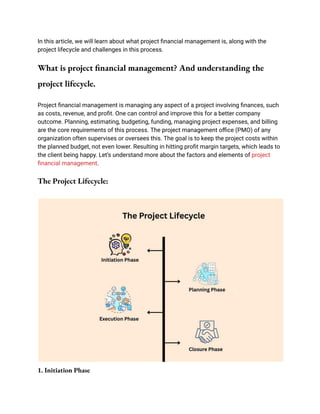
The Project Lifecycle:
1. Initiation Phase
3.
Before the project’sapproval, someone must evaluate its financial feasibility, considering
the agency’s capacity.
2. Planning Phase
Financial management starts during project planning. Project managers allocate project
expenses and budgets, along with the main milestones and their timeframes.
3. Execution Phase
The project team should closely monitor the budget for expenses and cost variance while
delivering tasks (you can calculate it by using the cost variance formula).
4. Closure Phase
Upon project completion, we should conduct a financial review to estimate the ROI and
overall financial impact.
Read More: The Essential Project Manager KPIs for Tracking Success
The Project Financials:
4.
1. Project Costs:
Projectcosts refer to the total funds that a project requires. This includes direct costs, such
as fixed labor, materials, and equipment, as well as indirect costs that include utilities and
quality control, among other things.
2. Project Revenue
Project revenue is the total amount of money a project earns before subtracting its costs.
One can estimate project revenue by looking at historical data, such as past performance,
or using the formulas. Estimating project revenue is critical for selecting the most profitable
projects during the project intake process.
3. Project Profit
Project profit is the total amount of money that a project earns after expenses. Net profit for
a project is the gross profit minus operating expenses and taxes.
4. Project Funding Sources
5.
Project funding sourcescan come from many sources. Companies can also issue bonds
and sell them for funding. Equity financing is when a developer raises private equity funds.
5. Project Cash Flows
Project cash flows refer to cash moving in and out of an organization and determine the
project’s rate of return or value. This money is used to fund the project.
Read More: Cost-Benefit Analysis in Project Management: A Comprehensive Guide
How to do project financial management?
Source – mcsl.com
1. Planning and Budgeting
Plan finances by defining scope, estimating costs that can be direct/indirect by using past
data, creating a detailed budget, adding a contingency fund that can be 10-15%, and setting
calculation rules. This forms your financial foundation.
6.
2. Monitoring andcontrolling
Track all project spending on time. Compare actual costs to the budget to find differences
and understand why. Use methods like EVM, along with AC, EV, CV, and CPI, to check
financial health. Control changes carefully, documenting their financial impact. Meeting
often to review finances, risks, and needed fixes.
3. Forecasting and Reporting
If your project earns money, predict revenue based on milestones and payment schedules.
Regularly create clear, accurate financial reports showing budget versus actual spending,
cost differences, and future forecasts for stakeholders. Also, track when money comes in
and goes out to ensure you always have enough cash on hand.
4. Communication and Collaboration
Communicate openly about project finances with everyone involved (team, clients,
management), ensuring they understand the financial status and any problems. The tools,
like project management software (Asana, Jira), accounting software (QuickBooks, Xero), or
even spreadsheets for tracking. To effectively manage project finances, employ techniques
such as Earned Value Management (EVM), the Cost Breakdown Structure (CBS), and a risk
register.
Read More: Streamlining Success: The Power of Project Management Software
Conclusion
Project financial management plays a crucial role in making sure the project is doing well
financially and also resulting in a better return on investment. There are many aspects to
take care of and consider while managing the finances of any project, such as meeting the
client’s requirements and making the most of the funds given without unplanned expenses.
Factors like planning, estimating, budgeting, monitoring, forecasting, and reporting help take
care of revenue, costs, and expenses.
Tracking the expenses of any project will help any organization calculate and utilise the
finances carefully during the crucial part of the project. This leads to the client’s
satisfaction, along with better outcomes from the project, benefiting the company. Precise
resource use makes careful project financial management a valuable process in today’s
environment.
7.
FAQ:
1. What isfinancial management in a project?
Project financial management is controlling the financial aspects of a project, such as its
costs, revenue, and profit. To do this requires planning, estimating, budgeting, funding,
managing project expenses, and billing.
2. What is project management finance?
A project manager working in finance typically manages the day-to-day operations of
assigned or self-managed projects.
3. What is financing in project management?
Project finance is a way for companies to raise money to realize growth opportunities.