Newly funded project
‘Uganda pig genetics’
Karen Marshall
Stakeholder meeting on Ugandan pigs
Entebbe, Uganda, 14 March 2017
Background – motivation to project
During the varied assessments, many
stakeholders expressed interest in:
 an evidence base on the most
appropriate pig breed-type for the
local production systems /
environments
 access to breeding pigs of known
breed-type, high genetic quality
Productivity
Genetics
Health-
care
Welfare
Feed
Background – current state of knowledge
Limited data on pig productivity exists
No data on local breeds; no data on pig performance on-farm
Organisation Type of data - 2015
NAGRC&DB Data on Camborough herd for last 2-3
years. Herd comprises 30-40 sows
(Camborough 22), 6 boars (PIC terminal
sire line).
KCCA Data on LW/LR crossbreeding herd for
last 2 years. Herd comprises 20 sows
(LW), 4 boars (LR)
Background – pig genetic diversity in Uganda
LandraceLarge White PIC Camborough 22 Local
Cross-bred
descendants
of Pietran?
Cross-bred
descendants
of Duroc?
Duroc? Saddleback?Pietran?
Synthetic LW, LR, White Duroc
Other?
This project
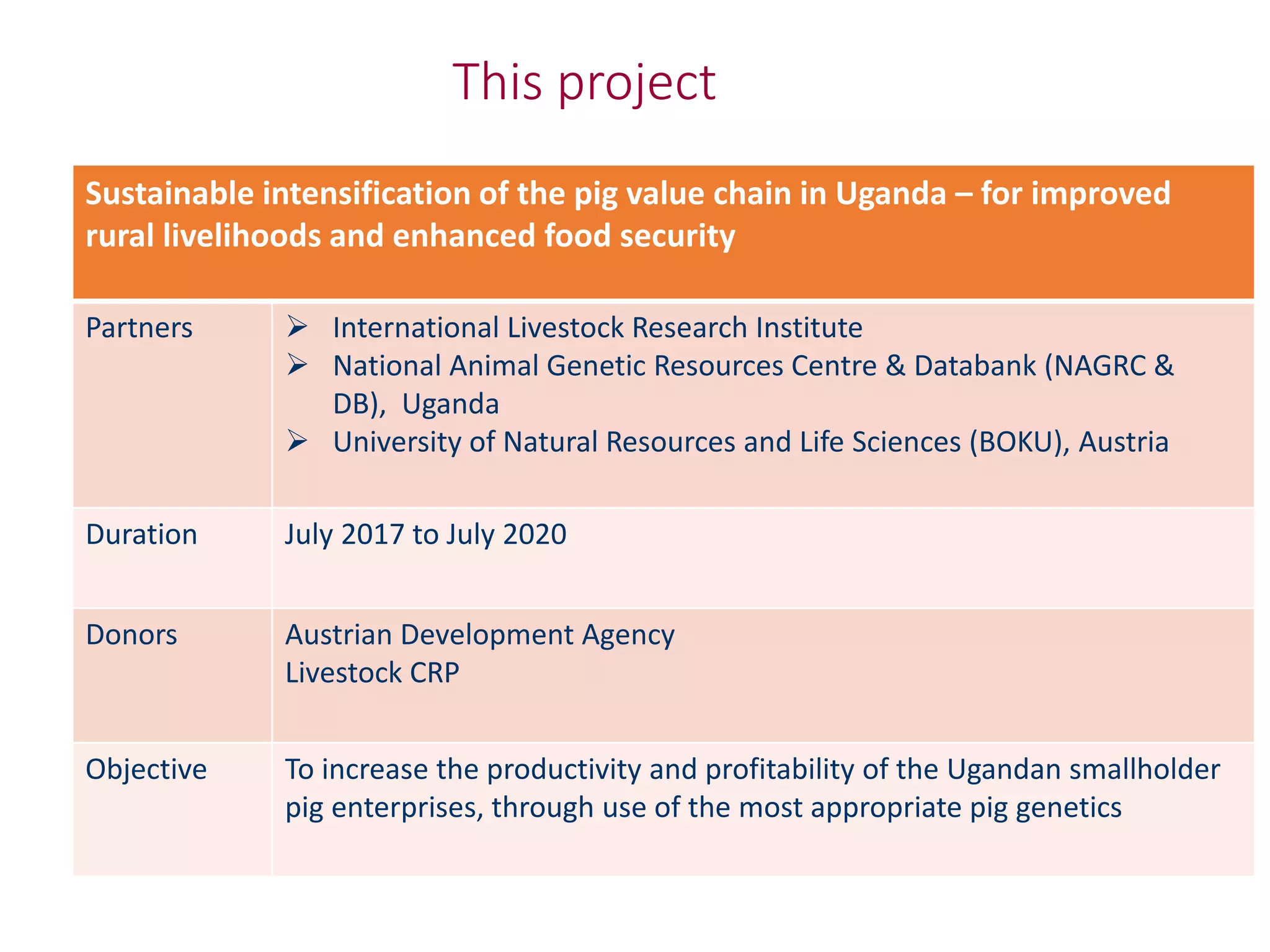
Sustainable intensification of the pig value chain in Uganda – for improved
rural livelihoods and enhanced food security
Partners  International Livestock Research Institute
 National Animal Genetic Resources Centre & Databank (NAGRC &
DB), Uganda
 University of Natural Resources and Life Sciences (BOKU), Austria
Duration July 2017 to July 2020
Donors Austrian Development Agency
Livestock CRP
Objective To increase the productivity and profitability of the Ugandan smallholder
pig enterprises, through use of the most appropriate pig genetics
Activity 1: Evaluate the profitability and productivity of
different household pig production systems in Uganda
 To create an evidence base for informed
decision making by pig keepers
 Approach:
 Monitoring 150+ pig keeping households, 400+
pigs, in for at-least a 14 month period
 Considering productivity (following through to
slaughter); cost-benefit (intra-household)
 Pig breed-type assignment by a genomic
approach
Genomic approach to breed assignment
Illumina PorcineSNP60
(64,000 SNPs)
PIG of unknown
breed composition
DNA
Genomic
analysis
Compare genotypes of pig of
unknown breed to pigs of known
breed-type (reference populations)
Breed A
Breed B
Breed C
50% breed A
50% breed B
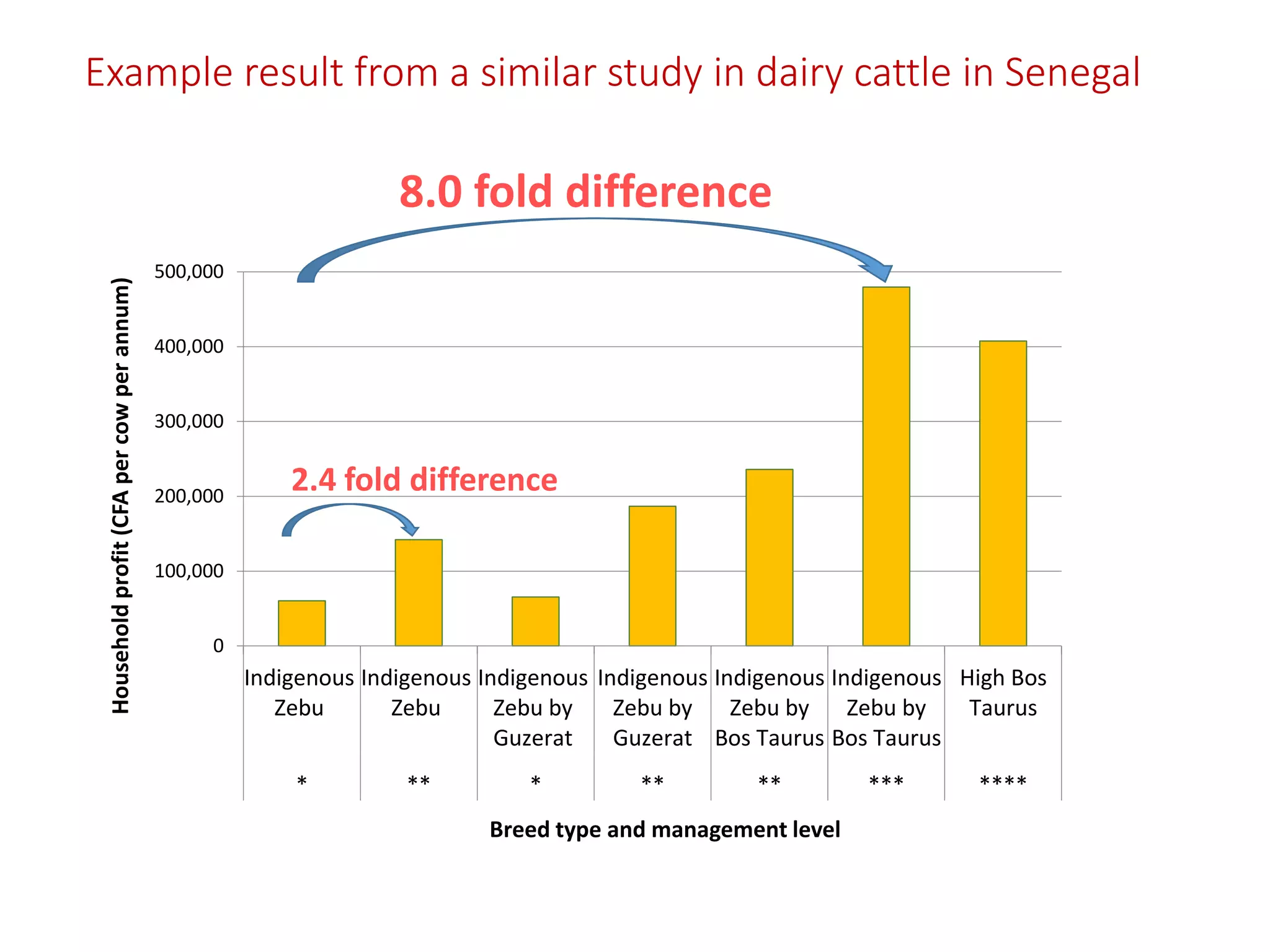
Example result from a similar study in dairy cattle in Senegal
0
100,000
200,000
300,000
400,000
500,000
Indigenous
Zebu
Indigenous
Zebu
Indigenous
Zebu by
Guzerat
Indigenous
Zebu by
Guzerat
Indigenous
Zebu by
Bos Taurus
Indigenous
Zebu by
Bos Taurus
High Bos
Taurus
* ** * ** ** *** ****
Householdprofit(CFApercowperannum)
Breed type and management level
8.0 fold difference
2.4 fold difference
Activity 2: Design, with stakeholders, a genetic
improvement strategy for the smallhold pig sector
 To produce pigs which meet the needs and preferences of
their women and men keepers and other value chain
actors, as well as market demand
Approach to breeding program design
1) derive the breeding goal;
2) assess the state of current breeding strategies, capacities and
infrastructure;
3) prepare the breeding plan, with attention to supportive
institutional arrangements, public and private sector
involvement, and sustainability;
4) plan implementation and ongoing monitoring and refinement
Stakeholder
owned and
driven
From: http://extension.missouri.edu/p/G2311
 To allow pig-keepers to confidently
access the breed-types they desire
 Approach:
 Registration scheme will be developed
and pilot-tested
 Led by NAGRC&DB - mandated via the
Animal Breeding Act of 2001 to register
and certify all animal breeds, breeders
and breeding centers
Activity 3: Develop, with stakeholders, a scheme for
registration of suppliers of pigs of known breed-type
Activity 4: Capacity building of women and men pig
keepers, as well as other stakeholders
 Capacity building activities:
 Training workshops for smallhold pig keepers and other
stakeholder such as village boar keepers, artificial
insemination service providers, and extension agents
 PhD student enrolled in BOKU and based locally
 Further dissemination activities:
 Media, including newspaper and radio
 The existing multi-stakeholder platforms
 Policy briefs and discussions.
Thank you
The most appropriate pig genetics for improved productivity
and profitability of the Ugandan smallholder pig enterprises
Acknowledgements
This work is financed by
Austrian Development Agency
CGIAR Research Program on Livestock
This presentation is licensed for use under the Creative Commons Attribution 4.0 International Licence.
better lives through livestock
ilri.org
ILRI thanks all donors and organizations which globally support its work through their contributions to
the CGIAR system

Uganda pig genetics

  • 1.
    Newly funded project ‘Ugandapig genetics’ Karen Marshall Stakeholder meeting on Ugandan pigs Entebbe, Uganda, 14 March 2017
  • 2.
    Background – motivationto project During the varied assessments, many stakeholders expressed interest in:  an evidence base on the most appropriate pig breed-type for the local production systems / environments  access to breeding pigs of known breed-type, high genetic quality Productivity Genetics Health- care Welfare Feed
  • 3.
    Background – currentstate of knowledge Limited data on pig productivity exists No data on local breeds; no data on pig performance on-farm Organisation Type of data - 2015 NAGRC&DB Data on Camborough herd for last 2-3 years. Herd comprises 30-40 sows (Camborough 22), 6 boars (PIC terminal sire line). KCCA Data on LW/LR crossbreeding herd for last 2 years. Herd comprises 20 sows (LW), 4 boars (LR)
  • 4.
    Background – piggenetic diversity in Uganda LandraceLarge White PIC Camborough 22 Local Cross-bred descendants of Pietran? Cross-bred descendants of Duroc? Duroc? Saddleback?Pietran? Synthetic LW, LR, White Duroc Other?
  • 5.
    This project Sustainable intensificationof the pig value chain in Uganda – for improved rural livelihoods and enhanced food security Partners  International Livestock Research Institute  National Animal Genetic Resources Centre & Databank (NAGRC & DB), Uganda  University of Natural Resources and Life Sciences (BOKU), Austria Duration July 2017 to July 2020 Donors Austrian Development Agency Livestock CRP Objective To increase the productivity and profitability of the Ugandan smallholder pig enterprises, through use of the most appropriate pig genetics
  • 6.
    Activity 1: Evaluatethe profitability and productivity of different household pig production systems in Uganda  To create an evidence base for informed decision making by pig keepers  Approach:  Monitoring 150+ pig keeping households, 400+ pigs, in for at-least a 14 month period  Considering productivity (following through to slaughter); cost-benefit (intra-household)  Pig breed-type assignment by a genomic approach
  • 7.
    Genomic approach tobreed assignment Illumina PorcineSNP60 (64,000 SNPs) PIG of unknown breed composition DNA Genomic analysis Compare genotypes of pig of unknown breed to pigs of known breed-type (reference populations) Breed A Breed B Breed C 50% breed A 50% breed B
  • 8.
    Example result froma similar study in dairy cattle in Senegal 0 100,000 200,000 300,000 400,000 500,000 Indigenous Zebu Indigenous Zebu Indigenous Zebu by Guzerat Indigenous Zebu by Guzerat Indigenous Zebu by Bos Taurus Indigenous Zebu by Bos Taurus High Bos Taurus * ** * ** ** *** **** Householdprofit(CFApercowperannum) Breed type and management level 8.0 fold difference 2.4 fold difference
  • 9.
    Activity 2: Design,with stakeholders, a genetic improvement strategy for the smallhold pig sector  To produce pigs which meet the needs and preferences of their women and men keepers and other value chain actors, as well as market demand
  • 10.
    Approach to breedingprogram design 1) derive the breeding goal; 2) assess the state of current breeding strategies, capacities and infrastructure; 3) prepare the breeding plan, with attention to supportive institutional arrangements, public and private sector involvement, and sustainability; 4) plan implementation and ongoing monitoring and refinement Stakeholder owned and driven From: http://extension.missouri.edu/p/G2311
  • 11.
     To allowpig-keepers to confidently access the breed-types they desire  Approach:  Registration scheme will be developed and pilot-tested  Led by NAGRC&DB - mandated via the Animal Breeding Act of 2001 to register and certify all animal breeds, breeders and breeding centers Activity 3: Develop, with stakeholders, a scheme for registration of suppliers of pigs of known breed-type
  • 12.
    Activity 4: Capacitybuilding of women and men pig keepers, as well as other stakeholders  Capacity building activities:  Training workshops for smallhold pig keepers and other stakeholder such as village boar keepers, artificial insemination service providers, and extension agents  PhD student enrolled in BOKU and based locally  Further dissemination activities:  Media, including newspaper and radio  The existing multi-stakeholder platforms  Policy briefs and discussions.
  • 13.
    Thank you The mostappropriate pig genetics for improved productivity and profitability of the Ugandan smallholder pig enterprises
  • 14.
    Acknowledgements This work isfinanced by Austrian Development Agency CGIAR Research Program on Livestock
  • 15.
    This presentation islicensed for use under the Creative Commons Attribution 4.0 International Licence. better lives through livestock ilri.org ILRI thanks all donors and organizations which globally support its work through their contributions to the CGIAR system

Editor's Notes

  • #2 There MUST be a CGIAR logo or a CRP logo. You can copy and paste the logo you need from the final slide of this presentation. Then you can delete that final slide   To replace a photo above, copy and paste this link in your browser: http://www.flickr.com/photos/ilri/sets/72157632057087650/detail/   Find a photo you like and the right size, copy and paste it in the block above.