M.A.
(INTEGRATED RURAL DEVELOPMENT AND MANAGEMENT)
Faculy of Social Science
Presented by
Rahul Kumar
Roll no. 31
Presented to
Dr. V.K. Paswan
Session- 2021-2023
Topic:Layer Farming in India
Subject: Animal Husbandry (403)
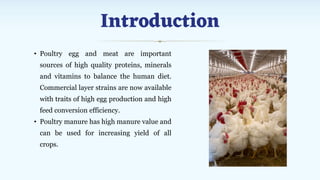
• Poultry egg and meat are important
sources of high quality proteins, minerals
and vitamins to balance the human diet.
Commercial layer strains are now available
with traits of high egg production and high
feed conversion efficiency.
• Poultry manure has high manure value and
can be used for increasing yield of all
crops.
Introduction
Importance in India
• Poultry is one of the fastest growing segments of the agricultural sector in India today.
• India has emerged on the world map as the 3rd largest egg producer (56 billion eggs) and
annual growth rate in egg production approximated 6% per year (Source; Report of the
Working Group on AH & dairying, 12th Five Year Plan).
• The current strength of layers in India is estimated to be 230 million and the annual
percapita availability of eggs has increased from 7 eggs in 1961 to 52 eggs in 2010.
However, the present availability is far below the ICMR recommendation of 180 eggs per
capita per annum.
• The poultry sector in India has undergone a paradigm shift in structure and operation.
This transformation has involved sizable investments in breeding, hatching, rearing and
processing.
Importance in India
• Today, with more and more ‘eggitarians’ on the rise, egg consumption is growing at
8% - 10% annually.
• According to the Ministry of Agriculture, India’s egg production is estimated at 47.3
billion eggs per annum.
• Egg being an excellent source of proteins is fast becoming a favorite among urban
Indians.
• 6% of the eggs produced in the country are converted into processed egg products
mainly for export.
Objectives
• To meet the growing demand of eggs, I intended to establish a layer poultry farm.
• raising of birds domestically or commercially, primarily for meat and eggs but also
for feathers.
Types of layer farming
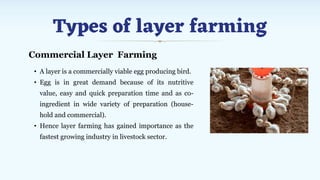
• A layer is a commercially viable egg producing bird.
• Egg is in great demand because of its nutritive
value, easy and quick preparation time and as co-
ingredient in wide variety of preparation (house-
hold and commercial).
• Hence layer farming has gained importance as the
fastest growing industry in livestock sector.
Commercial Layer Farming
Breeds:
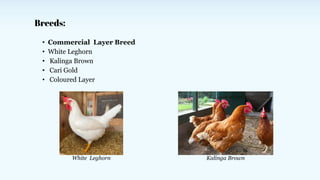
• Commercial Layer Breed
• White Leghorn
• Kalinga Brown
• Cari Gold
• Coloured Layer
White Leghorn Kalinga Brown
Breeds:
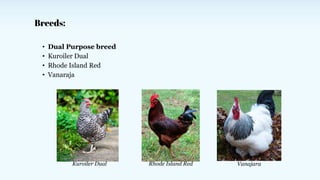
• Dual Purpose breed
• Kuroiler Dual
• Rhode Island Red
• Vanaraja
Kuroiler Dual Rhode Island Red Vanajara
HOUSING & MANAGEMENT
A comfortable, easy to clean and manage, providing sufficient area for the comfort of
the bird is essential requisite for getting optimum growth and production in layer
farming.
Location of Poultry House:
• Away from residential or crowded areas.
• Accessible to the market for eggs and availability of poultry feeds.
• Well connected with roads for transportation.
• Provision of electricity and clean water.
Requirement of a good housing:
• Well ventilated house.
• House built in east to west direction along the long axis of the house for natural
light and sun rays.
• Temperature 20o -25o C.
• Floor Concrete, rain proof, crack-free, rat-proof and easy to clean.
• Roof- should be moist proof, and common roofing materials may be asbestos, fiber
sheet, thatch/chitra etc.
• Light- Daylight desirable.
• Sanitation Ease in cleaning and spraying disinfectants / sanitizers.
• Height of the house 3 mts from the foundation to the roof.
Systems of Housing:
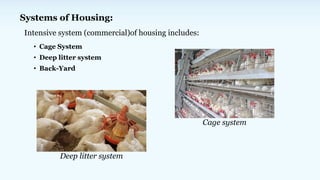
• Cage System
• Deep litter system
• Back-Yard
Intensive system (commercial)of housing includes:
Cage system
Deep litter system
Management:
• Brooding: Brooding is the caring of the chicks from day old till 88 weeks of age. It
is done in order to prevent chick mortality and achieve maximum growth by
providing warmth to the chicks.
• Natural Brooding: Under normal condition, the mother hen provides the chicks
with the warmth of the body and looks after the feeding too.
• Artificial Brooding:Under artificial brooding, a temperature controlled artificial
brooder is used in place of mother hen.
Poultry Feed:
• As feed is the major cost of poultry production and which significantly affects the
production performance of the birds. So feed and feeding is the most important
consideration for efficient poultry farming. Improper feeding not only affects the
production performance but also causes several deficiency diseases.
• Also, the feed needs to have all the nutrients (carbohydrates, protein , fats, minerals
& vitamins) in right proportion. In addition some additives to facilitate digestion
and growth are often added in reputed commercial feed.
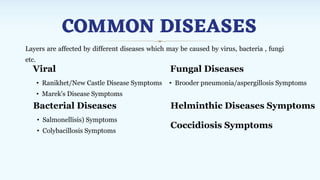
COMMON DISEASES
Layers are affected by different diseases which may be caused by virus, bacteria , fungi
etc.
Viral
• Ranikhet/New Castle Disease Symptoms
• Marek's Disease Symptoms
Bacterial Diseases
• Salmonellisis) Symptoms
• Colybacillosis Symptoms
Fungal Diseases
• Brooder pneumonia/aspergillosis Symptoms
Helminthic Diseases Symptoms
Coccidiosis Symptoms
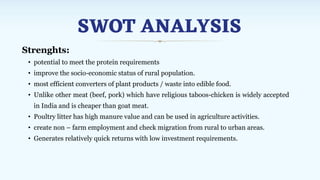
SWOT ANALYSIS
Strenghts:
• potential to meet the protein requirements
• improve the socio-economic status of rural population.
• most efficient converters of plant products / waste into edible food.
• Unlike other meat (beef, pork) which have religious taboos-chicken is widely accepted
in India and is cheaper than goat meat.
• Poultry litter has high manure value and can be used in agriculture activities.
• create non – farm employment and check migration from rural to urban areas.
• Generates relatively quick returns with low investment requirements.
SWOT ANALYSIS
Weakness:
• Poultry farming is labor intensive.
• A peculiar feature of the poultry industry is that it is highly fragmented.
• Poor transport, infrastructure and lack of cold chain facilities currently limit the
feasibility of handling significant volumes of chilled or frozen products.
• Low growing charges coupled with the cost of making investments in the
infrastructure such as sheds, feeders, breeders, heating and cooling systems result in a
low income for farmers.
• The stringent mortality norms (only a 5% mortality is permitted in most integration
contracts-else the farmer gets penalized and is offered a lower rate) leaves the farmers
in a vulnerable position and with no avenue to voice their grievances.
SWOT ANALYSIS
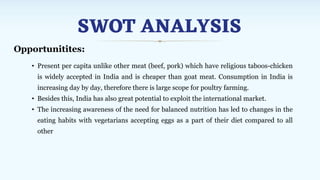
Opportunitites:
• Present per capita unlike other meat (beef, pork) which have religious taboos-chicken
is widely accepted in India and is cheaper than goat meat. Consumption in India is
increasing day by day, therefore there is large scope for poultry farming.
• Besides this, India has also great potential to exploit the international market.
• The increasing awareness of the need for balanced nutrition has led to changes in the
eating habits with vegetarians accepting eggs as a part of their diet compared to all
other
SWOT ANALYSIS
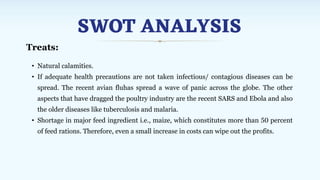
Treats:
• Natural calamities.
• If adequate health precautions are not taken infectious/ contagious diseases can be
spread. The recent avian fluhas spread a wave of panic across the globe. The other
aspects that have dragged the poultry industry are the recent SARS and Ebola and also
the older diseases like tuberculosis and malaria.
• Shortage in major feed ingredient i.e., maize, which constitutes more than 50 percent
of feed rations. Therefore, even a small increase in costs can wipe out the profits.
Rahul_kr_ layer farming.pptx

Rahul_kr_ layer farming.pptx

  • 1.
    M.A. (INTEGRATED RURAL DEVELOPMENTAND MANAGEMENT) Faculy of Social Science Presented by Rahul Kumar Roll no. 31 Presented to Dr. V.K. Paswan Session- 2021-2023 Topic:Layer Farming in India Subject: Animal Husbandry (403)
  • 2.
    • Poultry eggand meat are important sources of high quality proteins, minerals and vitamins to balance the human diet. Commercial layer strains are now available with traits of high egg production and high feed conversion efficiency. • Poultry manure has high manure value and can be used for increasing yield of all crops. Introduction
  • 3.
    Importance in India •Poultry is one of the fastest growing segments of the agricultural sector in India today. • India has emerged on the world map as the 3rd largest egg producer (56 billion eggs) and annual growth rate in egg production approximated 6% per year (Source; Report of the Working Group on AH & dairying, 12th Five Year Plan). • The current strength of layers in India is estimated to be 230 million and the annual percapita availability of eggs has increased from 7 eggs in 1961 to 52 eggs in 2010. However, the present availability is far below the ICMR recommendation of 180 eggs per capita per annum. • The poultry sector in India has undergone a paradigm shift in structure and operation. This transformation has involved sizable investments in breeding, hatching, rearing and processing.
  • 4.
    Importance in India •Today, with more and more ‘eggitarians’ on the rise, egg consumption is growing at 8% - 10% annually. • According to the Ministry of Agriculture, India’s egg production is estimated at 47.3 billion eggs per annum. • Egg being an excellent source of proteins is fast becoming a favorite among urban Indians. • 6% of the eggs produced in the country are converted into processed egg products mainly for export.
  • 5.
    Objectives • To meetthe growing demand of eggs, I intended to establish a layer poultry farm. • raising of birds domestically or commercially, primarily for meat and eggs but also for feathers.
  • 6.
    Types of layerfarming • A layer is a commercially viable egg producing bird. • Egg is in great demand because of its nutritive value, easy and quick preparation time and as co- ingredient in wide variety of preparation (house- hold and commercial). • Hence layer farming has gained importance as the fastest growing industry in livestock sector. Commercial Layer Farming
  • 7.
    Breeds: • Commercial LayerBreed • White Leghorn • Kalinga Brown • Cari Gold • Coloured Layer White Leghorn Kalinga Brown
  • 8.
    Breeds: • Dual Purposebreed • Kuroiler Dual • Rhode Island Red • Vanaraja Kuroiler Dual Rhode Island Red Vanajara
  • 9.
    HOUSING & MANAGEMENT Acomfortable, easy to clean and manage, providing sufficient area for the comfort of the bird is essential requisite for getting optimum growth and production in layer farming. Location of Poultry House: • Away from residential or crowded areas. • Accessible to the market for eggs and availability of poultry feeds. • Well connected with roads for transportation. • Provision of electricity and clean water.
  • 10.
    Requirement of agood housing: • Well ventilated house. • House built in east to west direction along the long axis of the house for natural light and sun rays. • Temperature 20o -25o C. • Floor Concrete, rain proof, crack-free, rat-proof and easy to clean. • Roof- should be moist proof, and common roofing materials may be asbestos, fiber sheet, thatch/chitra etc. • Light- Daylight desirable. • Sanitation Ease in cleaning and spraying disinfectants / sanitizers. • Height of the house 3 mts from the foundation to the roof.
  • 11.
    Systems of Housing: •Cage System • Deep litter system • Back-Yard Intensive system (commercial)of housing includes: Cage system Deep litter system
  • 12.
    Management: • Brooding: Broodingis the caring of the chicks from day old till 88 weeks of age. It is done in order to prevent chick mortality and achieve maximum growth by providing warmth to the chicks. • Natural Brooding: Under normal condition, the mother hen provides the chicks with the warmth of the body and looks after the feeding too. • Artificial Brooding:Under artificial brooding, a temperature controlled artificial brooder is used in place of mother hen.
  • 13.
    Poultry Feed: • Asfeed is the major cost of poultry production and which significantly affects the production performance of the birds. So feed and feeding is the most important consideration for efficient poultry farming. Improper feeding not only affects the production performance but also causes several deficiency diseases. • Also, the feed needs to have all the nutrients (carbohydrates, protein , fats, minerals & vitamins) in right proportion. In addition some additives to facilitate digestion and growth are often added in reputed commercial feed.
  • 14.
    COMMON DISEASES Layers areaffected by different diseases which may be caused by virus, bacteria , fungi etc. Viral • Ranikhet/New Castle Disease Symptoms • Marek's Disease Symptoms Bacterial Diseases • Salmonellisis) Symptoms • Colybacillosis Symptoms Fungal Diseases • Brooder pneumonia/aspergillosis Symptoms Helminthic Diseases Symptoms Coccidiosis Symptoms
  • 15.
    SWOT ANALYSIS Strenghts: • potentialto meet the protein requirements • improve the socio-economic status of rural population. • most efficient converters of plant products / waste into edible food. • Unlike other meat (beef, pork) which have religious taboos-chicken is widely accepted in India and is cheaper than goat meat. • Poultry litter has high manure value and can be used in agriculture activities. • create non – farm employment and check migration from rural to urban areas. • Generates relatively quick returns with low investment requirements.
  • 16.
    SWOT ANALYSIS Weakness: • Poultryfarming is labor intensive. • A peculiar feature of the poultry industry is that it is highly fragmented. • Poor transport, infrastructure and lack of cold chain facilities currently limit the feasibility of handling significant volumes of chilled or frozen products. • Low growing charges coupled with the cost of making investments in the infrastructure such as sheds, feeders, breeders, heating and cooling systems result in a low income for farmers. • The stringent mortality norms (only a 5% mortality is permitted in most integration contracts-else the farmer gets penalized and is offered a lower rate) leaves the farmers in a vulnerable position and with no avenue to voice their grievances.
  • 17.
    SWOT ANALYSIS Opportunitites: • Presentper capita unlike other meat (beef, pork) which have religious taboos-chicken is widely accepted in India and is cheaper than goat meat. Consumption in India is increasing day by day, therefore there is large scope for poultry farming. • Besides this, India has also great potential to exploit the international market. • The increasing awareness of the need for balanced nutrition has led to changes in the eating habits with vegetarians accepting eggs as a part of their diet compared to all other
  • 18.
    SWOT ANALYSIS Treats: • Naturalcalamities. • If adequate health precautions are not taken infectious/ contagious diseases can be spread. The recent avian fluhas spread a wave of panic across the globe. The other aspects that have dragged the poultry industry are the recent SARS and Ebola and also the older diseases like tuberculosis and malaria. • Shortage in major feed ingredient i.e., maize, which constitutes more than 50 percent of feed rations. Therefore, even a small increase in costs can wipe out the profits.