Acetabular fractures
By: Dr. Benjamin Ngau
PGY 5: Orthopedics
Scope
• Introduction
• Epidemiology
• Etiology
• Surgical Anatomy
• Classification
• Imaging
• Management
• Approaches
• Complications
Definitions
• Acetabular fractures are pelvic fractures that involve the articular surface of the hip
joint and may involve one or two columns, one or two walls, or the roof within the
pelvis
• Historical background: Acetabular fractures were treated Non Op up to 1960s
• Judet brothers and Leuternel in 1964 reported that the outcome of operative
treatment of acetabular fractures were far better than non operative treatment
• Their extensive studies on acetabular fractures revolutionized acetabular management.
Epidemiology
• Fractures occur in a bimodal distribution:
• high energy trauma in younger patients (e.g., motor vehicle accidents)
• low energy trauma in elderly patients (e.g., fall from standing height)
• Falls from a height >10 feet
• Extreme sporting events
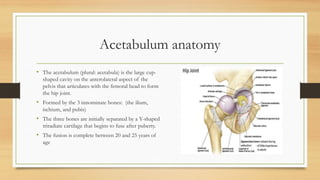
Acetabulum anatomy
• The acetabulum (plural: acetabula) is the large cup-
shaped cavity on the anterolateral aspect of the
pelvis that articulates with the femoral head to form
the hip joint.
• Formed by the 3 innominate bones: (the ilium,
ischium, and pubis)
• The three bones are initially separated by a Y-shaped
triradiate cartilage that begins to fuse after puberty.
• The fusion is complete between 20 and 25 years of
age
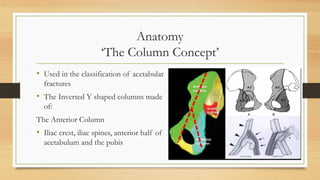
Anatomy
‘The Column Concept’
• Used in the classification of acetabular
fractures
• The Inverted Y shaped columns made
of:
The Anterior Column
• Iliac crest, iliac spines, anterior half of
acetabulum and the pubis
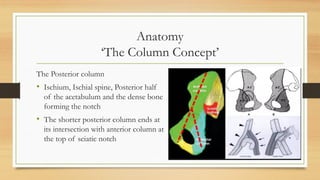
Anatomy
‘The Column Concept’
The Posterior column
• Ischium, Ischial spine, Posterior half
of the acetabulum and the dense bone
forming the notch
• The shorter posterior column ends at
its intersection with anterior column at
the top of sciatic notch
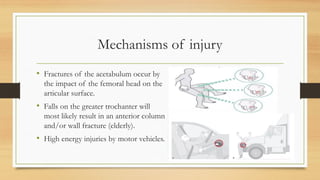
Mechanisms of injury
• Fractures of the acetabulum occur by
the impact of the femoral head on the
articular surface.
• Falls on the greater trochanter will
most likely result in an anterior column
and/or wall fracture (elderly).
• High energy injuries by motor vehicles.
Mechanisms of injury
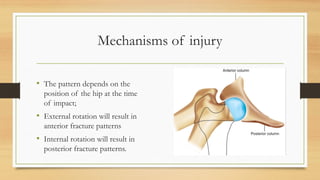
• The pattern depends on the
position of the hip at the time
of impact;
• External rotation will result in
anterior fracture patterns
• Internal rotation will result in
posterior fracture patterns.
Classification of acetabular fractures
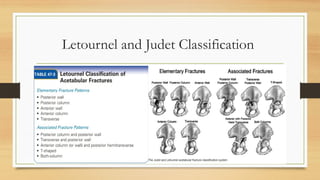
Letournel and Judet Classification
Classification
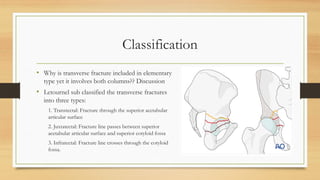
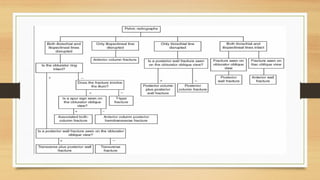
• Why is transverse fracture included in elementary
type yet it involves both columns?? Discussion
• Letournel sub classified the transverse fractures
into three types:
1. Transtectal: Fracture through the superior acetabular
articular surface
2. Juxtatectal: Fracture line passes between superior
acetabular articular surface and superior cotyloid fossa
3. Infratectal: Fracture line crosses through the cotyloid
fossa.
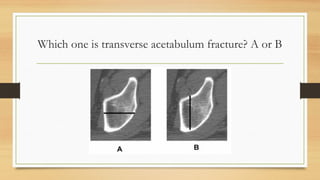
Which one is transverse acetabulum fracture? A or B
Imaging:
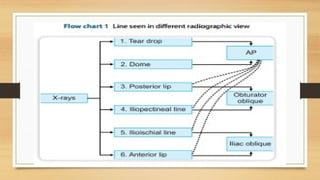
AP, Obturator oblique and Iliac oblique views
Anteropesterior Views (AP)
Ap delineates both sides acetabulum,
Associated pelvic ring fracture
Joint disruptions or dislocations (Hip joint, sacroiliac joint)
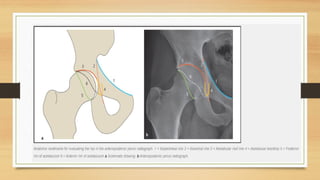
Six basic landmarks are identified in AP view:
1. Iliopectineal line,
2. Ilioischial line / Kohler’s Line
3. The teardrop of Kohler,
4. The roof of the acetabulum,
5. The anterior rim of the acetabulum,
6. The posterior rim of the acetabulum
Imaging
Judet Views
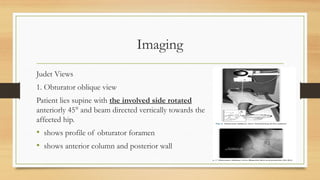
1. Obturator oblique view
Patient lies supine with the involved side rotated
anteriorly 45° and beam directed vertically towards the
affected hip.
• shows profile of obturator foramen
• shows anterior column and posterior wall
Imaging
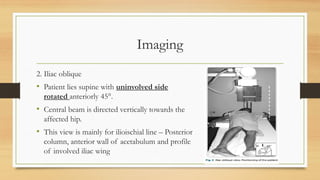
2. Iliac oblique
• Patient lies supine with uninvolved side
rotated anteriorly 45°.
• Central beam is directed vertically towards the
affected hip.
• This view is mainly for ilioischial line – Posterior
column, anterior wall of acetabulum and profile
of involved iliac wing
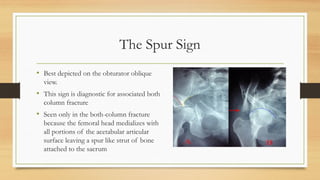
The Spur Sign
• Best depicted on the obturator oblique
view.
• This sign is diagnostic for associated both
column fracture
• Seen only in the both-column fracture
because the femoral head medializes with
all portions of the acetabular articular
surface leaving a spur like strut of bone
attached to the sacrum
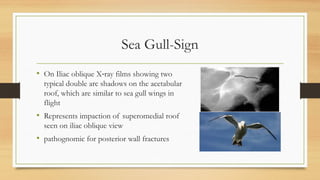
Sea Gull-Sign
• On Iliac oblique X ray films showing two
‐
typical double arc shadows on the acetabular
roof, which are similar to sea gull wings in
flight
• Represents impaction of superomedial roof
seen on iliac oblique view
• pathognomic for posterior wall fractures
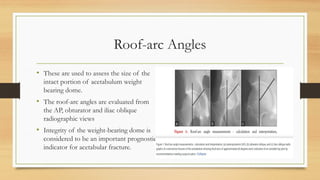
Roof-arc Angles
• These are used to assess the size of the
intact portion of acetabulum weight
bearing dome.
• The roof-arc angles are evaluated from
the AP, obturator and iliac oblique
radiographic views
• Integrity of the weight-bearing dome is
considered to be an important prognostic
indicator for acetabular fracture.
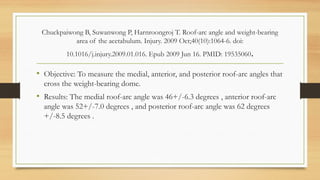
Chuckpaiwong B, Suwanwong P, Harnroongroj T. Roof-arc angle and weight-bearing
area of the acetabulum. Injury. 2009 Oct;40(10):1064-6. doi:
10.1016/j.injury.2009.01.016. Epub 2009 Jun 16. PMID: 19535060.
• Objective: To measure the medial, anterior, and posterior roof-arc angles that
cross the weight-bearing dome.
• Results: The medial roof-arc angle was 46+/-6.3 degrees , anterior roof-arc
angle was 52+/-7.0 degrees , and posterior roof-arc angle was 62 degrees
+/-8.5 degrees .
Chuckpaiwong B, Suwanwong P, Harnroongroj T. Roof-arc angle and weight-bearing
area of the acetabulum. Injury. 2009 Oct;40(10):1064-6. doi:
10.1016/j.injury.2009.01.016. Epub 2009 Jun 16. PMID: 19535060.
• Conclusions: In acetabular fracture, a medial roof-arc angle less than 46
degrees , an anterior roof-arc angle less than 52 degrees , or posterior roof-
arc angle less than 61 degrees is considered to be involved in a weight-
bearing area.
• Clinical relevance: These roof-arc angle values are be used as a surgical
guideline for an acetabular fracture around the weight-bearing area.
CT scan
• CT scan has revolutionized the imaging of acetabular fractures
• It is adjunct to the three radiographs: it does not replace the std radiographs
• 3-D reconstruction helps delineate:
 The extent and location of acetabular wall fractures,
 The presence of intra-articular free fragments or injury to the femoral head,
 Orientation of fracture lines,
CT scan
 Identification of additional fracture lines.
 Rotation of fracture fragments,
 Status of the posterior pelvic ring
 Marginal impaction - defined as depression of the articular surface of the joint
• CT roof-arc angle can be prepared and interpreted accordingly.
• Postoperatively, CT scanning is an invaluable investigative tool
whenever joint penetration by a fixation device is suspected.
Management
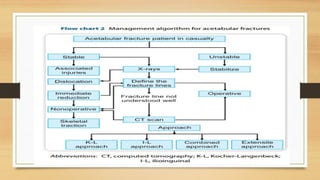
Protocol for acetabular fracture management:
1. Resuscitation of the patient: Basic and advanced life support protocols.
2. Diagnosis: Clinical and radiologic, once the patient stabilizes.
3. Treatment of associated life-threatening head, chest, abdominal, or other
injuries.
Management
4. Urgent reduction of dislocations:
• Gentle closed reduction of posterior dislocations on an emergent basis.
• Failed reduction: close reduction under general anesthesia is necessary.
• For central fracture-dislocations, heavy longitudinal skeletal traction by an upper tibial
or lower femoral Steinmann pin.
Distal femur vs Proximal tibia traction pin?? Discussion
5. Definite fixation if needed may be done after 2–3 days.
Management
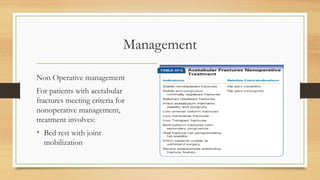
Non Operative management
For patients with acetabular
fractures meeting criteria for
nonoperative management,
treatment involves:
• Bed rest with joint
mobilization
Management
• Skeletal traction if the weight bearing dome is involved
• Protected weight bearing for 6-8 weeks
• DVT prophylaxis
• close radiographic follow-up
Indications for Non Operative management
Patient Factors
• Unstable or high operative risk patient Eg elderly patients Morbid obesity
• Open contaminated or infected wound
• Late presentation >3 weeks
Indications for Non Operative management
Fracture Characteristics
• Minimally displaced fracture <2mm
• < 20% posterior wall fractures – Must do EUA to test for stability
• displaced fracture with roof arcs > 45° in AP and Judet views or >10 mm on
axial CT cuts
Indications for Open Reduction and
Internal Fixation
• Displaced fractures with >2 mm articular step
• Failure to obtain concentric reduction by closed manoeuvers
• Fractures with medial roof-arc angle of <45°, an anterior <25° or a posterior
<70° across the weight-bearing portion of the acetabulum
• Incarcerated intra-articular fragments or impaction of the articular surface
• Associated vascular injury or if sciatic palsy develops after a closed reduction
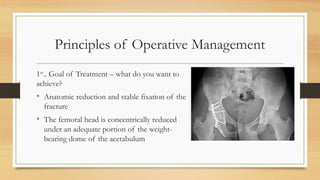
Principles of Operative Management
1st
.. Goal of Treatment – what do you want to
achieve?
• Anatomic reduction and stable fixation of the
fracture
• The femoral head is concentrically reduced
under an adequate portion of the weight-
bearing dome of the acetabulum
Principles of Operative Management
2nd
. Preoperative evaluation – Stable/unstable
• To exclude other injuries and if present formulate
a Mx Plan
• Medical Clearance, Labs, GXM, Imaging and
consent
• Target to treat on the 2nd
or 3rd
dat post trauma
• >3 weeks post trauma chances of obtaining good
results decrease
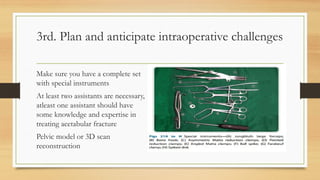
3rd. Plan and anticipate intraoperative challenges
Make sure you have a complete set
with special instruments
At least two assistants are necessary,
atleast one assistant should have
some knowledge and expertise in
treating acetabular fracture
Pelvic model or 3D scan
reconstruction
Choice of Approach
• Dictated by the fracture pattern and orientation, but it also depends on the
surgeon’s personal preference and experience
• The main determinants in the decision making process are:
• the fracture type
• the elapsed time from injury to operative intervention,
• the magnitude and location of maximal fracture displacement.
Anterior Approach (Ilioinguinal)
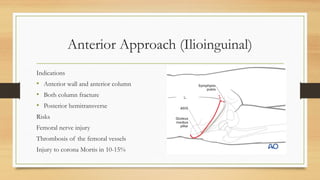
Indications
• Anterior wall and anterior column
• Both column fracture
• Posterior hemitransverse
Risks
Femoral nerve injury
Thrombosis of the femoral vessels
Injury to corona Mortis in 10-15%
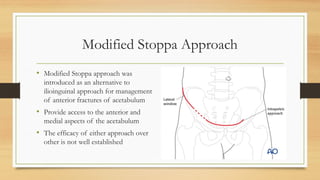
Modified Stoppa Approach
• Modified Stoppa approach was
introduced as an alternative to
ilioinguinal approach for management
of anterior fractures of acetabulum
• Provide access to the anterior and
medial aspects of the acetabulum
• The efficacy of either approach over
other is not well established
Meena S, Sharma PK, Mittal S, Sharma J, Chowdhury B. Modified Stoppa Approach versus
Ilioinguinal Approach for Anterior Acetabular Fractures; A Systematic Review and Meta-
Analysis. Bull Emerg Trauma. 2017 Jan;5(1):6-12. PMID: 28246617; PMCID: PMC5316130.
Conclusion:
• Modified Stoppa approach carries a lesser duration of surgery, lesser
intraoperative blood loss, fewer overall complications, and lesser postoperative
infection rates compared to ilioinguinal approach.
• Better anatomical reduction is achieved by ilioinguinal approach but associated
with risks and poor overall clinical outcomes
• So overall, modified Stoppa approach seems a better alternative for managing
these fractures.
Posterior Approach (Kocher-Langenbach)
Indications:
• Posterior wall and posterior column fx
• Most transverse and T-shaped
• Combination of above
Risks
• Increased HO risk compared with anterior approach
• Sciatic nerve injury (2-10%)
• Damage to blood supply of femoral head (medial femoral circumflex)
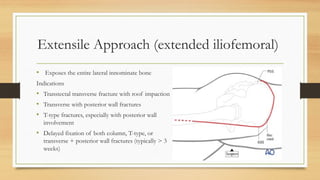
Extensile Approach (extended iliofemoral)
• Exposes the entire lateral innominate bone
Indications
• Transtectal transverse fracture with roof impaction
• Transverse with posterior wall fractures
• T-type fractures, especially with posterior wall
involvement
• Delayed fixation of both column, T-type, or
transverse + posterior wall fractures (typically > 3
weeks)
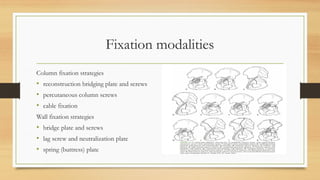
Fixation modalities
Column fixation strategies
• reconstruction bridging plate and screws
• percutaneous column screws
• cable fixation
Wall fixation strategies
• bridge plate and screws
• lag screw and neutralization plate
• spring (buttress) plate
Post operative care
• Immobilization: post op traction may be indicated for some complex fractures post op
• Drains: The posterior drains usually are removed at 48 hours. The retropubic drain should stay
in place longer, for 72–96 hours.
• The drains may be removed earlier if they drain less
than 10 mL/day
• Physiotherapy: non weight bearing and use of clutches
• Suture removal: Sutures are usually removed after 10–12 days
• Follow up and Xrays: intraop xrays to confirm reduction and r/o intraarticular implants
• Then Repeat xrays at 6 weeks, 3months and 12 months
Complications
• Post trauma DJD – most common complication
• H.O – esp with extensile approaches
• Debride Gluteus minimus intraop
• Tx with Indomethacin for 1 week and low dose external radiation
• Osteonecrosis
• DVT and PE
• Intraarticular implant placement
References
• Rockwood and Green's Fractures in Adults Book by Charles M Court-
Brown, Margaret M. McQueen, and William M Ricci, M D
• Textbook of ORTHOPEDICS AND TRAUMA by GS Kulkarni
MS MS (Ortho) FRCS FICS
• https://www.orthobullets.com/trauma/1034/acetabular-fractures
Comment and questions

Acetabular fractures.powerpoint presentation

  • 1.
    Acetabular fractures By: Dr.Benjamin Ngau PGY 5: Orthopedics
  • 2.
    Scope • Introduction • Epidemiology •Etiology • Surgical Anatomy • Classification • Imaging • Management • Approaches • Complications
  • 3.
    Definitions • Acetabular fracturesare pelvic fractures that involve the articular surface of the hip joint and may involve one or two columns, one or two walls, or the roof within the pelvis • Historical background: Acetabular fractures were treated Non Op up to 1960s • Judet brothers and Leuternel in 1964 reported that the outcome of operative treatment of acetabular fractures were far better than non operative treatment • Their extensive studies on acetabular fractures revolutionized acetabular management.
  • 4.
    Epidemiology • Fractures occurin a bimodal distribution: • high energy trauma in younger patients (e.g., motor vehicle accidents) • low energy trauma in elderly patients (e.g., fall from standing height) • Falls from a height >10 feet • Extreme sporting events
  • 5.
    Acetabulum anatomy • Theacetabulum (plural: acetabula) is the large cup- shaped cavity on the anterolateral aspect of the pelvis that articulates with the femoral head to form the hip joint. • Formed by the 3 innominate bones: (the ilium, ischium, and pubis) • The three bones are initially separated by a Y-shaped triradiate cartilage that begins to fuse after puberty. • The fusion is complete between 20 and 25 years of age
  • 6.
    Anatomy ‘The Column Concept’ •Used in the classification of acetabular fractures • The Inverted Y shaped columns made of: The Anterior Column • Iliac crest, iliac spines, anterior half of acetabulum and the pubis
  • 7.
    Anatomy ‘The Column Concept’ ThePosterior column • Ischium, Ischial spine, Posterior half of the acetabulum and the dense bone forming the notch • The shorter posterior column ends at its intersection with anterior column at the top of sciatic notch
  • 8.
    Mechanisms of injury •Fractures of the acetabulum occur by the impact of the femoral head on the articular surface. • Falls on the greater trochanter will most likely result in an anterior column and/or wall fracture (elderly). • High energy injuries by motor vehicles.
  • 9.
    Mechanisms of injury •The pattern depends on the position of the hip at the time of impact; • External rotation will result in anterior fracture patterns • Internal rotation will result in posterior fracture patterns.
  • 10.
  • 11.
    Letournel and JudetClassification
  • 12.
    Classification • Why istransverse fracture included in elementary type yet it involves both columns?? Discussion • Letournel sub classified the transverse fractures into three types: 1. Transtectal: Fracture through the superior acetabular articular surface 2. Juxtatectal: Fracture line passes between superior acetabular articular surface and superior cotyloid fossa 3. Infratectal: Fracture line crosses through the cotyloid fossa.
  • 13.
    Which one istransverse acetabulum fracture? A or B
  • 15.
    Imaging: AP, Obturator obliqueand Iliac oblique views Anteropesterior Views (AP) Ap delineates both sides acetabulum, Associated pelvic ring fracture Joint disruptions or dislocations (Hip joint, sacroiliac joint) Six basic landmarks are identified in AP view: 1. Iliopectineal line, 2. Ilioischial line / Kohler’s Line 3. The teardrop of Kohler, 4. The roof of the acetabulum, 5. The anterior rim of the acetabulum, 6. The posterior rim of the acetabulum
  • 19.
    Imaging Judet Views 1. Obturatoroblique view Patient lies supine with the involved side rotated anteriorly 45° and beam directed vertically towards the affected hip. • shows profile of obturator foramen • shows anterior column and posterior wall
  • 20.
    Imaging 2. Iliac oblique •Patient lies supine with uninvolved side rotated anteriorly 45°. • Central beam is directed vertically towards the affected hip. • This view is mainly for ilioischial line – Posterior column, anterior wall of acetabulum and profile of involved iliac wing
  • 21.
    The Spur Sign •Best depicted on the obturator oblique view. • This sign is diagnostic for associated both column fracture • Seen only in the both-column fracture because the femoral head medializes with all portions of the acetabular articular surface leaving a spur like strut of bone attached to the sacrum
  • 22.
    Sea Gull-Sign • OnIliac oblique X ray films showing two ‐ typical double arc shadows on the acetabular roof, which are similar to sea gull wings in flight • Represents impaction of superomedial roof seen on iliac oblique view • pathognomic for posterior wall fractures
  • 23.
    Roof-arc Angles • Theseare used to assess the size of the intact portion of acetabulum weight bearing dome. • The roof-arc angles are evaluated from the AP, obturator and iliac oblique radiographic views • Integrity of the weight-bearing dome is considered to be an important prognostic indicator for acetabular fracture.
  • 24.
    Chuckpaiwong B, SuwanwongP, Harnroongroj T. Roof-arc angle and weight-bearing area of the acetabulum. Injury. 2009 Oct;40(10):1064-6. doi: 10.1016/j.injury.2009.01.016. Epub 2009 Jun 16. PMID: 19535060. • Objective: To measure the medial, anterior, and posterior roof-arc angles that cross the weight-bearing dome. • Results: The medial roof-arc angle was 46+/-6.3 degrees , anterior roof-arc angle was 52+/-7.0 degrees , and posterior roof-arc angle was 62 degrees +/-8.5 degrees .
  • 25.
    Chuckpaiwong B, SuwanwongP, Harnroongroj T. Roof-arc angle and weight-bearing area of the acetabulum. Injury. 2009 Oct;40(10):1064-6. doi: 10.1016/j.injury.2009.01.016. Epub 2009 Jun 16. PMID: 19535060. • Conclusions: In acetabular fracture, a medial roof-arc angle less than 46 degrees , an anterior roof-arc angle less than 52 degrees , or posterior roof- arc angle less than 61 degrees is considered to be involved in a weight- bearing area. • Clinical relevance: These roof-arc angle values are be used as a surgical guideline for an acetabular fracture around the weight-bearing area.
  • 26.
    CT scan • CTscan has revolutionized the imaging of acetabular fractures • It is adjunct to the three radiographs: it does not replace the std radiographs • 3-D reconstruction helps delineate:  The extent and location of acetabular wall fractures,  The presence of intra-articular free fragments or injury to the femoral head,  Orientation of fracture lines,
  • 27.
    CT scan  Identificationof additional fracture lines.  Rotation of fracture fragments,  Status of the posterior pelvic ring  Marginal impaction - defined as depression of the articular surface of the joint • CT roof-arc angle can be prepared and interpreted accordingly. • Postoperatively, CT scanning is an invaluable investigative tool whenever joint penetration by a fixation device is suspected.
  • 28.
    Management Protocol for acetabularfracture management: 1. Resuscitation of the patient: Basic and advanced life support protocols. 2. Diagnosis: Clinical and radiologic, once the patient stabilizes. 3. Treatment of associated life-threatening head, chest, abdominal, or other injuries.
  • 29.
    Management 4. Urgent reductionof dislocations: • Gentle closed reduction of posterior dislocations on an emergent basis. • Failed reduction: close reduction under general anesthesia is necessary. • For central fracture-dislocations, heavy longitudinal skeletal traction by an upper tibial or lower femoral Steinmann pin. Distal femur vs Proximal tibia traction pin?? Discussion 5. Definite fixation if needed may be done after 2–3 days.
  • 31.
    Management Non Operative management Forpatients with acetabular fractures meeting criteria for nonoperative management, treatment involves: • Bed rest with joint mobilization
  • 32.
    Management • Skeletal tractionif the weight bearing dome is involved • Protected weight bearing for 6-8 weeks • DVT prophylaxis • close radiographic follow-up
  • 33.
    Indications for NonOperative management Patient Factors • Unstable or high operative risk patient Eg elderly patients Morbid obesity • Open contaminated or infected wound • Late presentation >3 weeks
  • 34.
    Indications for NonOperative management Fracture Characteristics • Minimally displaced fracture <2mm • < 20% posterior wall fractures – Must do EUA to test for stability • displaced fracture with roof arcs > 45° in AP and Judet views or >10 mm on axial CT cuts
  • 35.
    Indications for OpenReduction and Internal Fixation • Displaced fractures with >2 mm articular step • Failure to obtain concentric reduction by closed manoeuvers • Fractures with medial roof-arc angle of <45°, an anterior <25° or a posterior <70° across the weight-bearing portion of the acetabulum • Incarcerated intra-articular fragments or impaction of the articular surface • Associated vascular injury or if sciatic palsy develops after a closed reduction
  • 36.
    Principles of OperativeManagement 1st .. Goal of Treatment – what do you want to achieve? • Anatomic reduction and stable fixation of the fracture • The femoral head is concentrically reduced under an adequate portion of the weight- bearing dome of the acetabulum
  • 37.
    Principles of OperativeManagement 2nd . Preoperative evaluation – Stable/unstable • To exclude other injuries and if present formulate a Mx Plan • Medical Clearance, Labs, GXM, Imaging and consent • Target to treat on the 2nd or 3rd dat post trauma • >3 weeks post trauma chances of obtaining good results decrease
  • 38.
    3rd. Plan andanticipate intraoperative challenges Make sure you have a complete set with special instruments At least two assistants are necessary, atleast one assistant should have some knowledge and expertise in treating acetabular fracture Pelvic model or 3D scan reconstruction
  • 39.
    Choice of Approach •Dictated by the fracture pattern and orientation, but it also depends on the surgeon’s personal preference and experience • The main determinants in the decision making process are: • the fracture type • the elapsed time from injury to operative intervention, • the magnitude and location of maximal fracture displacement.
  • 40.
    Anterior Approach (Ilioinguinal) Indications •Anterior wall and anterior column • Both column fracture • Posterior hemitransverse Risks Femoral nerve injury Thrombosis of the femoral vessels Injury to corona Mortis in 10-15%
  • 41.
    Modified Stoppa Approach •Modified Stoppa approach was introduced as an alternative to ilioinguinal approach for management of anterior fractures of acetabulum • Provide access to the anterior and medial aspects of the acetabulum • The efficacy of either approach over other is not well established
  • 42.
    Meena S, SharmaPK, Mittal S, Sharma J, Chowdhury B. Modified Stoppa Approach versus Ilioinguinal Approach for Anterior Acetabular Fractures; A Systematic Review and Meta- Analysis. Bull Emerg Trauma. 2017 Jan;5(1):6-12. PMID: 28246617; PMCID: PMC5316130. Conclusion: • Modified Stoppa approach carries a lesser duration of surgery, lesser intraoperative blood loss, fewer overall complications, and lesser postoperative infection rates compared to ilioinguinal approach. • Better anatomical reduction is achieved by ilioinguinal approach but associated with risks and poor overall clinical outcomes • So overall, modified Stoppa approach seems a better alternative for managing these fractures.
  • 43.
    Posterior Approach (Kocher-Langenbach) Indications: •Posterior wall and posterior column fx • Most transverse and T-shaped • Combination of above Risks • Increased HO risk compared with anterior approach • Sciatic nerve injury (2-10%) • Damage to blood supply of femoral head (medial femoral circumflex)
  • 44.
    Extensile Approach (extendediliofemoral) • Exposes the entire lateral innominate bone Indications • Transtectal transverse fracture with roof impaction • Transverse with posterior wall fractures • T-type fractures, especially with posterior wall involvement • Delayed fixation of both column, T-type, or transverse + posterior wall fractures (typically > 3 weeks)
  • 45.
    Fixation modalities Column fixationstrategies • reconstruction bridging plate and screws • percutaneous column screws • cable fixation Wall fixation strategies • bridge plate and screws • lag screw and neutralization plate • spring (buttress) plate
  • 46.
    Post operative care •Immobilization: post op traction may be indicated for some complex fractures post op • Drains: The posterior drains usually are removed at 48 hours. The retropubic drain should stay in place longer, for 72–96 hours. • The drains may be removed earlier if they drain less than 10 mL/day • Physiotherapy: non weight bearing and use of clutches • Suture removal: Sutures are usually removed after 10–12 days • Follow up and Xrays: intraop xrays to confirm reduction and r/o intraarticular implants • Then Repeat xrays at 6 weeks, 3months and 12 months
  • 47.
    Complications • Post traumaDJD – most common complication • H.O – esp with extensile approaches • Debride Gluteus minimus intraop • Tx with Indomethacin for 1 week and low dose external radiation • Osteonecrosis • DVT and PE • Intraarticular implant placement
  • 48.
    References • Rockwood andGreen's Fractures in Adults Book by Charles M Court- Brown, Margaret M. McQueen, and William M Ricci, M D • Textbook of ORTHOPEDICS AND TRAUMA by GS Kulkarni MS MS (Ortho) FRCS FICS • https://www.orthobullets.com/trauma/1034/acetabular-fractures
  • 49.

Editor's Notes

  • #3  the literature from the 1950s and 1960s offered conflicting recommendations regarding the optimal care for a fracture of the acetabulum
  • #26 The CT scan is an essential adjunct to the three radiographic projections to further define the fracture pattern and assess for associated bony injuries.93,141 However, it does not completely replace the standard radiographic evaluation.2
  • #27 The CT scan is an essential adjunct to the three radiographic projections to further define the fracture pattern and assess for associated bony injuries.93,141 However, it does not completely replace the standard radiographic evaluation.2