


















TOPIC
ACCREDITATION
PRESENTED BY:
MR. OM VERMA
ASSISTANT PROFESSOR
CON……………
 Accreditation means an official approval of an
organization.
 Accreditation means the act of granting approval
to an organization by an official review board
after the organization has met specific written
requirements or standards..
DEFINITION
According to A.N.A
Accreditation is a voluntary, self
regulatory process where non-governmental
organization recognizes schools and/or programs
that have been found to or surpass certain
standards.
According to Sarah B Keating:-
Accreditation is a process that education
programs undergo to receive recognition for meeting
basic standards or criteria set by national, regional
or state organization.
– ACCORDING TO SELDEN
“Accrediting is the process whereby an
organization agency recognizes a college or
university or a program of study as having
met certain predetermined qualifications and
standard”.
Accreditation refers to a voluntary
review process of educational programs
by a professional organization.
NEEDS AND
 Up-gradation
 Improve patient satisfaction
 Recognition of institution
 Offer Advice
PURPOSE CON….
 Administration requirements
 Uniform standards of nursing education,
 Institutional self-improvement by evaluation
and inspection.
 Safeguard the institution from social,
educational and political pressure.
Purpose cont…
of nursing
Prescribe syllabus
Grant recognition
Inspection
Improve the quality
education
@ To ensure the safe practice of nursing by
setting standards for schools.
@ To encourage study and study and self
evaluation within the educational units, the
development and improvement of
educational programs.
@ Maintenance of adequate admission
requirement.
@ To assure maximum benefit for the
students in courses supplied by all co-
operating agencies.
@ Protection of institution of higher
education against educationally and socially
harmful pressures.
 Protect the autonomy of health
service programme
 Preserves the quality of nursing education
 Protects the public from ill-prepared nurses
 Protects the institution from political
pressure
 helps the practioner for the ever expanding
or the broad scope of nursing practices
FUNCTIONS
ADVANTAGES
Statutory power to punish the wrong
doers
Maintain the standards education
DISADVANTAGES
 Time consuming process
 Expensive
CLASSIFICATION
Accrediting Agencies in Higher Education
1.National accrediting agency.
2.National professional accrediting
Agency
3 . State accrediting bodies.
NATIONAL ACCREDITING
AGENCY
 Concerned with appraising the total of institution
of higher learning and safeguarding the quality of
education
 Each agency establishes criteria for the evaluation
of the institution and it publishes from time to
time a list of those agencies which it has
accredited
Indian Councils
 Central advisory board of education
 All India council for elementary education
 All India council for secondary education
 University grants commission
 All India council for technical education
 National assessment and accreditation
council.
National professional accrediting
Agency
 Professional accrediting is supported by state
license laws.
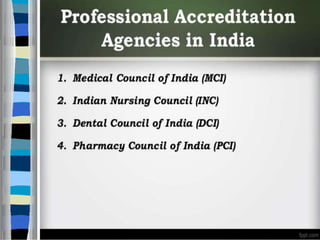
In the field of health All national
professional accrediting agencies, have
existed:
 Medical council of India
 Indian nursing council
 Dental council of India
 Pharmacy council of India
STATE ACCREDITING
AGENCIES
 State universities commissions and other agency
are authorized in some state to evaluate college, to
give initial approval to institutions to higher
learning to formulate standards, to issue licenses
and to have various other responsibilities.
PROCESS OF
ACCREDITATION:
 Applying for the institution to be accredited.
 Preparing a report by the institutional head
according to the criteria and format sent by the
accrediting agency.
 Visit to the site by the inspector appoint by the
accrediting agency to verify the self study report.
Cont…..
 Preparing a report by the visitors.
 Report made by the visitors along with the
institutional report is sent to the review board of
council.
 The board of review on the basis of all data and
reports makes the final decisions whether
accreditation should be granted or not.
CRITERIA FOR
ACCREDITATION:REPORT OF THE
INSPECTION OF THE COLLEGE
 Type of training given
 Date of previous inspection
 Recognition of the college by the government order
no. date and no. of seats sanctioned for the year.
 Number of the students admitted for the year after
the cost date of inspection and regarding the detail
of staff qualification.
CONT…
 Demonstration room
 Library
 Office of principal, tutors
 Laboratory
 No of classrooms
PROCESS OF RECOGNITION OF
SCHOOL/COLLEGES
 Trial basis:
 Recognition given on the temporary basis
based on the application submitted plus pending
inspection and is done after the favorable report of
accreditation.
 Permanent recognition:
 After the inspection and evaluation that is
when the school /college meet college all the
criteria prescribed by the INC permanent
recognition is given.
SERVICE RENDERED BY
ACCREDITATION
 Registration and admission of students.
 Distribution of study material
 Organization of personal contact program
 Registering students for external examination
 Distribution of mark sheets and certificates.
THE SCHOOL AND COLLEGES ARE
EXPECTED TO KEEP READY THE
FOLLOWING:
 General information:
 The name of the university is affiliated.
 Date of establishment of program
 Date recognition by state nursing council , INC or
university.
 Number of students graduating per year.
CONT…..
 Philosophy:
Aims and objectives of the institution and
departments
 Organization and administration:
 Organization chart of institution and college
 Placement of principal
 Line of authority
 Teaching and non-teaching staff
CONT..
 Teaching staff:
 Internal lectures
 External lectures
 Staff selection procedures
 Staff development programe
 Seminar attended
CONT..
 Administration and physical set up:
 Office and room for principal
 Staff, clinical staff, number of classroom,
nutrition lab etc.
 Hostel, criteria, dining hall, reading hall, toilet
facility etc.
 Number of books ,periodical
CONT…….
 Finance:
 Total budget sanctioned
 Drawing offices- separate and combined
 Committee:
 Advisory committee, development committee,
student welfare committee
CON…
 Staff teaching:
 Monitoring technique
 Construction and institution facilities:
 Syllabus , prospectus, application forms, bond
paper etc.
 Health facilities for students and staff:
 Medical checkup
CONT…..
 Clinical setup:
 Community experience , family people co-curricular
activities.
 Research of students , application forms and bond
paper signed,
 Attendance registration , practical record ,level
records
 Evaluation forms ,master plans ,examination
result and assignments.
 Drug study, lesson plans, nursing care plans and
clinical presentation.
ROLE OF INDIAN
NURSING COUNCIL,
STATE
REGISTRATION NURSING
COUNCILS,BOARDS AND
UNIVERSITY
ROLE OF INDIAN NURSING COUNCIL,
STATE REGISTRATION NURSING
COUNCILS,BOARDS AND UNIVERSITY.
 NATIONAL ASSESSMENT AND ACCREDITATION
COUNCIL:
 National assessment and accreditation council (NAAC)
was established by the university grants commission
( UGC) on16th sept.1994 for ensuring quality in higher
education ,in pursuance of the national policy on
education and the program of action in 1986.
 It is located at Bangalore.
 NAAC is entrusted with the task of performance
evaluation, assessment and accreditation of universities
and colleges in India.
 VISION:
 To make quality the defining element of
higher education in India through a combination
of self quality and external quality evaluation and
sustenance initiatives.
 MISSION:
 To arrange for periodic assessment and
accreditation of institutions of higher education or
units therefore or specific academic programme or
projects.
 To stimulate the academic environment for
promotion of quality of teaching –learning and
research in higher education institutions.
 To Assessment a performance and evaluation of
institutions
STEPS IN ASSESSMENT
 Steps1:
Preparation of the self study report by the institution,
its submission to NAAC
 Step2:
Peer team visit to the institution for validation of the
self –study report followed presentation of a
comprehensive assessment report to the institution.
 Step3:
Grading, certification and accreditation based on the
evaluation report by the peer team
GRADING:
 The assessment is on a four point scale
 A-Excellent or very good
 B-Good
 C-Satisfactory
 NA- notaccredited.
 If the overall score is more than 55% the institutions gets
the “accredited status “and any score less than that will
lead to “not accredited” status.
 The NAAC accreditation is valid for five years.
INDIAN NURSING COUNCIL
AIMS OF INC:
 To establish the uniform standard of training
throughout the state
 prohibit practice of nursing by non-qualified
nurses.
Functions of INC
 Prescribing and revising syllabus for
various courses of nursing.
 Inspection, monitoring and regulating
nursing educational institutions
Registration.
Recognition of qualification in nursing.
 Collection of data from training and
educational institutions of nursing.
Functions cont…
Authority to control nursing education.
Withdrawal of recognition from
defaulting institutions and examining
bodies.
Prescribing the standards of
examination
Evaluating the syllabus implemented by
the school and college of Nursing.
NATURE OF INSPECTION
BY INC
NATURE OF INSPECTION BY
INC
1st Inspection
Re-inspection
Periodic Inspection
1st Inspection
 This is the first step towards INC recognition.
The school that seek recognition are
required to submit :
 Permission letter for state government
 Permission letter for state nursing councils
 A copy of the inspection report of the state nursing
council
Re-inspection
 These are done for institutions which arefound
unsuitable on first or subsequent inspection by
INC.
 Once the institution takes necessary steps to
remove the deficiencies and inform the INC re-
inspection is done within one year or earlier.
Periodic Inspection
 Once an institution is give recognition by INC the
institute required to send an annual inspection fee
regularly.
 The INC inspects the institute generally after 3
year.
CONCLUSION:
 Accreditation refers to a voluntary reviewprocess
of educational programs by a professional
organization. At the end of seminar student will
be able to understand the knowledge about
accreditation and use it in hospital and college
settings.
SUMMERY:
Today we have learned about accreditation
definition objectives of accreditation, purposes,
advantages, disadvantages, functions, types nature and
criteria for selection for affiliation institute and role of
Indian council in accreditation .I hope u all understood
my presentation and use this knowledge in hospital
settings .
BIBLIOGRAPHY:
 R.Sudha nursing education principles and
concepts , Jaypee publication 1sted.p.374-5
 Basavanthappa BT. Nursing education, jaypee
brother, ed.1st, 2005p.
 Neeraja kp textbook of nursing education, jaypee
brothers.
 www.iso.org.com
THANK U

Accredition

  • 2.
  • 4.
    CON……………  Accreditation meansan official approval of an organization.  Accreditation means the act of granting approval to an organization by an official review board after the organization has met specific written requirements or standards..
  • 5.
  • 6.
    According to A.N.A Accreditationis a voluntary, self regulatory process where non-governmental organization recognizes schools and/or programs that have been found to or surpass certain standards. According to Sarah B Keating:- Accreditation is a process that education programs undergo to receive recognition for meeting basic standards or criteria set by national, regional or state organization.
  • 7.
    – ACCORDING TOSELDEN “Accrediting is the process whereby an organization agency recognizes a college or university or a program of study as having met certain predetermined qualifications and standard”.
  • 9.
    Accreditation refers toa voluntary review process of educational programs by a professional organization.
  • 11.
    NEEDS AND  Up-gradation Improve patient satisfaction  Recognition of institution  Offer Advice
  • 13.
    PURPOSE CON….  Administrationrequirements  Uniform standards of nursing education,  Institutional self-improvement by evaluation and inspection.  Safeguard the institution from social, educational and political pressure.
  • 14.
    Purpose cont… of nursing Prescribesyllabus Grant recognition Inspection Improve the quality education
  • 15.
    @ To ensurethe safe practice of nursing by setting standards for schools. @ To encourage study and study and self evaluation within the educational units, the development and improvement of educational programs. @ Maintenance of adequate admission requirement. @ To assure maximum benefit for the students in courses supplied by all co- operating agencies. @ Protection of institution of higher education against educationally and socially harmful pressures.
  • 16.
     Protect theautonomy of health service programme  Preserves the quality of nursing education  Protects the public from ill-prepared nurses  Protects the institution from political pressure  helps the practioner for the ever expanding or the broad scope of nursing practices FUNCTIONS
  • 17.
    ADVANTAGES Statutory power topunish the wrong doers Maintain the standards education
  • 18.
    DISADVANTAGES  Time consumingprocess  Expensive
  • 21.
    CLASSIFICATION Accrediting Agencies inHigher Education 1.National accrediting agency. 2.National professional accrediting Agency 3 . State accrediting bodies.
  • 22.
    NATIONAL ACCREDITING AGENCY  Concernedwith appraising the total of institution of higher learning and safeguarding the quality of education  Each agency establishes criteria for the evaluation of the institution and it publishes from time to time a list of those agencies which it has accredited
  • 23.
    Indian Councils  Centraladvisory board of education  All India council for elementary education  All India council for secondary education  University grants commission  All India council for technical education  National assessment and accreditation council.
  • 24.
    National professional accrediting Agency Professional accrediting is supported by state license laws. In the field of health All national professional accrediting agencies, have existed:  Medical council of India  Indian nursing council  Dental council of India  Pharmacy council of India
  • 25.
    STATE ACCREDITING AGENCIES  Stateuniversities commissions and other agency are authorized in some state to evaluate college, to give initial approval to institutions to higher learning to formulate standards, to issue licenses and to have various other responsibilities.
  • 26.
    PROCESS OF ACCREDITATION:  Applyingfor the institution to be accredited.  Preparing a report by the institutional head according to the criteria and format sent by the accrediting agency.  Visit to the site by the inspector appoint by the accrediting agency to verify the self study report.
  • 27.
    Cont…..  Preparing areport by the visitors.  Report made by the visitors along with the institutional report is sent to the review board of council.  The board of review on the basis of all data and reports makes the final decisions whether accreditation should be granted or not.
  • 28.
    CRITERIA FOR ACCREDITATION:REPORT OFTHE INSPECTION OF THE COLLEGE  Type of training given  Date of previous inspection  Recognition of the college by the government order no. date and no. of seats sanctioned for the year.  Number of the students admitted for the year after the cost date of inspection and regarding the detail of staff qualification.
  • 29.
    CONT…  Demonstration room Library  Office of principal, tutors  Laboratory  No of classrooms
  • 30.
    PROCESS OF RECOGNITIONOF SCHOOL/COLLEGES  Trial basis:  Recognition given on the temporary basis based on the application submitted plus pending inspection and is done after the favorable report of accreditation.
  • 31.
     Permanent recognition: After the inspection and evaluation that is when the school /college meet college all the criteria prescribed by the INC permanent recognition is given.
  • 32.
    SERVICE RENDERED BY ACCREDITATION Registration and admission of students.  Distribution of study material  Organization of personal contact program  Registering students for external examination  Distribution of mark sheets and certificates.
  • 33.
    THE SCHOOL ANDCOLLEGES ARE EXPECTED TO KEEP READY THE FOLLOWING:  General information:  The name of the university is affiliated.  Date of establishment of program  Date recognition by state nursing council , INC or university.  Number of students graduating per year.
  • 34.
    CONT…..  Philosophy: Aims andobjectives of the institution and departments  Organization and administration:  Organization chart of institution and college  Placement of principal  Line of authority  Teaching and non-teaching staff
  • 35.
    CONT..  Teaching staff: Internal lectures  External lectures  Staff selection procedures  Staff development programe  Seminar attended
  • 36.
    CONT..  Administration andphysical set up:  Office and room for principal  Staff, clinical staff, number of classroom, nutrition lab etc.  Hostel, criteria, dining hall, reading hall, toilet facility etc.  Number of books ,periodical
  • 37.
    CONT…….  Finance:  Totalbudget sanctioned  Drawing offices- separate and combined  Committee:  Advisory committee, development committee, student welfare committee
  • 38.
    CON…  Staff teaching: Monitoring technique  Construction and institution facilities:  Syllabus , prospectus, application forms, bond paper etc.  Health facilities for students and staff:  Medical checkup
  • 39.
    CONT…..  Clinical setup: Community experience , family people co-curricular activities.  Research of students , application forms and bond paper signed,  Attendance registration , practical record ,level records  Evaluation forms ,master plans ,examination result and assignments.  Drug study, lesson plans, nursing care plans and clinical presentation.
  • 40.
    ROLE OF INDIAN NURSINGCOUNCIL, STATE REGISTRATION NURSING COUNCILS,BOARDS AND UNIVERSITY
  • 41.
    ROLE OF INDIANNURSING COUNCIL, STATE REGISTRATION NURSING COUNCILS,BOARDS AND UNIVERSITY.  NATIONAL ASSESSMENT AND ACCREDITATION COUNCIL:  National assessment and accreditation council (NAAC) was established by the university grants commission ( UGC) on16th sept.1994 for ensuring quality in higher education ,in pursuance of the national policy on education and the program of action in 1986.  It is located at Bangalore.  NAAC is entrusted with the task of performance evaluation, assessment and accreditation of universities and colleges in India.
  • 42.
     VISION:  Tomake quality the defining element of higher education in India through a combination of self quality and external quality evaluation and sustenance initiatives.
  • 43.
     MISSION:  Toarrange for periodic assessment and accreditation of institutions of higher education or units therefore or specific academic programme or projects.  To stimulate the academic environment for promotion of quality of teaching –learning and research in higher education institutions.  To Assessment a performance and evaluation of institutions
  • 44.
    STEPS IN ASSESSMENT Steps1: Preparation of the self study report by the institution, its submission to NAAC  Step2: Peer team visit to the institution for validation of the self –study report followed presentation of a comprehensive assessment report to the institution.  Step3: Grading, certification and accreditation based on the evaluation report by the peer team
  • 45.
    GRADING:  The assessmentis on a four point scale  A-Excellent or very good  B-Good  C-Satisfactory  NA- notaccredited.  If the overall score is more than 55% the institutions gets the “accredited status “and any score less than that will lead to “not accredited” status.  The NAAC accreditation is valid for five years.
  • 46.
  • 47.
    AIMS OF INC: To establish the uniform standard of training throughout the state  prohibit practice of nursing by non-qualified nurses.
  • 48.
    Functions of INC Prescribing and revising syllabus for various courses of nursing.  Inspection, monitoring and regulating nursing educational institutions Registration. Recognition of qualification in nursing.  Collection of data from training and educational institutions of nursing.
  • 49.
    Functions cont… Authority tocontrol nursing education. Withdrawal of recognition from defaulting institutions and examining bodies. Prescribing the standards of examination Evaluating the syllabus implemented by the school and college of Nursing.
  • 50.
  • 51.
    NATURE OF INSPECTIONBY INC 1st Inspection Re-inspection Periodic Inspection
  • 52.
    1st Inspection  Thisis the first step towards INC recognition. The school that seek recognition are required to submit :  Permission letter for state government  Permission letter for state nursing councils  A copy of the inspection report of the state nursing council
  • 53.
    Re-inspection  These aredone for institutions which arefound unsuitable on first or subsequent inspection by INC.  Once the institution takes necessary steps to remove the deficiencies and inform the INC re- inspection is done within one year or earlier.
  • 54.
    Periodic Inspection  Oncean institution is give recognition by INC the institute required to send an annual inspection fee regularly.  The INC inspects the institute generally after 3 year.
  • 55.
    CONCLUSION:  Accreditation refersto a voluntary reviewprocess of educational programs by a professional organization. At the end of seminar student will be able to understand the knowledge about accreditation and use it in hospital and college settings.
  • 56.
    SUMMERY: Today we havelearned about accreditation definition objectives of accreditation, purposes, advantages, disadvantages, functions, types nature and criteria for selection for affiliation institute and role of Indian council in accreditation .I hope u all understood my presentation and use this knowledge in hospital settings .
  • 57.
    BIBLIOGRAPHY:  R.Sudha nursingeducation principles and concepts , Jaypee publication 1sted.p.374-5  Basavanthappa BT. Nursing education, jaypee brother, ed.1st, 2005p.  Neeraja kp textbook of nursing education, jaypee brothers.  www.iso.org.com
  • 58.