1
Accreditation in Nursing
Accreditation
• Meaning – give credit to something
• It is a voluntary process to have optimal and
achievable standards.
• “Accrediting is the process whereby an
organization agency recognizes a college or
university or a program of study as having
met certain predetermined qualifications
and standard”(Selden)
• John Braithwaite (2001) defines accreditation as a
process of assessment to evaluate the level of
performance in health institutions through self and
by the external peer to establish standards and to
implement ways to improve.
Importance of accreditation
• Enhances quality of education and services
• Recruitment of qualified and efficient employee to assure
quality services
• Provides more employment opportunities for students
• Creates goals for self-improvement of the organization.
• Promotes continuous quality improvement
• Recognizes benchmark practice.
Purposes of accreditation of educational
institutions
• Guarantee quality assurance in education.
• Promote and recognize excellence in higher education
• Enhanced academic reputation at national and international
level
• Improvements in academic processes.
• Protects an institution against harmful internal and external
pressure.
• Help educational institutions to evaluate their ongoing activities
for the benefit of the students.
• Assist prospective students in identifying acceptable institutions.
• Ensures public accountability.
Accreditation Process
The steps for accreditation program are as follows
1. Application for accreditation and registration
2. Self-appraisal
3. On the site visit
4. Report preparation
5. Awarding certification
6. Maintaining accreditation status.
8
Areas to be assessed for granting accreditation of an
educational institution
 Institutional philosophy, vision, and mission
 Organization and administration
 Curriculum and program of instruction
 Faculty positions, qualifications, and experience
 Resources, facilities, and services
 Special activities
 Student welfare services
 Library and learning resources.
 Physical infrastructure and facilities
 Social welfare programmes and activities
• Evaluation of the programme
9
Types of accrediting agencies
Regional
accrediting
agencies
Operate in
specific regions
of the country
National
accrediting
agencies
Accreditate
institutes of the
entire country
More
authoritative
State accrediting
agencies
Accreditation is
given by state
agencies and
state
universities.
National accrediting agencies – for education
• National educational accrediting agencies
Central Advisory Board Of Education(CABE)
All India Council For Elementary Education
All India Council For Secondary Education
All India Council For Technical Education(AICTE)
University Grants Commission (UGC), NAAC
• National professional accrediting agencies
Indian Nursing Council
MCI,DCI,PCI
accrediting agencies – for health care
• NABH
• QCI
• IHA
• BIS
• JCI
12
National assessment and accreditation council
(NAAC)
• It is an autonomous body funded by UGC and
accredits higher educational institutions in India.
• It was established in 1994 with headquarters in
Bangalore
13
Three step process of NAAC Accreditation
• Institutional eligibility for quality
assessment (IEQA)
• Preparation of self study report by
the institute (SSR)
• Peer team visit to the institute
NAAC criteria for assessment and
grading of educational institutions
• Infrastructure and learning resources
• Curricular aspects
• Governance, leadership, and management
• Student support and progression
• Teaching learning evaluation
• Research and innovations
• Institutional values and practice
Grading system
• Key aspects wise grading points
• Criteria-wise grade point average
• Cumulative grade point average
• Letter grading according to Cumulative grade point
average
• Accredited –A++,A+, A, B++, B+, B,C
• D –not credited
INC AS AN
ACCREDITATION BODY
• The INC is an autonomous statutory body that regulates the
functioning of all nursing programs.
• INC assesses and accredits institutions based on the minimum
laid down standards for nursing institutions to give official
recognition to start nursing programs, and for quality
assurance at the time of renewal/upgradation of school to
college of nursing.
• The accreditation process takes at least 9 months to complete
after submission of all required information with the first
application.
Process of Accreditation
1.Receiving, acknowledging, and scrutinizing request
applied by the concerned institute by accreditation
panel and making recommendations to the
accreditation committee. The accreditation committee
seeks the councils approval to reject or accept a
request.’( new application for the same program after
18 months or 2 attempts to supplement information)
1.Application for accreditation
• Organization -define
• Fee
• Self-evaluation by the school/college (SSR) and
supporting Documents
Documents - For a new proposal
• Particulars of the institute including offering Courses
• No objection certificate from state government for the offering courses
• Government order/essentiality certificate for the desired nursing
programs
• Land details indicating the total area, land of ownership, registration
number, etc.
• Building details showing land deed, totally covered area, completion
certificate, fire safety certificate, blueprint, water and sewerage system,
electricity connection, pollution certificate, etc.
• Finance backup, valuation certificate, FDRS balance, PAN/DAN, etc.
• Consent letter from the university only for starting a college of nursing offering
graduate/ postgraduate nursing program
• A consent letter from the respective State Nursing Registration Council to start the
desired nursing program
• Teaching, clinical, and physical facility details including budget.
• Documents related to parent hospital such as registered deed of hospital
(trust/society/ company) (hospital name) along with members, Notary-attested
registered resolution of governing body (name of trustee) and name of hospital
would be the parent hospital of institution for the next 3 years, CMHO certification
about owner of hospital of the hospital location and number of beds, income tax
return for the last 3 years, registration of hospital under shop and establishment
act, and a certificate from Pollution Control Board for both parent and affiliated
hospitals.
• For enhancement of seats - government
order/essentiality certificate for the desired number
of seats and payment of inspection fees for each
program through online or other modes per
requirement.
2. Notification to school/college to check their status of application on
web site and to submit new proposals if any.
3. Inspection by the appointed inspectors of INC to observe and
physically verify the documents
4. Preparation and submission of a report in prescribed format with
supporting documents
5. Scrutiny and review of inspection report.
6. Decision-making process: either grant or deny recognition
7.Approval and notification. If INC does not grant permission apply for
reinspection with supporting documents
8. Surviellance assessment by INC-Inspection for first 3
consecutive years followed by periodic and surprise
inspections.
9. Validity/renewal assessment and notification
Quality Assurance Standards(QAS) of
KUHS Accreditation Programme-2019
• There are 10 Key areas. Under each Key area there
will be five standards. Under each standard there will
be 5 to 10 Measurable indicators
• Score for each Measurable Indicators is 2,1 or
0points as the case may be
• Academic year need to be defined and specified and
score for each year to be displayed (once in three
years)
10 Key Areas in QAS-KUHS
• Infrastructure Facilities
• Teacher Profile And Teaching Learning
• Curriculum Implementation Monitoring
• Quality Assurance System
• Research Enabling Environment
• Out Reach Programmes
• Student Support And Guidance Programme
• Institutional Governance
• Innovation And Best Practices
• Feedback Implementation Process
26
National Accreditation Board for Hospitals and
Health Care Providers (NABH)
• NABH is apex national health care accreditation and quality
improvement body, established to provide accreditation for healthcare
organisations.
• It is a constituent board of Quality Council of India.
• NABH is responsible to set benchmark for ensuring quality health care
and progress of health industry
• A member of the ISQua (International society for Quality in heathcare)
• It is under the ministry of commerce and industry.
• HOPE- Healthcare Organizations Platform for Entry-level
certification- new portal for entry level certification.
27
Goals and objectives of NABH
• To provide accreditation to hospitals
• To improve health care quality and patient
safety at public and private hospitals.
• To improve patient satisfaction and
community confidence as services are
provided by credentialed health care
professionals
Hospital standards according to
NABH
There are 102 standards 636 indicators combined under
10 headings.
1.Patient centered standards
 Access, assessment and continuity of care
 Care of Patients
 Management of Medication
 Patient Rights and Education
 Hospital Infection Control
2. Organization centered
• Patient Safety and Quality Improvement
• Responsibilities of Management
• Facilities Management and Safety
• Human Resource Management
• Information Management System
30
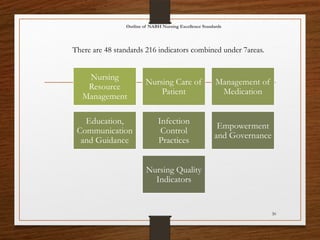
Outline of NABH Nursing Excellence Standards
Nursing
Resource
Management
Nursing Care of
Patient
Management of
Medication
Education,
Communication
and Guidance
Infection
Control
Practices
Empowerment
and Governance
Nursing Quality
Indicators
There are 48 standards 216 indicators combined under 7areas.
31
Benefits of accreditation
Assures basic level of quality and standards of education.
Helps the employers to determine credibility of educational
programme and student’s standard.
Provides opportunities for continuous advancement and
progress of the institution and educational programme.
Credits of the educational programme are most likely to be
transferred to other accredited institutions.
Demonstrates commitment to excellence.
Promotes professional development of employees.
32
Benefits of accreditation
Accreditation improves working condition in an educational
institution.
Accreditation enhances satisfaction of consumers of health
services.
Promote Research and Innovation.
Gives new sense of direction and identity for students.
Scope of Accreditation-Service
• Accreditation ensures a level of quality and thus
results in high quality of care and patient safety.
• It provides public recognition in terms of the level
of performance about the standards.
• The patients get services by credential staff and thus
protecting the rights of patients. It attracts foreign
patients by ensuring the delivery of best services.
• It helps to improve the quality of patient care, to ensure a safe environment, and to
reduce risks to patients and staff.
• It helps in elevating effectiveness, efficiency and cost containment, and accountability,
and the need to reduce errors and increase safety in the system.
• It helps to bring a fundamental change in the technical procedures of service delivery
and ensure social participation.
• Accreditation to a hospital stimulates continuous improvement and enables hospitals
to demonstrate a commitment to quality care.
• It also provides an opportunity for health-care units to benchmark with the best.
• It brings satisfaction among staff and provides continuous learning, a pleasant
working environment, leadership for them, and thus improve the overall professional
development of staff and provides guidance for quality improvement within nursing.
Scope of Accreditation-
Education
• Accreditation offers a base for both quantity and quality
(relevance and excellence of academic programs offered) of
higher education.
• It helps the institution to know its strengths, weaknesses, and
opportunities through an informed review process.
• It helps institutions to identify internal areas of planning and
resource allocation, innovative, and modern methods of
pedagogy.
• The outcome provides objective data to funding agencies for
performance funding.
• It provides reliable information on the quality of
education offered.
• Employers have access to information on the quality
of education offered to potential recruiters.
• Promotes intra- and inter-institutional interactions.
• It provides greater efficiency and more accountability
and prevents negligence.

accreditation process in nursing education

  • 1.
  • 2.
    Accreditation • Meaning –give credit to something • It is a voluntary process to have optimal and achievable standards. • “Accrediting is the process whereby an organization agency recognizes a college or university or a program of study as having met certain predetermined qualifications and standard”(Selden)
  • 3.
    • John Braithwaite(2001) defines accreditation as a process of assessment to evaluate the level of performance in health institutions through self and by the external peer to establish standards and to implement ways to improve.
  • 4.
    Importance of accreditation •Enhances quality of education and services • Recruitment of qualified and efficient employee to assure quality services • Provides more employment opportunities for students • Creates goals for self-improvement of the organization. • Promotes continuous quality improvement • Recognizes benchmark practice.
  • 5.
    Purposes of accreditationof educational institutions • Guarantee quality assurance in education. • Promote and recognize excellence in higher education • Enhanced academic reputation at national and international level • Improvements in academic processes. • Protects an institution against harmful internal and external pressure.
  • 6.
    • Help educationalinstitutions to evaluate their ongoing activities for the benefit of the students. • Assist prospective students in identifying acceptable institutions. • Ensures public accountability.
  • 7.
    Accreditation Process The stepsfor accreditation program are as follows 1. Application for accreditation and registration 2. Self-appraisal 3. On the site visit 4. Report preparation 5. Awarding certification 6. Maintaining accreditation status.
  • 8.
    8 Areas to beassessed for granting accreditation of an educational institution  Institutional philosophy, vision, and mission  Organization and administration  Curriculum and program of instruction  Faculty positions, qualifications, and experience  Resources, facilities, and services  Special activities  Student welfare services  Library and learning resources.  Physical infrastructure and facilities  Social welfare programmes and activities • Evaluation of the programme
  • 9.
    9 Types of accreditingagencies Regional accrediting agencies Operate in specific regions of the country National accrediting agencies Accreditate institutes of the entire country More authoritative State accrediting agencies Accreditation is given by state agencies and state universities.
  • 10.
    National accrediting agencies– for education • National educational accrediting agencies Central Advisory Board Of Education(CABE) All India Council For Elementary Education All India Council For Secondary Education All India Council For Technical Education(AICTE) University Grants Commission (UGC), NAAC • National professional accrediting agencies Indian Nursing Council MCI,DCI,PCI
  • 11.
    accrediting agencies –for health care • NABH • QCI • IHA • BIS • JCI
  • 12.
    12 National assessment andaccreditation council (NAAC) • It is an autonomous body funded by UGC and accredits higher educational institutions in India. • It was established in 1994 with headquarters in Bangalore
  • 13.
    13 Three step processof NAAC Accreditation • Institutional eligibility for quality assessment (IEQA) • Preparation of self study report by the institute (SSR) • Peer team visit to the institute
  • 14.
    NAAC criteria forassessment and grading of educational institutions • Infrastructure and learning resources • Curricular aspects • Governance, leadership, and management • Student support and progression • Teaching learning evaluation • Research and innovations • Institutional values and practice
  • 15.
    Grading system • Keyaspects wise grading points • Criteria-wise grade point average • Cumulative grade point average • Letter grading according to Cumulative grade point average • Accredited –A++,A+, A, B++, B+, B,C • D –not credited
  • 16.
    INC AS AN ACCREDITATIONBODY • The INC is an autonomous statutory body that regulates the functioning of all nursing programs. • INC assesses and accredits institutions based on the minimum laid down standards for nursing institutions to give official recognition to start nursing programs, and for quality assurance at the time of renewal/upgradation of school to college of nursing. • The accreditation process takes at least 9 months to complete after submission of all required information with the first application.
  • 17.
    Process of Accreditation 1.Receiving,acknowledging, and scrutinizing request applied by the concerned institute by accreditation panel and making recommendations to the accreditation committee. The accreditation committee seeks the councils approval to reject or accept a request.’( new application for the same program after 18 months or 2 attempts to supplement information)
  • 18.
    1.Application for accreditation •Organization -define • Fee • Self-evaluation by the school/college (SSR) and supporting Documents
  • 19.
    Documents - Fora new proposal • Particulars of the institute including offering Courses • No objection certificate from state government for the offering courses • Government order/essentiality certificate for the desired nursing programs • Land details indicating the total area, land of ownership, registration number, etc. • Building details showing land deed, totally covered area, completion certificate, fire safety certificate, blueprint, water and sewerage system, electricity connection, pollution certificate, etc. • Finance backup, valuation certificate, FDRS balance, PAN/DAN, etc.
  • 20.
    • Consent letterfrom the university only for starting a college of nursing offering graduate/ postgraduate nursing program • A consent letter from the respective State Nursing Registration Council to start the desired nursing program • Teaching, clinical, and physical facility details including budget. • Documents related to parent hospital such as registered deed of hospital (trust/society/ company) (hospital name) along with members, Notary-attested registered resolution of governing body (name of trustee) and name of hospital would be the parent hospital of institution for the next 3 years, CMHO certification about owner of hospital of the hospital location and number of beds, income tax return for the last 3 years, registration of hospital under shop and establishment act, and a certificate from Pollution Control Board for both parent and affiliated hospitals.
  • 21.
    • For enhancementof seats - government order/essentiality certificate for the desired number of seats and payment of inspection fees for each program through online or other modes per requirement.
  • 22.
    2. Notification toschool/college to check their status of application on web site and to submit new proposals if any. 3. Inspection by the appointed inspectors of INC to observe and physically verify the documents 4. Preparation and submission of a report in prescribed format with supporting documents 5. Scrutiny and review of inspection report. 6. Decision-making process: either grant or deny recognition 7.Approval and notification. If INC does not grant permission apply for reinspection with supporting documents
  • 23.
    8. Surviellance assessmentby INC-Inspection for first 3 consecutive years followed by periodic and surprise inspections. 9. Validity/renewal assessment and notification
  • 24.
    Quality Assurance Standards(QAS)of KUHS Accreditation Programme-2019 • There are 10 Key areas. Under each Key area there will be five standards. Under each standard there will be 5 to 10 Measurable indicators • Score for each Measurable Indicators is 2,1 or 0points as the case may be • Academic year need to be defined and specified and score for each year to be displayed (once in three years)
  • 25.
    10 Key Areasin QAS-KUHS • Infrastructure Facilities • Teacher Profile And Teaching Learning • Curriculum Implementation Monitoring • Quality Assurance System • Research Enabling Environment • Out Reach Programmes • Student Support And Guidance Programme • Institutional Governance • Innovation And Best Practices • Feedback Implementation Process
  • 26.
    26 National Accreditation Boardfor Hospitals and Health Care Providers (NABH) • NABH is apex national health care accreditation and quality improvement body, established to provide accreditation for healthcare organisations. • It is a constituent board of Quality Council of India. • NABH is responsible to set benchmark for ensuring quality health care and progress of health industry • A member of the ISQua (International society for Quality in heathcare) • It is under the ministry of commerce and industry. • HOPE- Healthcare Organizations Platform for Entry-level certification- new portal for entry level certification.
  • 27.
    27 Goals and objectivesof NABH • To provide accreditation to hospitals • To improve health care quality and patient safety at public and private hospitals. • To improve patient satisfaction and community confidence as services are provided by credentialed health care professionals
  • 28.
    Hospital standards accordingto NABH There are 102 standards 636 indicators combined under 10 headings. 1.Patient centered standards  Access, assessment and continuity of care  Care of Patients  Management of Medication  Patient Rights and Education  Hospital Infection Control
  • 29.
    2. Organization centered •Patient Safety and Quality Improvement • Responsibilities of Management • Facilities Management and Safety • Human Resource Management • Information Management System
  • 30.
    30 Outline of NABHNursing Excellence Standards Nursing Resource Management Nursing Care of Patient Management of Medication Education, Communication and Guidance Infection Control Practices Empowerment and Governance Nursing Quality Indicators There are 48 standards 216 indicators combined under 7areas.
  • 31.
    31 Benefits of accreditation Assuresbasic level of quality and standards of education. Helps the employers to determine credibility of educational programme and student’s standard. Provides opportunities for continuous advancement and progress of the institution and educational programme. Credits of the educational programme are most likely to be transferred to other accredited institutions. Demonstrates commitment to excellence. Promotes professional development of employees.

  • 32.
    32 Benefits of accreditation Accreditationimproves working condition in an educational institution. Accreditation enhances satisfaction of consumers of health services. Promote Research and Innovation. Gives new sense of direction and identity for students.
  • 33.
    Scope of Accreditation-Service •Accreditation ensures a level of quality and thus results in high quality of care and patient safety. • It provides public recognition in terms of the level of performance about the standards. • The patients get services by credential staff and thus protecting the rights of patients. It attracts foreign patients by ensuring the delivery of best services.
  • 34.
    • It helpsto improve the quality of patient care, to ensure a safe environment, and to reduce risks to patients and staff. • It helps in elevating effectiveness, efficiency and cost containment, and accountability, and the need to reduce errors and increase safety in the system. • It helps to bring a fundamental change in the technical procedures of service delivery and ensure social participation. • Accreditation to a hospital stimulates continuous improvement and enables hospitals to demonstrate a commitment to quality care. • It also provides an opportunity for health-care units to benchmark with the best. • It brings satisfaction among staff and provides continuous learning, a pleasant working environment, leadership for them, and thus improve the overall professional development of staff and provides guidance for quality improvement within nursing.
  • 35.
    Scope of Accreditation- Education •Accreditation offers a base for both quantity and quality (relevance and excellence of academic programs offered) of higher education. • It helps the institution to know its strengths, weaknesses, and opportunities through an informed review process. • It helps institutions to identify internal areas of planning and resource allocation, innovative, and modern methods of pedagogy. • The outcome provides objective data to funding agencies for performance funding.
  • 36.
    • It providesreliable information on the quality of education offered. • Employers have access to information on the quality of education offered to potential recruiters. • Promotes intra- and inter-institutional interactions. • It provides greater efficiency and more accountability and prevents negligence.