AKKI MARUTHI
ASSISTANT PROFESSOR
DEPARTMENT OF COMMERCE
SKNG, GFGC, GANGAVATHI
akkimaruthi@gmail.com
LEARNING OBJECTIVES
• Meaning of Brand and its Elements
• Meaning of Home- grown brands
• Brand accounting meaning and its valuation
• Purposes or objectives of brand accounting
• Factors and difficulties, valuation models of Brand Accounting
• Numerical on Brand Accounting
• Approaches of Brand Accounting
• Needs and importance of Brand Accounting
• References
MEANING OF BRAND
Kotler & Armstrong “the word ‘brand’ means a name, term, sign,
symbol or design or a combination of these identifies the maker or
seller of a product or service”
Key Brand Elements are brand name, promise, personality and
associations.
Brand Elements are slogans, characters, symbols, logos, internet
addresses
How to choose good Brand Elements?
Memorable, meaningful, likeable, transferable, adaptable and
protectable
HOME-GROWN BRANDS
• Brand achieves a significant value in commercial operation through
the tangible and intangible elements.
• Brands may be that which is acquired from outside source while
acquiring business or may also be nurtured internally by a company,
which are known as “Home-grown brands”.
• By assigning a brand name to the product, the manufacturer
distinguishes it from rival products and helps the customers to
identify it while going in for it.
• The necessity of branding of products has increased enormously due
to the influence of various factors like growth of competition,
increasing importance of advertising etc.
IDENTIFICATION OF BRANDS AS AN
ASSET/BRAND AS A STRATEGIC ASSETS
There are various definitions of the term ‘asset’. Asset as a concept,
is generally characterized by the following features :
• For an asset there must exist some specific right to future benefits
or service potentials.
• Rights over asset must accrue to a specific individual or firm.
• There must be a legally enforceable claim to the right or services
over the asset.
• The asset must be the result of a past transaction or event.
CONT.
• It creates goodwill in the market
• Brand enhances the market share
• Brand generates huge revenue as other assets
• It creates competitive position in the market
• It is an intangible asset
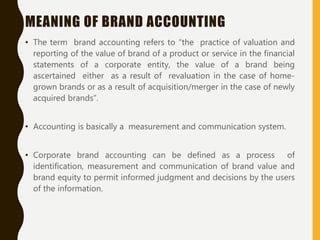
MEANING OF BRAND ACCOUNTING
• The term brand accounting refers to “the practice of valuation and
reporting of the value of brand of a product or service in the financial
statements of a corporate entity, the value of a brand being
ascertained either as a result of revaluation in the case of home-
grown brands or as a result of acquisition/merger in the case of newly
acquired brands”.
• Accounting is basically a measurement and communication system.
• Corporate brand accounting can be defined as a process of
identification, measurement and communication of brand value and
brand equity to permit informed judgment and decisions by the users
of the information.
OBJECTIVES/PURPOSES OF BRAND
ACCOUNTING
1. Real Economic Value
2. Future Profitability
3. Preventing Predation
4. Leverage Benefits
5. Quality Decisions
6. Quality Accounting
7. Social Obligation
8. Other Benefits
NEEDS/IMPORTANCE OF BRAND ACCOUNTING
• Collection of data and cost of Brand creation
• Allocation and apportionment of cost on various centers
• Valuation of brand and life
• Amortization of cost of brand
• Reflection on financial statement
• Interpreting on the financial statement
• It creates favorable images of the product
• It facilitate sales promotion in specific segments
• It helps to face market competition and brand wars effectively
• It helps to creates consumer loyalty and willing their confidence
DIFFICULTIES IN BRAND ACCOUNTING
Intangibles are not easily measurable and it poses severe challenges
in valuation of brands also. Some of the difficulties faced by the
accountants in brand valuation are as follows:
1. Distinctiveness
2. Disclosure
3. Uncertainty
4. The Dilemma
5. No Market
6. New Brands
7. Joint Costs
FACTORS AFFECTING THE VALUATION OF
BRANDS
The methods of brand valuation would depend on one or more of the
following variables
• Exclusive earning power of brand.
• Product as a brand and hence, product life cycle.
• Separating a brand from other less important value drivers
• Cost of acquisition of brand.
• Expenses incurred on nurturing a home grown brand.
• Impact of other brands as new entrants to the market.
• Intrinsic strength of the people and process handling the brand.
• Accuracy in projecting the super or extra earnings offered by a brand
and rate of discounting such cash flows.
• The cost of withdrawing or replacing the brand.
• Internationalization of a brand and therefore, local earning power of a
brand in various countries or markets.
VALUATION OF BRANDS
Brand value = (ML + MS + SM + IA + MT + SS + CS + BP)
Here,
• ML = Market Leadership
• MS = Extent of Market Share
• SM = Stability of Market
• IA = Levels of international acceptance
• MT = Ability to meet the changing modern marketing trends
• SS = Extent of Strategic support
• CS = Competitive strength
• BP = Social Brand protection
CONT.
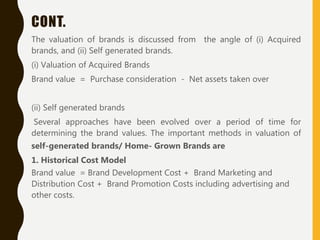
The valuation of brands is discussed from the angle of (i) Acquired
brands, and (ii) Self generated brands.
(i) Valuation of Acquired Brands
Brand value = Purchase consideration - Net assets taken over
(ii) Self generated brands
Several approaches have been evolved over a period of time for
determining the brand values. The important methods in valuation of
self-generated brands/ Home- Grown Brands are
1. Historical Cost Model
Brand value = Brand Development Cost + Brand Marketing and
Distribution Cost + Brand Promotion Costs including advertising and
other costs.
SELF GENERATED/HOME- GROWN BRANDS ARE
2. Replacement Cost Model
Brand value = Replacement Brand Cost
3. Market Price Model
Brand Value =is net realizable value from sale of a brand
4. Current Cost Model
Brand value = Current use value
5. Potential Earning Model
Total Market value of brand = Net Brand Revenue/ Capitalization Rate
Net Brand Revenues = (Brand units x Unit brand price) – (Brand units x
Unit brand cost) – (Marketing cost + R & D Cost + Tax Cost)
CONT.
6. Present Value Model
The DCF model for evaluating brand values has got three sources of
failure :
(i) Anticipation of cash flow, (ii) Choice of period, and (iii)
rate.
7. Sensitivity Model
Brand value = (Brand units sold x Unit Brand price) x AB x BI x BA--
+ BMDC + BPC)
Where, AB, BI and BA are sensitivity index of brand values. BDC =
Development Cost BMDC = Brand Marketing and Distribution Cost,
BPC=Brand Promotion Cost
CONT..,
8. Life Cycle Model
the brand value is indicated by means of relating the brand
to the brand strength.
9. Incremental Model
Brand value = Total expected benefits after acquiring or revaluing
brands – Total benefits of brands owned.
10. Super Profits Model
Brand value = Discounting Factor × (Total profit of an enterprise in ‘n’
years × Profit of an enterprise without the brand in ‘n’ years)
11. Market Oriented Approach
Brand value = Discounting Factor × Company’s profitability ratio x
Cumulative market’s size in next ten years –Cumulative total of market
share enjoyed by other branded and non-branded products in next 10
Years.
GENERAL APPROACHES
In determining the value of a brand in an acquisition or merger,
firms can choose from three main approaches;
• Cost approach; Brand equity is the amount of money that would
be required to reproduce or replace the brand
• Market approach; the present value of the future economic
benefits to be derived by the owner of the asset.
• Income approach; the discounted future cash flow from the
future earnings stream for the brand
Example,1
Cont..
Example, 2
Example, 3
REFERENCES
• strategic performance management and
business icmai study materials January 2019
• www.yourartilelibrary
• Management accounting by Dr. M.C Garg
• ASB, Goodwill and Intangible Assets, U.K
• WWW. Slideshre.net
THANK YOU
“Loyalty is not won by being first. It is
won by being best”

Brand Accounting

  • 1.
    AKKI MARUTHI ASSISTANT PROFESSOR DEPARTMENTOF COMMERCE SKNG, GFGC, GANGAVATHI akkimaruthi@gmail.com
  • 2.
    LEARNING OBJECTIVES • Meaningof Brand and its Elements • Meaning of Home- grown brands • Brand accounting meaning and its valuation • Purposes or objectives of brand accounting • Factors and difficulties, valuation models of Brand Accounting • Numerical on Brand Accounting • Approaches of Brand Accounting • Needs and importance of Brand Accounting • References
  • 4.
    MEANING OF BRAND Kotler& Armstrong “the word ‘brand’ means a name, term, sign, symbol or design or a combination of these identifies the maker or seller of a product or service” Key Brand Elements are brand name, promise, personality and associations. Brand Elements are slogans, characters, symbols, logos, internet addresses How to choose good Brand Elements? Memorable, meaningful, likeable, transferable, adaptable and protectable
  • 5.
    HOME-GROWN BRANDS • Brandachieves a significant value in commercial operation through the tangible and intangible elements. • Brands may be that which is acquired from outside source while acquiring business or may also be nurtured internally by a company, which are known as “Home-grown brands”. • By assigning a brand name to the product, the manufacturer distinguishes it from rival products and helps the customers to identify it while going in for it. • The necessity of branding of products has increased enormously due to the influence of various factors like growth of competition, increasing importance of advertising etc.
  • 6.
    IDENTIFICATION OF BRANDSAS AN ASSET/BRAND AS A STRATEGIC ASSETS There are various definitions of the term ‘asset’. Asset as a concept, is generally characterized by the following features : • For an asset there must exist some specific right to future benefits or service potentials. • Rights over asset must accrue to a specific individual or firm. • There must be a legally enforceable claim to the right or services over the asset. • The asset must be the result of a past transaction or event.
  • 7.
    CONT. • It createsgoodwill in the market • Brand enhances the market share • Brand generates huge revenue as other assets • It creates competitive position in the market • It is an intangible asset
  • 8.
    MEANING OF BRANDACCOUNTING • The term brand accounting refers to “the practice of valuation and reporting of the value of brand of a product or service in the financial statements of a corporate entity, the value of a brand being ascertained either as a result of revaluation in the case of home- grown brands or as a result of acquisition/merger in the case of newly acquired brands”. • Accounting is basically a measurement and communication system. • Corporate brand accounting can be defined as a process of identification, measurement and communication of brand value and brand equity to permit informed judgment and decisions by the users of the information.
  • 9.
    OBJECTIVES/PURPOSES OF BRAND ACCOUNTING 1.Real Economic Value 2. Future Profitability 3. Preventing Predation 4. Leverage Benefits 5. Quality Decisions 6. Quality Accounting 7. Social Obligation 8. Other Benefits
  • 10.
    NEEDS/IMPORTANCE OF BRANDACCOUNTING • Collection of data and cost of Brand creation • Allocation and apportionment of cost on various centers • Valuation of brand and life • Amortization of cost of brand • Reflection on financial statement • Interpreting on the financial statement • It creates favorable images of the product • It facilitate sales promotion in specific segments • It helps to face market competition and brand wars effectively • It helps to creates consumer loyalty and willing their confidence
  • 11.
    DIFFICULTIES IN BRANDACCOUNTING Intangibles are not easily measurable and it poses severe challenges in valuation of brands also. Some of the difficulties faced by the accountants in brand valuation are as follows: 1. Distinctiveness 2. Disclosure 3. Uncertainty 4. The Dilemma 5. No Market 6. New Brands 7. Joint Costs
  • 12.
    FACTORS AFFECTING THEVALUATION OF BRANDS The methods of brand valuation would depend on one or more of the following variables • Exclusive earning power of brand. • Product as a brand and hence, product life cycle. • Separating a brand from other less important value drivers • Cost of acquisition of brand. • Expenses incurred on nurturing a home grown brand. • Impact of other brands as new entrants to the market. • Intrinsic strength of the people and process handling the brand. • Accuracy in projecting the super or extra earnings offered by a brand and rate of discounting such cash flows. • The cost of withdrawing or replacing the brand. • Internationalization of a brand and therefore, local earning power of a brand in various countries or markets.
  • 13.
    VALUATION OF BRANDS Brandvalue = (ML + MS + SM + IA + MT + SS + CS + BP) Here, • ML = Market Leadership • MS = Extent of Market Share • SM = Stability of Market • IA = Levels of international acceptance • MT = Ability to meet the changing modern marketing trends • SS = Extent of Strategic support • CS = Competitive strength • BP = Social Brand protection
  • 14.
    CONT. The valuation ofbrands is discussed from the angle of (i) Acquired brands, and (ii) Self generated brands. (i) Valuation of Acquired Brands Brand value = Purchase consideration - Net assets taken over (ii) Self generated brands Several approaches have been evolved over a period of time for determining the brand values. The important methods in valuation of self-generated brands/ Home- Grown Brands are 1. Historical Cost Model Brand value = Brand Development Cost + Brand Marketing and Distribution Cost + Brand Promotion Costs including advertising and other costs.
  • 15.
    SELF GENERATED/HOME- GROWNBRANDS ARE 2. Replacement Cost Model Brand value = Replacement Brand Cost 3. Market Price Model Brand Value =is net realizable value from sale of a brand 4. Current Cost Model Brand value = Current use value 5. Potential Earning Model Total Market value of brand = Net Brand Revenue/ Capitalization Rate Net Brand Revenues = (Brand units x Unit brand price) – (Brand units x Unit brand cost) – (Marketing cost + R & D Cost + Tax Cost)
  • 16.
    CONT. 6. Present ValueModel The DCF model for evaluating brand values has got three sources of failure : (i) Anticipation of cash flow, (ii) Choice of period, and (iii) rate. 7. Sensitivity Model Brand value = (Brand units sold x Unit Brand price) x AB x BI x BA-- + BMDC + BPC) Where, AB, BI and BA are sensitivity index of brand values. BDC = Development Cost BMDC = Brand Marketing and Distribution Cost, BPC=Brand Promotion Cost
  • 17.
    CONT.., 8. Life CycleModel the brand value is indicated by means of relating the brand to the brand strength. 9. Incremental Model Brand value = Total expected benefits after acquiring or revaluing brands – Total benefits of brands owned. 10. Super Profits Model Brand value = Discounting Factor × (Total profit of an enterprise in ‘n’ years × Profit of an enterprise without the brand in ‘n’ years) 11. Market Oriented Approach Brand value = Discounting Factor × Company’s profitability ratio x Cumulative market’s size in next ten years –Cumulative total of market share enjoyed by other branded and non-branded products in next 10 Years.
  • 18.
    GENERAL APPROACHES In determiningthe value of a brand in an acquisition or merger, firms can choose from three main approaches; • Cost approach; Brand equity is the amount of money that would be required to reproduce or replace the brand • Market approach; the present value of the future economic benefits to be derived by the owner of the asset. • Income approach; the discounted future cash flow from the future earnings stream for the brand
  • 19.
  • 20.
  • 21.
  • 23.
  • 24.
    REFERENCES • strategic performancemanagement and business icmai study materials January 2019 • www.yourartilelibrary • Management accounting by Dr. M.C Garg • ASB, Goodwill and Intangible Assets, U.K • WWW. Slideshre.net
  • 25.
    THANK YOU “Loyalty isnot won by being first. It is won by being best”