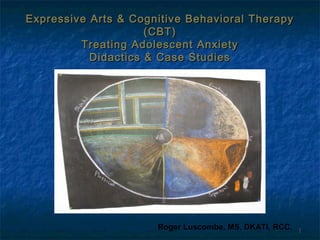
Expressive Arts & Cognitive Behavioral Therapy
(CBT)
Treating Adolescent Anxiety
Didactics & Case Studies

Roger Luscombe, MS, DKATI, RCC.

1
Resources








Approaches to Art Therapy, Theory & Technique 2nd ed.
Judith Aron Rubin, ed.
Play Therapy, Theory & Practice, A Comparative
Presentation, O’Connor & Braaverman, ed’s.
CBT Connections, Anxiety Disorders in Children &
Adolescents: University of British Columbia
Anxiety Disorder Association of British Columbia (Anxiety
B.C.)
2
Anxiety B.C.

five important elements










Anxiety is normal, everyone experiences it at times
Anxiety is not dangerous, although anxiety feels uncomfortable, it is
temporary, and will eventually decrease
Most people cannot tell when you are anxious
Anxiety is adaptive and helps us prepare for real danger or for
performing at our best, it triggers our “fight-flight-freeze” response
preparing our body to react
Anxiety becomes a problem when our body reacts in absence of
real danger

3
Key Issues in Anxiety


Anxiety is about fear



Clinical Anxiety is Irrational



Clinical Anxiety is Learned

4
Anxiety Disorders: Overview








Most common mental health problem
12 – 20% of children affected
Over 65,000 kids in B.C. with disorder
Impact and morbidity not widely
recognized
Girls often have more fears than boys
Number and types of fears across cultures
are fairly consistent
5
Anxiety: Overview Continued








Presence of one anxiety disorder increases risk
of developing additional anxiety disorder
Mom’s with any mental illness are 7 times more
likely to have a child with an anxiety disorder
Children and youth with anxiety disorders rarely
receive appropriate or effective interventions
If left untreated there is a significant increase in
risk of depression & substance abuse

6
The Experience of Anxiety


Body Fear



Mental Fear



Behavioral Indicators of Fear

7
Components of the Anxiety
Response


Behavioral Avoidance



Distorted Beliefs



Over Predictions of Fear



Attentional Bias



Physiological Responding
8
Causes and Maintenance of
Anxiety Disorders


Genetics



Temperament



Parenting



Cognitive Factors



Avoidance Behaviors
9
Types of Anxiety Disorders








Social anxiety disorder (separation anxiety
disorder)
Obsessive compulsive disorder
Specific phobias
Generalized anxiety disorder
Panic disorder w/o Agoraphobia
Post traumatic Stress disorder
10
anxiety

Regina
Lafay

11
Anxiety, Regina Lafay
www.survivorart.com



"One of the first pieces I did to express an emotion I had
not yet had diagnosed – a feeling that I had known since
I was a teen, yet nobody was available to explain it to me
or help me through it. I have only recently been
diagnosed with Generalized Anxiety Disorder, among
others. Words fail me, as they often do, so I choose art
to tell my stories. This image helped a group of troubled
teenage girls recognize that they are not alone. I
continue to be moved by their counselor’s letters, as she
and I still keep in touch."

12
Cognitive Behavioral Therapy







Psycho education
Managing body symptoms
Healthy thinking
Building tolerance
Relapse prevention
Evidence based
13
Evolution of CBT


Behavioral Therapy



Social Learning Theory



Cognitive Therapy



Cognitive Behavioral Therapy



Dialectical Behavioral Therapy



Family Cognitive Behavioral Therapy



Cognitive-Behavioral Art Therapy
14
CBT & Art Therapy









CBT not widely been accepted in the art therapy field
There has been the misconception that CBT focuses
only on the thinking process
In reality imagery, visual thinking and creativity are
aspects of cognition
Personal constructs are non verbal as well as verbal and
creating art can enrich personal constructs'
Emotional components, as illuminated in art therapy, are
an integral part of understanding a person’s cognitive
process


Approaches to Art Therapy, Rubin

15
Core CBT Components


Cognitive restructuring



Physical relaxation



Exposure, coping skills



Social skills training
16
Principals of CBT
THOUGHTS

BEHAVIOURS

EMOTIONS

17
Myers – Briggs Type Indicator







Carl Jung’s
Psychological Types
Eg.
ESTJ - Extraversion,
Sensing, Thinking,
Judging
INFP - Introversion,
Intuition, Feeling,
Perceiving

Dichotomies
Extraversion

Introversion

Sensing

iNtuition

Thinking

Feeling

Judging

Perceiving
18
Distorted Thinking











All or nothing thinking
Over generalizing
Mental filtering
Disqualification of the positive
Jumping to conclusions
Magnification (catastrophizing or minimizing)
Emotional reasoning
“Should” statements
Labeling
Personalization
19
Cognitive Approaches








Identification of inner, private thoughts
Use of positive self-talk
Techniques for challenging negative selftalk
Self-reward
Expectations of good things to happen
Evaluation of own performance – partial
successes
20
Physiological Approaches


Awareness of body clues



Deep breathing exercises



Relaxation activities

21
Behavioral Approaches


Problem solving skills



Coping skills



Peer support



Identification of pleasant events



Exposure
22
Exposure


Interoceptive Exposure




In vivo Exposure




Deliberately bring on bodily symptoms of
anxiety, e.g. spinning, breathing
Deliberately entering feared situations e.g.
movies, malls

Naturalistic Exposure


Deliberately engage in activities e.g. exercise
23
Role of Family & Teachers










Psycho education about anxiety and treatments
that work
Emphasize that well-intended intuitive responses
may actually enable anxiety problems
Consistency and firmness in follow through on
plans
If family concurrent difficulties with anxiety all
members receive treatment
Assist with homework
24
CBT Tools









Thought and Mood Charts
SUD’s Chart (subjective units of discomfort)
Fear Hierarchy Chart
Fear Monitoring Form
Grounding Tips
PTSD Impacts of Events Scale
Brief Screening Instrument for Panic Attacks
Relaxation Scripts


Breathing, progressive muscle relaxation

25
Children’s CBT Resources

Taming the Worry Dragons, Garland &
Clark, B.C. Children's Hospital

26
CBT Resources cont.

27
CBT Resources cont

28
CBT Case Formulation









Brief demographic
Problem identification
Problem history
Family and social adjustment
Main cognitive, physiological and behavioral
components of major problems
Client’s perspective
Case formulation
29
CBT Treatment Plan





Prioritization of treatment targets
Tracking of clients progress
Methods of treatment
Graduation from treatment

30
Case Study David

31
Case Formulation for David




Demographics:
 Adolescent, rural isolation, single parented,
marijuana friendly community
Problem Identification:
 Psychiatric Dx: Disthymic disorder with more severe
depression (double depression)
 Academic, social and family stressors
 Substance misuse
 General anxiety and social phobia

32
Case Formulation cont.- 1


Problem History, Family & Social
Adjustment:






Unhappy as a baby
Ongoing depression last couple years
History of family depression w/ hospitalization
Poor relationship with bio dad
Daily use of marijuana for 5 years
33
Case Formulation cont.- 2



Problem Identification
Cognitive




Physiological




Negative self image, self punishing, fears of future
failure, downward spiraling thinking
Poor diet, lack of regular meals, lack of exercise, over
sleeping,

Behavioral


School avoidance, social withdrawal, no employment,
heavy marijuana use (self identified)
34
Case Formulation cont.- 3


Client’s perspective






Depression, low self esteem, addiction
acknowledged
Sense that his personal history affects his
current state
Goals include reducing fears, increase self
esteem, improve friendships, school
graduation, and be drug free
35
Case Formulation cont.- 4


Case Formulation







Psychiatrist had diagnosed depression and
recommended CBT treatment
CBT idea had hooked David, though reluctant
some readiness present (Prochaska stages)
Positive male therapist transference
Anxiety seen as possible core disturbance

36
Stages of Change


James Prochaska & Carlo Diclemente







Precontemplation Stage
Contemplation Stage
Determination Stage
Action Stage
Maintenance Stage
Relapse
37
CBT Treatment Plan for David










Psycho education
Exploration of ABC triangle
Reframing
Social exposure
Expressive arts exploration
Stress reduction
Involve family in treatment
Relapse prevention
Ten to Twelve independent sessions
38
Treatment Plan cont. - 1


Tracking of client’s progress









Home work check-ins, reading assignments
Thought & mood records
Sleeping pattern changes
Socialization changes
School attendance record
Drug and alcohol consumption
Changes in family time
Diet & exercise changes
39
CBT Tools Used





ABC triangle presented
Distorted thinking examined
Reading homework on depression & CBT
Thought records, challenging depressive
thoughts

40
Expressive Arts Exploration








Icebreaking, rapport making
Invites cognitive conversation
Provide creative outlet
Self esteem through art making / product
Insight acquisition
Co-art making positive transference
Provides visible record of change
41
David’s Art Making & Gaming





Clay pieces
Biofeedback Game
Sandtray World
Roofing Paper Medicine Wheel

42
Clay - David
43
Sandtray - David

44
Biofeedback Stress
Management

45
Clay - David
46
Clay - David
47
Roofing Paper - David

48
Summary: David Case Study







CBT model intrigued youth
Psycho education around thoughts,
emotions, behaviors very beneficial
Art therapy engaged and gave youth
insight & increased self esteem
Positive transference enabled personal
transformation process
49
TF-CBT for Aboriginal Child
Trauma Victim








Honoring Children – Mending the Circle
Spiritual
Mental
Physical
Emotional
Relational
University of Oklahoma Health
Mending the Circle Sciences Center
50
51
Case Study Sara




Presenting Problem – General Anxiety &
Specific Phobia
Treatment Components





Play Therapy Genogram
Fears Assessment Tool
SUD’s Hierarchy Chart
Fish Hook Diagram for anxiety attack
52
Sara cont.


Play therapy family
genogram

53
Fears Assessment Tool


Self Rating Questionnaire, 8 biggest fears
Flying
 Punishment by mother
 Criticized by parents
 Giving a recital
 Snakes
 Mean dogs
 Dead people
 Spiders


54
SUD’s Chart for Flying Phobia










1
2
3
4
5
6
7
8
9

Looking at airplanes
Airplane play, sandtray, puzzles
Make airplane, clay, paper mache
Going to local airport
Going to Castelgar airport
Getting near a plane
Sitting in a plane
Short flight on plane
Long flight to Hawaii
55
Panic Attack Fish Hook Model
56
Summary of Cognitive Behavioral Art Therapy






CBT illustrates how thoughts & emotions
& behaviors co -influence each other
CBT has particular treatment strategies to
create healthy thinking, emotional
awareness and positive actions
Art Therapy accomplishes these same
goals and fits well with CBT treatment
strategies
57
In Memory Of


Dr Peter Donald McLean,


CBT Connections


Passed away


Nov 04, 2008

58

Art therapy cbt presentation revised

  • 1.
    Expressive Arts &Cognitive Behavioral Therapy (CBT) Treating Adolescent Anxiety Didactics & Case Studies Roger Luscombe, MS, DKATI, RCC. 1
  • 2.
    Resources     Approaches to ArtTherapy, Theory & Technique 2nd ed. Judith Aron Rubin, ed. Play Therapy, Theory & Practice, A Comparative Presentation, O’Connor & Braaverman, ed’s. CBT Connections, Anxiety Disorders in Children & Adolescents: University of British Columbia Anxiety Disorder Association of British Columbia (Anxiety B.C.) 2
  • 3.
    Anxiety B.C. five importantelements      Anxiety is normal, everyone experiences it at times Anxiety is not dangerous, although anxiety feels uncomfortable, it is temporary, and will eventually decrease Most people cannot tell when you are anxious Anxiety is adaptive and helps us prepare for real danger or for performing at our best, it triggers our “fight-flight-freeze” response preparing our body to react Anxiety becomes a problem when our body reacts in absence of real danger 3
  • 4.
    Key Issues inAnxiety  Anxiety is about fear  Clinical Anxiety is Irrational  Clinical Anxiety is Learned 4
  • 5.
    Anxiety Disorders: Overview       Mostcommon mental health problem 12 – 20% of children affected Over 65,000 kids in B.C. with disorder Impact and morbidity not widely recognized Girls often have more fears than boys Number and types of fears across cultures are fairly consistent 5
  • 6.
    Anxiety: Overview Continued     Presenceof one anxiety disorder increases risk of developing additional anxiety disorder Mom’s with any mental illness are 7 times more likely to have a child with an anxiety disorder Children and youth with anxiety disorders rarely receive appropriate or effective interventions If left untreated there is a significant increase in risk of depression & substance abuse 6
  • 7.
    The Experience ofAnxiety  Body Fear  Mental Fear  Behavioral Indicators of Fear 7
  • 8.
    Components of theAnxiety Response  Behavioral Avoidance  Distorted Beliefs  Over Predictions of Fear  Attentional Bias  Physiological Responding 8
  • 9.
    Causes and Maintenanceof Anxiety Disorders  Genetics  Temperament  Parenting  Cognitive Factors  Avoidance Behaviors 9
  • 10.
    Types of AnxietyDisorders       Social anxiety disorder (separation anxiety disorder) Obsessive compulsive disorder Specific phobias Generalized anxiety disorder Panic disorder w/o Agoraphobia Post traumatic Stress disorder 10
  • 11.
  • 12.
    Anxiety, Regina Lafay www.survivorart.com  "Oneof the first pieces I did to express an emotion I had not yet had diagnosed – a feeling that I had known since I was a teen, yet nobody was available to explain it to me or help me through it. I have only recently been diagnosed with Generalized Anxiety Disorder, among others. Words fail me, as they often do, so I choose art to tell my stories. This image helped a group of troubled teenage girls recognize that they are not alone. I continue to be moved by their counselor’s letters, as she and I still keep in touch." 12
  • 13.
    Cognitive Behavioral Therapy       Psychoeducation Managing body symptoms Healthy thinking Building tolerance Relapse prevention Evidence based 13
  • 14.
    Evolution of CBT  BehavioralTherapy  Social Learning Theory  Cognitive Therapy  Cognitive Behavioral Therapy  Dialectical Behavioral Therapy  Family Cognitive Behavioral Therapy  Cognitive-Behavioral Art Therapy 14
  • 15.
    CBT & ArtTherapy      CBT not widely been accepted in the art therapy field There has been the misconception that CBT focuses only on the thinking process In reality imagery, visual thinking and creativity are aspects of cognition Personal constructs are non verbal as well as verbal and creating art can enrich personal constructs' Emotional components, as illuminated in art therapy, are an integral part of understanding a person’s cognitive process  Approaches to Art Therapy, Rubin 15
  • 16.
    Core CBT Components  Cognitiverestructuring  Physical relaxation  Exposure, coping skills  Social skills training 16
  • 17.
  • 18.
    Myers – BriggsType Indicator     Carl Jung’s Psychological Types Eg. ESTJ - Extraversion, Sensing, Thinking, Judging INFP - Introversion, Intuition, Feeling, Perceiving Dichotomies Extraversion Introversion Sensing iNtuition Thinking Feeling Judging Perceiving 18
  • 19.
    Distorted Thinking           All ornothing thinking Over generalizing Mental filtering Disqualification of the positive Jumping to conclusions Magnification (catastrophizing or minimizing) Emotional reasoning “Should” statements Labeling Personalization 19
  • 20.
    Cognitive Approaches       Identification ofinner, private thoughts Use of positive self-talk Techniques for challenging negative selftalk Self-reward Expectations of good things to happen Evaluation of own performance – partial successes 20
  • 21.
    Physiological Approaches  Awareness ofbody clues  Deep breathing exercises  Relaxation activities 21
  • 22.
    Behavioral Approaches  Problem solvingskills  Coping skills  Peer support  Identification of pleasant events  Exposure 22
  • 23.
    Exposure  Interoceptive Exposure   In vivoExposure   Deliberately bring on bodily symptoms of anxiety, e.g. spinning, breathing Deliberately entering feared situations e.g. movies, malls Naturalistic Exposure  Deliberately engage in activities e.g. exercise 23
  • 24.
    Role of Family& Teachers      Psycho education about anxiety and treatments that work Emphasize that well-intended intuitive responses may actually enable anxiety problems Consistency and firmness in follow through on plans If family concurrent difficulties with anxiety all members receive treatment Assist with homework 24
  • 25.
    CBT Tools         Thought andMood Charts SUD’s Chart (subjective units of discomfort) Fear Hierarchy Chart Fear Monitoring Form Grounding Tips PTSD Impacts of Events Scale Brief Screening Instrument for Panic Attacks Relaxation Scripts  Breathing, progressive muscle relaxation 25
  • 26.
    Children’s CBT Resources Tamingthe Worry Dragons, Garland & Clark, B.C. Children's Hospital 26
  • 27.
  • 28.
  • 29.
    CBT Case Formulation        Briefdemographic Problem identification Problem history Family and social adjustment Main cognitive, physiological and behavioral components of major problems Client’s perspective Case formulation 29
  • 30.
    CBT Treatment Plan     Prioritizationof treatment targets Tracking of clients progress Methods of treatment Graduation from treatment 30
  • 31.
  • 32.
    Case Formulation forDavid   Demographics:  Adolescent, rural isolation, single parented, marijuana friendly community Problem Identification:  Psychiatric Dx: Disthymic disorder with more severe depression (double depression)  Academic, social and family stressors  Substance misuse  General anxiety and social phobia 32
  • 33.
    Case Formulation cont.-1  Problem History, Family & Social Adjustment:      Unhappy as a baby Ongoing depression last couple years History of family depression w/ hospitalization Poor relationship with bio dad Daily use of marijuana for 5 years 33
  • 34.
    Case Formulation cont.-2   Problem Identification Cognitive   Physiological   Negative self image, self punishing, fears of future failure, downward spiraling thinking Poor diet, lack of regular meals, lack of exercise, over sleeping, Behavioral  School avoidance, social withdrawal, no employment, heavy marijuana use (self identified) 34
  • 35.
    Case Formulation cont.-3  Client’s perspective    Depression, low self esteem, addiction acknowledged Sense that his personal history affects his current state Goals include reducing fears, increase self esteem, improve friendships, school graduation, and be drug free 35
  • 36.
    Case Formulation cont.-4  Case Formulation     Psychiatrist had diagnosed depression and recommended CBT treatment CBT idea had hooked David, though reluctant some readiness present (Prochaska stages) Positive male therapist transference Anxiety seen as possible core disturbance 36
  • 37.
    Stages of Change  JamesProchaska & Carlo Diclemente       Precontemplation Stage Contemplation Stage Determination Stage Action Stage Maintenance Stage Relapse 37
  • 38.
    CBT Treatment Planfor David          Psycho education Exploration of ABC triangle Reframing Social exposure Expressive arts exploration Stress reduction Involve family in treatment Relapse prevention Ten to Twelve independent sessions 38
  • 39.
    Treatment Plan cont.- 1  Tracking of client’s progress         Home work check-ins, reading assignments Thought & mood records Sleeping pattern changes Socialization changes School attendance record Drug and alcohol consumption Changes in family time Diet & exercise changes 39
  • 40.
    CBT Tools Used     ABCtriangle presented Distorted thinking examined Reading homework on depression & CBT Thought records, challenging depressive thoughts 40
  • 41.
    Expressive Arts Exploration        Icebreaking,rapport making Invites cognitive conversation Provide creative outlet Self esteem through art making / product Insight acquisition Co-art making positive transference Provides visible record of change 41
  • 42.
    David’s Art Making& Gaming     Clay pieces Biofeedback Game Sandtray World Roofing Paper Medicine Wheel 42
  • 43.
  • 44.
  • 45.
  • 46.
  • 47.
  • 48.
  • 49.
    Summary: David CaseStudy     CBT model intrigued youth Psycho education around thoughts, emotions, behaviors very beneficial Art therapy engaged and gave youth insight & increased self esteem Positive transference enabled personal transformation process 49
  • 50.
    TF-CBT for AboriginalChild Trauma Victim        Honoring Children – Mending the Circle Spiritual Mental Physical Emotional Relational University of Oklahoma Health Mending the Circle Sciences Center 50
  • 51.
  • 52.
    Case Study Sara   PresentingProblem – General Anxiety & Specific Phobia Treatment Components     Play Therapy Genogram Fears Assessment Tool SUD’s Hierarchy Chart Fish Hook Diagram for anxiety attack 52
  • 53.
    Sara cont.  Play therapyfamily genogram 53
  • 54.
    Fears Assessment Tool  SelfRating Questionnaire, 8 biggest fears Flying  Punishment by mother  Criticized by parents  Giving a recital  Snakes  Mean dogs  Dead people  Spiders  54
  • 55.
    SUD’s Chart forFlying Phobia          1 2 3 4 5 6 7 8 9 Looking at airplanes Airplane play, sandtray, puzzles Make airplane, clay, paper mache Going to local airport Going to Castelgar airport Getting near a plane Sitting in a plane Short flight on plane Long flight to Hawaii 55
  • 56.
    Panic Attack FishHook Model 56
  • 57.
    Summary of CognitiveBehavioral Art Therapy    CBT illustrates how thoughts & emotions & behaviors co -influence each other CBT has particular treatment strategies to create healthy thinking, emotional awareness and positive actions Art Therapy accomplishes these same goals and fits well with CBT treatment strategies 57
  • 58.
    In Memory Of  DrPeter Donald McLean,  CBT Connections  Passed away  Nov 04, 2008 58