What If Web 2.0 Really Does Change Everything? Brian Kelly UKOLN University of Bath Bath, UK Email [email_address] UKOLN is supported by: http://www.ukoln.ac.uk/web-focus/events/meetings/intute-2007-11/ Acceptable Use Policy Recording/broadcasting of this talk, taking photographs, discussing the content using email, instant messaging, blogs, SMS, video chat, etc. is permitted providing distractions to others is minimised. This work is licensed under a Attribution-NonCommercial-ShareAlike 2.0 licence (but note caveat) Resources bookmarked using  ‘ intute-2007-11 ’  tag
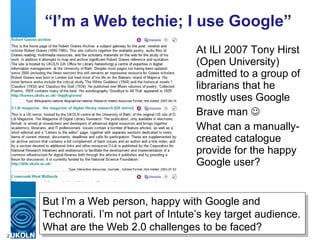
“ I’m a Web techie; I use Google” At ILI 2007 Tony Hirst (Open University) admitted to a group of librarians that he mostly uses Google Brave man   What can a manually-created catalogue provide for the happy Google user? But I’m a Web person, happy with Google and Technorati. I’m not part of Intute’s key target audience. What are the Web 2.0 challenges to be faced?
What If Web 2.0 Changes Everything? What you may expect: What If  Web 2.0  Changes Everything? Web 2.0 is about: RSS, syndication Blogs Wikis Cool interfaces – Ajax Trusting your users Yaddy, yaddy yada Hasn’t Intute services being doing this for a long time, before the Web 2.0 term was coined?
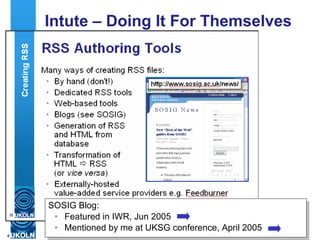
Intute – Doing It For Themselves SOSIG Blog: Featured in IWR, Jun 2005 Mentioned by me at UKSG conference, April 2005
Lessons From The Past What was the key to Intute’s success? ROADS  – open source software (community software development leading to sustainability) ROADS support for  whois++ : a lightweight distributed searching protocol  Response to  Z39.50 : either (a) a mature robust cross-searching standard or (b) “a legacy protocol that hasn’t taken off yet” – Dan Brickley Use of  MySQL : an open source RDBMS Use of  PostGres : a proper open source RDMS Distributed development & hosting , avoiding RDMS and other technical battles Note of the above, the success was based on RDN’s user-focussed approaches, its outreach activities – being Web 2.0!
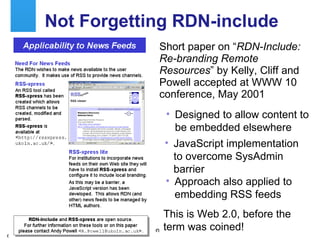
Not Forgetting RDN-include Short paper on “ RDN-Include: Re-branding Remote Resources ” by Kelly, Cliff and Powell accepted at WWW 10 conference, May 2001  Designed to allow content to be embedded elsewhere  JavaScript implementation to overcome SysAdmin barrier This is Web 2.0, before the term was coined! Approach also applied to embedding RSS feeds
What If Web 2.0 Really Changes Everything? An alternative perspective: What If Web 2.0  Really Changes Everything ? Web 2.0 is also about: The network as the platform Google, Yahoo, etc. as application providers New business models (not just funded by the taxpayer or subscription services) The wisdom of crowds ‘ Embracing constraints’ and ‘good enough’ solutions
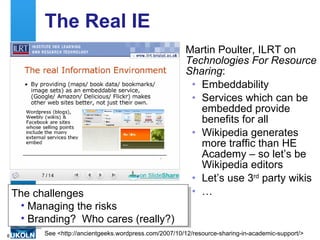
The Real IE Martin Poulter, ILRT on  Technologies For Resource Sharing : Embeddability Services which can be embedded provide benefits for all Wikipedia generates more traffic than HE Academy – so let’s be Wikipedia editors Let’s use 3 rd  party wikis … The challenges Managing the risks Branding?  Who cares (really?) See <http://ancientgeeks.wordpress.com/2007/10/12/resource-sharing-in-academic-support/>
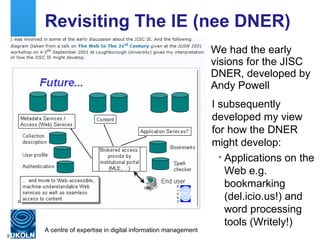
Revisiting The IE (nee DNER) We had the early visions for the JISC DNER, developed by Andy Powell I subsequently developed my view for how the DNER might develop: Applications on the Web e.g. bookmarking (del.icio.us!) and word processing tools (Writely!)
Web 2.0 As A DNER Development The DNER got a lot right: Networked services Lightweight standards Importance of RSS Trust (in the funded institutions) What we missed, which Web 2.0 is providing: Commercial providers of services New business models (we were Old Labour) Lightweight development User-generated content (we thought it would be the professionals) Trust – in the individuals The power of the network – services which get better as more people use them
Why We Should All Use Web 2.0 What we used to think: We’re in HE, and we have IT Services to provide our IT needs (though we moan about them) JISC builds on this to provide additional services What we (should) now realise: JISC & institutional services aren’t appropriate for: Our family photos, our music, … Use by our friends and families For social networking  We need our personal risk management strategies (for our family digital heirlooms) Institutions may feel a need to ensure students familiarise themselves with such services Academics are likely to make use of such services in any case
Can’t We Just Do it In-house?  Surely all we need to do is: Use Ajax to enhance our user interfaces Provide the popular (and increasingly expected) ‘favourite’, ‘comment’, ‘message; … social networking features within our own services and managed environments We can then avoid the spam, porn, misuse, … But: Have we got the mindset, the development processes, …? Can we expect to compete with the global providers - remember home-grown operating systems? What about the 1-9-90 rule?
Opportunities & Challenges The challenges: Getting our audiences back Responding to the wide diversity of applications being developed Responding to the lightweight development tools and approaches being taken The opportunities: Learning from Web 2.0 successes Responding to changes (we’ve been doing this for centuries!) Applying innovative practices appropriately (and not just on top of existing working practices) Globalisation talk
The  1 – 9 – 90 Challenge Participation Inequality: Encouraging More Users to Contribute   In most online communities, 90% of users are lurkers who never contribute, 9% of users contribute a little, and 1% of users account for almost all the action.  (Jakob Neilson, Oct 2006) Potential Benefits: Globalisation Cross-fertilisation Unexpected benefits Maximising impact Globalisation talk Potential Dangers: Globalisation Mono-culture Unexpected dangers Loss of impact There are dangers associated with going down this route, with developing alternative approaches and doing nothing
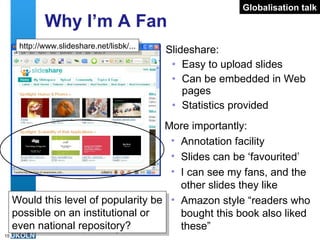
Why I’m A Fan Slideshare: Easy to upload slides Can be embedded in Web pages Statistics provided http://www.slideshare.net/lisbk/... Globalisation talk More importantly: Annotation facility Slides can be ‘favourited’ I can see my fans, and the other slides they like Amazon style “readers who bought this book also liked these”  Would this level of popularity be possible on an institutional or even national repository?
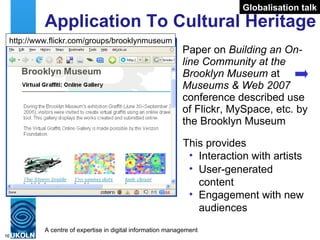
Application To Cultural Heritage Paper on  Building an On-line Community at the Brooklyn Museum  at  Museums & Web 2007  conference described use of Flickr, MySpace, etc. by the Brooklyn Museum This provides Interaction with artists User-generated content Engagement with new audiences http://www.flickr.com/groups/brooklynmuseum Globalisation talk
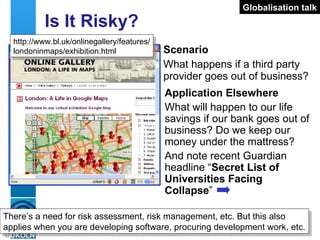
Is It Risky? Scenario What happens if a third party provider goes out of business? http://www.bl.uk/onlinegallery/features/ londoninmaps/exhibition.html Application Elsewhere What will happen to our life savings if our bank goes out of business? Do we keep our money under the mattress? And note recent Guardian headline “ Secret List of Universities Facing Collapse ” There’s a need for risk assessment, risk management, etc. But this also applies when you are developing software, procuring development work, etc.  Globalisation talk
A Mixed Economy We are likely to have a mixed economy: Systems managed in-house Use of external services We need to ensure these can co-exist and utilise their respective strengths http://efoundations.typepad.com/efoundations/2007/06/the_repository_.html “…  there is potential for institutions to push out their repository content to other services that have a more up to minute Web interface? This would not need to be a long term commitment and would enable institutions to cater in a more targeted way to their particular 'consumers '.  Rachel Heery, UKOLN  Globalisation talk
Revisiting The Question “ How Can Institutions Develop Innovative and Affordable Tools to Engage Increasingly Sophisticated Audiences ” Some thoughts: In some areas they shouldn’t attempt to compete with market place successes (e.g. Google) If some cases institutions should be indifferent to the service provider (e.g. Microsoft or Google Docs) There are real needs to: Answer the question “Why develop?” Be realistic if development work is funded Be user-focussed (and this isn’t necessarily easy) Be prepared to write off investment if users don’t want what we’ve developed Globalisation talk
Should We Develop? Which term reflects our IT developments and which reflects Slideshare, Facebook, …? Cool Worthy Is our IT development culture capable of being responsive to changes in: Rapidly changing technical environment Competition from others User expectations  Political changes (government centralisation of Web sites) …
Development Culture How do we go about IT development? Here are the rules: Project management Standards catalogue Accessibility requirements Here are the hurdles: Bidding process Negotiations Advisory group Progress reports … Which has responsibility for stifling creativity and innovation?
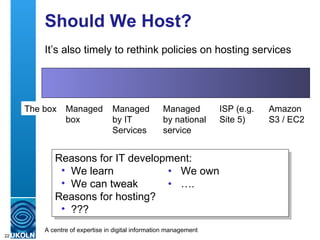
Should We Host? It’s also timely to rethink policies on hosting services The box Managed  box Managed by IT Services Managed by national service ISP (e.g. Site 5) Amazon S3 / EC2 Reasons for IT development: We learn • We own We can tweak •   …. Reasons for hosting? ???
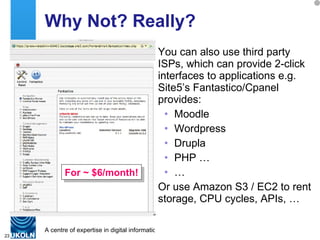
Why Not? Really?  You can also use third party ISPs, which can provide 2-click interfaces to applications e.g. Site5’s Fantastico/Cpanel provides: Moodle Wordpress Drupla PHP … … Or use Amazon S3 / EC2 to rent storage, CPU cycles, APIs, … For ~ $6/month!
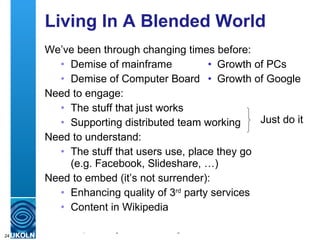
Living In A Blended World We’ve been through changing times before: Demise of mainframe • Growth of PCs Demise of Computer Board •   Growth of Google Need to engage: The stuff that just works Supporting distributed team working Need to understand: The stuff that users use, place they go (e.g. Facebook, Slideshare, …) Need to embed (it’s not surrender): Enhancing quality of 3 rd  party services Content in Wikipedia Just do it
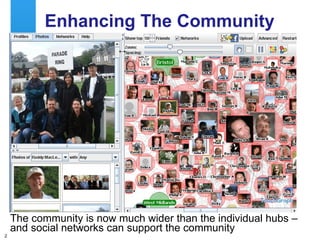
Enhancing The Community The community is now much wider than the individual hubs – and social networks can support the community
Conclusions Times have changed The simplicity of the past won’t return We need to  Reflect on our past (successes and failures) Understand what makes successful services Engage with success Identify our (possibly new) roles If we do this, we can continue to thrive And read OCLC’s recent report …
OCLC Report Read the OCLC report on “ Sharing, Privacy and Trust In Our Networked World ”: Open The Doors “ the library brand must go from institutional to personal. … The social Web is not being build by augmenting traditional Web sites with new tools. … Open the library doors, invite mass participation and relax the rules …  It will be messy … but mass participation & a little chaos often create exciting venues for collaboration, creativity, community building and transformation ” An exciting challenge for Intute  
Questions  Any questions?

[MS PowerPoint 97/2000 format]

  • 1.
    What If Web2.0 Really Does Change Everything? Brian Kelly UKOLN University of Bath Bath, UK Email [email_address] UKOLN is supported by: http://www.ukoln.ac.uk/web-focus/events/meetings/intute-2007-11/ Acceptable Use Policy Recording/broadcasting of this talk, taking photographs, discussing the content using email, instant messaging, blogs, SMS, video chat, etc. is permitted providing distractions to others is minimised. This work is licensed under a Attribution-NonCommercial-ShareAlike 2.0 licence (but note caveat) Resources bookmarked using ‘ intute-2007-11 ’ tag
  • 2.
    “ I’m aWeb techie; I use Google” At ILI 2007 Tony Hirst (Open University) admitted to a group of librarians that he mostly uses Google Brave man  What can a manually-created catalogue provide for the happy Google user? But I’m a Web person, happy with Google and Technorati. I’m not part of Intute’s key target audience. What are the Web 2.0 challenges to be faced?
  • 3.
    What If Web2.0 Changes Everything? What you may expect: What If Web 2.0 Changes Everything? Web 2.0 is about: RSS, syndication Blogs Wikis Cool interfaces – Ajax Trusting your users Yaddy, yaddy yada Hasn’t Intute services being doing this for a long time, before the Web 2.0 term was coined?
  • 4.
    Intute – DoingIt For Themselves SOSIG Blog: Featured in IWR, Jun 2005 Mentioned by me at UKSG conference, April 2005
  • 5.
    Lessons From ThePast What was the key to Intute’s success? ROADS – open source software (community software development leading to sustainability) ROADS support for whois++ : a lightweight distributed searching protocol Response to Z39.50 : either (a) a mature robust cross-searching standard or (b) “a legacy protocol that hasn’t taken off yet” – Dan Brickley Use of MySQL : an open source RDBMS Use of PostGres : a proper open source RDMS Distributed development & hosting , avoiding RDMS and other technical battles Note of the above, the success was based on RDN’s user-focussed approaches, its outreach activities – being Web 2.0!
  • 6.
    Not Forgetting RDN-includeShort paper on “ RDN-Include: Re-branding Remote Resources ” by Kelly, Cliff and Powell accepted at WWW 10 conference, May 2001 Designed to allow content to be embedded elsewhere JavaScript implementation to overcome SysAdmin barrier This is Web 2.0, before the term was coined! Approach also applied to embedding RSS feeds
  • 7.
    What If Web2.0 Really Changes Everything? An alternative perspective: What If Web 2.0 Really Changes Everything ? Web 2.0 is also about: The network as the platform Google, Yahoo, etc. as application providers New business models (not just funded by the taxpayer or subscription services) The wisdom of crowds ‘ Embracing constraints’ and ‘good enough’ solutions
  • 8.
    The Real IEMartin Poulter, ILRT on Technologies For Resource Sharing : Embeddability Services which can be embedded provide benefits for all Wikipedia generates more traffic than HE Academy – so let’s be Wikipedia editors Let’s use 3 rd party wikis … The challenges Managing the risks Branding? Who cares (really?) See <http://ancientgeeks.wordpress.com/2007/10/12/resource-sharing-in-academic-support/>
  • 9.
    Revisiting The IE(nee DNER) We had the early visions for the JISC DNER, developed by Andy Powell I subsequently developed my view for how the DNER might develop: Applications on the Web e.g. bookmarking (del.icio.us!) and word processing tools (Writely!)
  • 10.
    Web 2.0 AsA DNER Development The DNER got a lot right: Networked services Lightweight standards Importance of RSS Trust (in the funded institutions) What we missed, which Web 2.0 is providing: Commercial providers of services New business models (we were Old Labour) Lightweight development User-generated content (we thought it would be the professionals) Trust – in the individuals The power of the network – services which get better as more people use them
  • 11.
    Why We ShouldAll Use Web 2.0 What we used to think: We’re in HE, and we have IT Services to provide our IT needs (though we moan about them) JISC builds on this to provide additional services What we (should) now realise: JISC & institutional services aren’t appropriate for: Our family photos, our music, … Use by our friends and families For social networking We need our personal risk management strategies (for our family digital heirlooms) Institutions may feel a need to ensure students familiarise themselves with such services Academics are likely to make use of such services in any case
  • 12.
    Can’t We JustDo it In-house? Surely all we need to do is: Use Ajax to enhance our user interfaces Provide the popular (and increasingly expected) ‘favourite’, ‘comment’, ‘message; … social networking features within our own services and managed environments We can then avoid the spam, porn, misuse, … But: Have we got the mindset, the development processes, …? Can we expect to compete with the global providers - remember home-grown operating systems? What about the 1-9-90 rule?
  • 13.
    Opportunities & ChallengesThe challenges: Getting our audiences back Responding to the wide diversity of applications being developed Responding to the lightweight development tools and approaches being taken The opportunities: Learning from Web 2.0 successes Responding to changes (we’ve been doing this for centuries!) Applying innovative practices appropriately (and not just on top of existing working practices) Globalisation talk
  • 14.
    The 1– 9 – 90 Challenge Participation Inequality: Encouraging More Users to Contribute In most online communities, 90% of users are lurkers who never contribute, 9% of users contribute a little, and 1% of users account for almost all the action. (Jakob Neilson, Oct 2006) Potential Benefits: Globalisation Cross-fertilisation Unexpected benefits Maximising impact Globalisation talk Potential Dangers: Globalisation Mono-culture Unexpected dangers Loss of impact There are dangers associated with going down this route, with developing alternative approaches and doing nothing
  • 15.
    Why I’m AFan Slideshare: Easy to upload slides Can be embedded in Web pages Statistics provided http://www.slideshare.net/lisbk/... Globalisation talk More importantly: Annotation facility Slides can be ‘favourited’ I can see my fans, and the other slides they like Amazon style “readers who bought this book also liked these” Would this level of popularity be possible on an institutional or even national repository?
  • 16.
    Application To CulturalHeritage Paper on Building an On-line Community at the Brooklyn Museum at Museums & Web 2007 conference described use of Flickr, MySpace, etc. by the Brooklyn Museum This provides Interaction with artists User-generated content Engagement with new audiences http://www.flickr.com/groups/brooklynmuseum Globalisation talk
  • 17.
    Is It Risky?Scenario What happens if a third party provider goes out of business? http://www.bl.uk/onlinegallery/features/ londoninmaps/exhibition.html Application Elsewhere What will happen to our life savings if our bank goes out of business? Do we keep our money under the mattress? And note recent Guardian headline “ Secret List of Universities Facing Collapse ” There’s a need for risk assessment, risk management, etc. But this also applies when you are developing software, procuring development work, etc. Globalisation talk
  • 18.
    A Mixed EconomyWe are likely to have a mixed economy: Systems managed in-house Use of external services We need to ensure these can co-exist and utilise their respective strengths http://efoundations.typepad.com/efoundations/2007/06/the_repository_.html “… there is potential for institutions to push out their repository content to other services that have a more up to minute Web interface? This would not need to be a long term commitment and would enable institutions to cater in a more targeted way to their particular 'consumers '. Rachel Heery, UKOLN Globalisation talk
  • 19.
    Revisiting The Question“ How Can Institutions Develop Innovative and Affordable Tools to Engage Increasingly Sophisticated Audiences ” Some thoughts: In some areas they shouldn’t attempt to compete with market place successes (e.g. Google) If some cases institutions should be indifferent to the service provider (e.g. Microsoft or Google Docs) There are real needs to: Answer the question “Why develop?” Be realistic if development work is funded Be user-focussed (and this isn’t necessarily easy) Be prepared to write off investment if users don’t want what we’ve developed Globalisation talk
  • 20.
    Should We Develop?Which term reflects our IT developments and which reflects Slideshare, Facebook, …? Cool Worthy Is our IT development culture capable of being responsive to changes in: Rapidly changing technical environment Competition from others User expectations Political changes (government centralisation of Web sites) …
  • 21.
    Development Culture Howdo we go about IT development? Here are the rules: Project management Standards catalogue Accessibility requirements Here are the hurdles: Bidding process Negotiations Advisory group Progress reports … Which has responsibility for stifling creativity and innovation?
  • 22.
    Should We Host?It’s also timely to rethink policies on hosting services The box Managed box Managed by IT Services Managed by national service ISP (e.g. Site 5) Amazon S3 / EC2 Reasons for IT development: We learn • We own We can tweak • …. Reasons for hosting? ???
  • 23.
    Why Not? Really? You can also use third party ISPs, which can provide 2-click interfaces to applications e.g. Site5’s Fantastico/Cpanel provides: Moodle Wordpress Drupla PHP … … Or use Amazon S3 / EC2 to rent storage, CPU cycles, APIs, … For ~ $6/month!
  • 24.
    Living In ABlended World We’ve been through changing times before: Demise of mainframe • Growth of PCs Demise of Computer Board • Growth of Google Need to engage: The stuff that just works Supporting distributed team working Need to understand: The stuff that users use, place they go (e.g. Facebook, Slideshare, …) Need to embed (it’s not surrender): Enhancing quality of 3 rd party services Content in Wikipedia Just do it
  • 25.
    Enhancing The CommunityThe community is now much wider than the individual hubs – and social networks can support the community
  • 26.
    Conclusions Times havechanged The simplicity of the past won’t return We need to Reflect on our past (successes and failures) Understand what makes successful services Engage with success Identify our (possibly new) roles If we do this, we can continue to thrive And read OCLC’s recent report …
  • 27.
    OCLC Report Readthe OCLC report on “ Sharing, Privacy and Trust In Our Networked World ”: Open The Doors “ the library brand must go from institutional to personal. … The social Web is not being build by augmenting traditional Web sites with new tools. … Open the library doors, invite mass participation and relax the rules … It will be messy … but mass participation & a little chaos often create exciting venues for collaboration, creativity, community building and transformation ” An exciting challenge for Intute 
  • 28.
    Questions Anyquestions?