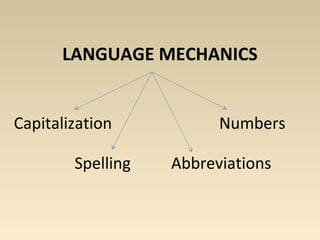
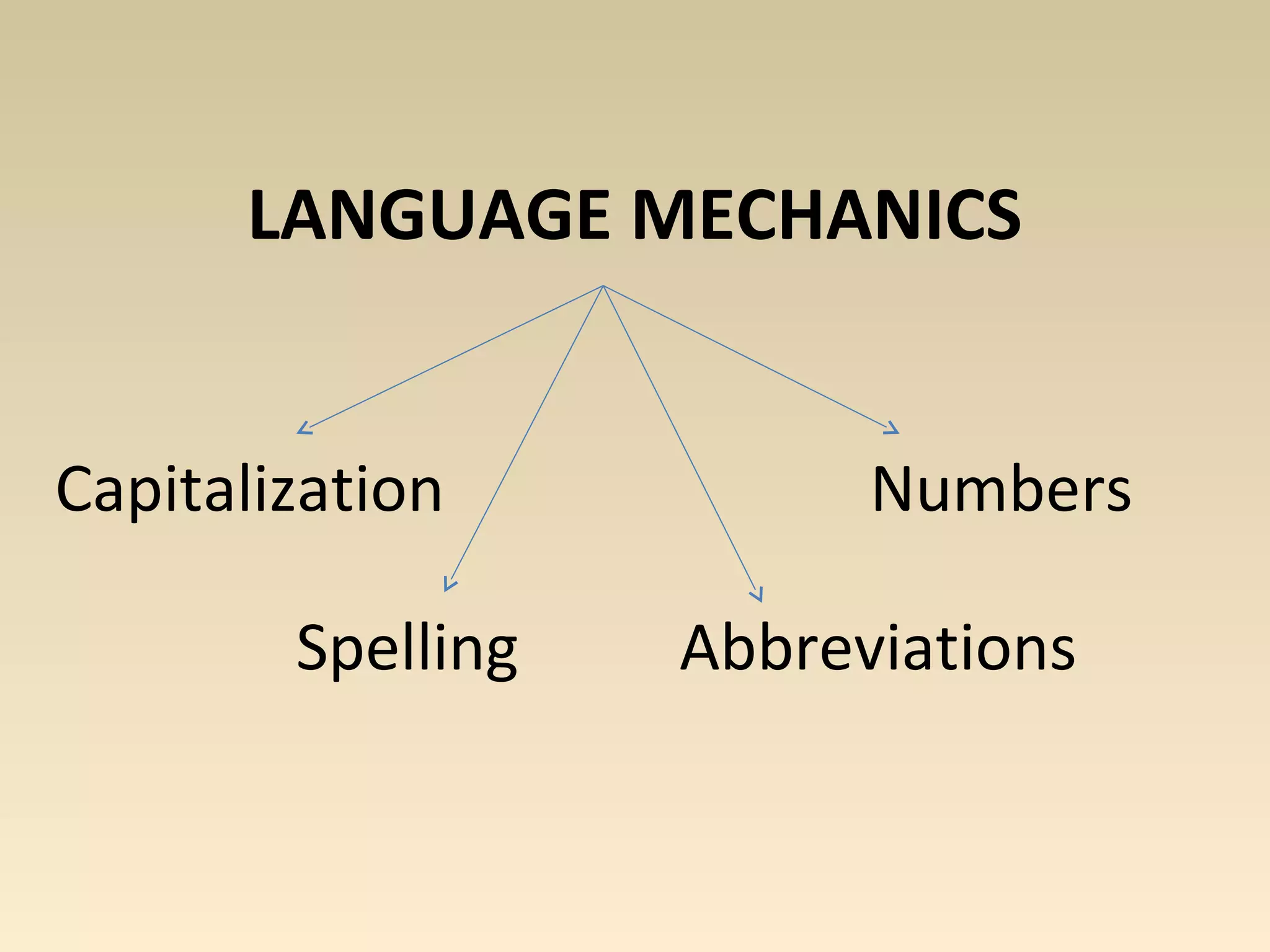
LANGUAGE MECHANICS 
Capitalization 
Numbers 
Spelling Abbreviations
CAPITALIZATION
CAPITALIZATION 
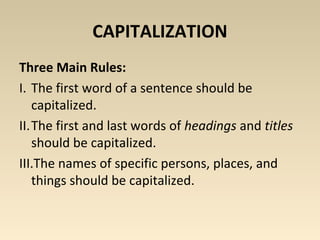
Three Main Rules: 
I. The first word of a sentence should be 
capitalized. 
II.The first and last words of headings and titles 
should be capitalized. 
III.The names of specific persons, places, and 
things should be capitalized.
I. The first word of a sentence 
should be capitalized. 
Examples: 
• That man won the lottery. 
• My parents always give me career advice.
I. The first word of a sentence 
should be capitalized. 
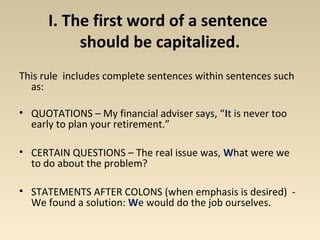
This rule includes complete sentences within sentences such 
as: 
• QUOTATIONS – My financial adviser says, “It is never too 
early to plan your retirement.” 
• CERTAIN QUESTIONS – The real issue was, What were we 
to do about the problem? 
• STATEMENTS AFTER COLONS (when emphasis is desired) - 
We found a solution: We would do the job ourselves.
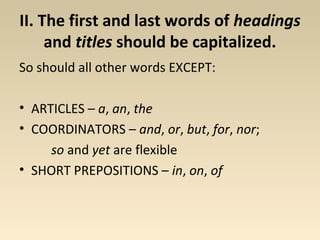
II. The first and last words of headings 
and titles should be capitalized. 
So should all other words EXCEPT: 
• ARTICLES – a, an, the 
• COORDINATORS – and, or, but, for, nor; 
so and yet are flexible 
• SHORT PREPOSITIONS – in, on, of
II. The first and last words of headings 
and titles should be capitalized. 
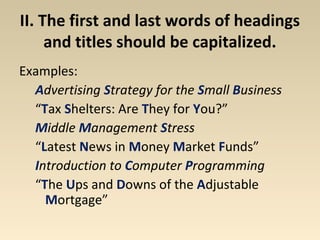
Examples: 
Advertising Strategy for the Small Business 
“Tax Shelters: Are They for You?” 
Middle Management Stress 
“Latest News in Money Market Funds” 
Introduction to Computer Programming 
“The Ups and Downs of the Adjustable 
Mortgage”
III. The names of specific persons, 
places, and things should be capitalized. 
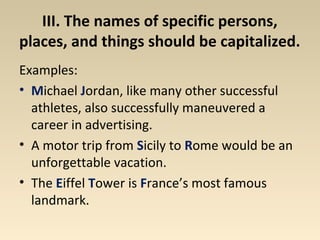
Examples: 
• Michael Jordan, like many other successful 
athletes, also successfully maneuvered a 
career in advertising. 
• A motor trip from Sicily to Rome would be an 
unforgettable vacation. 
• The Eiffel Tower is France’s most famous 
landmark.
III. The names of specific persons, 
places, and things should be capitalized. 
Others covered by this rule: 
• Names of organizations and institutions 
• Historical periods, events, and documents 
• National, political, religious, racial, social, and 
athletic groups 
• Days of the week, months of the year, and names 
of holidays 
• Compass points used to refer to a region or place
III. The names of specific persons, 
places, and things should be capitalized. 
Others covered by this rule: 
• Names of organizations and institutions 
 The convention of the American 
Psychological Association will be held 
during the week of May 24. 
 Warren earned his bachelor’s degree at 
Yale University.
III. The names of specific persons, 
places, and things should be capitalized. 
Others covered by this rule: 
• Historical periods, events, and documents 
 Literature of the Renaissance is marked by 
an awareness of classical culture. 
 The Revolutionary War began in 1775 and 
ended in 1783. 
 The Declaration of Independence was 
adopted on July 4, 1776.
III. The names of specific persons, 
places, and things should be capitalized. 
Others covered by this rule: 
• National, political, religious, racial, social, and 
athletic groups 
 The Republican candidate for mayor spent 
the morning shaking hands at the train 
station. 
 Babe Ruth was one of the most famous 
outfielders to ever play with the Yankees.
III. The names of specific persons, 
places, and things should be capitalized. 
Others covered by this rule: 
• Days of the week, months of the year, and names 
of holidays 
 I will have your order ready by Tuesday. 
 Winston entered law school in September. 
 I always overeat on Thanksgiving. 
• Seasons of the year are NOT capitalized. 
 Every summer, the Feins rent a cottage on 
Cape Cod.
III. The names of specific persons, 
places, and things should be capitalized. 
Others covered by this rule: 
• Compass points used to refer to a region or place 
 Voters in the Northeast are often stereotyped 
as liberals. 
• Compass points used as directions are NOT 
capitalized. 
 Los Angeles is west of Las Vegas.
A Few More Special Considerations 
Regarding Capitalization 
1. Regular nouns are capitalized when they are 
part of a name. 
*During lunch hour, the street was teeming 
with people. 
BUT 
I work at the corner of Twelfth Street and 
Arthur Avenue.
A Few More Special Considerations 
Regarding Capitalization 
*Cheryl graduated from high school in 1976. 
BUT 
Her alma mater is Madison High School. 
*Our office building is thirty stories high. 
BUT 
The Empire State Building is a major New York 
tourist attraction.
A Few More Special Considerations 
Regarding Capitalization 
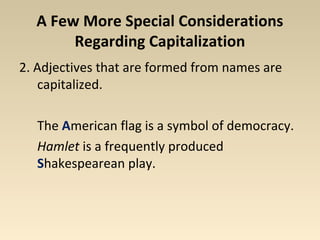
2. Adjectives that are formed from names are 
capitalized. 
The American flag is a symbol of democracy. 
Hamlet is a frequently produced 
Shakespearean play.
A Few More Special Considerations 
Regarding Capitalization 
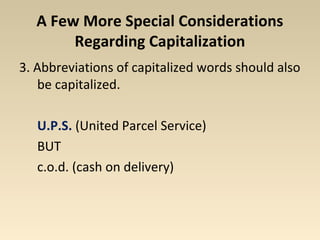
3. Abbreviations of capitalized words should also 
be capitalized. 
U.P.S. (United Parcel Service) 
BUT 
c.o.d. (cash on delivery)
A Few More Special Considerations 
Regarding Capitalization 
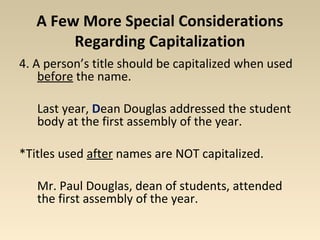
4. A person’s title should be capitalized when used 
before the name. 
Last year, Dean Douglas addressed the student 
body at the first assembly of the year. 
*Titles used after names are NOT capitalized. 
Mr. Paul Douglas, dean of students, attended 
the first assembly of the year.
A Few More Special Considerations 
Regarding Capitalization 
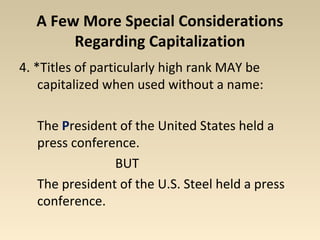
4. *Titles of particularly high rank MAY be 
capitalized when used without a name: 
The President of the United States held a 
press conference. 
BUT 
The president of the U.S. Steel held a press 
conference.
A Few More Special Considerations 
Regarding Capitalization 
4. *Terms of kinship MAY be capitalized when 
used as the person’s name. 
Before I went out, I told Dad that I’d be home 
by ten.
A Few More Special Considerations 
Regarding Capitalization 
5. The pronoun I is always capitalized. 
I am quite proud of myself. 
She washed the dishes, and I did the laundry.
A Few More Special Considerations 
Regarding Capitalization 
6. The first word of a complimentary closing is 
capitalized. 
Sincerely yours 
Yours truly
ABBREVIATIONS
ABBREVIATIONS 
• As a general rule, you should avoid 
abbreviations in your writing. 
• EXCEPTIONS: 
1. When the writing is technical 
2. When you are preparing lists or tables
Acceptable Abbreviations 
in Formal Writing 
• Titles 
• Company names 
• Terms used with figures and dates 
• Latin expressions
Acceptable Abbreviations 
in Formal Writing 
• Titles 
1.Mr., Mrs., Ms., Dr., and St. (meaning Saint) are 
always abbreviated when used before a name. 
Mr. James Cooper 
Mrs. K. M. Bowles 
Ms. L. Lewis 
Dr. Hyde 
St. Peter
Acceptable Abbreviations 
in Formal Writing 
• Titles 
2. Prof., Gov., Sen., and Rep. may be used before a FULL NAME 
(i.e., a first name/initial PLUS a last name). 
Prof. Fred Farkas Sen. Helen Coyne 
Gov. T.P. Barnes Rep. L.D. Woo 
When only a last name is used, however, the title must be spelled out. 
Professor Farkas Senator Coyne 
Governor Barnes Representative Woo
Acceptable Abbreviations 
in Formal Writing 
• Titles 
3. The designations Honorable and Reverend, because they indicate dignity 
and respect, should NOT be abbreviated EXCEPT in addresses and lists. 
Moreover, they should be used with a first name, initial, or title in 
addition to the last name. 
Reverend Tom Payne Honorable Bruce Ng 
Using the before such designations indicates additional formality. 
The Reverend Tom Payne 
We invited the Honorable Bruce Ng to the ceremony.
Acceptable Abbreviations 
in Formal Writing 
• Titles 
4. Titles appearing after names must be spelled out, EXCEPT Esq., Jr., 
Sr., and academic, professional, and religious designations. 
T.P. Barnes, governor 
BUT 
N. W. Smith, Esq. 
Frieda Parkas, Ph.D. 
Rod Johnson, C.P.A. 
Tom Payne, D.D.
Acceptable Abbreviations 
in Formal Writing 
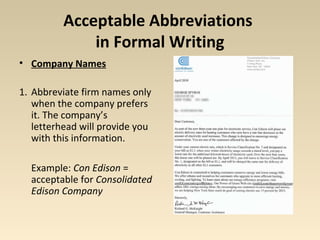
• Company Names 
1. Abbreviate firm names only 
when the company prefers 
it. The company’s 
letterhead will provide you 
with this information. 
Example: Con Edison = 
acceptable for Consolidated 
Edison Company
Acceptable Abbreviations 
in Formal Writing 
• Company Names 
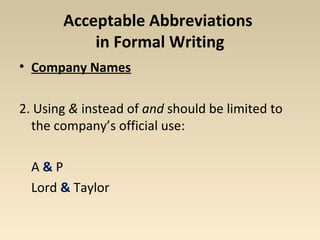
2. Using & instead of and should be limited to 
the company’s official use: 
A & P 
Lord & Taylor
Acceptable Abbreviations 
in Formal Writing 
• Company Names 
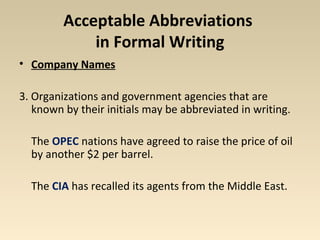
3. Organizations and government agencies that are 
known by their initials may be abbreviated in writing. 
The OPEC nations have agreed to raise the price of oil 
by another $2 per barrel. 
The CIA has recalled its agents from the Middle East.
Acceptable Abbreviations 
in Formal Writing 
• Terms Used with Figures and Dates 
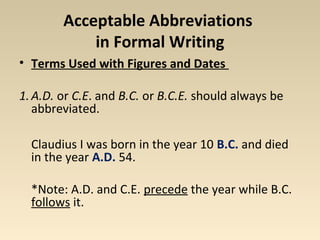
1.A.D. or C.E. and B.C. or B.C.E. should always be 
abbreviated. 
Claudius I was born in the year 10 B.C. and died 
in the year A.D. 54. 
*Note: A.D. and C.E. precede the year while B.C. 
follows it.
Acceptable Abbreviations 
in Formal Writing 
• Terms Used with Figures and Dates 
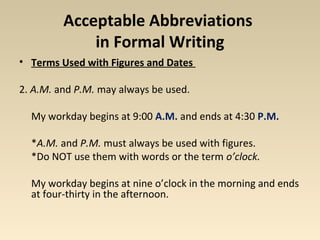
2. A.M. and P.M. may always be used. 
My workday begins at 9:00 A.M. and ends at 4:30 P.M. 
*A.M. and P.M. must always be used with figures. 
*Do NOT use them with words or the term o’clock. 
My workday begins at nine o’clock in the morning and ends 
at four-thirty in the afternoon.
Acceptable Abbreviations 
in Formal Writing 
• Terms Used with Figures and Dates 
3. Number or numbers may be abbreviated as no. (or No.) and nos. (or 
Nos.) respectively when used before figures. 
The model I am most interested in is no. 131. 
The following checks have not yet cleared: 
nos. 451, 454, and 458. 
*However, spell out number or numbers at the beginning of a 
sentence. 
Number 62159 is the missing invoice.
Acceptable Abbreviations 
in Formal Writing 
• Terms Used with Figures and Dates 
4. The dollar sign ($) is permissible in writing. It is 
proper to write 
Sue owes Roger $19.55. INSTEAD OF 
Sue owes Roger nineteen dollars and fifty-five 
cents.
Acceptable Abbreviations 
in Formal Writing 
*Certain words should NOT be abbreviated in 
writing, but can be abbreviated in addresses, 
lists, tables, and invoices. 
1. Names of cities, states, and countries 
Although Arnold was born in Philadelphia, 
Pennsylvania, he has lived in West Germany 
most of his life.
Acceptable Abbreviations 
in Formal Writing 
*Certain words should NOT be abbreviated in 
writing, but can be abbreviated in addresses, 
lists, tables, and invoices. 
2. Months of the year, days of the week 
The shipment of electric yoyos arrived 
Wednesday, October 1.
Acceptable Abbreviations 
in Formal Writing 
*Certain words should NOT be abbreviated in writing, but 
can be abbreviated in addresses, lists, tables, and 
invoices. 
3. Parts of place names, such as Street, Avenue, Road, 
Park, Port, Fort, Mount, River, as well as compass 
directions 
The Adirondack Mountains are northeast of the 
Mississippi River. 
The hardware store is on the west side of Bruckner 
Boulevard.
Acceptable Abbreviations 
in Formal Writing 
*Certain words should NOT be abbreviated in 
writing, but can be abbreviated in addresses, 
lists, tables, and invoices. 
4. Units of measure, courses of study, and the 
words page, chapter, and volume 
On page 14 of the physics textbook, the speed 
of light is listed as 186,000 miles per second.
NUMBERS
NUMBERS 
*General Rules: 
1. Spell out numbers that can be expressed in 
one or two words. 
2. Use figures for other numbers.
NUMBERS 
*Certain numbers should always be spelled out: 
1. Numbers that begin with a sentence 
One hundred fifty yards of wire are needed 
to complete the project. 
We will need 150 yards of wire to complete 
the project.
NUMBERS 
*Certain numbers should always be spelled out: 
2. Large round numbers 
Six billion dollars (or) $6 billion 
 Using figures would imply emphasis: 
$6,000,000,000
NUMBERS 
*Certain numbers should always be spelled out: 
3. Time expressed as a number alone or with the 
word o’ clock 
four in the afternoon 
four o’clock
NUMBERS 
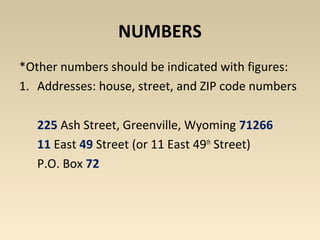
*Other numbers should be indicated with figures: 
1. Addresses: house, street, and ZIP code numbers 
225 Ash Street, Greenville, Wyoming 71266 
11 East 49 Street (or 11 East 49th Street) 
P.O. Box 72
NUMBERS 
*Other numbers should be indicated with 
figures: 
2. Decimals 
6.293 
0.00329
NUMBERS 
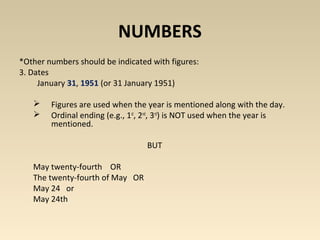
*Other numbers should be indicated with figures: 
3. Dates 
January 31, 1951 (or 31 January 1951) 
 Figures are used when the year is mentioned along with the day. 
 Ordinal ending (e.g., 1st, 2nd, 3rd) is NOT used when the year is 
mentioned. 
BUT 
May twenty-fourth OR 
The twenty-fourth of May OR 
May 24 or 
May 24th
NUMBERS 
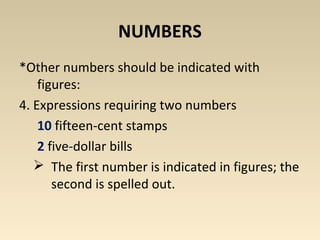
*Other numbers should be indicated with 
figures: 
4. Expressions requiring two numbers 
10 fifteen-cent stamps 
2 five-dollar bills 
 The first number is indicated in figures; the 
second is spelled out.
NUMBERS 
*Words and Symbols Used with Numbers 
1. The word percent should be spelled out, 
EXCEPT on invoices and lists (in which case 
you may use %). 
nine percent 
11 ½ percent
NUMBERS 
*Words and Symbols Used with Numbers 
2. The symbol should ₵ be used only in quoting 
prices. Otherwise, use words or units of a dollar. 
6 ₵ 
six cents 
$0.06
NUMBERS 
*Words and Symbols Used with Numbers 
3. The symbol # should be used only in tables, 
invoices, etc. 
 Instead, use number or the abbreviation 
no. or No. 
 The symbol should NEVER be used with 
house numbers or RFD numbers.

Language Mechanics

  • 1.
    LANGUAGE MECHANICS Capitalization Numbers Spelling Abbreviations
  • 2.
  • 3.
    CAPITALIZATION Three MainRules: I. The first word of a sentence should be capitalized. II.The first and last words of headings and titles should be capitalized. III.The names of specific persons, places, and things should be capitalized.
  • 4.
    I. The firstword of a sentence should be capitalized. Examples: • That man won the lottery. • My parents always give me career advice.
  • 5.
    I. The firstword of a sentence should be capitalized. This rule includes complete sentences within sentences such as: • QUOTATIONS – My financial adviser says, “It is never too early to plan your retirement.” • CERTAIN QUESTIONS – The real issue was, What were we to do about the problem? • STATEMENTS AFTER COLONS (when emphasis is desired) - We found a solution: We would do the job ourselves.
  • 6.
    II. The firstand last words of headings and titles should be capitalized. So should all other words EXCEPT: • ARTICLES – a, an, the • COORDINATORS – and, or, but, for, nor; so and yet are flexible • SHORT PREPOSITIONS – in, on, of
  • 7.
    II. The firstand last words of headings and titles should be capitalized. Examples: Advertising Strategy for the Small Business “Tax Shelters: Are They for You?” Middle Management Stress “Latest News in Money Market Funds” Introduction to Computer Programming “The Ups and Downs of the Adjustable Mortgage”
  • 8.
    III. The namesof specific persons, places, and things should be capitalized. Examples: • Michael Jordan, like many other successful athletes, also successfully maneuvered a career in advertising. • A motor trip from Sicily to Rome would be an unforgettable vacation. • The Eiffel Tower is France’s most famous landmark.
  • 9.
    III. The namesof specific persons, places, and things should be capitalized. Others covered by this rule: • Names of organizations and institutions • Historical periods, events, and documents • National, political, religious, racial, social, and athletic groups • Days of the week, months of the year, and names of holidays • Compass points used to refer to a region or place
  • 10.
    III. The namesof specific persons, places, and things should be capitalized. Others covered by this rule: • Names of organizations and institutions  The convention of the American Psychological Association will be held during the week of May 24.  Warren earned his bachelor’s degree at Yale University.
  • 11.
    III. The namesof specific persons, places, and things should be capitalized. Others covered by this rule: • Historical periods, events, and documents  Literature of the Renaissance is marked by an awareness of classical culture.  The Revolutionary War began in 1775 and ended in 1783.  The Declaration of Independence was adopted on July 4, 1776.
  • 12.
    III. The namesof specific persons, places, and things should be capitalized. Others covered by this rule: • National, political, religious, racial, social, and athletic groups  The Republican candidate for mayor spent the morning shaking hands at the train station.  Babe Ruth was one of the most famous outfielders to ever play with the Yankees.
  • 13.
    III. The namesof specific persons, places, and things should be capitalized. Others covered by this rule: • Days of the week, months of the year, and names of holidays  I will have your order ready by Tuesday.  Winston entered law school in September.  I always overeat on Thanksgiving. • Seasons of the year are NOT capitalized.  Every summer, the Feins rent a cottage on Cape Cod.
  • 14.
    III. The namesof specific persons, places, and things should be capitalized. Others covered by this rule: • Compass points used to refer to a region or place  Voters in the Northeast are often stereotyped as liberals. • Compass points used as directions are NOT capitalized.  Los Angeles is west of Las Vegas.
  • 15.
    A Few MoreSpecial Considerations Regarding Capitalization 1. Regular nouns are capitalized when they are part of a name. *During lunch hour, the street was teeming with people. BUT I work at the corner of Twelfth Street and Arthur Avenue.
  • 16.
    A Few MoreSpecial Considerations Regarding Capitalization *Cheryl graduated from high school in 1976. BUT Her alma mater is Madison High School. *Our office building is thirty stories high. BUT The Empire State Building is a major New York tourist attraction.
  • 17.
    A Few MoreSpecial Considerations Regarding Capitalization 2. Adjectives that are formed from names are capitalized. The American flag is a symbol of democracy. Hamlet is a frequently produced Shakespearean play.
  • 18.
    A Few MoreSpecial Considerations Regarding Capitalization 3. Abbreviations of capitalized words should also be capitalized. U.P.S. (United Parcel Service) BUT c.o.d. (cash on delivery)
  • 19.
    A Few MoreSpecial Considerations Regarding Capitalization 4. A person’s title should be capitalized when used before the name. Last year, Dean Douglas addressed the student body at the first assembly of the year. *Titles used after names are NOT capitalized. Mr. Paul Douglas, dean of students, attended the first assembly of the year.
  • 20.
    A Few MoreSpecial Considerations Regarding Capitalization 4. *Titles of particularly high rank MAY be capitalized when used without a name: The President of the United States held a press conference. BUT The president of the U.S. Steel held a press conference.
  • 21.
    A Few MoreSpecial Considerations Regarding Capitalization 4. *Terms of kinship MAY be capitalized when used as the person’s name. Before I went out, I told Dad that I’d be home by ten.
  • 22.
    A Few MoreSpecial Considerations Regarding Capitalization 5. The pronoun I is always capitalized. I am quite proud of myself. She washed the dishes, and I did the laundry.
  • 23.
    A Few MoreSpecial Considerations Regarding Capitalization 6. The first word of a complimentary closing is capitalized. Sincerely yours Yours truly
  • 24.
  • 25.
    ABBREVIATIONS • Asa general rule, you should avoid abbreviations in your writing. • EXCEPTIONS: 1. When the writing is technical 2. When you are preparing lists or tables
  • 26.
    Acceptable Abbreviations inFormal Writing • Titles • Company names • Terms used with figures and dates • Latin expressions
  • 27.
    Acceptable Abbreviations inFormal Writing • Titles 1.Mr., Mrs., Ms., Dr., and St. (meaning Saint) are always abbreviated when used before a name. Mr. James Cooper Mrs. K. M. Bowles Ms. L. Lewis Dr. Hyde St. Peter
  • 28.
    Acceptable Abbreviations inFormal Writing • Titles 2. Prof., Gov., Sen., and Rep. may be used before a FULL NAME (i.e., a first name/initial PLUS a last name). Prof. Fred Farkas Sen. Helen Coyne Gov. T.P. Barnes Rep. L.D. Woo When only a last name is used, however, the title must be spelled out. Professor Farkas Senator Coyne Governor Barnes Representative Woo
  • 29.
    Acceptable Abbreviations inFormal Writing • Titles 3. The designations Honorable and Reverend, because they indicate dignity and respect, should NOT be abbreviated EXCEPT in addresses and lists. Moreover, they should be used with a first name, initial, or title in addition to the last name. Reverend Tom Payne Honorable Bruce Ng Using the before such designations indicates additional formality. The Reverend Tom Payne We invited the Honorable Bruce Ng to the ceremony.
  • 30.
    Acceptable Abbreviations inFormal Writing • Titles 4. Titles appearing after names must be spelled out, EXCEPT Esq., Jr., Sr., and academic, professional, and religious designations. T.P. Barnes, governor BUT N. W. Smith, Esq. Frieda Parkas, Ph.D. Rod Johnson, C.P.A. Tom Payne, D.D.
  • 31.
    Acceptable Abbreviations inFormal Writing • Company Names 1. Abbreviate firm names only when the company prefers it. The company’s letterhead will provide you with this information. Example: Con Edison = acceptable for Consolidated Edison Company
  • 32.
    Acceptable Abbreviations inFormal Writing • Company Names 2. Using & instead of and should be limited to the company’s official use: A & P Lord & Taylor
  • 33.
    Acceptable Abbreviations inFormal Writing • Company Names 3. Organizations and government agencies that are known by their initials may be abbreviated in writing. The OPEC nations have agreed to raise the price of oil by another $2 per barrel. The CIA has recalled its agents from the Middle East.
  • 34.
    Acceptable Abbreviations inFormal Writing • Terms Used with Figures and Dates 1.A.D. or C.E. and B.C. or B.C.E. should always be abbreviated. Claudius I was born in the year 10 B.C. and died in the year A.D. 54. *Note: A.D. and C.E. precede the year while B.C. follows it.
  • 35.
    Acceptable Abbreviations inFormal Writing • Terms Used with Figures and Dates 2. A.M. and P.M. may always be used. My workday begins at 9:00 A.M. and ends at 4:30 P.M. *A.M. and P.M. must always be used with figures. *Do NOT use them with words or the term o’clock. My workday begins at nine o’clock in the morning and ends at four-thirty in the afternoon.
  • 36.
    Acceptable Abbreviations inFormal Writing • Terms Used with Figures and Dates 3. Number or numbers may be abbreviated as no. (or No.) and nos. (or Nos.) respectively when used before figures. The model I am most interested in is no. 131. The following checks have not yet cleared: nos. 451, 454, and 458. *However, spell out number or numbers at the beginning of a sentence. Number 62159 is the missing invoice.
  • 37.
    Acceptable Abbreviations inFormal Writing • Terms Used with Figures and Dates 4. The dollar sign ($) is permissible in writing. It is proper to write Sue owes Roger $19.55. INSTEAD OF Sue owes Roger nineteen dollars and fifty-five cents.
  • 38.
    Acceptable Abbreviations inFormal Writing *Certain words should NOT be abbreviated in writing, but can be abbreviated in addresses, lists, tables, and invoices. 1. Names of cities, states, and countries Although Arnold was born in Philadelphia, Pennsylvania, he has lived in West Germany most of his life.
  • 39.
    Acceptable Abbreviations inFormal Writing *Certain words should NOT be abbreviated in writing, but can be abbreviated in addresses, lists, tables, and invoices. 2. Months of the year, days of the week The shipment of electric yoyos arrived Wednesday, October 1.
  • 40.
    Acceptable Abbreviations inFormal Writing *Certain words should NOT be abbreviated in writing, but can be abbreviated in addresses, lists, tables, and invoices. 3. Parts of place names, such as Street, Avenue, Road, Park, Port, Fort, Mount, River, as well as compass directions The Adirondack Mountains are northeast of the Mississippi River. The hardware store is on the west side of Bruckner Boulevard.
  • 41.
    Acceptable Abbreviations inFormal Writing *Certain words should NOT be abbreviated in writing, but can be abbreviated in addresses, lists, tables, and invoices. 4. Units of measure, courses of study, and the words page, chapter, and volume On page 14 of the physics textbook, the speed of light is listed as 186,000 miles per second.
  • 42.
  • 43.
    NUMBERS *General Rules: 1. Spell out numbers that can be expressed in one or two words. 2. Use figures for other numbers.
  • 44.
    NUMBERS *Certain numbersshould always be spelled out: 1. Numbers that begin with a sentence One hundred fifty yards of wire are needed to complete the project. We will need 150 yards of wire to complete the project.
  • 45.
    NUMBERS *Certain numbersshould always be spelled out: 2. Large round numbers Six billion dollars (or) $6 billion  Using figures would imply emphasis: $6,000,000,000
  • 46.
    NUMBERS *Certain numbersshould always be spelled out: 3. Time expressed as a number alone or with the word o’ clock four in the afternoon four o’clock
  • 47.
    NUMBERS *Other numbersshould be indicated with figures: 1. Addresses: house, street, and ZIP code numbers 225 Ash Street, Greenville, Wyoming 71266 11 East 49 Street (or 11 East 49th Street) P.O. Box 72
  • 48.
    NUMBERS *Other numbersshould be indicated with figures: 2. Decimals 6.293 0.00329
  • 49.
    NUMBERS *Other numbersshould be indicated with figures: 3. Dates January 31, 1951 (or 31 January 1951)  Figures are used when the year is mentioned along with the day.  Ordinal ending (e.g., 1st, 2nd, 3rd) is NOT used when the year is mentioned. BUT May twenty-fourth OR The twenty-fourth of May OR May 24 or May 24th
  • 50.
    NUMBERS *Other numbersshould be indicated with figures: 4. Expressions requiring two numbers 10 fifteen-cent stamps 2 five-dollar bills  The first number is indicated in figures; the second is spelled out.
  • 51.
    NUMBERS *Words andSymbols Used with Numbers 1. The word percent should be spelled out, EXCEPT on invoices and lists (in which case you may use %). nine percent 11 ½ percent
  • 52.
    NUMBERS *Words andSymbols Used with Numbers 2. The symbol should ₵ be used only in quoting prices. Otherwise, use words or units of a dollar. 6 ₵ six cents $0.06
  • 53.
    NUMBERS *Words andSymbols Used with Numbers 3. The symbol # should be used only in tables, invoices, etc.  Instead, use number or the abbreviation no. or No.  The symbol should NEVER be used with house numbers or RFD numbers.