Academic Writing
01355431 Introduction to Research
Writing in English
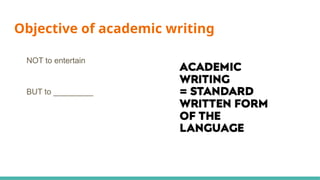
Objective of academic writing
NOT to entertain
BUT to _________
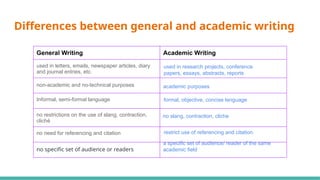
Differences between general and academic writing
General Writing Academic Writing
used in letters, emails, newspaper articles, diary
and journal entries, etc.
non-academic and no-technical purposes
Informal, semi-formal language
no restrictions on the use of slang, contraction,
cliché
no need for referencing and citation
no specific set of audience or readers
used in research projects, conference
papers, essays, abstracts, reports
formal, objective, concise language
academic purposes
restrict use of referencing and citation
no slang, contraction, cliche
a specific set of audience/ reader of the same
academic field
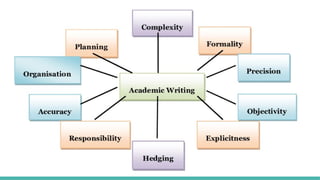
Features of academic writing
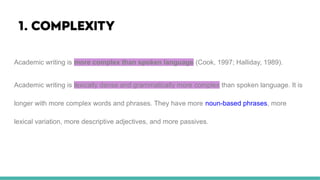
Academic writing is more complex than spoken language (Cook, 1997; Halliday, 1989).
Academic writing is lexically dense and grammatically more complex than spoken language. It is
longer with more complex words and phrases. They have more noun-based phrases, more
lexical variation, more descriptive adjectives, and more passives.
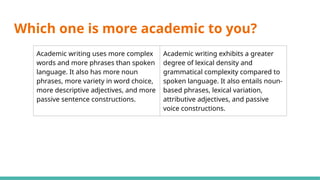
Which one is more academic to you?
Academic writing uses more complex
words and more phrases than spoken
language. It also has more noun
phrases, more variety in word choice,
more descriptive adjectives, and more
passive sentence constructions.
Academic writing exhibits a greater
degree of lexical density and
grammatical complexity compared to
spoken language. It also entails noun-
based phrases, lexical variation,
attributive adjectives, and passive
voice constructions.
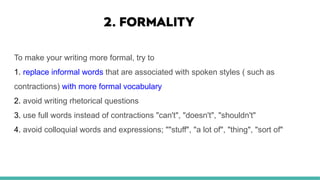
To make your writing more formal, try to
1. replace informal words that are associated with spoken styles ( such as
contractions) with more formal vocabulary
2. avoid writing rhetorical questions
3. use full words instead of contractions "can't", "doesn't", "shouldn't"
4. avoid colloquial words and expressions; ""stuff", "a lot of", "thing", "sort of"
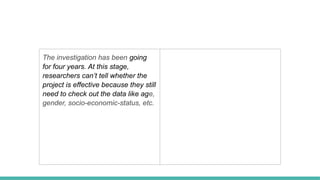
The investigation has been going
for four years. At this stage,
researchers can’t tell whether the
project is effective because they still
need to check out the data like age,
gender, socio-economic-status, etc.
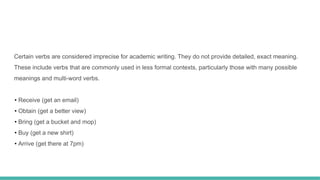
Certain verbs are considered imprecise for academic writing. They do not provide detailed, exact meaning.
These include verbs that are commonly used in less formal contexts, particularly those with many possible
meanings and multi-word verbs.
• Receive (get an email)
• Obtain (get a better view)
• Bring (get a bucket and mop)
• Buy (get a new shirt)
• Arrive (get there at 7pm)
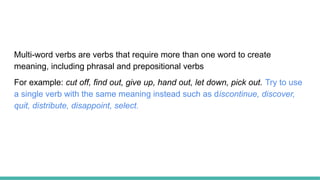
Multi-word verbs are verbs that require more than one word to create
meaning, including phrasal and prepositional verbs
For example: cut off, find out, give up, hand out, let down, pick out. Try to use
a single verb with the same meaning instead such as discontinue, discover,
quit, distribute, disappoint, select.
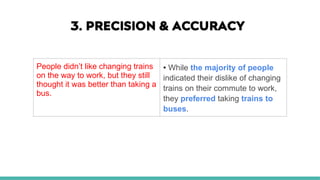
People didn’t like changing trains
on the way to work, but they still
thought it was better than taking a
bus.
• While the majority of people
indicated their dislike of changing
trains on their commute to work,
they preferred taking trains to
buses.
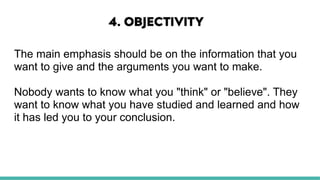
The main emphasis should be on the information that you
want to give and the arguments you want to make.
Nobody wants to know what you "think" or "believe". They
want to know what you have studied and learned and how
it has led you to your conclusion.
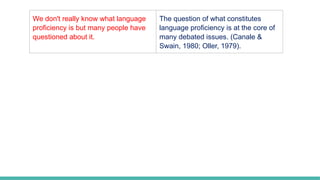
We don't really know what language
proficiency is but many people have
questioned about it.
The question of what constitutes
language proficiency is at the core of
many debated issues. (Canale &
Swain, 1980; Oller, 1979).
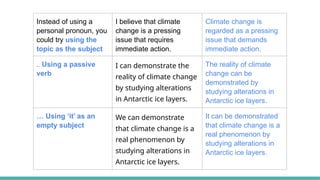
Instead of using a
personal pronoun, you
could try using the
topic as the subject
I believe that climate
change is a pressing
issue that requires
immediate action.
Climate change is
regarded as a pressing
issue that demands
immediate action.
.. Using a passive
verb
I can demonstrate the
reality of climate change
by studying alterations
in Antarctic ice layers.
The reality of climate
change can be
demonstrated by
studying alterations in
Antarctic ice layers.
… Using ‘it’ as an
empty subject
We can demonstrate
that climate change is a
real phenomenon by
studying alterations in
Antarctic ice layers.
It can be demonstrated
that climate change is a
real phenomenon by
studying alterations in
Antarctic ice layers.
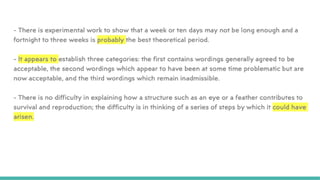
Hedging language in academic writing is used to express caution and avoid strong,
unqualified statements that may be easily disproved.
To avoid generalizations, you can:
- Use a quantifier (e.g. few, many, some)
- Use adverbs or adverbial phrases (e.g. occasionally, often, usually)
- Use modal verbs (e.g. can, may, might, would, could)
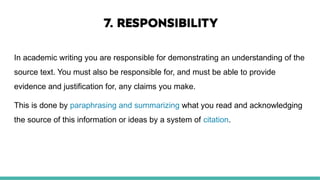
In academic writing you are responsible for demonstrating an understanding of the
source text. You must also be responsible for, and must be able to provide
evidence and justification for, any claims you make.
This is done by paraphrasing and summarizing what you read and acknowledging
the source of this information or ideas by a system of citation.
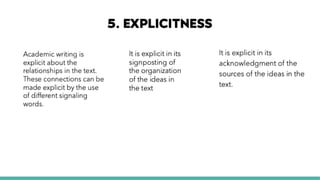
Academic writing is well organized and planned.
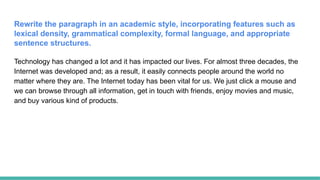
Rewrite the paragraph in an academic style, incorporating features such as
lexical density, grammatical complexity, formal language, and appropriate
sentence structures.
Technology has changed a lot and it has impacted our lives. For almost three decades, the
Internet was developed and; as a result, it easily connects people around the world no
matter where they are. The Internet today has been vital for us. We just click a mouse and
we can browse through all information, get in touch with friends, enjoy movies and music,
and buy various kind of products.

Academic Writing Features 013555431.pptx

  • 1.
    Academic Writing 01355431 Introductionto Research Writing in English
  • 2.
    Objective of academicwriting NOT to entertain BUT to _________
  • 3.
    Differences between generaland academic writing General Writing Academic Writing used in letters, emails, newspaper articles, diary and journal entries, etc. non-academic and no-technical purposes Informal, semi-formal language no restrictions on the use of slang, contraction, cliché no need for referencing and citation no specific set of audience or readers used in research projects, conference papers, essays, abstracts, reports formal, objective, concise language academic purposes restrict use of referencing and citation no slang, contraction, cliche a specific set of audience/ reader of the same academic field
  • 4.
  • 5.
    Academic writing ismore complex than spoken language (Cook, 1997; Halliday, 1989). Academic writing is lexically dense and grammatically more complex than spoken language. It is longer with more complex words and phrases. They have more noun-based phrases, more lexical variation, more descriptive adjectives, and more passives.
  • 6.
    Which one ismore academic to you? Academic writing uses more complex words and more phrases than spoken language. It also has more noun phrases, more variety in word choice, more descriptive adjectives, and more passive sentence constructions. Academic writing exhibits a greater degree of lexical density and grammatical complexity compared to spoken language. It also entails noun- based phrases, lexical variation, attributive adjectives, and passive voice constructions.
  • 7.
    To make yourwriting more formal, try to 1. replace informal words that are associated with spoken styles ( such as contractions) with more formal vocabulary 2. avoid writing rhetorical questions 3. use full words instead of contractions "can't", "doesn't", "shouldn't" 4. avoid colloquial words and expressions; ""stuff", "a lot of", "thing", "sort of"
  • 8.
    The investigation hasbeen going for four years. At this stage, researchers can’t tell whether the project is effective because they still need to check out the data like age, gender, socio-economic-status, etc.
  • 9.
    Certain verbs areconsidered imprecise for academic writing. They do not provide detailed, exact meaning. These include verbs that are commonly used in less formal contexts, particularly those with many possible meanings and multi-word verbs. • Receive (get an email) • Obtain (get a better view) • Bring (get a bucket and mop) • Buy (get a new shirt) • Arrive (get there at 7pm)
  • 10.
    Multi-word verbs areverbs that require more than one word to create meaning, including phrasal and prepositional verbs For example: cut off, find out, give up, hand out, let down, pick out. Try to use a single verb with the same meaning instead such as discontinue, discover, quit, distribute, disappoint, select.
  • 11.
    People didn’t likechanging trains on the way to work, but they still thought it was better than taking a bus. • While the majority of people indicated their dislike of changing trains on their commute to work, they preferred taking trains to buses.
  • 12.
    The main emphasisshould be on the information that you want to give and the arguments you want to make. Nobody wants to know what you "think" or "believe". They want to know what you have studied and learned and how it has led you to your conclusion.
  • 13.
    We don't reallyknow what language proficiency is but many people have questioned about it. The question of what constitutes language proficiency is at the core of many debated issues. (Canale & Swain, 1980; Oller, 1979).
  • 14.
    Instead of usinga personal pronoun, you could try using the topic as the subject I believe that climate change is a pressing issue that requires immediate action. Climate change is regarded as a pressing issue that demands immediate action. .. Using a passive verb I can demonstrate the reality of climate change by studying alterations in Antarctic ice layers. The reality of climate change can be demonstrated by studying alterations in Antarctic ice layers. … Using ‘it’ as an empty subject We can demonstrate that climate change is a real phenomenon by studying alterations in Antarctic ice layers. It can be demonstrated that climate change is a real phenomenon by studying alterations in Antarctic ice layers.
  • 16.
    Hedging language inacademic writing is used to express caution and avoid strong, unqualified statements that may be easily disproved. To avoid generalizations, you can: - Use a quantifier (e.g. few, many, some) - Use adverbs or adverbial phrases (e.g. occasionally, often, usually) - Use modal verbs (e.g. can, may, might, would, could)
  • 18.
    In academic writingyou are responsible for demonstrating an understanding of the source text. You must also be responsible for, and must be able to provide evidence and justification for, any claims you make. This is done by paraphrasing and summarizing what you read and acknowledging the source of this information or ideas by a system of citation.
  • 19.
    Academic writing iswell organized and planned.
  • 20.
    Rewrite the paragraphin an academic style, incorporating features such as lexical density, grammatical complexity, formal language, and appropriate sentence structures. Technology has changed a lot and it has impacted our lives. For almost three decades, the Internet was developed and; as a result, it easily connects people around the world no matter where they are. The Internet today has been vital for us. We just click a mouse and we can browse through all information, get in touch with friends, enjoy movies and music, and buy various kind of products.